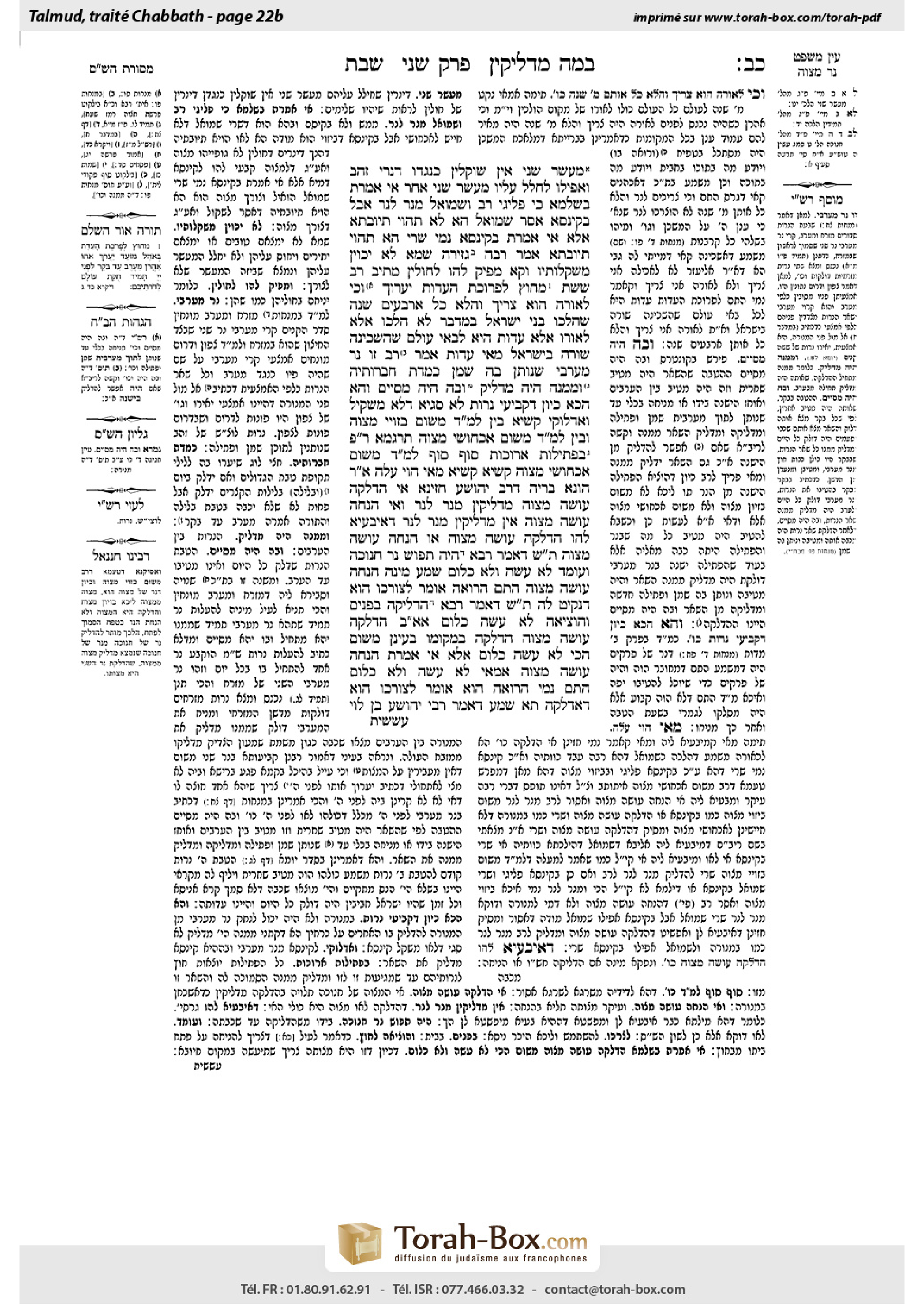
Shabbat 22b: Talmud study for Daf Yomi
Daf Yomi is the daily study of one Talmud folio. Explore 37 tractates with scans, Hebrew text, Sefaria English and AI-generated French translations where annotated.
Passage selection and English or AI-generated French translation are available where the scan has annotations. Daf Study is independent of Torah-Box and Sefaria.
Browse Shabbat · שבת · All tractatesShabbat 22b text and translations
This page of Shabbat includes the Aramaic text, an English translation and an AI-generated French translation, alongside the scan above.
שבת כ״ב ב · Aramaic and Hebrew text
מַעֲשֵׂר שֵׁנִי אֵין שׁוֹקְלִין כְּנֶגְדּוֹ דִּנָרֵי זָהָב, וַאֲפִילּוּ לְחַלֵּל עָלָיו מַעֲשֵׂר שֵׁנִי אַחֵר. אִי אָמְרַתְּ בִּשְׁלָמָא כִּי פְּלִיגִי רַב וּשְׁמוּאֵל מִנֵּר לְנֵר אֲבָל בְּקִינְסָא אָסַר שְׁמוּאֵל — הָא לָא תִּהְוֵי תְּיוּבְתָּא. אֶלָּא אִי אָמְרַתְּ בְּקִינְסָא נָמֵי שָׁרֵי — הָא תִּהְוֵי תְּיוּבְתָּא! אָמַר רַבָּה: גְּזֵירָה שֶׁמָּא לֹא יְכַוֵּין מִשְׁקְלוֹתָיו וְקָא מַפֵּיק לְהוּ לְחוּלִּין.
מֵתִיב רַב שֵׁשֶׁת: ״מִחוּץ לְפָרוֹכֶת הָעֵדוּת יַעֲרוֹךְ״, וְכִי לְאוֹרָהּ הוּא צָרִיךְ? וַהֲלֹא כׇּל אַרְבָּעִים שָׁנָה שֶׁהָלְכוּ בְנֵי יִשְׂרָאֵל בַּמִּדְבָּר לָא הָלְכוּ אֶלָּא לְאוֹרוֹ! אֶלָּא עֵדוּת הִיא לְבָאֵי עוֹלָם שֶׁהַשְּׁכִינָה שׁוֹרָה בְּיִשְׂרָאֵל. מַאי עֵדוּת? אָמַר רַב: זוֹ נֵר מַעֲרָבִי שֶׁנּוֹתֵן בָּהּ שֶׁמֶן כְּמִדַּת חַבְרוֹתֶיהָ, וּמִמֶּנָּה הָיָה מַדְלִיק וּבָהּ הָיָה מְסַיֵּים. וְהָא הָכָא כֵּיוָן דִּקְבִיעִי נֵרוֹת, לָא סַגְיָא דְּלָא מִשְׁקָל וְאַדְלוֹקֵי. קַשְׁיָא בֵּין לְמַאן דְּאָמַר מִשּׁוּם בִּזּוּי מִצְוָה, וּבֵין לְמַאן דְּאָמַר מִשּׁוּם אַכְחוֹשֵׁי מִצְוָה!
תַּרְגְּמַהּ רַב פָּפָּא בִּפְתִילוֹת אֲרוּכּוֹת. סוֹף סוֹף, לְמַאן דְּאָמַר מִשּׁוּם אַכְחוֹשֵׁי מִצְוָה קַשְׁיָא! — קַשְׁיָא.
מַאי הָוֵי עֲלַהּ? אָמַר רַב הוּנָא בְּרֵיהּ דְּרַב יְהוֹשֻׁעַ: חָזֵינַן, אִי הַדְלָקָה עוֹשָׂה מִצְוָה — מַדְלִיקִין מִנֵּר לְנֵר. וְאִי הַנָּחָה עוֹשָׂה מִצְוָה — אֵין מַדְלִיקִין מִנֵּר לְנֵר.
דְּאִיבַּעְיָא לְהוּ: הַדְלָקָה עוֹשָׂה מִצְוָה, אוֹ הַנָּחָה עוֹשָׂה מִצְוָה?
תָּא שְׁמַע, דְּאָמַר רָבָא: הָיָה תָּפוּשׂ נֵר חֲנוּכָּה וְעוֹמֵד — לֹא עָשָׂה וְלֹא כְלוּם. שְׁמַע מִינַּהּ: הַנָּחָה עוֹשָׂה מִצְוָה! הָתָם, הָרוֹאֶה אוֹמֵר לְצוֹרְכּוֹ הוּא דְּנָקֵיט לַהּ.
תָּא שְׁמַע, דְּאָמַר רָבָא: הִדְלִיקָהּ בִּפְנִים וְהוֹצִיאָהּ — לֹא עָשָׂה כְּלוּם. אִי אָמְרַתְּ בִּשְׁלָמָא הַדְלָקָה עוֹשָׂה מִצְוָה — הַדְלָקָה בִּמְקוֹמוֹ בָּעֵינַן, מִשּׁוּם הָכִי לֹא עָשָׂה כְּלוּם. אֶלָּא אִי אָמְרַתְּ הַנָּחָה עוֹשָׂה מִצְוָה, אַמַּאי לֹא עָשָׂה וְלֹא כְלוּם? הָתָם נָמֵי: הָרוֹאֶה הוּא אוֹמֵר לְצוֹרְכּוֹ הוּא דְּאַדְלְקַהּ.
תָּא שְׁמַע דְּאָמַר רַבִּי יְהוֹשֻׁעַ בֶּן לֵוִי:
Shabbat 22b · English translation
the second tithe, one may not weigh gold dinars with it in order to determine their precise weight. And doing so is prohibited even if he is weighing the coin in order to redeem other second-tithe produce with it, as one may not derive benefit from tithe money. The Gemara discusses this matter: Granted, if you say that when Rav and Shmuel disagree it is with regard to a case when one lights from lamp to lamp, but with a wood chip, Shmuel prohibits lighting, this will not be a conclusive refutation of Shmuel’s opinion. But if you say that he permits lighting from lamp to lamp with a wood chip as well, this would be a conclusive refutation of his opinion, as the Sages did not permit use of and benefit from a sacred object even for the purpose of a similar sacred need. Rabba said: This is not difficult, as in the case of weighing tithe money the Sages prohibited doing so as a decree lest the weights not be precisely equal. One will discover that the weight of the gold dinars is not equal to the weight of the sela that he used to weigh them, and he will reconsider and render them unsanctified, i.e., they will maintain their original, non-sacred status. In that case, he will have used the tithe money for an unsanctified purpose. However, when one lights even a wood chip for the purpose of Hanukkah lights, it is clear that it is for the purpose of performing a mitzva, and there is no reason to issue a decree.
Rav Sheshet raised an objection from that which was taught in a baraita. With regard to the Temple candelabrum, it is stated: “Outside the veil of the testimony, in the Tent of Meeting, shall Aaron order it from evening to morning before the Lord continually; it shall be a statute forever throughout your generations” (Leviticus 24:3). It must be understood: And does God require its light for illumination at night? Didn’t the children of Israel, all forty years that they walked in the wilderness, walk exclusively by His light, the pillar of fire? Rather, the lighting of the candelabrum is testimony to mankind that the Divine Presence rests among Israel. The Gemara asks: What is this testimony? Rav said: That is the westernmost lamp in the candelabrum in which the measure of oil placed was the same measure of oil as was placed in the other lamps, and nevertheless he would light the others from it each day and with it he would conclude, i.e., the westernmost lamp would continue burning throughout the day after all the others were extinguished. The rest of the lamps burned only at night, and each night he would relight the rest of the lamps from the westernmost lamp. But isn’t it true that here, in the Temple, since the lamps were fixed in the candelabrum, it was impossible to light directly from lamp to lamp? There was no alternative to taking a wood chip and lighting the rest of the lamps from the westernmost lamp. Consequently, it is difficult both according to the one who said that one may not light from lamp to lamp due to contempt for the mitzva and according to the one who said that one may not light from lamp to lamp due to weakening the mitzva.
Rav Pappa explained that it need not necessarily be understood that way. Rather, there were long wicks in the candelabrum, which made it possible to reach and light directly from one lamp to another. However, ultimately, according to the one who said that one may not light from lamp to lamp due to weakening the mitzva, it is difficult. The Gemara concludes: Indeed, the question remains difficult.
In summary, the Gemara asks: What is the halakhic conclusion reached about this matter in terms of lighting from lamp to lamp? Rav Huna, son of Rabbi Yehoshua, said: We see; if the halakha is in accordance with the opinion of the one who said that kindling the Hanukkah light accomplishes the mitzva and the rest is secondary, one may light from lamp to lamp. The lighting itself is the essence of the mitzva of Hanukkah lights. And if the halakha is in accordance with the opinion of the one who said that placing the lit lamp in a suitable place accomplishes the mitzva, then one may not light from lamp to lamp. According to that opinion, lighting is simply an auxiliary action that facilitates the fulfillment of the essence of the mitzva, which is placing the lamp in a place where its light can be seen by the public. Since lighting is merely a preparatory action, one may not demean the mitzva by lighting from lamp to lamp.
After the issue of whether lighting accomplishes the mitzva or placing accomplishes the mitzva was raised in the context of the previous discussion, the Gemara cites the discussion in its entirety. As a dilemma was raised before the Sages: In the case of the Hanukkah light, does lighting accomplish the mitzva, and placing the lit lamp is simply a continuation of that action, or does placing the kindled lamp accomplish the mitzva, and lighting is simply a practical necessity that facilitates placing the lamp?
The Gemara suggests: Come and hear a solution to this dilemma from that which Rava said: One who was holding a burning Hanukkah lamp in his hand and standing, he did nothing in terms of fulfilling the mitzva. Conclude from this that placing accomplishes the mitzva. Until he sets the lamp down in its appropriate place, he did not fulfill the mitzva. The Gemara rejects this: There, they said that he did not fulfill his obligation for a different reason. One who sees it will say that he is not holding the lamp in order to fulfill the mitzva, but he is holding it for his own needs. Since holding the lamp can mislead onlookers, he does not fulfill the mitzva in that manner.
Come and hear another resolution for this dilemma from that which Rava said: One who lights the Hanukkah lamp inside the house and then takes it out and places it at the entrance to his house did nothing in terms of fulfilling the mitzva. Granted, if you say that lighting accomplishes the mitzva it is understandable, as lighting in its place is required. That is why Rava ruled that he did nothing in terms of fulfilling the mitzva. However, if you say that placing accomplishes the mitzva, why did Rava rule that he did nothing? Didn’t he set it down in its appropriate place? The Gemara answers: There too, even though he subsequently brought it outside, one who sees him lighting inside will say to himself that he is lighting the lamp for his own needs and not in fulfillment of the mitzva.
Come and hear another resolution from that which Rabbi Yehoshua ben Levi said:
Shabbat 22b · Traduction française (IA)
Pour la seconde dîme, on ne peut pas peser des dinars d’or afin d’en déterminer le poids exact. Cela est interdit même si l’on pèse la pièce afin de racheter avec elle d’autres produits de la seconde dîme, car on ne peut tirer aucun profit de l’argent de la dîme. La Guemara examine cette question : admettons que, lorsque Rav et Chmouel sont en désaccord, leur désaccord porte sur un cas où l’on allume d’une lampe à l’autre, tandis que Chmouel interdit d’allumer au moyen d’une écharde ; cela ne constituerait pas une réfutation décisive de l’opinion de Chmouel. Mais si vous dites qu’il permet aussi d’allumer d’une lampe à l’autre au moyen d’une écharde, cela réfuterait définitivement son opinion, car les Sages n’ont pas permis de se servir d’un objet sacré ni d’en tirer profit, même pour répondre à un besoin sacré semblable. Rabba dit : Il n’y a pas de difficulté : dans le cas où l’on pèse l’argent de la dîme, les Sages l’ont interdit par décret, de peur que les poids ne soient pas exactement égaux. On pourrait constater que le poids des dinars d’or n’est pas égal à celui du séla utilisé pour les peser, puis revenir sur leur consécration et les déclarer non consacrés, c’est-à-dire leur rendre leur statut initial, non sacré. Dans ce cas, on aurait utilisé l’argent de la dîme à une fin profane. En revanche, lorsqu’on allume, même au moyen d’une écharde, pour les lumières de Hanoucca, il est manifeste que c’est pour accomplir une mitsva ; il n’y a donc aucune raison de décréter une interdiction.
Rav Chéchet soulève une objection à partir de ce qui a été enseigné dans une baraïta. Au sujet du candélabre du Temple, il est dit : « En dehors du voile du témoignage, dans la tente d’assignation, Aaron en prendra soin du soir au matin devant l’Éternel, continuellement ; ce sera une loi perpétuelle pour vos générations » (Lévitique 24,3). Il faut comprendre : Dieu a-t-il besoin de sa lumière pour éclairer la nuit ? Les enfants d’Israël n’ont-ils pas marché exclusivement à Sa lumière, celle de la colonne de feu, pendant les quarante années où ils ont erré dans le désert ? L’allumage du candélabre constitue plutôt un témoignage pour l’humanité : la Présence divine réside au milieu d’Israël. La Guemara demande : Quel est ce témoignage ? Rav dit : C’est la lampe la plus occidentale du candélabre, dans laquelle on mettait la même mesure d’huile que dans les autres lampes ; pourtant, chaque jour, on allumait les autres à partir d’elle et l’on terminait avec elle, c’est-à-dire que la lampe occidentale continuait à brûler pendant la journée, après que toutes les autres se fussent éteintes. Les autres lampes ne brûlaient que la nuit, et chaque soir, on les rallumait à partir de la lampe occidentale. Mais n’est-il pas vrai qu’ici, dans le Temple, puisque les lampes étaient fixées au candélabre, il était impossible d’allumer directement d’une lampe à l’autre ? Il n’y avait pas d’autre solution que de prendre une écharde et d’allumer les autres lampes à partir de la lampe occidentale. Par conséquent, cela pose une difficulté aussi bien selon celui qui dit qu’on ne peut pas allumer d’une lampe à l’autre par égard pour la mitsva que selon celui qui dit qu’on ne peut pas le faire parce que cela affaiblit la mitsva.
Rav Pappa explique qu’il n’est pas nécessaire de comprendre les choses ainsi. Il y avait plutôt dans le candélabre de longues mèches, qui permettaient d’atteindre les lampes et d’allumer directement de l’une à l’autre. Toutefois, en définitive, selon celui qui dit qu’on ne peut pas allumer d’une lampe à l’autre parce que cela affaiblit la mitsva, la difficulté subsiste. La Guemara conclut : en effet, la question reste difficile.
En résumé, la Guemara demande : quelle conclusion halakhique a-t-on tirée sur cette question de l’allumage d’une lampe à l’autre ? Rav Houna, fils de Rabbi Yehochoua, dit : Voyons. Si la halakha suit l’opinion de celui qui dit que l’allumage des lumières de Hanoucca accomplit la mitsva et que le reste est secondaire, on peut allumer d’une lampe à l’autre. L’allumage lui-même constitue l’essentiel de la mitsva des lumières de Hanoucca. Mais si la halakha suit l’opinion de celui qui dit que c’est le placement de la lampe allumée à un endroit approprié qui accomplit la mitsva, on ne peut pas allumer d’une lampe à l’autre. Selon cette opinion, l’allumage n’est qu’un acte auxiliaire qui facilite l’accomplissement de l’essentiel de la mitsva, à savoir placer la lampe à un endroit où le public peut voir sa lumière. Puisque l’allumage n’est qu’un acte préparatoire, on ne peut pas déprécier la mitsva en allumant d’une lampe à l’autre.
Après que la question de savoir si l’allumage accomplit la mitsva ou si c’est le placement qui l’accomplit a été soulevée dans le cadre de la discussion précédente, la Guemara rapporte la discussion dans son intégralité. En effet, une question fut soulevée devant les Sages : dans le cas des lumières de Hanoucca, est-ce l’allumage qui accomplit la mitsva, le placement de la lampe allumée n’étant que la continuation de cet acte, ou est-ce le placement de la lampe allumée qui accomplit la mitsva, l’allumage n’étant qu’une nécessité pratique qui facilite le placement de la lampe ?
La Guemara propose : Viens et entends une réponse à cette question, tirée de ce que Rava a dit : celui qui tenait à la main une lampe de Hanoucca allumée et restait debout n’a rien fait pour accomplir la mitsva. Il faut donc en conclure que c’est le placement qui accomplit la mitsva. Tant qu’il n’a pas posé la lampe à l’endroit approprié, il n’a pas accompli la mitsva. La Guemara rejette cette déduction : dans ce cas, on a dit qu’il n’avait pas accompli son obligation pour une autre raison. Celui qui le voit dira qu’il ne tient pas la lampe pour accomplir la mitsva, mais qu’il la tient pour ses propres besoins. Puisque le fait de tenir la lampe peut induire en erreur les personnes qui le voient, il n’accomplit pas la mitsva de cette manière.
Viens et entends une autre réponse à cette question, tirée de ce que Rava a dit : celui qui allume la lampe de Hanoucca à l’intérieur de la maison, puis la sort et la place à l’entrée de sa maison, n’a rien fait pour accomplir la mitsva. Si vous dites que c’est l’allumage qui accomplit la mitsva, cela se comprend, car l’allumage doit avoir lieu à l’endroit approprié. C’est pourquoi Rava a tranché qu’il n’avait rien fait pour accomplir la mitsva. Mais si vous dites que c’est le placement qui accomplit la mitsva, pourquoi Rava a-t-il tranché qu’il n’avait rien fait ? Ne l’a-t-il pas posée à l’endroit approprié ? La Guemara répond : là aussi, bien qu’il l’ait ensuite sortie, celui qui le voit allumer à l’intérieur se dira qu’il allume la lampe pour ses propres besoins et non pour accomplir la mitsva.
Viens et entends une autre réponse, tirée de ce que Rabbi Yehochoua ben Lévi a dit :
Traduction française générée par IA à partir de l’édition anglaise de Sefaria. Vérifie toujours un passage avec le texte source.
Text from Sefaria: William Davidson Edition - Vocalized Aramaic (CC BY NC); William Davidson Edition - English (CC BY NC).