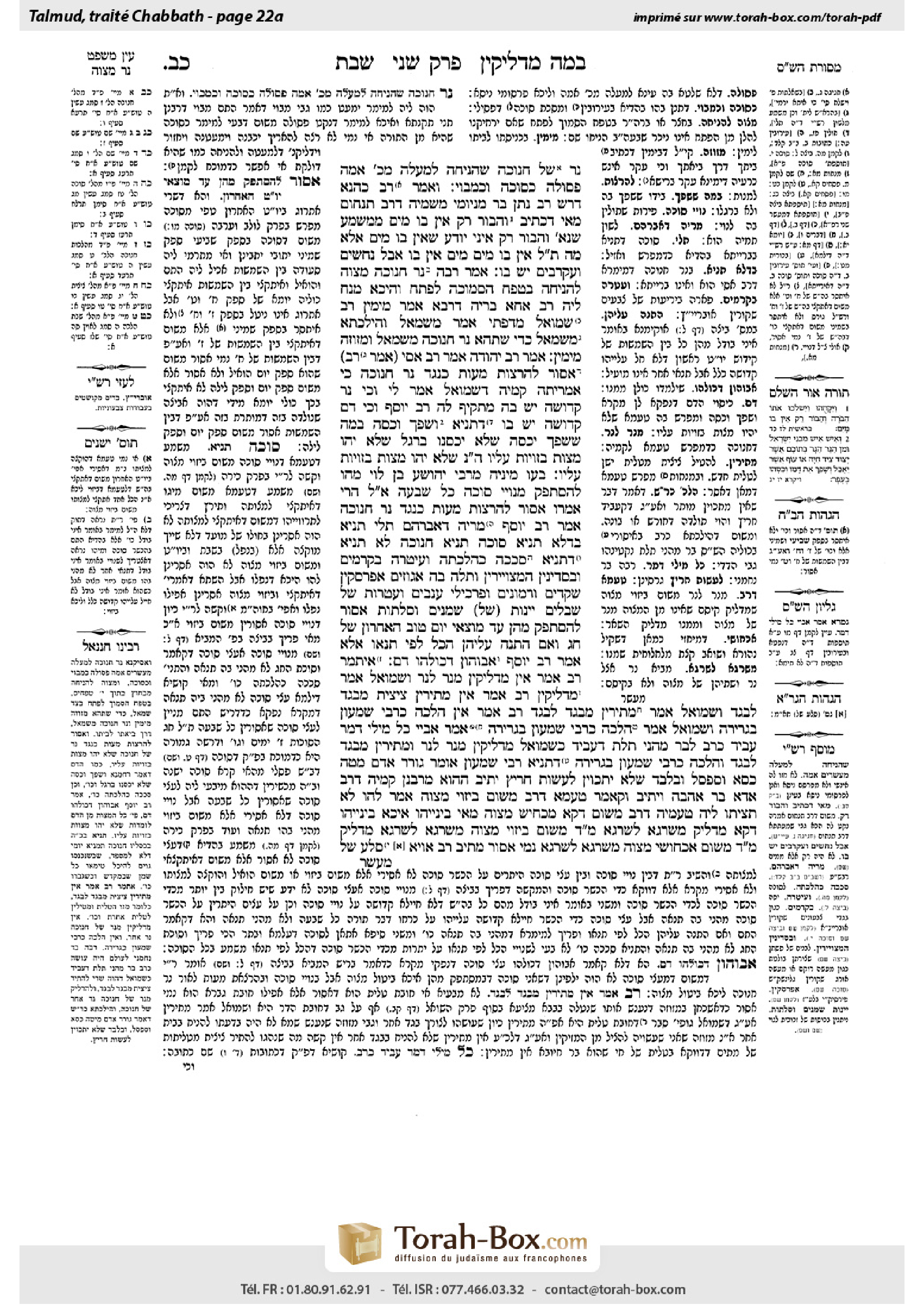
Shabbat 22a: Talmud study for Daf Yomi
Daf Yomi is the daily study of one Talmud folio. Explore 37 tractates with scans, Hebrew text, Sefaria English and AI-generated French translations where annotated.
Passage selection and English or AI-generated French translation are available where the scan has annotations. Daf Study is independent of Torah-Box and Sefaria.
Browse Shabbat · שבת · All tractatesShabbat 22a text and translations
This page of Shabbat includes the Aramaic text, an English translation and an AI-generated French translation, alongside the scan above.
שבת כ״ב א · Aramaic and Hebrew text
נֵר שֶׁל חֲנוּכָּה שֶׁהִנִּיחָה לְמַעְלָה מֵעֶשְׂרִים אַמָּה — פְּסוּלָה, כְּסוּכָּה וּכְמָבוֹי. וְאָמַר רַב כָּהֲנָא, דָּרֵשׁ רַב נָתָן בַּר מִנְיוֹמֵי מִשְּׁמֵיהּ דְּרַב תַּנְחוּם: מַאי דִכְתִיב ״וְהַבּוֹר רֵק אֵין בּוֹ מָיִם״? מִמַּשְׁמַע שֶׁנֶּאֱמַר ״וְהַבּוֹר רֵק״ אֵינִי יוֹדֵעַ שֶׁאֵין בּוֹ מָיִם? אֶלָּא מַה תַּלְמוּד לוֹמַר ״אֵין בּוֹ מָיִם״ — מַיִם אֵין בּוֹ, אֲבָל נְחָשִׁים וְעַקְרַבִּים יֵשׁ בּוֹ.
אָמַר רַבָּה: נֵר חֲנוּכָּה מִצְוָה לְהַנִּיחָהּ בְּטֶפַח הַסָּמוּךְ לַפֶּתַח. וְהֵיכָא מַנַּח לֵיהּ? רַב אַחָא בְּרֵיהּ דְּרָבָא אָמַר: מִיָּמִין רַב שְׁמוּאֵל מִדִּפְתִּי אָמַר: מִשְּׂמֹאל. וְהִילְכְתָא מִשְּׂמֹאל, כְּדֵי שֶׁתְּהֵא נֵר חֲנוּכָּה מִשְּׂמֹאל וּמְזוּזָה מִיָּמִין.
אָמַר רַב יְהוּדָה אָמַר רַב אַסִּי אָמַר רַב: אָסוּר לְהַרְצוֹת מָעוֹת כְּנֶגֶד נֵר חֲנוּכָּה. כִּי אַמְרִיתַהּ קַמֵּיהּ דִּשְׁמוּאֵל, אָמַר לִי: וְכִי נֵר קְדוּשָּׁה יֵשׁ בָּהּ? מַתְקֵיף לַהּ רַב יוֹסֵף: וְכִי דָּם קְדוּשָּׁה יֵשׁ בּוֹ? דְּתַנְיָא ״וְשָׁפַךְ … וְכִסָּה״ — בַּמֶּה שֶׁשָּׁפַךְ יְכַסֶּה. שֶׁלֹּא יְכַסֶּנּוּ בָּרֶגֶל, שֶׁלֹּא יְהוּ מִצְוֹת בְּזוּיוֹת עָלָיו. הָכָא נָמֵי, שֶׁלֹּא יְהוּ מִצְוֹת בְּזוּיוֹת עָלָיו.
בְּעוֹ מִינֵּיהּ מֵרַבִּי יְהוֹשֻׁעַ בֶּן לֵוִי: מַהוּ לְהִסְתַּפֵּק מִנּוֹיֵי סוּכָּה כׇּל שִׁבְעָה? אֲמַר לֵיהּ: הֲרֵי אָמְרוּ אָסוּר לְהַרְצוֹת מָעוֹת כְּנֶגֶד נֵר חֲנוּכָּה. אָמַר רַב יוֹסֵף: מָרֵיהּ דְּאַבְרָהָם! תָּלֵי תַּנְיָא בִּדְלָא תַּנְיָא. סוּכָּה תַּנְיָא, חֲנוּכָּה לָא תַּנְיָא. דְּתַנְיָא: סִכְּכָהּ כְּהִלְכָתָהּ וְעִיטְּרָהּ בִּקְרָמִים וּבִסְדִינִין הַמְצוּיָּירִין, וְתָלָה בָּהּ אֱגוֹזִים, אֲפַרְסְקִין, שְׁקֵדִים וְרִמּוֹנִים, וּפַרְכִּילֵי עֲנָבִים וַעֲטָרוֹת שֶׁל שִׁבֳּלִים, יֵינוֹת, (שֶׁל) שְׁמָנִים וּסְלָתוֹת — אָסוּר לְהִסְתַּפֵּק מֵהֶן עַד מוֹצָאֵי יוֹם טוֹב הָאַחֲרוֹן שֶׁל חַג. וְאִם הִתְנָה עֲלֵיהֶן — הַכֹּל לְפִי תְּנָאוֹ! — אֶלָּא אָמַר רַב יוֹסֵף: אֲבוּהוֹן דְּכוּלְּהוּ דָּם.
אִיתְּמַר: רַב אָמַר אֵין מַדְלִיקִין מִנֵּר לְנֵר, וּשְׁמוּאֵל אָמַר מַדְלִיקִין. רַב אָמַר אֵין מַתִּירִין צִיצִית מִבֶּגֶד לְבֶגֶד, וּשְׁמוּאֵל אָמַר מַתִּירִין מִבֶּגֶד לְבֶגֶד. רַב אָמַר אֵין הֲלָכָה כְּרַבִּי שִׁמְעוֹן בִּגְרִירָה, וּשְׁמוּאֵל אָמַר הֲלָכָה כְּרַבִּי שִׁמְעוֹן בִּגְרִירָה.
אָמַר אַבָּיֵי: כֹּל מִילֵּי דְּמָר עָבֵיד כְּרַב לְבַר מֵהָנֵי תְּלָת דְּעָבֵיד כִּשְׁמוּאֵל: מַדְלִיקִין מִנֵּר לְנֵר, וּמַתִּירִין מִבֶּגֶד לְבֶגֶד, וַהֲלָכָה כְּרַבִּי שִׁמְעוֹן בִּגְרִירָה. דְּתַנְיָא, רַבִּי שִׁמְעוֹן אוֹמֵר: גּוֹרֵר אָדָם מִטָּה כִּסֵּא וְסַפְסָל — וּבִלְבַד שֶׁלֹּא יִתְכַּוֵּין לַעֲשׂוֹת חָרִיץ.
יָתֵיב הָהוּא מֵרַבָּנַן קַמֵּיהּ דְּרַב אַדָּא בַּר אַהֲבָה וְיָתֵיב וְקָאָמַר: טַעְמָא דְרַב מִשּׁוּם בִּיזּוּי מִצְוָה. אֲמַר לְהוּ: לָא תְּצִיתוּ לֵיהּ, טַעְמֵיהּ דְּרַב מִשּׁוּם דְּקָא מַכְחִישׁ מִצְוָה. מַאי בֵּינַיְיהוּ? אִיכָּא בֵּינַיְיהוּ דְּקָא מַדְלֵיק מִשְּׁרָגָא לִשְׁרָגָא: מַאן דְּאָמַר מִשּׁוּם בִּיזּוּי מִצְוָה — מִשְּׁרָגָא לִשְׁרָגָא מַדְלֵיק. מַאן דְּאָמַר מִשּׁוּם אַכְחוֹשֵׁי מִצְוָה — מִשְּׁרָגָא לִשְׁרָגָא נָמֵי אָסוּר.
מֵתִיב רַב אַוְיָא: סֶלַע שֶׁל
Shabbat 22a · English translation
A Hanukkah lamp that one placed above twenty cubits is invalid, just as a sukka whose roofing is more than twenty cubits high, and just as an alleyway whose beam, its symbolic fourth partition in order to place an eiruv, is more than twenty cubits high, are invalid. The reason is the same in all three cases: People do not usually raise their heads and see objects at a height above twenty cubits. As there is a requirement to see all of these, they are deemed invalid when placed above that height. And the Gemara cites another statement that Rav Kahana said that Rav Natan bar Manyumi taught in the name of Rav Tanḥum: What is the meaning of the verse that is written with regard to Joseph: “And they took him, and cast him into the pit; and the pit was empty, there was no water in it” (Genesis 37:24)? By inference from that which is stated: And the pit was empty, don’t I know that there was no water in it? Rather, why does the verse say: There was no water in it? The verse comes to emphasize and teach that there was no water in it, but there were snakes and scorpions in it.
Rabba said: It is a mitzva to place the Hanukkah lamp within the handbreadth adjacent to the entrance. The Gemara asks: And where, on which side, does he place it? There is a difference of opinion: Rav Aḥa, son of Rava, said: On the right side of the entrance. Rav Shmuel from Difti said: On the left. And the halakha is to place it on the left so that the Hanukkah lamp will be on the left and the mezuza on the right. One who enters the house will be surrounded by mitzvot (ge’onim).
Rav Yehuda said that Rav Asi said that Rav said: It is prohibited to count money opposite a Hanukkah light. Rav Yehuda relates: When I said this halakha before Shmuel, he said to me: Does the Hanukkah light have sanctity that would prohibit one from using its light? Rav Yosef strongly objected to this question: What kind of question is that; does the blood of a slaughtered undomesticated animal or fowl have sanctity? As it was taught in a baraita that the Sages interpreted the verse: “He shall spill its blood and cover it with dust” (Leviticus 17:13): With that which he spilled, he shall cover. Just as a person spills the blood of a slaughtered animal with his hand, so too, he is obligated to cover the blood with this hand and not cover it with his foot. The reason is so that mitzvot will not be contemptible to him. Here too, one should treat the Hanukkah lights as if they were sacred and refrain from utilizing them for other purposes, so that mitzvot will not be contemptible to him.
The Gemara relates that they raised a dilemma before Rabbi Yehoshua ben Levi: What is the halakha with regard to using decorations of a sukka all seven days of the festival of Sukkot? He said to them: They already said in a similar vein that it is prohibited to count money opposite the Hanukkah light, which proves that one may not use the object of a mitzva for another purpose. Rav Yosef replied in surprise: Master of Abraham! He makes that which was taught dependent upon that which was not taught. As, with regard to sukka, the prohibition to enjoy use of its decorations was taught in a baraita, and the prohibition to enjoy use of the Hanukkah lights was not taught in a baraita at all. As it was taught in a Tosefta in tractate Sukka: With regard to one who roofed the sukka in accordance with its halakhic requirements, and decorated it with colorful curtains and sheets, and hung in it ornamental nuts, peaches, almonds, and pomegranates, and grape branches [parkilei], and wreaths of stalks of grain, wines, oils, and vessels full of flour, it is prohibited to use them until the conclusion of the last day of the Festival. And, if before he hung the decorations he stipulated with regard to them that he will be permitted to use them even during the Festival, everything is according to his stipulation, and he is permitted to use them. In any case, since the prohibition to benefit from the Hanukkah light is not explicitly taught, a proof should not be cited from there to resolve the dilemma with regard to sukka decorations. Rather, Rav Yosef said: There is no need to bring a proof for the halakhot of sukka from the Hanukkah light. Rather, the paradigm of them all is blood. The verse with regard to the covering of the blood of slaughter is the original source from which the prohibition to treat mitzvot with contempt is derived.
It was stated in a dispute between amora’im that Rav said: One may not light from one Hanukkah lamp to another lamp. And Shmuel said: One may light in that manner. The Gemara cites additional disputes between Rav and Shmuel. Rav said: One may not untie ritual fringes from one garment in order to affix them to another garment. And Shmuel said: One may untie them from one garment and affix them to another garment. And Rav said: The halakha is not in accordance with the opinion of Rabbi Shimon in the case of dragging, as Rabbi Shimon permitted dragging objects on Shabbat, even if, as a result, a furrow would be dug in the ground, as it was not the person’s intent to dig that hole. Shmuel said that the halakha is in accordance with the opinion of Rabbi Shimon in the case of dragging.
Abaye said: In all halakhic matters of the Master, Rabba, he conducted himself in accordance with the opinion of Rav, except these three where he conducted himself in accordance with the opinion of Shmuel. He ruled: One may light from one Hanukkah lamp to another lamp, and one may untie ritual fringes from garment to garment, and the halakha is in accordance with the opinion of Rabbi Shimon in the case of dragging. As it was taught in a baraita, Rabbi Shimon says: A person may drag a bed, chair, and bench on the ground, as long as he does not intend to make a furrow in the ground. Even if a furrow is formed inadvertently, one need not be concerned.
One of the Sages sat before Rav Adda bar Ahava, and he sat and said: The reason for the opinion of Rav, who prohibited lighting from one Hanukkah lamp to another, is due to contempt for the mitzva. Using the light for a purpose other than illumination demeans the mitzva of Hanukkah lights. Rav Adda bar Ahava said to his students: Do not listen to him, as the reason for Rav’s opinion is due to the fact that he thereby weakens the mitzva. By lighting from lamp to lamp he slightly diminishes the oil and wick designated for the purpose of the mitzva. The Gemara asks: What is the practical difference between them? The Gemara answers: The practical difference between them is in a case where he lights directly from lamp to lamp, without using a wood chip or another lamp to light the second lamp. According to the one who said that Rav’s reason is due to contempt for the mitzva, directly from lamp to lamp he may even light ab initio, as, by lighting another Hanukkah lamp, he does not thereby demean the sanctity of the mitzva because the second lamp is also a mitzva. According to the one who said that Rav’s reason is because he weakens the mitzva, lighting directly from lamp to lamp is also prohibited, as ultimately, he utilizes the mitzva lamp for a task that he could have accomplished with a non-sacred lamp.
Rav Avya raised an objection from that which was taught in a Tosefta: A sela of
Shabbat 22a · Traduction française (IA)
Une lampe de Hanouka placée à plus de vingt coudées de hauteur est invalide, tout comme une soukka dont le toit se trouve à plus de vingt coudées de hauteur et une ruelle dont la poutre — qui tient lieu de quatrième séparation symbolique pour permettre d’établir un érouv — se trouve à plus de vingt coudées de hauteur. La raison est la même dans les trois cas : les gens n’ont pas l’habitude de lever la tête pour voir des objets situés à plus de vingt coudées. Puisqu’il faut pouvoir voir chacun de ces éléments, ils sont invalides lorsqu’ils sont placés à cette hauteur. La Guemara cite également une autre déclaration : Rav Kahana a dit que Rav Natan bar Manyumi a enseigné au nom de Rav Tanḥum : Quel est le sens du verset écrit au sujet de Joseph : « Ils le prirent et le jetèrent dans la fosse ; la fosse était vide, il n’y avait pas d’eau dedans » (Genèse 37, 24) ? À partir de ce qui est dit — « la fosse était vide » — ne sais-je pas qu’il n’y avait pas d’eau dedans ? Pourquoi le verset précise-t-il donc : « Il n’y avait pas d’eau dedans » ? Le verset vient souligner et enseigner qu’il n’y avait pas d’eau dedans, mais qu’il y avait des serpents et des scorpions.
Rabba a dit : C’est une mitsva de placer la lampe de Hanouka à moins d’un empan de l’entrée. La Guemara demande : Où, de quel côté, la place-t-on ? Les avis divergent : Rav Aḥa, fils de Rava, a dit : À droite de l’entrée. Rav Shmuel de Difti a dit : À gauche. La halakha est de la placer à gauche, afin que la lampe de Hanouka soit à gauche et la mézouza à droite. Celui qui entre dans la maison est ainsi entouré de mitsvot (guéonim).
Rav Yehouda a dit au nom de Rav Asi, qui a dit au nom de Rav : Il est interdit de compter de l’argent à la lumière d’une lampe de Hanouka. Rav Yehouda rapporte : Lorsque j’ai énoncé cette halakha devant Shmuel, il m’a dit : La lampe de Hanouka a-t-elle une sainteté qui interdirait de se servir de sa lumière ? Rav Yosef s’opposa vivement à cette question : Quelle sorte de question est-ce là ? Le sang d’un animal sauvage abattu ou d’une volaille abattue a-t-il une sainteté ? Car il a été enseigné dans une baraïta que les Sages ont interprété le verset : « Il en répandra le sang et le couvrira de poussière » (Lévitique 17, 13) : Avec ce qu’il a répandu, il le couvrira. De même qu’une personne répand de sa main le sang d’un animal abattu, de même elle est tenue de couvrir le sang de cette main, et non de son pied. La raison en est que les mitsvot ne doivent pas lui sembler méprisables. Ici aussi, il faut traiter les lampes de Hanouka comme si elles étaient saintes et s’abstenir de les utiliser à d’autres fins, afin que les mitsvot ne lui semblent pas méprisables.
La Guemara rapporte qu’on posa à Rabbi Yehoshua ben Lévi la question suivante : Quelle est la halakha concernant l’utilisation des décorations d’une soukka pendant les sept jours de la fête de Soukkot ? Il leur répondit : On a déjà dit, dans le même esprit, qu’il est interdit de compter de l’argent à la lumière d’une lampe de Hanouka, ce qui prouve qu’on ne peut pas utiliser un objet de mitsva à une autre fin. Rav Yosef répondit avec étonnement : Maître d’Abraham ! Il fait dépendre ce qui a été enseigné de ce qui ne l’a pas été. En effet, l’interdiction de profiter des décorations d’une soukka a été enseignée dans une baraïta, tandis que l’interdiction de profiter des lampes de Hanouka n’a été enseignée dans aucune baraïta. Car il a été enseigné dans une Tosefta du traité Soukka : Celui qui a couvert la soukka conformément aux exigences de la halakha et l’a décorée de rideaux et de draps colorés, puis y a suspendu des noix décoratives, des pêches, des amandes et des grenades, des rameaux de vigne [parkilei], des guirlandes de tiges de céréales, des vins, des huiles et des récipients remplis de farine, ne peut pas les utiliser jusqu’à la fin du dernier jour de la fête. Mais s’il a stipulé, avant d’accrocher les décorations, qu’il pourrait les utiliser même pendant la fête, tout dépend de sa stipulation et il peut les utiliser. Quoi qu’il en soit, puisque l’interdiction de tirer profit de la lumière de Hanouka n’est pas explicitement enseignée, on ne peut pas s’en servir comme preuve pour trancher la question des décorations de la soukka. Rav Yosef dit plutôt : Il n’est pas nécessaire de tirer des preuves concernant les halakhot de la soukka de la lumière de Hanouka. Le modèle dont tout découle est plutôt le sang. Le verset concernant la couverture du sang de l’animal abattu est la source première dont on déduit l’interdiction de traiter les mitsvot avec mépris.
Un désaccord entre amoraïm a été rapporté : Rav a dit qu’on ne peut pas allumer une lampe à partir d’une autre lampe de Hanouka. Shmuel a dit qu’on peut procéder ainsi. La Guemara cite d’autres désaccords entre Rav et Shmuel. Rav a dit : On ne peut pas détacher les franges rituelles d’un vêtement pour les fixer à un autre vêtement. Shmuel a dit : On peut les détacher d’un vêtement et les fixer à un autre. Rav a également dit : La halakha ne suit pas l’avis de Rabbi Shimon dans le cas où l’on traîne des objets, car Rabbi Shimon permettait de traîner des objets pendant Chabbat, même si cela creusait un sillon dans le sol, puisqu’on n’avait pas l’intention de le creuser. Shmuel a dit que la halakha suit l’avis de Rabbi Shimon dans le cas où l’on traîne des objets.
Abaye a dit : Dans toutes les questions de halakha concernant le Maître, Rabba, il se conformait à l’avis de Rav, à l’exception de ces trois cas où il suivait l’avis de Shmuel. Il statuait qu’on pouvait allumer une lampe à partir d’une autre lampe de Hanouka, qu’on pouvait détacher les franges rituelles d’un vêtement pour les fixer à un autre, et que la halakha suivait l’avis de Rabbi Shimon dans le cas où l’on traîne des objets. Car il a été enseigné dans une baraïta que Rabbi Shimon dit : Une personne peut traîner un lit, une chaise et un banc sur le sol, à condition de ne pas avoir l’intention d’y creuser un sillon. Même si un sillon se forme involontairement, il n’y a pas lieu de s’en préoccuper.
Un des Sages était assis devant Rav Adda bar Ahava et disait : La raison pour laquelle Rav interdit d’allumer une lampe à partir d’une autre lampe de Hanouka tient au mépris de la mitsva. Utiliser la lumière à une fin autre que l’éclairage rabaisse la mitsva des lampes de Hanouka. Rav Adda bar Ahava dit à ses élèves : Ne l’écoutez pas, car la raison de l’avis de Rav est que cela affaiblit la mitsva. En allumant une lampe à partir d’une autre, on réduit légèrement l’huile et la mèche réservées à la mitsva. La Guemara demande : Quelle différence pratique y a-t-il entre ces deux explications ? La différence pratique concerne le cas où l’on allume directement une lampe à partir d’une autre, sans utiliser d’éclat de bois ni une autre lampe pour allumer la seconde. Selon celui qui dit que Rav interdit cette pratique par mépris de la mitsva, il est même permis de procéder ainsi a priori, car en allumant une autre lampe de Hanouka, on ne rabaisse pas la sainteté de la mitsva, puisque la seconde lampe est elle aussi une mitsva. Selon celui qui dit que Rav l’interdit parce que cela affaiblit la mitsva, allumer directement une lampe à partir d’une autre est également interdit, car, au bout du compte, on utilise la lampe de mitsva pour une tâche qu’on aurait pu accomplir avec une lampe profane.
Rav Avya souleva une objection à partir de ce qui a été enseigné dans une Tosefta : Un sélè de
Traduction française générée par IA à partir de l’édition anglaise de Sefaria. Vérifie toujours un passage avec le texte source.
Text from Sefaria: William Davidson Edition - Vocalized Aramaic (CC BY NC); William Davidson Edition - English (CC BY NC).