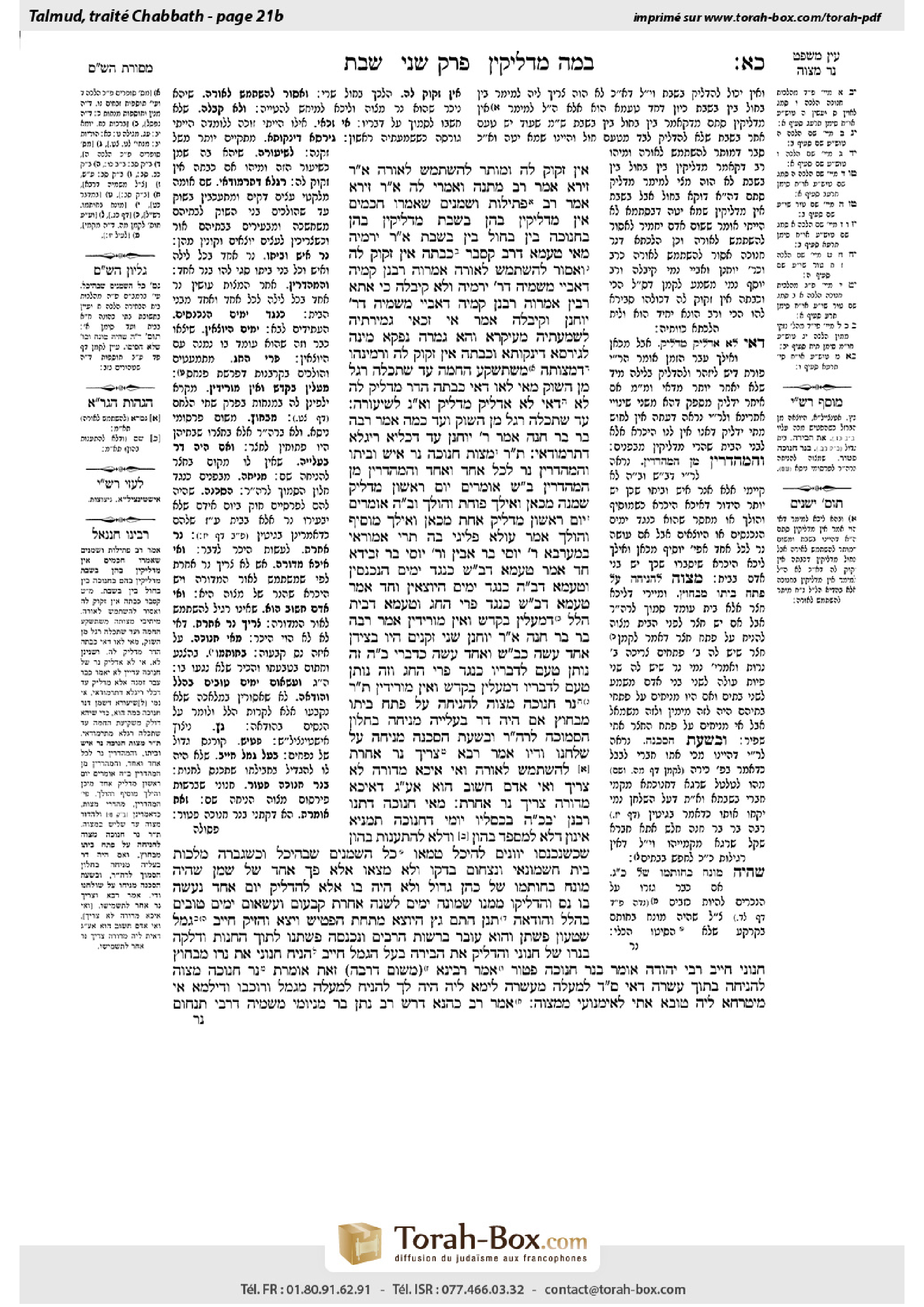
Shabbat 21b: Talmud study for Daf Yomi
Daf Yomi is the daily study of one Talmud folio. Explore 37 tractates with scans, Hebrew text, Sefaria English and AI-generated French translations where annotated.
Passage selection and English or AI-generated French translation are available where the scan has annotations. Daf Study is independent of Torah-Box and Sefaria.
Browse Shabbat · שבת · All tractatesShabbat 21b text and translations
This page of Shabbat includes the Aramaic text, an English translation and an AI-generated French translation, alongside the scan above.
שבת כ״א ב · Aramaic and Hebrew text
אֵין זָקוּק לָהּ, וּמוּתָּר לְהִשְׁתַּמֵּשׁ לְאוֹרָהּ. אָמַר רַבִּי זֵירָא אָמַר רַב מַתְנָה, וְאָמְרִי לַהּ אָמַר רַבִּי זֵירָא אָמַר רַב: פְּתִילוֹת וּשְׁמָנִים שֶׁאָמְרוּ חֲכָמִים אֵין מַדְלִיקִין בָּהֶן בְּשַׁבָּת, מַדְלִיקִין בָּהֶן בַּחֲנוּכָּה, בֵּין בַּחוֹל בֵּין בְּשַׁבָּת. אָמַר רַבִּי יִרְמְיָה: מַאי טַעְמָא דְּרַב? — קָסָבַר: כָּבְתָה אֵין זָקוּק לָהּ, וְאָסוּר לְהִשְׁתַּמֵּשׁ לְאוֹרָהּ.
אַמְרוּהָ רַבָּנַן קַמֵּיהּ דְּאַבָּיֵי מִשְּׁמֵיהּ דְּרַבִּי יִרְמְיָה, וְלָא קַבְּלַהּ. כִּי אֲתָא רָבִין אַמְרוּהָ רַבָּנַן קַמֵּיהּ דְּאַבָּיֵי מִשְּׁמֵיהּ דְּרַבִּי יוֹחָנָן, וְקַבְּלַהּ. אֲמַר: אִי זְכַאי, גְּמִירְתַּיהּ לִשְׁמַעְתֵּיהּ מֵעִיקָּרָא. וְהָא גַּמְרַהּ! נָפְקָא מִינַּהּ לְגִירְסָא דְיַנְקוּתָא.
וְכָבְתָה אֵין זָקוּק לָהּ? וּרְמִינְהוּ: מִצְוָתָהּ מִשֶּׁתִּשְׁקַע הַחַמָּה עַד שֶׁתִּכְלֶה רֶגֶל מִן הַשּׁוּק. מַאי לָאו, דְּאִי כָּבְתָה הֲדַר מַדְלֵיק לָהּ! לָא, דְּאִי לָא אַדְלֵיק — מַדְלֵיק. וְאִי נָמֵי לְשִׁיעוּרַהּ.
עַד שֶׁתִּכְלֶה רֶגֶל מִן הַשּׁוּק. וְעַד כַּמָּה? אָמַר רַבָּה בַּר בַּר חָנָה אָמַר רַבִּי יוֹחָנָן: עַד דְּכָלְיָא רִיגְלָא דְתַרְמוֹדָאֵי.
תָּנוּ רַבָּנַן: מִצְוַת חֲנוּכָּה, נֵר אִישׁ וּבֵיתוֹ. וְהַמְהַדְּרִין, נֵר לְכׇל אֶחָד וְאֶחָד. וְהַמְהַדְּרִין מִן הַמְהַדְּרִין, בֵּית שַׁמַּאי אוֹמְרִים: יוֹם רִאשׁוֹן מַדְלִיק שְׁמֹנָה, מִכָּאן וְאֵילָךְ פּוֹחֵת וְהוֹלֵךְ. וּבֵית הִלֵּל אוֹמְרִים: יוֹם רִאשׁוֹן מַדְלִיק אַחַת, מִכָּאן וְאֵילָךְ מוֹסִיף וְהוֹלֵךְ.
אָמַר עוּלָּא: פְּלִיגִי בַּהּ תְּרֵי אָמוֹרָאֵי בְּמַעְרְבָא, רַבִּי יוֹסֵי בַּר אָבִין וְרַבִּי יוֹסֵי בַּר זְבִידָא. חַד אָמַר טַעְמָא דְּבֵית שַׁמַּאי כְּנֶגֶד יָמִים הַנִּכְנָסִין, וְטַעְמָא דְּבֵית הִלֵּל כְּנֶגֶד יָמִים הַיּוֹצְאִין. וְחַד אָמַר טַעְמָא דְּבֵית שַׁמַּאי כְּנֶגֶד פָּרֵי הַחַג, וְטַעְמָא דְּבֵית הִלֵּל דְּמַעֲלִין בַּקֹּדֶשׁ וְאֵין מוֹרִידִין.
אָמַר רַבָּה בַּר בַּר חָנָה אָמַר רַבִּי יוֹחָנָן: שְׁנֵי זְקֵנִים הָיוּ בְּצַיְדָּן. אֶחָד עָשָׂה כְּבֵית שַׁמַּאי וְאֶחָד עָשָׂה כְּדִבְרֵי בֵּית הִלֵּל. זֶה נוֹתֵן טַעַם לִדְבָרָיו כְּנֶגֶד פָּרֵי הַחַג, וְזֶה נוֹתֵן טַעַם לִדְבָרָיו דְּמַעֲלִין בַּקֹּדֶשׁ וְאֵין מוֹרִידִין.
תָּנוּ רַבָּנַן: נֵר חֲנוּכָּה מִצְוָה לְהַנִּיחָהּ עַל פֶּתַח בֵּיתוֹ מִבַּחוּץ. אִם הָיָה דָּר בַּעֲלִיָּיה — מַנִּיחָהּ בַּחַלּוֹן הַסְּמוּכָה לִרְשׁוּת הָרַבִּים. וּבִשְׁעַת הַסַּכָּנָה — מַנִּיחָהּ עַל שֻׁלְחָנוֹ וְדַיּוֹ.
אָמַר רָבָא: צָרִיךְ נֵר אַחֶרֶת לְהִשְׁתַּמֵּשׁ לְאוֹרָהּ. וְאִי אִיכָּא מְדוּרָה — לֹא צָרִיךְ. וְאִי אָדָם חָשׁוּב הוּא — אַף עַל גַּב דְּאִיכָּא מְדוּרָה צָרִיךְ נֵר אַחֶרֶת.
מַאי חֲנוּכָּה? דְּתָנוּ רַבָּנַן: בְּכ״ה בְּכִסְלֵיו יוֹמֵי דַחֲנוּכָּה תְּמָנְיָא אִינּוּן דְּלָא לְמִסְפַּד בְּהוֹן וּדְלָא לְהִתְעַנּוֹת בְּהוֹן. שֶׁכְּשֶׁנִּכְנְסוּ יְוָוֽנִים לַהֵיכָל טִמְּאוּ כׇּל הַשְּׁמָנִים שֶׁבַּהֵיכָל. וּכְשֶׁגָּבְרָה מַלְכוּת בֵּית חַשְׁמוֹנַאי וְנִצְּחוּם, בָּדְקוּ וְלֹא מָצְאוּ אֶלָּא פַּךְ אֶחָד שֶׁל שֶׁמֶן שֶׁהָיָה מוּנָּח בְּחוֹתָמוֹ שֶׁל כֹּהֵן גָּדוֹל, וְלֹא הָיָה בּוֹ אֶלָּא לְהַדְלִיק יוֹם אֶחָד. נַעֲשָׂה בּוֹ נֵס וְהִדְלִיקוּ מִמֶּנּוּ שְׁמוֹנָה יָמִים. לְשָׁנָה אַחֶרֶת קְבָעוּם וַעֲשָׂאוּם יָמִים טוֹבִים בְּהַלֵּל וְהוֹדָאָה.
תְּנַן הָתָם: גֵּץ הַיּוֹצֵא מִתַּחַת הַפַּטִּישׁ וְיָצָא וְהִזִּיק — חַיָּיב. גָּמָל שֶׁטָּעוּן פִּשְׁתָּן וְהוּא עוֹבֵר בִּרְשׁוּת הָרַבִּים וְנִכְנְסָה פִּשְׁתָּנוֹ לְתוֹךְ הַחֲנוּת וְדָלְקָה בְּנֵרוֹ שֶׁל חֶנְוָנִי וְהִדְלִיק אֶת הַבִּירָה — בַּעַל הַגָּמָל חַיָּיב. הִנִּיחַ חֶנְוָנִי אֶת נֵרוֹ מִבְּחוּץ — חֶנְוָנִי חַיָּיב.
רַבִּי יְהוּדָה אוֹמֵר: בְּנֵר חֲנוּכָּה — פָּטוּר. אָמַר רָבִינָא מִשּׁוּם דְּרַבָּה: זֹאת אוֹמֶרֶת נֵר חֲנוּכָּה מִצְוָה לְהַנִּיחָהּ בְּתוֹךְ עֲשָׂרָה. דְּאִי סָלְקָא דַּעְתָּךְ לְמַעְלָה מֵעֲשָׂרָה, לֵימָא לֵיהּ: הָיָה לָךְ לְהַנִּיחַ לְמַעְלָה מִגָּמָל וְרוֹכְבוֹ! וְדִילְמָא, אִי מַיטְּרְחָא לֵיהּ טוּבָא אָתֵי לְאִימְּנוֹעֵי מִמִּצְוָה.
אָמַר רַב כָּהֲנָא, דָּרֵשׁ רַב נָתָן בַּר מִנְיוֹמֵי מִשְּׁמֵיהּ דְּרַבִּי תַּנְחוּם:
Shabbat 21b · English translation
one is not bound to attend to it. Therefore, there is no reason to make certain from the outset to light it with materials that burn well, as even if it is extinguished, he is not required to relight it. However, he also holds that it is permitted to use its light. As a result, he must ensure that the wick burns well on Shabbat; if not, he is liable to come to adjust the flame in order to use its light. The third opinion is that which Rabbi Zeira said that Rav Mattana said, and others say that Rabbi Zeira said that Rav said: The wicks and oils with which the Sages said one may not light on Shabbat, one may, nevertheless, light with them on Hanukkah, both during the week and on Shabbat. Rabbi Yirmeya said: What is Rav’s reason? He holds that if it is extinguished, one is not bound to attend to it and relight it, and it is prohibited to use its light. Therefore, even on Shabbat, there is no concern lest he come to adjust the wick, as it is prohibited to utilize its light.
The Gemara relates that the Sages said this halakha before Abaye in the name of Rabbi Yirmeya and he did not accept it, as he did not hold Rabbi Yirmeya in high regard. However, subsequently, when Ravin came from Eretz Yisrael to Babylonia, the Sages said this halakha before Abaye in the name of Rabbi Yoḥanan, and he accepted it. Then Abaye said regretfully: Had I merited, I would have learned this halakha from the outset. The Gemara wonders: Didn’t he ultimately learn it and accept it? What difference does it make from whom and at what point he learned it? The Gemara answers: The practical difference is with regard to knowledge acquired in one’s youth, which is better remembered.
With regard to the opinion that one need not rekindle the Hanukkah light if it is extinguished, the Gemara asks: And is it true that if the Hanukkah light is extinguished one is not bound to attend to it? The Gemara raises a contradiction from that which was taught in a baraita: The mitzva of kindling the Hanukkah lights is from sunset until traffic in the marketplace ceases. Does that not mean that if the light is extinguished, he must rekindle it so that it will remain lit for the duration of that period? The Gemara answers: No, the baraita can be understood otherwise: That if one did not yet light at sunset, he may still light the Hanukkah lights until traffic ceases. Alternatively, one could say that this is referring to the matter of its measure. One must prepare a wick and oil sufficient to burn for the period lasting from sunset until traffic ceases. If he did so, even if the light is extinguished beforehand, he need not relight it.
The expression until traffic in the marketplace ceases is mentioned here, and the Gemara asks: Until when exactly is this time? Rabba bar bar Ḥana said that Rabbi Yoḥanan said: Until the traffic of the people of Tadmor [tarmoda’ei] ceases. They sold kindling wood and remained in the marketplace later than everyone else. People who discovered at sunset that they had exhausted their wood supply could purchase wood from them.
The Sages taught in a baraita: The basic mitzva of Hanukkah is each day to have a light kindled by a person, the head of the household, for himself and his household. And the mehadrin, i.e., those who are meticulous in the performance of mitzvot, kindle a light for each and every one in the household. And the mehadrin min hamehadrin, who are even more meticulous, adjust the number of lights daily. Beit Shammai and Beit Hillel disagree as to the nature of that adjustment. Beit Shammai say: On the first day one kindles eight lights and, from there on, gradually decreases the number of lights until, on the last day of Hanukkah, he kindles one light. And Beit Hillel say: On the first day one kindles one light, and from there on, gradually increases the number of lights until, on the last day, he kindles eight lights.
Ulla said: There were two amora’im in the West, Eretz Yisrael, who disagreed with regard to this dispute, Rabbi Yosei bar Avin and Rabbi Yosei bar Zevida. One said that the reason for Beit Shammai’s opinion is that the number of lights corresponds to the incoming days, i.e., the future. On the first day, eight days remain in Hanukkah, one kindles eight lights, and on the second day seven days remain, one kindles seven, etc. The reason for Beit Hillel’s opinion is that the number of lights corresponds to the outgoing days. Each day, the number of lights corresponds to the number of the days of Hanukkah that were already observed. And one said that the reason for Beit Shammai’s opinion is that the number of lights corresponds to the bulls of the festival of Sukkot: Thirteen were sacrificed on the first day and each succeeding day one fewer was sacrificed (Numbers 29:12–31). The reason for Beit Hillel’s opinion is that the number of lights is based on the principle: One elevates to a higher level in matters of sanctity and one does not downgrade. Therefore, if the objective is to have the number of lights correspond to the number of days, there is no alternative to increasing their number with the passing of each day.
Rabba bar bar Ḥana said that Rabbi Yoḥanan said: There were two Elders in Sidon, and one of them acted in accordance with the opinion of Beit Shammai, and one of them acted in accordance with the opinion of Beit Hillel. Each provided a reason for his actions: One gave a reason for his actions: The number of lights corresponds to the bulls of the Festival. And one gave a reason for his actions: The number of lights is based on the principle: One elevates to a higher level in matters of sanctity and one does not downgrade.
The Sages taught in a baraita: It is a mitzva to place the Hanukkah lamp at the entrance to one’s house on the outside, so that all can see it. If he lived upstairs, he places it at the window adjacent to the public domain. And in a time of danger, when the gentiles issued decrees to prohibit kindling lights, he places it on the table and that is sufficient to fulfill his obligation.
Rava said: One must kindle another light in addition to the Hanukkah lights in order to use its light, as it is prohibited to use the light of the Hanukkah lights. And if there is a bonfire, he need not light an additional light, as he can use the light of the bonfire. However, if he is an important person, who is unaccustomed to using the light of a bonfire, even though there is a bonfire, he must kindle another light.
The Gemara asks: What is Hanukkah, and why are lights kindled on Hanukkah? The Gemara answers: The Sages taught in Megillat Ta’anit: On the twenty-fifth of Kislev, the days of Hanukkah are eight. One may not eulogize on them and one may not fast on them. What is the reason? When the Greeks entered the Sanctuary they defiled all the oils that were in the Sanctuary by touching them. And when the Hasmonean monarchy overcame them and emerged victorious over them, they searched and found only one cruse of oil that was placed with the seal of the High Priest, undisturbed by the Greeks. And there was sufficient oil there to light the candelabrum for only one day. A miracle occurred and they lit the candelabrum from it eight days. The next year the Sages instituted those days and made them holidays with recitation of hallel and special thanksgiving in prayer and blessings.
We learned there in a mishna with regard to damages: In the case of a spark that emerges from under a hammer, and went out of the artisan’s workshop, and caused damage, the one who struck the hammer is liable. Similarly, in the case of a camel that is laden with flax and it passed through the public domain, and its flax entered into a store, and caught fire from the storekeeper’s lamp, and set fire to the building, the camel owner is liable. Since his flax entered into another’s domain, which he had no permission to enter, all the damages were caused due to his negligence. However, if the storekeeper placed his lamp outside the store and it set fire to the flax, the storekeeper is liable, as he placed the lamp outside his domain where he had no right to place it.
Rabbi Yehuda says: If the flax was set on fire by the storekeeper’s Hanukkah lamp that he placed outside the entrance to his store, he is not liable, as in that case, it is permitted for the storekeeper to place his lamp outside. Ravina said in the name of Rabba: That is to say that it is a mitzva to place the Hanukkah lamp within ten handbreadths of the ground. As if it should enter your mind to say that he may place it above ten handbreadths, why is the storekeeper exempt? Let the camel owner say to the storekeeper: You should have placed the lamp above the height of a camel and its rider, and then no damage would have been caused. By failing to do so, the storekeeper caused the damage, and the camel owner should not be liable. The Gemara rejects this: And perhaps one is also permitted to place the Hanukkah lamp above ten handbreadths, and the reason Rabbi Yehuda exempted the storekeeper was due to concern for the observance of the mitzva of kindling Hanukkah lights. He held that if you burden one excessively, he will come to refrain from performing the mitzva of kindling Hanukkah lights. Since the storekeeper placed the Hanukkah lamp outside at the behest of the Sages, the storekeeper should not be required to take extra precautions.
With regard to the essence of the matter Rav Kahana said that Rav Natan bar Manyumi taught in the name of Rabbi Tanḥum:
Shabbat 21b · Traduction française (IA)
On n’est pas tenu de s’en occuper. Il n’y a donc aucune raison de veiller dès le départ à l’allumer avec des matériaux qui brûlent bien, puisque, même si elle s’éteint, on n’est pas tenu de la rallumer. Toutefois, il estime également qu’il est permis d’utiliser sa lumière. Il faut donc veiller à ce que la mèche brûle bien pendant Chabbat ; sinon, on risque d’en venir à régler la flamme afin d’utiliser sa lumière. La troisième opinion est celle que Rabbi Zeira a rapportée au nom de Rav Mattana ; d’autres rapportent que Rabbi Zeira a dit au nom de Rav : Les mèches et les huiles avec lesquelles les Sages ont interdit d’allumer pendant Chabbat peuvent néanmoins être utilisées pour allumer les lumières de Hanoucca, aussi bien en semaine que pendant Chabbat. Rabbi Yirmeya a dit : Quelle est la raison de Rav ? Il estime que si la lumière s’éteint, on n’est pas tenu de s’en occuper ni de la rallumer, et qu’il est interdit d’utiliser sa lumière. Par conséquent, même pendant Chabbat, il n’y a pas lieu de craindre qu’on en vienne à régler la mèche, puisqu’il est interdit d’utiliser sa lumière.
Les Sages enseignèrent cette halakha devant Abaye au nom de Rabbi Yirmeya, mais il ne l’accepta pas, car il n’avait pas une haute opinion de Rabbi Yirmeya. Cependant, par la suite, lorsque Ravin arriva de la terre d’Israël en Babylonie, les Sages enseignèrent cette halakha devant Abaye au nom de Rabbi Yoḥanan, et il l’accepta. Abaye dit alors avec regret : « Si j’en avais été digne, j’aurais appris cette halakha dès le départ. » La Guemara s’étonne : Ne l’a-t-il pas finalement apprise et acceptée ? Quelle importance y a-t-il à savoir de qui et à quel moment il l’a apprise ? La Guemara répond : Cela a une conséquence pratique pour les connaissances acquises dans sa jeunesse, que l’on retient mieux.
À propos de l’opinion selon laquelle il n’est pas nécessaire de rallumer la lumière de Hanoucca si elle s’éteint, la Guemara demande : Est-il vrai que si la lumière de Hanoucca s’éteint, on n’est pas tenu de s’en occuper ? La Guemara soulève une contradiction à partir de ce qui a été enseigné dans une baraïta : « La mitsva d’allumer les lumières de Hanoucca s’étend du coucher du soleil jusqu’à ce que la circulation cesse sur le marché. » Cela ne signifie-t-il pas que si la lumière s’éteint, il faut la rallumer afin qu’elle reste allumée pendant toute cette durée ? La Guemara répond : Non, on peut comprendre autrement la baraïta : si quelqu’un n’a pas encore allumé au coucher du soleil, il peut encore allumer les lumières de Hanoucca jusqu’à ce que la circulation cesse. On peut aussi dire que cela concerne la quantité nécessaire. Il faut préparer une mèche et de l’huile en quantité suffisante pour brûler du coucher du soleil jusqu’à ce que la circulation cesse. S’il l’a fait, même si la lumière s’éteint avant ce moment, il n’a pas besoin de la rallumer.
L’expression « jusqu’à ce que la circulation cesse sur le marché » est mentionnée ici, et la Guemara demande : Jusqu’à quand exactement ? Rabba bar bar Ḥana a dit au nom de Rabbi Yoḥanan : Jusqu’à ce que cesse la circulation des gens de Tadmor [tarmoda’ei]. Ils vendaient du bois d’allumage et restaient sur le marché plus tard que tous les autres. Les gens qui découvraient au coucher du soleil qu’ils avaient épuisé leur réserve de bois pouvaient leur en acheter.
Les Sages enseignèrent dans une baraïta : La mitsva élémentaire de Hanoucca consiste à ce que le chef de famille allume chaque jour une lumière pour lui-même et sa maisonnée. Les mehadrin, c’est-à-dire ceux qui accomplissent les mitsvot avec un soin particulier, allument une lumière pour chacun des membres de la maisonnée. Quant aux mehadrin min hamehadrin, qui redoublent encore de soin, ils modifient chaque jour le nombre de lumières. Beit Chammaï et Beit Hillel sont en désaccord sur la manière de procéder. Beit Chammaï disent : Le premier jour, on allume huit lumières, puis on en diminue progressivement le nombre, jusqu’à n’en allumer qu’une le dernier jour de Hanoucca. Beit Hillel disent : Le premier jour, on allume une lumière, puis on en augmente progressivement le nombre, jusqu’à en allumer huit le dernier jour.
Oulla a dit : Deux amoraïm de l’Ouest, c’est-à-dire de la terre d’Israël, Rabbi Yosei bar Avin et Rabbi Yosei bar Zevida, étaient en désaccord au sujet de cette controverse. L’un a dit que la raison de l’opinion de Beit Chammaï est que le nombre de lumières correspond aux jours à venir, c’est-à-dire au futur. Le premier jour, il reste huit jours de Hanoucca : on allume donc huit lumières ; le deuxième jour, il en reste sept : on en allume sept, et ainsi de suite. La raison de l’opinion de Beit Hillel est que le nombre de lumières correspond aux jours écoulés. Chaque jour, le nombre de lumières correspond au nombre de jours de Hanoucca déjà observés. L’autre a dit que la raison de l’opinion de Beit Chammaï est que le nombre de lumières correspond aux taureaux de la fête de Souccot : treize furent sacrifiés le premier jour, puis un de moins chaque jour suivant (Nombres 29:12–31). La raison de l’opinion de Beit Hillel est que le nombre de lumières repose sur le principe suivant : en matière de sainteté, on s’élève et l’on ne rétrograde pas. Par conséquent, si l’objectif est que le nombre de lumières corresponde au nombre de jours, il n’y a pas d’autre solution que d’augmenter leur nombre au fil des jours.
Rabba bar bar Ḥana a dit au nom de Rabbi Yoḥanan : Il y avait deux anciens à Sidon ; l’un agissait selon l’opinion de Beit Chammaï et l’autre selon celle de Beit Hillel. Chacun justifiait sa pratique : l’un expliquait que le nombre de lumières correspond aux taureaux de la fête. L’autre expliquait que le nombre de lumières repose sur le principe suivant : en matière de sainteté, on s’élève et l’on ne rétrograde pas.
Les Sages enseignèrent dans une baraïta : C’est une mitsva de placer la lampe de Hanoucca à l’extérieur, à l’entrée de sa maison, afin que tous puissent la voir. S’il habite à l’étage, il la place à la fenêtre donnant sur le domaine public. En période de danger, lorsque les non-Juifs promulguaient des décrets interdisant d’allumer des lumières, il la place sur la table ; cela suffit pour s’acquitter de son obligation.
Rava a dit : Il faut allumer une autre lumière en plus des lumières de Hanoucca, afin de pouvoir utiliser sa lumière, car il est interdit d’utiliser la lumière des lumières de Hanoucca. S’il y a un feu, il n’est pas nécessaire d’allumer une autre lumière, puisqu’on peut utiliser celle du feu. Toutefois, s’il s’agit d’une personne importante, qui n’a pas l’habitude d’utiliser la lumière d’un feu, elle doit allumer une autre lumière, même s’il y a un feu.
La Guemara demande : Qu’est-ce que Hanoucca, et pourquoi allume-t-on des lumières pendant Hanoucca ? La Guemara répond : Les Sages enseignèrent dans Megillat Ta’anit : « À partir du vingt-cinq Kislev, il y a huit jours de Hanoucca. Il est interdit de prononcer des oraisons funèbres ces jours-là et d’y jeûner. » Pour quelle raison ? Lorsque les Grecs pénétrèrent dans le Sanctuaire, ils souillèrent toutes les huiles qui s’y trouvaient en les touchant. Lorsque la monarchie hasmonéenne les vainquit et triompha d’eux, ses membres cherchèrent et ne trouvèrent qu’une seule fiole d’huile, scellée du sceau du grand prêtre et demeurée intacte malgré les Grecs. Elle contenait assez d’huile pour faire brûler la ménora pendant un seul jour. Un miracle se produisit : ils firent brûler la ménora avec cette huile pendant huit jours. L’année suivante, les Sages instituèrent ces jours comme fêtes, avec la récitation du Hallel et des actions de grâce particulières dans la prière et les bénédictions.
Nous avons appris là-bas, dans une Michna relative aux dommages : Dans le cas d’une étincelle qui jaillit sous un marteau, sort de l’atelier de l’artisan et cause un dommage, celui qui a frappé avec le marteau est responsable. De même, dans le cas d’un chameau chargé de lin qui traverse le domaine public, dont le lin pénètre dans une boutique, prend feu au contact de la lampe du boutiquier et incendie le bâtiment, le propriétaire du chameau est responsable. Comme son lin est entré dans le domaine d’autrui, où il n’avait pas l’autorisation d’entrer, tous les dommages résultent de sa négligence. Toutefois, si le boutiquier a placé sa lampe à l’extérieur de la boutique et qu’elle a mis le feu au lin, le boutiquier est responsable, car il a placé la lampe hors de son domaine, là où il n’avait pas le droit de la placer.
Rabbi Yehouda dit : Si le lin a pris feu à cause de la lampe de Hanoucca du boutiquier, qu’il avait placée à l’extérieur, à l’entrée de sa boutique, celui-ci n’est pas responsable, car dans ce cas, le boutiquier a le droit de placer sa lampe à l’extérieur. Ravina a dit au nom de Rabba : Cela signifie qu’il est une mitsva de placer la lampe de Hanoucca à moins de dix palmes du sol. Car si l’on devait envisager qu’il est permis de la placer à plus de dix palmes, pourquoi le boutiquier serait-il exonéré ? Le propriétaire du chameau pourrait dire au boutiquier : « Tu aurais dû placer la lampe au-dessus de la hauteur d’un chameau et de son cavalier, et alors aucun dommage ne se serait produit. » En ne le faisant pas, le boutiquier a causé le dommage, et le propriétaire du chameau ne devrait pas être tenu responsable. La Guemara rejette cet argument : Peut-être est-il aussi permis de placer la lampe de Hanoucca à plus de dix palmes, et si Rabbi Yehouda exonère le boutiquier, c’est par souci de préserver l’observance de la mitsva d’allumer les lumières de Hanoucca. Il estimait que si l’on impose une charge excessive à quelqu’un, il risque de renoncer à accomplir la mitsva d’allumer les lumières de Hanoucca. Puisque le boutiquier a placé la lampe de Hanoucca à l’extérieur à la demande des Sages, on ne devrait pas lui imposer de prendre des précautions supplémentaires.
À propos du fond du sujet, Rav Kahana a dit que Rav Natan bar Manyumi enseignait au nom de Rabbi Tanḥoum :
Traduction française générée par IA à partir de l’édition anglaise de Sefaria. Vérifie toujours un passage avec le texte source.
Text from Sefaria: William Davidson Edition - Vocalized Aramaic (CC BY NC); William Davidson Edition - English (CC BY NC).