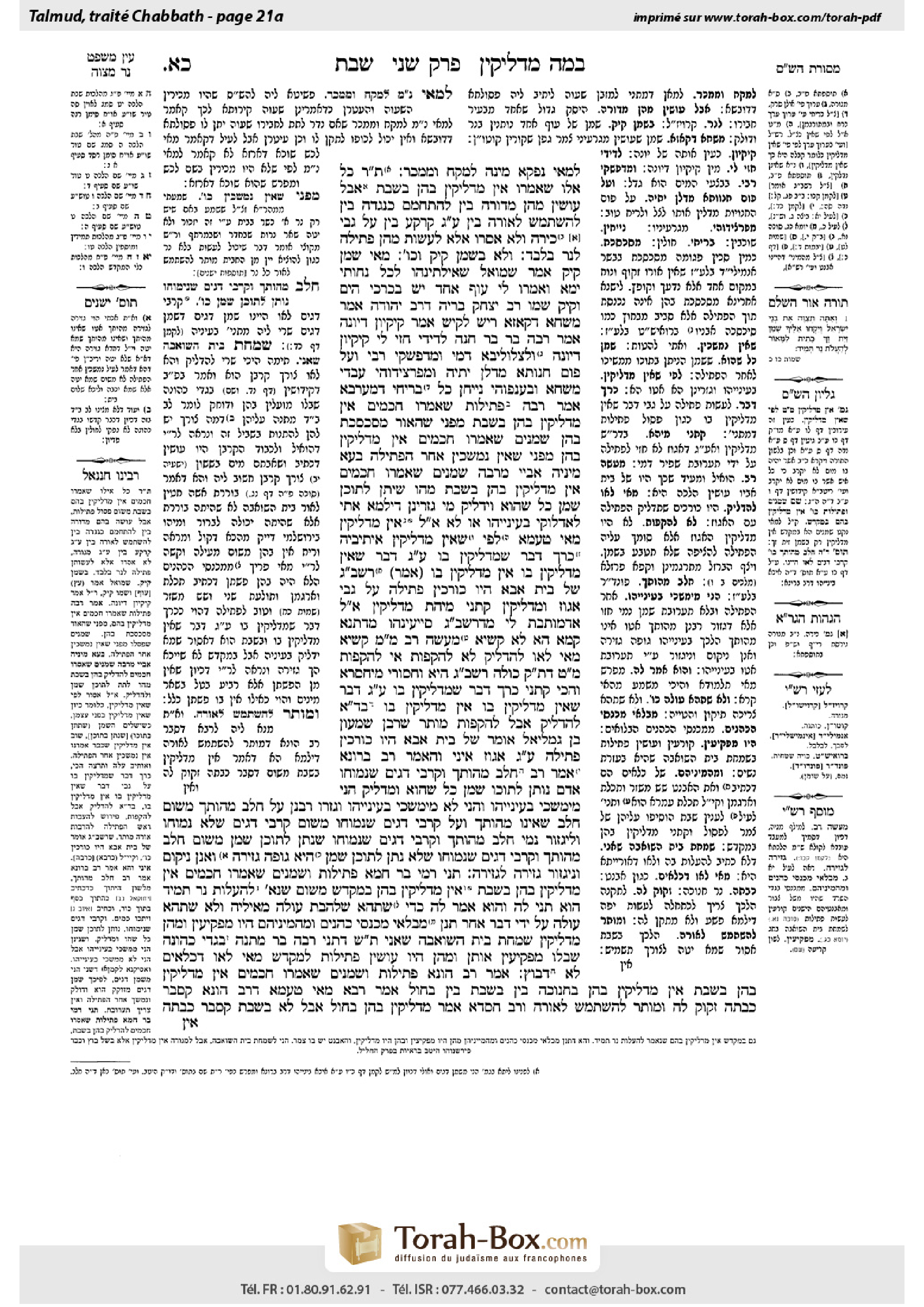
Shabbat 21a: Talmud study for Daf Yomi
Daf Yomi is the daily study of one Talmud folio. Explore 37 tractates with scans, Hebrew text, Sefaria English and AI-generated French translations where annotated.
Passage selection and English or AI-generated French translation are available where the scan has annotations. Daf Study is independent of Torah-Box and Sefaria.
Browse Shabbat · שבת · All tractatesShabbat 21a text and translations
This page of Shabbat includes the Aramaic text, an English translation and an AI-generated French translation, alongside the scan above.
שבת כ״א א · Aramaic and Hebrew text
לְמַאי נָפְקָא מִינַּהּ? לְמִקָּח וּמִמְכָּר.
תָּנוּ רַבָּנַן: כׇּל אֵלּוּ שֶׁאָמְרוּ אֵין מַדְלִיקִין בָּהֶן בְּשַׁבָּת, אֲבָל עוֹשִׂין מֵהֶן מְדוּרָה — בֵּין לְהִתְחַמֵּם כְּנֶגְדָּהּ בֵּין לְהִשְׁתַּמֵּשׁ לְאוֹרָהּ, בֵּין עַל גַּבֵּי קַרְקַע, בֵּין עַל גַּבֵּי כִּירָה. וְלֹא אָסְרוּ אֶלָּא לַעֲשׂוֹת מֵהֶן פְּתִילָה לַנֵּר בִּלְבַד.
וְלֹא בְּשֶׁמֶן קִיק וְכוּ׳. מַאי שֶׁמֶן קִיק? אָמַר שְׁמוּאֵל: שְׁאֵילְתִּינְהוּ לְכֹל נָחוֹתֵי יַמָּא, וַאֲמַרוּ לִי: עוֹף אֶחָד יֵשׁ בִּכְרַכֵּי הַיָּם וְקִיק שְׁמוֹ. רַב יִצְחָק בְּרֵיהּ דְּרַב יְהוּדָה אָמַר: מִשְׁחָא דְּקָאזָא. רֵישׁ לָקִישׁ אָמַר: קִיקָיוֹן דְּיוֹנָה. אָמַר רַבָּה בַּר בַּר חָנָה: לְדִידִי חֲזִי לִי קִיקָיוֹן דְּיוֹנָה, וְלִצְלוּלִיבָא דָּמֵי וּמִדֻּפְשְׁקֵי רָבֵי, וְעַל פּוּם חַנְוָתָא מַדְלָן יָתֵיהּ, וּמִפַּרְצִידוֹהִי עָבְדִי מִשְׁחָא, וּבְעַנְפוֹהִי נָיְיחָן כׇּל בְּרִיחֵי דְמַעְרְבָא.
אָמַר רַבָּה: פְּתִילוֹת שֶׁאָמְרוּ חֲכָמִים אֵין מַדְלִיקִין בָּהֶן בְּשַׁבָּת, מִפְּנֵי שֶׁהָאוּר מְסַכְסֶכֶת בָּהֶן. שְׁמָנִים שֶׁאָמְרוּ חֲכָמִים אֵין מַדְלִיקִין בָּהֶן, מִפְּנֵי שֶׁאֵין נִמְשָׁכִין אַחַר הַפְּתִילָה.
בְּעָא מִינֵּיהּ אַבָּיֵי מֵרַבָּה: שְׁמָנִים שֶׁאָמְרוּ חֲכָמִים אֵין מַדְלִיקִין בָּהֶן בְּשַׁבָּת, מַהוּ שֶׁיִּתֵּן לְתוֹכָן שֶׁמֶן כׇּל שֶׁהוּא וְיַדְלִיק? מִי גָּזְרִינַן דִּילְמָא אָתֵי לְאַדְלוֹקֵי בְּעֵינַיְיהוּ, אוֹ לָא? אֲמַר לֵיהּ: אֵין מַדְלִיקִין. מַאי טַעְמָא? לְפִי שֶׁאֵין מַדְלִיקִין.
אֵיתִיבֵיהּ: כָּרַךְ דָּבָר שֶׁמַּדְלִיקִין בּוֹ עַל גַּבֵּי דָּבָר שֶׁאֵין מַדְלִיקִין בּוֹ — אֵין מַדְלִיקִין בּוֹ. אָמַר רַבָּן שִׁמְעוֹן בֶּן גַּמְלִיאֵל: שֶׁל בֵּית אַבָּא הָיוּ כּוֹרְכִין פְּתִילָה עַל גַּבֵּי אֱגוֹז וּמַדְלִיקִין. קָתָנֵי מִיהַת מַדְלִיקִין!
אֲמַר לֵיהּ: אַדְּמוֹתְבַתְּ לֵיהּ מִדְּרַבָּן שִׁמְעוֹן בֶּן גַּמְלִיאֵל, סַיְּיעֵיהּ מִדְּתַנָּא קַמָּא! הָא לָא קַשְׁיָא: ״מַעֲשֶׂה רַב״. מִכׇּל מָקוֹם קַשְׁיָא: מַאי לָאו, לְהַדְלִיק? לָא, לְהַקְפּוֹת. אִי לְהַקְפּוֹת, מַאי טַעְמָא דְּתַנָּא קַמָּא? כּוּלָּהּ רַבָּן שִׁמְעוֹן בֶּן גַּמְלִיאֵל הִיא וְחַסּוֹרֵי מִיחַסְּרָא, וְהָכִי קָתָנֵי: כָּרַךְ דָּבָר שֶׁמַּדְלִיקִין בּוֹ עַל גַּבֵּי דָּבָר שֶׁאֵין מַדְלִיקִין בּוֹ — אֵין מַדְלִיקִין בּוֹ. בַּמֶּה דְּבָרִים אֲמוּרִים — לְהַדְלִיק, אֲבָל לְהַקְפּוֹת — מוּתָּר, שֶׁרַבָּן שִׁמְעוֹן בֶּן גַּמְלִיאֵל אוֹמֵר: שֶׁל בֵּית אַבָּא הָיוּ כּוֹרְכִין פְּתִילָה עַל גַּבֵּי אֱגוֹז.
אִינִי?! וְהָאָמַר רַב בְּרוֹנָא אָמַר רַב: חֵלֶב מְהוּתָּךְ וְקִרְבֵי דָגִים שֶׁנִּמּוֹחוּ, אָדָם נוֹתֵן לְתוֹכָן שֶׁמֶן כׇּל שֶׁהוּא וּמַדְלִיק? הָנֵי מִימַּשְׁכִי בְּעֵינַיְיהוּ, וְהָנֵי לָא מִימַּשְׁכִי בְּעֵינַיְיהוּ. וּגְזַרוּ רַבָּנַן עַל חֵלֶב מְהוּתָּךְ מִשּׁוּם חֵלֶב שֶׁאֵינוֹ מְהוּתָּךְ, וְעַל קִרְבֵי דָגִים שֶׁנִּמּוֹחוּ מִשּׁוּם קִרְבֵי דָגִים שֶׁלֹּא נִמּוֹחוּ. וְלִיגְזוֹר נָמֵי חֵלֶב מְהוּתָּךְ וְקִרְבֵי דָגִים שֶׁנִּמּוֹחוּ שֶׁנָּתַן לְתוֹכָן שֶׁמֶן מִשּׁוּם חֵלֶב מְהוּתָּךְ וְקִרְבֵי דָגִים שֶׁנִּמּוֹחוּ שֶׁלֹּא נָתַן לְתוֹכָן שֶׁמֶן! הִיא גּוּפָהּ, גְּזֵירָה, וַאֲנַן נֵיקוּם וְנִיגְזוֹר גְּזֵירָה לִגְזֵירָה?!
תָּנֵי רָמֵי בַּר חָמָא: פְּתִילוֹת וּשְׁמָנִים שֶׁאָמְרוּ חֲכָמִים אֵין מַדְלִיקִין בָּהֶן בְּשַׁבָּת — אֵין מַדְלִיקִין בָּהֶן בַּמִּקְדָּשׁ, מִשּׁוּם שֶׁנֶּאֱמַר: ״לְהַעֲלוֹת נֵר תָּמִיד״. הוּא תָּנֵי לַהּ, וְהוּא אָמַר לַהּ — כְּדֵי שֶׁתְּהֵא שַׁלְהֶבֶת עוֹלָה מֵאֵילֶיהָ, וְלֹא שֶׁתְּהֵא עוֹלָה עַל יְדֵי דָּבָר אַחֵר.
תְּנַן: מִבְּלָאֵי מִכְנְסֵי כֹּהֲנִים וּמֵהֶמְיָנֵיהֶם הָיוּ מַפְקִיעִין, וּמֵהֶן מַדְלִיקִין. שִׂמְחַת בֵּית הַשּׁוֹאֵבָה שָׁאנֵי.
תָּא שְׁמַע, דְּתָנֵי רַבָּה בַּר מַתְנָה: בִּגְדֵי כְהוּנָּה שֶׁבָּלוּ מַפְקִיעִין אוֹתָן, וּמֵהֶן הָיוּ עוֹשִׂין פְּתִילוֹת לַמִּקְדָּשׁ. מַאי לָאו, דְּכִלְאַיִם? לָא, דְּבוּץ.
אָמַר רַב הוּנָא: פְּתִילוֹת וּשְׁמָנִים שֶׁאָמְרוּ חֲכָמִים אֵין מַדְלִיקִין בָּהֶן בְּשַׁבָּת, אֵין מַדְלִיקִין בָּהֶן בַּחֲנוּכָּה, בֵּין בְּשַׁבָּת בֵּין בַּחוֹל. אָמַר רָבָא: מַאי טַעְמָא דְּרַב הוּנָא? — קָסָבַר: כָּבְתָה זָקוּק לָהּ, וּמוּתָּר לְהִשְׁתַּמֵּשׁ לְאוֹרָהּ. וְרַב חִסְדָּא אָמַר: מַדְלִיקִין בָּהֶן בַּחוֹל, אֲבָל לֹא בְּשַׁבָּת. קָסָבַר: כָּבְתָה
Shabbat 21a · English translation
The Gemara asks: What is the practical difference that emerges from that which Rami bar Avin taught? The Gemara explains: Its significance is with regard to buying and selling. One who buys tar can insist upon receiving the by-product of pitch and no other material. The same is true with regard to wax and honey.
The Sages taught in the Tosefta: With regard to all of those materials about which they said that one may not light the lamp with them on Shabbat; however, one may use them ab initio to make a bonfire. One may do so both to warm himself opposite it and to utilize its light, and he may ignite it both on the ground and on a stove. They prohibited using them only to make a wick for an oil lamp.
And we learned in the mishna that one may not light the Shabbat lamp with kik oil. The Gemara asks: What is kik oil? Shmuel said: I asked all the seafarers, and they said to me that there is a bird in the cities on the sea coast, and kik is its name. Kik oil is produced from that bird. Rav Yitzḥak, son of Rav Yehuda, said: This is referring to cotton oil. Reish Lakish said: It is the oil made from the seed of a plant like the castor plant [kikayon] of Jonah. Rabba bar bar Ḥana said: I have seen the species of the castor plant of Jonah, and it is similar to the ricinus tree and it grows in swamps, and they place it at the entrance of shops for shade, and they produce oil from its seeds, and all the sick people of the West, Eretz Yisrael, rest beneath its branches.
Rabba said: Those wicks about which the Sages said one may not light with them on Shabbat, the reason is: Because the fire flickers on them. It sputters on the wick and does not burn well. Those oils with which the Sages said that one may not light on Shabbat, the reason is: Because they are not drawn effectively by the wick.
Abaye raised a dilemma before Rabba: Those oils with which the Sages said one may not light on Shabbat, what is the ruling? May one, ab initio, add to them any amount of oil with which it is permissible to light and light with that mixture? The sides of the dilemma are: Do we issue a decree lest one come to light these oils in their natural form, without mixing them with permissible oils? Or no, that possibility is not a source of concern? Rabba said to him: One may not light that mixture. What is the reason for this? The reason is because the halakha is that one may not light (Arukh).
Abaye raised an objection to Rabba’s opinion from that which was taught in the Tosefta: One who wrapped a material with which one may light around a material with which one may not light, may not light with the bound wick. Rabban Shimon ben Gamliel said: In the ancestral house of my father, they would wrap a wick with which one is permitted to light around a nut, and that was how they would light. In any case, it is teaching that, according to Rabban Shimon ben Gamliel, one may light. Apparently, one is permitted to light with a combination of permitted and prohibited wicks.
Rabba said to him: Before you raise an objection to my opinion from the statement of Rabban Shimon ben Gamliel, support it from the statement of the first tanna, who said that it is prohibited to light in that case. The Gemara answers: This is not difficult, as it is preferable to challenge from the statement of Rabban Gamliel with regard to the custom in his father’s house. There is a principle that proof cited from an action is great, i.e., a practical precedent is more substantial than a theoretical halakha. Nevertheless, the difficulty from the statement of Rabban Shimon ben Gamliel remains: Is he not speaking of a case where he combined the wick and the nut to light them together? If so, one is permitted to combine the prohibited and the permitted. The Gemara answers: No, it is speaking in a case where he combined them to float the wick on the oil with the help of the nut. The Gemara asks: If it is speaking only with regard to a case of floating the wick, what is the reason that the first tanna prohibits doing so? The Gemara answers: The entire baraita is the opinion of Rabban Shimon ben Gamliel, and it is incomplete, and it teaches the following: One who wrapped a material with which one may light around a material with which one may not light, may not light with it. In what case is this statement said? When he combines the materials to light them together. However, if he utilizes that with which one may not light merely in order to float the wick, it is permitted, as we learned that Rabban Shimon ben Gamliel says: In the ancestral house of my father, they would wrap a wick with which one is permitted to light around a nut. That was how they would light.
In any case, to this point the conclusion is that one may not light with a mixture of permitted and prohibited oils. The Gemara asks: Is that so? Didn’t Rav Beruna say that Rav said: With regard to molten fat or fish innards that dissolved and became like oil, a person may place any amount of oil fit for lighting into it and light. Apparently, one may light with a mixture of permitted and prohibited oils. Rabba answers: These, the fat and the fish innards, are drawn by the wick even in their natural state, and those, the prohibited oils, are not drawn in their natural state. Originally, the Sages issued a decree to prohibit molten fat due to unmolten fat and to prohibit dissolved fish innards due to undissolved fish innards; however, the Sages did not issue a decree in a case where one added to them any amount of oil suitable for lighting, and permitted lighting with it. The Gemara asks: Let them also issue a decree to prohibit molten fat and dissolved fish innards to which he added oil due to molten fat and dissolved fish innards to which he did not add permitted oil. The Gemara rejects this: That prohibition with regard to molten fat and dissolved fish innards itself is based on a decree. And will we arise and issue one decree to prevent violation of another decree? The Sages do not issue decrees under those circumstances. Therefore, there is no reason to prohibit their use.
Rami bar Ḥama taught a baraita: Those wicks and oils, which the Sages said one may not light with them on Shabbat, one may not light with them in the Temple either because it is stated with regard to the Temple candelabrum: “And you shall command the children of Israel, that they bring unto you pure olive oil beaten for the light, to cause a lamp to burn continually” (Exodus 27:20). Rami bar Ḥama taught that baraita and he also said its explanation: What is the proof from the verse? One may interpret the verse homiletically: The requirement is to light the candelabrum so that the flame ascends of itself when it is kindled, and not that it ascends by means of something else, i.e., adjusting the wick after it was lit.
We learned in a mishna: They would unravel the threads of the tattered trousers of the priests and their belts in order to make wicks from them, and from those same wicks they would light at the Celebration of Drawing Water. There was wool in the belts of the priests. It is said that their belts were made from, among other things, tekhelet, which in the Bible refers to dyed wool. Apparently, one may light with a mixture that includes a wick unsuitable for lighting. The Gemara answers: The Celebration of Drawing Water is different, as in that celebration, they did not light the Temple candelabrum. They lit special lanterns made specifically for that purpose and were not stringent with regard to the wicks placed in them.
Come and hear a related question from that which Rabba bar Mattana taught: Priestly garments that were tattered, they would unravel them into threads from which they would make wicks for the Temple. Is this not also referring to garments made of diverse kinds, like the sashes of the priests that were made of a mixture of wool and linen? The Gemara answers: No, these wicks were made from linen garments alone.
Rav Huna said: Those wicks and oils with which the Sages said that one may not light the lamp on Shabbat, one may not light the lamp with them on Hanukkah either; both when it falls on Shabbat and when it falls during the week. Rava said: What is the reason for Rav Huna’s statement? He holds that if the Hanukkah light becomes extinguished, even though one lit it properly, one is bound to attend to it and relight it so that it will burn properly. Therefore, one must ensure that the wick burns properly from the outset. And utilizing the light of the Hanukkah lamp is permitted during the week. Consequently, in order to prevent him from inadvertently sinning on Shabbat, he must ensure from the outset that the wick burns well, lest he come to adjust the flame on Shabbat. Those wicks and oils do not burn well at all. And Rav Ḥisda said: Those same oils and wicks with which the Sages prohibited to light on Shabbat, one may light with them on Hanukkah during the week, but not on Shabbat. He holds that if the Hanukkah light is extinguished
Shabbat 21a · Traduction française (IA)
La Guemara demande : Quelle conséquence pratique découle de l’enseignement de Rami bar Avin ? La Guemara explique : Cela concerne les achats et les ventes. Celui qui achète du goudron peut exiger de recevoir le sous-produit que constitue la poix, et non un autre produit. Il en va de même pour la cire et le miel.
Les Sages ont enseigné dans la Tosefta : Pour tous ces produits au sujet desquels ils ont dit qu’on ne peut pas allumer la lampe avec eux pendant Chabbat, on peut néanmoins les utiliser d’emblée pour faire un feu. On peut le faire aussi bien pour se réchauffer devant le feu que pour profiter de sa lumière, et on peut allumer le feu aussi bien à même le sol que sur un poêle. Leur utilisation n’a été interdite que pour fabriquer une mèche de lampe à huile.
Et nous avons appris dans la Michna qu’on ne peut pas allumer la lampe de Chabbat avec de l’huile de kik. La Guemara demande : Qu’est-ce que l’huile de kik ? Chmouel dit : J’ai interrogé tous les marins, et ils m’ont répondu qu’il existe, dans les villes du littoral, un oiseau qui porte le nom de kik. L’huile de kik est produite à partir de cet oiseau. Rav Yits’hak, fils de Rav Yehouda, dit : Il s’agit d’huile de coton. Rech Lakich dit : Il s’agit de l’huile produite à partir des graines d’une plante semblable au ricin [kikayon] de Jonas. Rabba bar bar ‘Hana dit : J’ai vu l’espèce de ricin de Jonas ; elle ressemble au ricin, pousse dans les marécages et est placée à l’entrée des boutiques pour faire de l’ombre. On extrait de l’huile de ses graines, et tous les malades de l’Ouest, c’est-à-dire de la terre d’Israël, se reposent sous ses branches.
Rabba dit : La raison pour laquelle les Sages ont dit qu’on ne peut pas allumer avec certaines mèches pendant Chabbat est que la flamme y vacille. Elle crépite sur la mèche et ne brûle pas bien. Quant aux huiles avec lesquelles les Sages ont dit qu’on ne peut pas allumer pendant Chabbat, la raison est qu’elles ne sont pas bien absorbées par la mèche.
Abayé souleva une question devant Rabba : Pour les huiles au sujet desquelles les Sages ont dit qu’on ne peut pas allumer pendant Chabbat, qu’en est-il ? Peut-on leur ajouter d’emblée n’importe quelle quantité d’une huile avec laquelle il est permis d’allumer, puis allumer avec ce mélange ? Les deux possibilités sont les suivantes : Émet-on un décret, de crainte qu’on en vienne à allumer avec ces huiles telles quelles, sans les mélanger à des huiles autorisées ? Ou bien cette éventualité n’est-elle pas à craindre ? Rabba lui dit : On ne peut pas allumer avec ce mélange. Pourquoi ? Parce que la halakha est qu’on ne peut pas allumer (Arukh).
Abayé objecta à l’opinion de Rabba en s’appuyant sur ce qui a été enseigné dans la Tosefta : Celui qui enroule un matériau avec lequel il est permis d’allumer autour d’un matériau avec lequel il est interdit d’allumer ne peut pas allumer avec la mèche ainsi obtenue. Rabban Chimon ben Gamliel dit : Dans la maison ancestrale de mon père, on enroulait autour d’une noix une mèche avec laquelle il est permis d’allumer, et c’est ainsi qu’on allumait. En tout cas, on enseigne que, selon Rabban Chimon ben Gamliel, il est permis d’allumer. Apparemment, il est permis d’allumer avec une combinaison de mèches autorisées et interdites.
Rabba lui dit : Avant de soulever une objection à mon opinion à partir de la déclaration de Rabban Chimon ben Gamliel, appuie-la sur celle du premier tanna, qui a dit qu’il est interdit d’allumer dans ce cas. La Guemara répond : Il n’y a pas de difficulté, car il est préférable de soulever une objection à partir de la déclaration de Rabban Chimon ben Gamliel au sujet de la coutume dans la maison de son père. Il existe un principe selon lequel une preuve tirée d’un acte est de grande valeur, c’est-à-dire qu’un précédent pratique est plus probant qu’une halakha théorique. La difficulté soulevée par la déclaration de Rabban Chimon ben Gamliel demeure néanmoins : ne parle-t-il pas d’un cas où il a associé la mèche et la noix afin de les allumer ensemble ? Si c’est le cas, il est permis d’associer ce qui est interdit et ce qui est autorisé. La Guemara répond : Non, il s’agit d’un cas où il les a associés afin que la noix aide la mèche à flotter sur l’huile. La Guemara demande : S’il s’agit uniquement d’un cas où l’on fait flotter la mèche, pour quelle raison le premier tanna l’interdit-il ? La Guemara répond : Toute la baraïta exprime l’opinion de Rabban Chimon ben Gamliel, mais elle est incomplète et enseigne ceci : Celui qui enroule un matériau avec lequel il est permis d’allumer autour d’un matériau avec lequel il est interdit d’allumer ne peut pas allumer avec cette mèche. Dans quel cas cette déclaration s’applique-t-elle ? Lorsqu’il associe les matériaux afin de les allumer ensemble. Mais s’il utilise le matériau avec lequel il est interdit d’allumer uniquement pour faire flotter la mèche, cela est permis, comme nous l’avons appris : Rabban Chimon ben Gamliel dit que, dans la maison ancestrale de son père, on enroulait autour d’une noix une mèche avec laquelle il est permis d’allumer. C’est ainsi qu’on allumait.
Quoi qu’il en soit, jusqu’ici, la conclusion est qu’on ne peut pas allumer avec un mélange d’huiles autorisées et interdites. La Guemara demande : Est-ce bien le cas ? Rav Berouna n’a-t-il pas dit au nom de Rav : Pour la graisse fondue ou les entrailles de poisson qui ont fondu et sont devenues semblables à de l’huile, on peut ajouter n’importe quelle quantité d’huile propre à l’allumage, puis allumer ? Apparemment, il est permis d’allumer avec un mélange d’huiles autorisées et interdites. Rabba répond : La graisse et les entrailles de poisson sont absorbées par la mèche même à l’état naturel, tandis que les huiles interdites ne le sont pas à l’état naturel. À l’origine, les Sages ont décrété d’interdire la graisse fondue par crainte de la graisse non fondue, et les entrailles de poisson fondues par crainte des entrailles de poisson non fondues. Cependant, ils n’ont pas décrété d’interdiction dans le cas où l’on y ajoute n’importe quelle quantité d’huile adaptée à l’allumage, et ils ont permis d’allumer avec ce mélange. La Guemara demande : Qu’ils décrètent aussi d’interdire la graisse fondue et les entrailles de poisson fondues auxquelles on a ajouté de l’huile, par crainte de la graisse fondue et des entrailles de poisson fondues auxquelles on n’a pas ajouté d’huile autorisée ! La Guemara écarte cette objection : L’interdiction de la graisse fondue et des entrailles de poisson fondues repose elle-même sur un décret. Allons-nous donc édicter un décret pour empêcher la transgression d’un autre décret ? Les Sages n’édictent pas de décrets dans de telles circonstances. Il n’y a donc aucune raison d’interdire leur utilisation.
Rami bar ‘Hama a enseigné une baraïta : Les mèches et les huiles au sujet desquelles les Sages ont dit qu’on ne peut pas allumer avec elles pendant Chabbat ne peuvent pas non plus être utilisées pour allumer dans le Temple, car il est dit au sujet du candélabre du Temple : « Et tu ordonneras aux enfants d’Israël de t’apporter de l’huile d’olive pure, concassée, pour l’éclairage, afin de faire monter continuellement une lampe » (Exode 27,20). Rami bar ‘Hama a enseigné cette baraïta et en a également donné l’explication : Quelle preuve tire-t-on du verset ? On peut l’interpréter de manière homilétique : il faut allumer le candélabre de telle sorte que la flamme monte d’elle-même une fois allumée, et non qu’elle monte grâce à autre chose, c’est-à-dire en ajustant la mèche après l’avoir allumée.
Nous avons appris dans une Michna : On défaisait les fils des pantalons usés des prêtres et de leurs ceintures afin d’en faire des mèches, et c’est avec ces mèches qu’on allumait lors de la Célébration du puisage de l’eau. Les ceintures des prêtres contenaient de la laine. Il est dit que leurs ceintures étaient faites, entre autres, de tekhelet, qui désigne dans la Bible de la laine teinte. Apparemment, il est permis d’allumer avec un mélange comprenant une mèche qui ne convient pas à l’allumage. La Guemara répond : La Célébration du puisage de l’eau est différente, car, à cette occasion, on n’allumait pas le candélabre du Temple. On allumait des lanternes spéciales conçues à cet effet, et l’on n’était pas strict quant aux mèches qu’on y plaçait.
Viens entendre une question liée à ce sujet, tirée de ce que Rabba bar Mattana a enseigné : Les vêtements sacerdotaux usés étaient défaits en fils dont on faisait des mèches pour le Temple. Cela ne désigne-t-il pas aussi des vêtements faits de matières diverses, comme les ceintures des prêtres, composées d’un mélange de laine et de lin ? La Guemara répond : Non, ces mèches étaient faites uniquement à partir de vêtements de lin.
Rav Houna dit : Les mèches et les huiles au sujet desquelles les Sages ont dit qu’on ne peut pas allumer la lampe pendant Chabbat ne peuvent pas non plus servir à allumer la lampe de Hanoucca, que cette fête tombe pendant Chabbat ou en semaine. Rava dit : Quelle est la raison de la déclaration de Rav Houna ? Il estime que si la lampe de Hanoucca s’éteint, même si on l’avait allumée correctement, on est tenu de s’en occuper et de la rallumer afin qu’elle brûle comme il convient. Il faut donc s’assurer dès le départ que la mèche brûle correctement. En semaine, il est permis de profiter de la lumière de la lampe de Hanoucca. Par conséquent, afin d’éviter qu’on ne commette involontairement une faute pendant Chabbat, il faut s’assurer dès le départ que la mèche brûle bien, de peur qu’on en vienne à ajuster la flamme pendant Chabbat. Or, ces mèches et ces huiles ne brûlent pas bien du tout. Rav ‘Hisda dit : Ces mêmes huiles et mèches avec lesquelles les Sages ont interdit d’allumer pendant Chabbat peuvent servir à allumer pendant Hanoucca en semaine, mais pas pendant Chabbat. Il estime que si la lampe de Hanoucca s’éteint
Traduction française générée par IA à partir de l’édition anglaise de Sefaria. Vérifie toujours un passage avec le texte source.
Text from Sefaria: William Davidson Edition - Vocalized Aramaic (CC BY NC); William Davidson Edition - English (CC BY NC).