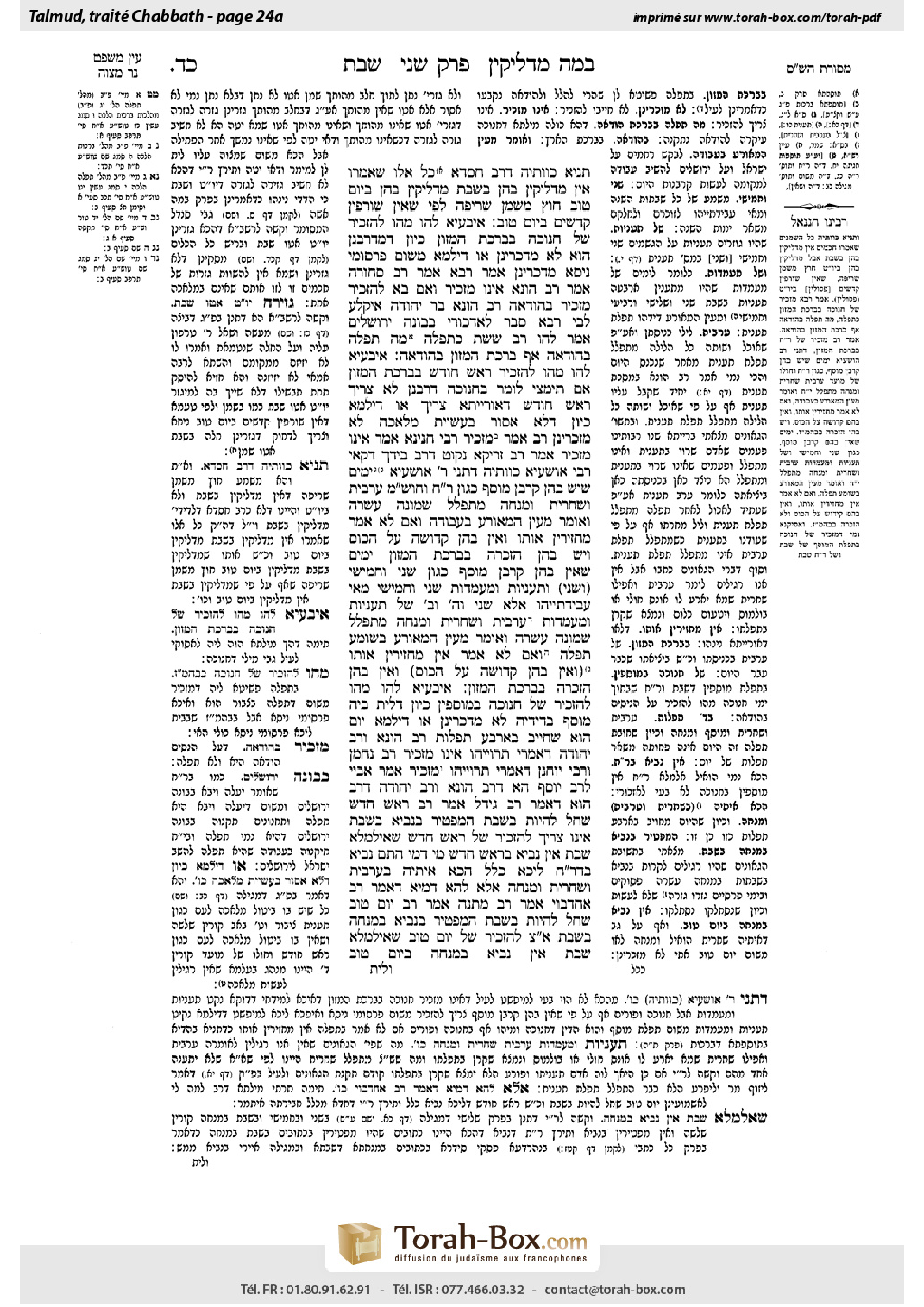
Shabbat 24a: Talmud study for Daf Yomi
Daf Yomi is the daily study of one Talmud folio. Explore 37 tractates with scans, Hebrew text, Sefaria English and AI-generated French translations where annotated.
Passage selection and English or AI-generated French translation are available where the scan has annotations. Daf Study is independent of Torah-Box and Sefaria.
Browse Shabbat · שבת · All tractatesShabbat 24a text and translations
This page of Shabbat includes the Aramaic text, an English translation and an AI-generated French translation, alongside the scan above.
שבת כ״ד א · Aramaic and Hebrew text
תַּנְיָא כְּווֹתֵיהּ דְּרַב חִסְדָּא. כׇּל אֵלּוּ שֶׁאָמְרוּ אֵין מַדְלִיקִין בָּהֶן בְּשַׁבָּת, מַדְלִיקִין בָּהֶן בְּיוֹם טוֹב, חוּץ מִשֶּׁמֶן שְׂרֵיפָה — לְפִי שֶׁאֵין שׂוֹרְפִין קׇדָשִׁים בְּיוֹם טוֹב.
אִיבַּעְיָא לְהוּ: מַהוּ לְהַזְכִּיר שֶׁל חֲנוּכָּה בְּבִרְכַּת הַמָּזוֹן? כֵּיוָן דְּמִדְּרַבָּנַן הוּא — לָא מַדְכְּרִינַן, אוֹ דִילְמָא מִשּׁוּם פַּרְסוֹמֵי נִיסָּא — מַדְכְּרִינַן?! אָמַר רָבָא אָמַר רַב סְחוֹרָה אָמַר רַב הוּנָא: אֵינוֹ מַזְכִּיר. וְאִם בָּא לְהַזְכִּיר — מַזְכִּיר בַּהוֹדָאָה. רַב הוּנָא בַּר יְהוּדָה אִיקְּלַע לְבֵי רָבָא. סְבַר לְאַדְכּוֹרֵי בְּ״בוֹנֵה יְרוּשָׁלַיִם״. אָמַר לְהוּ רַב שֵׁשֶׁת: כִּתְפִלָּה. מַה תְּפִלָּה בַּהוֹדָאָה — אַף בִּרְכַּת הַמָּזוֹן בַּהוֹדָאָה.
אִיבַּעְיָא לְהוּ: מַהוּ לְהַזְכִּיר רֹאשׁ חוֹדֶשׁ בְּבִרְכַּת הַמָּזוֹן? אִם תִּימְצֵי לוֹמַר בַּחֲנוּכָּה דְּרַבָּנַן לָא צְרִיךְ, רֹאשׁ חוֹדֶשׁ דְּאוֹרָיְיתָא — צְרִיךְ. אוֹ דִילְמָא כֵּיוָן דְּלָא אֲסִיר בַּעֲשִׂיַּית מְלָאכָה — לָא מַדְכְּרִינַן. רַב אָמַר: מַזְכִּיר, רַבִּי חֲנִינָא אָמַר: אֵינוֹ מַזְכִּיר. אָמַר רַב זְרִיקָא: נְקוֹט דְּרַב בִּידָךְ, דְקָאֵי רַבִּי אוֹשַׁעְיָא כְּווֹתֵיהּ. דְּתָנֵי רַבִּי אוֹשַׁעְיָא: יָמִים שֶׁיֵּשׁ בָּהֶן קׇרְבַּן מוּסַף, כְּגוֹן רֹאשׁ חוֹדֶשׁ וְחוּלּוֹ שֶׁל מוֹעֵד — עַרְבִית וְשַׁחֲרִית וּמִנְחָה מִתְפַּלֵּל שְׁמוֹנֶה עֶשְׂרֵה וְאוֹמֵר מֵעֵין הַמְאוֹרָע בָּעֲבוֹדָה. וְאִם לֹא אָמַר — מַחֲזִירִין אוֹתוֹ. וְאֵין בָּהֶן קְדוּשָּׁה עַל הַכּוֹס, וְיֵשׁ בָּהֶן הַזְכָּרָה בְּבִרְכַּת הַמָּזוֹן. יָמִים שֶׁאֵין בָּהֶן קׇרְבַּן מוּסַף, כְּגוֹן שֵׁנִי וַחֲמִישִׁי וְשֵׁנִי וְתַעֲנִיּוֹת וּמַעֲמָדוֹת.
שֵׁנִי וַחֲמִישִׁי מַאי עֲבִידְתַּיְיהוּ? אֶלָּא שֵׁנִי וַחֲמִישִׁי וְשֵׁנִי שֶׁל תַּעֲנִיּוֹת וּמַעֲמָדוֹת. עַרְבִית וְשַׁחֲרִית וּמִנְחָה מִתְפַּלֵּל שְׁמוֹנֶה עֶשְׂרֵה, וְאוֹמֵר מֵעֵין הַמְאוֹרָע בְּ״שׁוֹמֵעַ תְּפִלָּה״, וְאִם לֹא אָמַר — אֵין מַחֲזִירִין אוֹתוֹ. וְאֵין בָּהֶן קְדוּשָּׁה עַל הַכּוֹס וְאֵין בָּהֶן הַזְכָּרָה בְּבִרְכַּת הַמָּזוֹן.
אִיבַּעְיָא לְהוּ: מַהוּ לְהַזְכִּיר שֶׁל חֲנוּכָּה בְּמוּסָפִין? כֵּיוָן דְּלֵית בֵּיהּ מוּסָף בְּדִידֵיהּ לָא מַדְכְּרִינַן, אוֹ דִילְמָא יוֹם הוּא שֶׁחַיָּיב בְּאַרְבַּע תְּפִלּוֹת. רַב הוּנָא וְרַב יְהוּדָה דְּאָמְרִי תַּרְוַיְיהוּ: אֵינוֹ מַזְכִּיר. רַב נַחְמָן וְרַבִּי יוֹחָנָן דְּאָמְרִי תַּרְוַיְיהוּ: מַזְכִּיר.
אֲמַר לֵיהּ אַבָּיֵי לְרַב יוֹסֵף: הָא דְּרַב הוּנָא וְרַב יְהוּדָה דְּרַב הוּא. דְּאָמַר רַב גִּידֵּל אָמַר רַב: רֹאשׁ חֹדֶשׁ שֶׁחָל לִהְיוֹת בְּשַׁבָּת — הַמַּפְטִיר בַּנָּבִיא בְּשַׁבָּת אֵינוֹ צָרִיךְ לְהַזְכִּיר שֶׁל רֹאשׁ חֹדֶשׁ, שֶׁאִילְמָלֵא שַׁבָּת אֵין נָבִיא בְּרֹאשׁ חֹדֶשׁ
מִי דָּמֵי?! הָתָם נָבִיא בִּדְרֹאשׁ חֹדֶשׁ לֵיכָּא כְּלָל, הָכָא אִיתֵיהּ בְּעַרְבִית וְשַׁחֲרִית וּמִנְחָה. אֶלָּא לְהָא דָּמְיָא: דְּאָמַר רַב אַחַדְבוּי אָמַר רַב מַתְנָה אָמַר רַב: יוֹם טוֹב שֶׁחָל לִהְיוֹת בְּשַׁבָּת, הַמַּפְטִיר בְּנָבִיא בְּמִנְחָה בְּשַׁבָּת אֵינוֹ צָרִיךְ לְהַזְכִּיר שֶׁל יוֹם טוֹב, שֶׁאִילְמָלֵא שַׁבָּת אֵין נָבִיא בְּמִנְחָה בְּיוֹם טוֹב.
Shabbat 24a · English translation
It was taught in a baraita in accordance with the opinion of Rav Ḥisda. All of these oils with which the Sages said that one may not light on Shabbat, one may light with them on a Festival, with the exception of burnt oil, because one may not burn consecrated items on a Festival.
A dilemma was raised before the Sages: What is the ruling with regard to the obligation to mention Hanukkah in Grace after Meals? The dilemma is: Since it is merely an obligation by rabbinic law, do we not mention it? Or, perhaps due to publicity of the miracle, we mention it. Rava said that Rav Seḥora said that Rav Huna said: One does not mention it. And if, nevertheless, he comes to mention it, he mentions it in the blessing of thanksgiving. The Gemara relates that Rav Huna bar Yehuda happened by Rava’s house on Hanukkah. When, after eating, he came to recite Grace after Meals, he thought to mention Hanukkah in the blessing: Who builds Jerusalem. Rav Sheshet said to the yeshiva students: One mentions Hanukkah in Grace after Meals just as he does in the Amida prayer. Just as in the Amida prayer one mentions Hanukkah in the blessing of thanksgiving, so too, in Grace after Meals one mentions Hanukkah in the blessing of thanksgiving.
Based on the previous dilemma, an additional dilemma was raised before the Sages: What is the ruling with regard to the obligation to mention the New Moon in Grace after Meals? The dilemma is: If you say that on Hanukkah, since it is only by rabbinic law, one need not mention it in Grace after Meals; perhaps the New Moon, which is by Torah law, one is required to mention it. Or, perhaps since it is not a day on which it is prohibited to perform labor, one need not mention it. The Sages disputed this matter: Rav said: One mentions the New Moon in Grace after Meals. Rabbi Ḥanina said: One does not mention it. Rav Zerika said: Take the halakha of Rav in your hand as authoritative, since Rabbi Oshaya holds in accordance with his opinion. As Rabbi Oshaya taught in a Tosefta: Days on which there is an additional offering sacrificed in the Temple, i.e., the New Moon and the intermediate days of a Festival; in the evening, morning, and afternoon prayers, one recites the eighteen blessings of the Amida prayer and says a passage pertaining to the event of the day during the blessing of Temple service. And if he did not recite it, we require him to return to the beginning of the prayer and repeat it. And on those days, there is no kiddush recited over the cup of wine at the start of the day, but there is mention of the day recited in Grace after Meals, in accordance with Rav’s opinion. Days on which there is no additional offering, i.e., Monday, and Thursday, and fast days, and non-priestly watches [ma’amadot], have a different legal status as detailed below.
Before drawing a conclusion, the Gemara seeks to clarify: Monday and Thursday, what is their purpose in this discussion, i.e., why are Monday and Thursday mentioned here if no special prayers are recited on those days? The Gemara explains: Rather, certainly the reference is to Monday and Thursday and Monday that are fast days for rain and of ma’amadot. On those days, in the evening, morning, and afternoon prayers, one recites eighteen blessings and recites a passage pertaining to the event of the day, i.e., the fast, in the blessing: Who listens to prayer. However, if one did not mention it, we do not require him to return to the beginning of the prayer and repeat it. And, on those days, there is no kiddush recited over a cup of wine, and there is no mention of the day recited in Grace after Meals.
An additional dilemma was raised before the Sages: What is the ruling with regard to the obligation to mention Hanukkah in the additional prayer on Shabbat during Hanukkah or on the New Moon of Tevet, which falls during Hanukkah? The sides of the dilemma are: Do we say that since Hanukkah has no additional prayer of its own, and the additional prayer has no connection to Hanukkah, we do not mention it? Or, perhaps it is the essence of the day that is obligated in the mention of Hanukkah, in which case there is no distinction between the various prayers, and it should be mentioned in all four prayers, including the additional prayer on Shabbat and the New Moon. There is a dispute: Rav Huna and Rav Yehuda both said: One does not mention it. Rav Naḥman and Rabbi Yoḥanan both said: One mentions it.
Abaye said to Rav Yosef: This opinion of Rav Huna and Rav Yehuda is Rav’s opinion, as Rav Giddel said that Rav said: In the case of the New Moon that occurs on Shabbat, the one who recites the portion from the Prophets [haftara] on Shabbat need not mention the New Moon in the blessing, as, if it were not Shabbat, there would be no reading from the Prophets on the New Moon. The haftara is unrelated to the New Moon, and therefore the New Moon is not mentioned in the blessing. The same should be true with regard to mention of Hanukkah in the additional service on the New Moon, as, if it were not the New Moon, he would not be reciting the additional service on Hanukkah. Therefore, when he recites the additional prayer, he need not mention Hanukkah.
The Gemara rejects this comparison. Is this comparable? There, reading from the Prophets is not at all part of the service on the New Moon. Here, there is mention of Hanukkah in the evening, morning, and afternoon prayers. Rather, it is comparable to this: As Rav Aḥadvoi said that Rav Mattana said that Rav said: On a Festival that occurs on Shabbat, one who recites the portion from the Prophets during the afternoon service on Shabbat need not mention the Festival, as, if it were not Shabbat, there would be no reading from the Prophets during the afternoon service on a Festival. If so, even though there is a haftara during the morning service on a Festival, since they do not read from the Prophets in the afternoon, the reading is considered totally unrelated to the Festival and one does not mention the Festival. The same is true with regard to Hanukkah. One does not mention Hanukkah in the additional prayer.
Shabbat 24a · Traduction française (IA)
Une baraïta a été enseignée conformément à l’opinion de Rav Ḥisda : toutes ces huiles dont les Sages ont dit qu’il est interdit de les utiliser pour allumer les lampes de Chabbat peuvent être utilisées pour allumer les lampes d’un jour de fête, à l’exception de l’huile de terouma devenue impure, car il est interdit de brûler des objets consacrés un jour de fête.
Une question fut soulevée devant les Sages : quelle est la halakha concernant l’obligation de mentionner Hanoucca dans la bénédiction après le repas ? La question est la suivante : puisqu’il s’agit seulement d’une obligation rabbinique, ne faut-il pas la mentionner ? Ou peut-être la mentionne-t-on en raison de la publicité du miracle ? Rava a dit que Rav Seḥora a dit que Rav Huna a dit : on ne la mentionne pas. Et si, malgré tout, on vient à la mentionner, on la mentionne dans la bénédiction de reconnaissance. La Guemara rapporte que Rav Huna bar Yehuda passa chez Rava pendant Hanoucca. Après le repas, lorsqu’il s’apprêta à réciter la bénédiction après le repas, il pensa mentionner Hanoucca dans la bénédiction « Qui rebâtit Jérusalem ». Rav Sheshet dit aux élèves de la yéchiva : on mentionne Hanoucca dans la bénédiction après le repas comme on le fait dans la Amida. De même que, dans la Amida, on mentionne Hanoucca dans la bénédiction de reconnaissance, de même, dans la bénédiction après le repas, on mentionne Hanoucca dans la bénédiction de reconnaissance.
À la suite de la question précédente, une autre question fut soulevée devant les Sages : quelle est la halakha concernant l’obligation de mentionner la nouvelle lune dans la bénédiction après le repas ? La question est la suivante : si l’on dit que, pour Hanoucca, puisqu’il ne s’agit que d’une obligation rabbinique, on n’a pas besoin de la mentionner dans la bénédiction après le repas, peut-être faut-il mentionner la nouvelle lune, qui relève de la Torah. Ou peut-être, puisqu’il ne s’agit pas d’un jour où le travail est interdit, n’a-t-on pas besoin de la mentionner. Les Sages sont en désaccord sur cette question : Rav dit qu’on mentionne la nouvelle lune dans la bénédiction après le repas ; Rabbi Ḥanina dit qu’on ne la mentionne pas. Rav Zerika dit : tiens pour faisant autorité la halakha de Rav, puisque Rabbi Oshaya est du même avis. En effet, Rabbi Oshaya a enseigné dans une Tosefta : les jours où une offrande supplémentaire est offerte au Temple, c’est-à-dire la nouvelle lune et les jours intermédiaires d’une fête, on récite les dix-huit bénédictions de la Amida dans les prières du soir, du matin et de l’après-midi, et l’on dit un passage relatif à l’événement du jour dans la bénédiction du service du Temple. Si on ne l’a pas récité, on doit reprendre la prière depuis le début et la répéter. Ces jours-là, on ne récite pas le kiddouch sur une coupe de vin au début de la journée, mais on mentionne le jour dans la bénédiction après le repas, conformément à l’opinion de Rav. Les jours où il n’y a pas d’offrande supplémentaire, c’est-à-dire le lundi, le jeudi, les jours de jeûne et les gardes non sacerdotales [ma’amadot], ont un statut différent, comme cela sera précisé ci-dessous.
Avant de tirer une conclusion, la Guemara cherche à clarifier : que viennent faire le lundi et le jeudi dans cette discussion, autrement dit, pourquoi les mentionner ici si aucune prière particulière n’est récitée ces jours-là ? La Guemara explique : il faut plutôt comprendre qu’il s’agit bien des lundis et jeudis qui sont des jours de jeûne pour demander la pluie, ainsi que des jours de ma’amadot. Ces jours-là, on récite les dix-huit bénédictions dans les prières du soir, du matin et de l’après-midi, et l’on récite un passage relatif à l’événement du jour, c’est-à-dire le jeûne, dans la bénédiction « Qui écoute la prière ». Toutefois, si on ne l’a pas mentionné, on ne doit pas reprendre la prière depuis le début et la répéter. Ces jours-là, on ne récite pas le kiddouch sur une coupe de vin et on ne mentionne pas le jour dans la bénédiction après le repas.
Une autre question fut soulevée devant les Sages : quelle est la halakha concernant l’obligation de mentionner Hanoucca dans la prière supplémentaire du Chabbat pendant Hanoucca, ou le jour de la nouvelle lune de Tévet, qui tombe pendant Hanoucca ? Les termes de la question sont les suivants : dit-on que, puisque Hanoucca n’a pas de prière supplémentaire qui lui soit propre et que la prière supplémentaire n’a aucun lien avec Hanoucca, on ne la mentionne pas ? Ou peut-être est-ce le jour lui-même qui impose de mentionner Hanoucca ; dans ce cas, il n’y a pas de différence entre les diverses prières, et il faudrait la mentionner dans les quatre prières, y compris la prière supplémentaire du Chabbat et celle de la nouvelle lune. Les avis sont partagés : Rav Huna et Rav Yehuda disent tous deux qu’on ne la mentionne pas ; Rav Naḥman et Rabbi Yoḥanan disent tous deux qu’on la mentionne.
Abaye dit à Rav Yosef : cet avis de Rav Huna et de Rav Yehuda est celui de Rav, car Rav Giddel a dit que Rav a dit : lorsqu’une nouvelle lune tombe un Chabbat, celui qui récite le passage des Prophètes [haftara] le Chabbat n’a pas besoin de mentionner la nouvelle lune dans la bénédiction, car si ce n’était pas Chabbat, il n’y aurait pas de lecture des Prophètes à la nouvelle lune. La haftara n’a aucun lien avec la nouvelle lune ; celle-ci n’est donc pas mentionnée dans la bénédiction. Il devrait en être de même pour la mention de Hanoucca dans le service supplémentaire de la nouvelle lune : si ce n’était pas la nouvelle lune, il ne réciterait pas le service supplémentaire pendant Hanoucca. Par conséquent, lorsqu’il récite la prière supplémentaire, il n’a pas besoin de mentionner Hanoucca.
La Guemara rejette cette comparaison : est-ce comparable ? Dans ce cas, la lecture des Prophètes ne fait nullement partie du service de la nouvelle lune. Ici, Hanoucca est mentionnée dans les prières du soir, du matin et de l’après-midi. Il faut plutôt comparer à ceci : Rav Aḥadvoi a dit que Rav Mattana a dit que Rav a dit : lorsqu’un jour de fête tombe un Chabbat, celui qui récite le passage des Prophètes pendant l’office de l’après-midi du Chabbat n’a pas besoin de mentionner la fête, car si ce n’était pas Chabbat, il n’y aurait pas de lecture des Prophètes pendant l’office de l’après-midi d’un jour de fête. Ainsi, bien qu’il y ait une haftara pendant l’office du matin d’un jour de fête, puisqu’on ne lit pas les Prophètes l’après-midi, cette lecture est considérée comme entièrement étrangère à la fête et l’on ne mentionne pas la fête. Il en va de même pour Hanoucca : on ne la mentionne pas dans la prière supplémentaire.
Traduction française générée par IA à partir de l’édition anglaise de Sefaria. Vérifie toujours un passage avec le texte source.
Text from Sefaria: William Davidson Edition - Vocalized Aramaic (CC BY NC); William Davidson Edition - English (CC BY NC).