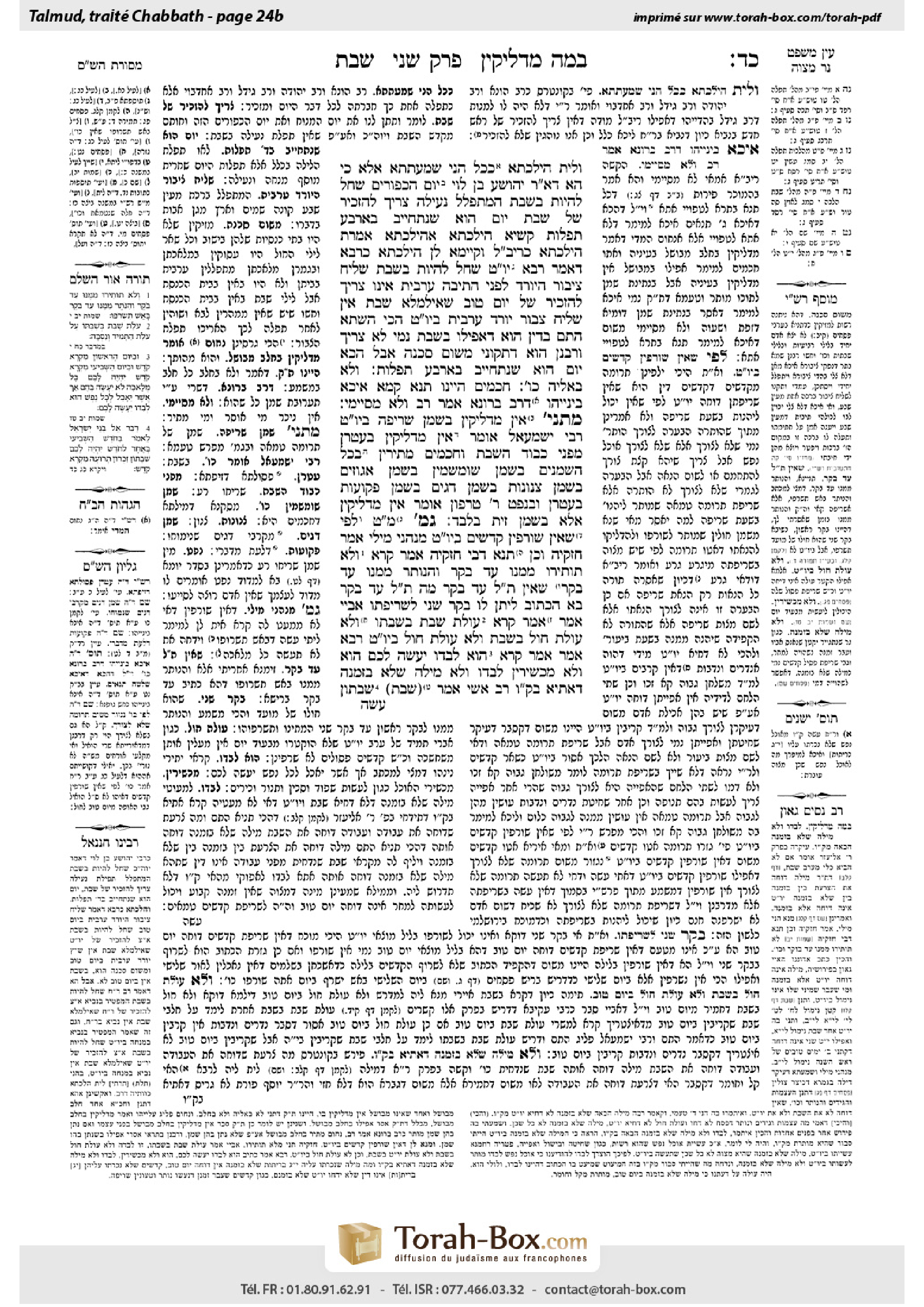
Shabbat 24b: Talmud study for Daf Yomi
Daf Yomi is the daily study of one Talmud folio. Explore 37 tractates with scans, Hebrew text, Sefaria English and AI-generated French translations where annotated.
Passage selection and English or AI-generated French translation are available where the scan has annotations. Daf Study is independent of Torah-Box and Sefaria.
Browse Shabbat · שבת · All tractatesShabbat 24b text and translations
This page of Shabbat includes the Aramaic text, an English translation and an AI-generated French translation, alongside the scan above.
שבת כ״ד ב · Aramaic and Hebrew text
וְלֵית הִילְכְתָא כְּכׇל הָנֵי שְׁמַעְתָּתָא, אֶלָּא כִּי הָא דְּאָמַר רַבִּי יְהוֹשֻׁעַ בֶּן לֵוִי: יוֹם הַכִּפּוּרִים שֶׁחָל לִהְיוֹת בְּשַׁבָּת — הַמִּתְפַּלֵּל נְעִילָה צָרִיךְ לְהַזְכִּיר שֶׁל שַׁבָּת. יוֹם הוּא שֶׁנִּתְחַיֵּיב בְּאַרְבַּע תְּפִלּוֹת.
קַשְׁיָא הִילְכְתָא אַהִילְכְתָא. אָמְרַתְּ הִילְכְתָא כְּרַבִּי יְהוֹשֻׁעַ בֶּן לֵוִי, וְקַיְימָא לַן הִילְכְתָא כְּרָבָא. דְּאָמַר רָבָא: יוֹם טוֹב שֶׁחָל לִהְיוֹת בְּשַׁבָּת, שְׁלִיחַ צִיבּוּר הַיּוֹרֵד לִפְנֵי הַתֵּיבָה עַרְבִית אֵינוֹ צָרִיךְ לְהַזְכִּיר שֶׁל יוֹם טוֹב, שֶׁאִילְמָלֵא שַׁבָּת אֵין שְׁלִיחַ צִבּוּר יוֹרֵד עַרְבִית בְּיוֹם טוֹב.
הָכִי הַשְׁתָּא?! הָתָם בְּדִין הוּא דַּאֲפִילּוּ בְּשַׁבָּת נָמֵי לָא צְרִיךְ, וְרַבָּנַן הוּא דְּתַקִּינוּ מִשּׁוּם סַכָּנָה. אֲבָל הָכָא — יוֹם הוּא שֶׁנִּתְחַיֵּיב בְּאַרְבַּע תְּפִלּוֹת.
וְלֹא בְּאַלְיָה כּוּ׳. חֲכָמִים הַיְינוּ תַּנָּא קַמָּא! אִיכָּא בֵינַיְיהוּ דְּרַב בְּרוֹנָא אָמַר רַב. וְלָא מְסַיְּימִי.
מַתְנִי׳ אֵין מַדְלִיקִין בְּשֶׁמֶן שְׂרֵיפָה בְּיוֹם טוֹב. רַבִּי יִשְׁמָעֵאל אוֹמֵר אֵין מַדְלִיקִין בְּעִטְרָן מִפְּנֵי כְּבוֹד הַשַּׁבָּת. וַחֲכָמִים מַתִּירִין בְּכָל הַשְּׁמָנִים: בְּשֶׁמֶן שׁוּמְשְׁמִין, בְּשֶׁמֶן אֱגוֹזִים, בְּשֶׁמֶן צְנוֹנוֹת, בְּשֶׁמֶן דָּגִים, בְּשֶׁמֶן פַּקּוּעוֹת, בְּעִטְרָן וּבְנֵפְטְ. רַבִּי טַרְפוֹן אוֹמֵר: אֵין מַדְלִיקִין אֶלָּא בְּשֶׁמֶן זַיִת בִּלְבַד.
גְּמָ׳ מַאי טַעְמָא? לְפִי שֶׁאֵין שׂוֹרְפִין קׇדָשִׁים בְּיוֹם טוֹב. מְנָהָנֵי מִילֵּי? אָמַר חִזְקִיָּה, וְכֵן תָּנָא דְּבֵי חִזְקִיָּה, אָמַר קְרָא: ״וְלֹא תוֹתִירוּ מִמֶּנּוּ עַד בֹּקֶר וְהַנּוֹתָר מִמֶּנּוּ עַד בֹּקֶר״. שֶׁאֵין תַּלְמוּד לוֹמַר ״עַד בֹּקֶר״! מַה תַּלְמוּד לוֹמַר ״עַד בֹּקֶר״ — בָּא הַכָּתוּב לִיתֵּן לוֹ בֹּקֶר שֵׁנִי לִשְׂרֵיפָתוֹ.
אַבָּיֵי אָמַר, אָמַר קְרָא: ״עוֹלַת שַׁבָּת בְּשַׁבַּתּוֹ״ — וְלֹא עוֹלַת חוֹל בְּשַׁבָּת, וְלֹא עוֹלַת חוֹל בְּיוֹם טוֹב.
רָבָא אָמַר, אָמַר קְרָא: ״הוּא לְבַדּוֹ יֵעָשֶׂה לָכֶם״. ״הוּא״ — וְלֹא מַכְשִׁירִין. ״לְבַדּוֹ״ — וְלֹא מִילָּה שֶׁלֹּא בִּזְמַנָּהּ, דְּאָתְיָא בְּקַל וָחוֹמֶר.
רַב אָשֵׁי אָמַר: (״שַׁבַּת״) ״שַׁבָּתוֹן״ —
Shabbat 24b · English translation
The Gemara concludes: And the halakha is not in accordance with any of these halakhot; rather, it is in accordance with that which Rabbi Yehoshua ben Levi said: On Yom Kippur that falls on Shabbat, one who recites the day’s closing prayer [ne’ila] must mention Shabbat even in that prayer, although ne’ila is not recited every Shabbat. The reason for this is that on Yom Kippur, the day itself is obligated in four prayers, i.e., morning, additional, afternoon, and closing. When it occurs on Shabbat, one must mention Shabbat in each of the prayers. Apparently, on a day that has a unique character, that character is manifest in all sacred aspects of the day; those engendered by the day itself as well as those engendered by other factors.
The Gemara challenges this: It is difficult, as there is a contradiction between one halakha and another halakha. On the one hand, you said that the halakha is in accordance with the opinion of Rabbi Yehoshua ben Levi. And, on the other hand, we hold that the halakha is in accordance with the opinion of Rava, which contradicts the first halakha, as Rava said: On a Festival that occurs on Shabbat, the prayer leader who descends before the ark to recite the prayer abridged from the seven blessings of the Shabbat evening Amida prayer need not mention the Festival, as, if it were not also Shabbat, the prayer leader would not descend before the ark to recite this prayer during the evening prayer on a Festival. The Gemara reverts to the previous assumption that an element that does not arise from the essential halakhot of the day is considered foreign to it and is not mentioned.
This challenge is rejected: How can you compare? There, actually, even on Shabbat, the prayer leader need not repeat the prayer, just as the prayer is not repeated any other evening. It was the Sages who instituted repetition of the prayer due to concern for potential danger. The Sages sought to slightly delay those leaving the synagogue to enable people who came late to leave together with the rest of the worshippers. This was necessary because synagogues were often located beyond the city limits, and it was dangerous to walk alone at night. This repetition of the prayer does not stem from the obligation of the day but was instituted for another purpose. However, here, on Yom Kippur, it is the day that is obligated in four prayers, and therefore on each day that there are added prayers, one must mention the events that occurred on that day in those prayers just as he does in all the standard prayers.
And we learned in the mishna that one may not light with the sheep’s tail or with fat. Naḥum the Mede says that one may light using cooked fat. And the Rabbis say that one may not light with it whether or not it is cooked. The Gemara asks: Isn’t the opinion of the Rabbis identical to the unattributed opinion of the first tanna in the mishna? The Gemara answers: The practical difference between them is with regard to what Rav Beruna said that Rav said that one may light with cooked fat to which oil was added. One of the tanna’im accepts this opinion as halakha and permits lighting with it, and the other prohibits it, and the opinions are not defined. Although it seems from the formulation of the mishna that they differ on this point, it is unclear what the opinion of each tanna is.
MISHNA: In continuation of the previous mishna, this mishna adds that one may not light with burnt oil on a Festival, as the Gemara will explain below. With regard to lighting Shabbat lamps, there were Sages who prohibited the use of specific oils. Rabbi Yishmael says that one may not light with tar [itran] in deference to Shabbat because tar smells bad and disturbs those in the house. And the Rabbis permit lighting with all oils for lamps as long as they burn properly; with sesame oil, with nut oil, with turnip oil, with fish oil, with gourd oil, with tar, and even with naphtha [neft]. Rabbi Tarfon says: One may light only with olive oil in deference to Shabbat, as it is the choicest and most pleasant of the oils.
GEMARA: With regard to the statement of the mishna that one may not light with burnt oil on a Festival, the Gemara asks: What is the reason for this? The Gemara answers: Because, in general, one may not burn consecrated items on a Festival. With regard to the fundamental principle that one may not burn consecrated items on a Festival, the Gemara asks: From where are these matters derived? Ḥizkiya said, and one of the Sages from the school of Ḥizkiya taught the same, that which the verse said: “And you shall let nothing of it remain until morning; but that which remains of it until morning you shall burn with fire” (Exodus 12:10), requires explanation. As the Torah did not need to state until morning the second time. It would have been sufficient to state: But that which remains of it you shall burn with fire. Rather, why does the Torah state until morning? The verse comes to provide him with the second morning for burning. Leftover meat of the Paschal lamb is not burned on the following morning, which is a Festival, but rather on the following day, the first of the intermediate days of the Festival. From there it is derived that burning consecrated items on a Festival is prohibited.
Abaye said: This is derived from another verse, as the verse said: “This is the burnt-offering of each Shabbat on its Shabbat” (Numbers 28:10). Only the burnt-offering of Shabbat is sacrificed on Shabbat, and not a weekday burnt-offering on Shabbat, and not a weekday burnt-offering on a Festival. Apparently, performing this mitzva is prohibited even on a Festival, since it was not explicitly enumerated among the actions permitted on a Festival.
Rava said: This is derived from a different verse, as the verse said with regard to the laws of a Festival: “No manner of work shall be done in them, save that which every man must eat, that alone may be done by you” (Exodus 12:16). From the word that, it is derived that for sustenance, one is permitted to perform prohibited labor on a Festival, but not for facilitators of sustenance. Although cooking is permitted, actions that involve prohibited labors for the purpose of facilitating cooking are prohibited. From the word alone, it is derived: And not circumcision performed not at its appointed time, i.e., a circumcision may be performed on a Festival only if it is on the eighth day. A circumcision that was postponed may not be performed on a Festival. It is possible that license to perform the postponed circumcision on a Festival could have been derived by means of an a fortiori inference. Therefore, the verse explicitly prohibited doing so. The same is true with regard to burning consecrated items. Although the Torah commands burning consecrated items, it was not permitted on a Festival since there is no obligation to do so specifically on that day.
Rav Ashi said: It is derived from a different source. In the verses that speak of the Festivals, as opposed to the term Shabbat, the term shabbaton (Leviticus 23:24) appears.
Shabbat 24b · Traduction française (IA)
La Guemara conclut : La halakha n’est conforme à aucune de ces halakhot ; elle suit plutôt l’enseignement de Rabbi Yehoshua ben Levi : à Yom Kippour qui tombe un Chabbat, celui qui récite la prière de clôture de la journée [ne’ila] doit mentionner le Chabbat même dans cette prière, bien que la ne’ila ne soit pas récitée chaque Chabbat. En effet, à Yom Kippour, la journée elle-même impose quatre prières : celle du matin, celle de l’offrande supplémentaire, celle de l’après-midi et celle de clôture. Lorsqu’il tombe un Chabbat, il faut mentionner le Chabbat dans chacune de ces prières. Il apparaît donc que, lors d’une journée dotée d’un caractère particulier, ce caractère se manifeste dans tous les aspects sacrés de la journée, qu’ils soient engendrés par la journée elle-même ou par d’autres facteurs.
La Guemara soulève une difficulté : il y a une contradiction entre deux halakhot. D’une part, tu as dit que la halakha suit l’avis de Rabbi Yehoshua ben Levi. D’autre part, nous retenons que la halakha suit l’avis de Rava, ce qui contredit la première halakha. En effet, Rava a dit : Lors d’une fête qui tombe un Chabbat, l’officiant qui descend devant l’arche pour réciter la prière abrégée en sept bénédictions de l’Amida du soir de Chabbat n’a pas besoin de mentionner la fête, car, si ce n’était pas également Chabbat, l’officiant ne descendrait pas devant l’arche pour réciter cette prière lors de la prière du soir d’une fête. La Guemara revient à l’hypothèse précédente : un élément qui ne découle pas des halakhot essentielles de la journée lui est considéré comme étranger et n’est pas mentionné.
Cette objection est rejetée : Comment pouvez-vous comparer les deux cas ? Là-bas, en réalité, même le Chabbat, l’officiant n’a pas besoin de répéter la prière, pas plus qu’il ne la répète les autres soirs. Ce sont les Sages qui ont institué la répétition de la prière par crainte d’un danger potentiel. Ils voulaient retarder légèrement ceux qui sortaient de la synagogue, afin que les personnes arrivées en retard puissent partir avec le reste des fidèles. C’était nécessaire, car les synagogues se trouvaient souvent au-delà des limites de la ville et il était dangereux de marcher seul la nuit. Cette répétition de la prière ne découle pas de l’obligation propre à la journée ; elle a été instituée dans un autre but. Ici, en revanche, à Yom Kippour, c’est la journée elle-même qui impose quatre prières. Par conséquent, chaque fois que des prières supplémentaires sont ajoutées, il faut y mentionner les événements survenus ce jour-là, comme dans toutes les prières habituelles.
Et nous avons appris dans la Michna qu’on ne peut pas allumer avec la graisse de la queue du mouton ni avec du suif. Naḥum le Mède dit qu’on peut allumer avec du suif cuit. Les Sages disent qu’on ne peut pas allumer avec du suif, qu’il soit cuit ou non. La Guemara demande : L’avis des Sages n’est-il pas identique à l’avis anonyme du premier tanna de la Michna ? La Guemara répond : La différence pratique entre eux concerne l’enseignement que Rav Beruna a rapporté au nom de Rav : on peut allumer avec du suif cuit auquel on a ajouté de l’huile. L’un des tannaïm accepte cet enseignement comme halakha et autorise l’allumage avec ce mélange, tandis que l’autre l’interdit, mais il n’est pas précisé lequel adopte quel avis. Bien que la formulation de la Michna laisse penser qu’ils divergent sur ce point, on ne sait pas quel est l’avis de chacun des tannaïm.
MICHNA : Dans le prolongement de la Michna précédente, celle-ci ajoute qu’on ne peut pas allumer avec de l’huile brûlée pendant une fête, comme la Guemara l’expliquera plus loin. Concernant l’allumage des lampes de Chabbat, certains Sages interdisaient l’usage de certaines huiles. Rabbi Yishmael dit qu’on ne peut pas allumer avec du goudron [itran], par égard pour le Chabbat, car le goudron sent mauvais et incommode les personnes présentes dans la maison. Les Sages autorisent l’allumage des lampes avec toutes les huiles, pourvu qu’elles brûlent correctement : l’huile de sésame, l’huile de noix, l’huile de navet, l’huile de poisson, l’huile de courge, le goudron et même le naphte [neft]. Rabbi Tarfon dit : On ne peut allumer qu’avec de l’huile d’olive, par égard pour le Chabbat, car c’est l’huile la plus raffinée et la plus agréable.
GUEMARA : À propos de l’enseignement de la Michna selon lequel on ne peut pas allumer avec de l’huile brûlée pendant une fête, la Guemara demande : Quelle en est la raison ? La Guemara répond : En règle générale, il est interdit de brûler des objets consacrés pendant une fête. Au sujet de ce principe fondamental, la Guemara demande : D’où tire-t-on cela ? Hizqiya a dit, et l’un des Sages de l’école de Hizqiya a enseigné la même chose, que le verset suivant nécessite une explication : « Vous n’en laisserez rien jusqu’au matin ; ce qui en restera jusqu’au matin, vous le brûlerez au feu » (Exode 12:10). En effet, la Torah n’avait pas besoin de répéter « jusqu’au matin » ; il aurait suffi de dire : « Ce qui en restera, vous le brûlerez au feu. » Pourquoi donc la Torah dit-elle « jusqu’au matin » ? Le verset prévoit pour lui un second matin auquel procéder à la combustion. La viande restante de l’agneau pascal n’est pas brûlée le lendemain matin, qui est un jour de fête, mais le jour suivant, premier jour des jours intermédiaires de la fête. On en déduit qu’il est interdit de brûler des objets consacrés pendant une fête.
Abayé a dit : On le déduit d’un autre verset, qui dit : « C’est l’holocauste de chaque Chabbat, pour son Chabbat » (Nombres 28:10). Seul l’holocauste du Chabbat est offert le Chabbat, et non un holocauste de jour ouvrable le Chabbat, ni un holocauste de jour ouvrable pendant une fête. Il apparaît donc que l’accomplissement de cette mitsva est interdit même pendant une fête, puisqu’il ne figure pas explicitement parmi les actes autorisés pendant une fête.
Rava a dit : On le déduit d’un autre verset, qui dit au sujet des lois d’une fête : « Aucun travail ne sera fait ces jours-là, sauf ce que chacun doit manger ; cela seul pourra être fait par vous » (Exode 12:16). Du mot « cela », on déduit que, pour assurer sa subsistance, il est permis d’effectuer un travail interdit pendant une fête, mais pas les travaux qui ne servent qu’à faciliter la préparation de nourriture. Bien que la cuisson soit autorisée, les actes relevant de travaux interdits lorsqu’ils servent à faciliter la cuisson sont interdits. Du mot « seul », on déduit que cette permission ne s’applique pas à la circoncision effectuée hors de son temps prescrit : une circoncision ne peut être pratiquée pendant une fête que si elle a lieu le huitième jour. Une circoncision reportée ne peut pas être pratiquée pendant une fête. On aurait pu déduire par raisonnement a fortiori qu’il est permis de pratiquer une circoncision reportée pendant une fête ; le verset l’interdit donc explicitement. Il en va de même pour la combustion d’objets consacrés. Bien que la Torah ordonne de brûler les objets consacrés, cela n’est pas autorisé pendant une fête, puisqu’il n’est pas obligatoire de le faire précisément ce jour-là.
Rav Ashi a dit : On le déduit d’une autre source. Dans les versets qui parlent des fêtes, contrairement à ceux qui emploient le terme « Chabbat », apparaît le terme « chabbaton » (Lévitique 23:24).
Traduction française générée par IA à partir de l’édition anglaise de Sefaria. Vérifie toujours un passage avec le texte source.
Text from Sefaria: William Davidson Edition - Vocalized Aramaic (CC BY NC); William Davidson Edition - English (CC BY NC).