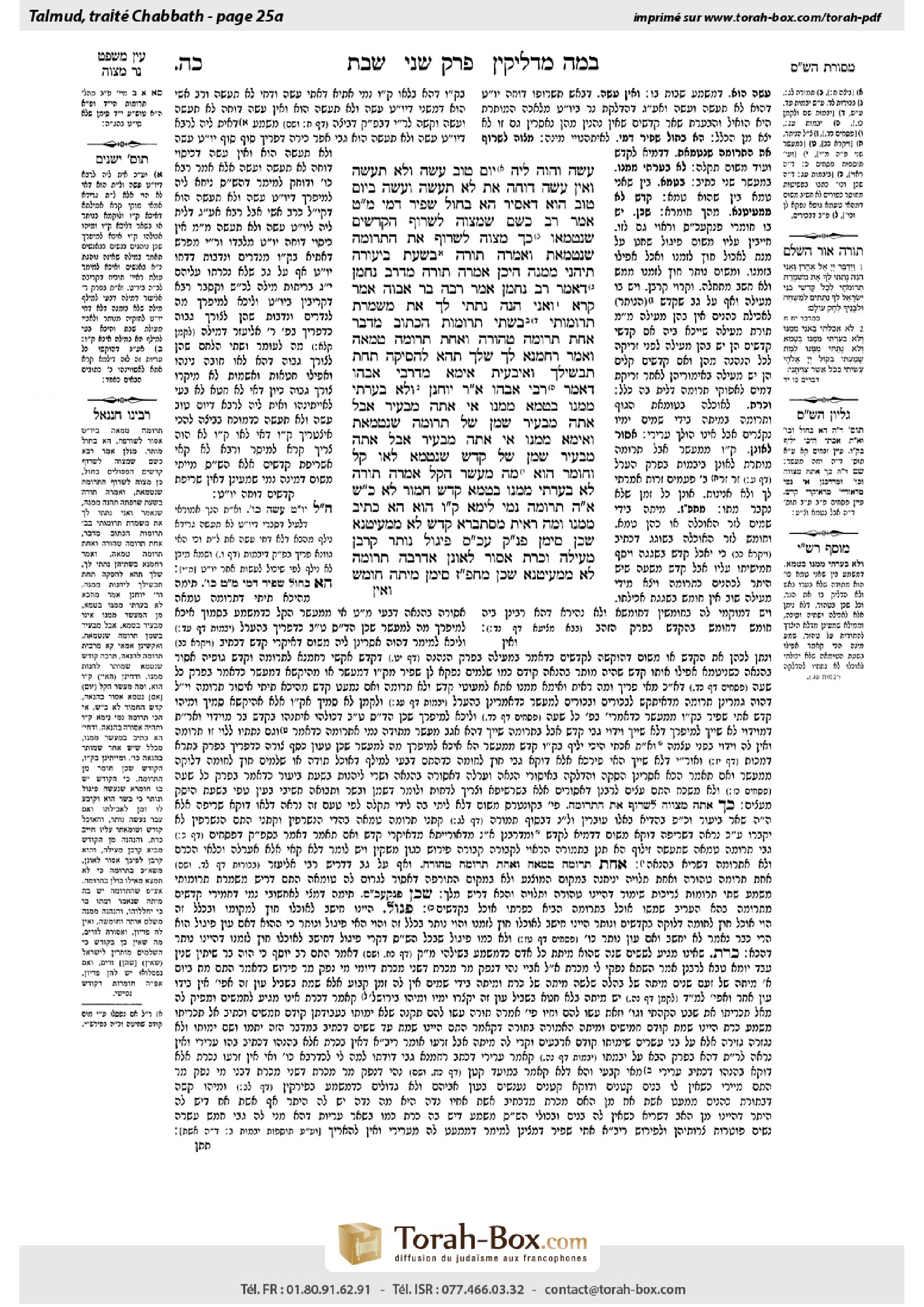
Shabbat 25a: Talmud study for Daf Yomi
Daf Yomi is the daily study of one Talmud folio. Explore 37 tractates with scans, Hebrew text, Sefaria English and AI-generated French translations where annotated.
Passage selection and English or AI-generated French translation are available where the scan has annotations. Daf Study is independent of Torah-Box and Sefaria.
Browse Shabbat · שבת · All tractatesShabbat 25a text and translations
This page of Shabbat includes the Aramaic text, an English translation and an AI-generated French translation, alongside the scan above.
שבת כ״ה א · Aramaic and Hebrew text
עֲשֵׂה. וְהָוֵה לֵיהּ יוֹם טוֹב עֲשֵׂה וְלֹא תַעֲשֶׂה — וְאֵין עֲשֵׂה דּוֹחֶה אֶת לֹא תַעֲשֶׂה וַעֲשֵׂה.
בְּיוֹם טוֹב הוּא דַּאֲסִיר, הָא בְּחוֹל — שַׁפִּיר דָּמֵי: מַאי טַעְמָא? אָמַר רַב: כְּשֵׁם שֶׁמִּצְוָה לִשְׂרוֹף הַקֳּדָשִׁים שֶׁנִּטְמְאוּ, כָּךְ מִצְוָה לִשְׂרוֹף אֶת הַתְּרוּמָה שֶׁנִּטְמֵאת. וְאָמְרָה תּוֹרָה: בִּשְׁעַת בִּיעוּרָהּ תֵּיהָנֵי מִמֶּנָּה. הֵיכָן אָמְרָה תּוֹרָה? מִדְּרַב נַחְמָן, דְּאָמַר רַב נַחְמָן אָמַר רַבָּה בַּר אֲבוּהּ, אָמַר קְרָא: ״וַאֲנִי הִנֵּה נָתַתִּי לְךָ אֶת מִשְׁמֶרֶת תְּרוּמוֹתָי״ — בִּשְׁתֵּי תְרוּמוֹת הַכָּתוּב מְדַבַּר, אַחַת תְּרוּמָה טְהוֹרָה וְאַחַת תְּרוּמָה טְמֵאָה. וְאָמַר רַחֲמָנָא: ״לְךָ״ — שֶׁלְּךָ תְּהֵא, לְהַסִּיקָהּ תַּחַת תַּבְשִׁילְךָ.
וְאִיבָּעֵית אֵימָא מִדְּרַבִּי אֲבָהוּ. דְּאָמַר רַבִּי אֲבָהוּ אָמַר רַבִּי יוֹחָנָן: ״וְלֹא בִעַרְתִּי מִמֶּנּוּ בְּטָמֵא״ — מִמֶּנּוּ אִי אַתָּה מַבְעִיר, אֲבָל אַתָּה מַבְעִיר שֶׁמֶן שֶׁל תְּרוּמָה שֶׁנִּטְמֵאת. וְאֵימָא: מִמֶּנּוּ אִי אַתָּה מַבְעִיר, אֲבָל אַתָּה מַבְעִיר שֶׁמֶן שֶׁל קֹדֶשׁ שֶׁנִּטְמָא!
לָאו קַל וָחוֹמֶר הוּא? מָה מַעֲשֵׂר הַקַּל אָמְרָה תּוֹרָה לֹא בִּעַרְתִּי מִמֶּנּוּ בְּטָמֵא, קֹדֶשׁ חָמוּר — לֹא כׇּל שֶׁכֵּן?
אִי הָכִי, תְּרוּמָה נָמֵי לֵימָא קַל וָחוֹמֶר הוּא! — הָא כְּתִיב ״מִמֶּנּוּ״.
וּמָה רָאִיתָ! — מִסְתַּבְּרָא קֹדֶשׁ לָא מְמַעֵיטְנָא, שֶׁכֵּן (סִימָן) פנ״ק עכ״ס: פִּיגּוּל, נוֹתָר, קׇרְבָּן, מְעִילָה וְכָרֵת, אָסוּר לְאוֹנֵן.
אַדְּרַבָּה, תְּרוּמָה לָא מְמַעֵיטְנָא, שֶׁכֵּן מחפ״ז (סִימָן): מִיתָה, חוֹמֶשׁ,
Shabbat 25a · English translation
The latter term is a positive mitzva to rest. And, if so, observance of a Festival is a mitzva that was commanded with both a positive mitzva to rest and a prohibition: “You shall do no manner of servile work” (Leviticus 23:8). And there is a principle that a positive mitzva, e.g., burning consecrated items whose time has expired, does not override a mitzva that was commanded with both a prohibition and a positive mitzva, e.g., observance of the Festival.
By inference, the conclusion is that, specifically on a Festival, lighting with burnt oil is prohibited. During the week one may well do so. The Gemara asks: What is the reason for this distinction? It would be reasonable to say that it is prohibited to derive any benefit from teruma that became ritually impure. Rav said: Just as there is a mitzva to burn consecrated items that became ritually impure, so too, there is a mitzva to burn teruma that became ritually impure, and the Torah said: While it is being destroyed, derive benefit from it. The Gemara asks: Where did the Torah say this? Where is there an allusion to this in the Bible? The Gemara answers: It can be derived from the statement of Rav Naḥman, as Rav Naḥman said that Rabba bar Avuh said: The verse said: “And I, behold, I have given you the charge of My terumot” (Numbers 18:8). From the amplification of the plural: My terumot, it is derived that the verse is speaking of two terumot, one teruma that is ritually pure and one teruma that is ritually impure. And God said: “I have given you,” i.e., it shall be yours, and you may derive benefit from it. Since there is a stringent prohibition against eating it, the benefit permitted is to burn it beneath your cooked dish. Similar forms of benefit may also be derived from burning teruma.
And if you wish, say instead an alternative manner to derive this halakha, from the statement of Rabbi Abbahu, as Rabbi Abbahu said that Rabbi Yoḥanan said: It is written in the confession of the tithes: “I have not eaten thereof in my mourning, neither have I destroyed from it while impure” (Deuteronomy 26:14). By inference: From it you may not destroy, but you may destroy the oil of teruma that has become ritually impure. The Gemara asks: And say differently: From it you may not destroy, but you may destroy and derive benefit from burning consecrated oil that became ritually impure.
The Gemara responds: That possibility is unacceptable. Is it not an a fortiori inference? If with regard to the tithe which is lenient, the Torah said: Neither have I destroyed from it, while impure, items consecrated to the Temple, which are more stringent, all the more so that it is prohibited to burn it while ritually impure.
The Gemara rejects this: If so, that this matter is derived through an a fortiori inference, then, with regard to teruma as well, let us say that it is an a fortiori inference, as teruma is more stringent than tithes. If it is prohibited to benefit from tithes while they are burning, all the more so would one be prohibited to benefit from the teruma while it is burning. The Gemara answers: Doesn’t it say: From it? From there it is derived that there is an item excluded from the prohibition of burning in ritual impurity.
The Gemara asks: And what did you see that led you to conclude that “from it” comes to exclude teruma? Perhaps “from it” comes to exclude consecrated items. The Gemara replies: It is reasonable that I do not exclude consecrated items from the prohibition against benefiting from its burning, as with regard to consecrated items there are many stringent elements. Their Hebrew acronym is peh, nun, kuf, ayin, kaf, samekh, which is a mnemonic for the following terms. Piggul: With regard to an offering, if, during one of the services involved in its sacrifice, i.e., slaughter, receiving the blood, bringing it to the altar, sprinkling it on the altar, the priest or the one bringing the offering entertains the thought of eating the sacrifice at a time that is unfit for eating, it is thereby invalidated. Notar: Meat of a sacrifice that remained beyond its allotted time may not be eaten and must be burned. Korban me’ila: One who unwittingly derives benefit from consecrated items is required to bring a guilt-offering for misuse of consecrated items. Karet: The punishment of one who eats consecrated items while ritually impure is karet. Asur le’onen: An acute mourner, i.e., one whose relative died that same day and has not yet been buried, is prohibited to eat consecrated items. None of these halakhot applies to teruma. Therefore, consecrated items are more stringent than teruma, and therefore it is consecrated items that are not excluded from the prohibition against deriving benefit while ritually impure.
The Gemara rejects this: On the contrary, it is teruma that I would not exclude from the prohibition, as, with regard to teruma, there are many stringent elements represented by the acronym mem, ḥet, peh, zayin, which is a mnemonic for the following: Mita: One for whom teruma is prohibited who ate it intentionally is punishable by death at the hand of Heaven. Ḥomesh: A non-priest, for whom teruma is prohibited, who unwittingly ate teruma is obligated to pay its value to the priest plus one-fifth of the sum.
Shabbat 25a · Traduction française (IA)
Cette dernière expression désigne une mitsva positive de se reposer. Si tel est le cas, l’observance d’une fête est une mitsva prescrite à la fois par une mitsva positive de se reposer et par une interdiction : « Vous ne ferez aucun travail servile » (Lévitique 23:8). Or, selon un principe, une mitsva positive — par exemple, brûler des choses consacrées dont le délai est expiré — ne l’emporte pas sur une mitsva prescrite à la fois par une interdiction et par une mitsva positive — par exemple, l’observance de la fête.
On en déduit que c’est précisément pendant une fête qu’il est interdit d’allumer avec de l’huile de combustion. En semaine, on peut parfaitement le faire. La Guemara demande : Quelle est la raison de cette distinction ? On pourrait raisonnablement dire qu’il est interdit de tirer le moindre bénéfice de la terouma devenue impure rituellement. Rav a dit : De même qu’il y a une mitsva de brûler les choses consacrées devenues impures rituellement, de même il y a une mitsva de brûler la terouma devenue impure rituellement, et la Torah a dit : pendant qu’on la détruit, on peut en tirer bénéfice. La Guemara demande : Où la Torah a-t-elle dit cela ? Où trouve-t-on dans la Bible une allusion à cela ? La Guemara répond : On peut le déduire de la déclaration de Rav Naḥman, car Rav Naḥman a dit au nom de Rabba bar Avuh : Le verset dit : « Et moi, voici, je vous ai confié la garde de mes teroumot » (Nombres 18:8). De l’emploi du pluriel « mes teroumot », on déduit que le verset parle de deux teroumot : l’une pure rituellement, l’autre impure rituellement. Et Dieu a dit : « Je vous ai donné », c’est-à-dire qu’elle vous appartient et que vous pouvez en tirer bénéfice. Puisqu’il est strictement interdit de la manger, le bénéfice permis consiste à la brûler sous votre plat en train de cuire. On peut aussi tirer des bénéfices analogues de la combustion de la terouma.
Et si tu le souhaites, on peut plutôt déduire cette halakha autrement, de la déclaration de Rabbi Abbahu, car Rabbi Abbahu a dit au nom de Rabbi Yoḥanan : Il est écrit dans la confession des dîmes : « Je n’en ai pas mangé dans mon deuil, et je n’en ai rien détruit alors que j’étais impur » (Deutéronome 26:14). On en déduit : tu ne peux rien détruire de celle-ci, mais tu peux détruire l’huile de terouma devenue impure rituellement. La Guemara demande : Et pourquoi ne pas dire plutôt : tu ne peux rien détruire de celle-ci, mais tu peux détruire l’huile consacrée devenue impure rituellement et tirer bénéfice de sa combustion ?
La Guemara répond : Cette possibilité n’est pas recevable. N’est-ce pas un raisonnement a fortiori ? Si, s’agissant de la dîme, qui est de statut moins strict, la Torah a dit : « Je n’en ai rien détruit alors que j’étais impur », à plus forte raison est-il interdit de brûler, alors qu’elles sont impures rituellement, les choses consacrées au Temple, dont le statut est plus strict.
La Guemara rejette cette réponse : Si tel est le cas, si cette règle se déduit d’un raisonnement a fortiori, alors, pour la terouma également, disons qu’il s’agit d’un raisonnement a fortiori, car la terouma est de statut plus strict que les dîmes. S’il est interdit de tirer bénéfice des dîmes pendant qu’on les brûle, à plus forte raison est-il interdit de tirer bénéfice de la terouma pendant qu’on la brûle. La Guemara répond : N’est-il pas écrit « de celle-ci » ? On en déduit qu’un élément est exclu de l’interdiction de le brûler en état d’impureté rituelle.
La Guemara demande : Et qu’est-ce qui t’a fait conclure que « de celle-ci » vient exclure la terouma ? Peut-être « de celle-ci » vient-il exclure les choses consacrées. La Guemara répond : Il est raisonnable de ne pas exclure les choses consacrées de l’interdiction de tirer bénéfice de leur combustion, car elles sont soumises à de nombreuses règles strictes. Leur acronyme hébraïque est פ, נ, ק, ע, כ, ס, qui sert de moyen mnémotechnique pour les termes suivants. Piggul : S’agissant d’une offrande, si, au cours de l’un des rites de son sacrifice — l’abattage, la réception du sang, son transport jusqu’à l’autel ou son aspersion sur l’autel — le prêtre ou celui qui apporte l’offrande pense à manger le sacrifice à un moment où il ne convient pas de le manger, celui-ci est alors invalidé. Notar : La viande d’un sacrifice qui a été conservée au-delà du délai qui lui est imparti ne peut être mangée et doit être brûlée. Korban me’ila : Celui qui tire involontairement bénéfice de choses consacrées doit apporter un sacrifice de culpabilité pour profanation de choses consacrées. Karet : Celui qui mange des choses consacrées alors qu’il est impur rituellement encourt le karet. Asur le’onen : Il est interdit à une personne en deuil aigu — c’est-à-dire dont le proche est mort ce même jour et n’a pas encore été enterré — de manger des choses consacrées. Aucune de ces halakhot ne s’applique à la terouma. Les choses consacrées sont donc de statut plus strict que la terouma ; par conséquent, ce sont les choses consacrées qui ne sont pas exclues de l’interdiction d’en tirer bénéfice en état d’impureté rituelle.
La Guemara rejette cette réponse : Au contraire, c’est la terouma que je n’exclurais pas de l’interdiction, car elle est soumise à de nombreuses règles strictes, représentées par l’acronyme מ, ח, פ, ז, qui sert de moyen mnémotechnique pour les éléments suivants : Mita : Celui qui, intentionnellement, mange de la terouma alors qu’il lui est interdit d’en manger est passible de mort par la main du Ciel. Ḥomesh : Un non-prêtre, à qui il est interdit de manger de la terouma, et qui en mange involontairement est tenu d’en rembourser la valeur au prêtre, augmentée d’un cinquième.
Traduction française générée par IA à partir de l’édition anglaise de Sefaria. Vérifie toujours un passage avec le texte source.
Text from Sefaria: William Davidson Edition - Vocalized Aramaic (CC BY NC); William Davidson Edition - English (CC BY NC).