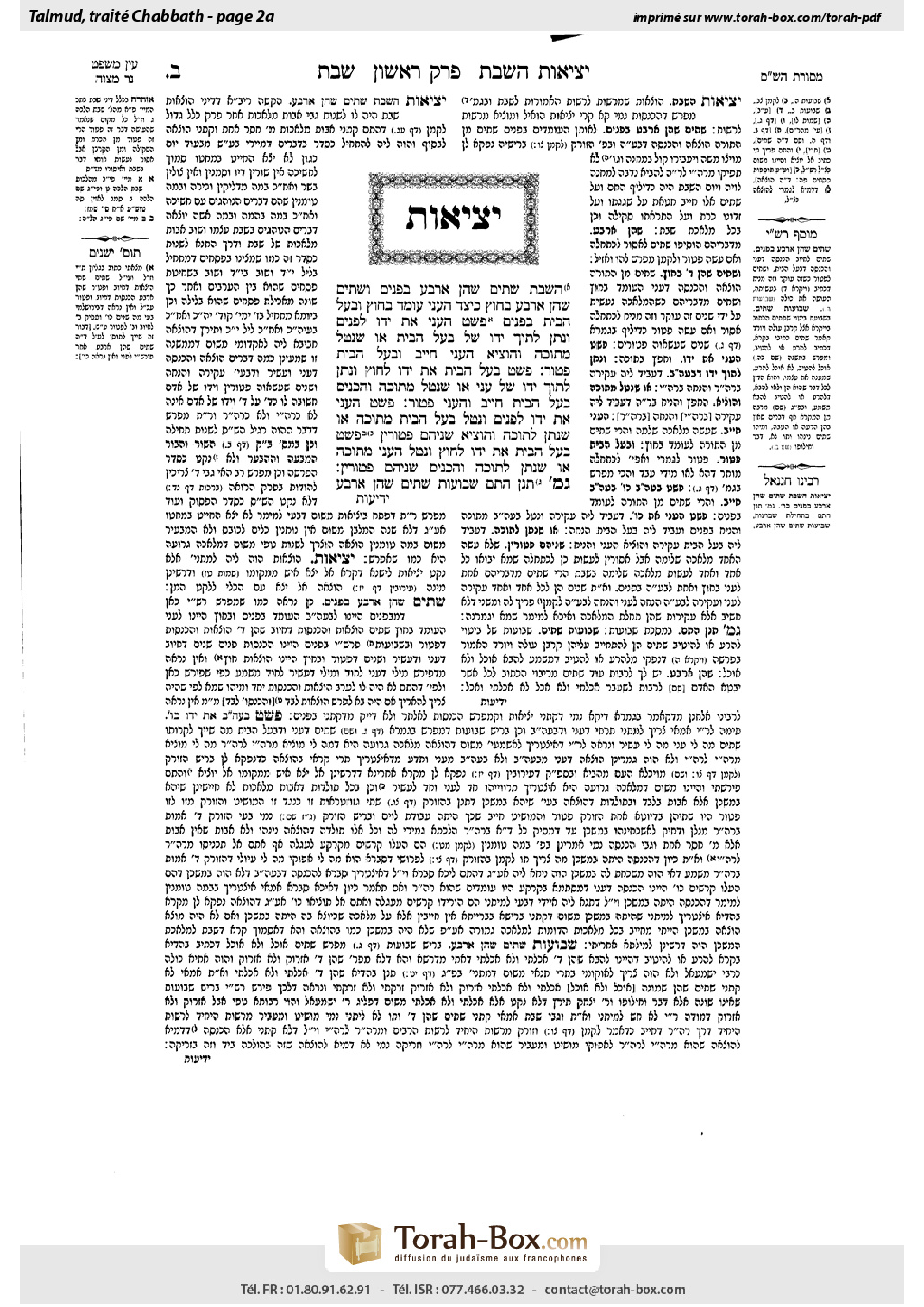
Shabbat 2a: Talmud study for Daf Yomi
Daf Yomi is the daily study of one Talmud folio. Explore 37 tractates with scans, Hebrew text, Sefaria English and AI-generated French translations where annotated.
Passage selection and English or AI-generated French translation are available where the scan has annotations. Daf Study is independent of Torah-Box and Sefaria.
Browse Shabbat · שבת · All tractatesShabbat 2a text and translations
This page of Shabbat includes the Aramaic text, an English translation and an AI-generated French translation, alongside the scan above.
שבת ב׳ א · Aramaic and Hebrew text
מַתְנִי׳ יְצִיאוֹת הַשַּׁבָּת, שְׁתַּיִם שֶׁהֵן אַרְבַּע בִּפְנִים, וּשְׁתַּיִם שֶׁהֵן אַרְבַּע בַּחוּץ.
כֵּיצַד?
הֶעָנִי עוֹמֵד בַּחוּץ, וּבַעַל הַבַּיִת בִּפְנִים: פָּשַׁט הֶעָנִי אֶת יָדוֹ לִפְנִים וְנָתַן לְתוֹךְ יָדוֹ שֶׁל בַּעַל הַבַּיִת, אוֹ שֶׁנָּטַל מִתּוֹכָהּ וְהוֹצִיא — הֶעָנִי חַיָּיב וּבַעַל הַבַּיִת פָּטוּר.
פָּשַׁט בַּעַל הַבַּיִת אֶת יָדוֹ לַחוּץ וְנָתַן לְתוֹךְ יָדוֹ שֶׁל עָנִי, אוֹ שֶׁנָּטַל מִתּוֹכָהּ וְהִכְנִיס — בַּעַל הַבַּיִת חַיָּיב וְהֶעָנִי פָּטוּר.
פָּשַׁט הֶעָנִי אֶת יָדוֹ לִפְנִים וְנָטַל בַּעַל הַבַּיִת מִתּוֹכָהּ, אוֹ שֶׁנָּתַן לְתוֹכָהּ וְהוֹצִיא — שְׁנֵיהֶם פְּטוּרִין.
פָּשַׁט בַּעַל הַבַּיִת אֶת יָדוֹ לַחוּץ וְנָטַל הֶעָנִי מִתּוֹכָהּ, אוֹ שֶׁנָּתַן לְתוֹכָהּ וְהִכְנִיס — שְׁנֵיהֶם פְּטוּרִין.
גְּמָ׳ תְּנַן הָתָם: שְׁבוּעוֹת, שְׁתַּיִם שֶׁהֵן אַרְבַּע.
Shabbat 2a · English translation
MISHNA: The acts of carrying out from a public domain into a private domain or vice versa, which are prohibited on Shabbat, are primarily two basic actions that comprise four cases from the perspective of a person inside a private domain, and two basic actions that comprise four cases from the perspective of a person outside, in a public domain.
The mishna elaborates: How do these eight cases take place? In order to answer that question, the mishna cites cases involving a poor person and a homeowner.
The poor person stands outside, in the public domain, and the homeowner stands inside, in the private domain. The poor person lifted an object in the public domain, extended his hand into the private domain, and placed the object into the hand of the homeowner. In that case, the poor person performed the prohibited labor of carrying from the public domain into the private domain in its entirety. Or, the poor person reached his hand into the private domain, took an item from the hand of the homeowner, and carried it out into the public domain. In that case, the poor person performed the prohibited labor of carrying out from the private domain into the public domain in its entirety. In both of these cases, because the poor person performed the prohibited labor in its entirety, he is liable and the homeowner is exempt.
The mishna cites two additional cases. In these, the prohibited labor is performed by the homeowner, who is in the private domain: The homeowner lifted an item in the private domain, extended his hand into the public domain, and placed the object into the hand of the poor person. In that case, the homeowner performed the labor of carrying out from the private domain into the public domain in its entirety. Or, the homeowner reached his hand into the public domain, took an object from the hand of the poor person, and carried it into the private domain. In that case, the homeowner performed the labor of carrying from the public domain into the private domain in its entirety. In both of those cases, because the homeowner performed the prohibited labor in its entirety, he is liable and the poor person is exempt.
There are four additional cases where neither the homeowner nor the poor person performed the labor in its entirety, and therefore neither is liable: The poor person extended his hand into the private domain and either the homeowner took an object from his hand and placed it in the private domain or the homeowner placed an object into the hand of the poor person, and the poor person carried the object out into the public domain. In those cases and the two that follow, the act of transferring the object from one domain to another was performed jointly by two people, the poor person and the homeowner. Because each performed only part of the prohibited labor, both of them are exempt.
So too, in a case where the homeowner extended his hand into the public domain and, either the poor person took an object from the homeowner’s hand and placed it in the public domain or the poor person placed an object into the homeowner’s hand and the homeowner carried the object into the private domain. Because each performed only part of the prohibited labor, both of them are exempt.
GEMARA: We learned in our mishna: The acts of carrying out on Shabbat are two that comprise four. Similarly, we learned in the mishna there, in tractate Shevuot: Oaths on a statement, which, when violated, render one liable to bring a sin-offering are two that comprise four. The first two cases, which are mentioned explicitly in the Torah, are: One who swore that he would perform a specific action in the future and one who swore to refrain from performing said action. Based on an amplification in the language of the Torah, two more cases are added: One who swore that he performed a specific action in the past and one who swore that he did not perform said action.
Shabbat 2a · Traduction française (IA)
MICHNA : Les actes de transfert d’un domaine public vers un domaine privé, ou inversement, interdits le Chabbat, sont au nombre de deux actes fondamentaux qui comprennent quatre cas du point de vue d’une personne se trouvant dans un domaine privé, et de deux actes fondamentaux qui comprennent quatre cas du point de vue d’une personne se trouvant à l’extérieur, dans un domaine public.
La Michna précise : comment se présentent ces huit cas ? Pour répondre à cette question, la Michna cite des cas mettant en scène un pauvre et un maître de maison.
Le pauvre se tient à l’extérieur, dans le domaine public, et le maître de maison à l’intérieur, dans le domaine privé. Le pauvre a soulevé un objet dans le domaine public, tendu la main dans le domaine privé et placé l’objet dans la main du maître de maison. Dans ce cas, le pauvre a accompli intégralement le travail interdit consistant à transférer un objet du domaine public au domaine privé. Ou bien, le pauvre a introduit la main dans le domaine privé, pris un objet de la main du maître de maison et l’a transporté à l’extérieur, dans le domaine public. Dans ce cas, le pauvre a accompli intégralement le travail interdit consistant à transférer un objet du domaine privé au domaine public. Dans ces deux cas, puisque le pauvre a accompli intégralement le travail interdit, il est passible, tandis que le maître de maison est exempté.
La Michna cite deux cas supplémentaires. Dans ceux-ci, le travail interdit est accompli par le maître de maison, qui se trouve dans le domaine privé : le maître de maison a soulevé un objet dans le domaine privé, tendu la main dans le domaine public et placé l’objet dans la main du pauvre. Dans ce cas, le maître de maison a accompli intégralement le travail consistant à transférer un objet du domaine privé au domaine public. Ou bien, le maître de maison a introduit la main dans le domaine public, pris un objet de la main du pauvre et l’a transporté dans le domaine privé. Dans ce cas, le maître de maison a accompli intégralement le travail consistant à transférer un objet du domaine public au domaine privé. Dans ces deux cas, puisque le maître de maison a accompli intégralement le travail interdit, il est passible, tandis que le pauvre est exempté.
Il existe quatre cas supplémentaires dans lesquels ni le maître de maison ni le pauvre n’ont accompli le travail dans son intégralité ; aucun des deux n’est donc passible : le pauvre a tendu la main dans le domaine privé, puis le maître de maison a soit pris un objet de sa main et l’a placé dans le domaine privé, soit placé un objet dans la main du pauvre, qui l’a transporté à l’extérieur, dans le domaine public. Dans ces cas, ainsi que dans les deux qui suivent, le transfert de l’objet d’un domaine à l’autre a été effectué conjointement par deux personnes, le pauvre et le maître de maison. Puisque chacun n’a accompli qu’une partie du travail interdit, tous deux sont exemptés.
Il en va de même lorsque le maître de maison a tendu la main dans le domaine public et que, soit le pauvre a pris un objet de la main du maître de maison et l’a placé dans le domaine public, soit le pauvre a placé un objet dans la main du maître de maison, qui l’a transporté dans le domaine privé. Puisque chacun n’a accompli qu’une partie du travail interdit, tous deux sont exemptés.
GUEMARA : Nous avons appris dans notre Michna que les actes de transfert le Chabbat sont au nombre de deux qui comprennent quatre cas. De même, nous avons appris dans la Michna de là-bas, dans le traité Chevouot : les serments portant sur une déclaration qui, lorsqu’ils sont transgressés, rendent leur auteur passible d’apporter un sacrifice expiatoire, sont au nombre de deux qui comprennent quatre cas. Les deux premiers cas, mentionnés explicitement dans la Torah, sont les suivants : celui qui a juré qu’il accomplirait une action déterminée à l’avenir et celui qui a juré qu’il s’abstiendrait de l’accomplir. Sur la base d’une extension du langage de la Torah, deux autres cas sont ajoutés : celui qui a juré qu’il avait accompli une action déterminée dans le passé et celui qui a juré qu’il ne l’avait pas accomplie.
Traduction française générée par IA à partir de l’édition anglaise de Sefaria. Vérifie toujours un passage avec le texte source.
Text from Sefaria: William Davidson Edition - Vocalized Aramaic (CC BY NC); William Davidson Edition - English (CC BY NC).