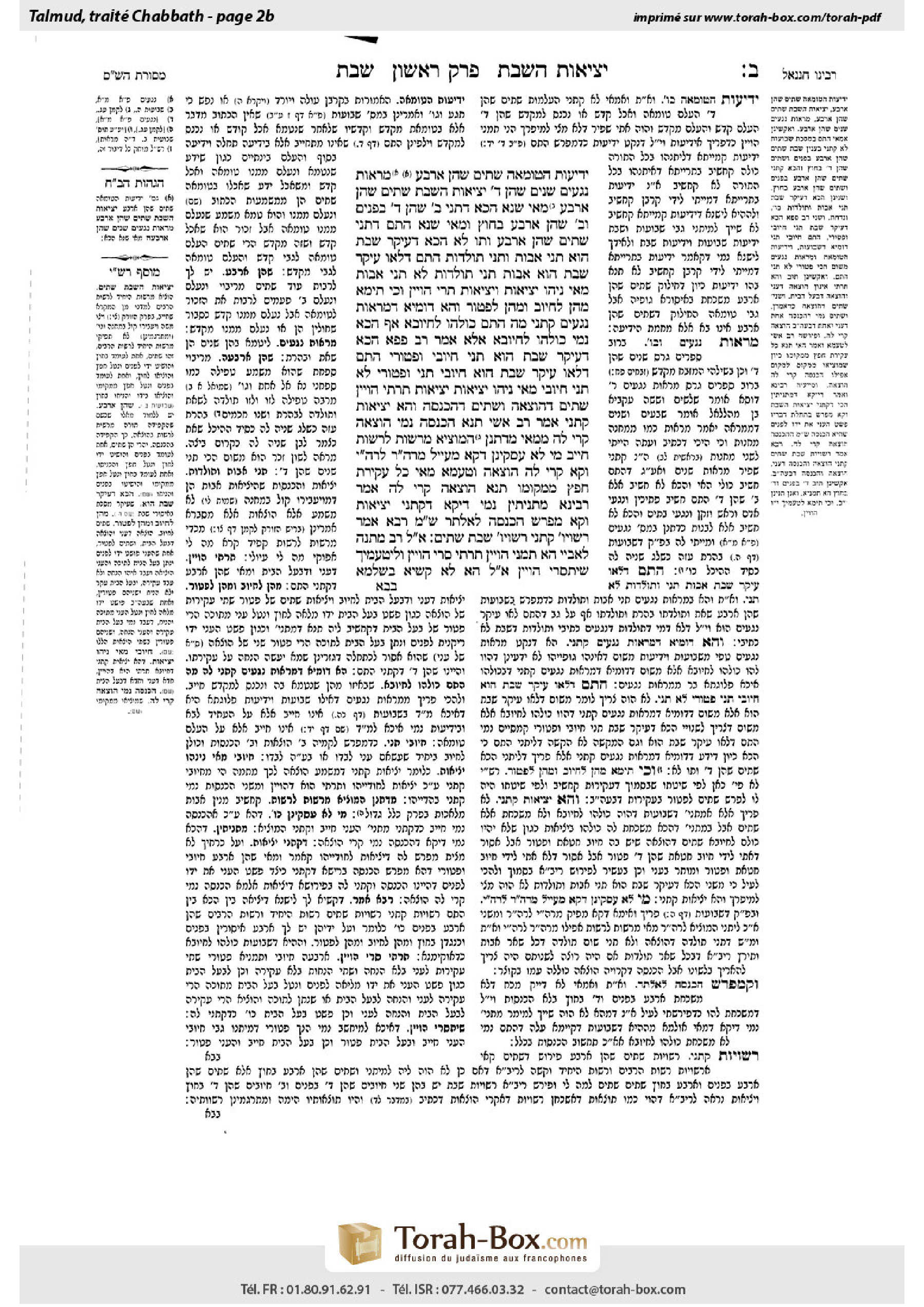
Shabbat 2b: Talmud study for Daf Yomi
Daf Yomi is the daily study of one Talmud folio. Explore 37 tractates with scans, Hebrew text, Sefaria English and AI-generated French translations where annotated.
Passage selection and English or AI-generated French translation are available where the scan has annotations. Daf Study is independent of Torah-Box and Sefaria.
Browse Shabbat · שבת · All tractatesShabbat 2b text and translations
This page of Shabbat includes the Aramaic text, an English translation and an AI-generated French translation, alongside the scan above.
שבת ב׳ ב · Aramaic and Hebrew text
יְדִיעוֹת הַטּוּמְאָה, שְׁתַּיִם שֶׁהֵן אַרְבַּע.
מַרְאוֹת נְגָעִים, שְׁנַיִם שֶׁהֵן אַרְבָּעָה.
יְצִיאוֹת הַשַּׁבָּת, שְׁתַּיִם שֶׁהֵן אַרְבַּע.
מַאי שְׁנָא הָכָא דְּתָנֵי ״שְׁתַּיִם שֶׁהֵן אַרְבַּע בִּפְנִים וּשְׁתַּיִם שֶׁהֵן אַרְבַּע בַּחוּץ״, וּמַאי שְׁנָא הָתָם דְּתָנֵי ״שְׁתַּיִם שֶׁהֵן אַרְבַּע״ וְתוּ לָא?
הָכָא דְּעִיקַּר שַׁבָּת הוּא, תָּנֵי אָבוֹת וְתָנֵי תּוֹלָדוֹת. הָתָם דְּלָאו עִיקַּר שַׁבָּת הוּא, אָבוֹת תָּנֵי, תּוֹלָדוֹת לָא תָּנֵי.
אָבוֹת מַאי נִיהוּ? — יְצִיאוֹת, וִיצִיאוֹת תְּרֵי הָוְיָין!
וְכִי תֵּימָא, מֵהֶן לְחִיּוּב וּמֵהֶן לִפְטוּר, וְהָא דּוּמְיָא דְּמַרְאוֹת נְגָעִים קָתָנֵי: מָה הָתָם כּוּלְּהוּ לְחִיּוּבָא, אַף הָכָא נָמֵי כּוּלְּהוּ לְחִיּוּבָא!
אֶלָּא אָמַר רַב פָּפָּא: הָכָא דְּעִיקַּר שַׁבָּת הוּא, תָּנֵי חִיּוּבֵי וּפְטוּרֵי. הָתָם דְּלָאו עִיקָּר שַׁבָּת הוּא, חִיּוּבֵי תָּנֵי וּפְטוּרֵי לָא תָּנֵי.
חִיּוּבֵי מַאי נִיהוּ? — יְצִיאוֹת, יְצִיאוֹת תַּרְתֵּי הָוְיָין! — שְׁתַּיִם דְּהוֹצָאָה וּשְׁתַּיִם דְּהַכְנָסָה.
וְהָא ״יְצִיאוֹת״ קָתָנֵי! אָמַר רַב אָשֵׁי: תַּנָּא הַכְנָסָה נָמֵי ״הוֹצָאָה״ קָרֵי לַהּ.
מִמַּאי? מִדִּתְנַן: הַמּוֹצִיא מֵרְשׁוּת לִרְשׁוּת — חַיָּיב. מִי לָא עָסְקִינַן דְּקָא מְעַיֵּיל מֵרְשׁוּת הָרַבִּים לִרְשׁוּת הַיָּחִיד, וְקָא קָרֵי לַהּ ״הוֹצָאָה״?
וְטַעְמָא מַאי? — כׇּל עֲקִירַת חֵפֶץ מִמְּקוֹמוֹ תַּנָּא ״הוֹצָאָה״ קָרֵי לַהּ.
אָמַר רָבִינָא: מַתְנִיתִין נָמֵי דַּיְקָא, דְּקָתָנֵי ״יְצִיאוֹת״ וְקָא מְפָרֵשׁ הַכְנָסָה לְאַלְתַּר. שְׁמַע מִינַּהּ.
רָבָא אָמַר, ״רְשׁוּיוֹת״ קָתָנֵי: ״רְשׁוּיוֹת שַׁבָּת שְׁתַּיִם״.
אֲמַר לֵיהּ רַב מַתְנָה לְאַבָּיֵי: הָא תַּמְנֵי הָוְיָין? תַּרְתֵּי סְרֵי הָוְיָין!
וְלִיטַעְמָיךְ שִׁיתְסְרֵי הָוְיָין!
אָמַר לֵיהּ — הָא לָא קַשְׁיָא: בִּשְׁלָמָא
Shabbat 2b · English translation
Similarly, with regard to awareness of ritual impurity, there are two cases that comprise four. It is prohibited for one who is ritually impure to enter the Temple or to consume a consecrated item. However, one who unwittingly violates this serious prohibition is obligated to bring a sacrifice for his transgression only if he was clearly aware of his ritually impure status both before committing the transgression and thereafter. The two cases of unwitting transgression in this area are: One who was aware and then forgot that he is ritually impure, and then either ate consecrated meat or entered the Temple, and subsequently recalled that he was ritually impure. Two additional cases are: One who was aware of his ritually impure status but was unaware that the food he was about to eat was consecrated and ate it, or he was unaware that he was about to enter the Temple and entered it.
Signs of affliction by leprosy are two that comprise four. The Torah (Leviticus 13) mentions two types of signs of affliction with regard to leprosy, baheret and se’et. Two additional, secondary signs of affliction were added. They are not as white as those delineated in the Torah. Consequently, there are derivatives of both baheret and se’et.
The mishna in Shevuot also mentions that the acts of carrying out on Shabbat are two basic actions that comprise four.
The Gemara asks: What is different here that our mishna teaches: Two that comprise four inside and two that comprise four outside, and what is different there, in tractate Shevuot, that the mishna teaches with regard to transfers on Shabbat: Two that comprise four, and nothing more?
The Gemara answers: Here, in tractate Shabbat, which contains the primary discussion of the halakhot of Shabbat, the mishna teaches the primary categories of labor that are prohibited on Shabbat, including carrying out from the private to the public domain, and it teaches the subcategories of labor that are prohibited on Shabbat, including carrying from the public into the private domain. But there, in tractate Shevuot, which does not contain the primary discussion of the halakhot of Shabbat, the mishna teaches the primary categories of labor prohibited on Shabbat but does not teach the subcategories of labor.
The Gemara asks: What are the primary categories of labor prohibited on Shabbat? They are acts of carrying out from the private domain to the public domain. However, the Gemara objects: The acts of carrying out are only two in number: There is the case of the homeowner who takes an object out of the private domain and places it in the hand of the poor person in the public domain and the case of a poor person who takes an object from the homeowner’s hand in the private domain and takes it out into the public domain. What are the two additional cases referred to by the phrase: Two that comprise four, in tractate Shevuot?
And if you say that the mishna in tractate Shevuot enumerates all four cases of carrying out, among them those for which there is liability and among them those for which there is exemption, including those mentioned in the second half of our mishna in which each individual performs only half of the prohibited labor, that is not feasible. The mishna in Shevuot teaches the prohibition of carrying out on Shabbat parallel to the signs of affliction by leprosy. Just as there, with regard to leprosy, all four of them are cases for which there is liability, so too, here, with regard to Shabbat, all four of them are cases for which there is liability.
Rather, Rav Pappa said that the difference between the manner in which the halakha is cited in tractates Shevuot and Shabbat must be understood as follows: Here, where it contains the primary discussion of the halakhot of Shabbat, the mishna teaches both cases of liability and cases of exemption, meaning cases of carrying out for which one is liable by Torah law as well as those for which one is exempt by Torah law. However, there, where it does not contain the primary discussion of the halakhot of Shabbat, the mishna teaches cases of liability but does not teach cases of exemption.
The Gemara asks: What are the cases of liability? They are acts of carrying out from the private domain to the public domain. The Gemara objects on the grounds that there are only two acts of carrying out: Carrying out while standing inside and carrying out while standing outside. What is the meaning of the phrase in Shevuot: Which comprise four? The Gemara answers: It is possible to arrive at a total of four. Cases of carrying in from the public domain to the private domain are also enumerated in tractate Shevuot. Consequently, there are two cases of carrying out and two cases of carrying in.
The Gemara objects: In Shevuot, the phrase: Acts of carrying out, is taught in the mishna, not acts of carrying in. Rav Ashi said: The tanna in Shevuot also refers to carrying in as carrying out.
From where do I know this? From that which we learned in a mishna: One who carries out an object from one domain to another is liable. Are we not also dealing with a case where he is carrying it in from the public domain to the private domain, and nevertheless the mishna characterizes it as carrying out?
And what is the reason that the term carrying out is used to refer to an act of carrying in? The tanna characterizes any act that involves lifting of an object from its place and transferring it to another domain as carrying out. Carrying out does not refer only to carrying an object out from one’s house. Rather, it is a general depiction of moving an object from the domain in which it is located into another domain.
Ravina said: Our mishna is also precise, and its language leads us to the same conclusion, as the expression: Acts of carrying out on Shabbat, was taught in our mishna, yet immediately a case of carrying in is articulated. The first case listed in our mishna involves the poor person placing an object into the hand of the homeowner, which is a case of carrying in from the public to the private domain. The Gemara notes: Indeed, conclude from this that the term carrying out also refers to carrying in.
Rava said: The language of the mishnayot poses no difficulty. The tanna in both of these mishnayot did not teach: Acts of carrying out on Shabbat. Rather, he taught: Domains of Shabbat. The correct version of the mishna is: The domains of Shabbat are two that comprise four, and, according to this tanna, there are four instances of prohibited labor in these two domains, inside and outside.
Rav Mattana said to Abaye: The mishna speaks of two that comprise four inside and two that comprise four outside, for a total of eight. Yet there is a difficulty: Are these eight cases? They are twelve. Upon closer inspection, in the four cases in the latter part of the mishna, the homeowner and the poor person each performs an individual action contributing to the overall prohibited labor of carrying in or carrying out. Consequently, there are four actions in the first part of the mishna and eight actions in the second part.
Abaye responded: According to your reasoning, they are sixteen actions, as even in the first part of our mishna, the one who receives the object and the one who places the object each participates in the performance of a prohibited action. Therefore, there are a total of sixteen actions.
Rav Mattana said to Abaye: That is not difficult, as granted,
Shabbat 2b · Traduction française (IA)
De même, en ce qui concerne la connaissance de l’impureté rituelle, il y a deux cas qui en comprennent quatre. Il est interdit à une personne rituellement impure d’entrer dans le Temple ou de consommer un aliment consacré. Toutefois, celui qui transgresse involontairement cette grave interdiction n’est tenu d’apporter un sacrifice pour sa transgression que s’il avait clairement conscience de son état d’impureté rituelle avant la transgression, puis de nouveau après celle-ci. Les deux cas de transgression involontaire dans ce domaine sont les suivants : une personne qui savait qu’elle était rituellement impure, puis l’a oublié, et qui a ensuite soit mangé de la viande consacrée, soit pénétré dans le Temple, avant de se rappeler par la suite qu’elle était rituellement impure. Deux autres cas sont les suivants : une personne qui avait conscience de son état d’impureté rituelle, mais ignorait que la nourriture qu’elle s’apprêtait à manger était consacrée, et l’a mangée ; ou bien elle ignorait qu’elle s’apprêtait à entrer dans le Temple, et y est entrée.
Les signes d’atteinte par la lèpre sont au nombre de deux qui en comprennent quatre. La Torah (Lévitique 13) mentionne deux types de signes d’atteinte liés à la lèpre : la baheret et la se’et. Deux autres signes d’atteinte secondaires ont été ajoutés. Ils ne sont pas aussi blancs que ceux définis dans la Torah. Il existe donc des dérivés de la baheret comme de la se’et.
La Michna du traité Chevouot mentionne également que les actes de sortie pendant Chabbat sont deux actions principales qui en comprennent quatre.
La Guemara demande : Quelle est la différence entre ici, où notre Michna enseigne : « Deux qui en comprennent quatre à l’intérieur, et deux qui en comprennent quatre à l’extérieur », et là, dans le traité Chevouot, où la Michna enseigne au sujet des transferts pendant Chabbat : « Deux qui en comprennent quatre », sans rien ajouter ?
La Guemara répond : Ici, dans le traité Chabbat, qui contient la discussion principale des halakhot de Chabbat, la Michna enseigne les catégories principales de travaux interdits pendant Chabbat, notamment la sortie du domaine privé vers le domaine public, ainsi que les sous-catégories de travaux interdits pendant Chabbat, notamment l’introduction du domaine public vers le domaine privé. Mais là, dans le traité Chevouot, qui ne contient pas la discussion principale des halakhot de Chabbat, la Michna enseigne les catégories principales de travaux interdits pendant Chabbat, mais pas leurs sous-catégories.
La Guemara demande : Quelles sont les catégories principales de travaux interdits pendant Chabbat ? Ce sont les actes de sortie du domaine privé vers le domaine public. Toutefois, la Guemara objecte : Les actes de sortie ne sont qu’au nombre de deux : le cas du maître de maison qui sort un objet du domaine privé et le place dans la main du pauvre, dans le domaine public, et le cas du pauvre qui prend un objet de la main du maître de maison, dans le domaine privé, et le sort dans le domaine public. Quels sont les deux cas supplémentaires auxquels fait référence l’expression « deux qui en comprennent quatre », dans le traité Chevouot ?
Et si tu dis que la Michna du traité Chevouot énumère les quatre cas de sortie, aussi bien ceux qui entraînent une obligation que ceux qui entraînent une exemption, y compris ceux mentionnés dans la seconde partie de notre Michna, où chacun n’accomplit que la moitié du travail interdit, cela n’est pas possible. La Michna de Chevouot enseigne l’interdiction de sortir pendant Chabbat parallèlement aux signes d’atteinte par la lèpre. De même que là, en ce qui concerne la lèpre, les quatre cas entraînent tous une obligation, de même ici, en ce qui concerne Chabbat, les quatre cas entraînent tous une obligation.
Rav Pappa a plutôt dit qu’il faut comprendre ainsi la différence entre la manière dont la halakha est rapportée dans les traités Chevouot et Chabbat : ici, dans le traité qui contient la discussion principale des halakhot de Chabbat, la Michna enseigne aussi bien les cas entraînant une obligation que les cas entraînant une exemption, c’est-à-dire les cas de sortie pour lesquels on est passible selon la Torah, ainsi que ceux pour lesquels on est exempt selon la Torah. Mais là, dans le traité qui ne contient pas la discussion principale des halakhot de Chabbat, la Michna enseigne les cas entraînant une obligation, mais pas ceux entraînant une exemption.
La Guemara demande : Quels sont les cas entraînant une obligation ? Ce sont les actes de sortie du domaine privé vers le domaine public. La Guemara objecte qu’il n’y a que deux actes de sortie : sortir en se tenant à l’intérieur et sortir en se tenant à l’extérieur. Que signifie alors l’expression employée dans Chevouot : « qui en comprennent quatre » ? La Guemara répond qu’on peut parvenir à un total de quatre. Les cas d’introduction du domaine public vers le domaine privé sont également énumérés dans le traité Chevouot. Il y a donc deux cas de sortie et deux cas d’introduction.
La Guemara objecte : Dans Chevouot, la Michna emploie l’expression « actes de sortie », et non « actes d’introduction ». Rav Achi a dit : Dans Chevouot également, le tanna désigne l’introduction comme une sortie.
Comment le sais-je ? De ce que nous avons appris dans une Michna : « Celui qui transporte un objet d’un domaine à un autre est passible. » Ne s’agit-il pas aussi d’un cas où il l’introduit du domaine public vers le domaine privé ? Pourtant, la Michna qualifie cela de sortie.
Et pourquoi emploie-t-on le terme « sortie » pour désigner un acte d’introduction ? Le tanna qualifie de sortie tout acte qui consiste à soulever un objet de son emplacement et à le transférer dans un autre domaine. La sortie ne désigne pas uniquement le fait de sortir un objet de sa maison. Il s’agit plutôt d’une description générale du déplacement d’un objet du domaine où il se trouve vers un autre domaine.
Ravina a dit : Notre Michna est également précise, et sa formulation nous conduit à la même conclusion, car l’expression « actes de sortie pendant Chabbat » figure dans notre Michna, alors qu’un cas d’introduction est aussitôt énoncé. Le premier cas cité dans notre Michna concerne le pauvre qui place un objet dans la main du maître de maison ; c’est un cas d’introduction du domaine public vers le domaine privé. La Guemara fait remarquer : En effet, conclus-en que le terme « sortie » désigne également l’introduction.
Rava a dit : La formulation des Michnayot ne pose aucune difficulté. Dans aucune de ces deux Michnayot le tanna n’a enseigné : « Actes de sortie pendant Chabbat ». Il a plutôt enseigné : « Domaines de Chabbat ». La formulation exacte de la Michna est : « Les domaines de Chabbat sont deux qui en comprennent quatre » ; selon ce tanna, les deux domaines, intérieur et extérieur, comptent quatre cas de travail interdit.
Rav Mattana dit à Abaye : La Michna parle de deux qui en comprennent quatre à l’intérieur et de deux qui en comprennent quatre à l’extérieur, soit huit au total. Pourtant, il y a une difficulté : ces cas sont-ils au nombre de huit ? Ils sont au nombre de douze. À y regarder de plus près, dans les quatre cas de la dernière partie de la Michna, le maître de maison et le pauvre accomplissent chacun une action distincte qui contribue au travail interdit global d’introduction ou de sortie. Il y a donc quatre actions dans la première partie de la Michna et huit dans la seconde.
Abaye répondit : Selon ton raisonnement, il y a seize actions, car même dans la première partie de notre Michna, celui qui reçoit l’objet et celui qui le place participent chacun à l’accomplissement d’un travail interdit. Il y a donc seize actions au total.
Rav Mattana dit à Abaye : Cela ne pose pas de difficulté, car, certes,
Traduction française générée par IA à partir de l’édition anglaise de Sefaria. Vérifie toujours un passage avec le texte source.
Text from Sefaria: William Davidson Edition - Vocalized Aramaic (CC BY NC); William Davidson Edition - English (CC BY NC).