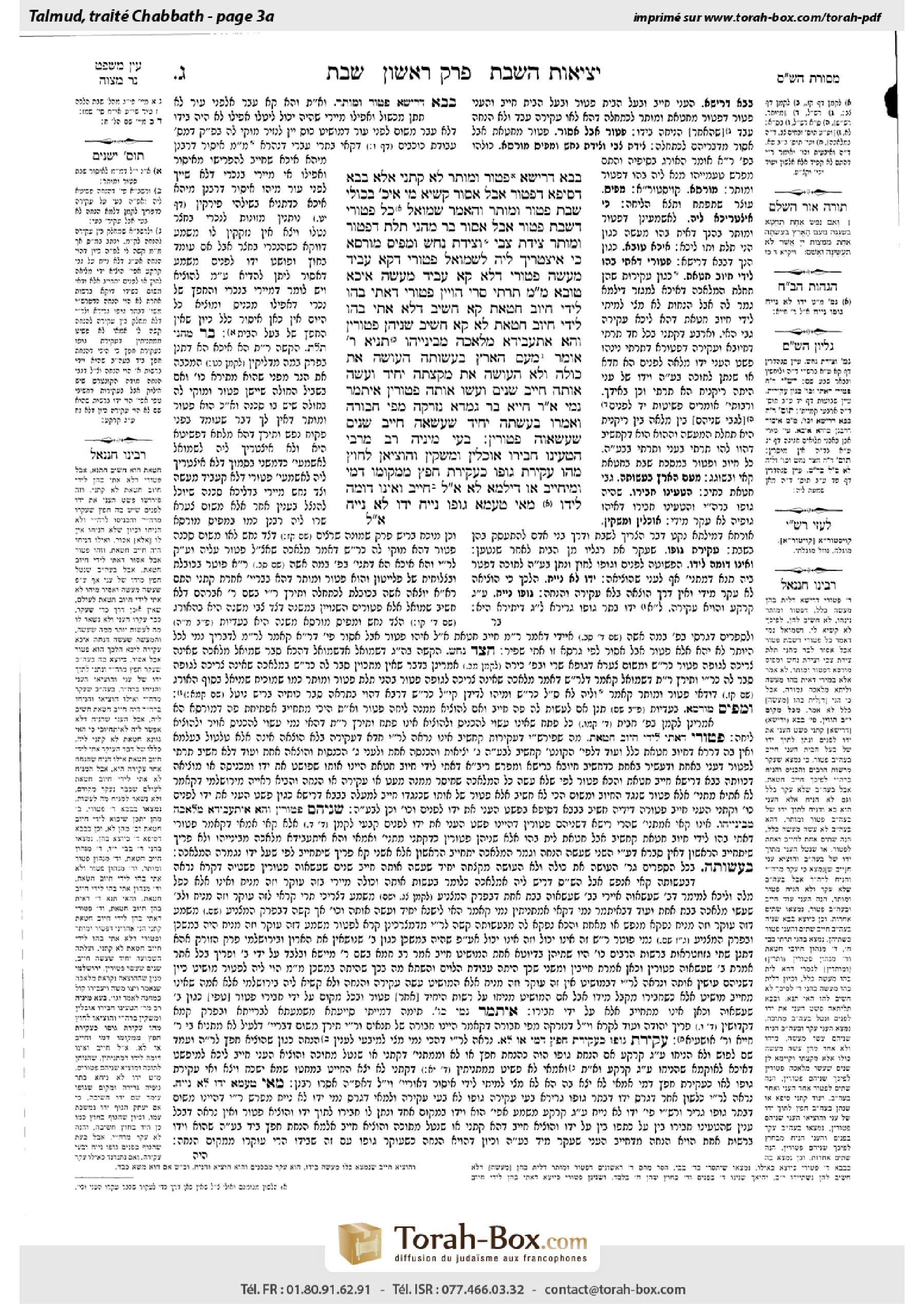
Shabbat 3a: Talmud study for Daf Yomi
Daf Yomi is the daily study of one Talmud folio. Explore 37 tractates with scans, Hebrew text, Sefaria English and AI-generated French translations where annotated.
Passage selection and English or AI-generated French translation are available where the scan has annotations. Daf Study is independent of Torah-Box and Sefaria.
Browse Shabbat · שבת · All tractatesShabbat 3a text and translations
This page of Shabbat includes the Aramaic text, an English translation and an AI-generated French translation, alongside the scan above.
שבת ג׳ א · Aramaic and Hebrew text
בָּבָא דְרֵישָׁא, פָּטוּר וּמוּתָּר לָא קָתָנֵי. אֶלָּא בָּבָא דְסֵיפָא, דְּפָטוּר אֲבָל אָסוּר — קַשְׁיָא.
מִי אִיכָּא בְּכוּלֵּי שַׁבָּת ״פָּטוּר וּמוּתָּר״?! וְהָאָמַר שְׁמוּאֵל: כֹּל פְּטוּרֵי דְשַׁבָּת פָּטוּר אֲבָל אָסוּר, בַּר מֵהָנֵי תְּלָת דְּפָטוּר וּמוּתָּר: צֵידַת צְבִי, וְצֵידַת נָחָשׁ, וּמֵפִיס מוּרְסָא!
כִּי אִיצְטְרִיךְ לֵיהּ לִשְׁמוּאֵל, פְּטוּרֵי דְּקָא עָבֵיד מַעֲשֶׂה, פְּטוּרֵי דְּלָא קָא עָבֵיד מַעֲשֶׂה אִיכָּא טוּבָא.
מִכׇּל מָקוֹם, תַּרְתֵּי סְרֵי הָוְיָין! פְּטוּרֵי דְּאָתֵי בְּהוּ לִידֵי חִיּוּב חַטָּאת — קָא חָשֵׁיב, דְּלָא אָתֵי בְּהוּ לִידֵי חִיּוּב חַטָּאת — לָא קָא חָשֵׁיב.
שְׁנֵיהֶן פְּטוּרִין, וְהָא אִתְעֲבִידָא מְלָאכָה מִבֵּינַיְיהוּ? תַּנְיָא רַבִּי אוֹמֵר: ״מֵעַם הָאָרֶץ בַּעֲשׂוֹתָהּ״, הָעוֹשֶׂה אֶת כּוּלָּהּ, וְלֹא הָעוֹשֶׂה אֶת מִקְצָתָהּ. יָחִיד וְעָשָׂה אוֹתָהּ — חַיָּיב, שְׁנַיִם וְעָשׂוּ אוֹתָהּ — פְּטוּרִין. אִיתְּמַר נָמֵי, אָמַר רַבִּי חִיָּיא בַּר גַּמְדָּא: נִזְרְקָה מִפִּי חֲבוּרָה וְאָמְרוּ: ״בַּעֲשֹׂתָהּ״, יָחִיד שֶׁעֲשָׂאָהּ — חַיָּיב, שְׁנַיִם שֶׁעֲשָׂאוּהָ — פְּטוּרִין.
בְּעָא מִינֵּיהּ רַב מֵרַבִּי: הִטְעִינוֹ חֲבֵירוֹ אוֹכָלִין וּמַשְׁקִין, וְהוֹצִיאָן לַחוּץ, מַהוּ? עֲקִירַת גּוּפוֹ כַּעֲקִירַת חֵפֶץ מִמְּקוֹמוֹ דָּמֵי, וּמִיחַיַּיב, אוֹ דִילְמָא לָא? אֲמַר לֵיהּ: חַיָּיב, וְאֵינוֹ דּוֹמֶה לְיָדוֹ. מַאי טַעְמָא? — גּוּפוֹ נָיַיח, יָדוֹ לָא נָיַיח.
Shabbat 3a · English translation
the first section of the mishna speaks of cases in which the one performing the actions is exempt from punishment by Torah law, and even by rabbinic law he is ab initio permitted to perform those actions. When the poor person or homeowner neither lifted nor placed the object, i.e., the object was placed into or removed from their hands by others, their role is insignificant. Therefore, it was not taught in the mishna, and those cases were not factored into the total number of acts of carrying from domain to domain. However, with regard to the latter section of the mishna, where the person performing those actions is exempt by Torah law, but his actions are prohibited by rabbinic law, it is difficult. Since the Sages prohibited those actions, they should be included in the total in the mishna, which should be twelve, not eight.
Incidentally, the Gemara wonders: Is there, in all the halakhot of Shabbat, an act for which the mishna deems one exempt and the act is permitted? Didn’t Shmuel say: With regard to all exempt rulings in the halakhot of Shabbat, although one who performs the action is exempt by Torah law, his action is prohibited by rabbinic law. This applies to all cases except for these three cases for which one is exempt and he is permitted to perform the action: Trapping a deer, where he does not actually trap it, rather he sits in the entrance of a house that a deer had previously entered on its own, preventing its exit; and trapping a poisonous snake because of the danger that it poses; and one who drains an abscess, meaning one who lances the boil of pus and drains the liquid from it. If so, the cases in the first section of our mishna, where the ruling is exempt, must be understood as exempt but prohibited.
The Gemara answers: In these cases, too, the ruling is: Exempt and permitted. When, though, was it necessary for Shmuel to cite specific cases as exempt and permitted? It was necessary in exempt cases where he performs a defined action. However, there are many exempt cases where he does not perform an action, which are completely permitted.
The Gemara returns to Rav Mattana’s question: In any case, there are twelve actions that should have been enumerated in the mishna. The Gemara answers: The mishna took into consideration cases of exempt acts where the one who performed them could come, through their performance, to incur liability to bring a sin-offering. The mishna did not take into consideration cases of exempt acts where the one who performed them could not come, through their performance, to incur liability to bring a sin-offering. Here, only the instances where one lifts an object from its place are taken into consideration. Having lifted an object, if he continued, he could potentially incur liability to bring a sin-offering. Under no circumstances can one who merely places an object come to violate a more serious prohibition.
The Gemara asks about the mishna itself: In the latter section of the mishna, instances in which they are both exempt are enumerated. However, wasn’t a prohibited labor performed between the two of them? Since together they performed an act prohibited by a severe Torah prohibition, how is it possible that their partnership will result in both being exempt? The Gemara answers that it was taught in a baraita that Rabbi Yehuda HaNasi said: It is written: “And if one soul sins unwittingly from the people of the land when he does it, one of the laws of God that should not be done and he is responsible” (Leviticus 4:27). The verse’s emphasis on the words “when he does it” means: One who does all of it, i.e., the entire transgression, is liable and not one who does part of it. Therefore, an individual, and he performed an action in its entirety, is liable. However, two people, and they performed an action together, are not liable, as each one performed only part of the action. The Gemara comments: It was also stated in support of Rabbi Yehuda HaNasi’s opinion: Rabbi Ḥiyya bar Gamda said: Amidst a discussion of these matters, it emanated from the group of Sages and they said: From the verse’s emphasis on “when he does it” it is derived: An individual who performed it is liable. However, two who performed it are not liable.
Rav raised a dilemma before Rabbi Yehuda HaNasi: One whom another person loaded with food and drink on his back in the private domain on Shabbat, and he carried them out while they were still on his back, what is the halakha with regard to the prohibition of carrying out on Shabbat? Clearly, one who lifts an object with his hand in the private domain, and carries it out into the public domain is liable, as he performed the complete act of carrying out. However, in the case of one who is laden with an object; is moving his body from its place in the private domain considered like lifting the object itself from its place? In that case, he would be liable. Or, perhaps it is not considered like lifting the object from its place, and therefore he would not be liable. Rabbi Yehuda HaNasi said to him: He is liable, and it is not similar to the halakha of one who had an object placed in his hand and carried it out to the public domain, with regard to which we learned in the mishna that he is not liable by Torah law. What is the reason for the distinction between these two apparently similar cases? His body is at rest, in a defined place. However, his hand is not at rest. Since a hand is not generally fixed in one place, moving it and even transferring it to a different domain without a bona fide act of lifting is not considered lifting. However, the body is generally fixed in one place. Moving it from its place is considered lifting in terms of Shabbat, and he is liable for doing so.
Shabbat 3a · Traduction française (IA)
La première partie de la Michna traite de cas où celui qui accomplit les actes est exempt de sanction selon la Torah et où, même selon la loi rabbinique, il lui est permis a priori de les accomplir. Lorsque le pauvre ou le propriétaire n’a ni soulevé ni déposé l’objet, c’est-à-dire que d’autres l’ont placé dans leurs mains ou l’en ont retiré, leur rôle est insignifiant. C’est pourquoi ces cas ne sont pas enseignés dans la Michna et n’ont pas été pris en compte dans le nombre total des actes de transfert d’un domaine à l’autre. En revanche, pour ce qui est de la dernière partie de la Michna, où celui qui accomplit ces actes est exempt selon la Torah, mais où ses actes sont interdits par la loi rabbinique, la difficulté demeure. Puisque les Sages ont interdit ces actes, ils devraient être inclus dans le total de la Michna, qui devrait être de douze et non de huit.
Incidemment, la Guemara s’interroge : Existe-t-il, dans l’ensemble des halakhot de Chabbat, un acte pour lequel la Michna déclare quelqu’un exempt et qui soit permis ? Shmuel n’a-t-il pas dit : dans tous les cas d’exemption dans les halakhot de Chabbat, bien que celui qui accomplit l’acte soit exempt selon la Torah, son acte est interdit par la loi rabbinique. Cela s’applique à tous les cas, à l’exception de ces trois cas où l’on est exempt et où l’acte est permis : piéger un cerf sans le capturer réellement, mais en s’asseyant à l’entrée d’une maison où un cerf était entré de lui-même auparavant, afin de l’empêcher d’en sortir ; piéger un serpent venimeux en raison du danger qu’il représente ; et drainer un abcès, c’est-à-dire inciser une tumeur purulente et en évacuer le liquide. Si tel est le cas, les situations de la première partie de notre Michna, où la décision est « exempt », doivent être comprises comme « exempt, mais interdit ».
La Guemara répond : Dans ces cas également, la décision est : « exempt et permis ». Mais dans quels cas Shmuel devait-il citer des exemples précis d’actes exemptés et permis ? Il le fallait pour les cas d’exemption où la personne accomplit une action définie. Cependant, il existe de nombreux cas d’exemption où elle n’accomplit aucune action, et ceux-là sont entièrement permis.
La Guemara revient à la question de Rav Mattana : dans tous les cas, il y a douze actes qui auraient dû être énumérés dans la Michna. La Guemara répond : la Michna a pris en compte les cas d’actes exemptés où celui qui les accomplit pourrait, par leur accomplissement, en venir à être tenu d’apporter un sacrifice expiatoire. Elle n’a pas pris en compte les cas d’actes exemptés où celui qui les accomplit ne pourrait pas, par leur accomplissement, en venir à être tenu d’apporter un sacrifice expiatoire. Ici, seuls sont pris en compte les cas où l’on soulève un objet de sa place. Après l’avoir soulevé, s’il poursuivait son action, il pourrait éventuellement être tenu d’apporter un sacrifice expiatoire. En revanche, celui qui se contente de déposer un objet ne peut en aucun cas en venir à transgresser une interdiction plus grave.
La Guemara interroge la Michna elle-même : dans sa dernière partie, elle énumère des cas où les deux sont exempts. Mais un travail interdit n’a-t-il pas été accompli par eux deux ? Puisqu’ensemble ils ont accompli un acte interdit par une grave interdiction de la Torah, comment se peut-il que leur collaboration aboutisse à ce qu’ils soient tous deux exempts ? La Guemara répond qu’il a été enseigné dans une baraïta que Rabbi Yehuda HaNasi a dit : Il est écrit : « Si une personne parmi le peuple du pays pèche involontairement en accomplissant l’une des choses que l’Éternel a ordonné de ne pas faire, et se rend ainsi coupable » (Lévitique 4:27). L’accent mis par le verset sur les mots « en l’accomplissant » signifie : celui qui accomplit l’acte dans son intégralité, c’est-à-dire la transgression entière, est responsable, et non celui qui n’en accomplit qu’une partie. Par conséquent, un individu qui accomplit l’acte dans son intégralité est responsable. En revanche, deux personnes qui accomplissent ensemble un acte ne sont pas responsables, car chacune n’en a accompli qu’une partie. La Guemara ajoute qu’une déclaration a également été faite à l’appui de l’opinion de Rabbi Yehuda HaNasi : Rabbi Ḥiyya bar Gamda a dit : Au cours d’une discussion sur ces sujets, cette conclusion a émané du groupe des Sages, qui ont dit : De l’accent mis par le verset sur les mots « en l’accomplissant », on déduit qu’un individu qui l’a accompli est responsable, tandis que deux personnes qui l’ont accompli ne sont pas responsables.
Rav souleva un dilemme devant Rabbi Yehuda HaNasi : quel est le statut, au regard de l’interdiction de transporter pendant Chabbat, d’une personne qu’un autre a chargée de nourriture et de boisson sur le dos, dans le domaine privé, et qui les a transportées à l’extérieur alors qu’elles étaient encore sur son dos ? Il est clair que celui qui soulève un objet de sa main dans le domaine privé et le transporte dans le domaine public est responsable, puisqu’il a accompli l’acte complet de transfert. Mais, dans le cas d’une personne chargée d’un objet, le déplacement de son corps depuis sa place dans le domaine privé est-il considéré comme le soulèvement de l’objet lui-même depuis sa place ? Dans ce cas, elle serait responsable. Ou bien ce déplacement n’est-il pas considéré comme le soulèvement de l’objet depuis sa place, et ne serait-elle donc pas responsable ? Rabbi Yehuda HaNasi lui répondit : Elle est responsable. Ce cas n’est pas comparable à celui d’une personne à qui l’on a placé un objet dans la main et qui l’a transporté dans le domaine public, cas au sujet duquel nous avons appris dans la Michna qu’elle n’est pas responsable selon la Torah. Quelle est la raison de cette distinction entre ces deux cas apparemment semblables ? Son corps est au repos, en un lieu déterminé. Sa main, en revanche, n’est pas au repos. Puisqu’une main n’est généralement pas fixée en un lieu, la déplacer, voire la transférer dans un autre domaine sans véritable acte de soulèvement, n’est pas considéré comme un soulèvement. Le corps, cependant, est généralement fixé en un lieu. Le déplacer de sa place est considéré, au regard de Chabbat, comme un soulèvement, et la personne est responsable de l’avoir fait.
Traduction française générée par IA à partir de l’édition anglaise de Sefaria. Vérifie toujours un passage avec le texte source.
Text from Sefaria: William Davidson Edition - Vocalized Aramaic (CC BY NC); William Davidson Edition - English (CC BY NC).