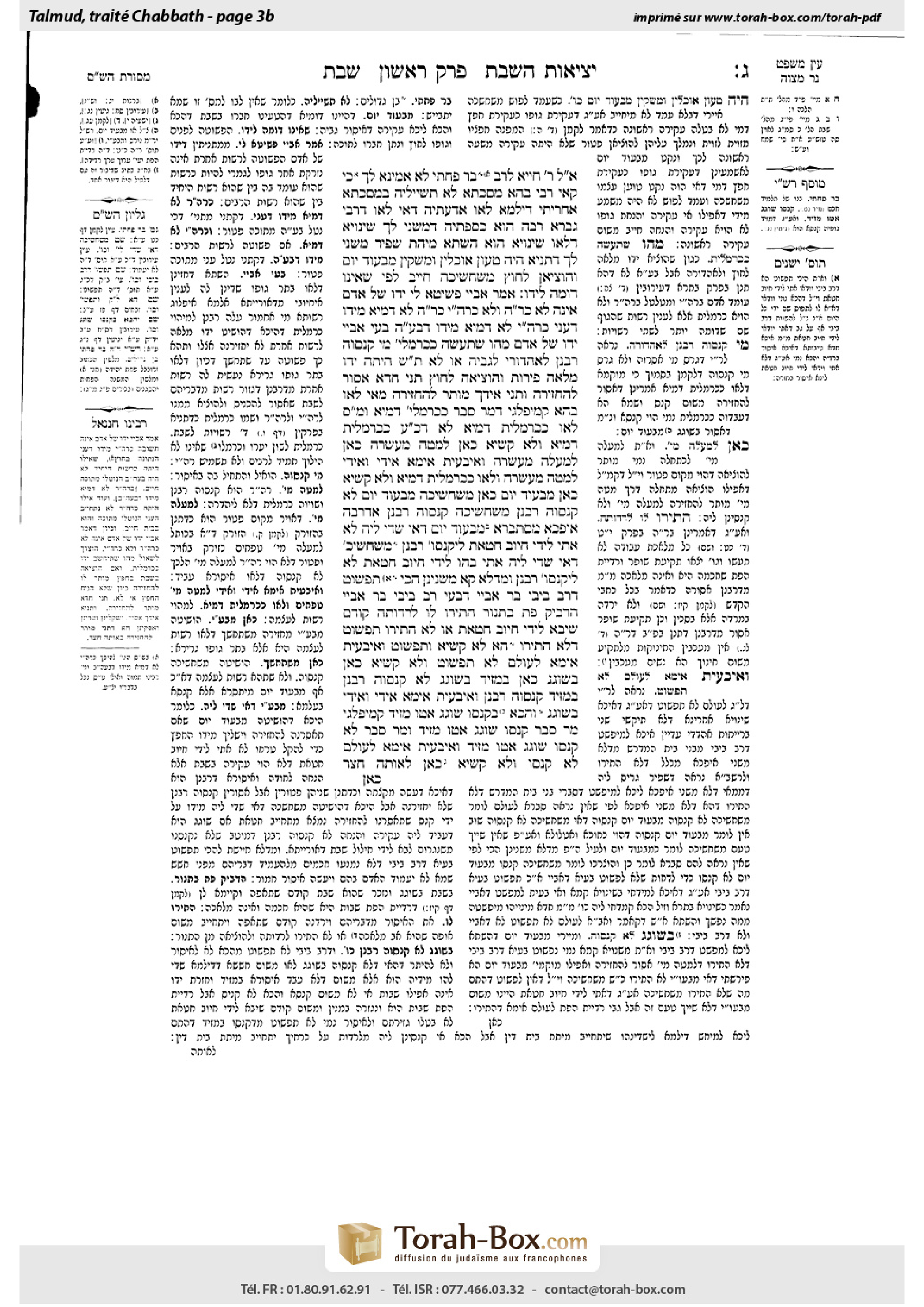
Shabbat 3b: Talmud study for Daf Yomi
Daf Yomi is the daily study of one Talmud folio. Explore 37 tractates with scans, Hebrew text, Sefaria English and AI-generated French translations where annotated.
Passage selection and English or AI-generated French translation are available where the scan has annotations. Daf Study is independent of Torah-Box and Sefaria.
Browse Shabbat · שבת · All tractatesShabbat 3b text and translations
This page of Shabbat includes the Aramaic text, an English translation and an AI-generated French translation, alongside the scan above.
שבת ג׳ ב · Aramaic and Hebrew text
אֲמַר לֵיהּ רַבִּי חִיָּיא לְרַב: בַּר פַּחֲתֵי! לָא אָמֵינָא לָךְ, כִּי קָאֵי רַבִּי בְּהָא מַסֶּכְתָּא לָא תְּשַׁיְּילֵיהּ בְּמַסֶּכְתָּא אַחֲרִיתִי, דִּילְמָא לָאו אַדַּעְתֵּיהּ. דְּאִי לָאו דְּרַבִּי גַּבְרָא רַבָּה הוּא — כַּסֵּפְתֵּיהּ, דִּמְשַׁנֵּי לָךְ שִׁינּוּיָא דְּלָאו שִׁינּוּיָא הוּא.
הַשְׁתָּא מִיהַת שַׁפִּיר מְשַׁנֵּי לָךְ. דְּתַנְיָא: הָיָה טָעוּן אוֹכָלִין וּמַשְׁקִין מִבְּעוֹד יוֹם, וְהוֹצִיאָן לַחוּץ מִשֶּׁחָשֵׁיכָה — חַיָּיב, לְפִי שֶׁאֵינוֹ דּוֹמֶה לְיָדוֹ.
אָמַר אַבָּיֵי: פְּשִׁיטָא לִי יָדוֹ שֶׁל אָדָם אֵינָהּ לֹא כִּרְשׁוּת הָרַבִּים וְלֹא כִּרְשׁוּת הַיָּחִיד. כִּרְשׁוּת הָרַבִּים לָא דָּמְיָא — מִיָּדוֹ דְעָנִי. כִּרְשׁוּת הַיָּחִיד לָא דָּמְיָא — מִיָּדוֹ דְּבַעַל הַבַּיִת.
בָּעֵי אַבָּיֵי: יָדוֹ שֶׁל אָדָם, מַהוּ שֶׁתֵּעָשֶׂה כְּכַרְמְלִית? מִי קַנְסוּהּ רַבָּנַן לְאַהְדּוֹרֵי לְגַבֵּיהּ, אוֹ לָא?
תָּא שְׁמַע: הָיְתָה יָדוֹ מְלֵאָה פֵּירוֹת וְהוֹצִיאָהּ לַחוּץ, תָּנֵי חֲדָא אָסוּר לְהַחֲזִירָהּ, וְתָנֵי אִידַּךְ מוּתָּר לְהַחֲזִירָהּ. מַאי לָאו בְּהָא קָמִיפַּלְגִי? דְּמָר סָבַר כְּכַרְמְלִית דָּמְיָא, וּמָר סָבַר לָאו כְּכַרְמְלִית דָּמְיָא?!
לָא, דְּכוּלֵּי עָלְמָא כְּכַרְמְלִית דָּמְיָא, וְלָא קַשְׁיָא: כָּאן, לְמַטָּה מֵעֲשָׂרָה. כָּאן, לְמַעְלָה מֵעֲשָׂרָה.
וְאִיבָּעֵית אֵימָא: אִידֵּי וְאִידֵּי לְמַטָּה מֵעֲשָׂרָה וְלָאו כְּכַרְמְלִית דָּמְיָא, וְלָא קַשְׁיָא: כָּאן מִבְּעוֹד יוֹם, כָּאן מִשֶּׁחָשֵׁיכָה. מִבְּעוֹד יוֹם — לָא קַנְסוּהּ רַבָּנַן, מִשֶּׁחָשֵׁיכָה — קַנְסוּהּ רַבָּנַן.
אַדְּרַבָּה, אִיפְּכָא מִסְתַּבְּרָא! מִבְּעוֹד יוֹם, דְּאִי שָׁדֵי לֵיהּ לָא אָתֵי לִידֵי חִיּוּב חַטָּאת — לִיקְנְסוּהּ רַבָּנַן. מִשֶּׁחָשֵׁיכָה, דְּאִי שָׁדֵי לֵיהּ אָתֵי בְּהוּ לִידֵי חִיּוּב חַטָּאת — לָא לִיקְנְסוּהּ רַבָּנַן.
וּמִדְּלָא קָא מְשַׁנִּינַן הָכִי, תִּפְשׁוֹט דְּרַב בִּיבִי בַּר אַבָּיֵי. דְּבָעֵי רַב בִּיבִי בַּר אַבָּיֵי: הִדְבִּיק פַּת בַּתַּנּוּר, הִתִּירוּ לוֹ לִרְדּוֹתָהּ קוֹדֶם שֶׁיָּבֹא לִידֵי חִיּוּב חַטָּאת, אוֹ לֹא הִתִּירוּ?
תִּפְשׁוֹט דְּלֹא הִתִּירוּ. הָא לָא קַשְׁיָא, וְתִפְשׁוֹט.
וְאִיבָּעֵית אֵימָא, לְעוֹלָם לָא תִּפְשׁוֹט, וְלָא קַשְׁיָא: כָּאן בְּשׁוֹגֵג, כָּאן בְּמֵזִיד. בְּשׁוֹגֵג — לָא קַנְסוּהּ רַבָּנַן. בְּמֵזִיד קַנְסוּהּ רַבָּנַן.
וְאִיבָּעֵית אֵימָא, אִידֵּי וְאִידֵּי בְּשׁוֹגֵג, וְהָכָא בְּקָנְסוּ שׁוֹגֵג אַטּוּ מֵזִיד קָמִיפַּלְגִי: מָר סָבַר קָנְסוּ שׁוֹגֵג אַטּוּ מֵזִיד. וּמָר סָבַר לֹא קָנְסוּ שׁוֹגֵג אַטּוּ מֵזִיד.
וְאִיבָּעֵית אֵימָא, לְעוֹלָם לֹא קָנְסוּ, וְלָא קַשְׁיָא: כָּאן לְאוֹתָהּ חָצֵר,
Shabbat 3b · English translation
Rabbi Ḥiyya said to Rav, his sister’s son: Son of great men, didn’t I tell you that when Rabbi Yehuda HaNasi is involved in this tractate do not ask him questions in another tractate, as perhaps it will not be on his mind and he will be unable to answer? The dilemma that Rav asked was not related to the subject matter of the tractate which they were studying. As, had it not been for the fact that Rabbi Yehuda HaNasi is a great man, you would have shamed him, as he would have been forced to give you an answer that is not an appropriate answer.
Now, he was involved in another tractate. Nevertheless, he answered you well, as it was taught in a baraita: One who was laden with food and drink while it was still day, before Shabbat began, and, consequently, did not perform the act of lifting on Shabbat, and he carried them out into the public domain after dark on Shabbat is liable. Since, as a rule, his body is fixed in one place, moving it is considered like lifting an object, and he is liable. It is not similar to lifting his hand and moving it from place to place. Since his hand is not fixed in one place, moving it is not considered lifting.
Abaye said: It is obvious to me that the hand of a person in and of itself, when he moves it out of the domain where he is located, is considered to be neither like the public domain nor like the private domain, even if it is the hand of someone standing in one of those domains. Proof that the hand is not considered like the public domain can be derived from the ruling of the mishna with regard to the hand of the poor person. As we learned with regard to the poor person who brought his hand carrying an object that he lifted from the public domain into the private domain and the homeowner took the object from his hand; the homeowner is not liable. Apparently, the hand of the poor person is not considered part of the public domain, even though he himself is located in the public domain. Proof that it is not considered like the private domain can be derived from the ruling of the mishna with regard to the hand of the homeowner. As we learned with regard to the homeowner who moved his hand carrying an object that he lifted from the private domain into the public domain and the poor person took the object from his hand; the poor person is not liable for carrying out from a private domain.
However, Abaye raised a dilemma: What is the ruling with regard to the hand of a person with an object in it, when that person reached his hand into a different domain? Does it assume karmelit status? A karmelit is an intermediate domain established by the Sages that is neither a private nor a public domain. This dilemma is based on the fact that his hand left one domain and did not yet enter a second domain. In terms of practical halakha, the two sides of this dilemma are: Did the Sages penalize him and issue a rabbinic decree prohibiting him from bringing his hand with the object back to the domain where he is standing or not?
The Gemara says: Come and hear a resolution to this dilemma from that which we learned elsewhere, with regard to the question: What must one in the private domain do in a case where his hand was filled with fruits and he extended it outside, into the public domain? It was taught in one baraita that it is prohibited for him to bring it back into his house, and it was taught in another baraita that it is permitted for him to bring it back. Is it not with regard to this that they disagree; that the Sage in one baraita holds that his hand is like a karmelit, and the Sage in the other baraita holds that it is not like a karmelit?
The Gemara rejects this explanation: No, everyone agrees that it is like a karmelit, and yet, this is not difficult, as the difference between the baraitot can be explained in the following manner: Here, the baraita prohibiting him from bringing his hand back, is referring to a case where he took it out at a height below ten handbreadths off the ground, within the airspace of the public domain. And there, the baraita permitting him to bring his hand back, is referring to a case where he took it out at a height above ten handbreadths off the ground, outside the airspace of the public domain. Consequently, the object is considered to be neither in the public domain nor in a karmelit.
And if you wish, say instead that this baraita and that baraita are both referring to a case where he took his hand out to the public domain at a height below ten handbreadths, and his hand is not considered a karmelit. And yet, this is not difficult. As here, the baraita permitting him to bring it back, is referring to a case where he took it out while it was still day on Shabbat eve. Since he extended his hand before Shabbat and, in doing so, did nothing wrong, the Sages did not penalize him and permitted him to bring his hand back on Shabbat itself. However, there, the baraita prohibiting him from bringing it back, is referring to a case where he took it out after dark, and Shabbat had already begun. Since there is an element of prohibition involved, the Sages penalized him and prohibited him from bringing it back.
The Gemara comments that this explanation is difficult. On the contrary, the opposite is reasonable. In the case where he extended his hand while it was still day, when even were he to throw the object from his hand into the public domain, he would not incur liability to bring a sin-offering because the object was lifted from its place on a weekday, let the Sages penalize him. However, in the case where he extended his hand after dark, where were he to throw the object from his hand into the public domain, he would thereby incur liability to bring a sin-offering, let the Sages not penalize him. Were the Sages to penalize him by prohibiting him from bringing his hand back, he is liable to drop the object in the public domain, and by doing so he would violate a Torah prohibition.
And from the fact that we did not explain it that way, but preferred the contrary distinction, resolve the dilemma raised by Rav Beivai bar Abaye, whose dilemma is predicated on the same fundamental issue. As Rav Beivai bar Abaye raised the dilemma: One who unwittingly stuck bread in the oven on Shabbat, as bread was baked by sticking the dough to the sides of a heated oven, did they permit him to override a rabbinic prohibition and remove it from the oven before it bakes, i.e., before he incurs liability to bring a sin-offering for baking bread on Shabbat, or did they not permit him to do so? Removing the bread is also prohibited on Shabbat. However, its prohibition is only by rabbinic law. The fundamental dilemma is: May one violate a rabbinical prohibition in order to avoid violating a Torah prohibition or not?
Based on the above, resolve that the Sages did not permit one to do so. In resolving Abaye’s dilemma, the concern that one would likely throw the object from his hand, and thereby violate a Torah prohibition, was not taken into consideration. The one who extended his hand into the public domain was penalized by the Sages and prohibited to bring his hand back. Here too, resolve the dilemma and say that he may not remove the bread, even though he will thereby violate a Torah prohibition. The dilemma of Rav Beivai bar Abaye, which was thought to be unresolved, is thereby resolved. As a result, there is room for uncertainty whether or not the resolution of the previous dilemma, through which Rav Beivai’s dilemma would also be resolved, is valid. The Gemara rejects this difficulty: That is not difficult. It is possible that even though a resolution had not been previously found for the dilemma of Rav Beivai bar Abaye, that does not mean that it cannot be resolved And, indeed, as proof can be brought from the resolution of the other dilemma, resolve this dilemma as well.
And if you wish, say instead: Actually, do not resolve the dilemma, but, nevertheless, resolve the contradiction between the baraitot in the following manner. Here, the baraita that taught that it is permitted to bring one’s hand back is referring to a case where he extended it unwittingly. There, the baraita that taught that it is prohibited for one to bring it back is referring to a case where he took it out intentionally. When he took it out unwittingly, the Sages did not penalize him. When he took it out intentionally, the Sages penalized him and prohibited him from bringing it back.
And if you wish, say instead, in order to resolve the contradiction that this baraita and that baraita are both referring to a case where he took his hand out unwittingly. And here they disagree with regard to the question: Did the Sages penalize an unwitting offender due to an intentional offender? The Sage who prohibits him from bringing his hand back holds that they penalized an unwitting offender due to an intentional offender. Therefore, even though he took his hand out unwittingly, they penalized him and prohibited him from bringing the object back so that he would not come to do so intentionally. The Sage who permits him to bring it back holds that they did not penalize an unwitting offender due to an intentional offender. Therefore, they did not prohibit him from bringing it back.
And if you wish, say instead that, actually, they did not penalize an unwitting offender due to an intentional offender, and still, this is not difficult, and there is no contradiction. Here, the baraita that permits bringing it back, is referring to bringing it back to the same courtyard where he is standing.
Shabbat 3b · Traduction française (IA)
Rabbi Ḥiyya dit à Rav, le fils de sa sœur : « Fils de grands hommes, ne t’ai-je pas dit que, lorsque Rabbi Yehuda HaNasi étudie ce traité, tu ne dois pas lui poser de questions sur un autre traité, car il se peut qu’il n’ait pas cela à l’esprit et qu’il soit incapable de répondre ? Le dilemme que Rav lui a soumis n’était pas lié au sujet du traité qu’ils étudiaient. En effet, si Rabbi Yehuda HaNasi n’avait pas été un grand homme, tu l’aurais couvert de honte, puisqu’il aurait été contraint de te donner une réponse inappropriée. »
Or, il étudiait un autre traité. Pourtant, il t’a bien répondu, comme on l’a enseigné dans une baraïta : celui qui était chargé de nourriture et de boisson alors qu’il faisait encore jour, avant le début du Chabbat, et qui, par conséquent, n’a pas effectué l’acte de soulèvement pendant Chabbat, puis les a transportées dans le domaine public une fois la nuit tombée, pendant Chabbat, est passible. En règle générale, son corps étant fixé en un lieu, le déplacer est considéré comme le fait de soulever un objet, et il est donc passible. Cela ne ressemble pas au fait de lever la main et de la déplacer d’un endroit à un autre : puisque sa main n’est pas fixée en un lieu, son déplacement n’est pas considéré comme un soulèvement.
Abaye dit : « Il m’est évident que la main d’une personne, prise en elle-même, lorsqu’elle la déplace hors du domaine où elle se trouve, n’est considérée ni comme relevant du domaine public ni comme relevant du domaine privé, même s’il s’agit de la main d’une personne qui se tient dans l’un de ces domaines. » On peut prouver que la main n’est pas considérée comme relevant du domaine public à partir de la décision de la Michna concernant la main du pauvre. En effet, nous avons appris au sujet du pauvre qui a introduit dans le domaine privé sa main, portant un objet qu’il avait soulevé dans le domaine public, et dont le maître de maison a pris l’objet de la main : le maître de maison n’est pas passible. Apparemment, la main du pauvre n’est pas considérée comme faisant partie du domaine public, bien que lui-même s’y trouve. On peut prouver qu’elle n’est pas considérée comme relevant du domaine privé à partir de la décision de la Michna concernant la main du maître de maison. En effet, nous avons appris au sujet du maître de maison qui a déplacé dans le domaine public sa main, portant un objet qu’il avait soulevé dans le domaine privé, et dont le pauvre a pris l’objet de la main : le pauvre n’est pas passible d’avoir fait sortir un objet du domaine privé.
Cependant, Abaye souleva un dilemme : quel est le statut de la main d’une personne qui tient un objet lorsque cette personne la tend dans un autre domaine ? Est-elle considérée comme une karmelit ? Une karmelit est un domaine intermédiaire établi par les Sages, qui n’est ni un domaine privé ni un domaine public. Ce dilemme repose sur le fait que sa main a quitté un domaine sans être encore entrée dans un second domaine. Du point de vue de la halakha pratique, les deux possibilités sont les suivantes : les Sages l’ont-ils sanctionné et ont-ils décrété qu’il lui est interdit de ramener sa main, avec l’objet, dans le domaine où il se tient, ou non ?
La Guemara dit : « Viens et entends » une solution à ce dilemme à partir de ce que nous avons appris ailleurs, à propos de la question suivante : que doit faire une personne qui se trouve dans le domaine privé, dont la main est remplie de fruits et qui l’a tendue à l’extérieur, dans le domaine public ? Une baraïta enseigne qu’il lui est interdit de la ramener dans sa maison, tandis qu’une autre baraïta enseigne qu’il lui est permis de la ramener. N’est-ce pas précisément sur ce point qu’elles sont en désaccord : le tanna de l’une des baraïtot considère que sa main est comme une karmelit, tandis que celui de l’autre baraïta considère qu’elle n’est pas comme une karmelit ?
La Guemara rejette cette explication : non, tous conviennent que sa main est comme une karmelit. Pourtant, il n’y a pas de difficulté, car la différence entre les baraïtot peut s’expliquer ainsi : ici, la baraïta qui lui interdit de ramener sa main concerne un cas où il l’a sortie à une hauteur inférieure à dix palmes du sol, dans l’espace aérien du domaine public. Là, la baraïta qui lui permet de la ramener concerne un cas où il l’a sortie à une hauteur supérieure à dix palmes du sol, hors de l’espace aérien du domaine public. Par conséquent, l’objet n’est considéré ni comme se trouvant dans le domaine public ni comme se trouvant dans une karmelit.
Et si tu veux, dis plutôt que les deux baraïtot concernent un cas où il a sorti sa main dans le domaine public à une hauteur inférieure à dix palmes, et que sa main n’est pas considérée comme une karmelit. Pourtant, il n’y a pas de difficulté : ici, la baraïta qui lui permet de la ramener concerne un cas où il l’a sortie alors qu’il faisait encore jour, la veille de Chabbat. Puisqu’il a tendu la main avant Chabbat et qu’il n’a ainsi rien fait de mal, les Sages ne l’ont pas sanctionné et lui ont permis de la ramener pendant Chabbat même. Là, en revanche, la baraïta qui lui interdit de la ramener concerne un cas où il l’a sortie après la tombée de la nuit, alors que Chabbat avait déjà commencé. Comme une interdiction est en jeu, les Sages l’ont sanctionné et lui ont interdit de la ramener.
La Guemara fait remarquer que cette explication est difficile. Au contraire, c’est l’inverse qui semble raisonnable. Dans le cas où il a tendu la main alors qu’il faisait encore jour, même s’il avait jeté l’objet de sa main dans le domaine public, il ne serait pas passible d’apporter un sacrifice expiatoire, car l’objet avait été soulevé de son emplacement un jour de semaine : que les Sages le sanctionnent. En revanche, dans le cas où il a tendu la main après la tombée de la nuit, s’il jetait l’objet de sa main dans le domaine public, il serait passible d’apporter un sacrifice expiatoire : que les Sages ne le sanctionnent pas. En effet, s’ils le sanctionnaient en lui interdisant de ramener sa main, il serait contraint de laisser tomber l’objet dans le domaine public et, ce faisant, il transgresserait une interdiction de la Torah.
Et du fait que nous n’avons pas expliqué les choses ainsi, mais que nous avons préféré la distinction inverse, résous le dilemme soulevé par Rav Beivai bar Abaye, qui repose sur la même question fondamentale. Rav Beivai bar Abaye souleva le dilemme suivant : si quelqu’un, par inadvertance, a collé du pain dans le four pendant Chabbat — car le pain était cuit en collant la pâte aux parois d’un four chauffé — lui a-t-on permis d’enfreindre une interdiction rabbinique et de le retirer du four avant qu’il ne cuise, c’est-à-dire avant qu’il ne soit passible d’apporter un sacrifice expiatoire pour avoir cuit du pain pendant Chabbat, ou ne le lui a-t-on pas permis ? Retirer le pain est également interdit pendant Chabbat, mais cette interdiction relève uniquement du droit rabbinique. La question fondamentale est la suivante : peut-on enfreindre une interdiction rabbinique afin d’éviter de transgresser une interdiction de la Torah, ou non ?
À partir de ce qui précède, résous la question en concluant que les Sages n’ont pas permis d’agir ainsi. Pour résoudre le dilemme d’Abaye, on n’a pas tenu compte du fait qu’il risquait probablement de jeter l’objet de sa main et de transgresser ainsi une interdiction de la Torah. Celui qui avait tendu sa main dans le domaine public a été sanctionné par les Sages, qui lui ont interdit de la ramener. Ici aussi, résous le dilemme et dis qu’il ne peut pas retirer le pain, même si cela l’amène à transgresser une interdiction de la Torah. Le dilemme de Rav Beivai bar Abaye, que l’on pensait non résolu, se trouve ainsi tranché. Dès lors, on peut douter de la validité de la solution au dilemme précédent, qui aurait également tranché celui de Rav Beivai. La Guemara rejette cette difficulté : il n’y a pas de difficulté. Même si l’on n’avait pas encore trouvé de solution au dilemme de Rav Beivai bar Abaye, cela ne signifie pas qu’il ne puisse pas être résolu ; et, en effet, on peut s’appuyer sur la solution de l’autre dilemme pour résoudre celui-ci également.
Et si tu veux, dis plutôt : en réalité, ne résous pas le dilemme ; néanmoins, résous la contradiction entre les baraïtot de la manière suivante. Ici, la baraïta qui enseigne qu’il est permis de ramener sa main concerne un cas où il l’a tendue par inadvertance. Là, la baraïta qui enseigne qu’il est interdit de la ramener concerne un cas où il l’a sortie intentionnellement. Lorsqu’il l’a sortie par inadvertance, les Sages ne l’ont pas sanctionné. Lorsqu’il l’a sortie intentionnellement, les Sages l’ont sanctionné et lui ont interdit de la ramener.
Et si tu veux, dis plutôt, afin de résoudre la contradiction, que les deux baraïtot concernent un cas où il a sorti sa main par inadvertance. Elles sont alors en désaccord sur la question suivante : les Sages ont-ils sanctionné celui qui a agi par inadvertance en raison de celui qui agit intentionnellement ? Le tanna qui lui interdit de ramener sa main considère que les Sages ont sanctionné celui qui a agi par inadvertance en raison de celui qui agit intentionnellement. Ainsi, bien qu’il ait sorti sa main par inadvertance, ils l’ont sanctionné et lui ont interdit de ramener l’objet, afin qu’il n’en vienne pas à agir intentionnellement. Le tanna qui lui permet de la ramener considère que les Sages n’ont pas sanctionné celui qui a agi par inadvertance en raison de celui qui agit intentionnellement. Ils ne lui ont donc pas interdit de la ramener.
Et si tu veux, dis plutôt qu’en réalité, les Sages n’ont pas sanctionné celui qui a agi par inadvertance en raison de celui qui agit intentionnellement ; pourtant, il n’y a pas de difficulté ni de contradiction. Ici, la baraïta qui permet de la ramener concerne le fait de la ramener dans la même cour où il se tient.
Traduction française générée par IA à partir de l’édition anglaise de Sefaria. Vérifie toujours un passage avec le texte source.
Text from Sefaria: William Davidson Edition - Vocalized Aramaic (CC BY NC); William Davidson Edition - English (CC BY NC).