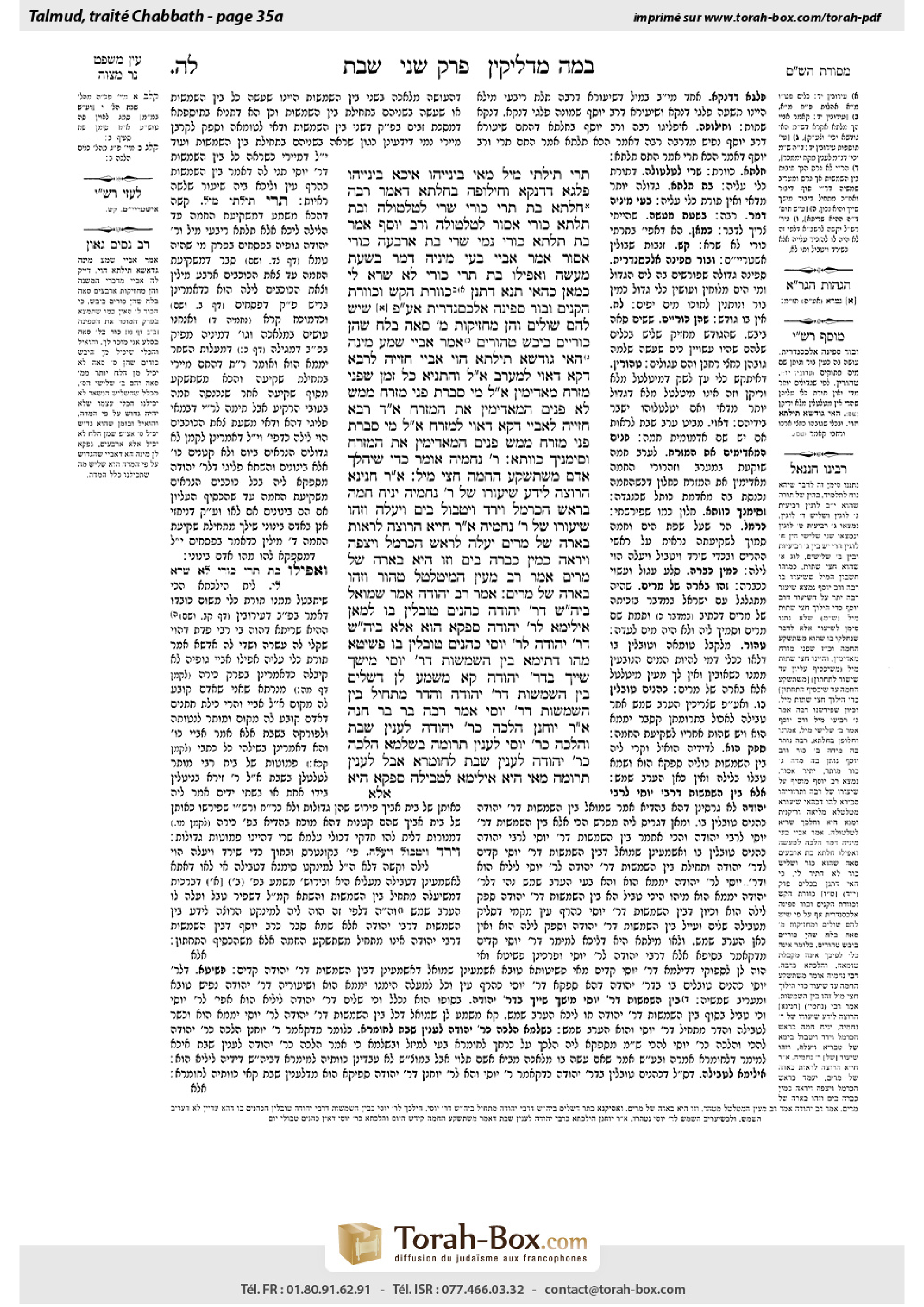
Shabbat 35a: Talmud study for Daf Yomi
Daf Yomi is the daily study of one Talmud folio. Explore 37 tractates with scans, Hebrew text, Sefaria English and AI-generated French translations where annotated.
Passage selection and English or AI-generated French translation are available where the scan has annotations. Daf Study is independent of Torah-Box and Sefaria.
Browse Shabbat · שבת · All tractatesShabbat 35a text and translations
This page of Shabbat includes the Aramaic text, an English translation and an AI-generated French translation, alongside the scan above.
שבת ל״ה א · Aramaic and Hebrew text
תְּרֵי תִילְתֵי מִיל. מַאי בֵּינַיְיהוּ? — אִיכָּא בֵּינַיְיהוּ פַּלְגָא דְּדַנְקָא.
וְחִילּוּפַהּ בְּחַלְּתָא. דְּאָמַר רַבָּה: חַלְּתָא בַּת תְּרֵי כוֹרֵי — שְׁרֵי לְטַלְטוֹלַהּ, וּבַת תְּלָתָא כוֹרֵי — אֲסִיר לְטַלְטוֹלַהּ. וְרַב יוֹסֵף אָמַר: בַּת תְּלָתָא כוֹרֵי — נָמֵי שְׁרֵי, בַּת אַרְבְּעָה כוֹרֵי — אֲסִיר.
אָמַר אַבָּיֵי: בְּעַי מִינֵּיהּ דְּמָר בִּשְׁעַת מַעֲשֶׂה, וַאֲפִילּוּ בַּת תְּרֵי כוֹרֵי לָא שְׁרָא לִי. כְּמַאן — כְּהַאי תַּנָּא דִּתְנַן: כַּוֶּורֶת הַקַּשׁ וְכַוֶּורֶת הַקָּנִים וּבוֹר סְפִינָה אֲלֶכְּסַנְדְּרִית, אַף עַל פִּי שֶׁיֵּשׁ לָהֶם שׁוּלַיִם וְהֵן מַחֲזִיקוֹת אַרְבָּעִים סְאָה בַּלַּח שֶׁהֵן כּוֹרַיִים בַּיָּבֵשׁ — טְהוֹרִים. אָמַר אַבָּיֵי: שְׁמַע מִינַּהּ הַאי גּוּדְשָׁא תִּילְּתָא הָוֵי.
אַבָּיֵי חַזְיֵיהּ לְרָבָא דְּקָא דָּאוֵי לְמַעֲרָב. אֲמַר לֵיהּ: וְהָתַנְיָא כׇּל זְמַן שֶׁפְּנֵי מִזְרָח מַאֲדִימִין? אֲמַר לֵיהּ: מִי סָבְרַתְּ פְּנֵי מִזְרָח מַמָּשׁ? לָא, פָּנִים הַמַּאֲדִימִין אֶת הַמִּזְרָח. אִיכָּא דְאָמְרִי: רָבָא חַזְיֵיהּ לְאַבָּיֵי דְּקָא דָּאוֵי לְמִזְרָח. אֲמַר לֵיהּ מִי סָבְרַתְּ פְּנֵי מִזְרָח מַמָּשׁ? פָּנִים הַמַּאֲדִימִין אֶת הַמִּזְרָח. וְסִימָנָיךְ: כַּוְּותָא.
רַבִּי נְחֶמְיָה אוֹמֵר כְּדֵי שֶׁיְּהַלֵּךְ אָדָם מִשֶּׁתִּשְׁקַע הַחַמָּה חֲצִי מִיל. אָמַר רַבִּי חֲנִינָא: הָרוֹצֶה לֵידַע שִׁיעוּרוֹ שֶׁל רַבִּי נְחֶמְיָה יַנִּיחַ חַמָּה בְּרֹאשׁ הַכַּרְמֶל וְיֵרֵד וְיִטְבּוֹל בַּיָּם וְיַעֲלֶה — וְזֶהוּ שִׁיעוּרוֹ שֶׁל רַבִּי נְחֶמְיָה.
אָמַר רַבִּי חִיָּיא: הָרוֹצֶה לִרְאוֹת בְּאֵרָהּ שֶׁל מִרְיָם יַעֲלֶה לְרֹאשׁ הַכַּרְמֶל וְיִצְפֶּה וְיִרְאֶה כְּמִין כְּבָרָה בַּיָּם — וְזוֹ הִיא בְּאֵרָהּ שֶׁל מִרְיָם. אָמַר רַב: מַעְיָן הַמִּיטַּלְטֵל טָהוֹר — וְזֶהוּ בְּאֵרָהּ שֶׁל מִרְיָם.
אָמַר רַב יְהוּדָה אָמַר שְׁמוּאֵל: בֵּין הַשְּׁמָשׁוֹת דְּרַבִּי יְהוּדָה, כֹּהֲנִים טוֹבְלִין בּוֹ. לְמַאן? אִילֵימָא לְרַבִּי יְהוּדָה — סְפֵקָא הוּא. אֶלָּא, בֵּין הַשְּׁמָשׁוֹת דְּרַבִּי יְהוּדָה, לְרַבִּי יוֹסֵי כֹּהֲנִים טוֹבְלִין בּוֹ.
פְּשִׁיטָא! מַהוּ דְתֵימָא: בֵּין הַשְּׁמָשׁוֹת דְּרַבִּי יוֹסֵי מֵישָׁךְ שָׁיֵיךְ בִּדְרַבִּי יְהוּדָה — קָא מַשְׁמַע לַן דְּשָׁלֵים בֵּין הַשְּׁמָשׁוֹת דְּרַבִּי יְהוּדָה, וַהֲדַר מַתְחֵיל בֵּין הַשְּׁמָשׁוֹת דְּרַבִּי יוֹסֵי.
אָמַר רַבָּה בַּר בַּר חָנָה אָמַר רַבִּי יוֹחָנָן: הֲלָכָה כְּרַבִּי יְהוּדָה לְעִנְיַן שַׁבָּת, וַהֲלָכָה כְּרַבִּי יוֹסֵי לְעִנְיַן תְּרוּמָה. בִּשְׁלָמָא הֲלָכָה כְּרַבִּי יְהוּדָה לְעִנְיַן שַׁבָּת — לְחוּמְרָא. אֲבָל לְעִנְיַן תְּרוּמָה — מַאי הִיא? אִילֵימָא לִטְבִילָה — סְפֵקָא הִיא?
Shabbat 35a · English translation
it means two-thirds of a mil. The Gemara explains: What is the practical difference between them? The practical difference between them is half of one-sixth [danka], i.e., one-twelfth of a mil. Their disputes are consistent, as the duration of twilight according to Rav Yosef is shorter than its duration according to Rabba.
The Gemara comments: And with regard to the legal status of a wicker vessel their dispute is the opposite. In that case, the size of the vessel permitted by Rav Yosef is larger than the size of the vessel permitted by Rabba. As Rabba said with regard to a wicker vessel with a capacity of two kor, one is permitted to move it on Shabbat. And one with a capacity of three kor, one is prohibited to move it on Shabbat. It is much larger than the dimensions of a vessel and one is only permitted to move vessels on Shabbat. And Rav Yosef said: A vessel with a capacity of three kor, one is also permitted to move it, and only one with a capacity of four kor, it is prohibited to move.
Abaye said: I raised the dilemma before my Master, Rabba, when it was practical, when I actually needed to know what to do, and he did not permit me to move even a vessel with a capacity of two kor. The Gemara explains: In accordance with whose opinion did Rabba issue his practical halakhic ruling? In accordance with the opinion of this tanna that we learned in the mishna discussing the laws of ritual purity: A round straw barrel, and a round barrel made of reeds, and the cistern of an Alexandrian ship, which is a large vessel placed on a boat and filled with potable water, although these vessels have bottoms, i.e., they are receptacles, since they have a capacity of forty se’a of liquid, which is the equivalent of two kor of dry goods, they are ritually pure. Even if they come into contact with a source of ritual impurity, they do not become impure. Beyond a certain size, containers are no longer considered vessels and, consequently, cannot become ritually impure. Rabba held: Since with regard to the halakhot of ritual impurity a vessel of two kor is not considered a vessel, it may not be moved on Shabbat. With regard to this mishna, Abaye said: Learn from it that the surplus of dry goods in a vessel relative to liquids is one-third of the contents of the vessel. It says in the mishna that a vessel that can hold forty se’a of liquid holds two kor of dry produce, which is the equivalent of sixty se’a.
The Gemara relates: Abaye saw that Rava was gazing westward on Shabbat eve to determine whether or not the sky was red and whether or not it was twilight. Abaye said to Rava: Wasn’t it taught in a baraita that twilight is from when the sun sets, as long as the eastern face of the sky is reddened by the light of the sun? Why, then, are you looking westward? Rava said to him: Do you hold that the reference is actually to the eastern face of the sky? No, it is referring to the face of the sky that causes the east to redden, i.e., the west. Some say a different version of that incident. Rava saw that Abaye was gazing eastward. He said to him, do you hold that the reference is to the actual eastern face of the sky? The reference is to the face of the sky that causes the east to redden, i.e., the west. And your mnemonic is a window, as it is on the wall opposite the window that one can see how much sunlight is shining through.
With regard to that which was taught in the baraita that Rabbi Neḥemya says: The duration of twilight is the time it takes for a person to walk half a mil after the sun sets. Rabbi Ḥanina said: One who wants to know the precise measure of Rabbi Neḥemya’s twilight should do the following: Leave the sun at the top of Mount Carmel, as when one is standing on the seashore he can still see the top of Mount Carmel in sunlight, and descend and immerse himself in the sea, and emerge, and that is Rabbi Neḥemya’s measure of the duration of twilight.
Because of its similarity to Rabbi Ḥanina’s statement, the Gemara cites that which Rabbi Ḥiyya said: One who wants to see Miriam’s well, which accompanied the Jewish people throughout their sojourn in the desert, should do the following: He should climb to the top of Mount Carmel and look out, and he will see a rock that looks like a sieve in the sea, and that is Miriam’s well. Rav said: A spring that is portable, i.e., that moves from place to place, is ritually pure and is regarded as an actual spring and not as drawn water. And what is a movable spring? It is Miriam’s well.
Rav Yehuda said that Shmuel said: During Rabbi Yehuda’s twilight, ritually impure priests who want to immerse themselves during the day to become ritually pure, so that sunset will follow immersion and they will be permitted to eat teruma, can still immerse themselves during that period. According to this opinion, twilight is still considered to be day. The Gemara asks: In accordance with whose opinion is that true? If you say that it is in accordance with Rabbi Yehuda’s own opinion, his opinion cited above is that twilight is a period of uncertainty. Therefore, one who immerses at that time may not eat teruma until after the sunset of the following day. Rather, the reference is to twilight of Rabbi Yehuda, in accordance with the opinion of Rabbi Yosei. Priests can immerse then, as Rabbi Yosei considers that time to still be day, and sunset will follow.
The Gemara asks: It is obvious that according to Rabbi Yosei they are immersing themselves during the day. The Gemara answers: Lest you say that the twilight of Rabbi Yosei is subsumed within and takes place at the end of the twilight of Rabbi Yehuda. When the twilight of Rabbi Yehuda ends, Rabbi Yosei’s twilight is also over. It is already night, sunset of that day has already passed, and there is no sunset to enable them to eat teruma. Therefore, he teaches us that Rabbi Yehuda’s twilight ends, and only thereafter does Rabbi Yosei’s twilight begin.
Rabba bar bar Ḥana said that Rabbi Yoḥanan said: The halakha is in accordance with the opinion of Rabbi Yehuda with regard to the matter of Shabbat, and the halakha is in accordance with the opinion of Rabbi Yosei with regard to the matter of teruma. The Gemara asks: Granted, concerning the statement that the halakha is in accordance with the opinion of Rabbi Yehuda with regard to the matter of Shabbat, as like all other cases of uncertainty, the ruling is stringent with regard to Torah prohibitions. However, with regard to teruma, what is the case under discussion? If you say that it is referring to the matter of immersion, immersion is also a case of uncertainty with regard to a Torah law. Why would the ruling be more lenient in that case than in the case of Shabbat?
Shabbat 35a · Traduction française (IA)
Cela signifie deux tiers d’un mil. La Guemara explique : Quelle est la différence pratique entre les deux opinions ? Elle correspond à une demi-sixième [danka], c’est-à-dire un douzième de mil. Leurs divergences sont cohérentes, car, selon Rav Yosef, la durée du crépuscule est plus courte que selon Rabba.
La Guemara fait remarquer : En ce qui concerne le statut halakhique d’un récipient en osier, leur désaccord est inverse. Dans ce cas, la taille du récipient que Rav Yosef permet de déplacer est supérieure à celle du récipient que Rabba permet de déplacer. En effet, Rabba a dit qu’il est permis de déplacer pendant Chabbat un récipient en osier d’une capacité de deux kor, mais qu’il est interdit d’en déplacer un d’une capacité de trois kor. Celui-ci est bien plus grand que les dimensions d’un récipient, et seuls les récipients peuvent être déplacés pendant Chabbat. Rav Yosef, quant à lui, a dit qu’il est également permis de déplacer un récipient d’une capacité de trois kor, mais qu’il est interdit de déplacer un récipient d’une capacité de quatre kor.
Abaye dit : J’ai soumis le dilemme à mon maître, Rabba, au moment où la question se posait concrètement, alors que j’avais effectivement besoin de savoir comment agir, et il ne m’a pas autorisé à déplacer ne serait-ce qu’un récipient d’une capacité de deux kor. La Guemara explique : Selon l’opinion de quel tanna Rabba a-t-il rendu sa décision halakhique pratique ? Selon l’opinion de ce tanna, que nous avons apprise dans la Michna traitant des lois de pureté rituelle : « Un tonneau rond en paille, un tonneau rond en roseaux et la citerne d’un navire alexandrin, qui est un grand récipient placé sur un bateau et rempli d’eau potable, bien qu’ils aient un fond, c’est-à-dire qu’ils soient des réceptacles, sont purs rituellement dès lors qu’ils ont une capacité de quarante séa de liquide, soit l’équivalent de deux kor de produits secs. » Même s’ils entrent en contact avec une source d’impureté rituelle, ils ne deviennent pas impurs. Au-delà d’une certaine taille, les récipients ne sont plus considérés comme des récipients et ne peuvent donc pas devenir rituellement impurs. Rabba estimait que, puisque, selon les lois de pureté rituelle, un récipient de deux kor n’est pas considéré comme un récipient, il ne peut pas être déplacé pendant Chabbat. À propos de cette Michna, Abaye dit : Apprends-en que le volume supplémentaire des produits secs par rapport aux liquides dans un récipient est égal à un tiers de son contenu. La Michna dit qu’un récipient pouvant contenir quarante séa de liquide peut contenir deux kor de produits secs, soit l’équivalent de soixante séa.
La Guemara rapporte : Abaye vit Rava regarder vers l’ouest, la veille de Chabbat, pour déterminer si le ciel était rouge et si le crépuscule avait commencé. Abaye dit à Rava : N’a-t-on pas enseigné dans une baraïta que le crépuscule commence au coucher du soleil, tant que la face orientale du ciel est rougie par la lumière du soleil ? Pourquoi regardes-tu donc vers l’ouest ? Rava lui répondit : Penses-tu que le texte fait réellement référence à la face orientale du ciel ? Non, il fait référence à la face du ciel qui fait rougir l’est, c’est-à-dire l’ouest. Certains rapportent une autre version de cet épisode. Rava vit Abaye regarder vers l’est. Il lui dit : Penses-tu que le texte fait référence à la face du ciel située à l’est ? Il fait référence à la face du ciel qui fait rougir l’est, c’est-à-dire l’ouest. Et ton moyen mnémotechnique est une fenêtre : c’est sur le mur opposé à la fenêtre que l’on peut voir quelle quantité de lumière solaire la traverse.
À propos de ce qui a été enseigné dans la baraïta, selon Rabbi Neḥemya, à savoir que la durée du crépuscule correspond au temps qu’il faut à une personne pour parcourir un demi-mil après le coucher du soleil, Rabbi Ḥanina dit : Celui qui veut connaître la mesure exacte du crépuscule selon Rabbi Neḥemya doit procéder ainsi : laisser le soleil au sommet du mont Carmel — car, lorsqu’on se tient sur le rivage, on peut encore voir le sommet du mont Carmel éclairé par le soleil — puis descendre dans la mer, s’y immerger et en ressortir. Telle est la durée du crépuscule selon Rabbi Neḥemya.
En raison de sa similitude avec la déclaration de Rabbi Ḥanina, la Guemara rapporte les paroles de Rabbi Ḥiyya : Celui qui veut voir le puits de Miriam, qui a accompagné le peuple juif tout au long de son séjour dans le désert, doit procéder ainsi : gravir le sommet du mont Carmel et regarder au loin. Il verra dans la mer un rocher qui ressemble à un tamis ; c’est le puits de Miriam. Rav dit : Une source mobile, c’est-à-dire qui se déplace d’un endroit à l’autre, est rituellement pure et est considérée comme une véritable source, et non comme de l’eau puisée. Et qu’est-ce qu’une source mobile ? C’est le puits de Miriam.
Rav Yehuda dit au nom de Shmuel : Pendant le crépuscule de Rabbi Yehuda, les prêtres rituellement impurs qui souhaitent s’immerger pendant la journée afin de devenir rituellement purs, pour que le coucher du soleil survienne après leur immersion et qu’ils soient autorisés à manger de la terouma, peuvent encore s’immerger. Selon cette opinion, le crépuscule est encore considéré comme le jour. La Guemara demande : Selon l’opinion de qui cela est-il vrai ? Si tu dis que c’est selon l’opinion de Rabbi Yehuda lui-même, son opinion citée plus haut est que le crépuscule est une période de doute. Par conséquent, celui qui s’immerge à ce moment-là ne peut pas manger de terouma avant le coucher du soleil du lendemain. Il faut plutôt comprendre qu’il s’agit du crépuscule de Rabbi Yehuda selon l’opinion de Rabbi Yosei. Les prêtres peuvent alors s’immerger, car Rabbi Yosei considère que ce moment relève encore du jour, et le coucher du soleil surviendra ensuite.
La Guemara demande : Il est évident que, selon Rabbi Yosei, ils s’immergent pendant le jour. La Guemara répond : De crainte que tu ne dises que le crépuscule de Rabbi Yosei est inclus dans celui de Rabbi Yehuda et qu’il en constitue la dernière partie, de sorte que lorsque le crépuscule de Rabbi Yehuda prend fin, celui de Rabbi Yosei est lui aussi terminé. Il fait alors déjà nuit, le coucher du soleil de ce jour est déjà passé, et il n’y a donc plus de coucher du soleil à attendre pour qu’ils puissent manger de la terouma. C’est pourquoi il nous enseigne que le crépuscule de Rabbi Yehuda prend fin et que celui de Rabbi Yosei ne commence qu’ensuite.
Rabba bar bar Ḥana dit au nom de Rabbi Yoḥanan : La halakha suit l’opinion de Rabbi Yehuda en matière de Chabbat, et celle de Rabbi Yosei en matière de terouma. La Guemara demande : Il est compréhensible que la halakha suive l’opinion de Rabbi Yehuda en matière de Chabbat, car, comme dans tous les autres cas d’incertitude, la décision est rigoureuse en ce qui concerne les interdictions de la Torah. Mais, en matière de terouma, de quel cas s’agit-il ? Si tu dis qu’il s’agit de l’immersion, celle-ci constitue également un cas d’incertitude concernant une loi de la Torah. Pourquoi la décision serait-elle plus indulgente dans ce cas qu’en matière de Chabbat ?
Traduction française générée par IA à partir de l’édition anglaise de Sefaria. Vérifie toujours un passage avec le texte source.
Text from Sefaria: William Davidson Edition - Vocalized Aramaic (CC BY NC); William Davidson Edition - English (CC BY NC).