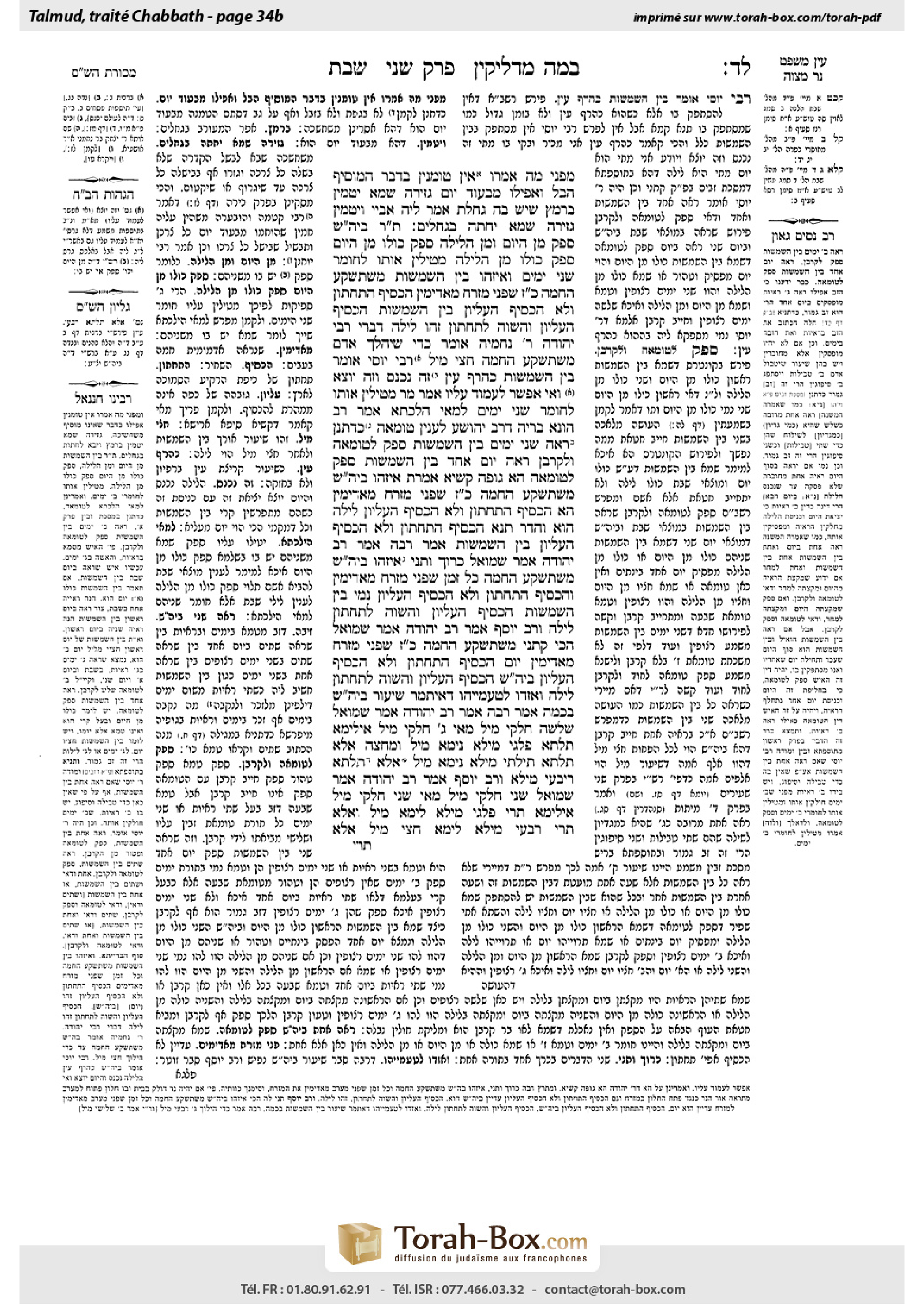
Shabbat 34b: Talmud study for Daf Yomi
Daf Yomi is the daily study of one Talmud folio. Explore 37 tractates with scans, Hebrew text, Sefaria English and AI-generated French translations where annotated.
Passage selection and English or AI-generated French translation are available where the scan has annotations. Daf Study is independent of Torah-Box and Sefaria.
Browse Shabbat · שבת · All tractatesShabbat 34b text and translations
This page of Shabbat includes the Aramaic text, an English translation and an AI-generated French translation, alongside the scan above.
שבת ל״ד ב · Aramaic and Hebrew text
מִפְּנֵי מָה אָמְרוּ אֵין טוֹמְנִין בְּדָבָר הַמּוֹסִיף הֶבֶל וַאֲפִילּוּ מִבְּעוֹד יוֹם? — גְּזֵירָה שֶׁמָּא יַטְמִין בְּרֶמֶץ שֶׁיֵּשׁ בָּהּ גַּחֶלֶת. אֲמַר לֵיהּ אַבָּיֵי: וְיַטְמִין? גְּזֵירָה שֶׁמָּא יְחַתֶּה בַּגֶּחָלִים.
תָּנוּ רַבָּנַן: בֵּין הַשְּׁמָשׁוֹת סָפֵק מִן הַיּוֹם וּמִן הַלַּיְלָה, סָפֵק כּוּלּוֹ מִן הַיּוֹם, סָפֵק כּוּלּוֹ מִן הַלַּיְלָה — מְטִילִין אוֹתוֹ לְחוֹמֶר שְׁנֵי יָמִים.
וְאֵיזֶהוּ בֵּין הַשְּׁמָשׁוֹת? — מִשֶּׁתִּשְׁקַע הַחַמָּה כָּל זְמַן שֶׁפְּנֵי מִזְרָח מַאֲדִימִין. הִכְסִיף הַתַּחְתּוֹן וְלֹא הִכְסִיף הָעֶלְיוֹן — בֵּין הַשְּׁמָשׁוֹת. הִכְסִיף הָעֶלְיוֹן וְהִשְׁוָה לַתַּחְתּוֹן — זֶהוּ לַיְלָה, דִּבְרֵי רַבִּי יְהוּדָה. רַבִּי נְחֶמְיָה אוֹמֵר: כְּדֵי שֶׁיְּהַלֵּךְ אָדָם מִשֶּׁתִּשְׁקַע הַחַמָּה חֲצִי מִיל. רַבִּי יוֹסִי אוֹמֵר: בֵּין הַשְּׁמָשׁוֹת כְּהֶרֶף עַיִן, זֶה נִכְנָס וְזֶה יוֹצֵא, וְאִי אֶפְשָׁר לַעֲמוֹד עָלָיו.
אָמַר מָר: מְטִילִין אוֹתוֹ לְחוֹמֶר שְׁנֵי יָמִים. לְמַאי הִלְכְתָא? אָמַר רַב הוּנָא בְּרֵיהּ דְּרַב יְהוֹשֻׁעַ לְעִנְיַן טוּמְאָה, כְּדִתְנַן: רָאָה שְׁנֵי יָמִים בֵּין הַשְּׁמָשׁוֹת — סָפֵק לַטּוּמְאָה וְלַקׇּרְבָּן. רָאָה יוֹם אֶחָד בֵּין הַשְּׁמָשׁוֹת — סָפֵק לַטּוּמְאָה.
הָא גּוּפַהּ קַשְׁיָא. אָמְרַתְּ אֵיזֶהוּ בֵּין הַשְּׁמָשׁוֹת — מִשֶּׁתִּשְׁקַע הַחַמָּה, כָּל זְמַן שֶׁפְּנֵי מִזְרָח מַאֲדִימִין. הָא הִכְסִיף הַתַּחְתּוֹן וְלֹא הִכְסִיף הָעֶלְיוֹן — לַיְלָה הוּא. וַהֲדַר תָּנֵי: הִכְסִיף הַתַּחְתּוֹן וְלֹא הִכְסִיף הָעֶלְיוֹן — בֵּין הַשְּׁמָשׁוֹת. אָמַר רַבָּה אָמַר רַב יְהוּדָה אָמַר שְׁמוּאֵל: כְּרוֹךְ וּתְנִי: אֵיזֶהוּ בֵּין הַשְּׁמָשׁוֹת — מִשֶּׁתִּשְׁקַע הַחַמָּה כָּל זְמַן שֶׁפְּנֵי מִזְרָח מַאֲדִימִין. וְהִכְסִיף הַתַּחְתּוֹן וְלֹא הִכְסִיף הָעֶלְיוֹן — נָמֵי בֵּין הַשְּׁמָשׁוֹת. הִכְסִיף הָעֶלְיוֹן וְהִשְׁוָה לַתַּחְתּוֹן — לַיְלָה. וְרַב יוֹסֵף אָמַר רַב יְהוּדָה אָמַר שְׁמוּאֵל, הָכִי קָתָנֵי: מִשֶּׁתִּשְׁקַע הַחַמָּה כָּל זְמַן שֶׁפְּנֵי מִזְרָח מַאֲדִימִין — יוֹם. הִכְסִיף הַתַּחְתּוֹן וְלֹא הִכְסִיף הָעֶלְיוֹן — בֵּין הַשְּׁמָשׁוֹת. הִכְסִיף הָעֶלְיוֹן וְהִשְׁוָה לַתַּחְתּוֹן — לַיְלָה.
וְאָזְדוּ לְטַעְמַיְיהוּ, דְּאִיתְּמַר: שִׁיעוּר בֵּין הַשְּׁמָשׁוֹת בְּכַמָּה? אָמַר רַבָּה אָמַר רַב יְהוּדָה אָמַר שְׁמוּאֵל: שְׁלֹשָׁה חֶלְקֵי מִיל. מַאי שְׁלֹשָׁה חֶלְקֵי מִיל? אִילֵימָא תְּלָתָא פַּלְגֵי מִילָא — נֵימָא מִיל וּמֶחֱצָה. אֶלָּא תְּלָתָא תִּילְתֵי מִילָא — נֵימָא מִיל. אֶלָּא: תְּלָתָא רִיבְעֵי מִילָא. וְרַב יוֹסֵף אָמַר רַב יְהוּדָה אָמַר שְׁמוּאֵל: שְׁנֵי חֶלְקֵי מִיל. מַאי שְׁנֵי חֶלְקֵי מִיל? אִילֵימָא תְּרֵי פַּלְגֵי מִילָא — לֵימָא מִיל. וְאֶלָּא תְּרֵי רִבְעֵי מִילָא — לֵימָא חֲצִי מִיל. אֶלָּא
Shabbat 34b · English translation
Why did the Sages say that one may not insulate hot water for Shabbat in something that adds heat, even while it is still day? It is a decree lest one come to cover it in hot ashes that contain a glowing ember. People may not differentiate between addition of heat by means of hot ashes and other additions of heat. Abaye said to him: Let him insulate it with hot ashes, what is the problem? Rava answered him: It is a decree lest one come to stoke the coals in order to make them burn on Shabbat and thereby violate a Torah prohibition.
The Sages taught a baraita which discusses the range of problems that arise with regard to the twilight period. Twilight is a period of uncertainty. It is uncertain whether it consists of both day and night, it is uncertain whether it is completely day, and it is uncertain whether it is completely night. Therefore, the Sages impose the stringencies of both days upon it. If there is a stringency that applies on either of the days, one is obligated to adhere to it during the twilight period.
Nevertheless, the definition of twilight is uncertain. And what is twilight? From when the sun sets, as long as the eastern face of the sky is reddened by the light of the sun. If the lower segment of the sky has lost its color, and the upper segment has not yet lost its color, that is the twilight period. If the upper segment has lost its color, and its color equals that of the lower one, it is night; this is the statement of Rabbi Yehuda. Rabbi Neḥemya says: The duration of the twilight period is the time it takes for a person to walk half a mil after the sun sets. Rabbi Yosei says: Twilight does not last for a quantifiable period of time; rather, it is like the blink of an eye: This, night, enters and that, day, leaves, and it is impossible to calculate it due to its brevity.
It was taught in the baraita that the Master said: The Sages impose the stringencies of both days upon twilight. The Gemara asks: With regard to what halakha was this stated? Rav Huna, son of Rav Yehoshua, said: With regard to the matter of ritual impurity, as we learned in a mishna: With regard to a zav who saw an emission for two consecutive days during twilight, it is unclear whether it should be considered as if he only saw the emission for a single day, as perhaps twilight of the first day was part of the following day, and twilight of the second day was part of the previous day; or, whether it should be considered as two days, attributing each twilight to either the previous or the following day; or, whether it should be considered three days, as it is possible to view the twilight period as two days. By Torah law, a zav who saw two emissions is ritually impure, and all of the stringencies of a zav apply to him. If he sees a third emission, he is liable to bring an offering as part of his purification ritual. Therefore, this zav, with regard to whom there is uncertainty whether he saw emissions for one day, two days, or three days, has uncertain status with regard to both ritual impurity and to sacrifice. If he saw an emission one day during twilight, he has uncertain status with regard to ritual impurity because it may be considered two days.
The Gemara comments on the baraita cited by the Gemara. This baraita is itself difficult, self-contradictory. Initially you said, what is twilight? From when the sun sets, as long as the eastern face of the sky is reddened by the light of the sun. By inference, if the bottom segment lost its color, and the upper one has not lost its color, it is night. And then the baraita taught: If the lower segment of the sky has lost its color, and the upper segment has not yet lost its color, that is the twilight period. There is an apparent internal contradiction in the baraita. Rabba said that Rav Yehuda said that Shmuel said: In order to resolve the contradiction, unify the two statements and teach it as follows: What is twilight? From when the sun sets, as long as the eastern face of the sky is reddened by the light of the sun. If the lower segment of the sky has lost its color and the upper segment has not yet lost its color, that is also the twilight period. Only if the upper segment lost its color, and it equals that of the lower one, is it night. And Rav Yosef said that Rav Yehuda said that Shmuel said otherwise: From when the sun sets, as long as the eastern face of the sky is reddened by the light of the sun, it is day. If the lower segment of the sky has lost its color, and the upper segment has not yet lost its color, that is the twilight period. If the upper segment lost its color and it equals that of the lower one, it is night.
And the Gemara remarks: In this dispute over the precise definition of twilight both Rabba and Rav Yosef follow their line of reasoning stated elsewhere. As it was stated: What is the measure of the duration of twilight? Rabba said that Rav Yehuda said that Shmuel said: The time it takes to walk three parts of a mil. The Gemara asks: What is the meaning of three parts of a mil? If you say that it refers to three halves of a mil, let him say a mil and a half. Rather, if you say that it means three-thirds of a mil, let him simply say one mil. Rather, it means three-quarters of a mil. And Rav Yosef said that Rav Yehuda said that Shmuel said: The duration of twilight is two parts of a mil. Again the Gemara asks: What is the meaning of two parts of a mil? If you say that it means two halves of a mil, let him simply say one mil. Rather, if you say that it means two-quarters of a mil, let him say instead: Half of a mil. Rather,
Shabbat 34b · Traduction française (IA)
Pourquoi les Sages ont-ils dit qu’on ne peut pas envelopper de l’eau chaude pour Chabbat dans un matériau qui ajoute de la chaleur, même tant qu’il fait encore jour ? C’est un décret, de peur qu’on ne la recouvre de cendres chaudes contenant une braise incandescente. On pourrait ne pas distinguer l’ajout de chaleur au moyen de cendres chaudes des autres façons d’ajouter de la chaleur. Abaye lui dit : Qu’on l’enveloppe donc de cendres chaudes ; quel est le problème ? Rava lui répondit : C’est un décret, de peur qu’on ne ravive les braises pour les faire brûler pendant Chabbat et qu’on ne transgresse ainsi une interdiction de la Torah.
Les Sages ont enseigné une baraïta qui examine les différents problèmes liés à la période du crépuscule. Le crépuscule est une période d’incertitude. On ne sait pas s’il comprend à la fois le jour et la nuit, s’il fait entièrement jour ou s’il fait entièrement nuit. C’est pourquoi les Sages lui appliquent les rigueurs des deux jours. Si une rigueur s’applique à l’un ou l’autre de ces jours, il faut s’y conformer pendant le crépuscule.
Néanmoins, la définition du crépuscule reste incertaine. Qu’est-ce que le crépuscule ? C’est la période qui commence au coucher du soleil, tant que la face orientale du ciel est rougie par la lumière du soleil. Si la partie inférieure du ciel a perdu sa couleur, tandis que la partie supérieure ne l’a pas encore perdue, c’est la période du crépuscule. Si la partie supérieure a perdu sa couleur et que celle-ci est devenue semblable à celle de la partie inférieure, c’est la nuit ; telle est l’opinion de Rabbi Yehouda. Rabbi Neḥemya dit : Le crépuscule dure le temps qu’il faut à une personne pour parcourir un demi-mil après le coucher du soleil. Rabbi Yosei dit : Le crépuscule ne dure pas une période mesurable ; il est plutôt comme un battement de paupière : la nuit entre et le jour s’en va, et il est impossible d’en calculer la durée tant elle est brève.
Il a été enseigné dans la baraïta que le Maître a dit : Les Sages appliquent au crépuscule les rigueurs des deux jours. La Guemara demande : À propos de quelle halakha cela a-t-il été dit ? Rav Houna, fils de Rav Yehoshoua, dit : À propos de l’impureté rituelle, comme nous l’avons appris dans une Michna : au sujet d’un zav qui a eu un écoulement pendant le crépuscule deux jours consécutifs, on ne sait pas s’il faut considérer qu’il n’a eu cet écoulement que pendant un seul jour, puisque le crépuscule du premier jour faisait peut-être partie du jour suivant et celui du deuxième jour du jour précédent ; s’il faut considérer qu’il s’agissait de deux jours, en attribuant chaque crépuscule soit au jour précédent, soit au jour suivant ; ou s’il faut considérer qu’il s’agissait de trois jours, car il est possible de considérer la période du crépuscule comme deux jours. Selon la Torah écrite, un zav qui a eu deux écoulements est rituellement impur, et toutes les rigueurs applicables à un zav s’appliquent à lui. S’il a un troisième écoulement, il est tenu d’apporter une offrande dans le cadre de son rite de purification. Ce zav, dont on ne sait pas s’il a eu des écoulements pendant un, deux ou trois jours, a donc un statut incertain tant du point de vue de l’impureté rituelle que de celui du sacrifice. S’il a eu un écoulement un jour pendant le crépuscule, son statut au regard de l’impureté rituelle est incertain, car cela peut être considéré comme deux jours.
La Guemara commente la baraïta qu’elle a citée. Cette baraïta présente elle-même une difficulté, car elle semble se contredire. Tu as d’abord dit : « Qu’est-ce que le crépuscule ? C’est la période qui commence au coucher du soleil, tant que la face orientale du ciel est rougie par la lumière du soleil. » On en déduit que si la partie inférieure a perdu sa couleur et que la partie supérieure ne l’a pas perdue, c’est la nuit. Or, la baraïta enseigne ensuite : « Si la partie inférieure du ciel a perdu sa couleur, tandis que la partie supérieure ne l’a pas encore perdue, c’est la période du crépuscule. » Il y a donc une contradiction apparente au sein de la baraïta. Rabba dit au nom de Rav Yehouda, qui dit au nom de Shmouel : Pour résoudre la contradiction, réunis les deux énoncés et enseigne-les ainsi : « Qu’est-ce que le crépuscule ? C’est la période qui commence au coucher du soleil, tant que la face orientale du ciel est rougie par la lumière du soleil. Si la partie inférieure du ciel a perdu sa couleur et que la partie supérieure ne l’a pas encore perdue, c’est également la période du crépuscule. Ce n’est que si la partie supérieure a perdu sa couleur et que celle-ci est devenue semblable à celle de la partie inférieure que c’est la nuit. » Rav Yossef dit au nom de Rav Yehouda, qui dit au nom de Shmouel, autrement : « À partir du coucher du soleil, tant que la face orientale du ciel est rougie par la lumière du soleil, c’est le jour. Si la partie inférieure du ciel a perdu sa couleur et que la partie supérieure ne l’a pas encore perdue, c’est la période du crépuscule. Si la partie supérieure a perdu sa couleur et que celle-ci est devenue semblable à celle de la partie inférieure, c’est la nuit. »
Et la Guemara fait remarquer que, dans cette controverse sur la définition précise du crépuscule, Rabba et Rav Yossef suivent chacun la ligne de raisonnement qu’ils ont exposée ailleurs. En effet, il a été enseigné : « Quelle est la durée du crépuscule ? » Rabba dit au nom de Rav Yehouda, qui dit au nom de Shmouel : « Le temps qu’il faut pour parcourir trois parts d’un mil. » La Guemara demande : Que signifie « trois parts d’un mil » ? Si tu dis qu’il s’agit de trois demi-mils, qu’il dise alors un mil et demi. Si tu dis plutôt qu’il s’agit de trois tiers de mil, qu’il dise simplement un mil. Il faut donc dire qu’il s’agit de trois quarts de mil. Rav Yossef dit au nom de Rav Yehouda, qui dit au nom de Shmouel : « Le crépuscule dure deux parts d’un mil. » La Guemara demande de nouveau : Que signifie « deux parts d’un mil » ? Si tu dis qu’il s’agit de deux demi-mils, qu’il dise simplement un mil. Si tu dis plutôt qu’il s’agit de deux quarts de mil, qu’il dise alors un demi-mil. Il faut donc dire que…
Traduction française générée par IA à partir de l’édition anglaise de Sefaria. Vérifie toujours un passage avec le texte source.
Text from Sefaria: William Davidson Edition - Vocalized Aramaic (CC BY NC); William Davidson Edition - English (CC BY NC).