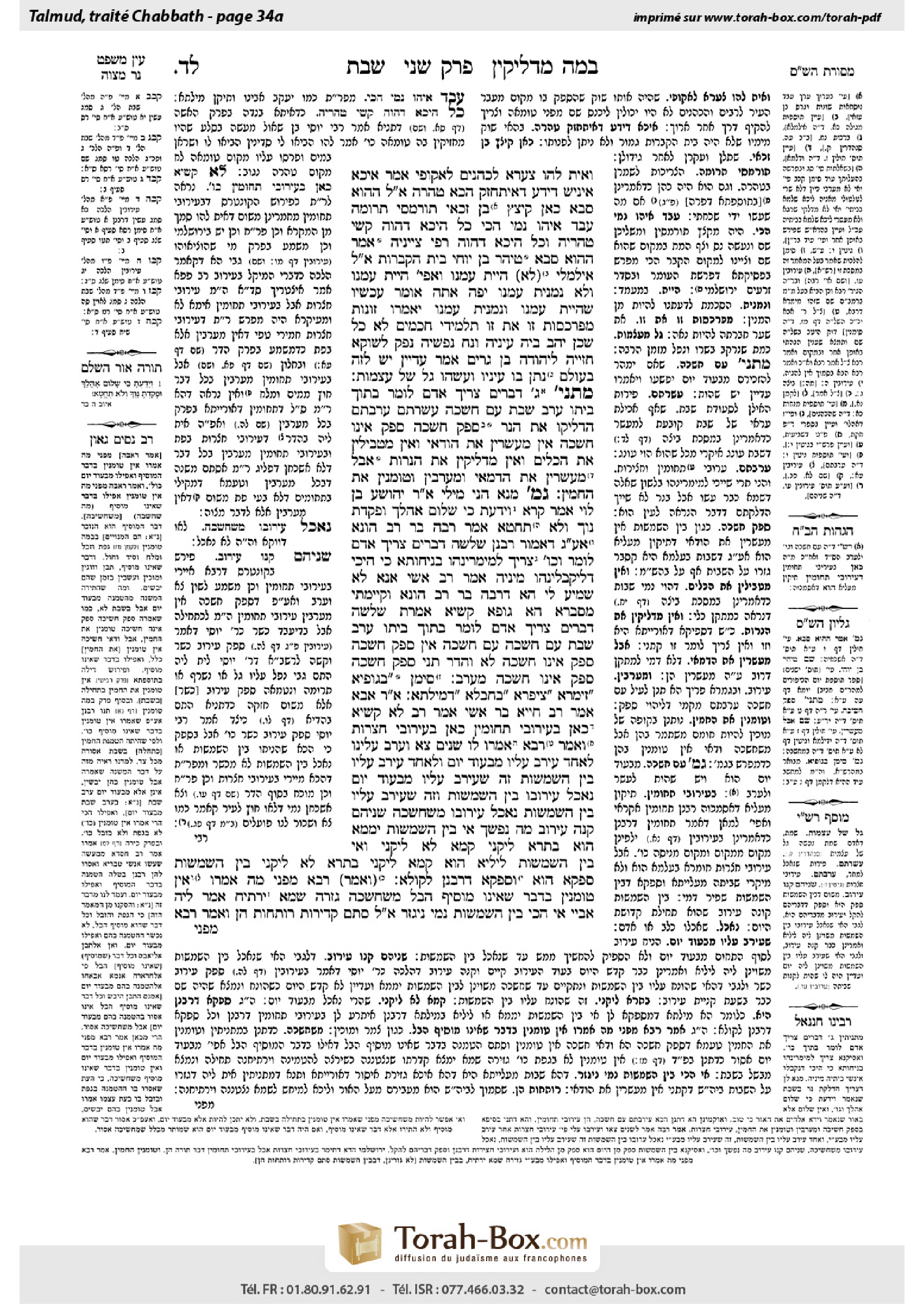
Shabbat 34a: Talmud study for Daf Yomi
Daf Yomi is the daily study of one Talmud folio. Explore 37 tractates with scans, Hebrew text, Sefaria English and AI-generated French translations where annotated.
Passage selection and English or AI-generated French translation are available where the scan has annotations. Daf Study is independent of Torah-Box and Sefaria.
Browse Shabbat · שבת · All tractatesShabbat 34a text and translations
This page of Shabbat includes the Aramaic text, an English translation and an AI-generated French translation, alongside the scan above.
שבת ל״ד א · Aramaic and Hebrew text
וְאִית לְהוּ צַעֲרָא לְכֹהֲנִים לְאַקּוֹפֵי. אֲמַר: אִיכָּא אִינִישׁ דְּיָדַע דְּאִיתַּחְזַק הָכָא טָהֳרָה? אֲמַר לֵיהּ הָהוּא סָבָא: כָּאן קִיצֵּץ בֶּן זַכַּאי תּוּרְמְסֵי תְּרוּמָה. עֲבַד אִיהוּ נָמֵי הָכִי, כָּל הֵיכָא דַּהֲוָה קְשֵׁי — טַהֲרֵיהּ, וְכָל הֵיכָא דַּהֲוָה רְפֵי — צַיְּינֵיהּ.
אֲמַר הָהוּא סָבָא: טִיהֵר בֶּן יוֹחַי בֵּית הַקְּבָרוֹת! אֲמַר לֵיהּ: אִילְמָלֵי לֹא הָיִיתָ עִמָּנוּ, וַאֲפִילּוּ הָיִיתָ עִמָּנוּ, וְלֹא נִמְנֵיתָ עִמָּנוּ — יָפֶה אַתָּה אוֹמֵר. עַכְשָׁיו שֶׁהָיִיתָ עִמָּנוּ, וְנִמְנֵיתָ עִמָּנוּ, יֹאמְרוּ: זוֹנוֹת מְפַרְכְּסוֹת זוֹ אֶת זוֹ, תַּלְמִידֵי חֲכָמִים לֹא כָּל שֶׁכֵּן?! יְהַב בֵּיהּ עֵינֵיהּ וְנָח נַפְשֵׁיהּ. נְפַק לְשׁוּקָא חַזְיֵיהּ לִיהוּדָה בֶּן גֵּרִים. אֲמַר: עֲדַיִין יֵשׁ לְזֶה בָּעוֹלָם? נָתַן בּוֹ עֵינָיו וְעָשָׂהוּ גַּל שֶׁל עֲצָמוֹת.
מַתְנִי׳ שְׁלֹשָׁה דְּבָרִים צָרִיךְ אָדָם לוֹמַר בְּתוֹךְ בֵּיתוֹ עֶרֶב שַׁבָּת עִם חֲשֵׁכָה: עִשַּׂרְתֶּם? עֵרַבְתֶּם? — הַדְלִיקוּ אֶת הַנֵּר. סָפֵק חֲשֵׁכָה סָפֵק אֵינוֹ חֲשֵׁכָה — אֵין מְעַשְּׂרִין אֶת הַוַּדַּאי, וְאֵין מַטְבִּילִין אֶת הַכֵּלִים, וְאֵין מַדְלִיקִין אֶת הַנֵּרוֹת. אֲבָל מְעַשְּׂרִין אֶת הַדְּמַאי, וּמְעָרְבִין, וְטוֹמְנִין אֶת הַחַמִּין.
גְּמָ׳ מְנָא הָנֵי מִילֵּי? אָמַר רַבִּי יְהוֹשֻׁעַ בֶּן לֵוִי: אָמַר קְרָא: ״וְיָדַעְתָּ כִּי שָׁלוֹם אָהֳלֶךָ וּפָקַדְתָּ נָוְךָ וְלֹא תֶחֱטָא״. אָמַר רַבָּה בַּר רַב הוּנָא: אַף עַל גַּב דַּאֲמוּר רַבָּנַן שְׁלֹשָׁה דְּבָרִים צָרִיךְ אָדָם לוֹמַר וְכוּ׳ — צְרִיךְ לְמֵימְרִינֵהוּ בְּנִיחוּתָא, כִּי הֵיכִי דְּלִיקַבְּלִינְהוּ מִינֵּיהּ. אָמַר רַב אָשֵׁי: אֲנָא לָא שְׁמִיעַ לִי הָא דְּרַבָּה בַּר רַב הוּנָא, וְקַיֵּימְתַּהּ מִסְּבָרָא.
הָא גוּפָא קַשְׁיָא: אָמְרַתְּ שְׁלֹשָׁה דְּבָרִים צָרִיךְ אָדָם לוֹמַר בְּתוֹךְ בֵּיתוֹ עֶרֶב שַׁבָּת עִם חֲשֵׁכָה. עִם חֲשֵׁכָה — אִין, סָפֵק חֲשֵׁכָה סָפֵק אֵינוֹ חֲשֵׁכָה — לָא. וַהֲדַר תָּנֵי: סָפֵק חֲשֵׁכָה סָפֵק אֵינוֹ חֲשֵׁכָה — מְעָרֵב.
סִימָן: בְּגוּפְיָא זִימְרָא צִיפְּרָא בְּחַבְלָא דְמֵילָתָא.
אָמַר רַבִּי אַבָּא אָמַר רַב חִיָּיא בַּר אָשֵׁי אָמַר רַב: לָא קַשְׁיָא, כָּאן בְּעֵירוּבֵי תְּחוּמִין, כָּאן בְּעֵירוּבֵי חֲצֵרוֹת.
וְאָמַר רָבָא: אָמְרוּ לוֹ שְׁנַיִם צֵא וְעָרֵב עָלֵינוּ, לְאֶחָד עֵירַב עָלָיו מִבְּעוֹד יוֹם, וּלְאֶחָד עֵירַב עָלָיו בֵּין הַשְּׁמָשׁוֹת — זֶה שֶׁעֵירַב עָלָיו מִבְּעוֹד יוֹם נֶאֱכַל עֵירוּבוֹ בֵּין הַשְּׁמָשׁוֹת, וְזֶה שֶׁעֵירַב עָלָיו בֵּין הַשְּׁמָשׁוֹת נֶאֱכַל עֵירוּבוֹ מִשֶּׁחָשֵׁכָה. שְׁנֵיהֶם קָנוּ עֵירוּב.
מָה נַפְשָׁךְ. אִי בֵּין הַשְּׁמָשׁוֹת יְמָמָא הוּא — בָּתְרָא לִיקְנֵי קַמָּא לָא לִיקְנֵי. וְאִי בֵּין הַשְּׁמָשׁוֹת לֵילְיָא הוּא — קַמָּא לִיקְנֵי בָּתְרָא לָא לִיקְנֵי! בֵּין הַשְּׁמָשׁוֹת סְפֵקָא הוּא, וּסְפֵקָא דְרַבָּנַן לְקוּלָּא.
[אָמַר] רָבָא: מִפְּנֵי מָה אָמְרוּ אֵין טוֹמְנִין בְּדָבָר שֶׁאֵינוֹ מוֹסִיף הֶבֶל מִשֶּׁחָשֵׁכָה? — גְּזֵרָה שֶׁמָּא יַרְתִּיחַ. אֲמַר לֵיהּ אַבָּיֵי: אִי הָכִי, בֵּין הַשְּׁמָשׁוֹת נָמֵי נִיגְזַר?! אֲמַר לֵיהּ: סְתָם קְדֵירוֹת רוֹתְחוֹת הֵן.
וְאָמַר רָבָא:
Shabbat 34a · English translation
and the priests are troubled by being forced to circumvent it, as it is prohibited for them to become ritually impure from contact with a corpse. There was suspicion, but no certainty, that a corpse was buried there. Therefore, they were unable to definitively determine its status. Rabbi Shimon said: Is there a person who knows that there was a presumption of ritual purity here? Is there anyone who remembers a time when this place was not considered ritually impure, or that at least part of it was considered to be ritually pure? An Elder said to him: Here ben Zakkai planted and cut the teruma of lupines. In this marketplace Rabbi Yoḥanan ben Zakkai, who himself was a priest, once planted lupines that were given to him as teruma. On that basis, the conclusion can be drawn that it was definitely ritually pure. Rabbi Shimon, like Jacob, also did so and took steps to improve the city and examined the ground (Tosafot). Everywhere that the ground was hard, he pronounced it ritually pure as there was certainly no corpse there, and every place that the ground was soft, he marked it indicating that perhaps a corpse was buried there. In that way, he purified the marketplace so that even priests could walk through it.
A certain Elder said in ridicule and surprise: Ben Yoḥai purified the cemetery. Rabbi Shimon got angry and said to him: Had you not been with us, and even had you been with us and were not counted with us in rendering this ruling, what you say is fine. You could have said that you were unaware of my intention or that you did not agree or participate in this decision. Now that you were with us and were counted with us in rendering this ruling, you will cause people to say that Sages are unwilling to cooperate with one another. They will say: If competing prostitutes still apply makeup to each other to help one another look beautiful, all the more so that Torah scholars should cooperate with each other. He directed his eyes toward him and the Elder died. Rabbi Shimon went out to the marketplace and he saw Yehuda, son of converts, who was the cause of this entire incident. Rabbi Shimon, said: This one still has a place in the world? He directed his eyes toward him and turned him into a pile of bones.
MISHNA: There are three things a person must say in his home on Shabbat eve at nightfall and not before. The mishna elaborates: He should ask the members of his household, have you tithed the crop that required tithing? Have you placed the eiruv for joining the courtyards and joining the Shabbat borders? If you have done so, light the lamp in honor of Shabbat. The Sages stated a principle: If the time arrives on Friday when there is uncertainty whether it is nightfall and uncertainty whether it is not yet nightfall, one may not tithe the crop that has definitely not been tithed, and one may not immerse ritually impure vessels in a ritual bath to render them ritually pure, and one may not light the Shabbat lights. However, one may tithe demai, doubtfully tithed produce, which must be tithed due to mere suspicion. And one may place an eiruv and insulate the hot water to be used on Shabbat.
GEMARA: The Gemara attempts to clarify: From where are these matters, that one must ask these questions in his home at nightfall of Shabbat, derived? Rabbi Yehoshua ben Levi said: As the verse said: “And you shall know that your tent is in peace; and you shall visit your habitation, and shall not sin” (Job 5:24). From here it is derived that one should visit his habitation, i.e., ask in his home, so that he will not come to sin. Rabba bar Rav Huna said: Although the Sages said that there are three things a person should, indeed he is required to, say in his home on Shabbat eve at nightfall, one must say them calmly so that the members of his household will accept them from him. If he says them harshly, his family members may mislead him and cause him to sin. Rav Ashi said: I did not hear this halakha of Rabba bar Rav Huna, but I fulfilled it based on my own reasoning.
The Gemara asks: This mishna itself is difficult, as it contains an internal contradiction. On the one hand, you stated initially that there are three things a person must say in his home before Shabbat at nightfall, and this means: At nightfall, i.e., before nightfall, yes, he should say those things; when there is uncertainty whether it is nightfall and uncertainty whether it is not yet nightfall, no, he should not say them. Even if one were to ask then, it is no longer permitted to correct these matters. And then it taught: When there is uncertainty whether it is nightfall and uncertainty whether it is not yet nightfall, one may place an eiruv. One may correct the situation even then. Why did the mishna restrict asking these questions to an earlier time?
Incidentally, prior to answering this question, the Gemara lists all of the other halakhot in tractate Shabbat stated by the Sage who answers the question, with the mnemonic: Self, pruning, bird, cord, silk.
Rabbi Abba said that Rabbi Ḥiyya bar Ashi said that Rav said: This is not difficult and there is no contradiction here. Here, at the beginning of the mishna, where it indicates that the eiruv can only be placed while it is still day, it is referring to the joining of Shabbat boundaries, which is based on a Torah law. Therefore, one must place this eiruv while it is definitely day. And here, where the mishna said that it is permitted even when it is uncertain whether or not it is already nighttime, it is referring to the joining of courtyards, which is more lenient and based merely on a stringency.
In connection to this, the Gemara cites the halakha that Rava said in order to emphasize the rabbinic aspect of the halakhot of eiruv: One to whom two people said: Go and place an eiruv, a joining of courtyards (Rabbeinu Ḥananel), for us. For one of them he placed an eiruv while it was still day, and for one he placed an eiruv at twilight, when it is uncertain whether it is day or night. The one for whom he placed an eiruv while it was still day had his eiruv eaten during twilight, and the one for whom he placed an eiruv during twilight had his eiruv eaten after nightfall. The principle is as follows: Whether or not an eiruv takes effect is determined at the moment that Shabbat begins. If one placed the eiruv beforehand, and it remains intact at the moment Shabbat begins, the eiruv is in effect. However, if the eiruv that was placed at the appropriate time was eaten during twilight, it is problematic. Twilight is a period of uncertainty. There is uncertainty whether it is day, and consequently the eiruv was not in place at the moment that Shabbat began, or whether it is night, and it was in place. In the latter case, there is still uncertainty as to whether or not the eiruv was in place prior to Shabbat, so that it could take effect at all. In that case, Rava ruled that both of them acquired the eiruv.
The Gemara is surprised by this: Whichever way you look at it, this ruling is difficult. If the twilight period is considered day, let the latter one acquire his eiruv, but let the first one not acquire his because his eiruv was eaten while it was still day. And if the twilight period is night, let the first one acquire his eiruv, but let the latter one not acquire his eiruv because his was not placed before Shabbat. In any event, it is impossible for the eiruv in both of these cases to be valid. The Gemara answers this according to Rava’s position: The status of twilight is uncertain, as it is unknown whether it is day, or night, or both, and uncertainty in the case of a rabbinic ordinance is ruled leniently. Therefore, in both cases the eiruv is acquired.
And Rava said: Why did they say that one may not insulate hot water even in something that does not add heat, but only retains the pre-existing heat, from nightfall on Friday? It is a decree lest one come to boil the pot on Shabbat. Abaye said to him: If so, if it is due to concern that one may boil it, then during twilight we should also issue a decree and prohibit insulating in something that does not add heat. Rava said to him: During twilight, there is no reason to be concerned because at that time most pots are boiling, as they have just been taken off of the fire. Later at night the pots cool down and it is conceivable that one may come to boil them in order to restore the heat.
And Rava said:
Shabbat 34a · Traduction française (IA)
et les prêtres sont contrariés à l’idée d’être contraints de contourner cet endroit, car il leur est interdit de contracter une impureté rituelle au contact d’un cadavre. On soupçonnait qu’un cadavre y était enterré, sans en avoir la certitude. Ils ne pouvaient donc pas en déterminer définitivement le statut. Rabbi Shimon dit : Quelqu’un sait-il qu’il y avait ici une présomption de pureté rituelle ? Quelqu’un se souvient-il d’une époque où cet endroit n’était pas considéré comme rituellement impur, ou du moins où une partie de celui-ci était considérée comme rituellement pure ? Un ancien lui dit : Ici, ben Zakkaï a planté et récolté la terouma de lupins. Sur cette place du marché, Rabbi Yoḥanan ben Zakkaï, qui était lui-même prêtre, avait un jour planté des lupins qu’on lui avait donnés comme terouma. On peut en conclure que l’endroit était certainement rituellement pur. Rabbi Shimon fit de même, comme Jacob, et entreprit d’améliorer la ville en examinant le sol (Tosafot). Partout où le sol était dur, il déclara l’endroit rituellement pur, puisqu’il n’y avait certainement aucun cadavre ; partout où le sol était meuble, il le marqua pour signaler qu’un cadavre y était peut-être enterré. Ainsi, il purifia la place du marché afin que même les prêtres puissent la traverser.
Un certain ancien dit avec moquerie et étonnement : Ben Yoḥai a purifié le cimetière ! Rabbi Shimon se mit en colère et lui dit : Si tu n’avais pas été avec nous, ou même si tu avais été avec nous sans être compté parmi nous lorsque nous avons rendu cette décision, ce que tu dis serait acceptable. Tu aurais pu dire que tu ignorais mon intention, que tu n’étais pas d’accord ou que tu n’avais pas participé à cette décision. Mais maintenant que tu étais avec nous et que tu as été compté parmi nous lorsque nous avons rendu cette décision, tu vas faire dire aux gens que les Sages refusent de coopérer entre eux. Ils diront : Si des prostituées rivales se maquillent tout de même l’une l’autre pour s’aider à paraître belles, à plus forte raison les érudits de la Torah devraient-ils coopérer entre eux. Il posa les yeux sur lui, et l’ancien mourut. Rabbi Shimon sortit sur la place du marché et vit Yehuda, fils de convertis, qui était à l’origine de toute cette affaire. Rabbi Shimon dit : Celui-là a-t-il encore sa place dans le monde ? Il posa les yeux sur lui et le transforma en un tas d’ossements.
MICHNA : Trois choses doivent être dites par une personne chez elle, à la tombée de la nuit de la veille du Chabbat, et pas avant. La Michna précise : Elle doit demander aux membres de son foyer : « Avez-vous prélevé la dîme sur les produits qui doivent être soumis à la dîme ? Avez-vous établi l’érouv pour réunir les cours et l’érouv pour les limites du Chabbat ? » Si vous l’avez fait, allumez la lampe en l’honneur du Chabbat. Les Sages ont énoncé un principe : lorsque, le vendredi, vient un moment où l’on ne sait pas avec certitude si la nuit est tombée ou si le jour n’est pas encore achevé, on ne peut pas prélever la dîme sur des produits dont on sait qu’ils n’ont pas été soumis à la dîme ; on ne peut pas non plus immerger des ustensiles rituellement impurs dans un mikvé pour les rendre rituellement purs, ni allumer les lumières du Chabbat. Cependant, on peut prélever la dîme sur du demaï, c’est-à-dire des produits dont le prélèvement de la dîme est incertain et qui doivent être soumis à la dîme par simple soupçon. On peut aussi établir un érouv et isoler l’eau chaude destinée au Chabbat.
GUEMARA : La Guemara cherche à préciser : De quel verset déduit-on qu’il faut poser ces questions chez soi à la tombée de la nuit du Chabbat ? Rabbi Yehoshua ben Levi dit : Comme le dit le verset : « Tu sauras que ta tente est en paix ; tu visiteras ta demeure, et tu ne pécheras pas » (Job 5,24). On en déduit qu’il faut visiter sa demeure, c’est-à-dire poser des questions chez soi, afin de ne pas en venir à pécher. Rabba bar Rav Huna dit : Bien que les Sages aient dit qu’il y a trois choses qu’une personne doit, et est effectivement tenue de, dire chez elle à la tombée de la nuit de la veille du Chabbat, elle doit les dire calmement, afin que les membres de son foyer les acceptent. Si elle les dit durement, les membres de sa famille risquent de l’induire en erreur et de la faire pécher. Rav Ashi dit : Je n’avais pas entendu cette halakha de Rabba bar Rav Huna, mais je l’ai observée de mon propre chef.
La Guemara demande : Cette Michna elle-même pose problème, car elle contient une contradiction interne. D’une part, tu as dit au début qu’il y a trois choses qu’une personne doit dire chez elle avant le Chabbat, à la tombée de la nuit. Cela signifie qu’à la tombée de la nuit, c’est-à-dire avant la nuit, oui, elle doit dire ces choses ; mais lorsqu’on ne sait pas avec certitude si la nuit est tombée ou si le jour n’est pas encore achevé, non, elle ne doit pas les dire. Même si elle posait alors ces questions, il ne serait déjà plus permis de remédier à ces situations. Pourtant, la Michna enseigne ensuite que, lorsqu’on ne sait pas avec certitude si la nuit est tombée ou si le jour n’est pas encore achevé, on peut établir un érouv. On peut donc remédier à la situation même à ce moment-là. Pourquoi la Michna limite-t-elle à un moment antérieur le fait de poser ces questions ?
À titre incident, avant de répondre à cette question, la Guemara énumère toutes les autres halakhot du traité Chabbat énoncées par le Sage qui répond à la question, à l’aide du moyen mnémotechnique suivant : soi, élagage, oiseau, corde, soie.
Rabbi Abba dit au nom de Rabbi Ḥiyya bar Ashi, qui dit au nom de Rav : Il n’y a là aucune difficulté ni contradiction. Au début de la Michna, où il est indiqué que l’érouv ne peut être établi que tant qu’il fait encore jour, il s’agit de l’érouv pour les limites du Chabbat, qui relève d’une loi de la Torah. Cet érouv doit donc être établi alors qu’il fait encore certainement jour. En revanche, lorsque la Michna dit que cela est permis même si l’on ne sait pas avec certitude si la nuit est déjà tombée, il s’agit de l’érouv des cours, qui est plus souple et ne repose que sur une mesure de rigueur.
À ce propos, la Guemara cite la halakha enseignée par Rava afin de souligner l’aspect rabbinique des lois relatives à l’érouv : deux personnes dirent à quelqu’un : « Va établir pour nous un érouv, un érouv des cours (Rabbeinu Ḥananel). » Il établit l’érouv de l’un alors qu’il faisait encore jour, et celui de l’autre au crépuscule, moment où l’on ne sait pas avec certitude s’il fait jour ou nuit. L’érouv de la personne pour qui il l’avait établi alors qu’il faisait encore jour fut mangé au crépuscule ; celui de la personne pour qui il l’avait établi au crépuscule fut mangé après la tombée de la nuit. Le principe est le suivant : la validité de l’érouv se détermine au moment où le Chabbat commence. Si l’érouv a été établi auparavant et qu’il est encore intact au début du Chabbat, il est valable. Toutefois, si l’érouv établi au moment approprié a été mangé au crépuscule, la situation est problématique. Le crépuscule est une période d’incertitude : on ne sait pas s’il fait encore jour, auquel cas l’érouv n’était pas en place au début du Chabbat, ou s’il fait nuit, auquel cas il était en place. Dans ce dernier cas, on ne sait toujours pas avec certitude si l’érouv était en place avant le Chabbat, condition nécessaire pour qu’il puisse prendre effet. Dans ce cas, Rava trancha que les deux personnes avaient acquis l’érouv.
La Guemara s’étonne : Quelle que soit la manière dont on considère la question, cette décision pose problème. Si le crépuscule est considéré comme faisant partie du jour, que la seconde personne acquière son érouv, mais que la première ne l’acquière pas, puisque son érouv a été mangé alors qu’il faisait encore jour. Et si le crépuscule est considéré comme la nuit, que la première personne acquière son érouv, mais que la seconde ne l’acquière pas, puisque son érouv n’a pas été établi avant le Chabbat. Dans tous les cas, il est impossible que l’érouv soit valable dans ces deux situations. La Guemara répond selon la position de Rava : le statut du crépuscule est incertain, car on ne sait pas s’il s’agit du jour, de la nuit ou des deux ; or, en cas d’incertitude concernant une ordonnance rabbinique, on tranche avec indulgence. Par conséquent, dans les deux cas, l’érouv est acquis.
Et Rava dit : Pourquoi a-t-on dit qu’à partir de la tombée de la nuit du vendredi, on ne peut pas isoler l’eau chaude, même dans un matériau qui n’ajoute pas de chaleur mais ne fait que conserver celle qui est déjà présente ? C’est un décret, de crainte qu’on ne vienne à faire bouillir la marmite pendant le Chabbat. Abaye lui dit : Si tel est le cas, si cette interdiction est motivée par la crainte qu’on fasse bouillir la marmite, nous devrions également édicter un décret au crépuscule et interdire de l’isoler dans un matériau qui n’ajoute pas de chaleur. Rava lui répondit : Au crépuscule, il n’y a pas lieu de s’inquiéter, car la plupart des marmites sont alors en train de bouillir, puisqu’elles viennent d’être retirées du feu. Plus tard dans la nuit, les marmites refroidissent, et l’on peut concevoir que quelqu’un les fasse bouillir pour les réchauffer.
Et Rava dit :
Traduction française générée par IA à partir de l’édition anglaise de Sefaria. Vérifie toujours un passage avec le texte source.
Text from Sefaria: William Davidson Edition - Vocalized Aramaic (CC BY NC); William Davidson Edition - English (CC BY NC).