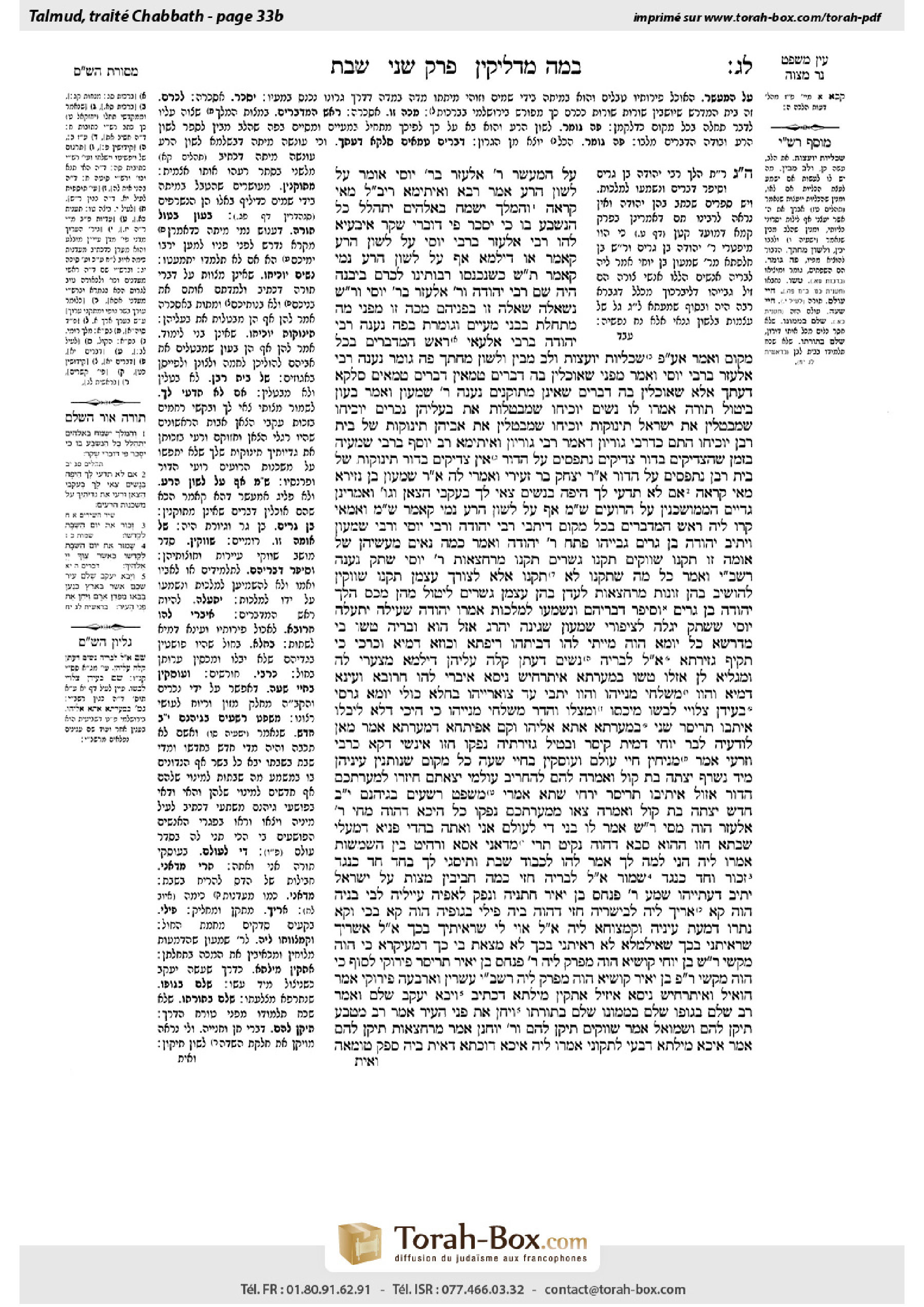
Shabbat 33b: Talmud study for Daf Yomi
Daf Yomi is the daily study of one Talmud folio. Explore 37 tractates with scans, Hebrew text, Sefaria English and AI-generated French translations where annotated.
Passage selection and English or AI-generated French translation are available where the scan has annotations. Daf Study is independent of Torah-Box and Sefaria.
Browse Shabbat · שבת · All tractatesShabbat 33b text and translations
This page of Shabbat includes the Aramaic text, an English translation and an AI-generated French translation, alongside the scan above.
שבת ל״ג ב · Aramaic and Hebrew text
עַל הַמַּעֲשֵׂר. רַבִּי אֶלְעָזָר בְּרַבִּי יוֹסֵי אוֹמֵר: עַל לָשׁוֹן הָרָע. אָמַר רָבָא וְאִיתֵּימָא רַבִּי יְהוֹשֻׁעַ בֶּן לֵוִי: מַאי קְרָאָה — ״וְהַמֶּלֶךְ יִשְׂמַח בֵּאלֹהִים יִתְהַלֵּל כׇּל הַנִּשְׁבָּע בּוֹ כִּי יִסָּכֵר פִּי דוֹבְרֵי שָׁקֶר״.
אִיבַּעְיָא לְהוּ: רַבִּי אֶלְעָזָר בְּרַבִּי יוֹסֵי עַל לָשׁוֹן הָרָע קָאָמַר, אוֹ דִילְמָא אַף עַל לָשׁוֹן הָרָע נָמֵי קָאָמַר? תָּא שְׁמַע: כְּשֶׁנִּכְנְסוּ רַבּוֹתֵינוּ לַכֶּרֶם בְּיַבְנֶה הָיָה שָׁם רַבִּי יְהוּדָה וְרַבִּי אֶלְעָזָר בְּרַבִּי יוֹסֵי וְרַבִּי שִׁמְעוֹן נִשְׁאֲלָה שְׁאֵלָה זוֹ בִּפְנֵיהֶם: מַכָּה זוֹ, מִפְּנֵי מָה מַתְחֶלֶת בִּבְנֵי מֵעַיִים וְגוֹמֶרֶת בַּפֶּה? נַעֲנָה רַבִּי יְהוּדָה בְּרַבִּי אִלְעַאי ״רֹאשׁ הַמְדַבְּרִים בְּכָל מָקוֹם״ וְאָמַר: אַף עַל פִּי שֶׁכְּלָיוֹת יוֹעֲצוֹת, וְלֵב מֵבִין, וְלָשׁוֹן מְחַתֵּךְ — פֶּה גּוֹמֵר. נַעֲנָה רַבִּי אֶלְעָזָר בְּרַבִּי יוֹסֵי וְאָמַר: מִפְּנֵי שֶׁאוֹכְלִין בָּהּ דְּבָרִים טְמֵאִין. דְּבָרִים טְמֵאִים סָלְקָא דַּעְתָּךְ? אֶלָּא שֶׁאוֹכְלִין בָּהּ דְּבָרִים שֶׁאֵינָן מְתוּקָּנִים. נַעֲנָה רַבִּי שִׁמְעוֹן וְאָמַר: בַּעֲוֹן בִּיטּוּל תּוֹרָה.
אָמְרוּ לוֹ: נָשִׁים יוֹכִיחוּ! — שֶׁמְּבַטְּלוֹת אֶת בַּעֲלֵיהֶן. גּוֹיִם יוֹכִיחוּ! — שֶׁמְּבַטְּלִין אֶת יִשְׂרָאֵל. תִּינוֹקוֹת יוֹכִיחוּ! — שֶׁמְּבַטְּלִין אֶת אֲבִיהֶן. תִּינוֹקוֹת שֶׁל בֵּית רַבָּן יוֹכִיחוּ!
הָתָם כִּדְרַבִּי גּוּרְיוֹן, דְּאָמַר רַבִּי גּוּרְיוֹן וְאִיתֵּימָא רַב יוֹסֵף בְּרַבִּי שְׁמַעְיָה: בִּזְמַן שֶׁהַצַּדִּיקִים בַּדּוֹר — צַדִּיקִים נִתְפָּסִים עַל הַדּוֹר, אֵין צַדִּיקִים בַּדּוֹר — תִּינוֹקוֹת שֶׁל בֵּית רַבָּן נִתְפָּסִים עַל הַדּוֹר. אָמַר רַבִּי יִצְחָק בַּר זְעֵירִי, וְאָמְרִי לַהּ אָמַר רַבִּי שִׁמְעוֹן בֶּן נְזִירָא: מַאי קְרָאָה — ״אִם לֹא תֵדְעִי לָךְ הַיָּפָה בַּנָּשִׁים צְאִי לָךְ בְּעִקְבֵי הַצֹּאן וְגוֹ׳״, וְאָמְרִינַן: גְּדָיִים הַמְמוּשְׁכָּנִין עַל הָרוֹעִים. שְׁמַע מִינַּהּ: אַף עַל לָשׁוֹן הָרָע נָמֵי קָאָמַר — שְׁמַע מִינַּהּ.
וְאַמַּאי קָרוּ לֵיהּ ״רֹאשׁ הַמְדַבְּרִים בְּכָל מָקוֹם״? דְּיָתְבִי רַבִּי יְהוּדָה וְרַבִּי יוֹסֵי וְרַבִּי שִׁמְעוֹן, וְיָתֵיב יְהוּדָה בֶּן גֵּרִים גַּבַּיְיהוּ. פָּתַח רַבִּי יְהוּדָה וְאָמַר: כַּמָּה נָאִים מַעֲשֵׂיהֶן שֶׁל אוּמָּה זוֹ: תִּקְּנוּ שְׁוָוקִים, תִּקְּנוּ גְּשָׁרִים, תִּקְנוּ מֶרְחֲצָאוֹת. רַבִּי יוֹסֵי שָׁתַק. נַעֲנָה רַבִּי שִׁמְעוֹן בֶּן יוֹחַאי וְאָמַר: כׇּל מַה שֶּׁתִּקְּנוּ, לֹא תִּקְּנוּ אֶלָּא לְצוֹרֶךְ עַצְמָן. תִּקְּנוּ שְׁוָוקִין — לְהוֹשִׁיב בָּהֶן זוֹנוֹת, מֶרְחֲצָאוֹת — לְעַדֵּן בָּהֶן עַצְמָן, גְּשָׁרִים — לִיטּוֹל מֵהֶן מֶכֶס. הָלַךְ יְהוּדָה בֶּן גֵּרִים וְסִיפֵּר דִּבְרֵיהֶם, וְנִשְׁמְעוּ לַמַּלְכוּת. אָמְרוּ: יְהוּדָה שֶׁעִילָּה — יִתְעַלֶּה. יוֹסֵי שֶׁשָּׁתַק — יִגְלֶה לְצִיפּוֹרִי. שִׁמְעוֹן שֶׁגִּינָּה — יֵהָרֵג.
אֲזַל הוּא וּבְרֵיהּ, טְשׁוֹ בֵּי מִדְרְשָׁא. כׇּל יוֹמָא הֲוָה מַתְיָא לְהוּ דְּבֵיתְהוּ רִיפְתָּא וְכוּזָא דְמַיָּא וְכָרְכִי. כִּי תְּקֵיף גְּזֵירְתָא אֲמַר לֵיהּ לִבְרֵיהּ: נָשִׁים דַּעְתָּן קַלָּה עֲלֵיהֶן, דִילְמָא מְצַעֲרִי לַהּ וּמְגַלְּיָא לַן. אֲזַלוּ טְשׁוֹ בִּמְעָרְתָּא. אִיתְרְחִישׁ נִיסָּא אִיבְּרִי לְהוּ חָרוּבָא וְעֵינָא דְמַיָּא, וַהֲווֹ מַשְׁלְחִי מָנַיְיהוּ וַהֲווֹ יָתְבִי עַד צַוְּארַיְיהוּ בְּחָלָא. כּוּלֵּי יוֹמָא גָּרְסִי. בְּעִידָּן צַלּוֹיֵי לָבְשִׁי מִיכַּסּוּ וּמְצַלּוּ, וַהֲדַר מַשְׁלְחִי מָנַיְיהוּ כִּי הֵיכִי דְּלָא לִיבְלוּ. אִיתִּיבוּ תְּרֵיסַר שְׁנֵי בִּמְעָרְתָּא. אֲתָא אֵלִיָּהוּ וְקָם אַפִּיתְחָא דִמְעָרְתָּא, אֲמַר: מַאן לוֹדְעֵיהּ לְבַר יוֹחַי דְּמִית קֵיסָר וּבְטִיל גְּזֵירְתֵיהּ.
נְפַקוּ, חֲזוֹ אִינָשֵׁי דְּקָא כָּרְבִי וְזָרְעִי, אָמְרִין: מַנִּיחִין חַיֵּי עוֹלָם וְעוֹסְקִין בְּחַיֵּי שָׁעָה. כׇּל מָקוֹם שֶׁנּוֹתְנִין עֵינֵיהֶן מִיָּד נִשְׂרָף. יָצְתָה בַּת קוֹל וְאָמְרָה לָהֶם: לְהַחֲרִיב עוֹלָמִי יְצָאתֶם?! חִיזְרוּ לִמְעָרַתְכֶם! הֲדוּר אֲזוּל אִיתִּיבוּ תְּרֵיסַר יַרְחֵי שַׁתָּא. אָמְרִי: מִשְׁפַּט רְשָׁעִים בְּגֵיהִנָּם שְׁנֵים עָשָׂר חֹדֶשׁ. יָצְתָה בַּת קוֹל וְאָמְרָה: צְאוּ מִמְּעָרַתְכֶם! נְפַקוּ. כָּל הֵיכָא דַּהֲוָה מָחֵי רַבִּי אֶלְעָזָר, הֲוָה מַסֵּי רַבִּי שִׁמְעוֹן. אָמַר לוֹ: בְּנִי, דַּי לָעוֹלָם אֲנִי וְאַתָּה.
בַּהֲדֵי פַּנְיָא דְּמַעֲלֵי שַׁבְּתָא חֲזוֹ הָהוּא סָבָא דַּהֲוָה נָקֵיט תְּרֵי מַדָּאנֵי אָסָא וְרָהֵיט בֵּין הַשְּׁמָשׁוֹת. אֲמַרוּ לֵיהּ: הָנֵי לְמָה לָךְ? אֲמַר לְהוּ: לִכְבוֹד שַׁבָּת. וְתִיסְגֵּי לָךְ בְּחַד! — חַד כְּנֶגֶד ״זָכוֹר״ וְחַד כְּנֶגֶד ״שָׁמוֹר״. אֲמַר לֵיהּ לִבְרֵיהּ: חֲזִי כַּמָּה חֲבִיבִין מִצְוֹת עַל יִשְׂרָאֵל. אִיְּתִיבָה דַּעְתַּיְיהוּ.
שְׁמַע רַבִּי פִּנְחָס בֶּן יָאִיר חַתְנֵיהּ וּנְפַק לְאַפֵּיהּ. עַיְּילֵיהּ לְבֵי בָנֵי, הֲוָה קָא אָרֵיךְ לֵיהּ לְבִישְׂרֵיהּ. חֲזָא דַּהֲוָה בֵּיהּ פִּילֵי בְּגוּפֵיהּ. הֲוָה קָא בָכֵי וְקָא נָתְרָן דִּמְעָת עֵינֵיהּ וְקָמְצַוְּחָא לֵיהּ. אָמַר לוֹ: אוֹי לִי שֶׁרְאִיתִיךָ בְּכָךְ. אָמַר לוֹ: אַשְׁרֶיךָ שֶׁרְאִיתַנִי בְּכָךְ, שֶׁאִילְמָלֵא לֹא רְאִיתַנִי בְּכָךְ — לֹא מָצָאתָ בִּי כָּךְ. דְּמֵעִיקָּרָא כִּי הֲוָה מַקְשֵׁי רַבִּי שִׁמְעוֹן בֶּן יוֹחַי קוּשְׁיָא, הֲוָה מְפָרֵק לֵיהּ רַבִּי פִּנְחָס בֶּן יָאִיר תְּרֵיסַר פֵּירוּקֵי. לְסוֹף, כִּי הֲוָה מַקְשֵׁי רַבִּי פִּנְחָס בֶּן יָאִיר קוּשְׁיָא — הֲוָה מְפָרֵק לֵיהּ רַבִּי שִׁמְעוֹן בֶּן יוֹחַי עֶשְׂרִין וְאַרְבְּעָה פֵּירוּקֵי.
אֲמַר: הוֹאִיל וְאִיתְרְחִישׁ נִיסָּא אֵיזִיל אַתְקֵין מִילְּתָא. דִּכְתִיב: ״וַיָּבֹא יַעֲקֹב שָׁלֵם״, וְאָמַר רַב: שָׁלֵם בְּגוּפוֹ, שָׁלֵם בְּמָמוֹנוֹ, שָׁלֵם בְּתוֹרָתוֹ. ״וַיִּחַן אֶת פְּנֵי הָעִיר״, אָמַר רַב: מַטְבֵּעַ תִּיקֵּן לָהֶם, וּשְׁמוּאֵל אָמַר: שְׁוָוקִים תִּיקֵּן לָהֶם, וְרַבִּי יוֹחָנָן אָמַר: מֶרְחֲצָאוֹת תִּיקֵּן לָהֶם. אֲמַר: אִיכָּא מִילְּתָא דְּבָעֵי לְתַקּוֹנֵי? אֲמַרוּ לֵיהּ: אִיכָּא דּוּכְתָּא דְּאִית בֵּיהּ סְפֵק טוּמְאָה
Shabbat 33b · English translation
for neglecting to separate tithes. Rabbi Elazar, son of Rabbi Yosei, says: Askara comes as punishment for slander. Rava said, and some say that it was Rabbi Yehoshua ben Levi who said it: What is the verse that alludes to this? “But the king shall rejoice in God; every one that swears by Him shall glory; for the mouth of them that speak lies shall be stopped” (Psalms 63:12). The punishment for lying is that the mouth will be stopped. Askara affects the mouth along with other parts of the body.
A dilemma was raised before those who were sitting in the study hall: Did Rabbi Elazar, son of Rabbi Yosei, say that askara comes as punishment only for slander, or perhaps he said it was also for slander? Come and hear a resolution to this dilemma from that which was taught in a baraita: When our Sages entered the vineyard in Yavne, Rabbi Yehuda, and Rabbi Elazar, son of Rabbi Yosei, and Rabbi Shimon were there, and a question was asked before them with regard to this plague of askara: Why does it begin in the intestines and end in the mouth? Rabbi Yehuda, son of Rabbi Ila’i, who was the head of the speakers in every place, responded and said: Even though the kidneys advise, and the heart understands, and the tongue shapes the voice that emerges from the mouth, still, the mouth completes the formation of the voice. Therefore, the disease begins in the same place that slander begins and it ends in the mouth. Rabbi Elazar, son of Rabbi Yosei, responded and said: This disease ends in the mouth because one eats with it non-kosher things. They immediately wondered about this: Does it enter your mind to say that askara is caused by eating non-kosher food? Are those who eat non-kosher food so numerous? Rather, it comes as a punishment for eating foods that were not ritually prepared, i.e., were not tithed. Rabbi Shimon responded and said: This disease comes as a punishment for the sin of dereliction in the study of Torah.
They said to him: Women will prove that dereliction in the study of Torah is not the cause, as they are not obligated to study Torah and, nevertheless, they contract askara. He answered them: They are punished because they cause their husbands to be idle from the study of Torah. They said to him: Gentiles will prove that this is not the cause, as they also contract askara even though they are not obligated to study Torah. He answered them: They are also punished because they cause Israel to be idle from the study of Torah. They said to him: Children will prove that this is not the cause, for they are not at all obligated to study Torah and they also suffer from askara. He answered them: They are punished because they cause their fathers to be idle from the study of Torah. They said to him: School children will prove that this is not the cause, as they study Torah and, nevertheless, they suffer from askara.
The Gemara answers: There, it must be understood in accordance with the statement of Rabbi Guryon, as Rabbi Guryon said, and some say that it was Rav Yosef, son of Rabbi Shemaya, who said it: At a time when there are righteous people in the generation, the righteous are seized, i.e., they die or suffer, for the sins of the generation. If there are no righteous people in the generation, school children, who are also without sin, are seized for the sins of the generation. Rabbi Yitzḥak bar Ze’iri said, and some say that Rabbi Shimon ben Nezira said: What is the verse that alludes to this? “If you know not, you fairest among women, go your way forth by the footsteps of the flock and feed your kids, beside the shepherds’ tents [mishkenot]” (Song of Songs 1:8). And we say in explanation of this verse: They are the lambs that are taken as collateral [hamemushkanin], which is etymologically similar to the word mishkenot, in place of the shepherds. If the shepherds and leaders of the generation corrupt the multitudes, young children die because of their sins. With regard to the dilemma, conclude from it that Rabbi Elazar, son of Rabbi Yosei, said that the illness of askara also results from slander, as the baraita provides an additional cause of the illness. The Gemara comments: Indeed, conclude from it.
In this baraita Rabbi Yehuda is described as head of the speakers in every place. The Gemara asks: And why did they call him head of the speakers in every place? The Gemara relates that this resulted due to an incident that took place when Rabbi Yehuda and Rabbi Yosei and Rabbi Shimon were sitting, and Yehuda, son of converts, sat beside them. Rabbi Yehuda opened and said: How pleasant are the actions of this nation, the Romans, as they established marketplaces, established bridges, and established bathhouses. Rabbi Yosei was silent. Rabbi Shimon ben Yoḥai responded and said: Everything that they established, they established only for their own purposes. They established marketplaces, to place prostitutes in them; bathhouses, to pamper themselves; and bridges, to collect taxes from all who pass over them. Yehuda, son of converts, went and related their statements to his household, and those statements continued to spread until they were heard by the monarchy. They ruled and said: Yehuda, who elevated the Roman regime, shall be elevated and appointed as head of the Sages, the head of the speakers in every place. Yosei, who remained silent, shall be exiled from his home in Judea as punishment, and sent to the city of Tzippori in the Galilee. And Shimon, who denounced the government, shall be killed.
Rabbi Shimon bar Yoḥai and his son, Rabbi Elazar, went and hid in the study hall. Every day Rabbi Shimon’s wife would bring them bread and a jug of water and they would eat. When the decree intensified, Rabbi Shimon said to his son: Women are easily impressionable and, therefore, there is room for concern lest the authorities torture her and she reveal our whereabouts. They went and they hid in a cave. A miracle occurred and a carob tree was created for them as well as a spring of water. They would remove their clothes and sit covered in sand up to their necks. They would study Torah all day in that manner. At the time of prayer, they would dress, cover themselves, and pray, and they would again remove their clothes afterward so that they would not become tattered. They sat in the cave for twelve years. Elijah the Prophet came and stood at the entrance to the cave and said: Who will inform bar Yoḥai that the emperor died and his decree has been abrogated?
They emerged from the cave, and saw people who were plowing and sowing. Rabbi Shimon bar Yoḥai said: These people abandon eternal life of Torah study and engage in temporal life for their own sustenance. The Gemara relates that every place that Rabbi Shimon and his son Rabbi Elazar directed their eyes was immediately burned. A Divine Voice emerged and said to them: Did you emerge from the cave in order to destroy My world? Return to your cave. They again went and sat there for twelve months. They said: The judgment of the wicked in Gehenna lasts for twelve months. Surely their sin was atoned in that time. A Divine Voice emerged and said to them: Emerge from your cave. They emerged. Everywhere that Rabbi Elazar would strike, Rabbi Shimon would heal. Rabbi Shimon said to Rabbi Elazar: My son, you and I suffice for the entire world, as the two of us are engaged in the proper study of Torah.
As the sun was setting on Shabbat eve, they saw an elderly man who was holding two bundles of myrtle branches and running at twilight. They said to him: Why do you have these? He said to them: In honor of Shabbat. They said to him: And let one suffice. He answered them: One is corresponding to: “Remember the Shabbat day, to keep it holy” (Exodus 20:8), and one is corresponding to: “Observe the Shabbat day, to keep it holy” (Deuteronomy 5:12). Rabbi Shimon said to his son: See how beloved the mitzvot are to Israel. Their minds were put at ease and they were no longer as upset that people were not engaged in Torah study.
Rabbi Pineḥas ben Ya’ir, Rabbi Shimon’s son-in-law, heard and went out to greet him. He brought him into the bathhouse and began tending to his flesh. He saw that Rabbi Shimon had cracks in the skin on his body. He was crying, and the tears fell from his eyes and caused Rabbi Shimon pain. Rabbi Pineḥas said to Rabbi Shimon, his father-in-law: Woe is me, that I have seen you like this. Rabbi Shimon said to him: Happy are you that you have seen me like this, as had you not seen me like this, you would not have found in me this prominence in Torah, as the Gemara relates: At first, when Rabbi Shimon ben Yoḥai would raise a difficulty, Rabbi Pineḥas ben Ya’ir would respond to his question with twelve answers. Ultimately, when Rabbi Pineḥas ben Ya’ir would raise a difficulty, Rabbi Shimon ben Yoḥai would respond with twenty-four answers.
Rabbi Shimon said: Since a miracle transpired for me, I will go and repair something for the sake of others in gratitude for God’s kindness, as it is written: “And Jacob came whole to the city of Shechem, which is in the land of Canaan, when he came from Paddan-aram; and he graced the countenance of the city” (Genesis 33:18). Rav said, the meaning of: And Jacob came whole, is: Whole in his body, whole in his money, whole in his Torah. And what did he do? And he graced the countenance of the city; he performed gracious acts to benefit the city. Rav said: Jacob established a currency for them. And Shmuel said: He established marketplaces for them. And Rabbi Yoḥanan said: He established bathhouses for them. In any event, clearly one for whom a miracle transpires should perform an act of kindness for his neighbors as a sign of gratitude. He said: Is there something that needs repair? They said to him: There is a place where there is uncertainty with regard to ritual impurity
Shabbat 33b · Traduction française (IA)
pour avoir négligé de prélever les dîmes. Rabbi Elazar, fils de Rabbi Yosei, dit : « L’askara survient comme punition pour la médisance. » Rava dit — et certains disent que c’est Rabbi Yehoshua ben Levi qui l’a dit : Quel verset y fait allusion ? « Mais le roi se réjouira en Dieu ; quiconque jure par Lui se glorifiera, car la bouche de ceux qui profèrent des mensonges sera fermée » (Psaumes 63:12). La punition du mensonge est que la bouche soit fermée. L’askara affecte la bouche ainsi que d’autres parties du corps.
Une question fut posée à ceux qui étaient assis dans la maison d’étude : Rabbi Elazar, fils de Rabbi Yosei, a-t-il dit que l’askara survient uniquement comme punition pour la médisance, ou a-t-il peut-être dit qu’elle survient aussi pour la médisance ? Venez entendre la réponse à cette question à partir de ce qui fut enseigné dans une baraïta : Lorsque nos Sages entrèrent dans le vignoble de Yavné, Rabbi Yehuda, Rabbi Elazar, fils de Rabbi Yosei, et Rabbi Shimon s’y trouvaient. On leur posa une question au sujet de cette plaie qu’est l’askara : Pourquoi commence-t-elle dans les intestins et se termine-t-elle dans la bouche ? Rabbi Yehuda, fils de Rabbi Ila’i, qui était le chef des orateurs en tout lieu, répondit : Même si les reins conseillent, que le cœur comprend et que la langue façonne la voix qui sort de la bouche, c’est néanmoins la bouche qui achève de former la voix. C’est pourquoi la maladie commence à l’endroit où débute la médisance et se termine dans la bouche. Rabbi Elazar, fils de Rabbi Yosei, répondit : Cette maladie se termine dans la bouche parce qu’on y mange des aliments non cachères. Ils s’étonnèrent aussitôt : Peut-on envisager que l’askara soit causée par la consommation d’aliments non cachères ? Ceux qui en mangent sont-ils si nombreux ? Elle survient plutôt comme punition pour avoir mangé des aliments qui n’avaient pas été préparés rituellement, c’est-à-dire dont les dîmes n’avaient pas été prélevées. Rabbi Shimon répondit : Cette maladie survient comme punition pour le péché de négligence dans l’étude de la Torah.
Ils lui dirent : Les femmes prouvent que la négligence dans l’étude de la Torah n’en est pas la cause, puisqu’elles ne sont pas tenues d’étudier la Torah et contractent pourtant l’askara. Il leur répondit : Elles sont punies parce qu’elles détournent leurs maris de l’étude de la Torah. Ils lui dirent : Les non-Juifs prouvent que ce n’en est pas la cause, puisqu’ils contractent eux aussi l’askara, alors qu’ils ne sont pas tenus d’étudier la Torah. Il leur répondit : Eux aussi sont punis parce qu’ils détournent Israël de l’étude de la Torah. Ils lui dirent : Les enfants prouvent que ce n’en est pas la cause, car ils ne sont nullement tenus d’étudier la Torah et souffrent eux aussi de l’askara. Il leur répondit : Ils sont punis parce qu’ils détournent leurs pères de l’étude de la Torah. Ils lui dirent : Les écoliers prouvent que ce n’en est pas la cause, puisqu’ils étudient la Torah et souffrent pourtant de l’askara.
La Guemara répond : Dans ce cas, il faut comprendre cela conformément à la déclaration de Rabbi Guryon. En effet, Rabbi Guryon a dit — et certains disent que c’est Rav Yosef, fils de Rabbi Shemaya, qui l’a dit : Lorsqu’il y a des justes dans la génération, les justes sont frappés, c’est-à-dire qu’ils meurent ou souffrent, à cause des péchés de la génération. S’il n’y a pas de justes dans la génération, les écoliers, qui sont eux aussi sans péché, sont frappés à cause des péchés de la génération. Rabbi Yitzḥak bar Ze’iri a dit — et certains disent que c’est Rabbi Shimon ben Nezira qui l’a dit : Quel verset y fait allusion ? « Si tu ne le sais pas, toi la plus belle des femmes, sors sur les traces du troupeau et fais paître tes chevreaux près des tentes des bergers [mishkenot] » (Cantique des Cantiques 1:8). Nous expliquons ce verset ainsi : ce sont les agneaux qui sont pris en gage [hamemushkanin], terme apparenté à mishkenot, à la place des bergers. Si les bergers et les dirigeants de la génération corrompent les multitudes, de jeunes enfants meurent à cause de leurs péchés. Pour répondre à la question, conclus-en que Rabbi Elazar, fils de Rabbi Yosei, a dit que l’askara résulte aussi de la médisance, puisque la baraïta mentionne une cause supplémentaire de cette maladie. La Guemara fait remarquer : En effet, conclus-en ainsi.
Dans cette baraïta, Rabbi Yehuda est décrit comme le chef des orateurs en tout lieu. La Guemara demande : Pourquoi l’appelait-on le chef des orateurs en tout lieu ? La Guemara raconte que cela résulta d’un événement qui eut lieu alors que Rabbi Yehuda, Rabbi Yosei et Rabbi Shimon étaient assis, avec à leurs côtés Yehuda, fils de convertis. Rabbi Yehuda prit la parole et dit : « Comme les actions de ce peuple, les Romains, sont louables ! Ils ont établi des marchés, construit des ponts et aménagé des bains publics. » Rabbi Yosei garda le silence. Rabbi Shimon ben Yoḥai répondit : « Tout ce qu’ils ont établi, ils ne l’ont fait que pour leur propre intérêt. Ils ont établi des marchés pour y installer des prostituées, des bains publics pour se dorloter et des ponts pour percevoir des impôts de tous ceux qui les empruntent. » Yehuda, fils de convertis, alla rapporter leurs propos à sa famille, et ceux-ci se répandirent jusqu’à parvenir aux oreilles du pouvoir. Les autorités décrétèrent : « Yehuda, qui a fait l’éloge du régime romain, sera élevé en dignité et nommé chef des Sages, le chef des orateurs en tout lieu. Yosei, qui est resté silencieux, sera exilé de son foyer en Judée à titre de punition et envoyé dans la ville de Tzippori, en Galilée. Quant à Shimon, qui a dénoncé le gouvernement, il sera mis à mort. »
Rabbi Shimon bar Yoḥai et son fils, Rabbi Elazar, allèrent se cacher dans la maison d’étude. Chaque jour, la femme de Rabbi Shimon leur apportait du pain et une cruche d’eau, et ils mangeaient. Lorsque le décret se fit plus sévère, Rabbi Shimon dit à son fils : « Les femmes sont facilement influençables ; il y a donc lieu de craindre que les autorités ne la torturent et qu’elle ne révèle où nous nous trouvons. » Ils partirent alors se cacher dans une grotte. Un miracle se produisit : un caroubier poussa pour eux, ainsi qu’une source d’eau. Ils ôtaient leurs vêtements et s’asseyaient dans le sable, ensevelis jusqu’au cou. Ils étudiaient ainsi la Torah toute la journée. À l’heure de la prière, ils s’habillaient, se couvraient et priaient, puis ôtaient de nouveau leurs vêtements afin qu’ils ne s’usent pas. Ils restèrent dans la grotte pendant douze ans. Le prophète Élie vint se tenir à l’entrée de la grotte et dit : « Qui informera bar Yoḥai que l’empereur est mort et que son décret a été abrogé ? »
Ils sortirent de la grotte et virent des gens labourer et semer. Rabbi Shimon bar Yoḥai dit : « Ces gens abandonnent la vie éternelle de l’étude de la Torah et s’occupent de la vie temporaire pour assurer leur subsistance. » La Guemara raconte que chaque endroit sur lequel Rabbi Shimon et son fils Rabbi Elazar posaient les yeux était aussitôt brûlé. Une voix céleste se fit entendre et leur dit : « Êtes-vous sortis de la grotte pour détruire Mon monde ? Retournez dans votre grotte. » Ils y retournèrent et y restèrent assis pendant douze mois. Ils dirent : « Le jugement des méchants dans la Géhenne dure douze mois. Leur faute a sûrement été expiée pendant ce temps. » Une voix céleste se fit entendre et leur dit : « Sortez de votre grotte. » Ils en sortirent. Partout où Rabbi Elazar frappait, Rabbi Shimon guérissait. Rabbi Shimon dit à Rabbi Elazar : « Mon fils, toi et moi suffisons au monde entier, car nous étudions tous deux la Torah comme il convient. »
Alors que le soleil se couchait, à la veille du Chabbat, ils virent un vieil homme qui tenait deux bouquets de branches de myrte et courait au crépuscule. Ils lui dirent : « Pourquoi as-tu ces branches ? » Il leur répondit : « En l’honneur du Chabbat. » Ils lui dirent : « Un seul ne suffirait-il pas ? » Il leur répondit : « L’un correspond à “Souviens-toi du jour du Chabbat pour le sanctifier” (Exode 20:8), et l’autre à “Observe le jour du Chabbat pour le sanctifier” (Deutéronome 5:12). » Rabbi Shimon dit à son fils : « Vois comme les mitsvot sont chères à Israël. » Ils furent apaisés et ne furent plus aussi contrariés que les gens ne s’adonnent pas à l’étude de la Torah.
Rabbi Pineḥas ben Ya’ir, le gendre de Rabbi Shimon, l’apprit et sortit à sa rencontre. Il le conduisit aux bains publics et se mit à prendre soin de son corps. Il vit que la peau de Rabbi Shimon était crevassée. Il pleura, et ses larmes tombèrent de ses yeux et firent souffrir Rabbi Shimon. Rabbi Pineḥas dit à Rabbi Shimon, son beau-père : « Malheur à moi d’avoir à te voir dans cet état ! » Rabbi Shimon lui dit : « Heureux es-tu de m’avoir vu ainsi, car si tu ne m’avais pas vu dans cet état, tu n’aurais pas trouvé chez moi cette éminence dans la Torah. » En effet, la Guemara raconte qu’au début, lorsque Rabbi Shimon ben Yoḥai soulevait une difficulté, Rabbi Pineḥas ben Ya’ir répondait à sa question par douze réponses. Par la suite, lorsque Rabbi Pineḥas ben Ya’ir soulevait une difficulté, Rabbi Shimon ben Yoḥai lui répondait par vingt-quatre réponses.
Rabbi Shimon dit : « Puisqu’un miracle s’est produit pour moi, je vais aller réparer quelque chose au bénéfice des autres, en reconnaissance de la bonté de Dieu », comme il est écrit : « Jacob arriva intact à la ville de Sichem, qui est au pays de Canaan, à son retour de Paddan-Aram, et il fit grâce à la ville » (Genèse 33:18). Rav dit que « Jacob arriva intact » signifie : intact dans son corps, intact dans ses biens et intact dans sa Torah. Et que fit-il ? « Il fit grâce à la ville » : il accomplit des actes de bienfaisance au bénéfice de la ville. Rav dit : Jacob leur établit une monnaie. Shmuel dit : Il leur établit des marchés. Rabbi Yoḥanan dit : Il leur aménagea des bains publics. Quoi qu’il en soit, il est clair que celui pour qui un miracle se produit doit accomplir un acte de bonté envers ses voisins en signe de reconnaissance. Rabbi Shimon demanda : « Y a-t-il quelque chose qui ait besoin d’être réparé ? » Ils lui répondirent : « Il y a un endroit au sujet duquel on ne sait pas s’il est rituellement impur »
Traduction française générée par IA à partir de l’édition anglaise de Sefaria. Vérifie toujours un passage avec le texte source.
Text from Sefaria: William Davidson Edition - Vocalized Aramaic (CC BY NC); William Davidson Edition - English (CC BY NC).