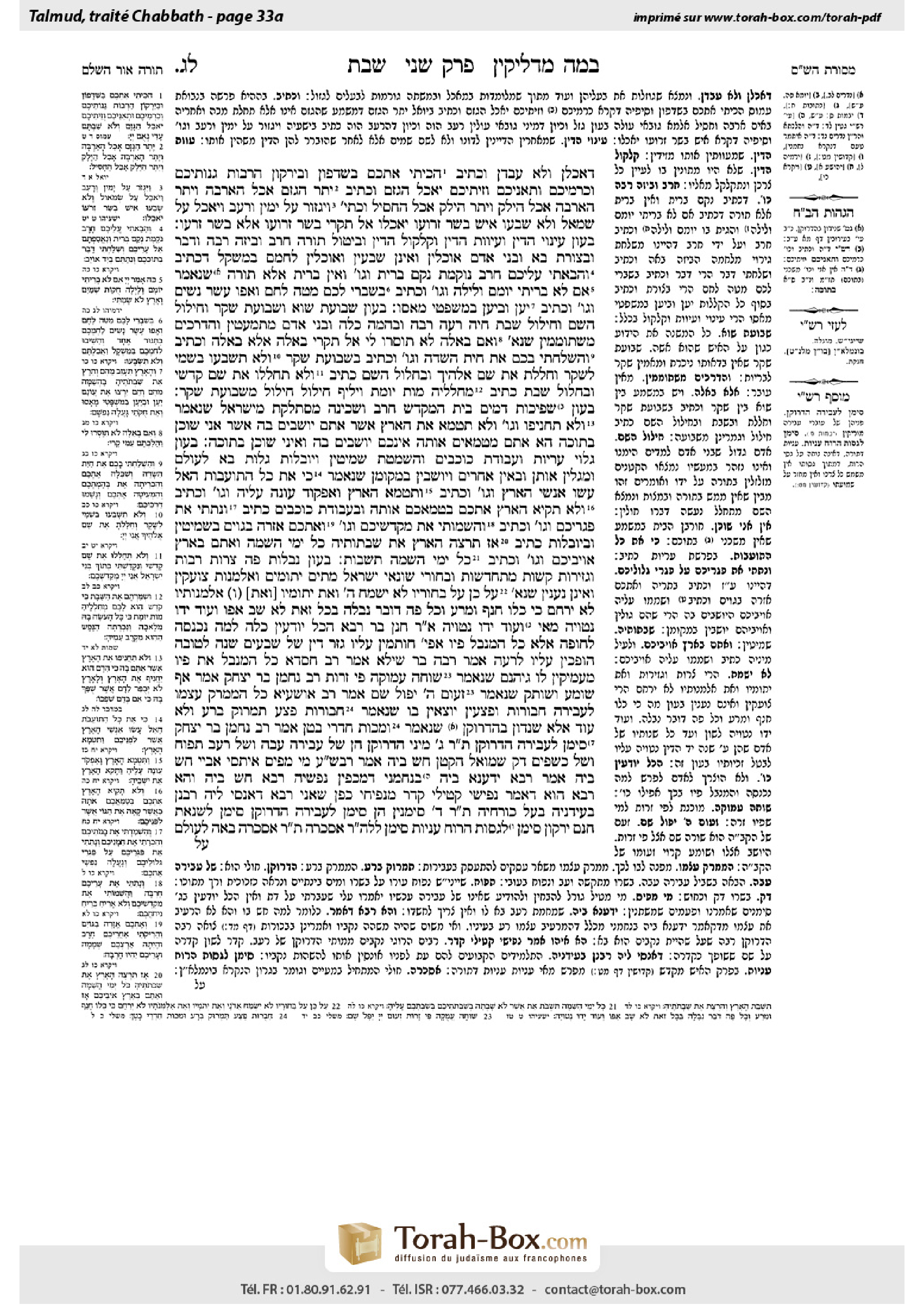
Shabbat 33a: Talmud study for Daf Yomi
Daf Yomi is the daily study of one Talmud folio. Explore 37 tractates with scans, Hebrew text, Sefaria English and AI-generated French translations where annotated.
Passage selection and English or AI-generated French translation are available where the scan has annotations. Daf Study is independent of Torah-Box and Sefaria.
Browse Shabbat · שבת · All tractatesShabbat 33a text and translations
This page of Shabbat includes the Aramaic text, an English translation and an AI-generated French translation, alongside the scan above.
שבת ל״ג א · Aramaic and Hebrew text
דְּאׇכְלָן וְלָא עָבְדָן. וּכְתִיב: ״הִכֵּיתִי אֶתְכֶם בַּשִּׁדָּפוֹן וּבַיֵּרָקוֹן הַרְבּוֹת גַּנּוֹתֵיכֶם וְכַרְמֵיכֶם וּתְאֵנֵיכֶם וְזֵיתֵיכֶם יֹאכַל הַגָּזָם״, וּכְתִיב: ״יֶתֶר הַגָּזָם אָכַל הָאַרְבֶּה וְיֶתֶר הָאַרְבֶּה אָכַל הַיָּלֶק וְיֶתֶר הַיֶּלֶק אָכַל הֶחָסִיל״. וּכְתִיב: ״וַיִּגְזוֹר עַל יָמִין וְרָעֵב וַיֹּאכַל עַל שְׂמֹאל וְלֹא שָׂבֵעוּ אִישׁ בְּשַׂר זְרוֹעוֹ יֹאכֵלוּ״, אַל תִּקְרֵי ״בְּשַׂר זְרוֹעוֹ״ אֶלָּא ״בְּשַׂר זַרְעוֹ״.
בַּעֲוֹן עִינּוּי הַדִּין, וְעִיוּוּת הַדִּין, וְקִלְקוּל הַדִּין, וּבִיטּוּל תּוֹרָה — חֶרֶב וּבִיזָּה רָבָה, וְדֶבֶר וּבַצּוֹרֶת בָּא, וּבְנֵי אָדָם אוֹכְלִין וְאֵינָן שְׂבֵעִין, וְאוֹכְלִין לַחְמָם בְּמִשְׁקָל. דִּכְתִיב: ״וְהֵבֵאתִי עֲלֵיכֶם חֶרֶב נוֹקֶמֶת נְקַם בְּרִית וְגוֹ׳״. וְאֵין ״בְּרִית״ אֶלָּא תּוֹרָה, שֶׁנֶּאֱמַר: ״אִם לֹא בְרִיתִי יוֹמָם וָלָיְלָה וְגוֹ׳״, וּכְתִיב: ״בְּשִׁבְרִי לָכֶם מַטֵּה לֶחֶם וְאָפוּ עֶשֶׂר נָשִׁים וְגוֹ׳״, וּכְתִיב: ״יַעַן וּבְיַעַן בְּמִשְׁפָּטַי מָאָסוּ״.
בַּעֲוֹן שְׁבוּעַת שָׁוְא וּשְׁבוּעַת שֶׁקֶר וְחִילּוּל הַשֵּׁם וְחִילּוּל שַׁבָּת — חַיָּה רָעָה רָבָה, וּבְהֵמָה כָּלָה, וּבְנֵי אָדָם מִתְמַעֲטִין, וְהַדְּרָכִים מִשְׁתּוֹמְמִין. שֶׁנֶּאֱמַר: ״וְאִם בְּאֵלֶּה לֹא תִוָּסְרוּ לִי״ — אַל תִּקְרֵי ״בְּאֵלֶּה״, אֶלָּא ״בְּאָלָה״. וּכְתִיב: ״וְהִשְׁלַחְתִּי בָכֶם אֶת חַיַּת הַשָּׂדֶה וְגוֹ׳״, וּכְתִיב בִּשְׁבוּעַת שֶׁקֶר: ״וְלֹא תִשָּׁבְעוּ בִשְׁמִי לַשָּׁקֶר וְחִלַּלְתָּ אֶת שֵׁם אֱלֹהֶיךָ״, וּבְחִלּוּל הַשֵּׁם כְּתִיב: ״וְלֹא תְחַלְּלוּ אֶת שֵׁם קׇדְשִׁי״. וּבְחִלּוּל שַׁבָּת כְּתִיב: ״מְחַלְּלֶיהָ מוֹת יוּמָת״, וְיָלֵיף ״חִילּוּל״ ״חִילּוּל״ מִשְּׁבוּעַת שֶׁקֶר.
בַּעֲוֹן שְׁפִיכוּת דָּמִים בֵּית הַמִּקְדָּשׁ חָרֵב, וּשְׁכִינָה מִסְתַּלֶּקֶת מִיִּשְׂרָאֵל, שֶׁנֶּאֱמַר: ״וְלֹא תַחֲנִיפוּ וְגוֹ׳ וְלֹא תְטַמֵּא אֶת הָאָרֶץ אֲשֶׁר אַתֶּם יוֹשְׁבִים בָּהּ אֲשֶׁר אֲנִי שׁוֹכֵן בְּתוֹכָהּ״. הָא אַתֶּם מְטַמְּאִים אוֹתָהּ — אֵינְכֶם יוֹשְׁבִים בָּהּ, וְאֵינִי שׁוֹכֵן בְּתוֹכָהּ.
בַּעֲוֹן גִּלּוּי עֲרָיוֹת וַעֲבוֹדָה זָרָה וְהַשְׁמָטַת שְׁמִיטִּין וְיוֹבְלוֹת — גָּלוּת בָּא לָעוֹלָם, וּמַגְלִין אוֹתָן, וּבָאִין אֲחֵרִים וְיוֹשְׁבִין בִּמְקוֹמָן. שֶׁנֶּאֱמַר: ״כִּי אֶת כׇּל הַתּוֹעֵבוֹת הָאֵל עָשׂוּ אַנְשֵׁי הָאָרֶץ וְגוֹ׳״, וּכְתִיב: ״וַתִּטְמָא הָאָרֶץ וָאֶפְקוֹד עֲוֹנָהּ עָלֶיהָ וְגוֹ׳״, וּכְתִיב: ״וְלֹא תָקִיא הָאָרֶץ אֶתְכֶם בְּטַמַּאֲכֶם אוֹתָהּ״.
וּבַעֲבוֹדָה זָרָה כְּתִיב: ״וְנָתַתִּי אֶת פִּגְרֵיכֶם וְגוֹ׳״, וּכְתִיב: ״וַהֲשִׁמּוֹתִי אֶת מִקְדְּשֵׁיכֶם וְגוֹ׳״, ״וְאֶתְכֶם אֱזָרֶה בַגּוֹיִם״.
בִּשְׁמִיטִּין וּבְיוֹבְלוֹת כְּתִיב: ״אָז תִּרְצֶה הָאָרֶץ אֶת שַׁבְּתוֹתֶיהָ כֹּל יְמֵי הֳשַׁמָּה וְאַתֶּם בְּאֶרֶץ אוֹיְבֵיכֶם וְגוֹ׳״, וּכְתִיב: ״כׇּל יְמֵי הׇשַּׁמָּה תִּשְׁבּוֹת״.
בַּעֲוֹן נַבְלוּת פֶּה צָרוֹת רַבּוֹת, וּגְזֵירוֹת קָשׁוֹת מִתְחַדְּשׁוֹת, וּבַחוּרֵי שׂוֹנְאֵי יִשְׂרָאֵל מֵתִים, יְתוֹמִים וְאַלְמָנוֹת צוֹעֲקִין וְאֵינָן נַעֲנִין, שֶׁנֶּאֱמַר: ״עַל כֵּן עַל בַּחוּרָיו לֹא יִשְׂמַח ה׳ וְאֶת יְתוֹמָיו (וְאַלְמְנוֹתָיו) [וְאֶת אַלְמְנוֹתָיו] לֹא יְרַחֵם כִּי כֻלּוֹ חָנֵף וּמֵרַע וְכׇל פֶּה דּוֹבֵר נְבָלָה בְּכׇל זֹאת לֹא שָׁב אַפּוֹ וְעוֹד יָדוֹ נְטוּיָה״.
מַאי ״וְעוֹד יָדוֹ נְטוּיָה״ — אָמַר רַבִּי חָנָן בַּר רָבָא: הַכֹּל יוֹדְעִין כַּלָּה לָמָּה נִכְנְסָה לַחוּפָּה. אֶלָּא כׇּל הַמְנַבֵּל פִּיו אֲפִילּוּ חוֹתְמִין עָלָיו גְּזַר דִּין שֶׁל שִׁבְעִים שָׁנָה לְטוֹבָה — הוֹפְכִין עָלָיו לְרָעָה. אָמַר רַבָּה בַּר שֵׁילָא אָמַר רַב חִסְדָּא: כׇּל הַמְנַבֵּל אֶת פִּיו — מַעֲמִיקִין לוֹ גֵּיהִנָּם, שֶׁנֶּאֱמַר: ״שׁוּחָה עֲמוּקָּה פִּי זָרוֹת״. רַב נַחְמָן בַּר יִצְחָק אָמַר: אַף שׁוֹמֵעַ וְשׁוֹתֵק, שֶׁנֶּאֱמַר: ״זְעוּם ה׳ יִפּוֹל שָׁם״.
אָמַר רַב אוֹשַׁעְיָא: כׇּל הַמְּמָרֵק עַצְמוֹ לַעֲבֵירָה — חַבּוּרוֹת וּפְצָעִין יוֹצְאִין בּוֹ, שֶׁנֶּאֱמַר: ״חַבּוּרוֹת פֶּצַע תַּמְרוּק בְּרָע״. וְלֹא עוֹד אֶלָּא שֶׁנִּדּוֹן בְּהִדְרוֹקָן: שֶׁנֶּאֱמַר ״וּמַכּוֹת חַדְרֵי בָטֶן״. אָמַר רַב נַחְמָן בַּר יִצְחָק: סִימָן לַעֲבֵירָה הִדְרוֹקָן.
תָּנוּ רַבָּנַן: שְׁלֹשָׁה מִינֵי הִדְרוֹקָן הֵן: שֶׁל עֲבֵירָה עָבֶה, וְשֶׁל רָעָב תָּפוּחַ, וְשֶׁל כְּשָׁפִים דַּק.
שְׁמוּאֵל הַקָּטָן חָשׁ בֵּיהּ. אֲמַר: רִבּוֹנוֹ שֶׁל עוֹלָם, מִי מֵפִיס? אִיתַּסִּי. אַבָּיֵי חָשׁ בֵּיהּ. אֲמַר רָבָא: יָדַעְנָא בֵּיהּ בְּנַחֲמָנִי דְּמַכְפֵּין נַפְשֵׁיהּ. רָבָא חָשׁ בֵּיהּ. וְהָא רָבָא הוּא דְּאָמַר נְפִישִׁי קְטִילֵי קְדָר מִנְּפִיחֵי כָפָן? שָׁאנֵי רָבָא, דְּאׇנְסִי לֵיהּ רַבָּנַן בְּעִידָּנֵיהּ בְּעַל כּוּרְחֵיהּ.
תָּנוּ רַבָּנַן: אַרְבָּעָה סִימָנִין הֵן: סִימָן לַעֲבֵירָה — הִדְרוֹקָן, סִימָן לְשִׂנְאַת חִנָּם — יֵרָקוֹן, סִימָן לְגַסּוּת הָרוּחַ — עֲנִיּוּת, סִימָן לְלָשׁוֹן הָרָע — אַסְכָּרָה.
תָּנוּ רַבָּנַן: אַסְכָּרָה בָּאָה לְעוֹלָם
Shabbat 33a · English translation
who eat and do nothing to support themselves, and cause their husbands to commit the sin of theft. And it is written: “I have smitten you with blight and mildew; the multitude of your gardens and your vineyards and your fig trees and your olive trees has the palmerworm devoured” (Amos 4:9). And it is written: “That which the palmerworm has left the locust has eaten; and that which the locust has left the cankerworm has eaten; and that which the cankerworm has left the caterpillar has eaten” (Joel 1:4). And it is written: “And one snatches on the right hand, and is hungry; and he eats on the left hand, and is not satisfied; they eat every man the flesh of his own arm [besar zero’o]” (Isaiah 9:19). Do not read it: The flesh of his own arm [besar zero’o]; rather, the flesh of his own offspring [besar zaro]. All the punishments for theft listed above were explicitly mentioned in the verses.
Furthermore, the Sages said that due to the sin of delay of justice, i.e., judges delay issuing their rulings due to personal considerations, and for distortion of justice, i.e., judges intentionally distort their verdicts, and for miscarriage of justice that results from negligence, and for dereliction in the study of Torah, violence and looting abound in the world, and pestilence and famine come, and people eat and are not sated, and they eat their bread measured by weight. As it is written: “And I will bring a sword upon you, that shall execute the vengeance of the covenant; and you shall be gathered together within your cities; and I will send the pestilence among you; and you shall be delivered into the hand of the enemy” (Leviticus 26:25). And covenant means nothing other than Torah, as it is stated: “If My covenant be not with day and night, if I have not appointed the ordinances of heaven and earth” (Jeremiah 33:25). The study of Torah is the mitzva practiced both day and night. And it is written with regard to this punishment: “When I break your staff of bread, ten women shall bake your bread in one oven, and they shall deliver your bread again by weight; and ye shall eat, and not be satisfied” (Leviticus 26:26). And it is written: “Even because they rejected My ordinances, and their soul abhorred My statutes” (Leviticus 26:43). All of these punishments result from breaching the covenant of the Torah and the perversion of justice.
Due to the sin of an oath taken in vain and a false oath, and desecration of God’s name, and desecration of Shabbat, wild beasts abound in the world, and domesticated animals cease to exist, and human beings decrease in number, and the roads become desolate, as it is stated: “And if in spite of these [be’eleh] things you will not be corrected unto Me, but will walk contrary unto Me casually” (Leviticus 26:23). Do not read of these [be’eleh]; rather, due to a vain oath [be’ala]. And it is written that the punishment for this is: “And I will send the beast of the field among you, which shall rob you of your children, and destroy your cattle, and make you few in number; and your ways shall become desolate” (Leviticus 26:22). And it is written with regard to a false oath: “And you shall not swear by My name falsely, so that you desecrate [veḥillalta] the name of your God: I am the Lord” (Leviticus 19:12). And it is written with regard to desecrating the name of God: “And you shall not desecrate [teḥallelu] My Holy Name” (Leviticus 22:32). And it is written with regard to desecrating Shabbat: “Every one that desecrates it [meḥaleleha] shall surely be put to death” (Exodus 31:14). And derive by means of a verbal analogy [gezera shava] desecration [ḥillul] of Shabbat from desecration [ḥillul] of a false oath. Just as punishment for a false oath is desolation and wild beasts, one receives the same punishment for desecrating Shabbat and the name of God.
Due to the sin of bloodshed, the Holy Temple is destroyed, and the Divine Presence leaves Israel, as it says: “So you shall not pollute the land wherein you are; for blood, it pollutes the land; and no expiation can be made for the land for the blood that is shed therein, but by the blood of him that shed it. And you shall not defile the land which you inhabit, in the midst of which I dwell; for I the Lord dwell in the midst of the children of Israel” (Numbers 35:33–34). However, if you defile the land, you will not inhabit it, and I will not dwell in it.
Due to the sin of prohibited sexual relations, and idol worship, and failure to let the land lie fallow during the Sabbatical and Jubilee Years, exile comes to the world and they exile the Jewish people from their land, and others come and settle in their place. As it is stated with regard to illicit sexual relations: “For all these abominations have the men of the land done, that were before you, and the land is defiled; that the land expel not you also, when you defile it, as it expelled the nation that was before you” (Leviticus 18:27–28). And it is written: “And the land was defiled, therefore I did visit the iniquity thereof upon it, and the land expelled her inhabitants” (Leviticus 18:25). And it is written: “That the land expel not you also, when you defile it, as it expelled the nation that was before you.”
And with regard to idol worship it is written: “And I will cast your carcasses upon the carcasses of your idols” (Leviticus 26:30). And it is written: “And I will bring your sanctuaries unto desolation, and I will not smell the savor of your sweet odors” (Leviticus 26:31). “And you will I scatter among the nations, and I will draw out the sword after you; and your land shall be a desolation, and your cities shall be a waste” (Leviticus 26:33).
With regard to the sin of failure to observe the Sabbatical and Jubilee Years it is written: “Then shall the land be paid her Sabbaths, as long as it lies desolate, and you are in your enemies’ land; even then shall the land rest, and repay her Sabbaths” (Leviticus 26:34). And it is written: “As long as it lies desolate it shall have rest; even the rest which it had not in your Sabbaths, when you dwelt upon it” (Leviticus 26: 35).
Due to the sin of vulgar speech, troubles abound, and harsh decrees are renewed, and the youth among the enemies of Israel, a euphemistic reference to Israel, die, and orphans and widows cry out for help and are not answered, as it is stated: “Therefore the Lord shall have no joy in their young men, neither shall He have compassion on their fatherless and widows; for everyone is ungodly and an evildoer, and every mouth speaks wantonness. For all this His anger is not turned away, but His hand is stretched out still” (Isaiah 9:16).
The Gemara explains: What is the meaning of the phrase: But His hand is stretched out still? Rabbi Ḥanan bar Rava said: Everybody knows why the bride enters the wedding canopy. There is no secret revealed. Nevertheless, anyone who speaks vulgarly about it, even if they, on High, sealed for him a decree of seventy years of good fortune, they will reverse it to bad fortune because of this sin. And Rabba bar Sheila said that Rav Ḥisda said: Anyone who speaks vulgarly, they deepen Gehenna for him, as it is stated: “The mouth that speaks perversity is a deep pit: he that is abhorred of the Lord shall fall therein” (Proverbs 22:14), i.e., Gehenna is deepened for one who speaks vulgarly. Rav Naḥman bar Yitzḥak said: Even one who hears vulgar speech and is silent is punished, as it is stated: “He that is abhorred of the Lord shall fall therein,” even if he himself does not speak at all.
And in a similar vein, Rav Oshaya said: Anyone who prepares himself to commit a sin, wounds and bruises emerge on him, as it is stated: “Sharp wounds for one devoted to evil; so do stripes that reach the inward parts” (Proverbs 20:30). And not only that, but he is sentenced to suffer from the disease of edema [hidrokan], as it is stated: So do stripes that reach the inward parts. Rav Naḥman bar Yitzḥak said: A sign indicating one who committed a sin is the disease hidrokan, which afflicts the inner parts.
The Sages taught in a baraita: There are three types of hidrokan: The one that comes as punishment for sin is thick; and that which is the result of hunger is swollen, but not as thick; and the one caused by witchcraft is thin, and the flesh of the sick person becomes thin in other places.
The Gemara relates: Shmuel HaKatan fell ill with hidrokan. He said: Master of the Universe, who will draw lots, meaning, who will be able to determine that this hidrokan is not the consequence of sin? He was cured. Abaye also fell ill with hidrokan. Rava testified and said about him: I know about Naḥmani, Abaye, that he starves himself and that his hidrokan is the result of hunger. The Gemara relates that Rava fell ill with hidrokan, and they asked: But Rava did not starve himself, and there is no reason to suspect him of sin, and we cannot say that he contracted hidrokan because he did not relieve himself on time. Rava knew to relieve himself, as it is he who said: More have been killed due to the chamber pot, because they were not careful about relieving themselves in a timely manner, than those swollen due to starvation. The Gemara answers: Rava is different because the Sages compel him to remain in place against his will while he lectures. Since he could not relieve himself, he became sick with hidrokan.
On a related note, the Sages taught in a baraita that there are four signs: A sign of sin is hidrokan, a sign of gratuitous hatred is jaundice, a sign of arrogance is poverty, and a sign of slander is askara.
The Sages taught: Askara comes to the world as punishment
Shabbat 33a · Traduction française (IA)
qui mangent sans rien faire pour subvenir à leurs besoins et amènent leurs maris à commettre le péché du vol. Et il est écrit : « Je vous ai frappés de brûlure et de moisissure ; la multitude de vos jardins, de vos vignes, de vos figuiers et de vos oliviers, le criquet l’a dévorée » (Amos 4:9). Et il est écrit : « Ce qu’a laissé la chenille, la sauterelle l’a mangé ; ce qu’a laissé la sauterelle, le criquet l’a mangé ; et ce qu’a laissé le criquet, la larve l’a mangé » (Joël 1:4). Et il est écrit : « On arrache à droite et l’on a faim, on dévore à gauche et l’on n’est pas rassasié ; chacun dévore la chair de son propre bras [besar zero’o] » (Isaïe 9:19). Ne lis pas « la chair de son propre bras » [besar zero’o], mais « la chair de sa propre descendance » [besar zaro]. Tous les châtiments du vol énumérés ci-dessus étaient explicitement mentionnés dans les versets.
En outre, les Sages ont dit qu’en raison du péché consistant à retarder la justice, c’est-à-dire lorsque les juges tardent à rendre leurs décisions pour des considérations personnelles, de la perversion de la justice, c’est-à-dire lorsque les juges faussent délibérément leurs verdicts, des erreurs judiciaires dues à la négligence et du relâchement dans l’étude de la Torah, la violence et le pillage se multiplient dans le monde, la peste et la famine surviennent, et les gens mangent sans être rassasiés, leur pain étant mesuré au poids. Comme il est écrit : « Je ferai venir contre vous l’épée qui vengera l’alliance ; vous vous rassemblerez dans vos villes, j’enverrai la peste au milieu de vous et vous serez livrés aux mains de l’ennemi » (Lévitique 26:25). Or, l’alliance ne désigne rien d’autre que la Torah, comme il est dit : « Si Mon alliance avec le jour et la nuit n’existe pas, si Je n’ai pas établi les lois du ciel et de la terre » (Jérémie 33:25). L’étude de la Torah est la mitsva que l’on pratique le jour comme la nuit. Et il est écrit, à propos de ce châtiment : « Quand Je briserai votre bâton de pain, dix femmes feront cuire votre pain dans un seul four et vous le rendront au poids ; vous mangerez sans être rassasiés » (Lévitique 26:26). Et il est écrit : « Parce qu’ils ont rejeté Mes lois et que leur âme a pris Mes statuts en aversion » (Lévitique 26:43). Tous ces châtiments résultent de la rupture de l’alliance de la Torah et de la perversion de la justice.
En raison du péché du serment prononcé en vain, du faux serment, de la profanation du nom de Dieu et de la profanation du Chabbat, les bêtes sauvages se multiplient dans le monde, les animaux domestiques disparaissent, le nombre des êtres humains diminue et les routes deviennent désertes, comme il est dit : « Si, malgré ces [be’eleh] choses, vous ne vous laissez pas corriger par Moi et marchez contre Moi avec désinvolture » (Lévitique 26:23). Ne lis pas « ces [be’eleh] choses », mais « à cause d’un serment vain » [be’ala]. Et il est écrit que le châtiment en est le suivant : « J’enverrai contre vous les bêtes des champs, qui vous priveront de vos enfants, détruiront votre bétail, réduiront votre nombre et rendront vos chemins déserts » (Lévitique 26:22). Et il est écrit au sujet du faux serment : « Vous ne jurerez pas faussement par Mon nom, profanant [veḥillalta] ainsi le nom de votre Dieu ; Je suis le Seigneur » (Lévitique 19:12). Et il est écrit au sujet de la profanation du nom de Dieu : « Vous ne profanerez [teḥallelu] pas Mon saint nom » (Lévitique 22:32). Et il est écrit au sujet de la profanation du Chabbat : « Quiconque le profane [meḥaleleha] sera mis à mort » (Exode 31:14). On déduit, par une analogie verbale [gezera shava], la profanation [ḥillul] du Chabbat de la profanation [ḥillul] liée au faux serment. De même que le châtiment du faux serment est la désolation et la présence de bêtes sauvages, on reçoit le même châtiment pour avoir profané le Chabbat et le nom de Dieu.
En raison du péché de meurtre, le Temple est détruit et la Présence divine quitte Israël, comme il est dit : « Vous ne souillerez donc pas le pays où vous êtes, car le sang souille le pays ; et il ne peut être fait d’expiation pour le pays à cause du sang qui y a été versé, sinon par le sang de celui qui l’a versé. Vous ne rendrez pas impur le pays où vous demeurez et au milieu duquel Je réside ; car Moi, le Seigneur, Je réside au milieu des enfants d’Israël » (Nombres 35:33-34). Cependant, si vous souillez le pays, vous ne l’habiterez pas et Je n’y résiderai pas.
En raison du péché des relations sexuelles interdites, du culte des idoles et du manquement à laisser la terre en jachère pendant les années sabbatiques et jubilaires, l’exil survient dans le monde : le peuple juif est exilé de son pays et d’autres viennent s’y installer à sa place. Comme il est dit à propos des relations sexuelles illicites : « Car les hommes du pays, qui étaient avant vous, ont commis toutes ces abominations, et le pays en a été souillé ; ainsi le pays ne vous expulsera pas, vous aussi, lorsque vous le souillerez, comme il a expulsé la nation qui était avant vous » (Lévitique 18:27-28). Et il est écrit : « Le pays a été souillé ; Je lui ai donc fait rendre compte de sa faute, et le pays a expulsé ses habitants » (Lévitique 18:25). Et il est écrit : « Ainsi le pays ne vous expulsera pas, vous aussi, lorsque vous le souillerez, comme il a expulsé la nation qui était avant vous. »
Et au sujet du culte des idoles, il est écrit : « Je jetterai vos cadavres sur les cadavres de vos idoles » (Lévitique 26:30). Et il est écrit : « Je réduirai vos sanctuaires en ruines et Je ne respirerai pas le parfum de vos offrandes agréables » (Lévitique 26:31). « Je vous disperserai parmi les nations, Je tirerai l’épée derrière vous ; votre pays sera une désolation et vos villes seront en ruines » (Lévitique 26:33).
Au sujet du péché consistant à ne pas observer les années sabbatiques et jubilaires, il est écrit : « Alors le pays jouira de ses sabbats, aussi longtemps qu’il restera désolé et que vous serez dans le pays de vos ennemis ; alors le pays se reposera et compensera ses sabbats » (Lévitique 26:34). Et il est écrit : « Tant qu’il restera désolé, il se reposera, pour jouir du repos qu’il n’a pas eu pendant vos sabbats, lorsque vous y habitiez » (Lévitique 26:35).
En raison du péché du langage grossier, les malheurs se multiplient, de sévères décrets sont renouvelés, les jeunes gens parmi les ennemis d’Israël — expression euphémique désignant Israël — meurent, et les orphelins et les veuves appellent à l’aide sans recevoir de réponse, comme il est dit : « C’est pourquoi le Seigneur ne se réjouira pas de leurs jeunes gens et n’aura pas compassion de leurs orphelins et de leurs veuves ; car tous sont impies et malfaisants, et toute bouche profère des paroles obscènes. Malgré tout cela, Sa colère ne s’est pas détournée et Sa main reste étendue » (Isaïe 9:16).
La Guemara explique : Que signifie l’expression « Sa main reste étendue » ? Rabbi Ḥanan bar Rava a dit : Tout le monde sait pourquoi la mariée entre sous le dais nuptial. Rien de secret n’est révélé. Néanmoins, quiconque en parle de façon grossière, même si, dans les Cieux, un décret de soixante-dix années de bonheur a été scellé pour lui, ce décret sera changé en malheur à cause de ce péché. Et Rabba bar Sheila a dit au nom de Rav Ḥisda : Quiconque parle de façon grossière, on lui creuse davantage la Géhenne, comme il est dit : « La bouche qui profère la perversité est une fosse profonde ; celui qui est en horreur au Seigneur y tombera » (Proverbes 22:14), c’est-à-dire que la Géhenne est approfondie pour celui qui parle de façon grossière. Rav Naḥman bar Yitzḥak a dit : Même celui qui entend des propos grossiers et garde le silence est puni, comme il est dit : « Celui qui est en horreur au Seigneur y tombera », même s’il ne parle pas lui-même.
Dans le même ordre d’idées, Rav Oshaya a dit : Quiconque se prépare à commettre un péché voit apparaître sur lui des blessures et des plaies, comme il est dit : « Les blessures profondes sont pour celui qui se livre au mal ; les coups pénètrent jusqu’au fond de son être » (Proverbes 20:30). Et ce n’est pas tout : il est condamné à souffrir d’hydropisie [hidrokan], comme il est dit : « les coups pénètrent jusqu’au fond de son être ». Rav Naḥman bar Yitzḥak a dit : L’hydropisie est un signe indiquant que quelqu’un a commis un péché ; elle affecte les organes internes.
Les Sages ont enseigné dans une baraïta : Il existe trois types d’hydropisie [hidrokan] : celle qui vient comme châtiment d’un péché est épaisse ; celle qui résulte de la faim est enflée, mais moins épaisse ; et celle qui est causée par la sorcellerie est mince, tandis que la chair du malade s’amincit à d’autres endroits.
La Guemara rapporte : Shmuel HaKatan tomba malade d’hydropisie [hidrokan]. Il dit : « Maître de l’Univers, qui tirera au sort ? », c’est-à-dire : qui pourra déterminer que cette hydropisie n’est pas la conséquence d’un péché ? Il fut guéri. Abaye tomba lui aussi malade d’hydropisie [hidrokan]. Rava témoigna à son sujet et dit : « Je sais que Naḥmani, Abaye, se prive de nourriture et que son hydropisie résulte de la faim. » La Guemara rapporte que Rava tomba malade d’hydropisie [hidrokan], et l’on demanda : Mais Rava ne se privait pas de nourriture, et il n’y a aucune raison de le soupçonner de péché ; on ne peut pas non plus dire qu’il avait contracté l’hydropisie parce qu’il ne s’était pas soulagé à temps. Rava savait se soulager, car c’est lui qui a dit : « Plus nombreux sont ceux qui sont morts à cause du pot de chambre, parce qu’ils ne prenaient pas soin de se soulager à temps, que ceux qui ont enflé à cause de la famine. » La Guemara répond : Le cas de Rava est différent, car les Sages le contraignaient à rester sur place contre son gré pendant qu’il donnait son enseignement. Comme il ne pouvait pas se soulager, il tomba malade d’hydropisie [hidrokan].
À ce propos, les Sages ont enseigné dans une baraïta qu’il existe quatre signes : l’hydropisie [hidrokan] est le signe du péché, la jaunisse celui de la haine gratuite, la pauvreté celui de l’arrogance, et l’askara celui de la médisance.
Les Sages ont enseigné : l’askara survient dans le monde comme châtiment.
Traduction française générée par IA à partir de l’édition anglaise de Sefaria. Vérifie toujours un passage avec le texte source.
Text from Sefaria: William Davidson Edition - Vocalized Aramaic (CC BY NC); William Davidson Edition - English (CC BY NC).