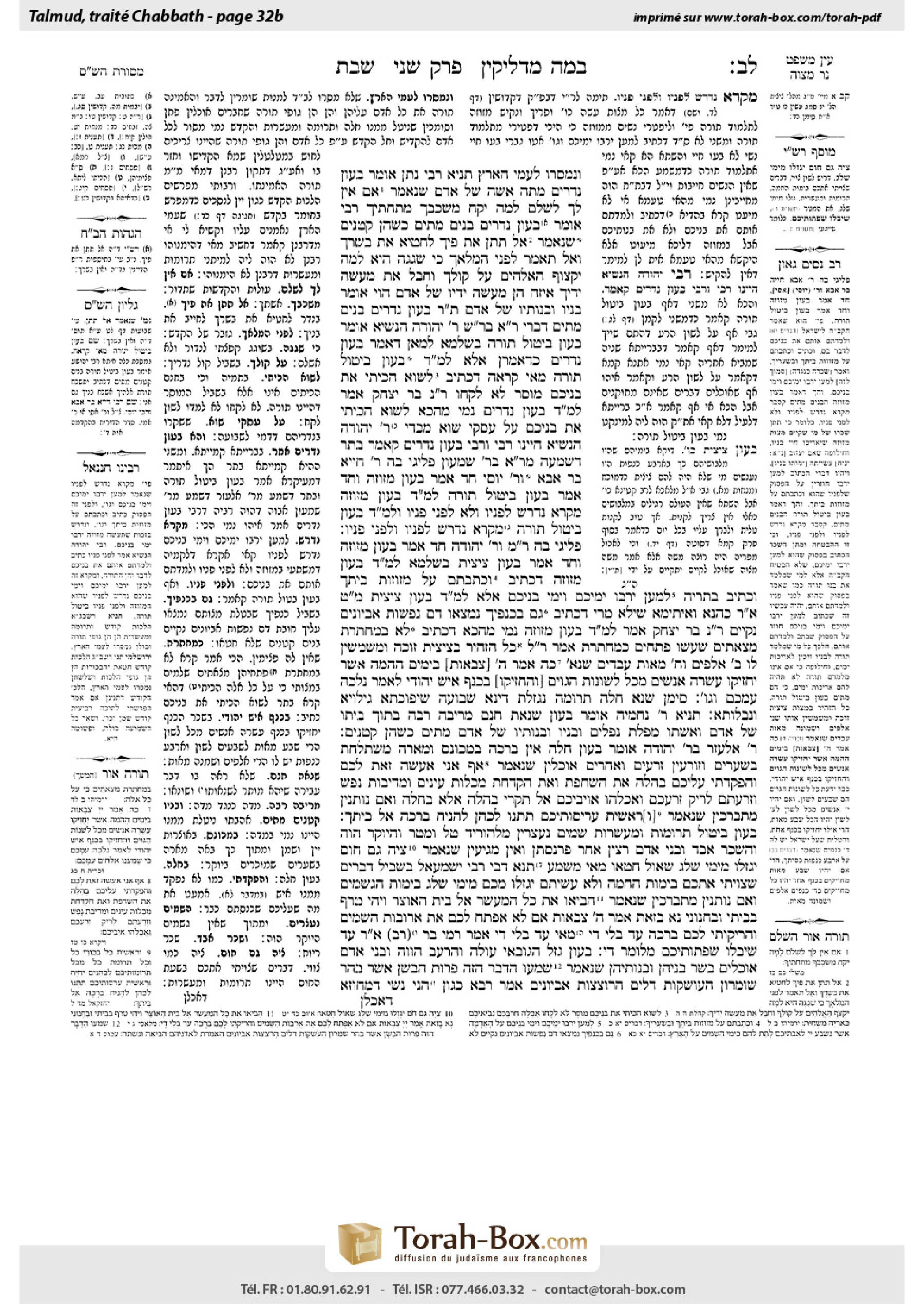
Shabbat 32b: Talmud study for Daf Yomi
Daf Yomi is the daily study of one Talmud folio. Explore 37 tractates with scans, Hebrew text, Sefaria English and AI-generated French translations where annotated.
Passage selection and English or AI-generated French translation are available where the scan has annotations. Daf Study is independent of Torah-Box and Sefaria.
Browse Shabbat · שבת · All tractatesShabbat 32b text and translations
This page of Shabbat includes the Aramaic text, an English translation and an AI-generated French translation, alongside the scan above.
שבת ל״ב ב · Aramaic and Hebrew text
וְנִמְסְרוּ לְעַמֵּי הָאָרֶץ.
תַּנְיָא רַבִּי נָתָן אוֹמֵר: בַּעֲוֹן נְדָרִים מֵתָה אִשָּׁה שֶׁל אָדָם, שֶׁנֶּאֱמַר: ״אִם אֵין לְךָ לְשַׁלֵּם לָמָּה יִקַּח מִשְׁכָּבְךָ מִתַּחְתֶּיךָ״. רַבִּי אוֹמֵר: בַּעֲוֹן נְדָרִים בָּנִים מֵתִים כְּשֶׁהֵן קְטַנִּים, שֶׁנֶּאֱמַר: ״אַל תִּתֵּן אֶת פִּיךָ לַחֲטִיא אֶת בְּשָׂרֶךָ וְאַל תֹּאמַר לִפְנֵי הַמַּלְאָךְ כִּי שְׁגָגָה הִיא לָמָּה יִקְצוֹף הָאֱלֹהִים עַל קוֹלֶךָ וְחִבֵּל אֶת מַעֲשֵׂה יָדֶיךָ״. אֵיזֶה הֵן מַעֲשֵׂה יָדָיו שֶׁל אָדָם? הֱוֵי אוֹמֵר בָּנָיו וּבְנוֹתָיו שֶׁל אָדָם.
תָּנוּ רַבָּנַן: בַּעֲוֹן נְדָרִים בָּנִים מֵתִים, דִּבְרֵי רַבִּי אֶלְעָזָר בְּרַבִּי שִׁמְעוֹן. רַבִּי יְהוּדָה הַנָּשִׂיא אוֹמֵר: בַּעֲוֹן בִּיטּוּל תּוֹרָה. בִּשְׁלָמָא לְמַאן דְּאָמַר בַּעֲוֹן נְדָרִים — כְּדַאֲמַרַן, אֶלָּא לְמַאן דְּאָמַר בַּעֲוֹן בִּיטּוּל תּוֹרָה מַאי קְרָאָה? דִּכְתִיב: ״לַשָּׁוְא הִכֵּיתִי אֶת בְּנֵיכֶם מוּסָר לֹא לָקָחוּ״. רַב נַחְמָן בַּר יִצְחָק אָמַר: לְמַאן דְּאָמַר בַּעֲוֹן נְדָרִים נָמֵי מֵהָכָא: ״לַשָּׁוְא הִכֵּיתִי אֶת בְּנֵיכֶם״ — עַל עִסְקֵי שָׁוְא. מִכְּדֵי רַבִּי יְהוּדָה הַנָּשִׂיא הַיְינוּ רַבִּי, וְרַבִּי בַּעֲוֹן נְדָרִים קָאָמַר?! בָּתַר דְּשַׁמְעַהּ מֵרַבִּי אֶלְעָזָר בְּרַבִּי שִׁמְעוֹן.
פְּלִיגִי בַּהּ רַבִּי חִיָּיא בַּר אַבָּא וְרַבִּי יוֹסֵי, חַד אָמַר בַּעֲוֹן מְזוּזָה. וְחַד אָמַר בַּעֲוֹן בִּיטּוּל תּוֹרָה. לְמַאן דְּאָמַר בַּעֲוֹן מְזוּזָה, מִקְרָא נִדְרָשׁ לְפָנָיו וְלֹא לִפְנֵי פָנָיו. וּלְמַאן דְּאָמַר בַּעֲוֹן בִּיטּוּל תּוֹרָה, מִקְרָא נִדְרָשׁ לְפָנָיו וְלִפְנֵי פָנָיו.
פְּלִיגִי בַּהּ רַבִּי מֵאִיר וְרַבִּי יְהוּדָה. חַד אָמַר בַּעֲוֹן מְזוּזָה, וְחַד אָמַר בַּעֲוֹן צִיצִית. בִּשְׁלָמָא לְמַאן דְּאָמַר בַּעֲוֹן מְזוּזָה, דִּכְתִיב: ״וּכְתַבְתָּם עַל מְזוּזוֹת בֵּיתֶךָ״, וּכְתִיב בָּתְרֵיהּ: ״לְמַעַן יִרְבּוּ יְמֵיכֶם וִימֵי בְנֵיכֶם״. אֶלָּא לְמַאן דְּאָמַר בַּעֲוֹן צִיצִית מַאי טַעְמָא? אָמַר רַב כָּהֲנָא, וְאִיתֵּימָא שֵׁילָא מָרִי, דִּכְתִיב: ״גַּם בִּכְנָפַיִךְ נִמְצְאוּ דַּם נַפְשׁוֹת אֶבְיוֹנִים נְקִיִּים״. רַב נַחְמָן בַּר יִצְחָק אָמַר: לְמַאן דְּאָמַר בַּעֲוֹן מְזוּזָה נָמֵי מֵהָכָא, דִּכְתִיב: ״לֹא בַּמַּחְתֶּרֶת מְצָאתִים״ — שֶׁעָשׂוּ פְּתָחִים כְּמַחְתֶּרֶת.
אָמַר רֵישׁ לָקִישׁ: כׇּל הַזָּהִיר בְּצִיצִית זוֹכֶה וּמְשַׁמְּשִׁין לוֹ שְׁנֵי אֲלָפִים וּשְׁמוֹנֶה מֵאוֹת עֲבָדִים. שֶׁנֶּאֱמַר: ״כֹּה אָמַר ה׳ [צְבָאוֹת] בַּיָּמִים הָהֵמָּה אֲשֶׁר יַחֲזִיקוּ עֲשָׂרָה אֲנָשִׁים מִכֹּל לְשׁוֹנוֹת הַגּוֹיִם [וְהֶחֱזִיקוּ] בִּכְנַף אִישׁ יְהוּדִי לֵאמֹר נֵלְכָה עִמָּכֶם וְגוֹ׳״.
סִימָן: שְׂנֹא חַלָּה תְּרוּמָה נִגְזֶלֶת דִּינָא שְׁבוּעָה שִׁיפּוּכְתָּא גִּילּוּיָא וְנִבְלוּתָא. תַּנְיָא, רַבִּי נְחֶמְיָה אוֹמֵר: בַּעֲוֹן שִׂנְאַת חִנָּם מְרִיבָה רָבָה בְּתוֹךְ בֵּיתוֹ שֶׁל אָדָם, וְאִשְׁתּוֹ מַפֶּלֶת נְפָלִים, וּבָנָיו וּבְנוֹתָיו שֶׁל אָדָם מֵתִים כְּשֶׁהֵן קְטַנִּים. רַבִּי אֶלְעָזָר בְּרַבִּי יְהוּדָה אוֹמֵר: בַּעֲוֹן חַלָּה אֵין בְּרָכָה בַּמְכוּנָּס, וּמְאֵרָה מִשְׁתַּלַּחַת בַּשְּׁעָרִים, וְזוֹרְעִין זְרָעִים וַאֲחֵרִים אוֹכְלִין, שֶׁנֶּאֱמַר: ״אַף אֲנִי אֶעֱשֶׂה זֹּאת לָכֶם וְהִפְקַדְתִּי עֲלֵיכֶם בֶּהָלָה אֶת הַשַּׁחֶפֶת וְאֶת הַקַּדַּחַת מְכַלּוֹת עֵינַיִם וּמְדִיבוֹת נָפֶשׁ וּזְרַעְתֶּם לָרִיק זַרְעֲכֶם וַאֲכָלֻהוּ אוֹיְבֵיכֶם״. אַל תִּקְרֵי ״בֶּהָלָה״ אֶלָּא ״בַּחַלָּה״. וְאִם נוֹתְנִין — מִתְבָּרְכִין, שֶׁנֶּאֱמַר: ״[וְ]רֵאשִׁית עֲרִיסוֹתֵיכֶם תִּתְּנוּ לַכֹּהֵן לְהָנִיחַ בְּרָכָה אֶל בֵּיתֶךָ״.
בַּעֲוֹן בִּיטּוּל תְּרוּמוֹת וּמַעַשְׂרוֹת שָׁמַיִם נֶעֱצָרִין מִלְּהוֹרִיד טַל וּמָטָר, וְהַיּוֹקֶר הֹוֶה, וְהַשָּׂכָר אָבֵד, וּבְנֵי אָדָם רָצִין אַחַר פַּרְנָסָתָן וְאֵין מַגִּיעִין, שֶׁנֶּאֱמַר: ״צִיָּה גַם חוֹם יִגְזְלוּ מֵימֵי שֶׁלֶג שְׁאוֹל חָטָאוּ״. מַאי מַשְׁמַע? תָּנָא דְּבֵי רַבִּי יִשְׁמָעֵאל: בִּשְׁבִיל דְּבָרִים שֶׁצִּוִּיתִי אֶתְכֶם בִּימוֹת הַחַמָּה וְלֹא עֲשִׂיתֶם, יִגָּזְלוּ מִכֶּם מֵימֵי שֶׁלֶג בִּימוֹת הַגְּשָׁמִים. וְאִם נוֹתְנִין — מִתְבָּרְכִין, שֶׁנֶּאֱמַר: ״הָבִיאוּ אֶת כׇּל הַמַּעֲשֵׂר אֶל בֵּית הָאוֹצָר וִיהִי טֶרֶף בְּבֵיתִי וּבְחָנוּנִי נָא בָּזֹאת אָמַר ה׳ צְבָאוֹת אִם לֹא אֶפְתַּח לָכֶם אֵת אֲרוּבּוֹת הַשָּׁמַיִם וַהֲרִיקוֹתִי לָכֶם בְּרָכָה עַד בְּלִי דָי״. מַאי ״עַד בְּלִי דָי״? אָמַר רָמֵי בַּר (רַב) [חָמָא] אָמַר רַב: עַד שֶׁיִּבְלוּ שִׂפְתוֹתֵיכֶם מִלּוֹמַר ״דָּי״.
בַּעֲוֹן גֵּזֶל הַגּוֹבַאי עוֹלֶה, וְהָרָעָב הוֹוֶה, וּבְנֵי אָדָם אוֹכְלִים בְּשַׂר בְּנֵיהֶן וּבְנוֹתֵיהֶן, שֶׁנֶּאֱמַר: ״שִׁמְעוּ הַדָּבָר הַזֶּה פָּרוֹת הַבָּשָׁן אֲשֶׁר בְּהַר שׁוֹמְרוֹן הָעוֹשְׁקוֹת דַּלִּים הָרוֹצְצוֹת אֶבְיוֹנִים״. אָמַר רָבָא: כְּגוֹן הָנֵי נְשֵׁי דְמָחוֹזָא
Shabbat 32b · English translation
and they were given, among others, to ignoramuses to fulfill. When they are negligent in the performance of these mitzvot, they are punished for it.
It was taught in a baraita that Rabbi Natan says: Due to the sin of vows unfulfilled a person’s wife dies. The allusion is as it is stated: “If you have not the wherewithal to pay, why should He take away your bed from under you?” (Proverbs 22:27). Rabbi Yehuda HaNasi says: Due to the sin of vows unfulfilled, children die when they are young, as it is stated: “Better is it that you should not vow, than that you should vow and not pay. Suffer not your mouth to bring your flesh into guilt, neither say you before the messenger that it was an error; wherefore should God be angry at your voice and destroy the work of your hands?” (Ecclesiastes 5:4–5). What is the work of a person’s hands? You must say that it is a person’s sons and daughters.
In order to clarify which sins cause one’s young children to die, the Gemara cites what the Sages taught in a baraita: For the sin of vows, one’s children die, this is the statement of Rabbi Elazar, son of Rabbi Shimon. Rabbi Yehuda HaNasi says: For the sin of dereliction in the study of Torah. The Gemara asks: Granted, according to the opinion of the one who said that one’s children die due to the sin of vows, as we stated above. However, according to the opinion of the one who said that one’s children die due to sin of dereliction in the study of Torah, what is the verse that supports this? The Gemara replies: As it is written: “In vain have I smitten your children; they received no morality” (Jeremiah 2:30). Children die because their fathers did not accept the morality, the Torah. Rav Naḥman bar Yitzḥak said: According to the one who said that one’s children die because of the sin of vows, it can also be derived from here: In vain have I smitten your children; on matters of vanity, i.e., when one vows in vain and does not fulfill it. The Gemara asks: After all, Rabbi Yehuda HaNasi is Rabbi, and it was taught in a Tosefta that Rabbi said that one’s children die because of the sin of vows. How then could it be that Rabbi Yehuda HaNasi said that it is due to the sin of dereliction in the study of Torah? The Gemara answers: After he heard it from Rabbi Elazar, son of Rabbi Shimon, he reconsidered and taught in accordance with Rabbi Elazar’s opinion.
On the same topic, Rabbi Ḥiyya bar Abba and Rabbi Yosei disagree. One said that children die due to the sin of not affixing a mezuza to one’s doorpost. And one said children die due to the sin of dereliction in the study of Torah. According to the one who said that children die because of the sin of not affixing a mezuza, his opinion there is based on an exegetical principle, which states that a verse is interpreted homiletically based on juxtaposition to the verse immediately preceding it and not on juxtaposition to the verse before the one preceding it. In this case, it says: “That your days may be multiplied, and the days of your children” (Deuteronomy 11:21), and the preceding verse says: “And you shall write them upon the doorposts of your house, and upon your gates” (Deuteronomy 11:20). And according to the one who said that children die due to the sin of dereliction in the study of Torah, that is because in his opinion the exegetical principle is that a verse is interpreted homiletically based on juxtaposition to the verse immediately preceding it, as well as to the verse before the one preceding it. In his opinion, the blessing of long life also relates to the verse before the one immediately preceding it: “And you shall teach them your children, talking of them” (Deuteronomy 11:19).
The tanna’im Rabbi Meir and Rabbi Yehuda also disagreed about this. One said: Children die due to the sin of mezuza, and one said children die due to the sin of not affixing ritual fringes. The Gemara asks: Granted, according to the opinion of the one who said that children die due to the sin of mezuza, it is based on the juxtaposition of the verses, as it is written: “And you shall write them upon the doorposts of your house, and upon your gates,” and it says thereafter: “That your days may be multiplied, and the days of your children.” However, according to the one who said that children die because of the sin of ritual fringes, what is the reason? What is the connection between these matters? Rav Kahana said, and some say that it was Sheila Mari: It is homiletically interpreted as is written: “Also in your corners is found the blood of the souls of the innocent poor” (Jeremiah 2:34). Due to one’s failure to affix ritual fringes to the corners of his garments, the innocent poor, young children, who have not had opportunity to sin, die. Rav Naḥman bar Yitzḥak said: According to the one who said that children die because of the sin of mezuza, it is also derived from here, as it is written in the continuation of that verse: “You did not find them breaking in; yet for all these things.” We see that this punishment comes because they made entrances like a thief’s breach in the wall. They did not place mezuzot in their entrances.
Since the Gemara discussed the importance of the mitzva of ritual fringes, it cites that which Reish Lakish said: Anyone who is vigilant in performing the mitzva of ritual fringes merits that two thousand eight hundred servants will serve him in the World-to-Come. As it is stated: “Thus says the Lord of hosts: In those days it shall come to pass, that ten men shall take hold, out of all the languages of the nations, shall even take hold of the corner of the garment of him that is a Jew, saying: We will go with you, for we have heard that God is with you” (Zechariah 8:23). On each corner of a Jewish person’s garment with ritual fringes, ten people from each of the seventy nations will take hold. That totals seven hundred people on each corner; 2,800 people altogether.
Together with these statements, the Gemara cites a mnemonic for additional rabbinic adages with regard to punishments for various sins: Hate, ḥalla, teruma, stolen, judgment, oath, pouring, uncovering, and vulgarity. It was taught in a baraita, Rabbi Neḥemya says: Due to the sin of gratuitous hatred that one has for another, the punishment is great discord within a person’s home, and his wife miscarries, and his sons and daughters die when they are young. Rabbi Elazar, son of Rabbi Yehuda, said: Due to the sin of failure to separate ḥalla from the dough, no blessing takes effect on the grain gathered in the storehouse and a curse spreads to the prices of crops, which increase, and they plant seeds and others eat their yield, as it is stated: “I also will do this unto you: I will appoint terror [behala] over you, even consumption and fever, that shall make the eyes to fail and the soul to languish; and you shall sow your seed in vain, for your enemies shall eat it” (Leviticus 26:16). Do not read it behala; rather, read it as beḥalla. Due to negligence in the separation of ḥalla from the dough, these punishments come. And if they give ḥalla, they are blessed, as it is stated: “And the first of your dough you shall give unto the priest to cause a blessing to rest on your house” (Ezekiel 44:30).
They also said: Due to the sin of abrogation of terumot and tithes, the heavens are prevented from pouring down dew and rain, and expense prevails, and profit is lost, and people pursue their livelihood but do not attain it, as it is stated: “Drought and heat consume the snow waters; so does the netherworld those that have sinned” (Job 24:19). The Gemara asks: What is the inference? How is that concept derived from this verse? The school of Rabbi Yishmael taught that it should be explained as follows: Due to the things that I commanded you during the summer, separating terumot and tithes from the summer crops, and you did not do them, the snow waters will be robbed from you during the rainy season. And if people give terumot and tithes, they are blessed, as it is stated: “Bring you the whole tithe into the storehouse, that there may be food in My house, and try Me now with this, says the Lord of Hosts, if I will not open you the windows of heaven, and pour you out a blessing, that there shall be more than sufficiency [ad bli dai]” (Malachi 3:10). The Gemara asks: What is the meaning of: More than sufficiency [ad bli dai]? Rami bar Rav said that Rav said: It means that the abundance will be so great that your lips will be worn out [yivlu], similar to the word beli, from saying enough [dai].
Due to the sin of robbery, locusts emerge, and famine prevails, and people eat the flesh of their sons and daughters, as it is stated: “Hear this word, you cows of Bashan, that are in the mountain of Samaria, that oppress the poor, that crush the needy, that say unto their lords: Bring, that we may feast” (Amos 4:1). Afterward it says: “And I also have given you cleanness of teeth in all your cities, and want of bread in all your places” (Amos 4:6), which refers to famine. Rava said: The cows of Bashan; like those women of the city of Meḥoza,
Shabbat 32b · Traduction française (IA)
et ils furent donnés, entre autres, aux ignorants pour qu’ils les accomplissent. Lorsqu’ils négligent l’accomplissement de ces mitsvot, ils en sont punis.
Il a été enseigné dans une baraïta que Rabbi Natan dit : À cause du péché des vœux non acquittés, la femme d’un homme meurt. L’allusion se trouve dans ce qui est dit : « Si tu n’as pas de quoi payer, pourquoi prendrait-il ton lit de dessous toi ? » (Proverbes 22,27). Rabbi Yehouda ha-Nassi dit : À cause du péché des vœux non acquittés, les enfants meurent en bas âge, comme il est dit : « Mieux vaut ne pas faire de vœu que d’en faire un et de ne pas l’acquitter. Ne laisse pas ta bouche entraîner ta chair dans la faute, et ne dis pas devant le messager que c’était une erreur ; pourquoi Dieu se mettrait-il en colère contre ta voix et détruirait-il l’œuvre de tes mains ? » (Ecclésiaste 5,4-5). Quelle est l’œuvre des mains d’un homme ? Il faut dire que ce sont ses fils et ses filles.
Afin de préciser quels péchés entraînent la mort des jeunes enfants, la Guemara cite ce que les Sages ont enseigné dans une baraïta : À cause du péché des vœux, les enfants meurent ; telle est l’opinion de Rabbi Elazar, fils de Rabbi Shimon. Rabbi Yehouda ha-Nassi dit : À cause du péché de négligence dans l’étude de la Torah. La Guemara demande : Cela se comprend selon l’opinion de celui qui dit que les enfants meurent à cause du péché des vœux, comme nous l’avons indiqué plus haut. Mais, selon l’opinion de celui qui dit que les enfants meurent à cause du péché de négligence dans l’étude de la Torah, quel verset l’étaye ? La Guemara répond : Car il est écrit : « J’ai frappé vos enfants en vain ; ils n’ont pas reçu de leçon » (Jérémie 2,30). Les enfants meurent parce que leurs pères n’ont pas accepté la leçon, c’est-à-dire la Torah. Rav Naḥman bar Yitzḥak dit : Selon celui qui affirme que les enfants meurent à cause du péché des vœux, on peut également le déduire de ce verset : « J’ai frappé vos enfants en vain » — pour des choses vaines, c’est-à-dire lorsqu’on fait un vœu en vain et qu’on ne l’acquitte pas. La Guemara demande : Après tout, Rabbi Yehouda ha-Nassi est Rabbi, et il a été enseigné dans une Tosefta que Rabbi a dit que les enfants meurent à cause du péché des vœux. Comment Rabbi Yehouda ha-Nassi aurait-il donc pu dire que cela est dû au péché de négligence dans l’étude de la Torah ? La Guemara répond : Après l’avoir entendu de Rabbi Elazar, fils de Rabbi Shimon, il revint sur son avis et enseigna conformément à l’opinion de Rabbi Elazar.
Sur le même sujet, Rabbi Ḥiyya bar Abba et Rabbi Yosei sont en désaccord. L’un dit que les enfants meurent à cause du péché de ne pas fixer de mezouza au montant de sa porte ; l’autre dit qu’ils meurent à cause du péché de négligence dans l’étude de la Torah. Selon celui qui dit que les enfants meurent parce qu’on n’a pas fixé de mezouza, son avis repose sur un principe d’exégèse selon lequel un verset s’interprète par homilétique en fonction de sa juxtaposition au verset qui le précède immédiatement, et non en fonction de sa juxtaposition au verset qui précède celui-ci. Ici, il est dit : « afin que vos jours et les jours de vos enfants se multiplient » (Deutéronome 11,21), et le verset précédent dit : « Vous les inscrirez sur les montants de votre maison et sur vos portes » (Deutéronome 11,20). Quant à celui qui dit que les enfants meurent à cause du péché de négligence dans l’étude de la Torah, c’est parce que, selon lui, le principe d’exégèse veut qu’un verset s’interprète par homilétique en fonction de sa juxtaposition au verset qui le précède immédiatement, ainsi qu’à celui qui précède ce dernier. Selon lui, la bénédiction d’une longue vie se rapporte aussi au verset qui précède celui qui précède immédiatement : « Vous les enseignerez à vos enfants, en en parlant » (Deutéronome 11,19).
Les tannaïm Rabbi Meïr et Rabbi Yehouda sont également en désaccord à ce sujet. L’un dit : Les enfants meurent à cause du péché lié à la mezouza ; l’autre dit qu’ils meurent à cause du péché de ne pas fixer de franges rituelles. La Guemara demande : Cela se comprend selon celui qui dit que les enfants meurent à cause du péché lié à la mezouza, car cela repose sur la juxtaposition des versets, comme il est écrit : « Vous les inscrirez sur les montants de votre maison et sur vos portes », puis il est dit : « afin que vos jours et les jours de vos enfants se multiplient ». Mais, selon celui qui dit que les enfants meurent à cause du péché lié aux franges rituelles, quelle en est la raison ? Quel rapport y a-t-il entre ces choses ? Rav Kahana dit — certains disent que c’est Sheila Mari — : Le verset s’interprète par homilétique comme il est écrit : « Même sur les pans de ton vêtement se trouve le sang des âmes des pauvres innocents » (Jérémie 2,34). À cause de leur négligence à fixer des franges rituelles aux pans de leurs vêtements, les pauvres innocents, c’est-à-dire les jeunes enfants qui n’ont pas eu l’occasion de pécher, meurent. Rav Naḥman bar Yitzḥak dit : Selon celui qui affirme que les enfants meurent à cause du péché lié à la mezouza, on peut également le déduire de la suite de ce verset, où il est écrit : « Tu ne les as pas trouvés en train de forcer l’entrée ; pourtant, pour toutes ces choses… » Nous voyons que cette punition leur est infligée parce qu’ils ont fait des entrées semblables à une brèche dans un mur, comme celle d’un voleur. Ils n’ont pas placé de mezouzot à leurs entrées.
Puisque la Guemara a évoqué l’importance de la mitsva des franges rituelles, elle cite ce que Reish Lakish a dit : Quiconque veille à accomplir la mitsva des franges rituelles mérite que deux mille huit cents serviteurs le servent dans le Monde futur. Comme il est dit : « Ainsi parle le Seigneur des Armées : En ces jours-là, dix hommes de toutes les langues des nations saisiront, oui, saisiront le pan du vêtement d’un Juif en disant : Nous irons avec vous, car nous avons entendu que Dieu est avec vous » (Zacharie 8,23). À chaque pan du vêtement d’un Juif portant des franges rituelles, dix personnes de chacune des soixante-dix nations s’accrocheront. Cela fait sept cents personnes à chaque pan, soit deux mille huit cents personnes en tout.
À la suite de ces propos, la Guemara cite un moyen mnémotechnique pour d’autres sentences rabbiniques concernant les punitions dues à divers péchés : haine, ḥalla, terouma, vol, jugement, serment, versement, dévoilement et vulgarité. Il a été enseigné dans une baraïta que Rabbi Neḥemya dit : À cause du péché de haine gratuite envers autrui, une grande discorde règne dans le foyer de l’homme, sa femme fait une fausse couche, et ses fils et ses filles meurent en bas âge. Rabbi Elazar, fils de Rabbi Yehouda, a dit : À cause du péché de ne pas prélever la ḥalla de la pâte, aucune bénédiction ne s’attache au grain amassé dans le grenier, une malédiction frappe les prix des récoltes, qui augmentent, et l’on sème des graines dont d’autres récoltent le produit, comme il est dit : « Moi aussi, je vous ferai cela : je vous enverrai la terreur [behala], la consomption et la fièvre, qui feront défaillir vos yeux et languir votre âme ; vous sèmerez vos graines en vain, car vos ennemis les mangeront » (Lévitique 26,16). Ne lis pas behala ; lis plutôt beḥalla. Ces punitions surviennent à cause de la négligence dans le prélèvement de la ḥalla de la pâte. Et s’ils prélèvent la ḥalla, ils sont bénis, comme il est dit : « Vous donnerez au prêtre les prémices de votre pâte, afin qu’une bénédiction repose sur ta maison » (Ézéchiel 44,30).
Ils ont également dit : À cause du péché de négliger les teroumot et les dîmes, les cieux sont empêchés de faire tomber la rosée et la pluie, les dépenses augmentent, les profits disparaissent, et les gens cherchent à gagner leur vie sans y parvenir, comme il est dit : « La sécheresse et la chaleur absorbent les eaux de neige ; ainsi le Chéol ceux qui ont péché » (Job 24,19). La Guemara demande : Quelle est la déduction ? Comment cette idée est-elle tirée de ce verset ? L’école de Rabbi Yishmael a enseigné qu’il faut l’expliquer ainsi : À cause des choses que Je vous ai ordonnées pendant l’été — prélever les teroumot et les dîmes des récoltes estivales — et que vous n’avez pas faites, les eaux de neige vous seront retirées pendant la saison des pluies. Et si les gens donnent les teroumot et les dîmes, ils sont bénis, comme il est dit : « Apportez toute la dîme au trésor, afin qu’il y ait de la nourriture dans Ma maison ; mettez-Moi donc à l’épreuve en cela, dit le Seigneur des Armées : verrai-Je si Je n’ouvre pas pour vous les fenêtres des cieux et ne déverse pas sur vous une bénédiction jusqu’à l’abondance [ad bli dai] » (Malachie 3,10). La Guemara demande : Que signifie « jusqu’à l’abondance [ad bli dai] » ? Rami bar Rav dit au nom de Rav : Cela signifie que l’abondance sera si grande que vos lèvres s’useront [yivlu], terme apparenté à beli, à force de dire : « assez [dai] ».
À cause du péché de vol, des sauterelles apparaissent, la famine sévit, et les gens mangent la chair de leurs fils et de leurs filles, comme il est dit : « Écoutez cette parole, vaches de Bashan qui êtes sur la montagne de Samarie, vous qui opprimez les pauvres, écrasez les nécessiteux et dites à vos maîtres : Apportez, que nous festoyions » (Amos 4,1). Puis il est dit : « Je vous ai aussi envoyé la dent propre dans toutes vos villes et le manque de pain dans tous vos lieux » (Amos 4,6), ce qui désigne la famine. Rava dit : Les vaches de Bashan, comme ces femmes de la ville de Meḥoza,
Traduction française générée par IA à partir de l’édition anglaise de Sefaria. Vérifie toujours un passage avec le texte source.
Text from Sefaria: William Davidson Edition - Vocalized Aramaic (CC BY NC); William Davidson Edition - English (CC BY NC).