Shabbat 32a: Talmud study for Daf Yomi
Daf Yomi is the daily study of one Talmud folio. Explore 37 tractates with scans, Hebrew text, Sefaria English and AI-generated French translations where annotated.
Passage selection and English or AI-generated French translation are available where the scan has annotations. Daf Study is independent of Torah-Box and Sefaria.
Browse Shabbat · שבת · All tractatesShabbat 32a text and translations
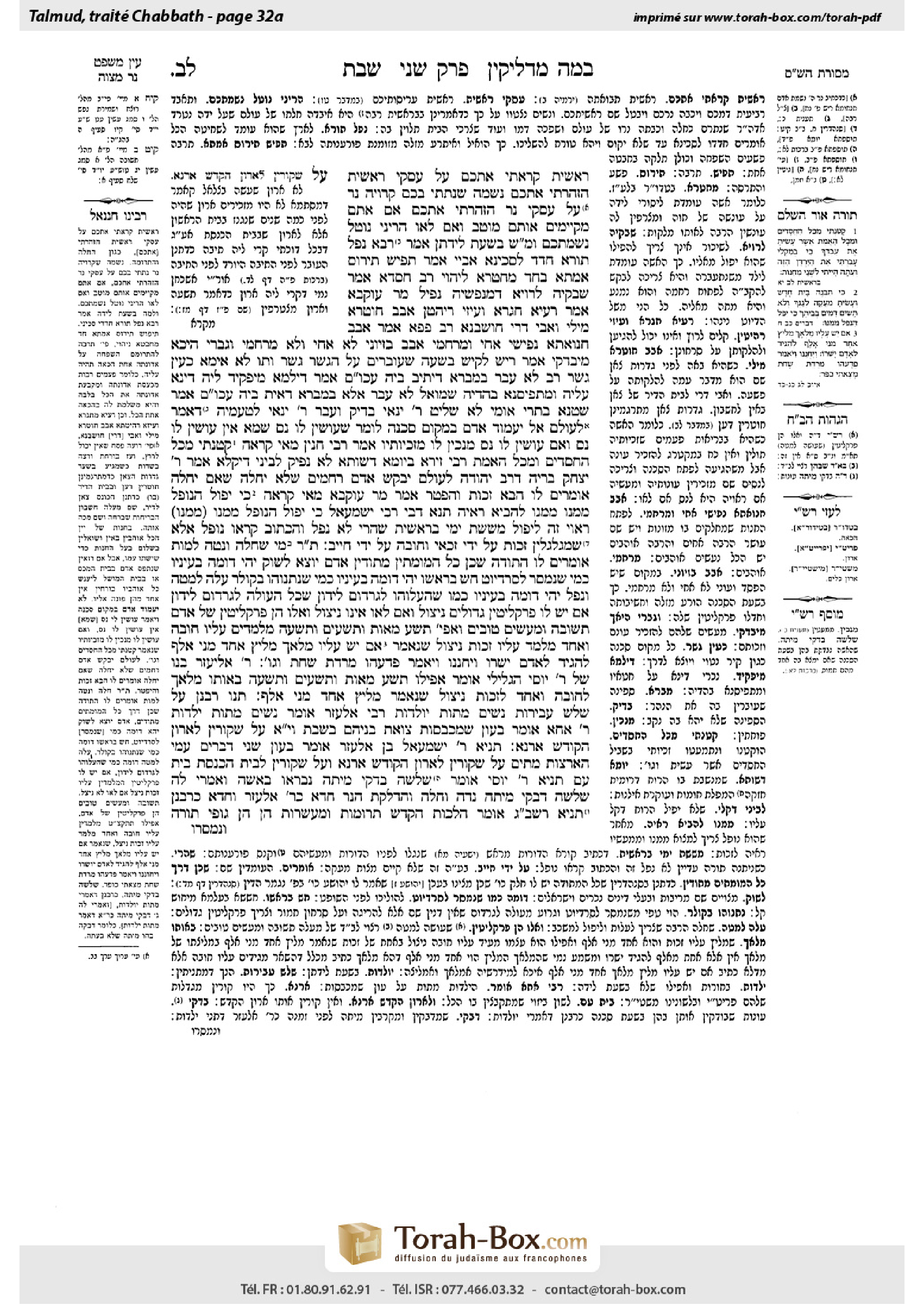
This page of Shabbat includes the Aramaic text, an English translation and an AI-generated French translation, alongside the scan above.
שבת ל״ב א · Aramaic and Hebrew text
״רֵאשִׁית״ קָרָאתִי אֶתְכֶם — עַל עִסְקֵי רֵאשִׁית הִזְהַרְתִּי אֶתְכֶם. נְשָׁמָה שֶׁנָּתַתִּי בָּכֶם קְרוּיָה ״נֵר״ — עַל עִסְקֵי נֵר הִזְהַרְתִּי אֶתְכֶם. אִם אַתֶּם מְקַיְּימִים אוֹתָם — מוּטָב, וְאִם לָאו — הֲרֵינִי נוֹטֵל נִשְׁמַתְכֶם.
וּמַאי שְׁנָא בִּשְׁעַת לֵידָתָן? אָמַר רָבָא: נְפַל תּוֹרָא — חַדֵּד לְסַכִּינָא. אַבָּיֵי אָמַר: תַּפִּישׁ תֵּירוּס אַמְּתָא, בְּחַד מַחְטְרָא לֶיהֱוֵי. רַב חִסְדָּא אָמַר: שִׁבְקֵיהּ לְרַוְיָא, דְּמִנַּפְשֵׁיהּ נָפֵיל. מָר עוּקְבָא אָמַר: רָעֲיָא חֲגִרָא וְעִיזֵּי רָהֲטָן, אַבָּב חוּטְרָא מִילֵּי, וְאַבֵּי דָרֵי חוּשְׁבָּנָא. רַב פָּפָּא אָמַר: אַבָּב חַנְוָאתָא נְפִישִׁי אַחֵי וּמְרַחֲמֵי, אַבָּב בִּזְיוֹנֵי — לָא אַחֵי וְלָא מְרַחֲמֵי.
וְגַבְרֵי הֵיכָא מִיבַּדְקִי? אָמַר רֵישׁ לָקִישׁ: בְּשָׁעָה שֶׁעוֹבְרִים עַל הַגֶּשֶׁר. גֶּשֶׁר וְתוּ לָא? אֵימָא: כְּעֵין גֶּשֶׁר. רַב לָא עָבַר בְּמַבָּרָא דְּיָתֵיב בֵּיהּ גּוֹי, אָמַר: דִילְמָא מִיפְּקִיד לֵיהּ דִּינָא עֲלֵיהּ וּמִתְּפִיסְנָא בַּהֲדֵיהּ. שְׁמוּאֵל לָא עָבַר אֶלָּא בְּמַבָּרָא דְּאִית בֵּיהּ גּוֹי, אָמַר: שִׂטְנָא בִּתְרֵי אוּמֵּי לָא שָׁלֵיט.
רַבִּי יַנַּאי בָּדֵיק וְעָבַר. רַבִּי יַנַּאי לְטַעְמֵיהּ, דְּאָמַר: לְעוֹלָם אַל יַעֲמוֹד אָדָם בְּמָקוֹם סַכָּנָה לוֹמַר שֶׁעוֹשִׂין לוֹ נֵס, שֶׁמָּא אֵין עוֹשִׂין לוֹ נֵס. וְאִם עוֹשִׂין לוֹ נֵס — מְנַכִּין לוֹ מִזְּכֻיוֹתָיו. אָמַר רַבִּי חָנִין: מַאי קְרָאָה? — ״קָטֹנְתִּי מִכֹּל הַחֲסָדִים וּמִכׇּל הָאֱמֶת״. רַבִּי זֵירָא בְּיוֹמָא דְשׁוּתָא לָא נָפֵיק לְבֵינֵי דִּיקְלֵי.
אָמַר רַב יִצְחָק בְּרֵיהּ דְּרַב יְהוּדָה: לְעוֹלָם יְבַקֵּשׁ אָדָם רַחֲמִים שֶׁלֹּא יֶחֱלֶה, שֶׁאִם יֶחֱלֶה אוֹמְרִים לוֹ: הָבֵא זְכוּת וְהִפָּטֵר. אָמַר מָר עוּקְבָא: מַאי קְרָאָה? — ״כִּי יִפּוֹל הַנּוֹפֵל מִמֶּנּוּ״ — מִמֶּנּוּ לְהָבִיא רְאָיָה. תָּנָא דְּבֵי רַבִּי יִשְׁמָעֵאל: ״כִּי יִפּוֹל הַנּוֹפֵל מִמֶּנּוּ״ (מִמֶּנּוּ) — רָאוּי זֶה לִיפּוֹל מִשֵּׁשֶׁת יְמֵי בְרֵאשִׁית, שֶׁהֲרֵי לֹא נָפַל, וְהַכָּתוּב קְרָאוֹ ״נוֹפֵל״. אֶלָּא, שֶׁמְגַלְגְּלִין זְכוּת עַל יְדֵי זַכַּאי וְחוֹבָה עַל יְדֵי חַיָּיב.
תָּנוּ רַבָּנַן: מִי שֶׁחָלָה וְנָטָה לָמוּת, אוֹמְרִים לוֹ: הִתְוַדֵּה, שֶׁכֵּן כׇּל הַמּוּמָתִין מִתְוַדִּין. אָדָם יוֹצֵא לַשּׁוּק, יְהִי דּוֹמֶה בְּעֵינָיו כְּמִי שֶׁנִּמְסַר לְסַרְדְּיוֹט. חָשׁ בְּרֹאשׁוֹ — יְהִי דּוֹמֶה בְּעֵינָיו כְּמִי שֶׁנְּתָנוּהוּ בְּקוֹלָר. עָלָה לַמִּטָּה וְנָפַל — יְהִי דּוֹמֶה בְּעֵינָיו כְּמִי שֶׁהֶעְלוּהוּ לַגַּרְדּוֹם לִידּוֹן, שֶׁכָּל הָעוֹלֶה לַגַּרְדּוֹם לִידּוֹן אִם יֵשׁ לוֹ פְּרַקְלִיטִין גְּדוֹלִים — נִיצּוֹל, וְאִם לָאו — אֵינוֹ נִיצּוֹל.
וְאֵלּוּ הֵן פְּרַקְלִיטִין שֶׁל אָדָם: תְּשׁוּבָה וּמַעֲשִׂים טוֹבִים. וַאֲפִילּוּ תְּשַׁע מֵאוֹת וְתִשְׁעִים וְתִשְׁעָה מְלַמְּדִים עָלָיו חוֹבָה וְאֶחָד מְלַמֵּד עָלָיו זְכוּת — נִיצּוֹל, שֶׁנֶּאֱמַר: ״אִם יֵשׁ עָלָיו מַלְאָךְ מֵלִיץ אֶחָד מִנִּי אָלֶף לְהַגִּיד לְאָדָם יׇשְׁרוֹ. וַיְחֻנֶּנּוּ וַיֹּאמֶר פְּדָעֵהוּ מֵרֶדֶת שָׁחַת וְגוֹ׳״. רַבִּי אֱלִיעֶזֶר בְּנוֹ שֶׁל רַבִּי יוֹסֵי הַגְּלִילִי אוֹמֵר: אֲפִילּוּ תְּשַׁע מֵאוֹת וְתִשְׁעִים וְתִשְׁעָה בְּאוֹתוֹ מַלְאָךְ לְחוֹבָה וְאֶחָד לִזְכוּת — נִיצּוֹל, שֶׁנֶּאֱמַר: ״מֵלִיץ אֶחָד מִנִּי אָלֶף״.
תָּנוּ רַבָּנַן: עַל שָׁלֹשׁ עֲבֵירוֹת נָשִׁים מֵתוֹת יוֹלְדוֹת. רַבִּי אֶלְעָזָר אוֹמֵר נָשִׁים מֵתוֹת יְלָדוֹת. רַבִּי אַחָא אוֹמֵר בְּעָוֹן שֶׁמְּכַבְּסוֹת צוֹאַת בְּנֵיהֶם בְּשַׁבָּת. וְיֵשׁ אוֹמְרִים: עַל שֶׁקּוֹרִין לַאֲרוֹן הַקּוֹדֶשׁ ״אֲרָנָא״.
תַּנְיָא, רַבִּי יִשְׁמָעֵאל בֶּן אֶלְעָזָר אוֹמֵר: בַּעֲוֹן שְׁנֵי דְבָרִים עַמֵּי הָאֲרָצוֹת מֵתִים — עַל שֶׁקּוֹרִין לַאֲרוֹן הַקּוֹדֶשׁ ״אֲרָנָא״, וְעַל שֶׁקּוֹרִין לְבֵית הַכְּנֶסֶת ״בֵּית עָם״. תַּנְיָא רַבִּי יוֹסֵי אוֹמֵר: שְׁלֹשָׁה בִּדְקֵי מִיתָה נִבְרְאוּ בָּאִשָּׁה, וְאָמְרִי לַהּ: שְׁלֹשָׁה דִּבְקֵי מִיתָה: נִדָּה וְחַלָּה וְהַדְלָקַת הַנֵּר. חֲדָא כְּרַבִּי אֶלְעָזָר וַחֲדָא כְּרַבָּנַן.
תַּנְיָא רַבָּן שִׁמְעוֹן בֶּן גַּמְלִיאֵל אוֹמֵר: הִלְכוֹת הֶקְדֵּשׁ, תְּרוּמוֹת וּמַעַשְׂרוֹת — הֵן הֵן גּוּפֵי תּוֹרָה,
Shabbat 32a · English translation
I called you first, as it is stated: “Israel is the Lord’s hallowed portion, His first fruits of the increase” (Jeremiah 2:3) and I warned you about matters of the first: “Of the first of your dough you shall set apart ḥalla for a gift” (Numbers 15:20). The soul that I have placed in you is called ner: “The spirit of man is the lamp [ner] of the Lord” (Proverbs 20:27), and I warned you about matters of the Shabbat lamp. If you fulfill these mitzvot, fine, and if not, then I will take your soul.
And, if so, what is different during childbirth? Why does the divine attribute of judgment punish them for dereliction in fulfillment of these mitzvot specifically then? The Gemara cites several folk sayings expressing the concept that when a person is in danger, he is punished for his sins. Rava said: If the ox fell, sharpen the knife to slaughter it. Abaye said: If the maidservant’s insolence abounds, she will be struck by a single blow as punishment for all her sins. So too, when a woman is giving birth and her suffering is great due to Eve’s sin of eating from the Tree of Knowledge, all the punishments for her own sins are added to that suffering. Rav Ḥisda said: Leave the drunk, as he falls on his own. Similarly, the time of birth is a time of danger, and if the Holy One, Blessed be He, does not come to her assistance at that time, that is sufficient to cause her death. Mar Ukva said: The shepherd is crippled, and the goats are running, and he cannot catch them. However, next to the gate, he speaks harsh words, and inside the pen he settles the account. Similarly, as long as a woman is in a healthy state, her sins are in abeyance, and she is not held accountable for them. However, when she is giving birth, which is a time of danger, she is held accountable for her sins and a calculation is made whether or not she is worthy of a miracle. Rav Pappa said: At the entrance to the stores, during a time of prosperity, brothers and loved ones abound. When a person is prospering financially, everyone acts like his brother or friend. However, at the gate of disgrace, during a time of loss and poverty, he has no brothers and no loved ones; everyone abandons him.
And the Gemara asks: And where are men examined? When are men vulnerable to judgment and held accountable for their actions? Reish Lakish said: When they are crossing a bridge. The Gemara wonders: Only when they are crossing a bridge and at no other time? Rather, say: Anything like a bridge, any place where danger is commonplace. On a similar note, the Gemara relates: Rav would not cross a river in a ferry in which a gentile sat. He said to himself: Perhaps a judgment will be reckoned with him, and I will be caught together with him when he is punished. Whereas, Shmuel would only cross in a ferry if there was a gentile in it. He said: Satan does not have dominion over two nations. He settles his accounts with people from each nationality separately.
Rabbi Yannai would examine the ferry and cross. The Gemara comments that Rabbi Yannai acted in accordance with his reasoning stated elsewhere, as he said: A person should never stand in a place of danger saying that they on High will perform a miracle for him, lest in the end they do not perform a miracle for him. And, moreover, even if they do perform a miracle for him, they will deduct it from his merits. Rabbi Ḥanin said: What is the verse that alludes to this? When Jacob said: “I am not worthy of all the mercies, and of all the truth, which You have shown unto Your servant” (Genesis 32:11), and he explains: Since You have bestowed upon me so much kindness and truth, my merits have been diminished. Similarly, the Gemara relates that Rabbi Zeira would not go out and walk among the palm trees on a day when there was a southern wind blowing due to the fear that the trees might fall on him.
In a similar vein, Rav Yitzḥak, son of Rav Yehuda, said: A person should always pray that he will not become ill, as if he becomes ill they say to him: Bring proof of your virtue and exempt yourself. It is preferable for a person not to be forced to prove that he merits staying alive, as he might not be able to prove it. Mar Ukva said: What is the verse that alludes to this? As it says: “When you build a new house, then you shall make a parapet for your roof, that you bring not blood upon your house, if the fallen falls mimenu” (Deuteronomy 22:8). He explains: Mimenu, from him proof must be brought. When one falls from his previous situation, it is his own responsibility to prove his innocence and emerge unharmed. The school of Rabbi Yishmael taught: What is the meaning of the phrase: If the fallen falls from it? This person was destined to fall from that roof from the six days of Creation, it was ingrained into nature. As, although he did not yet fall, the verse calls him fallen. Nevertheless, the owner of the house is indicted for this, as merit is engendered by means of the innocent and guilt by means of the guilty.
The Sages taught: One who became ill and tended toward death, they say to him: Confess, as all those executed by the courts confess. Even if he is dying of natural causes, it is worthwhile for him to consider his death atonement for his sins. The Sages said: When a person goes out to the marketplace where there are fights and disputes, he should consider himself as someone who has been handed over to a soldier [seradiyot]. If his head hurt, he should consider it as if they placed him in a chain [kolar] around his neck. If he climbed into bed and fell ill, he should consider himself as if they took him up to the gallows to be judged, as with regard to anyone who goes up to the gallows to be judged, if he has great advocates [peraklitin], he is spared, and if not, he is not spared.
And with regard to divine judgment, these are a person’s advocates: Repentance and good deeds. The Gemara comments: And even if there are nine hundred ninety-nine asserting his guilt and only one asserting his innocence, he is spared, as it is stated: “If there be for him an angel, an advocate, one among a thousand, to vouch for a man’s uprightness; then He is gracious unto him, and says: Deliver him from going down to the pit, I have found a ransom” (Job 33:23–24). Rabbi Eliezer, son of Rabbi Yosei HaGelili, says: Even if there are nine hundred ninety-nine portions within that same angel accusing him, and one portion asserting his innocence, he is spared, as it stated: “An advocate, one among a thousand.” Even when the advocate who asserts his innocence finds only one-tenth of one percent of innocence in this man, even then, he is gracious unto him, and says: Deliver him from going down to the pit, I have found a ransom.
The Sages taught in a baraita: For three transgressions women die in childbirth [yoledot]. Rabbi Elazar has a different version and says that women die when they are young [yeladot]. These transgressions are those enumerated in the mishna: The halakhot of a menstruating woman, ḥalla, and Shabbat lights. Rabbi Aḥa says they are punished for the sin of laundering their children’s feces from clothing on Shabbat. And some say: Because they call the Holy Ark simply ark.
Similarly, we learned in a baraita that Rabbi Yishmael ben Elazar says: On account of two sins, ignoramuses [amei ha’aretz] die young (Rav Ya’akov Emden): Because they call the Holy Ark simply ark, and because they call the synagogue the house of the people. It was taught in a baraita that Rabbi Yosei says: Three crucibles potentially leading to death were created in the woman, and some say: Three accelerants of death. They are: Menstruation, ḥalla, and lighting the Shabbat lights. The Gemara explains that one version, accelerants of death, is in accordance with the opinion of Rabbi Elazar, who said that women die young. And the other one, crucibles of death, is in accordance with the opinion of the Rabbis, who said that women die in childbirth.
Similarly, it was taught in a baraita that Rabbi Shimon ben Gamliel says: The halakhot of consecrated items, terumot, and tithes are themselves the essence of Torah and are extremely severe,
Shabbat 32a · Traduction française (IA)
Je vous ai appelés les premiers, comme il est dit : « Israël est la part consacrée au Seigneur, les prémices de sa récolte » (Jérémie 2, 3), et je vous ai mis en garde au sujet des premières choses : « Vous prélèverez une offrande de ḥalla sur les prémices de votre pâte » (Nombres 15, 20). L’âme que j’ai placée en vous est appelée ner, comme il est dit : « L’esprit de l’homme est la lampe [ner] du Seigneur » (Proverbes 20, 27), et je vous ai mis en garde au sujet des lampes de Chabbat. Si vous accomplissez ces mitsvot, tant mieux ; sinon, je prendrai votre âme.
Et si tel est le cas, qu’est-ce qui distingue l’accouchement ? Pourquoi l’attribut divin de justice les punit-il pour avoir négligé l’accomplissement de ces mitsvot précisément à ce moment-là ? La Guemara cite plusieurs dictons populaires exprimant l’idée qu’une personne en danger est punie pour ses fautes. Rava dit : Si le bœuf est tombé, aiguise le couteau pour l’abattre. Abaye dit : Si l’insolence de la servante devient excessive, elle recevra un seul coup qui la punira pour toutes ses fautes. De même, lorsqu’une femme accouche et que sa souffrance est grande en raison de la faute d’Ève, qui a mangé du fruit de l’Arbre de la connaissance, toutes les punitions dues à ses propres fautes s’ajoutent à cette souffrance. Rav Ḥisda dit : Laisse l’ivrogne, il tombe de lui-même. De même, le moment de l’accouchement est un moment de danger ; si le Saint, béni soit-Il, ne vient pas à son secours à cet instant, cela suffit à causer sa mort. Mar Ukva dit : Le berger est boiteux, les chèvres s’enfuient et il ne peut les rattraper. Pourtant, près de la porte, il profère des paroles dures, tandis qu’à l’intérieur de l’enclos, il règle ses comptes. De même, tant qu’une femme est en bonne santé, ses fautes restent en suspens et elle n’en est pas tenue responsable. Mais lorsqu’elle accouche, en un moment de danger, elle doit répondre de ses fautes et l’on examine si elle mérite ou non un miracle. Rav Pappa dit : À l’entrée des magasins, en période de prospérité, les frères et les êtres chers abondent. Lorsqu’une personne prospère financièrement, tout le monde se comporte comme son frère ou son ami. Mais à la porte de la disgrâce, en période de pertes et de pauvreté, elle n’a ni frères ni êtres chers ; tout le monde l’abandonne.
La Guemara demande : Et où les hommes sont-ils examinés ? Quand sont-ils exposés au jugement et tenus responsables de leurs actes ? Reish Lakish dit : Lorsqu’ils traversent un pont. La Guemara s’étonne : Seulement lorsqu’ils traversent un pont, et à aucun autre moment ? Il faut plutôt dire : dans toute situation semblable à la traversée d’un pont, c’est-à-dire dans tout endroit où le danger est fréquent. À ce propos, la Guemara rapporte que Rav ne traversait pas une rivière dans un bac où se trouvait un non-Juif. Il se disait : Peut-être qu’un jugement sera prononcé contre lui et que je serai pris avec lui lorsqu’il sera puni. Shmuel, quant à lui, ne traversait en bac que s’il s’y trouvait un non-Juif. Il disait : Satan n’exerce pas sa domination sur deux peuples ; il règle ses comptes séparément avec les gens de chaque peuple.
Rabbi Yannai inspectait le bac, puis traversait. La Guemara fait remarquer que Rabbi Yannai agissait conformément à son raisonnement énoncé ailleurs, car il disait : Une personne ne doit jamais se tenir dans un lieu dangereux en se disant que ceux d’en haut accompliront un miracle pour elle, de peur qu’en fin de compte ils n’accomplissent pas de miracle. De plus, même s’ils accomplissent un miracle pour elle, ils le déduiront de ses mérites. Rabbi Ḥanin dit : Quel verset y fait allusion ? Jacob dit : « Je ne suis pas digne de toutes les bontés et de toute la fidélité dont Tu as usé envers ton serviteur » (Genèse 32, 11), et il explique : Puisque Tu m’as accordé tant de bonté et de fidélité, mes mérites ont diminué. De même, la Guemara rapporte que Rabbi Zeira ne sortait pas se promener parmi les palmiers les jours où soufflait un vent du sud, car il craignait que les arbres ne tombent sur lui.
Dans le même esprit, Rav Yitzḥak, fils de Rav Yehuda, dit : Une personne doit toujours prier pour ne pas tomber malade, car si elle tombe malade, on lui dit : « Apporte la preuve de ta vertu et obtiens ta libération. » Il est préférable de ne pas être contraint de prouver que l’on mérite de rester en vie, car on pourrait ne pas y parvenir. Mar Ukva dit : Quel verset y fait allusion ? Comme il est dit : « Lorsque tu construiras une maison neuve, tu feras un parapet à ton toit, afin de ne pas attirer le sang sur ta maison, si le tombé tombe mimenu » (Deutéronome 22, 8). Il explique : Mimenu, c’est de lui qu’il faut apporter la preuve. Lorsqu’une personne tombe de sa situation antérieure, il lui incombe de prouver son innocence et de s’en tirer indemne. L’école de Rabbi Yishmael enseigna : Que signifie l’expression « si le tombé tombe de là » ? Cet homme était destiné à tomber de ce toit depuis les six jours de la Création ; cela était inscrit dans la nature. En effet, bien qu’il ne soit pas encore tombé, le verset le qualifie de tombé. Néanmoins, le propriétaire de la maison est mis en cause, car le mérite s’acquiert par l’intermédiaire des innocents et la culpabilité par celui des coupables.
Les Sages enseignèrent : À celui qui est tombé malade et dont l’état s’est aggravé au point qu’il risque de mourir, on dit : « Confesse-toi », comme le font tous ceux qui sont exécutés par les tribunaux. Même s’il meurt de causes naturelles, il lui est avantageux de considérer sa mort comme une expiation de ses fautes. Les Sages dirent : Lorsqu’une personne se rend au marché, où il y a des querelles et des disputes, elle doit se considérer comme quelqu’un qui a été livré à un soldat [seradiyot]. Si elle a mal à la tête, elle doit se considérer comme si on lui avait passé une chaîne [kolar] autour du cou. Si elle s’est mise au lit et est tombée malade, elle doit se considérer comme si on l’avait conduite à la potence pour y être jugée ; car, pour quiconque monte à la potence afin d’y être jugé, s’il a de nombreux avocats [peraklitin], il est épargné, et sinon, il ne l’est pas.
En ce qui concerne le jugement divin, les avocats d’une personne sont le repentir et les bonnes actions. La Guemara fait remarquer que même si neuf cent quatre-vingt-dix-neuf personnes affirment sa culpabilité et qu’une seule affirme son innocence, elle est épargnée, comme il est dit : « S’il se trouve pour lui un ange, un avocat, un entre mille, pour attester de la droiture de l’homme, alors Il lui fera grâce et dira : “Délivrez-le de la descente dans la fosse ; j’ai trouvé une rançon” » (Job 33, 23-24). Rabbi Eliezer, fils de Rabbi Yosei HaGelili, dit : Même si, dans cet ange même, neuf cent quatre-vingt-dix-neuf parts l’accusent et qu’une seule part affirme son innocence, il est épargné, comme il est dit : « Un avocat, un entre mille. » Même si l’avocat qui atteste de son innocence ne trouve chez cet homme qu’un dixième de un pour cent d’innocence, alors même, Il lui fera grâce et dira : « Délivrez-le de la descente dans la fosse ; j’ai trouvé une rançon. »
Les Sages enseignèrent dans une baraïta : Pour trois transgressions, les femmes meurent en accouchant [yoledot]. Rabbi Elazar propose une autre version et dit que les femmes meurent jeunes [yeladot]. Ces transgressions sont celles qui sont énumérées dans la Michna : les halakhot de la femme menstruée, de la ḥalla et des lampes de Chabbat. Rabbi Aḥa dit qu’elles sont punies pour avoir lavé, le Chabbat, les vêtements souillés par les excréments de leurs enfants. Et certains disent : parce qu’elles appellent l’Arche sainte simplement « arche ».
De même, nous avons appris dans une baraïta que Rabbi Yishmael ben Elazar dit : Pour deux fautes, les ignorants [amei ha’aretz] meurent jeunes (Rav Ya’akov Emden) : parce qu’ils appellent l’Arche sainte simplement « arche », et parce qu’ils appellent la synagogue « la maison du peuple ». Il fut enseigné dans une baraïta que Rabbi Yosei dit : Trois creusets susceptibles d’entraîner la mort furent créés chez la femme, et certains disent : trois facteurs qui accélèrent la mort. Ce sont : la menstruation, la ḥalla et l’allumage des lampes de Chabbat. La Guemara explique que la version « facteurs qui accélèrent la mort » concorde avec l’opinion de Rabbi Elazar, qui dit que les femmes meurent jeunes. L’autre version, « creusets de la mort », concorde avec l’opinion des Rabbins, qui disent que les femmes meurent en accouchant.
De même, il fut enseigné dans une baraïta que Rabbi Shimon ben Gamliel dit : Les halakhot des choses consacrées, des teroumot et des dîmes sont en elles-mêmes l’essence de la Torah et sont d’une extrême gravité,
Traduction française générée par IA à partir de l’édition anglaise de Sefaria. Vérifie toujours un passage avec le texte source.
Text from Sefaria: William Davidson Edition - Vocalized Aramaic (CC BY NC); William Davidson Edition - English (CC BY NC).