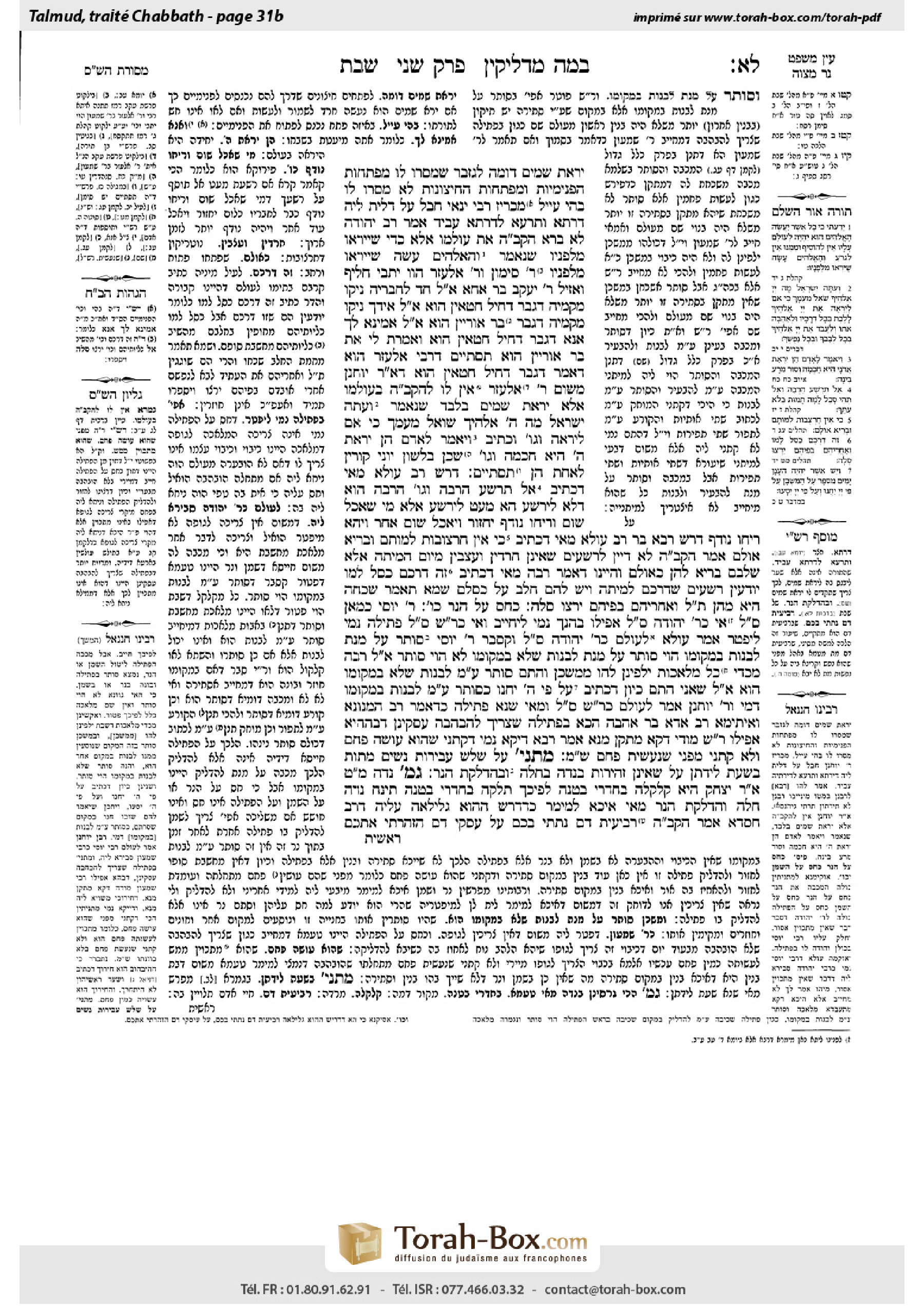
Shabbat 31b: Talmud study for Daf Yomi
Daf Yomi is the daily study of one Talmud folio. Explore 37 tractates with scans, Hebrew text, Sefaria English and AI-generated French translations where annotated.
Passage selection and English or AI-generated French translation are available where the scan has annotations. Daf Study is independent of Torah-Box and Sefaria.
Browse Shabbat · שבת · All tractatesShabbat 31b text and translations
This page of Shabbat includes the Aramaic text, an English translation and an AI-generated French translation, alongside the scan above.
שבת ל״א ב · Aramaic and Hebrew text
יִרְאַת שָׁמַיִם, דּוֹמֶה לְגִזְבָּר שֶׁמָּסְרוּ לוֹ מַפְתְּחוֹת הַפְּנִימִיּוֹת וּמַפְתְּחוֹת הַחִיצוֹנוֹת לֹא מָסְרוּ לוֹ, בְּהֵי עָיֵיל? מַכְרִיז רַבִּי יַנַּאי: חֲבָל עַל דְּלֵית לֵיהּ דָּרְתָא וְתַרְעָא לְדָרְתָא עָבֵיד. אָמַר רַב יְהוּדָה: לֹא בָּרָא הַקָּדוֹשׁ בָּרוּךְ הוּא אֶת עוֹלָמוֹ אֶלָּא כְּדֵי שֶׁיִּירְאוּ מִלְּפָנָיו, שֶׁנֶּאֱמַר: ״וְהָאֱלֹהִים עָשָׂה שֶׁיִּירְאוּ מִלְּפָנָיו״.
רַבִּי סִימוֹן וְרַבִּי אֶלְעָזָר הֲווֹ יָתְבִי. חָלֵיף וְאָזֵיל רַבִּי יַעֲקֹב בַּר אַחָא. אֲמַר לֵיהּ חַד לְחַבְרֵיהּ: נֵיקוּ מִקַּמֵּיהּ, דִּגְבַר דָּחֵיל חֶטְאִין הוּא. אֲמַר לֵיהּ אִידַּךְ: נֵיקוּ מִקַּמֵּיהּ, דִּגְבַר בַּר אוֹרְיָין הוּא. אֲמַר לֵיהּ: אָמֵינָא לָךְ אֲנָא דִּגְבַר דָּחֵיל חֶטְאִין הוּא, וְאָמְרַתְּ לִי אַתְּ בַּר אוֹרְיָין הוּא?!
תִּסְתַּיֵּים דְּרַבִּי אֶלְעָזָר הוּא דְּאָמַר דִּגְבַר דָּחֵיל חֶטְאִין הוּא. דְּאָמַר רַבִּי יוֹחָנָן מִשּׁוּם רַבִּי אֶלְעָזָר: אֵין לוֹ לְהַקָּדוֹשׁ בָּרוּךְ הוּא בְּעוֹלָמוֹ אֶלָּא יִרְאַת שָׁמַיִם בִּלְבַד, שֶׁנֶּאֱמַר: ״וְעַתָּה יִשְׂרָאֵל מָה ה׳ אֱלֹהֶיךָ שׁוֹאֵל מֵעִמָּךְ כִּי אִם לְיִרְאָה וְגוֹ׳״, וּכְתִיב: ״וַיֹּאמֶר לָאָדָם הֵן יִרְאַת ה׳ הִיא חׇכְמָה וְגוֹ׳״ — שֶׁכֵּן בְּלָשׁוֹן יְוָנִי קוֹרִין לְאַחַת ״הֵן״. תִּסְתַּיֵּים.
דָּרֵשׁ רַב עוּלָּא: מַאי דִכְתִיב ״אַל תִּרְשַׁע הַרְבֵּה וְגוֹ׳״ — הַרְבֵּה הוּא דְּלָא לִירְשַׁע, הָא מְעַט לִירְשַׁע?! אֶלָּא: מִי שֶׁאָכַל שׁוּם וְרֵיחוֹ נוֹדֵף יַחְזוֹר וְיֹאכַל שׁוּם אַחֵר וִיהֵא רֵיחוֹ נוֹדֵף?!
דָּרֵשׁ רָבָא בַּר רַב עוּלָּא: מַאי דִכְתִיב ״כִּי אֵין חַרְצֻבּוֹת לְמוֹתָם וּבָרִיא אוּלָם״ — אָמַר הַקָּדוֹשׁ בָּרוּךְ הוּא: לֹא דַּיָּין לָרְשָׁעִים שֶׁאֵינָן חֲרֵדִין וַעֲצֵבִין מִיּוֹם הַמִּיתָה, אֶלָּא שֶׁלִּבָּם בָּרִיא לָהֶן כְּאוּלָם. וְהַיְינוּ דְּאָמַר רַבָּה מַאי דִכְתִיב ״זֶה דַרְכָּם כֵּסֶל לָמוֹ״ — יוֹדְעִין רְשָׁעִים שֶׁדַּרְכָּם לְמִיתָה, וְיֵשׁ לָהֶם חֵלֶב עַל כִּסְלָם. שֶׁמָּא תֹּאמַר שִׁכְחָה הִיא מֵהֶן? תַּלְמוּד לוֹמַר: ״וְאַחֲרֵיהֶם בְּפִיהֶם יִרְצוּ סֶלָה״.
כְּחָס עַל הַנֵּר כּוּ׳. רַבִּי יוֹסֵי כְּמַאן סְבִירָא לֵיהּ? אִי כְּרַבִּי יְהוּדָה סְבִירָא לֵיהּ, אֲפִילּוּ בְּהָנָךְ נָמֵי לִיחַיֵּיב! וְאִי כְּרַבִּי שִׁמְעוֹן סְבִירָא לֵיהּ, פְּתִילָה נָמֵי לִיפְטַר. אָמַר עוּלָּא: לְעוֹלָם כְּרַבִּי יְהוּדָה סְבִירָא לֵיהּ, וְקָסָבַר רַבִּי יוֹסֵי סוֹתֵר עַל מְנָת לִבְנוֹת בִּמְקוֹמוֹ הָוֵי סוֹתֵר. עַל מְנָת לִבְנוֹת שֶׁלֹּא בִּמְקוֹמוֹ — לָא הָוֵי סוֹתֵר.
אֲמַר לֵיהּ רַבָּה: מִכְּדֵי כׇּל מְלָאכוֹת יָלְפִינַן לְהוּ מִמִּשְׁכָּן, וְהָתָם סוֹתֵר עַל מְנָת לִבְנוֹת שֶׁלֹּא בִּמְקוֹמוֹ הוּא! אֲמַר לֵיהּ: שָׁאנֵי הָתָם כֵּיוָן דִּכְתִיב ״עַל פִּי ה׳ יַחֲנוּ״, כְּסוֹתֵר עַל מְנָת לִבְנוֹת בִּמְקוֹמוֹ דָּמֵי.
וְרַבִּי יוֹחָנָן אָמַר: לְעוֹלָם כְּרַבִּי שִׁמְעוֹן סְבִירָא לֵיהּ. וּמַאי שְׁנָא פְּתִילָה? כִּדְאָמַר רַב הַמְנוּנָא, וְאִיתֵּימָא רַב אַדָּא בַּר אַהֲבָה: הָכָא בִּפְתִילָה שֶׁצָּרִיךְ לְהַבְהֲבָהּ עָסְקִינַן, דִּבְהָהִיא אֲפִילּוּ רַבִּי שִׁמְעוֹן מוֹדֵי, דְּקָא מְתַקֵּן מָנָא. אָמַר רָבָא: דַּיְקָא נָמֵי, דְּקָתָנֵי שֶׁהוּא עוֹשָׂהּ פֶּחָם, וְלָא קָתָנֵי מִפְּנֵי שֶׁנַּעֲשֵׂית פֶּחָם. שְׁמַע מִינַּהּ.
מַתְנִי׳ עַל שָׁלֹשׁ עֲבֵירוֹת נָשִׁים מֵתוֹת בִּשְׁעַת לֵידָתָן: עַל שֶׁאֵינָן זְהִירוֹת בַּנִּדָּה, בַּחַלָּה, וּבְהַדְלָקַת הַנֵּר.
גְּמָ׳ נִדָּה מַאי טַעְמָא? אָמַר רַבִּי יִצְחָק: הִיא קִלְקְלָה בְּחַדְרֵי בִטְנָהּ, לְפִיכָךְ תִּלְקֶה בְּחַדְרֵי בִטְנָהּ. תִּינַח נִדָּה — חַלָּה וְהַדְלָקַת הַנֵּר מַאי אִיכָּא לְמֵימַר? כְּדִדְרַשׁ הַהוּא גָּלִילָאָה עֲלֵיהּ דְּרַב חִסְדָּא, אָמַר הַקָּדוֹשׁ בָּרוּךְ הוּא: רְבִיעִית דָּם נָתַתִּי בָּכֶם — עַל עִסְקֵי דָם הִזְהַרְתִּי אֶתְכֶם.
Shabbat 31b · English translation
fear of Heaven is like a treasurer [gizbar] to whom they gave keys to the inner doors of the treasury but they did not give keys to the outer door. With what key will he enter? Although the Torah is the inner key, without fear of Heaven one cannot gain access to the genuine Torah. Similarly, Rabbi Yannai would proclaim: Woe unto one who does not have a courtyard, and who makes a fence for the courtyard, i.e., a person who lacks fear of Heaven and is nevertheless involved in Torah study. Rav Yehuda said: The Holy One, Blessed be He, only created His world so that people would fear before Him, as it is stated: “And God has so made it that men should fear before Him” (Ecclesiastes 3:14).
The Gemara also related that Rabbi Simon and Rabbi Elazar were sitting. Rabbi Ya’akov bar Aḥa passed and went adjacent to them. One said to the other: Let us stand before him as he is a man who fears sin. The other said to him in response: Let us stand before him, as he is a man of Torah study. He said to him: I said to you that he is a man who fears sin, and you said me that he is a man of Torah study? The former is much greater praise than the latter.
The Gemara remarks: Conclude that Rabbi Elazar is the one who said that he is praiseworthy because he is a man who fears sin, as elsewhere he also spoke in praise of fear. As Rabbi Yoḥanan said in the name of Rabbi Elazar: The Holy One, Blessed be He, has in His world only fear of Heaven alone, as it is stated: “And now, Israel, what does the Lord your God ask of you, but to fear the Lord your God” (Deuteronomy 10:12). And it is written: “And unto man He said: Behold [hen], the fear of the Lord, that is wisdom; and to depart from evil is understanding” (Job 28:28), as in the Greek language they call one hen. Apparently, fear of God is of primary importance. The Gemara concludes: Indeed, conclude that Rabbi Elazar is the one who said so.
Rav Ulla taught: What is the meaning of that which is written: “Be not overmuch wicked” (Ecclesiastes 7:17)? This appears difficult, as, is that to say that only overmuch one should not be wicked; a little, one should be wicked? Rather, this can be understood based on the following adage: One who ate a clove of garlic and its odor spreads, should he again eat another clove of garlic so that its odor will spread further? If you were somewhat wicked, do not think that it is legitimate to continue and be very wicked.
Rava bar Rav Ulla taught: What is the meaning of that which is written: “For there are no pangs [ḥartzubot] at their death and their body is sound” (Psalms 73:4)? The Holy One, Blessed be He, said: Is it not enough for wicked people that they are not anxious [ḥared] or sad [atzuv], ḥartzubot is an acronym of ḥared and atzuv, in anticipation of the day of their death, but also, their heart is as unyielding for them as the entrance to a hall is wide, and they devote no thought to it. And that is what Rabba said: What is the meaning of that which is written: “This is the way of them that are foolish and of those who after them speak approvingly, Selah” (Psalms 49:14)? It means that the wicked know that their path leads to eternal death, but they have fat on their kidneys that prevents that realization from entering their hearts. Lest you say that it is simply forgotten from them; therefore, the verse states: “And of those who after them speak approvingly, Selah” (Psalms 49:14). They are aware of their fate and speak of it, but it does not affect them.
We learned in the mishna that if one extinguished a flame on Shabbat because he sought to spare the lamp, the oil, or the wick, he is liable, but Rabbi Yosei exempts in all cases except in a case in which he extinguished the flame to spare the wick. The Gemara asks with regard to Rabbi Yosei: In accordance with whose opinion does he hold with regard to prohibited labor performed on Shabbat not for its own sake? If he holds in accordance with the opinion of Rabbi Yehuda, who holds that one is liable for a prohibited labor performed on Shabbat not for its own sake, then even in all those cases he should also deem him liable. And if he holds in accordance with the opinion of Rabbi Shimon, who holds that one is exempt for a prohibited labor performed on Shabbat not for its own sake, then even in the case of a wick he should also deem him exempt. Ulla said: Actually, Rabbi Yosei holds in accordance with the opinion of Rabbi Yehuda. However, Rabbi Yosei holds that with regard to every destructive action, if he dismantles in order to rebuild in the same place, then it is considered to be dismantling, and he is liable for having performed a prohibited labor on Shabbat. However, one who demolishes in order to build elsewhere it is not considered performance of the prohibited labor of dismantling. He merely performed a destructive act and is not liable. When one extinguishes the flame to spare the lamp or the oil, he does not do so in order to relight them. When he does so to spare the wick, he indicates that he intends to relight the wick.
Rabba said to him: That reasoning is implausible. After all, all labors prohibited on Shabbat, we derive them from the labors performed in the Tabernacle, and there it was a case of dismantling in order to build elsewhere. They would dismantle the Tabernacle and reconstruct it at the next encampment. Ulla said to Rabba: That is not a proof, as there, in the case of the Tabernacle, it is different. Since it is written: “At the commandment of the Lord they encamped” (Numbers 9:23). The time and place of their travels and their encampments were not determined by them but rather by the word of God. Consequently, when they took down the Tabernacle it was tantamount to demolishing in order to build in the same place. Since the demolition and the construction were both accomplished at the command of God, there was never a case of destruction without a constructive purpose.
And Rabbi Yoḥanan said: Actually, Rabbi Yosei holds in accordance with the opinion of Rabbi Shimon. And as far as the question, what is different about a wick, that can be answered as Rav Hamnuna said, and some say, Rav Adda bar Ahava said: Here, we are dealing with a wick that one must singe before lighting it in order to facilitate its burning, as, in that case, even Rabbi Shimon agrees that extinguishing the flame is prohibited, as, by doing so, he prepares a vessel for use. Rava said: That interpretation is also precise in the language of the mishna, as it was taught in the mishna that one who extinguished a wick is liable because he makes the wick into charcoal intentionally, and it was not taught because charcoal was made on its own. The Gemara concludes: Conclude from it that the mishna is to be understood in that manner.
MISHNA: This mishna concludes the aggadic treatment of the topic of kindling the Shabbat lights. For three transgressions women are punished and die during childbirth: For the fact that they are not careful in observing the laws of a menstruating woman, and in separating ḥalla from the dough, and in lighting the Shabbat lamp.
GEMARA: The Gemara asks: A woman who was not careful in observing the laws of menstruation, what is the reason that she is punished during childbirth? Rabbi Yitzḥak said: She sinned with regard to the chambers of her womb; therefore, she is afflicted in the chambers of her womb. The Gemara asks: Granted, with regard to menstruation; but with regard to a woman who was not careful in separating ḥalla and in kindling the Shabbat lights, what is there to say? Rather, it must be explained in accordance with that which that Galilean taught before Rav Ḥisda. The Holy One, Blessed be He, said: I placed a quarter [revi’it] of a log of blood in you when you were formed, and about matters of the blood of menstruation I warned you.
Shabbat 31b · Traduction française (IA)
La crainte du Ciel est comparable à un trésorier [gizbar] auquel on a remis les clés des portes intérieures du trésor, mais pas celle de la porte extérieure. Avec quelle clé pourra-t-il entrer ? Bien que la Torah soit la clé intérieure, sans la crainte du Ciel, on ne peut accéder à la véritable Torah. De même, Rabbi Yannai proclamait : « Malheur à celui qui n’a pas de cour et qui construit une clôture autour de celle-ci », c’est-à-dire à celui qui n’a pas la crainte du Ciel et qui, malgré cela, s’adonne à l’étude de la Torah. Rav Yehouda a dit : Le Saint, béni soit-Il, n’a créé Son monde que pour que les hommes Le craignent, comme il est dit : « Et Dieu a fait en sorte que les hommes Le craignent » (Ecclésiaste 3, 14).
La Guemara rapporte également que Rabbi Simon et Rabbi Elazar étaient assis. Rabbi Ya’akov bar Aḥa passa près d’eux. L’un dit à l’autre : « Levons-nous devant lui, car c’est un homme qui craint le péché. » L’autre lui répondit : « Levons-nous devant lui, car c’est un homme versé dans l’étude de la Torah. » Il lui dit : « Je t’ai dit que c’est un homme qui craint le péché, et toi, tu m’as répondu que c’est un homme versé dans l’étude de la Torah ? » Le premier éloge est bien plus grand que le second.
La Guemara fait remarquer : Concluons que c’est Rabbi Elazar qui a dit qu’il est digne d’éloges parce qu’il craint le péché, car ailleurs aussi, il a fait l’éloge de la crainte. En effet, Rabbi Yoḥanan a dit au nom de Rabbi Elazar : Le Saint, béni soit-Il, n’a dans Son monde que la crainte du Ciel, comme il est dit : « Et maintenant, Israël, que demande de toi l’Éternel, ton Dieu, sinon de craindre l’Éternel, ton Dieu ? » (Deutéronome 10, 12). Et il est écrit : « Et Il a dit à l’homme : Voici [hen], la crainte de l’Éternel, c’est la sagesse ; s’éloigner du mal, c’est l’intelligence » (Job 28, 28), car en grec, on appelle « hen » le nombre un. Il apparaît donc que la crainte de Dieu est d’une importance primordiale. La Guemara conclut : En effet, concluons que c’est Rabbi Elazar qui l’a dit.
Rav Ulla enseignait : Que signifie ce qui est écrit : « Ne sois pas excessivement méchant » (Ecclésiaste 7, 17) ? Cela semble difficile : cela voudrait-il dire qu’il ne faut pas être excessivement méchant, mais qu’on peut l’être un peu ? Il faut plutôt le comprendre à la lumière du dicton suivant : celui qui a mangé une gousse d’ail et dont l’odeur empeste, doit-il en manger une autre pour que l’odeur soit encore plus forte ? Si tu as été quelque peu méchant, ne crois pas qu’il soit légitime de continuer et de devenir très méchant.
Rava bar Rav Ulla enseignait : Que signifie ce qui est écrit : « Il n’y a pas de souffrances [ḥartzubot] à leur mort, et leur corps est bien portant » (Psaumes 73, 4) ? Le Saint, béni soit-Il, a dit : Ne suffit-il pas aux méchants de n’être ni inquiets [ḥared] ni attristés [atzuv] à l’approche du jour de leur mort — ḥartzubot est un acronyme de ḥared et atzuv —, pour qu’en outre leur cœur leur soit aussi largement ouvert que l’entrée d’une salle, sans qu’ils y réfléchissent ? C’est ce que Rabba a dit : Que signifie ce qui est écrit : « Telle est la voie de ceux qui sont insensés, et de ceux qui, après eux, approuvent leurs paroles. Sélah » (Psaumes 49, 14) ? Cela signifie que les méchants savent que leur voie mène à la mort éternelle, mais qu’ils ont de la graisse sur les reins, qui empêche cette prise de conscience de pénétrer dans leur cœur. Pour que l’on ne dise pas qu’ils l’oublient simplement, le verset précise : « Et de ceux qui, après eux, approuvent leurs paroles. Sélah » (Psaumes 49, 14). Ils connaissent leur sort et en parlent, mais cela ne les touche pas.
Nous avons appris dans la Michna que si quelqu’un éteint une flamme pendant Chabbat parce qu’il cherche à préserver la lampe, l’huile ou la mèche, il est passible ; Rabbi Yossei l’exempte dans tous les cas, sauf lorsqu’il éteint la flamme pour préserver la mèche. La Guemara demande au sujet de Rabbi Yossei : De quelle opinion se réclame-t-il concernant un travail interdit accompli pendant Chabbat sans que ce soit pour son propre but ? S’il suit l’opinion de Rabbi Yehouda, selon laquelle on est passible pour un travail interdit accompli pendant Chabbat sans que ce soit pour son propre but, alors il devrait aussi déclarer passible dans tous ces cas. Et s’il suit l’opinion de Rabbi Shimon, selon laquelle on est exempté pour un travail interdit accompli pendant Chabbat sans que ce soit pour son propre but, alors il devrait aussi exempter dans le cas de la mèche. Oula a dit : En réalité, Rabbi Yossei suit l’opinion de Rabbi Yehouda. Toutefois, selon Rabbi Yossei, pour tout acte de destruction, si l’on démolit afin de reconstruire au même endroit, cela est considéré comme une démolition et l’on est passible d’avoir accompli un travail interdit pendant Chabbat. En revanche, celui qui démolit afin de construire ailleurs n’est pas considéré comme ayant accompli le travail interdit de démolition. Il n’a fait qu’un acte destructeur et n’est pas passible. Lorsqu’on éteint la flamme pour préserver la lampe ou l’huile, on ne le fait pas dans l’intention de les rallumer. Lorsqu’on le fait pour préserver la mèche, cela indique qu’on a l’intention de la rallumer.
Rabba lui dit : Ce raisonnement est peu plausible. Après tout, nous déduisons tous les travaux interdits pendant Chabbat des travaux accomplis dans le Tabernacle, et là, il s’agissait de démolir afin de reconstruire ailleurs. Ils démontaient le Tabernacle et le remontaient au campement suivant. Oula dit à Rabba : Ce n’est pas une preuve, car le cas du Tabernacle est différent. Il est écrit : « Selon l’ordre de l’Éternel, ils campaient » (Nombres 9, 23). Le moment et le lieu de leurs déplacements et de leurs campements n’étaient pas déterminés par eux, mais par la parole de Dieu. Par conséquent, lorsqu’ils démontaient le Tabernacle, cela équivalait à démolir pour reconstruire au même endroit. Puisque la démolition et la construction étaient toutes deux accomplies sur l’ordre de Dieu, il n’y a jamais eu de démolition dépourvue de but constructif.
Et Rabbi Yoḥanan a dit : En réalité, Rabbi Yossei suit l’opinion de Rabbi Shimon. Quant à la question de savoir en quoi la mèche est différente, on peut répondre comme l’a dit Rav Hamnouna — certains disent que c’est Rav Adda bar Ahava qui l’a dit : Ici, il s’agit d’une mèche qu’il faut roussir avant de l’allumer afin de faciliter sa combustion. Dans ce cas, même Rabbi Shimon convient qu’il est interdit d’éteindre la flamme, car ce faisant, on prépare un ustensile à l’usage. Rava a dit : Cette interprétation est également confirmée par la formulation de la Michna, puisqu’il y est enseigné que celui qui éteint une mèche est passible parce qu’il transforme intentionnellement la mèche en charbon ; il n’est pas enseigné qu’il est passible parce que du charbon s’est formé de lui-même. La Guemara conclut : Concluons-en que la Michna doit être comprise de cette manière.
MICHNA : Cette Michna conclut le développement aggadique sur l’allumage des lumières de Chabbat. Pour trois transgressions, les femmes sont punies et meurent en couches : parce qu’elles ne sont pas vigilantes dans l’observance des lois relatives à la femme menstruée, dans le prélèvement de la ḥalla sur la pâte et dans l’allumage de la lampe de Chabbat.
GUEMARA : La Guemara demande : Pour quelle raison une femme qui n’a pas été vigilante dans l’observance des lois relatives à la menstruation est-elle punie en couches ? Rabbi Yitzḥak a dit : Elle a péché concernant les chambres de son utérus ; elle est donc frappée dans les chambres de son utérus. La Guemara demande : Cela se comprend pour la menstruation ; mais que dire d’une femme qui n’a pas été vigilante dans le prélèvement de la ḥalla et dans l’allumage des lumières de Chabbat ? Il faut plutôt l’expliquer conformément à l’enseignement qu’un Galiléen a donné devant Rav Ḥisda : Le Saint, béni soit-Il, a dit : « J’ai placé en toi un quart [revi’it] de log de sang lorsque tu as été formée, et c’est au sujet des questions relatives au sang menstruel que je t’ai mise en garde. »
Traduction française générée par IA à partir de l’édition anglaise de Sefaria. Vérifie toujours un passage avec le texte source.
Text from Sefaria: William Davidson Edition - Vocalized Aramaic (CC BY NC); William Davidson Edition - English (CC BY NC).