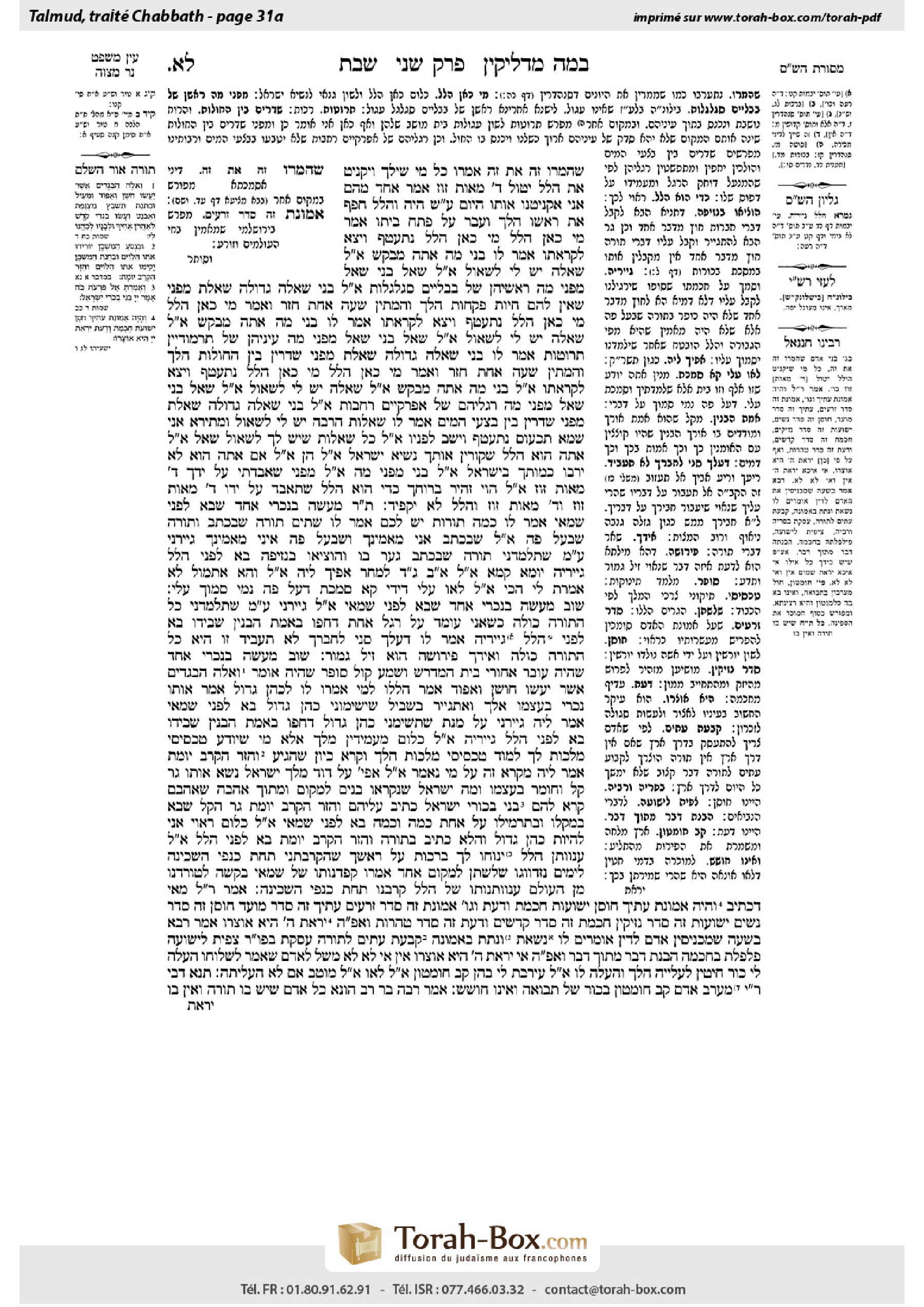
Shabbat 31a: Talmud study for Daf Yomi
Daf Yomi is the daily study of one Talmud folio. Explore 37 tractates with scans, Hebrew text, Sefaria English and AI-generated French translations where annotated.
Passage selection and English or AI-generated French translation are available where the scan has annotations. Daf Study is independent of Torah-Box and Sefaria.
Browse Shabbat · שבת · All tractatesShabbat 31a text and translations
This page of Shabbat includes the Aramaic text, an English translation and an AI-generated French translation, alongside the scan above.
שבת ל״א א · Aramaic and Hebrew text
שֶׁהִמְרוּ זֶה אֶת זֶה, אָמְרוּ: כׇּל מִי שֶׁיֵּלֵךְ וְיַקְנִיט אֶת הִלֵּל יִטּוֹל אַרְבַּע מֵאוֹת זוּז. אָמַר אֶחָד מֵהֶם: אֲנִי אַקְנִיטֶנּוּ. אוֹתוֹ הַיּוֹם עֶרֶב שַׁבָּת הָיָה, וְהִלֵּל חָפַף אֶת רֹאשׁוֹ. הָלַךְ וְעָבַר עַל פֶּתַח בֵּיתוֹ, אָמַר: מִי כָּאן הִלֵּל, מִי כָּאן הִלֵּל? נִתְעַטֵּף וְיָצָא לִקְרָאתוֹ. אָמַר לוֹ: בְּנִי, מָה אַתָּה מְבַקֵּשׁ? אָמַר לוֹ: שְׁאֵלָה יֵשׁ לִי לִשְׁאוֹל. אָמַר לוֹ: שְׁאַל בְּנִי. שְׁאַל: מִפְּנֵי מָה רָאשֵׁיהֶן שֶׁל בַּבְלִיִּים סְגַלְגַּלּוֹת? אָמַר לוֹ: בְּנִי, שְׁאֵלָה גְּדוֹלָה שָׁאַלְתָּ. מִפְּנֵי שֶׁאֵין לָהֶם חַיּוֹת פִּקְּחוֹת.
הָלַךְ וְהִמְתִּין שָׁעָה אַחַת, חָזַר וְאָמַר: מִי כָּאן הִלֵּל, מִי כָּאן הִלֵּל? נִתְעַטֵּף וְיָצָא לִקְרָאתוֹ. אָמַר לוֹ: בְּנִי, מָה אַתָּה מְבַקֵּשׁ? אָמַר לוֹ: שְׁאֵלָה יֵשׁ לִי לִשְׁאוֹל. אָמַר לוֹ: שְׁאַל בְּנִי. שְׁאַל: מִפְּנֵי מָה עֵינֵיהֶן שֶׁל תַּרְמוֹדִיִּין תְּרוּטוֹת? אָמַר לוֹ: בְּנִי, שְׁאֵלָה גְּדוֹלָה שָׁאַלְתָּ. מִפְּנֵי שֶׁדָּרִין בֵּין הַחוֹלוֹת.
הָלַךְ וְהִמְתִּין שָׁעָה אַחַת, חָזַר וְאָמַר: מִי כָּאן הִלֵּל, מִי כָּאן הִלֵּל? נִתְעַטֵּף וְיָצָא לִקְרָאתוֹ, אָמַר לוֹ: בְּנִי, מָה אַתָּה מְבַקֵּשׁ? אָמַר לוֹ: שְׁאֵלָה יֵשׁ לִי לִשְׁאוֹל. אָמַר לוֹ: שְׁאַל בְּנִי. שְׁאַל: מִפְּנֵי מָה רַגְלֵיהֶם שֶׁל אַפְרִקִיִּים רְחָבוֹת? אָמַר לוֹ: בְּנִי שְׁאֵלָה גְּדוֹלָה שָׁאַלְתָּ — מִפְּנֵי שֶׁדָּרִין בֵּין בִּצְעֵי הַמַּיִם.
אָמַר לוֹ: שְׁאֵלוֹת הַרְבֵּה יֵשׁ לִי לִשְׁאוֹל, וּמִתְיָרֵא אֲנִי שֶׁמָּא תִּכְעוֹס. נִתְעַטֵּף וְיָשַׁב לְפָנָיו. אָמַר לוֹ: כׇּל שְׁאֵלוֹת שֶׁיֵּשׁ לָךְ לִשְׁאוֹל שְׁאַל. אָמַר לוֹ אַתָּה הוּא הִלֵּל שֶׁקּוֹרִין אוֹתְךָ ״נְשִׂיא יִשְׂרָאֵל״? אָמַר לוֹ: הֵן. אָמַר לוֹ: אִם אַתָּה הוּא, לֹא יִרְבּוּ כְּמוֹתְךָ בְּיִשְׂרָאֵל. אָמַר לוֹ: בְּנִי, מִפְּנֵי מָה? אָמַר לוֹ מִפְּנֵי שֶׁאִבַּדְתִּי עַל יָדְךָ אַרְבַּע מֵאוֹת זוּז. אָמַר לוֹ: הֱוֵי זָהִיר בְּרוּחֲךָ כְּדַי הוּא הִלֵּל שֶׁתְּאַבֵּד עַל יָדוֹ אַרְבַּע מֵאוֹת זוּז וְאַרְבַּע מֵאוֹת זוּז, וְהִלֵּל לֹא יַקְפִּיד.
תָּנוּ רַבָּנַן: מַעֲשֶׂה בְּגוֹי אֶחָד שֶׁבָּא לִפְנֵי שַׁמַּאי. אָמַר לוֹ: כַּמָּה תּוֹרוֹת יֵשׁ לָכֶם? אָמַר לוֹ: שְׁתַּיִם, תּוֹרָה שֶׁבִּכְתָב וְתוֹרָה שֶׁבְּעַל פֶּה. אָמַר לוֹ: שֶׁבִּכְתָב אֲנִי מַאֲמִינְךָ, וְשֶׁבְּעַל פֶּה — אֵינִי מַאֲמִינְךָ. גַּיְּירֵנִי עַל מְנָת שֶׁתְּלַמְּדֵנִי תּוֹרָה שֶׁבִּכְתָב. גָּעַר בּוֹ וְהוֹצִיאוֹ בִּנְזִיפָה. בָּא לִפְנֵי הִלֵּל, גַּיְירֵיהּ. יוֹמָא קַמָּא אֲמַר לֵיהּ: א״ב ג״ד. לִמְחַר אֲפֵיךְ לֵיהּ. אֲמַר לֵיהּ: וְהָא אֶתְמוֹל לָא אֲמַרְתְּ לִי הָכִי! אֲמַר לֵיהּ: לָאו עֲלַי דִּידִי קָא סָמְכַתְּ? דְּעַל פֶּה נָמֵי סְמוֹךְ עֲלַי.
שׁוּב מַעֲשֶׂה בְּגוֹי אֶחָד שֶׁבָּא לִפְנֵי שַׁמַּאי. אָמַר לוֹ: גַּיְּירֵנִי עַל מְנָת שֶׁתְּלַמְּדֵנִי כׇּל הַתּוֹרָה כּוּלָּהּ כְּשֶׁאֲנִי עוֹמֵד עַל רֶגֶל אַחַת! דְּחָפוֹ בְּאַמַּת הַבִּנְיָן שֶׁבְּיָדוֹ. בָּא לִפְנֵי הִלֵּל, גַּיְירֵיהּ. אָמַר לוֹ: דַּעֲלָךְ סְנֵי לְחַבְרָךְ לָא תַּעֲבֵיד — זוֹ הִיא כׇּל הַתּוֹרָה כּוּלָּהּ, וְאִידַּךְ פֵּירוּשָׁהּ הוּא, זִיל גְּמוֹר.
שׁוּב מַעֲשֶׂה בְּגוֹי אֶחָד שֶׁהָיָה עוֹבֵר אֲחוֹרֵי בֵּית הַמִּדְרָשׁ, וְשָׁמַע קוֹל סוֹפֵר שֶׁהָיָה אוֹמֵר: ״וְאֵלֶּה הַבְּגָדִים אֲשֶׁר יַעֲשׂוּ חוֹשֶׁן וְאֵפוֹד״. אָמַר: הַלָּלוּ לְמִי? אָמְרוּ לוֹ: לְכֹהֵן גָּדוֹל. אָמַר אוֹתוֹ גּוֹי בְּעַצְמוֹ: אֵלֵךְ וְאֶתְגַּיֵּיר בִּשְׁבִיל שֶׁיְּשִׂימוּנִי כֹּהֵן גָּדוֹל. בָּא לִפְנֵי שַׁמַּאי, אָמַר לוֹ: גַּיְּירֵנִי עַל מְנָת שֶׁתְּשִׂימֵנִי כֹּהֵן גָּדוֹל. דְּחָפוֹ בְּאַמַּת הַבִּנְיָן שֶׁבְּיָדוֹ. בָּא לִפְנֵי הִלֵּל, גַּיְירֵיהּ.
אָמַר לוֹ: כְּלוּם מַעֲמִידִין מֶלֶךְ אֶלָּא מִי שֶׁיּוֹדֵעַ טַכְסִיסֵי מַלְכוּת, לֵךְ לְמוֹד טַכְסִיסֵי מַלְכוּת. הָלַךְ וְקָרָא. כֵּיוָן שֶׁהִגִּיעַ ״וְהַזָּר הַקָּרֵב יוּמָת״, אָמַר לֵיהּ: מִקְרָא זֶה עַל מִי נֶאֱמַר? אָמַר לוֹ: אֲפִילּוּ עַל דָּוִד מֶלֶךְ יִשְׂרָאֵל. נָשָׂא אוֹתוֹ גֵּר קַל וָחוֹמֶר בְּעַצְמוֹ: וּמַה יִּשְׂרָאֵל שֶׁנִּקְרְאוּ בָּנִים לַמָּקוֹם וּמִתּוֹךְ אַהֲבָה שֶׁאֲהָבָם קְרָא לָהֶם: ״בְּנִי בְּכוֹרִי יִשְׂרָאֵל״, כְּתִיב עֲלֵיהֶם ״וְהַזָּר הַקָּרֵב יוּמָת״ — גֵּר הַקַּל שֶׁבָּא בְּמַקְלוֹ וּבְתַרְמִילוֹ, עַל אַחַת כַּמָּה וְכַמָּה.
בָּא לִפְנֵי שַׁמַּאי, אָמַר לוֹ: כְּלוּם רָאוּי אֲנִי לִהְיוֹת כֹּהֵן גָּדוֹל? וַהֲלֹא כְּתִיב בַּתּוֹרָה: ״וְהַזָּר הַקָּרֵב יוּמָת״. בָּא לִפְנֵי הִלֵּל, אָמַר לוֹ: עַנְוְותָן הִלֵּל, יָנוּחוּ לְךָ בְּרָכוֹת עַל רֹאשְׁךָ, שֶׁקֵּרַבְתַּנִי תַּחַת כַּנְפֵי הַשְּׁכִינָה. לְיָמִים נִזְדַּוְּוגוּ שְׁלָשְׁתָּן לִמְקוֹם אֶחָד, אָמְרוּ: קַפְּדָנוּתוֹ שֶׁל שַׁמַּאי בִּקְּשָׁה לְטוֹרְדֵנוּ מִן הָעוֹלָם, עִנְוְותָנוּתוֹ שֶׁל הִלֵּל קֵרְבַתְנוּ תַּחַת כַּנְפֵי הַשְּׁכִינָה.
אָמַר רֵישׁ לָקִישׁ: מַאי דִכְתִיב ״וְהָיָה אֱמוּנַת עִתֶּיךָ חוֹסֶן יְשׁוּעוֹת חׇכְמַת וָדָעַת וְגוֹ׳״. ״אֱמוּנַת״ — זֶה סֵדֶר זְרָעִים. ״עִתֶּיךָ״ — זֶה סֵדֶר מוֹעֵד. ״חוֹסֶן״ — זֶה סֵדֶר נָשִׁים. ״יְשׁוּעוֹת״ — זֶה סֵדֶר נְזִיקִין. ״חׇכְמַת״ — זֶה סֵדֶר קׇדָשִׁים. ״וָדָעַת״ — זֶה סֵדֶר טְהָרוֹת. וַאֲפִילּוּ הָכִי, ״יִרְאַת ה׳ הִיא אוֹצָרוֹ״.
אָמַר רָבָא: בְּשָׁעָה שֶׁמַּכְנִיסִין אָדָם לְדִין, אוֹמְרִים לוֹ: נָשָׂאתָ וְנָתַתָּ בָּאֱמוּנָה? קָבַעְתָּ עִתִּים לַתּוֹרָה? עָסַקְתָּ בִּפְרִיָּה וּרְבִיָּה? צִפִּיתָ לִישׁוּעָה? פִּלְפַּלְתָּ בְּחׇכְמָה? הֵבַנְתָּ דָּבָר מִתּוֹךְ דָּבָר? וַאֲפִילּוּ הָכִי, אִי יִרְאַת ה׳ הִיא אוֹצָרוֹ — אִין, אִי לָא — לָא. מָשָׁל לְאָדָם שֶׁאָמַר לִשְׁלוּחוֹ: הַעֲלֵה לִי כּוֹר חִיטִּין לָעֲלִיָּיה. הָלַךְ וְהֶעֱלָה לוֹ. אָמַר לוֹ: עֵירַבְתָּ לִי בָּהֶן קַב חוֹמְטוֹן? אָמַר לוֹ: לָאו. אָמַר לוֹ: מוּטָב אִם לֹא הֶעֱלֵיתָה.
תָּנָא דְּבֵי רַבִּי יִשְׁמָעֵאל: מְעָרֵב אָדָם קַב חוֹמְטוֹן בְּכוֹר שֶׁל תְּבוּאָה, וְאֵינוֹ חוֹשֵׁשׁ.
אָמַר רַבָּה בַּר רַב הוּנָא: כׇּל אָדָם שֶׁיֵּשׁ בּוֹ תּוֹרָה וְאֵין בּוֹ
Shabbat 31a · English translation
who wagered with each other and said: Anyone who will go and aggravate Hillel to the point that he reprimands him, will take four-hundred zuz. One of them said: I will aggravate him. That day that he chose to bother Hillel was Shabbat eve, and Hillel was washing the hair on his head. He went and passed the entrance to Hillel’s house and in a demeaning manner said: Who here is Hillel, who here is Hillel? Hillel wrapped himself in a dignified garment and went out to greet him. He said to him: My son, what do you seek? He said to him: I have a question to ask. Hillel said to him: Ask, my son, ask. The man asked him: Why are the heads of Babylonians oval? He was alluding to and attempting to insult Hillel, who was Babylonian. He said to him: My son, you have asked a significant question. The reason is because they do not have clever midwives. They do not know how to shape the child’s head at birth.
That man went and waited one hour, a short while, returned to look for Hillel, and said: Who here is Hillel, who here is Hillel? Again, Hillel wrapped himself and went out to greet him. Hillel said to him: My son, what do you seek? The man said to him: I have a question to ask. He said to him: Ask, my son, ask. The man asked: Why are the eyes of the residents of Tadmor bleary [terutot]? Hillel said to him: My son, you have asked a significant question. The reason is because they live among the sands and the sand gets into their eyes.
Once again the man went, waited one hour, returned, and said: Who here is Hillel, who here is Hillel? Again, he, Hillel, wrapped himself and went out to greet him. He said to him: My son, what do you seek? He said to him: I have a question to ask. He said to him: Ask, my son, ask. The man asked: Why do Africans have wide feet? Hillel said to him: You have asked a significant question. The reason is because they live in marshlands and their feet widened to enable them to walk through those swampy areas.
That man said to him: I have many more questions to ask, but I am afraid lest you get angry. Hillel wrapped himself and sat before him, and he said to him: All of the questions that you have to ask, ask them. The man got angry and said to him: Are you Hillel whom they call the Nasi of Israel? He said to him: Yes. He said to him: If it is you, then may there not be many like you in Israel. Hillel said to him: My son, for what reason do you say this? The man said to him: Because I lost four hundred zuz because of you. Hillel said to him: Be vigilant of your spirit and avoid situations of this sort. Hillel is worthy of having you lose four hundred zuz and another four hundred zuz on his account, and Hillel will not get upset.
The Sages taught: There was an incident involving one gentile who came before Shammai. The gentile said to Shammai: How many Torahs do you have? He said to him: Two, the Written Torah and the Oral Torah. The gentile said to him: With regard to the Written Torah, I believe you, but with regard to the Oral Torah, I do not believe you. Convert me on condition that you will teach me only the Written Torah. Shammai scolded him and cast him out with reprimand. The same gentile came before Hillel, who converted him and began teaching him Torah. On the first day, he showed him the letters of the alphabet and said to him: Alef, bet, gimmel, dalet. The next day he reversed the order of the letters and told him that an alef is a tav and so on. The convert said to him: But yesterday you did not tell me that. Hillel said to him: You see that it is impossible to learn what is written without relying on an oral tradition. Didn’t you rely on me? Therefore, you should also rely on me with regard to the matter of the Oral Torah, and accept the interpretations that it contains.
There was another incident involving one gentile who came before Shammai and said to Shammai: Convert me on condition that you teach me the entire Torah while I am standing on one foot. Shammai pushed him away with the builder’s cubit in his hand. This was a common measuring stick and Shammai was a builder by trade. The same gentile came before Hillel. He converted him and said to him: That which is hateful to you do not do to another; that is the entire Torah, and the rest is its interpretation. Go study.
There was another incident involving one gentile who was passing behind the study hall and heard the voice of a teacher who was teaching Torah to his students and saying the verse: “And these are the garments which they shall make: A breastplate, and an efod, and a robe, and a tunic of checkered work, a mitre, and a girdle” (Exodus 28:4). The gentile said: These garments, for whom are they designated? The students said to him: For the High Priest. The gentile said to himself: I will go and convert so that they will install me as High Priest. He came before Shammai and said to him: Convert me on condition that you install me as High Priest. Shammai pushed him with the builder’s cubit in his hand. He came before Hillel; he converted him.
Hillel said to him, to the convert: Is it not the way of the world that only one who knows the protocols [takhsisei] of royalty is appointed king? Go and learn the royal protocols by engaging in Torah study. He went and read the Bible. When he reached the verse which says: “And the common man that draws near shall be put to death” (Numbers 1:51), the convert said to Hillel: With regard to whom is the verse speaking? Hillel said to him: Even with regard to David, king of Israel. The convert reasoned an a fortiori inference himself: If the Jewish people are called God’s children, and due to the love that God loved them he called them: “Israel is My son, My firstborn” (Exodus 4:22), and nevertheless it is written about them: And the common man that draws near shall be put to death; a mere convert who came without merit, with nothing more than his staff and traveling bag, all the more so that this applies to him, as well.
The convert came before Shammai and told him that he retracts his demand to appoint him High Priest, saying: Am I at all worthy to be High Priest? Is it not written in the Torah: And the common man that draws near shall be put to death? He came before Hillel and said to him: Hillel the patient, may blessings rest upon your head as you brought me under the wings of the Divine Presence. The Gemara relates: Eventually, the three converts gathered together in one place, and they said: Shammai’s impatience sought to drive us from the world; Hillel’s patience brought us beneath the wings of the Divine Presence.
The Gemara continues discussing the conduct of the Sages, citing that Reish Lakish said: What is the meaning of that which is written: “And the faith of your times shall be a strength of salvation, wisdom, and knowledge, the fear of the Lord is his treasure” (Isaiah 33:6)? Faith; that is the order of Zera’im, Seeds, in the Mishna, because a person has faith in God and plants his seeds (Jerusalem Talmud). Your times; that is the order of Moed, Festival, which deals with the various occasions and Festivals that occur throughout the year. Strength; that is the order of Nashim, Women. Salvations; that is the order of Nezikin, Damages, as one who is being pursued is rescued from the hands of his pursuer. Wisdom; that is the order of Kodashim, Consecrated Items. And knowledge; that is the order of Teharot, Purity, which is particularly difficult to master. And even if a person studies and masters all of these, “the fear of the Lord is his treasure,” it is preeminent.
With regard to the same verse, Rava said: After departing from this world, when a person is brought to judgment for the life he lived in this world, they say to him in the order of that verse: Did you conduct business faithfully? Did you designate times for Torah study? Did you engage in procreation? Did you await salvation? Did you engage in the dialectics of wisdom or understand one matter from another? And, nevertheless, beyond all these, if the fear of the Lord is his treasure, yes, he is worthy, and if not, no, none of these accomplishments have any value. There is a parable that illustrates this. A person who said to his emissary: Bring a kor of wheat up to the attic for me to store there. The messenger went and brought it up for him. He said to the emissary: Did you mix a kav of ḥomton, a preservative to keep away worms, into it for me? He said to him: No. He said to him: If so, it would have been preferable had you not brought it up. Of what use is worm-infested wheat? Likewise, Torah and mitzvot without the fear of God are of no value.
On a related note, the Gemara cites a halakha that was taught in the school of Rabbi Yishmael: A person who sells wheat may, ab initio, mix a kav of ḥomton into a kor of grain and need not be concerned that by selling it all at the price of grain he will be guilty of theft, as the kav of ḥomton is essential for the preservation of the wheat.
Rabba bar Rav Huna said: Any person who has Torah in him but does not have
Shabbat 31a · Traduction française (IA)
qui avaient parié entre eux en disant : « Celui qui ira importuner Hillel au point de le faire le réprimander recevra quatre cents zouz. » L’un d’eux dit : « C’est moi qui vais l’importuner. » Le jour où il choisit de déranger Hillel était la veille de Chabbat, et Hillel se lavait les cheveux. Il passa devant l’entrée de la maison de Hillel et lança d’un ton méprisant : « Où est Hillel ? Où est Hillel ? » Hillel s’enveloppa dans un vêtement digne et sortit à sa rencontre. Il lui demanda : « Mon fils, que cherches-tu ? » L’homme répondit : « J’ai une question à poser. » Hillel lui dit : « Demande, mon fils, demande. » L’homme lui demanda : « Pourquoi les têtes des Babyloniens sont-elles ovales ? » Il faisait allusion à Hillel, qui était Babylonien, et cherchait à l’insulter. Hillel lui répondit : « Mon fils, tu as posé une question importante. C’est parce qu’ils n’ont pas de sages-femmes habiles. Elles ne savent pas façonner la tête de l’enfant à la naissance. »
Cet homme partit, attendit une heure — un court moment — puis revint chercher Hillel et dit : « Où est Hillel ? Où est Hillel ? » De nouveau, Hillel s’enveloppa et sortit à sa rencontre. Hillel lui demanda : « Mon fils, que cherches-tu ? » L’homme lui dit : « J’ai une question à poser. » Hillel lui répondit : « Demande, mon fils, demande. » L’homme demanda : « Pourquoi les yeux des habitants de Tadmor sont-ils troubles [terutot] ? » Hillel lui répondit : « Mon fils, tu as posé une question importante. C’est parce qu’ils vivent au milieu des sables, et que le sable leur entre dans les yeux. »
Une nouvelle fois, l’homme partit, attendit une heure, revint et dit : « Où est Hillel ? Où est Hillel ? » De nouveau, Hillel s’enveloppa et sortit à sa rencontre. Il lui demanda : « Mon fils, que cherches-tu ? » L’homme lui répondit : « J’ai une question à poser. » Hillel lui dit : « Demande, mon fils, demande. » L’homme demanda : « Pourquoi les Africains ont-ils les pieds larges ? » Hillel lui répondit : « Tu as posé une question importante. C’est parce qu’ils vivent dans des marécages et que leurs pieds se sont élargis pour leur permettre de marcher dans ces zones marécageuses. »
L’homme lui dit : « J’ai encore beaucoup de questions à poser, mais j’ai peur que tu te mettes en colère. » Hillel s’enveloppa et s’assit devant lui, puis lui dit : « Pose toutes les questions que tu as à poser. » L’homme se mit en colère et lui demanda : « Es-tu Hillel, celui qu’on appelle le Nassi d’Israël ? » Hillel répondit : « Oui. » L’homme lui dit : « Si c’est bien toi, qu’il n’y en ait pas beaucoup comme toi en Israël ! » Hillel lui demanda : « Mon fils, pourquoi dis-tu cela ? » L’homme répondit : « Parce que j’ai perdu quatre cents zouz à cause de toi. » Hillel lui dit : « Veille sur ton esprit et évite ce genre de situation. Hillel mérite que tu perdes quatre cents zouz, puis encore quatre cents zouz à cause de lui, sans que Hillel se fâche. »
Les Sages ont enseigné : Un incident eut lieu avec un non-Juif qui se présenta devant Chammaï. Le non-Juif lui demanda : « Combien avez-vous de Torahs ? » Chammaï lui répondit : « Deux : la Torah écrite et la Torah orale. » Le non-Juif lui dit : « En ce qui concerne la Torah écrite, je vous crois, mais en ce qui concerne la Torah orale, je ne vous crois pas. Convertis-moi à condition que tu ne m’enseignes que la Torah écrite. » Chammaï le réprimanda et le chassa en le rabrouant. Le même non-Juif se présenta devant Hillel, qui le convertit et commença à lui enseigner la Torah. Le premier jour, il lui montra les lettres de l’alphabet et lui dit : « Alef, bet, guimel, dalet. » Le lendemain, il inversa l’ordre des lettres et lui dit que l’alef était un tav, et ainsi de suite. Le converti lui dit : « Mais hier, tu ne m’as pas dit cela. » Hillel lui répondit : « Tu vois qu’il est impossible d’apprendre ce qui est écrit sans s’appuyer sur une tradition orale. N’as-tu pas eu confiance en moi ? Tu dois donc aussi me faire confiance au sujet de la Torah orale et accepter les interprétations qu’elle contient. »
Un autre incident eut lieu avec un non-Juif qui se présenta devant Chammaï et lui dit : « Convertis-moi à condition de m’enseigner toute la Torah pendant que je me tiens sur un seul pied. » Chammaï le repoussa à l’aide de la règle de maçon qu’il tenait à la main. C’était une règle de mesure courante, et Chammaï exerçait le métier de maçon. Le même non-Juif se présenta devant Hillel. Celui-ci le convertit et lui dit : « Ce qui t’est odieux, ne le fais pas à autrui ; voilà toute la Torah, et le reste en est l’interprétation. Va étudier. »
Un autre incident eut lieu avec un non-Juif qui passait derrière la maison d’étude et entendit un maître enseigner la Torah à ses élèves et citer le verset : « Voici les vêtements qu’ils feront : un pectoral, un éphod, un manteau, une tunique à carreaux, une tiare et une ceinture » (Exode 28:4). Le non-Juif se demanda : « À qui ces vêtements sont-ils destinés ? » Les élèves lui répondirent : « Au Grand Prêtre. » Le non-Juif se dit : « Je vais me convertir afin qu’on me nomme Grand Prêtre. » Il se présenta devant Chammaï et lui dit : « Convertis-moi à condition que tu me nommes Grand Prêtre. » Chammaï le repoussa à l’aide de la règle de maçon qu’il tenait à la main. L’homme se présenta devant Hillel, qui le convertit.
Hillel dit au converti : « N’est-il pas dans l’ordre des choses que seul celui qui connaît les protocoles [takhsisei] de la royauté soit nommé roi ? Va apprendre les protocoles royaux en étudiant la Torah. » Le converti alla lire la Bible. Lorsqu’il arriva au verset qui dit : « Le profane qui s’approche sera mis à mort » (Nombres 1:51), il demanda à Hillel : « De qui parle ce verset ? » Hillel lui répondit : « Même de David, roi d’Israël. » Le converti tira lui-même une conclusion a fortiori : si le peuple juif est appelé enfant de Dieu et si, par amour pour lui, Dieu l’a appelé « Israël est mon fils, mon premier-né » (Exode 4:22), et qu’il est néanmoins écrit à son sujet : « Le profane qui s’approche sera mis à mort », à plus forte raison cela s’applique-t-il à un simple converti, venu sans mérite, n’ayant que son bâton et son sac de voyage.
Le converti se présenta devant Chammaï et lui dit qu’il renonçait à sa demande d’être nommé Grand Prêtre. Il lui dit : « Suis-je seulement digne d’être Grand Prêtre ? N’est-il pas écrit dans la Torah : “Le profane qui s’approche sera mis à mort” ? » Il se présenta devant Hillel et lui dit : « Hillel le patient, que les bénédictions reposent sur ta tête, puisque tu m’as fait entrer sous les ailes de la Présence divine. » La Guemara rapporte : Finalement, les trois convertis se réunirent en un même lieu et dirent : « L’impatience de Chammaï a cherché à nous chasser du monde ; la patience de Hillel nous a fait entrer sous les ailes de la Présence divine. »
La Guemara poursuit son examen de la conduite des Sages et rapporte que Rech Lakich a dit : Quel est le sens de ce qui est écrit : « La fidélité de tes temps sera une force de salut, de sagesse et de connaissance ; la crainte du Seigneur est son trésor » (Isaïe 33:6) ? « Fidélité » désigne l’ordre Zeraïm, « Semences », de la Michna, car l’homme fait confiance à Dieu et sème ses graines (Talmud de Jérusalem). « Tes temps » désigne l’ordre Moed, « Fêtes », qui traite des différentes occasions et fêtes de l’année. « Force » désigne l’ordre Nachim, « Femmes ». « Salvations » désigne l’ordre Nezikin, « Dommages », car celui qui est poursuivi est sauvé des mains de son poursuivant. « Sagesse » désigne l’ordre Kodachim, « Choses consacrées ». Et « connaissance » désigne l’ordre Taharot, « Puretés », dont la maîtrise est particulièrement difficile. Même si une personne étudie et maîtrise tout cela, « la crainte du Seigneur est son trésor » : elle est prééminente.
Au sujet de ce même verset, Rava dit : Après avoir quitté ce monde, lorsqu’un homme est traduit en jugement pour la vie qu’il y a menée, on lui pose des questions dans l’ordre du verset : « As-tu mené tes affaires avec fidélité ? As-tu fixé des moments pour l’étude de la Torah ? T’es-tu consacré à la procréation ? As-tu attendu le salut ? T’es-tu livré aux raisonnements dialectiques de la sagesse, ou as-tu compris une chose à partir d’une autre ? » Et pourtant, au-delà de tout cela, si la crainte du Seigneur est son trésor, alors oui, il en est digne ; sinon, non : toutes ces réalisations n’ont aucune valeur. Une parabole illustre cela. Un homme dit à son émissaire : « Monte-moi un kor de blé au grenier pour que je l’y entrepose. » Le messager le lui monta. L’homme lui demanda : « Y as-tu mélangé un kav de ḥomton, un produit destiné à éloigner les vers ? » Le messager répondit : « Non. » L’homme lui dit : « Dans ce cas, il aurait mieux valu que tu ne le montes pas. À quoi sert un blé infesté de vers ? » De même, la Torah et les mitsvot dépourvues de la crainte de Dieu n’ont aucune valeur.
À ce propos, la Guemara cite une halakha enseignée dans l’école de Rabbi Yichmaël : Celui qui vend du blé peut, a priori, mélanger un kav de ḥomton à un kor de grain ; il n’a pas à craindre qu’en vendant le tout au prix du grain, il soit coupable de vol, puisque le kav de ḥomton est nécessaire à la conservation du blé.
Rabba bar Rav Houna a dit : Toute personne qui possède en elle la Torah, mais ne possède pas
Traduction française générée par IA à partir de l’édition anglaise de Sefaria. Vérifie toujours un passage avec le texte source.
Text from Sefaria: William Davidson Edition - Vocalized Aramaic (CC BY NC); William Davidson Edition - English (CC BY NC).