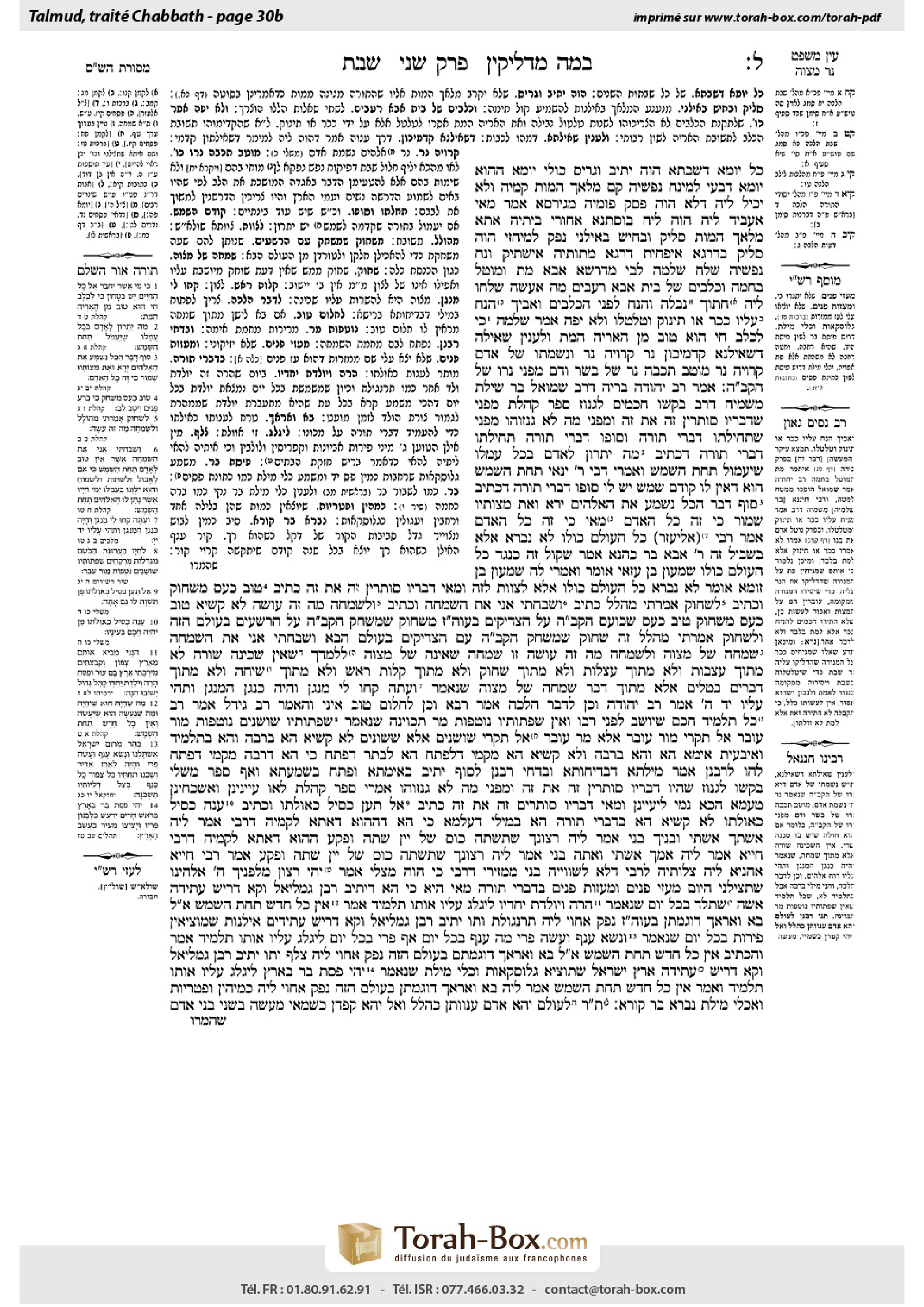
Shabbat 30b: Talmud study for Daf Yomi
Daf Yomi is the daily study of one Talmud folio. Explore 37 tractates with scans, Hebrew text, Sefaria English and AI-generated French translations where annotated.
Passage selection and English or AI-generated French translation are available where the scan has annotations. Daf Study is independent of Torah-Box and Sefaria.
Browse Shabbat · שבת · All tractatesShabbat 30b text and translations
This page of Shabbat includes the Aramaic text, an English translation and an AI-generated French translation, alongside the scan above.
שבת ל׳ ב · Aramaic and Hebrew text
כׇּל יוֹמָא דְשַׁבְּתָא הֲוָה יָתֵיב וְגָרֵיס כּוּלֵּי יוֹמָא. הַהוּא יוֹמָא דְּבָעֵי לְמֵינַח נַפְשֵׁיהּ, קָם מַלְאַךְ הַמָּוֶת קַמֵּיהּ וְלָא יְכִיל לֵיהּ, דְּלָא הֲוָה פָּסֵק פּוּמֵּיהּ מִגִּירְסָא. אֲמַר: מַאי אַעֲבֵיד לֵיהּ? הֲוָה לֵיהּ בּוּסְתָּנָא אֲחוֹרֵי בֵּיתֵיהּ, אֲתָא מַלְאַךְ הַמָּוֶת סָלֵיק וּבָחֵישׁ בְּאִילָנֵי. נְפַק לְמִיחְזֵי. הֲוָה סָלֵיק בְּדַרְגָּא, אִיפְּחִית דַּרְגָּא מִתּוּתֵיהּ, אִישְׁתִּיק וְנָח נַפְשֵׁיהּ.
שְׁלַח שְׁלֹמֹה לְבֵי מִדְרְשָׁא: אַבָּא מֵת וּמוּטָל בַּחַמָּה, וּכְלָבִים שֶׁל בֵּית אַבָּא רְעֵבִים — מָה אֶעֱשֶׂה? שְׁלַחוּ לֵיהּ: חֲתוֹךְ נְבֵלָה וְהַנַּח לִפְנֵי הַכְּלָבִים. וְאָבִיךְ, הַנַּח עָלָיו כִּכָּר אוֹ תִּינוֹק וְטַלְטְלוֹ. וְלֹא יָפֶה אָמַר שְׁלֹמֹה: ״כִּי לְכֶלֶב חַי הוּא טוֹב מִן הָאַרְיֵה הַמֵּת״. וּלְעִנְיַן שְׁאֵילָה דְּשָׁאֵילְנָא קֳדָמֵיכוֹן: נֵר קְרוּיָה ״נֵר״, וְנִשְׁמָתוֹ שֶׁל אָדָם קְרוּיָה ״נֵר״. מוּטָב תִּכְבֶּה נֵר שֶׁל בָּשָׂר וָדָם מִפְּנֵי נֵרוֹ שֶׁל הַקָּדוֹשׁ בָּרוּךְ הוּא.
אָמַר רַב יְהוּדָה בְּרֵיהּ דְּרַב שְׁמוּאֵל בַּר שִׁילַת מִשְּׁמֵיהּ דְּרַב: בִּקְּשׁוּ חֲכָמִים לִגְנוֹז סֵפֶר קֹהֶלֶת מִפְּנֵי שֶׁדְּבָרָיו סוֹתְרִין זֶה אֶת זֶה. וּמִפְּנֵי מָה לֹא גְּנָזוּהוּ? — מִפְּנֵי שֶׁתְּחִילָּתוֹ דִּבְרֵי תוֹרָה וְסוֹפוֹ דִּבְרֵי תוֹרָה. תְּחִילָּתוֹ דִּבְרֵי תוֹרָה, דִּכְתִיב: ״מַה יִּתְרוֹן לָאָדָם בְּכׇל עֲמָלוֹ שֶׁיַּעֲמוֹל תַּחַת הַשֶּׁמֶשׁ״ — וְאָמְרִי דְּבֵי רַבִּי יַנַּאי תַּחַת הַשֶּׁמֶשׁ הוּא דְּאֵין לוֹ. קוֹדֶם שֶׁמֶשׁ — יֵשׁ לוֹ. סוֹפוֹ דִּבְרֵי תוֹרָה, דִּכְתִיב: ״סוֹף דָּבָר הַכֹּל נִשְׁמָע אֶת הָאֱלֹהִים יְרָא וְאֶת מִצְוֹתָיו שְׁמוֹר כִּי זֶה כׇּל הָאָדָם״. מַאי ״כִּי זֶה כׇּל הָאָדָם״? — אָמַר רַבִּי (אֱלִיעֶזֶר) [אֶלְעָזָר]: כׇּל הָעוֹלָם כּוּלּוֹ לֹא נִבְרָא אֶלָּא בִּשְׁבִיל זֶה. רַבִּי אַבָּא בַּר כָּהֲנָא אָמַר: שָׁקוּל זֶה כְּנֶגֶד כׇּל הָעוֹלָם כּוּלּוֹ. שִׁמְעוֹן בֶּן עַזַּאי אוֹמֵר, וְאָמְרִי לַהּ שִׁמְעוֹן בֶּן זוֹמָא אוֹמֵר: לֹא נִבְרָא כׇּל הָעוֹלָם כּוּלּוֹ אֶלָּא לִצְווֹת לָזֶה.
וּמַאי ״דְּבָרָיו סוֹתְרִין זֶה אֶת זֶה״? כְּתִיב: ״טוֹב כַּעַס מִשְּׂחוֹק״, וּכְתִיב ״לִשְׂחוֹק אָמַרְתִּי מְהוֹלָל״! כְּתִיב ״וְשִׁבַּחְתִּי אֲנִי אֶת הַשִּׂמְחָה״, וּכְתִיב ״וּלְשִׂמְחָה מַה זֹּה עוֹשָׂה! לָא קַשְׁיָא ״טוֹב כַּעַס מִשְּׂחוֹק״: טוֹב כַּעַס שֶׁכּוֹעֵס הַקָּדוֹשׁ בָּרוּךְ הוּא עַל הַצַּדִּיקִים בָּעוֹלָם הַזֶּה, מִשְּׂחוֹק שֶׁמְּשַׂחֵק הַקָּדוֹשׁ בָּרוּךְ הוּא עַל הָרְשָׁעִים בָּעוֹלָם הַזֶּה. וְ״לִשְׁחוֹק אָמַרְתִּי מְהוֹלָל״ — זֶה שְׂחוֹק שֶׁמְּשַׂחֵק הַקָּדוֹשׁ בָּרוּךְ הוּא עִם הַצַּדִּיקִים בָּעוֹלָם הַבָּא.
״וְשִׁבַּחְתִּי אֲנִי אֶת הַשִּׂמְחָה״ — שִׂמְחָה שֶׁל מִצְוָה. ״וּלְשִׂמְחָה מַה זֹּה עוֹשָׂה״ — זוֹ שִׂמְחָה שֶׁאֵינָהּ שֶׁל מִצְוָה. לְלַמֶּדְךָ שֶׁאֵין שְׁכִינָה שׁוֹרָה לֹא מִתּוֹךְ עַצְבוּת וְלֹא מִתּוֹךְ עַצְלוּת וְלֹא מִתּוֹךְ שְׂחוֹק וְלֹא מִתּוֹךְ קַלּוּת רֹאשׁ וְלֹא מִתּוֹךְ שִׂיחָה וְלֹא מִתּוֹךְ דְּבָרִים בְּטֵלִים, אֶלָּא מִתּוֹךְ דְּבַר שִׂמְחָה שֶׁל מִצְוָה, שֶׁנֶּאֱמַר: ״וְעַתָּה קְחוּ לִי מְנַגֵּן וְהָיָה כְּנַגֵּן הַמְנַגֵּן וַתְּהִי עָלָיו יַד ה׳״. אָמַר רַב יְהוּדָה: וְכֵן לִדְבַר הֲלָכָה. אָמַר רָבָא: וְכֵן לַחֲלוֹם טוֹב.
אִינִי, וְהָאָמַר רַב גִּידֵּל אָמַר רַב: כׇּל תַּלְמִיד חָכָם שֶׁיּוֹשֵׁב לִפְנֵי רַבּוֹ וְאֵין שִׂפְתוֹתָיו נוֹטְפוֹת מָר, תִּכָּוֶינָה, שֶׁנֶּאֱמַר: ״שִׂפְתוֹתָיו שׁוֹשַׁנִּים נוֹטְפוֹת מוֹר עוֹבֵר״: אַל תִּקְרֵי ״מוֹר עוֹבֵר״, אֶלָּא ״מָר עוֹבֵר״. אַל תִּקְרֵי ״שׁוֹשַׁנִּים״, אֶלָּא ״שֶׁשּׁוֹנִים״. לָא קַשְׁיָא: הָא בְּרַבָּה וְהָא בְּתַלְמִידָא. וְאִיבָּעֵית אֵימָא הָא וְהָא בְּרַבָּה, וְלָא קַשְׁיָא: הָא מִקַּמֵּי דְּלִפְתַּח, הָא לְבָתַר דִּפְתַח. כִּי הָא דְּרַבָּה מִקַּמֵּי דְּפָתַח לְהוּ לְרַבָּנַן אָמַר מִילְּתָא דִּבְדִיחוּתָא וּבָדְחִי רַבָּנַן, לְסוֹף יָתֵיב בְּאֵימְתָא וּפָתַח בִּשְׁמַעְתָּא.
וְאַף סֵפֶר מִשְׁלֵי בִּקְּשׁוּ לִגְנוֹז שֶׁהָיוּ דְּבָרָיו סוֹתְרִין זֶה אֶת זֶה. וּמִפְּנֵי מָה לֹא גְּנָזוּהוּ? אָמְרִי: סֵפֶר קֹהֶלֶת לָאו עַיְינִינַן וְאַשְׁכְּחִינַן טַעְמָא? הָכָא נָמֵי לִיעַיֵּין. וּמַאי דְּבָרָיו סוֹתְרִים זֶה אֶת זֶה? — כְּתִיב ״אַל תַּעַן כְּסִיל כְּאִוַּלְתּוֹ״, וּכְתִיב: ״עֲנֵה כְסִיל כְּאִוַּלְתּוֹ״. לָא קַשְׁיָא: הָא בְּדִבְרֵי תוֹרָה, הָא בְּמִילֵּי דְעָלְמָא.
כִּי הָא דְּהָהוּא דַּאֲתָא לְקַמֵּיהּ דְּרַבִּי אֲמַר לֵיהּ: אִשְׁתְּךָ אִשְׁתִּי, וּבָנֶיךָ בָּנַי. אֲמַר לֵיהּ: רְצוֹנֶךָ שֶׁתִּשְׁתֶּה כּוֹס שֶׁל יַיִן? שָׁתָה וּפָקַע. הָהוּא דַּאֲתָא לְקַמֵּיהּ דְּרַבִּי חִיָּיא, אֲמַר לֵיהּ: אִמְּךָ אִשְׁתִּי, וְאַתָּה בְּנִי. אֲמַר לֵיהּ: רְצוֹנֶךָ שֶׁתִּשְׁתֶּה כּוֹס שֶׁל יַיִן? שָׁתָה וּפָקַע. אֲמַר רַבִּי חִיָּיא: אַהְנְיָא לֵיהּ צְלוֹתֵיהּ לְרַבִּי דְּלָא לְשַׁוּוֹיֵיהּ בְּנֵי מַמְזֵירֵי. דְּרַבִּי כִּי הֲוָה מְצַלֵּי אֲמַר: ״יְהִי רָצוֹן מִלְּפָנֶיךָ ה׳ אֱלֹהֵינוּ, שֶׁתַּצִּילֵנִי הַיּוֹם מֵעַזֵּי פָּנִים וּמֵעַזּוּת פָּנִים״.
בְּדִבְרֵי תוֹרָה מַאי הִיא? — כִּי הָא דְּיָתֵיב רַבָּן גַּמְלִיאֵל וְקָא דָרֵישׁ: עֲתִידָה אִשָּׁה שֶׁתֵּלֵד בְּכָל יוֹם, שֶׁנֶּאֱמַר ״הָרָה וְיוֹלֶדֶת יַחְדָּיו״. לִיגְלֵג עָלָיו אוֹתוֹ תַּלְמִיד, אָמַר: ״אֵין כׇּל חָדָשׁ תַּחַת הַשָּׁמֶשׁ״! אֲמַר לֵיהּ: בֹּא וְאַרְאֶךָּ דּוּגְמָתָן בָּעוֹלָם הַזֶּה. נְפַק אַחְוִי לֵיהּ תַּרְנְגוֹלֶת.
וְתוּ, יָתֵיב רַבָּן גַּמְלִיאֵל וְקָא דָרֵישׁ: עֲתִידִים אִילָנוֹת שֶׁמּוֹצִיאִין פֵּירוֹת בְּכָל יוֹם, שֶׁנֶּאֱמַר: ״וְנָשָׂא עָנָף וְעָשָׂה פֶרִי״ — מֶה עָנָף בְּכָל יוֹם אַף פְּרִי בְּכָל יוֹם. לִיגְלֵג עָלָיו אוֹתוֹ תַּלְמִיד, אָמַר: וְהָכְתִיב ״אֵין כׇּל חָדָשׁ תַּחַת הַשָּׁמֶשׁ״. אֲמַר לֵיהּ: בֹּא וְאַרְאֶךָּ דּוּגְמָתָם בָּעוֹלָם הַזֶּה. נְפַק אַחְוִי לֵיהּ צָלָף.
וְתוּ, יָתֵיב רַבָּן גַּמְלִיאֵל וְקָא דָרֵישׁ: עֲתִידָה אֶרֶץ יִשְׂרָאֵל שֶׁתּוֹצִיא גְּלוּסְקָאוֹת וּכְלֵי מֵילָת שֶׁנֶּאֱמַר: ״יְהִי פִסַּת בַּר בָּאָרֶץ״. לִיגְלֵג עָלָיו אוֹתוֹ תַּלְמִיד וְאָמַר: ״אֵין כׇּל חָדָשׁ תַּחַת הַשָּׁמֶשׁ״. אֲמַר לֵיהּ: בֹּא וְאַרְאֶךָּ דּוּגְמָתָן בָּעוֹלָם הַזֶּה. נְפַק אַחְוִי לֵיהּ כְּמֵיהִין וּפִטְרִיּוֹת. וְאַכְּלֵי מֵילָת — נְבָרָא בַּר קוֹרָא.
תָּנוּ רַבָּנַן: לְעוֹלָם יְהֵא אָדָם עַנְוְותָן כְּהִלֵּל וְאַל יְהֵא קַפְּדָן כְּשַׁמַּאי. מַעֲשֶׂה בִּשְׁנֵי בְּנֵי אָדָם
Shabbat 30b · English translation
What did David do? Every Shabbat he would sit and learn all day long to protect himself from the Angel of Death. On that day on which the Angel of Death was supposed to put his soul to rest, the day on which David was supposed to die, the Angel of Death stood before him and was unable to overcome him because his mouth did not pause from study. The Angel of Death said: What shall I do to him? David had a garden [bustana] behind his house; the Angel of Death came, climbed, and shook the trees. David went out to see. As he climbed the stair, the stair broke beneath him. He was startled and was silent, interrupted his studies for a moment, and died.
Since David died in the garden, Solomon sent the following question to the study hall: Father died and is lying in the sun, and the dogs of father’s house are hungry. There is room for concern lest the dogs come and harm his body. What shall I do? They sent an answer to him: Cut up an animal carcass and place it before the dogs. Since the dogs are hungry, handling the animal carcass to feed them is permitted. And with regard to your father, it is prohibited to move his body directly. Place a loaf of bread or an infant on top of him, and you can move him into the shade due to the bread or the infant. And is it not appropriate what Solomon said: “For a living dog is better than a dead lion.” The ultimate conclusion of this discussion is that life is preferable to death. And now, with regard to the question that I asked before you; Rav Tanḥum spoke modestly, as, actually, they had asked him the question. A lamp is called ner and a person’s soul is also called ner, as it is written: “The spirit of man is the lamp [ner] of the Lord” (Proverbs 20:27). It is preferable that the lamp of a being of flesh and blood, an actual lamp, will be extinguished in favor of the lamp of the Holy One, Blessed be He, a person’s soul. Therefore, one is permitted to extinguish a flame for the sake of a sick person.
Since contradictions in Ecclesiastes were mentioned, the Gemara cites additional relevant sources. Rav Yehuda, son of Rav Shmuel bar Sheilat, said in the name of Rav: The Sages sought to suppress the book of Ecclesiastes and declare it apocryphal because its statements contradict each other and it is liable to confuse its readers. And why did they not suppress it? Because its beginning consists of matters of Torah and its end consists of matters of Torah. The ostensibly contradictory details are secondary to the essence of the book, which is Torah. The Gemara elaborates: Its beginning consists of matters of Torah, as it is written: “What profit has man of all his labor which he labors under the sun?” (Ecclesiastes 1:3), and the Sages of the school of Rabbi Yannai said: By inference: Under the sun is where man has no profit from his labor; however, before the sun, i.e., when engaged in the study of Torah, which preceded the sun, he does have profit. Its ending consists of matters of Torah, as it is written: “The end of the matter, all having been heard: Fear God, and keep His mitzvot; for this is the whole man” (Ecclesiastes 12:13). With regard to this verse, the Gemara asks: What is the meaning of the phrase: For this is the whole man? Rabbi Eliezer said: The entire world was only created for this person. Rabbi Abba bar Kahana said: This person is equivalent to the entire world. Shimon ben Azzai says and some say that Shimon ben Zoma says: The entire world was only created as companion to this man, so that he will not be alone.
And to the essence of the matter, the Gemara asks: What is the meaning of: Its statements that contradict each other? It is written: “Vexation is better than laughter” (Ecclesiastes 7:3), and it is written: “I said of laughter: It is praiseworthy” (Ecclesiastes 2:2), which is understood to mean that laughter is commendable. Likewise in one verse it is written: “So I commended mirth” (Ecclesiastes 8:15), and in another verse it is written: “And of mirth: What does it accomplish?” (Ecclesiastes 2:2). The Gemara answers: This is not difficult, as the contradiction can be resolved. Vexation is better than laughter means: The vexation of the Holy One, Blessed be He, toward the righteous in this world is preferable to the laughter which the Holy One, Blessed be He, laughs with the wicked in this world by showering them with goodness. I said of laughter: It is praiseworthy, that is the laughter which the Holy One, Blessed be He, laughs with the righteous in the World-to-Come.
Similarly, “So I commended mirth,” that is the joy of a mitzva. “And of mirth: What does it accomplish?” that is joy that is not the joy of a mitzva. The praise of joy mentioned here is to teach you that the Divine Presence rests upon an individual neither from an atmosphere of sadness, nor from an atmosphere of laziness, nor from an atmosphere of laughter, nor from an atmosphere of frivolity, nor from an atmosphere of idle conversation, nor from an atmosphere of idle chatter, but rather from an atmosphere imbued with the joy of a mitzva. As it was stated with regard to Elisha that after he became angry at the king of Israel, his prophetic spirit left him until he requested: “But now bring me a minstrel; and it came to pass, when the minstrel played, that the hand of the Lord came upon him” (II Kings 3:15). Rav Yehuda said: And, so too, one should be joyful before stating a matter of halakha. Rava said: And, so too, one should be joyful before going to sleep in order to have a good dream.
The Gemara asks: Is that so, that one should introduce matters of halakha joyfully? Didn’t Rav Giddel say that Rav said: Any Torah scholar who sits before his teacher and his lips are not dripping with myrrh due to fear of his teacher, those lips shall be burnt, as it is stated: “His lips are as lilies, dripping with flowing myrrh [shoshanim notefot mor over]” (Song of Songs 5:13)? He interpreted homiletically: Do not read mor over, flowing myrrh; rather, read mar over, flowing bitterness. Likewise, do not read shoshanim, lilies; rather, read sheshonim, that are studying, meaning that lips that are studying Torah must be full of bitterness. The Gemara explains: This is not difficult, there is no contradiction here, as this, where it was taught that one should introduce matters of halakha joyfully, is referring to a rabbi, and that, where it was taught that one must be filled with bitterness, is referring to a student, who must listen to his teacher with trepidation. And if you wish, say instead that this and that are referring to a rabbi, and it is not difficult. This, where it was taught that he must be joyful, is before he begins teaching, whereas that, where it was taught that he must be filled with bitterness and trepidation, is after he already began teaching halakha. That explanation is like that which Rabba did. Before he began teaching halakha to the Sages, he would say something humorous and the Sages would be cheered. Ultimately, he sat in trepidation and began teaching the halakha.
And, the Gemara continues, the Sages sought to suppress the book of Proverbs as well because its statements contradict each other. And why did they not suppress it? They said: In the case of the book of Ecclesiastes, didn’t we analyze it and find an explanation that its statements were not contradictory? Here too, let us analyze it. And what is the meaning of: Its statements contradict each other? On the one hand, it is written: “Answer not a fool according to his folly, lest you also be like him” (Proverbs 26:4), and on the other hand, it is written: “Answer a fool according to his folly, lest he be wise in his own eyes” (Proverbs 26:5). The Gemara resolves this apparent contradiction: This is not difficult, as this, where one should answer a fool, is referring to a case where the fool is making claims about Torah matters; whereas that, where one should not answer him, is referring to a case where the fool is making claims about mundane matters.
The Gemara relates how Sages conducted themselves in both of those circumstances. As in the case of that man who came before Rabbi Yehuda HaNasi and said to him: Your wife is my wife and your children are my children, Rabbi Yehuda HaNasi said to him: Would you like to drink a cup of wine? He drank and burst and died. Similarly, the Gemara relates: There was that man who came before Rabbi Ḥiyya and said to him: Your mother is my wife, and you are my son. He said to him: Would you like to drink a cup of wine? He drank and burst and died. Rabbi Ḥiyya said with regard to the incident involving Rabbi Yehuda HaNasi: Rabbi Yehuda HaNasi’s prayer that his children will not be rendered mamzerim, children of illicit relations, was effective for him. As when Rabbi Yehuda HaNasi would pray, he said after his prayer: May it be Your will, O Lord, my God, that You will deliver me today from impudent people and from insolence. Insolence, in this case, refers to mamzerut. It was due to his prayer that that man burst and was unsuccessful in disparaging Rabbi Yehuda HaNasi’s children.
In matters of Torah, what is the case with regard to which the verse said that one should respond to a fool’s folly? As in the case where Rabban Gamliel was sitting and he interpreted a verse homiletically: In the future, in the World-to-Come, a woman will give birth every day, as it says: “The woman with child and her that gives birth together” (Jeremiah 31:7), explaining that birth will occur on the same day as conception. A certain student scoffed at him and said: That cannot be, as it has already been stated: “There is nothing new under the sun” (Ecclesiastes 1:9). Rabban Gamliel said to him: Come and I will show you an example of this in this world. He took him outside and showed him a chicken that lays eggs every day.
And furthermore: Rabban Gamliel sat and interpreted a verse homiletically: In the future, in the World-to-Come, trees will produce fruits every day, as it is stated: “And it shall bring forth branches and bear fruit” (Ezekiel 17:23); just as a branch grows every day, so too, fruit will be produced every day. A certain student scoffed at him and said: Isn’t it written: There is nothing new under the sun? He said to him: Come and I will show you an example of this in this world. He went outside and showed him a caper bush, part of which is edible during each season of the year.
And furthermore: Rabban Gamliel sat and interpreted a verse homiletically: In the future, the World-to-Come, Eretz Yisrael will produce cakes and fine wool garments that will grow in the ground, as it is stated: “Let abundant grain be in the land.” A certain student scoffed at him and said: There is nothing new under the sun. He said to him: Come and I will show you an example in this world. He went outside and showed him truffles and mushrooms, which emerge from the earth over the course of a single night and are shaped like a loaf of bread. And with regard to wool garments, he showed him the covering of a heart of palm, a young palm branch, which is wrapped in a thin net-like covering.
Since the Gemara discussed the forbearance of Sages, who remain silent in the face of nonsensical comments, it cites additional relevant examples. The Sages taught in a baraita: A person should always be patient like Hillel and not impatient like Shammai. The Gemara related: There was an incident involving two people
Shabbat 30b · Traduction française (IA)
Que fit David ? Chaque Chabbat, il s’asseyait et étudiait toute la journée afin de se protéger de l’Ange de la Mort. Le jour où l’Ange de la Mort devait mettre son âme au repos, c’est-à-dire le jour où David devait mourir, l’Ange de la Mort se tint devant lui, mais fut incapable de le vaincre, car il ne cessait d’étudier. L’Ange de la Mort se dit : « Que vais-je faire de lui ? » David avait un jardin [bustana] derrière sa maison. L’Ange de la Mort vint, y grimpa et secoua les arbres. David sortit pour voir ce qui se passait. Alors qu’il montait l’escalier, celui-ci se brisa sous lui. Il sursauta et se tut, interrompant son étude un instant, et mourut.
Puisque David mourut dans le jardin, Salomon envoya la question suivante à la maison d’étude : « Mon père est mort et gît au soleil, et les chiens de la maison de mon père ont faim. Il y a lieu de craindre que les chiens ne viennent lui faire du mal. Que dois-je faire ? » On lui répondit : « Découpe une carcasse d’animal et dépose-la devant les chiens. » Puisque les chiens ont faim, il est permis de manipuler la carcasse pour les nourrir. Quant à ton père, il est interdit de déplacer directement son corps. Place un pain ou un nourrisson sur lui, et tu pourras le déplacer à l’ombre grâce au pain ou au nourrisson. N’est-il pas approprié de rappeler ce que Salomon a dit : « Car un chien vivant vaut mieux qu’un lion mort » ? La conclusion de cette discussion est que la vie est préférable à la mort. À présent, au sujet de la question que j’ai posée devant vous — Rav Tanḥum s’exprimait avec modestie, car, en réalité, c’est à lui qu’on avait posé la question. Une lampe est appelée ner, et l’âme d’une personne est également appelée ner, comme il est écrit : « L’esprit de l’homme est la lampe [ner] du Seigneur » (Proverbes 20:27). Il vaut mieux que la lampe d’un être de chair et de sang, c’est-à-dire une lampe véritable, soit éteinte pour préserver la lampe du Saint, béni soit-Il, c’est-à-dire l’âme d’une personne. Par conséquent, il est permis d’éteindre une flamme pour le bien d’un malade.
Puisque des contradictions dans l’Ecclésiaste ont été mentionnées, la Guemara cite d’autres sources pertinentes. Rav Yehuda, fils de Rav Shmuel bar Sheilat, a dit au nom de Rav : Les Sages ont voulu mettre à l’écart le livre de l’Ecclésiaste et le déclarer apocryphe, car ses propos se contredisent et risquent de troubler ses lecteurs. Pourquoi ne l’ont-ils pas mis à l’écart ? Parce que son début porte sur des paroles de Torah et sa fin porte sur des paroles de Torah. Les détails apparemment contradictoires sont secondaires par rapport à l’essence du livre, qui est la Torah. La Guemara développe : son début porte sur des paroles de Torah, comme il est écrit : « Quel profit l’homme retire-t-il de tout le labeur auquel il s’applique sous le soleil ? » (Ecclésiaste 1:3). Les Sages de l’école de Rabbi Yannai ont dit : On en déduit que l’homme ne retire aucun profit de son labeur sous le soleil ; en revanche, avant le soleil, c’est-à-dire lorsqu’il se consacre à l’étude de la Torah, qui précéda le soleil, il en retire un profit. Sa fin porte sur des paroles de Torah, comme il est écrit : « Pour conclure, après avoir tout entendu : crains Dieu et observe ses mitsvot, car c’est là tout l’homme » (Ecclésiaste 12:13). À propos de ce verset, la Guemara demande : Que signifie l’expression « car c’est là tout l’homme » ? Rabbi Eliezer a dit : Le monde entier n’a été créé que pour cet homme. Rabbi Abba bar Kahana a dit : Cet homme équivaut au monde entier. Shimon ben Azzai dit — et certains disent que c’est Shimon ben Zoma qui le dit — : Le monde entier n’a été créé que pour accompagner cet homme, afin qu’il ne soit pas seul.
Pour en venir au fond de la question, la Guemara demande : Que signifie l’affirmation selon laquelle ses propos se contredisent ? Il est écrit : « Le chagrin vaut mieux que le rire » (Ecclésiaste 7:3), et il est écrit : « J’ai dit du rire : il est louable » (Ecclésiaste 2:2), ce qui signifie que le rire est digne d’éloge. De même, dans un verset, il est écrit : « J’ai donc loué la joie » (Ecclésiaste 8:15), tandis que dans un autre, il est écrit : « Et de la joie, que peut-elle accomplir ? » (Ecclésiaste 2:2). La Guemara répond : Il n’y a pas là de difficulté, car la contradiction peut être résolue. « Le chagrin vaut mieux que le rire » signifie que le chagrin que le Saint, béni soit-Il, fait éprouver aux justes en ce monde est préférable au rire avec lequel le Saint, béni soit-Il, traite les méchants en ce monde en les comblant de bienfaits. « J’ai dit du rire : il est louable » désigne le rire avec lequel le Saint, béni soit-Il, se réjouit avec les justes dans le Monde à venir.
De même, « J’ai donc loué la joie » désigne la joie d’une mitsva. « Et de la joie, que peut-elle accomplir ? » désigne une joie qui n’est pas celle d’une mitsva. L’éloge de la joie mentionné ici vise à t’enseigner que la Présence divine ne repose sur une personne ni dans une atmosphère de tristesse, ni dans une atmosphère de paresse, ni dans une atmosphère de rire, ni dans une atmosphère de frivolité, ni dans une atmosphère de conversation vaine, ni dans une atmosphère de bavardage futile, mais seulement dans une atmosphère empreinte de la joie d’une mitsva. En effet, il a été dit au sujet d’Élisée qu’après s’être mis en colère contre le roi d’Israël, son esprit prophétique le quitta jusqu’à ce qu’il demande : « Mais maintenant, faites venir un musicien ; et tandis que le musicien jouait, la main du Seigneur fut sur lui » (II Rois 3:15). Rav Yehuda a dit : De même, il faut être joyeux avant d’énoncer une halakha. Rava a dit : De même, il faut être joyeux avant de s’endormir afin de faire un bon rêve.
La Guemara demande : Est-il vrai qu’il faut aborder les questions de halakha avec joie ? Rav Giddel n’a-t-il pas dit au nom de Rav : Tout érudit en Torah qui s’assied devant son maître sans que ses lèvres ruissellent de myrrhe, par crainte de son maître, verra ces lèvres brûler, comme il est dit : « Ses lèvres sont comme des lis, elles dégouttent de myrrhe fluide [shoshanim notefot mor over] » (Cantique des Cantiques 5:13) ? Il interpréta ce verset par homélie : ne lis pas mor over, « myrrhe fluide », mais mar over, « amertume fluide ». De même, ne lis pas shoshanim, « des lis », mais sheshonim, « ceux qui étudient » ; autrement dit, les lèvres de ceux qui étudient la Torah doivent être pleines d’amertume. La Guemara explique : Il n’y a pas de contradiction, car l’enseignement selon lequel il faut aborder les questions de halakha avec joie concerne un rabbin, tandis que celui selon lequel il faut être empli d’amertume concerne un élève, qui doit écouter son maître avec appréhension. Si tu le souhaites, dis plutôt que les deux enseignements concernent un rabbin, et qu’il n’y a pas de difficulté : l’enseignement selon lequel il doit être joyeux concerne le moment précédant le début de son enseignement, tandis que celui selon lequel il doit être empli d’amertume et d’appréhension concerne le moment où il a déjà commencé à enseigner la halakha. Cette explication correspond à la conduite de Rabba. Avant de commencer à enseigner la halakha aux Sages, il disait quelque chose de drôle, ce qui les mettait de bonne humeur. Puis il s’asseyait avec appréhension et commençait à enseigner la halakha.
La Guemara poursuit : Les Sages ont également voulu mettre à l’écart le livre des Proverbes, car ses propos se contredisent. Pourquoi ne l’ont-ils pas mis à l’écart ? Ils se sont dit : Pour le livre de l’Ecclésiaste, ne l’avons-nous pas examiné et trouvé une explication montrant que ses propos ne se contredisent pas ? Faisons de même ici et examinons-le. Que signifie donc l’affirmation selon laquelle ses propos se contredisent ? D’un côté, il est écrit : « Ne réponds pas à l’insensé selon sa folie, de peur que tu ne lui ressembles toi-même » (Proverbes 26:4) ; de l’autre, il est écrit : « Réponds à l’insensé selon sa folie, de peur qu’il ne se croie sage à ses propres yeux » (Proverbes 26:5). La Guemara résout cette contradiction apparente : Il n’y a pas de difficulté, car l’injonction de répondre à l’insensé concerne le cas où il avance des arguments sur des questions de Torah, tandis que l’injonction de ne pas lui répondre concerne le cas où il avance des arguments sur des questions profanes.
La Guemara rapporte comment les Sages se comportaient dans ces deux situations. Ainsi, un homme se présenta devant Rabbi Yehuda HaNasi et lui dit : « Ta femme est ma femme et tes enfants sont mes enfants. » Rabbi Yehuda HaNasi lui demanda : « Voudrais-tu boire une coupe de vin ? » Il but, éclata et mourut. De même, la Guemara rapporte qu’un homme se présenta devant Rabbi Ḥiyya et lui dit : « Ta mère est ma femme, et tu es mon fils. » Rabbi Ḥiyya lui demanda : « Voudrais-tu boire une coupe de vin ? » Il but, éclata et mourut. Au sujet de l’incident concernant Rabbi Yehuda HaNasi, Rabbi Ḥiyya dit : La prière de Rabbi Yehuda HaNasi, pour que ses enfants ne deviennent pas des mamzerim, c’est-à-dire des enfants issus d’une union interdite, fut exaucée. En effet, lorsque Rabbi Yehuda HaNasi priait, il disait après sa prière : « Que telle soit Ta volonté, Seigneur, mon Dieu : délivre-moi aujourd’hui des insolents et de l’insolence. » Ici, l’insolence désigne la mamzerout. C’est grâce à sa prière que cet homme éclata et ne parvint pas à dénigrer les enfants de Rabbi Yehuda HaNasi.
En matière de Torah, dans quel cas le verset dit-il qu’il faut répondre à la folie d’un insensé ? C’est lorsque Rabban Gamliel était assis et interprétait un verset par homélie : dans l’avenir, dans le Monde à venir, une femme enfantera chaque jour, comme il est dit : « La femme enceinte et celle qui enfante ensemble » (Jérémie 31:7), ce qui signifie que l’accouchement aura lieu le jour même de la conception. Un certain élève se moqua de lui et dit : « Cela ne peut pas être, car il est déjà dit : “Il n’y a rien de nouveau sous le soleil” » (Ecclésiaste 1:9). Rabban Gamliel lui dit : « Viens, je vais te montrer un exemple de cela en ce monde. » Il l’emmena dehors et lui montra une poule qui pond des œufs chaque jour.
Et de plus, Rabban Gamliel était assis et interprétait un verset par homélie : dans l’avenir, dans le Monde à venir, les arbres produiront des fruits chaque jour, comme il est dit : « Il donnera des rameaux et portera des fruits » (Ézéchiel 17:23). De même qu’un rameau pousse chaque jour, les fruits seront eux aussi produits chaque jour. Un certain élève se moqua de lui et dit : « N’est-il pas écrit : “Il n’y a rien de nouveau sous le soleil” ? » Rabban Gamliel lui dit : « Viens, je vais te montrer un exemple de cela en ce monde. » Il sortit et lui montra un câprier, dont une partie est comestible à chaque saison de l’année.
Et de plus, Rabban Gamliel était assis et interprétait un verset par homélie : dans l’avenir, dans le Monde à venir, la Terre d’Israël produira des gâteaux et des vêtements de laine fine qui pousseront dans le sol, comme il est dit : « Que le blé abonde dans le pays. » Un certain élève se moqua de lui et dit : « Il n’y a rien de nouveau sous le soleil. » Rabban Gamliel lui dit : « Viens, je vais te montrer un exemple en ce monde. » Il sortit et lui montra des truffes et des champignons, qui émergent du sol en une seule nuit et ont la forme d’une miche de pain. Quant aux vêtements de laine, il lui montra l’enveloppe du cœur du palmier, une jeune pousse de palmier entourée d’une fine enveloppe en forme de filet.
Puisque la Guemara a parlé de la patience des Sages, qui gardent le silence face à des propos absurdes, elle cite d’autres exemples pertinents. Les Sages ont enseigné dans une baraïta : Il faut toujours être patient comme Hillel et ne pas être impatient comme Shammai. La Guemara rapporte : Il y eut un incident impliquant deux personnes
Traduction française générée par IA à partir de l’édition anglaise de Sefaria. Vérifie toujours un passage avec le texte source.
Text from Sefaria: William Davidson Edition - Vocalized Aramaic (CC BY NC); William Davidson Edition - English (CC BY NC).