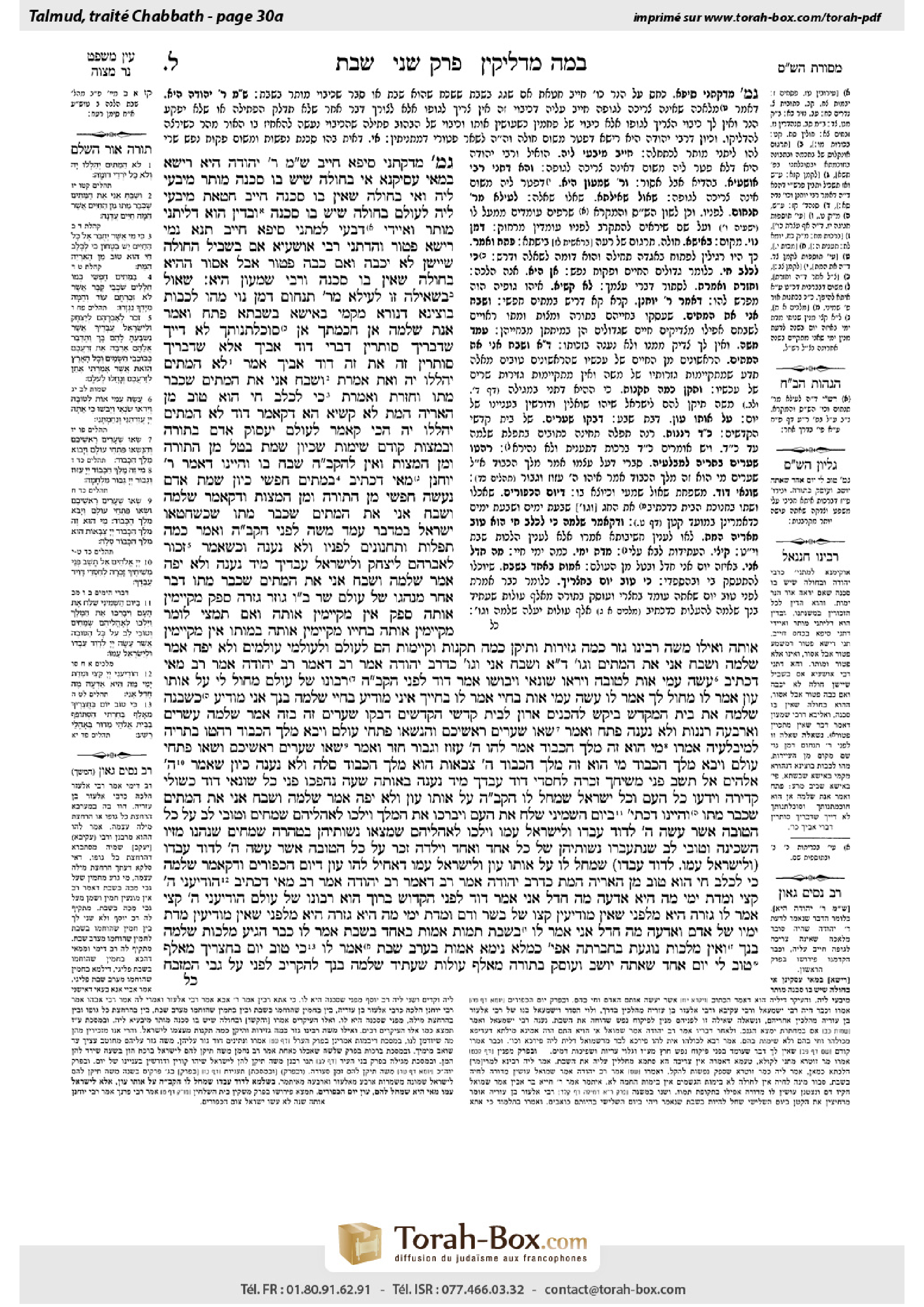
Shabbat 30a: Talmud study for Daf Yomi
Daf Yomi is the daily study of one Talmud folio. Explore 37 tractates with scans, Hebrew text, Sefaria English and AI-generated French translations where annotated.
Passage selection and English or AI-generated French translation are available where the scan has annotations. Daf Study is independent of Torah-Box and Sefaria.
Browse Shabbat · שבת · All tractatesShabbat 30a text and translations
This page of Shabbat includes the Aramaic text, an English translation and an AI-generated French translation, alongside the scan above.
שבת ל׳ א · Aramaic and Hebrew text
גְּמָ׳ מִדְּקָתָנֵי סֵיפָא חַיָּיב — שְׁמַע מִינַּהּ רַבִּי יְהוּדָה הִיא. רֵישָׁא בְּמַאי עָסְקִינַן? אִי בְּחוֹלֶה שֶׁיֵּשׁ בּוֹ סַכָּנָה — ״מוּתָּר״ מִיבְּעֵי לֵיהּ. וְאִי בְּחוֹלֶה שֶׁאֵין בּוֹ סַכָּנָה ״חַיָּיב חַטָּאת״ מִיבְּעֵי לֵיהּ!
לְעוֹלָם בְּחוֹלֶה שֶׁיֵּשׁ בּוֹ סַכָּנָה, וּבְדִין הוּא דְּלִיתְנֵי ״מוּתָּר״, וְאַיְּידֵי דְּבָעֵי לְמִתְנֵי סֵיפָא ״חַיָּיב״, תְּנָא נָמֵי רֵישָׁא ״פָּטוּר״. וְהָדְתָנֵי רַבִּי אוֹשַׁעְיָא אִם בִּשְׁבִיל הַחוֹלֶה שֶׁיִּישַׁן לֹא יְכַבֶּה, וְאִם כִּבָּה, פָּטוּר אֲבָל אָסוּר! — הַהִיא בְּחוֹלֶה שֶׁאֵין בּוֹ סַכָּנָה, וְרַבִּי שִׁמְעוֹן הִיא.
שְׁאוּל שְׁאֵילָה זוֹ לְעֵילָּא מֵרַבִּי תַּנְחוּם דְּמִן נוֹי: מַהוּ לְכַבּוֹת בּוּצִינָא דְנוּרָא מִקַּמֵּי בְּאִישָׁא בְּשַׁבְּתָא? פְּתַח וַאֲמַר: אַנְתְּ שְׁלֹמֹה אָן חׇכְמְתָךְ, אָן סוּכְלְתָנוּתָךְ? לֹא דַּיֶּיךָּ שֶׁדְּבָרֶיךָ סוֹתְרִין דִּבְרֵי דָּוִד אָבִיךָ, אֶלָּא שֶׁדְּבָרֶיךָ סוֹתְרִין זֶה אֶת זֶה. דָּוִד אָבִיךָ אָמַר: ״לֹא הַמֵּתִים יְהַלְלוּ יָהּ״, וְאַתְּ אָמַרְתָּ: ״וְשַׁבֵּחַ אֲנִי אֶת הַמֵּתִים שֶׁכְּבָר מֵתוּ״, וְחָזַרְתָּ וְאָמַרְתָּ: ״כִּי לְכֶלֶב חַי הוּא טוֹב מִן הָאַרְיֵה הַמֵּת״!
לָא קַשְׁיָא, הָא דְּקָאָמַר דָּוִד ״לֹא הַמֵּתִים יְהַלְלוּ יָהּ״ — הָכִי קָאָמַר: לְעוֹלָם יַעֲסוֹק אָדָם בְּתוֹרָה וּבְמִצְוֹת קוֹדֶם שֶׁיָּמוּת, שֶׁכֵּיוָן שֶׁמֵּת, בָּטֵל מִן הַתּוֹרָה וּמִן הַמִּצְוֹת וְאֵין לְהַקָּדוֹשׁ בָּרוּךְ הוּא שֶׁבַח בּוֹ. וְהַיְינוּ דְּאָמַר רַבִּי יוֹחָנָן, מַאי דִכְתִיב: ״בַּמֵּתִים חׇפְשִׁי״ — כֵּיוָן שֶׁמֵּת אָדָם נַעֲשֶׂה חׇפְשִׁי מִן הַתּוֹרָה וּמִן הַמִּצְוֹת.
וּדְקָאָמַר שְׁלֹמֹה ״וְשַׁבֵּחַ אֲנִי אֶת הַמֵּתִים שֶׁכְּבָר מֵתוּ״, שֶׁכְּשֶׁחָטְאוּ יִשְׂרָאֵל בַּמִּדְבָּר, עָמַד מֹשֶׁה לִפְנֵי הַקָּדוֹשׁ בָּרוּךְ הוּא וְאָמַר כַּמָּה תְּפִלּוֹת וְתַחֲנוּנִים לְפָנָיו וְלֹא נַעֲנָה, וּכְשֶׁאָמַר ״זְכוֹר לְאַבְרָהָם לְיִצְחָק וּלְיִשְׂרָאֵל עֲבָדֶיךָ״ — מִיָּד נַעֲנָה. וְלֹא יָפֶה אָמַר שְׁלֹמֹה ״וְשַׁבֵּחַ אֲנִי אֶת הַמֵּתִים שֶׁכְּבָר מֵתוּ״? דָּבָר אַחֵר: מִנְהָגוֹ שֶׁל עוֹלָם, מֶלֶךְ בָּשָׂר וָדָם גּוֹזֵר גְּזֵרָה — סָפֵק מְקַיְּימִין אוֹתָהּ סָפֵק אֵין מְקַיְּימִין אוֹתָהּ. וְאִם תִּמְצֵי לוֹמַר מְקַיְּימִין אוֹתָהּ — בְּחַיָּיו מְקַיְּימִין אוֹתָהּ בְּמוֹתוֹ אֵין מְקַיְּימִין אוֹתָהּ. וְאִילּוּ מֹשֶׁה רַבֵּינוּ גָּזַר כַּמָּה גְּזֵירוֹת וְתִיקֵּן כַּמָּה תַּקָּנוֹת וְקַיָּימוֹת הֵן לְעוֹלָם וּלְעוֹלְמֵי עוֹלָמִים. וְלֹא יָפֶה אָמַר שְׁלֹמֹה ״וְשַׁבֵּחַ אֲנִי אֶת הַמֵּתִים וְגוֹ׳״?!
דָּבָר אַחֵר: ״וְשַׁבֵּחַ אֲנִי וְגוֹ׳״, כִּדְרַב יְהוּדָה אָמַר רַב. דְּאָמַר רַב יְהוּדָה אָמַר רַב: מַאי דִכְתִיב ״עֲשֵׂה עִמִּי אוֹת לְטוֹבָה וְיִרְאוּ שׂוֹנְאַי וְיֵבוֹשׁוּ״ — אָמַר דָּוִד לִפְנֵי הַקָּדוֹשׁ בָּרוּךְ הוּא: רִבּוֹנוֹ שֶׁל עוֹלָם, מְחוֹל לִי עַל אוֹתוֹ עָוֹן. אָמַר לוֹ: מָחוּל לָךְ. אָמַר לוֹ: עֲשֵׂה עִמִּי אוֹת בְּחַיַּי. אָמַר לוֹ: בְּחַיֶּיךָ אֵינִי מוֹדִיעַ, בְּחַיַּי שְׁלֹמֹה בִּנְךָ אֲנִי מוֹדִיעַ.
כְּשֶׁבָּנָה שְׁלֹמֹה אֶת בֵּית הַמִּקְדָּשׁ, בִּיקֵּשׁ לְהַכְנִיס אָרוֹן לְבֵית קׇדְשֵׁי הַקֳּדָשִׁים. דָּבְקוּ שְׁעָרִים זֶה בָּזֶה. אָמַר שְׁלֹמֹה עֶשְׂרִים וְאַרְבָּעָה רְנָנוֹת, וְלֹא נַעֲנָה. פָּתַח וְאָמַר: ״שְׂאוּ שְׁעָרִים רָאשֵׁיכֶם וְהִנָּשְׂאוּ פִּתְחֵי עוֹלָם וְיָבֹא מֶלֶךְ הַכָּבוֹד״. רְהַטוּ בָּתְרֵיהּ לְמִיבְלְעֵיהּ, אֲמַרוּ: ״מִי הוּא זֶה מֶלֶךְ הַכָּבוֹד״. אֲמַר לְהוּ: ״ה׳ עִזּוּז וְגִבּוֹר״. חָזַר וְאָמַר: ״שְׂאוּ שְׁעָרִים רָאשֵׁיכֶם וּשְׂאוּ פִּתְחֵי עוֹלָם וְיָבֹא מֶלֶךְ הַכָּבוֹד מִי הוּא זֶה מֶלֶךְ הַכָּבוֹד ה׳ צְבָאוֹת הוּא מֶלֶךְ הַכָּבוֹד סֶלָה״, וְלֹא נַעֲנָה. כֵּיוָן שֶׁאָמַר: ״ה׳ אֱלֹהִים אַל תָּשֵׁב פְּנֵי מְשִׁיחֶךָ זָכְרָה לְחַסְדֵי דָּוִד עַבְדֶּךָ״, מִיָּד נַעֲנָה. בְּאוֹתָהּ שָׁעָה נֶהְפְּכוּ פְּנֵי כׇּל שׂוֹנְאֵי דָוִד כְּשׁוּלֵי קְדֵירָה, וַיֵּדְעוּ כׇל הָעָם וְכׇל יִשְׂרָאֵל שֶׁמָּחַל לוֹ הַקָּדוֹשׁ בָּרוּךְ הוּא עַל אוֹתוֹ עָוֹן. וְלֹא יָפֶה אָמַר שְׁלֹמֹה: ״וְשַׁבֵּחַ אֲנִי אֶת הַמֵּתִים שֶׁכְּבָר מֵתוּ״?!
וְהַיְינוּ דִּכְתִיב: ״בַּיּוֹם הַשְּׁמִינִי שִׁלַּח אֶת הָעָם וַיְבָרֲכוּ אֶת הַמֶּלֶךְ וַיֵּלְכוּ לְאׇהֳלֵיהֶם שְׂמֵחִים וְטוֹבֵי לֵב עַל כׇּל הַטּוֹבָה אֲשֶׁר עָשָׂה ה׳ לְדָוִד עַבְדּוֹ וּלְיִשְׂרָאֵל עַמּוֹ״. ״וַיֵּלְכוּ לְאׇהֳלֵיהֶם״ — שֶׁמָּצְאוּ נְשׁוֹתֵיהֶן בְּטָהֳרָה. ״שְׂמֵחִים״ — שֶׁנֶּהֱנוּ מִזִּיו הַשְּׁכִינָה. ״וְטוֹבֵי לֵב״ — שֶׁנִּתְעַבְּרוּ נְשׁוֹתֵיהֶן שֶׁל כׇּל אֶחָד וְאֶחָד וְיָלְדָה זָכָר. ״עַל כׇּל הַטּוֹבָה אֲשֶׁר עָשָׂה ה׳ לְדָוִד עַבְדּוֹ (וּלְיִשְׂרָאֵל עַמּוֹ״. ״לְדָוִד עַבְדּוֹ)״ — שֶׁמָּחַל לוֹ עַל אוֹתוֹ עָוֹן. ״וּלְיִשְׂרָאֵל עַמּוֹ״ — דְּאַחֵיל לְהוּ עָוֹן דְּיוֹם הַכִּפּוּרִים.
וּדְקָאָמַר שְׁלֹמֹה: ״כִּי לְכֶלֶב חַי הוּא טוֹב מִן הָאַרְיֵה הַמֵּת״, כִּדְרַב יְהוּדָה אָמַר רַב. דְּאָמַר רַב יְהוּדָה אָמַר רַב, מַאי דִכְתִיב: ״הוֹדִיעֵנִי ה׳ קִצִּי וּמִדַּת יָמַי מַה הִיא אֵדְעָה מֶה חָדֵל אָנִי״ — אָמַר דָּוִד לִפְנֵי הַקָּדוֹשׁ בָּרוּךְ הוּא: רִבּוֹנוֹ שֶׁל עוֹלָם, הוֹדִיעֵנִי ה׳ קִצִּי. אָמַר לוֹ: גְּזֵרָה הִיא מִלְּפָנַי שֶׁאֵין מוֹדִיעִין קִצּוֹ שֶׁל בָּשָׂר וָדָם. ״וּמִדַּת יָמַי מַה הִיא״ — גְּזֵרָה הִיא מִלְּפָנַי שֶׁאֵין מוֹדִיעִין מִדַּת יָמָיו שֶׁל אָדָם. ״וְאֵדְעָה מֶה חָדֵל אָנִי״ — אָמַר לוֹ: בְּשַׁבָּת תָּמוּת. אָמוּת בְּאֶחָד בְּשַׁבָּת? אָמַר לוֹ: כְּבָר הִגִּיעָה מַלְכוּת שְׁלֹמֹה בִּנְךָ, וְאֵין מַלְכוּת נוֹגַעַת בַּחֲבֶרְתָּהּ אֲפִילּוּ כִּמְלֹא נִימָא. אָמוּת בְּעֶרֶב שַׁבָּת? אָמַר לוֹ: ״כִּי טוֹב יוֹם בַּחֲצֵרֶיךָ מֵאָלֶף״ — טוֹב לִי יוֹם אֶחָד שֶׁאַתָּה יוֹשֵׁב וְעוֹסֵק בַּתּוֹרָה מֵאֶלֶף עוֹלוֹת שֶׁעָתִיד שְׁלֹמֹה בִּנְךָ לְהַקְרִיב לְפָנַי עַל גַּבֵּי הַמִּזְבֵּחַ.
Shabbat 30a · English translation
GEMARA: From the fact that it was taught in the latter clause of the mishna that one who extinguishes a flame on Shabbat is liable, conclude from it that this mishna is in accordance with the opinion of Rabbi Yehuda, who holds that one who performs a prohibited labor on Shabbat is liable to bring a sin-offering even if it is a labor that is not necessary for its own sake [melakha she’eina tzerikha legufa]. In the mishna, one does not extinguish the flame to achieve the product produced by extinguishing it. He does so to prevent the light from shining. If so, with what is the first clause of the mishna dealing? If it is referring to one who extinguished the flame due to a critically ill person, the term exempt is imprecise. It should have said permitted, as it is permitted even ab initio to perform a prohibited labor on Shabbat in a case of danger. And if it is speaking about a non-critically ill person, why is one who extinguished the flame exempt? It should have said that one is liable to bring a sin-offering.
The Gemara replies: Actually, the first clause was referring to a critically ill person, and it should have taught that it is permitted. And since the latter clause of the mishna had to teach that one is liable, in the first clause too, it taught employing the opposite term, exempt, so that the mishna would maintain stylistic uniformity. The halakha is, indeed, that not only is one exempt if he extinguished a light for a critically ill person, it is even permitted to do so ab initio. The Gemara asks: What of that which Rabbi Oshaya taught: If one wants to extinguish a flame on Shabbat for a sick person so he can sleep, he may not extinguish it, and if he extinguished it, he is not liable after the fact, but ab initio he is prohibited to do so? The Gemara answers: This is not similar, as that baraita is referring to a non-critically ill person and it is in accordance with the opinion of Rabbi Shimon, who said that one who performs a prohibited labor not necessary for its own sake is exempt. Our mishna is referring to a critically ill person.
The Gemara relates: This question was asked before Rabbi Tanḥum from the village of Nevi: What is the ruling with regard to extinguishing a burning lamp before a sick person on Shabbat? The Gemara relates that Rabbi Tanḥum delivered an entire homily touching upon both aggadic and halakhic materials surrounding this question. He began and said: You, King Solomon, where is your wisdom, where is your understanding? Not only do your statements contradict the statements of your father David, but your statements even contradict each other. Your father David said: “The dead praise not the Lord, neither any that go down into silence” (Psalms 115:17); and you said: “And I praised the dead that are already dead more than the living that are yet alive” (Ecclesiastes 4:2). And then again you said: “For a living dog is better than a dead lion” (Ecclesiastes 9:4). These are different assessments of life and death.
He resolved the contradictions in the following manner: This is not difficult. That which David said: “The dead praise not the Lord,” this is what he is saying: A person should always engage in Torah and mitzvot before he dies, as once he is dead he is idle from Torah and mitzvot and there is no praise for the Holy One, Blessed be He, from him. And that is what Rabbi Yoḥanan said: What is the meaning of that which is written: “Set free among the dead, like the slain that lie in the grave, whom You remember no more” (Psalms 88:6)? When a person dies he then becomes free of Torah and mitzvot.
And that which Solomon said: “And I praised the dead that are already dead”; he was not speaking of all dead people, but rather in praise of certain dead people. As when Israel sinned in the desert, Moses stood before the Holy One, Blessed be He, and he said several prayers and supplications before Him, and his prayers were not answered. And when he said: “Remember Abraham, Isaac, and Israel, Your servants” (Exodus 32:13), his prayers were answered immediately. Consequently, did Solomon not speak appropriately when he said: “Wherefore I praised the dead that are already dead”? Certainly the merit of the deceased forefathers is greater than that of the righteous people who are alive. Alternatively, the way of the world is such that when a flesh-and-blood prince issues a decree on the public it is uncertain whether they fulfill it and uncertain whether they do not fulfill it. And even if you want to say that they fulfill it, it is only during his lifetime that they fulfill it; after he dies they do not fulfill it. But Moses our teacher issued several decrees and instituted several ordinances, and they are in effect forever and ever. And, if so, is it not appropriate that which Solomon said: “Wherefore I praised the dead that are already dead”?
Alternatively, another explanation is given for the verse: “And I praised the dead that are already dead,” is in accordance with that which Rav Yehuda said that Rav said. As Rav Yehuda said that Rav said: What is the meaning of the verse that was written: “Work on my behalf a sign for good; that they that hate me may see it, and be put to shame” (Psalms 86:17)? David said before the Holy One, Blessed be He: Master of the Universe, forgive me for that sin in the matter of Bathsheba. He said to him: It is forgiven you. David said to Him: Show me a sign in my lifetime so that all will know that You have forgiven me. God said to him: In your lifetime I will not make it known that you were forgiven; however, in the lifetime of your son Solomon I will make it known.
When Solomon built the Temple and sought to bring the Ark into the Holy of Holies, the gates clung together and could not be opened. Solomon uttered twenty-four songs of praise, as in his prayer there are twenty-four expressions of prayer, song, etc. (I Kings 8), and his prayer was not answered. He began and said: “Lift up your heads, O you gates, and be you lifted up, you everlasting doors; that the King of glory may come in” (Psalms 24:7). Immediately, the gates ran after him to swallow him, as they thought that in the words: “King of glory” he was referring to himself, and they said to him: “Who is the King of glory?” (Psalms 24:8). He said to them: “The Lord strong and mighty, the Lord mighty in battle” (Psalms 24:8). And he said again: “Lift up your heads, O you gates, yea, lift them up, you everlasting doors; that the King of glory may come in. Who then is the King of glory? The Lord of hosts; He is the King of glory. Selah” (Psalms 24:9–10), and he was not answered. When he said: “O Lord God, turn not away the face of Your anointed; remember the good deeds of David Your servant” (II Chronicles 6:42), he was immediately answered, and a fire descended from Heaven (II Chronicles 7:1). At that moment, the faces of all of David’s enemies turned dark like the charred bottom of a pot. And all of Israel knew that the Holy One, Blessed be He, forgave him for that sin. And if so, is it not appropriate what Solomon said: “And I praised the dead that are already dead,” David, more than the living, Solomon, to whose request to open the gates of the Temple God did not respond?
And that is what is written: “On the eighth day he sent the people away, and they blessed the king, and went unto their tents joyful and glad of heart for all the goodness that the Lord had shown unto David His servant and to Israel His people” (I Kings 8:66). The Gemara explains: And went unto their tents, in accordance with the common expression: One’s house is his wife. It is explained that when they returned home they found their wives ritually pure from the ritual impurity of menstruation. Joyful means that they enjoyed the aura of the Divine Presence at the dedication of the Temple. And glad of heart means that the wife of each and every one of them was impregnated and gave birth to a male. The verse continues: For all the goodness that the Lord had shown unto David His servant and to Israel His people. Unto David His servant means that at that opportunity they all saw that God forgave him for that sin. And to Israel His people means that He forgave them for the sin of Yom Kippur, as they did not fast that year (see I Kings 8:65).
The Gemara continues: And that which Solomon said: “For a living dog is better than a dead lion” (Ecclesiastes 9:4), is in accordance with that which Rav Yehuda said that Rav said. As Rav Yehuda said that Rav said: What is the meaning of that verse which David said: “Lord, make me to know my end, and the measure of my days, what it is; let me know how short-lived I am” (Psalms 39:5)? It means that David said before the Holy One, Blessed be He: Master of the Universe, Lord, make me to know my end; in how long will I die? God said to him: It is decreed before Me that I do not reveal the end of the life of flesh and blood. He asked further: And the measure of my days; on what day of the year will I die? He said to him: It is decreed before Me not to reveal the measure of a person’s days. Again he requested: Let me know how short-lived I am; on what day of the week will I die? He said to him: You will die on Shabbat. David requested of God: Let me die on the first day of the week so that the honor of Shabbat will not be tarnished by the pain of death. He said to him: On that day the time of the kingdom of your son Solomon has already arrived, and one kingdom does not overlap with another and subtract from the time allotted to another even a hairbreadth. He said to him: I will cede a day of my life and die on Shabbat eve. God said to him: “For a day in your courts is better than a thousand” (Psalms 84:11); a single day in which you sit and engage in Torah is preferable to Me than the thousand burnt-offerings that your son Solomon will offer before Me on the altar (see I Kings 3:4).
Shabbat 30a · Traduction française (IA)
GUEMARA : Puisqu’il est enseigné dans la dernière partie de la Michna que celui qui éteint une flamme pendant Chabbat est passible, on peut en conclure que cette Michna suit l’opinion de Rabbi Yehouda, qui estime que celui qui accomplit pendant Chabbat un travail interdit est passible d’apporter un sacrifice expiatoire, même s’il s’agit d’un travail qui n’est pas nécessaire en lui-même [melakha she’eina tzerikha legufa]. Dans la Michna, on n’éteint pas la flamme pour obtenir le résultat de son extinction ; on le fait pour empêcher la lumière de briller. Si tel est le cas, à quoi se rapporte la première partie de la Michna ? S’il s’agit de quelqu’un qui a éteint la flamme en raison d’un malade en danger de mort, le terme « exempt » est inexact. Il aurait fallu dire « permis », car il est permis, même a priori, d’accomplir un travail interdit pendant Chabbat en cas de danger. Et s’il s’agit d’un malade qui n’est pas en danger de mort, pourquoi celui qui a éteint la flamme est-il exempt ? Il aurait fallu dire qu’il est passible d’apporter un sacrifice expiatoire.
La Guemara répond : En réalité, la première partie se rapporte à un malade en danger de mort et aurait dû enseigner que c’est permis. Mais comme la dernière partie de la Michna devait enseigner que l’on est passible, la première partie emploie également le terme opposé, « exempt », afin de maintenir l’uniformité du style de la Michna. En effet, la halakha est que celui qui éteint une lumière pour un malade en danger de mort est non seulement exempt, mais qu’il est même permis de le faire a priori. La Guemara demande : Que penser alors de ce que Rabbi Ochaïa a enseigné : si quelqu’un veut éteindre une flamme pendant Chabbat pour qu’un malade puisse dormir, il ne doit pas l’éteindre ; et s’il l’a éteinte, il n’est pas passible après coup, mais il lui est interdit de le faire a priori ? La Guemara répond : Ce cas est différent, car cette baraïta se rapporte à un malade qui n’est pas en danger de mort et suit l’opinion de Rabbi Chimon, qui a dit que celui qui accomplit un travail interdit qui n’est pas nécessaire en lui-même est exempt. Notre Michna se rapporte à un malade en danger de mort.
La Guemara rapporte : Cette question fut posée à Rabbi Tanḥoum, du village de Nevi : quelle est la règle concernant l’extinction, pendant Chabbat, d’une lampe allumée devant un malade ? La Guemara rapporte que Rabbi Tanḥoum prononça un long discours abordant à la fois des sujets aggadiques et halakhiques liés à cette question. Il commença ainsi : « Toi, roi Salomon, où sont ta sagesse et ton intelligence ? Non seulement tes paroles contredisent celles de ton père David, mais elles se contredisent même entre elles. Ton père David a dit : “Les morts ne louent pas l’Éternel, ni ceux qui descendent dans le silence” (Psaumes 115, 17), tandis que toi, tu as dit : “Et j’ai estimé les morts, qui sont déjà morts, plus heureux que les vivants, qui sont encore en vie” (Ecclésiaste 4, 2). Et tu as encore dit : “Car un chien vivant vaut mieux qu’un lion mort” (Ecclésiaste 9, 4). Voilà des appréciations différentes de la vie et de la mort. »
Il résolut les contradictions de la manière suivante : il n’y a pas de difficulté. Lorsque David a dit : « Les morts ne louent pas l’Éternel », il voulait dire ceci : une personne doit toujours s’adonner à la Torah et aux mitsvot avant de mourir, car une fois morte, elle est inactive en matière de Torah et de mitsvot et ne peut plus louer le Saint, béni soit-Il. C’est ce que Rabbi Yoḥanan a dit : quel est le sens de ce qui est écrit : « Libre parmi les morts, comme les transpercés qui gisent dans la tombe, dont Tu ne te souviens plus » (Psaumes 88, 6) ? Lorsqu’une personne meurt, elle est alors libérée de la Torah et des mitsvot.
Et lorsque Salomon a dit : « Et j’ai estimé les morts, qui sont déjà morts », il ne parlait pas de tous les morts, mais faisait l’éloge de certains d’entre eux. En effet, lorsque Israël pécha dans le désert, Moïse se tint devant le Saint, béni soit-Il, et Lui adressa plusieurs prières et supplications, mais ses prières ne furent pas exaucées. Lorsqu’il dit : « Souviens-Toi d’Abraham, d’Isaac et d’Israël, Tes serviteurs » (Exode 32, 13), ses prières furent immédiatement exaucées. Salomon n’a-t-il donc pas parlé à juste titre en disant : « C’est pourquoi j’ai estimé les morts, qui sont déjà morts » ? Le mérite des patriarches défunts est assurément supérieur à celui des justes qui sont en vie. Autre explication : il est dans l’ordre du monde que, lorsqu’un prince de chair et de sang promulgue un décret à l’intention du public, on ne sait pas avec certitude si les gens l’appliqueront ou non. Et même si l’on veut dire qu’ils l’appliquent, ce n’est que de son vivant ; après sa mort, ils ne l’appliquent plus. Mais Moïse notre maître a promulgué plusieurs décrets et institué plusieurs ordonnances, qui restent en vigueur à jamais. Dès lors, Salomon n’a-t-il pas eu raison de dire : « C’est pourquoi j’ai estimé les morts, qui sont déjà morts » ?
Une autre explication du verset « Et j’ai estimé les morts, qui sont déjà morts » est donnée conformément à ce que Rav Yehouda a dit au nom de Rav. En effet, Rav Yehouda a dit au nom de Rav : quel est le sens du verset : « Accomplis en ma faveur un signe de bonté, afin que ceux qui me haïssent le voient et soient confondus » (Psaumes 86, 17) ? David dit au Saint, béni soit-Il : « Maître de l’univers, pardonne-moi cette faute, celle de Bat-Chéva. » Il lui répondit : « Elle t’est pardonnée. » David lui dit : « Montre-moi un signe de mon vivant, afin que tous sachent que Tu m’as pardonné. » Dieu lui dit : « De ton vivant, je ne ferai pas savoir que tu as été pardonné ; toutefois, je le ferai savoir du vivant de ton fils Salomon. »
Lorsque Salomon construisit le Temple et voulut faire entrer l’Arche dans le Saint des saints, les portes se soudèrent et ne purent être ouvertes. Salomon prononça vingt-quatre chants de louange, car sa prière contient vingt-quatre expressions de prière, de chant, etc. (I Rois 8), mais sa prière ne fut pas exaucée. Il commença par dire : « Levez vos têtes, portes, élevez-vous, portes éternelles, afin que le Roi de gloire fasse son entrée » (Psaumes 24, 7). Aussitôt, les portes se précipitèrent vers lui pour l’engloutir, car elles pensaient qu’en disant « Roi de gloire », il parlait de lui-même, et elles lui dirent : « Qui est le Roi de gloire ? » (Psaumes 24, 8). Il leur répondit : « L’Éternel, fort et puissant, l’Éternel, puissant dans les combats » (Psaumes 24, 8). Puis il dit de nouveau : « Levez vos têtes, portes, élevez-les, portes éternelles, afin que le Roi de gloire fasse son entrée. Qui est donc le Roi de gloire ? L’Éternel des armées, c’est Lui le Roi de gloire. Sélah » (Psaumes 24, 9-10), mais il ne fut pas exaucé. Lorsqu’il dit : « Éternel Dieu, ne repousse pas ton oint ; souviens-toi des actes de bonté de David, ton serviteur » (II Chroniques 6, 42), il fut immédiatement exaucé et un feu descendit du Ciel (II Chroniques 7, 1). À cet instant, le visage de tous les ennemis de David devint sombre comme le fond calciné d’une marmite. Tout Israël sut alors que le Saint, béni soit-Il, lui avait pardonné cette faute. Dès lors, Salomon n’a-t-il pas eu raison de dire : « Et j’ai estimé les morts, qui sont déjà morts », c’est-à-dire David, davantage que les vivants, c’est-à-dire lui-même, puisque Dieu n’avait pas répondu à sa demande d’ouvrir les portes du Temple ?
C’est ce qui est écrit : « Le huitième jour, il renvoya le peuple, qui bénit le roi, puis s’en alla dans ses tentes, joyeux et le cœur content de tout le bien que l’Éternel avait fait à David, son serviteur, et à Israël, son peuple » (I Rois 8, 66). La Guemara explique : « S’en alla dans ses tentes » s’entend conformément à l’expression courante selon laquelle la maison d’un homme, c’est sa femme. Il est expliqué qu’à leur retour chez eux, ils trouvèrent leurs femmes rituellement pures de l’impureté menstruelle. « Joyeux » signifie qu’ils avaient joui de l’aura de la Présence divine lors de l’inauguration du Temple. « Et le cœur content » signifie que la femme de chacun d’eux avait conçu et donné naissance à un garçon. Le verset poursuit : « De tout le bien que l’Éternel avait fait à David, son serviteur, et à Israël, son peuple. » « À David, son serviteur » signifie qu’à cette occasion, tous virent que Dieu lui avait pardonné cette faute. « Et à Israël, son peuple » signifie qu’Il leur avait pardonné la faute de Yom Kippour, puisqu’ils n’avaient pas jeûné cette année-là (voir I Rois 8, 65).
La Guemara poursuit : lorsque Salomon a dit : « Car un chien vivant vaut mieux qu’un lion mort » (Ecclésiaste 9, 4), il s’accordait avec ce que Rav Yehouda a dit au nom de Rav. En effet, Rav Yehouda a dit au nom de Rav : quel est le sens de ce verset prononcé par David : « Éternel, fais-moi connaître ma fin et quelle est la mesure de mes jours ; que je sache combien je suis éphémère » (Psaumes 39, 5) ? Cela signifie que David dit au Saint, béni soit-Il : « Maître de l’univers, Éternel, fais-moi connaître ma fin : dans combien de temps mourrai-je ? » Dieu lui dit : « Il a été décrété devant Moi que je ne révèle pas la fin de la vie d’un être de chair et de sang. » Il demanda ensuite : « Et la mesure de mes jours : quel jour de l’année mourrai-je ? » Dieu lui dit : « Il a été décrété devant Moi de ne pas révéler la mesure des jours d’une personne. » Il demanda encore : « Que je sache combien je suis éphémère : quel jour de la semaine mourrai-je ? » Dieu lui dit : « Tu mourras un Chabbat. » David demanda à Dieu : « Fais-moi mourir le premier jour de la semaine, afin que la douleur de la mort ne ternisse pas l’honneur du Chabbat. » Dieu lui dit : « Ce jour-là, le règne de ton fils Salomon aura déjà commencé, et un royaume n’empiète pas sur un autre et ne retranche pas à celui-ci, ne serait-ce que l’épaisseur d’un cheveu, du temps qui lui est alloué. » David lui dit : « Je céderai un jour de ma vie et mourrai la veille de Chabbat. » Dieu lui répondit : « Car un jour dans tes parvis vaut mieux que mille » (Psaumes 84, 11) : un seul jour où tu sièges et t’adonnes à la Torah m’est préférable aux mille holocaustes que ton fils Salomon m’offrira sur l’autel (voir I Rois 3, 4).
Traduction française générée par IA à partir de l’édition anglaise de Sefaria. Vérifie toujours un passage avec le texte source.
Text from Sefaria: William Davidson Edition - Vocalized Aramaic (CC BY NC); William Davidson Edition - English (CC BY NC).