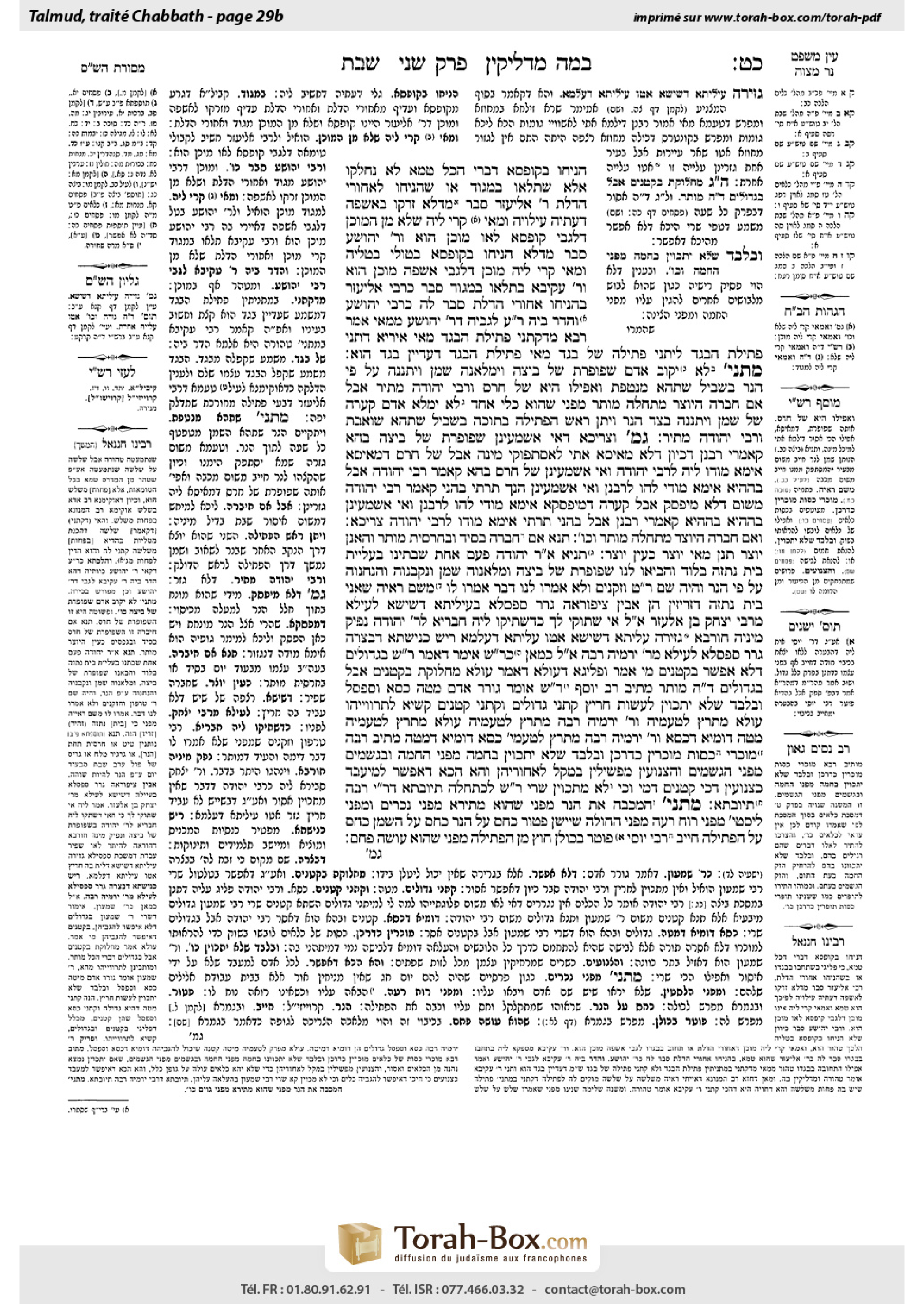
Shabbat 29b: Talmud study for Daf Yomi
Daf Yomi is the daily study of one Talmud folio. Explore 37 tractates with scans, Hebrew text, Sefaria English and AI-generated French translations where annotated.
Passage selection and English or AI-generated French translation are available where the scan has annotations. Daf Study is independent of Torah-Box and Sefaria.
Browse Shabbat · שבת · All tractatesShabbat 29b text and translations
This page of Shabbat includes the Aramaic text, an English translation and an AI-generated French translation, alongside the scan above.
שבת כ״ט ב · Aramaic and Hebrew text
הִנִּיחוֹ בְּקוּפְסָא — דִּבְרֵי הַכֹּל טָמֵא. לֹא נֶחְלְקוּ אֶלָּא שֶׁתְּלָאוֹ בְּמַגּוֹד אוֹ שֶׁהִנִּיחוֹ לַאֲחוֹרֵי הַדֶּלֶת. רַבִּי אֱלִיעֶזֶר סָבַר מִדְּלֹא זְרָקוֹ בָּאַשְׁפָּה דַּעְתֵּיהּ עִילָּוֵיהּ. וּמַאי קָרֵי לֵיהּ ״שֶׁלֹּא מִן הַמּוּכָן״ — דִּלְגַבֵּי קוּפְסָא לָאו מוּכָן הוּא. וְרַבִּי יְהוֹשֻׁעַ סָבַר מִדְּלֹא הִנִּיחוֹ בְּקוּפְסָא בַּטּוֹלֵי בַּטְּלֵיהּ, וּמַאי קָרֵי לֵיהּ ״מוּכָן״ — דִּלְגַבֵּי אַשְׁפָּה מוּכָן הוּא. וְרַבִּי עֲקִיבָא, בִּתְלָאוֹ בְּמַגּוֹד סָבַר כְּרַבִּי אֱלִיעֶזֶר, בְּהִנִּיחוֹ אֲחוֹרֵי הַדֶּלֶת סָבַר לַהּ כְּרַבִּי יְהוֹשֻׁעַ.
וַהֲדַר בֵּיהּ רַבִּי עֲקִיבָא לְגַבֵּיהּ דְּרַבִּי יְהוֹשֻׁעַ. מִמַּאי? אָמַר רָבָא: מִדְּקָתָנֵי ״פְּתִילַת הַבֶּגֶד״. מַאי אִירְיָא דְּתָנֵי ״פְּתִילַת הַבֶּגֶד״? לִיתְנֵי ״פְּתִילָה שֶׁל בֶּגֶד״. מַאי ״פְּתִילַת הַבֶּגֶד״ — דַּעֲדַיִין בֶּגֶד הוּא.
מַתְנִי׳ לֹא יִקּוֹב אָדָם שְׁפוֹפֶרֶת שֶׁל בֵּיצָה וִימַלְּאֶנָּה שֶׁמֶן וְיִתְּנֶנָּה עַל פִּי הַנֵּר בִּשְׁבִיל שֶׁתְּהֵא מְנַטֶּפֶת, וַאֲפִילּוּ הִיא שֶׁל חֶרֶס. וְרַבִּי יְהוּדָה מַתִּיר. אֲבָל אִם חִבְּרָהּ הַיּוֹצֵר מִתְּחִלָּה — מוּתָּר, מִפְּנֵי שֶׁהוּא כְּלִי אֶחָד. לֹא יְמַלֵּא אָדָם קְעָרָה שֶׁל שֶׁמֶן וְיִתְּנֶנָּה בְּצַד הַנֵּר וְיִתֵּן רֹאשׁ הַפְּתִילָה בְּתוֹכָהּ בִּשְׁבִיל שֶׁתְּהֵא שׁוֹאֶבֶת. וְרַבִּי יְהוּדָה מַתִּיר.
גְּמָ׳ וּצְרִיכָא. דְּאִי אַשְׁמְעִינַן שְׁפוֹפֶרֶת שֶׁל בֵּיצָה — בְּהָא קָאָמְרִי רַבָּנַן, דְּכֵיוָן דְּלָא מְאִיסָא אָתֵי לְאִסְתַּפּוֹקֵי מִינַּהּ. אֲבָל שֶׁל חֶרֶס דִּמְאִיסָא — אֵימָא מוֹדוּ לֵיהּ לְרַבִּי יְהוּדָה. וְאִי אַשְׁמְעִינַן שֶׁל חֶרֶס — בְּהָא קָאָמַר רַבִּי יְהוּדָה, אֲבָל בְּהַהִיא — אֵימָא מוֹדֵי לְהוּ לְרַבָּנַן. וְאִי אַשְׁמְעִינַן הָנָךְ תַּרְתֵּי, בְּהָנֵי קָאָמַר רַבִּי יְהוּדָה מִשּׁוּם דְּלָא מִיפְּסַק, אֲבָל קְעָרָה דְּמִיפַּסְקָא — אֵימָא מוֹדֵי לְהוּ לְרַבָּנַן. וְאִי אַשְׁמְעִינַן בְּהַהִיא, בְּהַהִיא קָאָמְרִי רַבָּנַן, אֲבָל בְּהָנֵי תַּרְתֵּי — אֵימָא מוֹדוּ לְרַבִּי יְהוּדָה. צְרִיכָא.
וְאִם חִבְּרָהּ הַיּוֹצֵר מִתְּחִלָּה מוּתָּר וְכוּ׳. תָּנָא אִם חִבְּרָהּ בְּסִיד וּבְחַרְסִית מוּתָּר. וְהָאֲנַן ״יוֹצֵר״ תְּנַן! מַאי ״יוֹצֵר״, כְּעֵין יוֹצֵר.
תַּנְיָא אָמַר רַבִּי יְהוּדָה: פַּעַם אַחַת שָׁבַתְנוּ בַּעֲלִיַּית בֵּית נַתְּזָה בְּלוֹד, וְהֵבִיאוּ לָנוּ שְׁפוֹפֶרֶת שֶׁל בֵּיצָה וּמִלֵּאנוּהָ שֶׁמֶן וּנְקַבְנוּהָ וְהִנַּחְנוּהָ עַל פִּי הַנֵּר. וְהָיָה שָׁם רַבִּי טַרְפוֹן וּזְקֵנִים, וְלֹא אָמְרוּ לָנוּ דָּבָר. אָמְרוּ לוֹ: מִשָּׁם רְאָיָה?! שָׁאנֵי בֵּית נַתְּזָה דִּזְרִיזִין הֵן.
אָבִין צִיפּוֹרָאָה גְּרַר סַפְסַלָּא בְּעִילִּיתָא דְשֵׁישָׁא לְעִילָּא מֵרַבִּי יִצְחָק בֶּן אֶלְעָזָר. אֲמַר לֵיהּ: אִי שְׁתִיקִי לָךְ כְּדִשְׁתִיקוּ לֵיהּ חַבְרַיָּא לְרַבִּי יְהוּדָה נָפֵיק מִינֵּיהּ חוּרְבָּא. גְּזֵירָה עִלִּיתָא דְשֵׁישָׁא אַטּוּ עִלִּיתָא דְעָלְמָא.
רֵישׁ כְּנִישְׁתָּא דְּבׇצְרָה גְּרַר סַפְסַלָּא לְעֵילָּא מֵרַבִּי יִרְמְיָה רַבָּה. אֲמַר לֵיהּ: כְּמַאן, כְּרַבִּי שִׁמְעוֹן? — אֵימַר דְּאָמַר רַבִּי שִׁמְעוֹן בִּגְדוֹלִים דְּלָא אֶפְשָׁר, בִּקְטַנִּים מִי אָמַר?! וּפְלִיגָא דְּעוּלָּא. דְּאָמַר עוּלָּא מַחֲלוֹקֶת בִּקְטַנִּים, אֲבָל בִּגְדוֹלִים דִּבְרֵי הַכֹּל מוּתָּר.
מֵתִיב רַב יוֹסֵף: רַבִּי שִׁמְעוֹן אוֹמֵר גּוֹרֵר אָדָם מִטָּה כִּסֵּא וְסַפְסָל, וּבִלְבַד שֶׁלֹּא יִתְכַּוֵּין לַעֲשׂוֹת חָרִיץ. קָתָנֵי גְּדוֹלִים, וְקָתָנֵי קְטַנִּים, קַשְׁיָא לְתַרְוַויְיהוּ!
עוּלָּא מְתָרֵץ לְטַעְמֵיהּ וְרַבִּי יִרְמְיָה רַבָּה מְתָרֵץ לְטַעְמֵיהּ: עוּלָּא מְתָרֵץ לְטַעְמֵיהּ — מִטָּה דּוּמְיָא דְּכִסֵּא. וְרַבִּי יִרְמְיָה רַבָּה מְתָרֵץ לְטַעְמֵיהּ — כִּסֵּא דּוּמְיָא דְּמִטָּה.
מֵתִיב רַבָּה: מוֹכְרֵי כְּסוּת מוֹכְרִין כְּדַרְכָּן, וּבִלְבַד שֶׁלֹּא יִתְכַּוֵּין בַּחַמָּה מִפְּנֵי הַחַמָּה וּבַגְּשָׁמִים מִפְּנֵי הַגְּשָׁמִים, וְהַצְּנוּעִין מַפְשִׁילִין בְּמַקֵּל לַאֲחוֹרֵיהֶן. וְהָא הָכָא דְּאֶפְשָׁר לְמִיעְבַּד כִּצְנוּעִין — דְּכִי קְטַנִּים דָּמֵי, וְכִי לָא מִתְכַּוֵּין — שָׁרֵי רַבִּי שִׁמְעוֹן לְכַתְּחִלָּה. תְּיוּבְתָּא דְּרַבִּי יִרְמְיָה רַבָּה. תְּיוּבְתָּא.
מַתְנִי׳ הַמְכַבֶּה אֶת הַנֵּר מִפְּנֵי שֶׁהוּא מִתְיָרֵא מִפְּנֵי גּוֹיִם וּמִפְּנֵי לִיסְטִים, מִפְּנֵי רוּחַ רָעָה, מִפְּנֵי הַחוֹלֶה שֶׁיִּישַׁן — פָּטוּר. כְּחָס עַל הַנֵּר, כְּחָס עַל הַשֶּׁמֶן, כְּחָס עַל הַפְּתִילָה — חַיָּיב. רַבִּי יוֹסֵי פּוֹטֵר בְּכוּלָּן, חוּץ מִן הַפְּתִילָה — מִפְּנֵי שֶׁהוּא עוֹשָׂהּ פֶּחָם.
Shabbat 29b · English translation
If one placed it in a box, everyone agrees that it can become ritually impure because his placing the cloth in a box indicates that he considers the cloth significant and is keeping it in order to use it. They only disagreed in a case where one hung the garment on a dryer, i.e., a stake in the wall, or where he placed it behind a door. Rabbi Eliezer held: From the fact that he did not throw it in the garbage dump, it is certainly on his mind and he is planning to use it. And what is the reason that he called it not prepared? It is because, relative to a cloth placed in a box, it is not considered prepared for use. And Rabbi Yehoshua held that since he did not place it in a box, certainly he has negated its garment status. And what is the reason that he called it prepared? Because relative to one thrown in the garbage, this garment is prepared for use, although, in fact, the cloth has already been negated. And Rabbi Akiva, in the case where he hung it on a dryer, held in accordance with the opinion of Rabbi Eliezer that one has not yet negated it from use and it can therefore become ritually impure. In the case where he placed it behind a door, Rabbi Akiva held in accordance with the opinion of Rabbi Yehoshua that, in doing so, he negated its garment status, and it can no longer become ritually impure.
The Gemara comments: And Rabbi Akiva retracted his opinion in favor of the opinion of Rabbi Yehoshua and held in accordance with his opinion. And from where do we know this? Rava said: From the term that we learned in our mishna: The wick of a garment [petilat habeged]. Why did it specifically teach: The wick of a garment? Teach that halakha using the phrase: A wick made from a garment. What is the reason that the mishna taught: A wick of a garment? It is because it remains a garment. Nevertheless, Rabbi Akiva deemed it ritually pure, in accordance with the opinion of Rabbi Yehoshua.
MISHNA: The fundamental dispute in this mishna is with regard to the determination whether or not indirect acts of kindling and extinguishing fall within the parameters of the prohibition on Shabbat. The Rabbis said: A person may not pierce a hole in an eggshell and fill it with oil, and place it over the mouth of a lamp so that the egg will drip additional oil into the lamp and thereby extend the time that it burns. And this is the ruling even if it is not an actual egg but an earthenware vessel. And Rabbi Yehuda permits doing so. However, if the craftsman, who crafts ceramic vessels, attached the egg to the lamp from the outset, one is permitted to fill it with oil because it constitutes a single, large vessel. The Rabbis decreed that a person may not fill a bowl with oil, and place it beside the lamp, and place the unlit head of the wick into the bowl so that it draws additional oil from the bowl and thereby extend the time that the lamp burns. And Rabbi Yehuda permits doing so.
GEMARA: The Gemara comments on the fact that the mishna cited three cases that all share the same rationale: And it was necessary to cite all of the aforementioned cases because it is impossible to derive one from the other. As, had the Gemara only taught us the prohibition of an eggshell, I would have said that, specifically in that case, the Rabbis said that it is prohibited to do so. Since the egg is not dirty and disgusting, there is room for concern that one might come to take oil from it, which would be tantamount to taking oil from a burning lamp on Shabbat, because it causes the flame to be extinguished faster. However, an earthenware tube that is disgusting, say that the Rabbis agree with Rabbi Yehuda that there is no room for concern, and even according to their opinion it would be permitted. And, conversely, had the Gemara only taught us the prohibition of an earthenware tube, I would have said that, specifically in that case, Rabbi Yehuda says that one is permitted to do so because it is disgusting, as explained above; however, in that case of the eggshell that is not disgusting, say that he agrees with the Rabbis that it is prohibited. And had the Gemara taught us only those two cases of the eggshell and the earthenware tube, I would have said that, specifically in those cases, Rabbi Yehuda said that it is permitted because there is no separation between the lamp and the second receptacle. However, in the case of a bowl, which is separate, say that he agrees with the Rabbis that it is prohibited. And, conversely, had the Gemara only taught us in that case of the added bowl, I would have said that only in that case did the Rabbis say it is prohibited because it is separate. However, in these two cases of the eggshell and the ceramic tube, I would say that the Rabbis agree with Rabbi Yehuda and permit doing so. Therefore, it was necessary for the mishna to specifically state the halakha in each of the cases cited.
And we also learned in our mishna that if the craftsman attached the tube to the lamp from the outset, it is permitted to fill it with oil and use it. It was taught in a baraita that even if a homeowner attached it to the vessel before Shabbat by means of plaster or with dry potter’s clay, it is permitted. The Gemara asks: Didn’t we specifically learn in the mishna: If the craftsman attached it from the outset, not a layman? The Gemara answers: What is the meaning of craftsman in the mishna? It refers to any attachment similar to the attachment of the craftsman.
With regard to the dispute between Rabbi Yehuda and the Rabbis, it was taught in a baraita that Rabbi Yehuda said to the Rabbis: One time we spent our Shabbat in the upper story of the house of Nit’za in the city of Lod. And they brought us an eggshell, and we filled it with oil, and pierced it, and left it over the lamp in order to extend its burning. And Rabbi Tarfon and other Elders were there and they did not say anything to us. Apparently, there is no prohibition. The Rabbis said to him: Do you bring proof from there? The legal status of the Elders who were sitting in the house of Nit’za is different. They are vigilant. There is no room for concern lest they use the oil in the eggshell and accelerate the extinguishing of the lamp. However, in every other circumstance, doing so is prohibited.
The Gemara relates: Avin from the city of Tzippori dragged a bench in an upper story, whose floor was made of marble, before Rabbi Yitzḥak ben Elazar. Rabbi Yitzḥak ben Elazar said to him: If I remain silent and say nothing to you, as Rabbi Tarfon and the members of the group of Elders were silent and said nothing to Rabbi Yehuda, damage will result, as it will lead to unfounded leniency in the future. Had they told Rabbi Yehuda at that time that it is prohibited to puncture the eggshell, he would not have disagreed with the Rabbis. He would not have mistakenly derived a general leniency. So too, here the Sages issued a decree on a marble-floored upper story due to a standard upper story with an earth floor. One who drags a bench on an earth floor will create a furrow.
On the topic of dragging, the Gemara relates that the Head of the Kenesset of Batzra dragged a bench before Rabbi Yirmeya the Great on Shabbat. Rabbi Yirmeya said to him: In accordance with whose opinion do you permit yourself to drag a bench on Shabbat? Is it in accordance with the opinion of Rabbi Shimon? Say that Rabbi Shimon said his statement specifically with regard to large benches that are impossible to move from place to place in any other way, but in the case of small benches did he say that one is permitted to drag them? And this disagrees with the opinion of Ulla, as Ulla said: The dispute with regard to dragging is in the case of small benches; however, in the case of large benches, everyone agrees that one is permitted to drag them, as there is no other way to move them.
Rav Yosef raised an objection from what was taught in a baraita, Rabbi Shimon says: One may drag a bed, a chair, and a bench across the floor on Shabbat even though it creates a furrow, as long as he does not intend to create a furrow. This baraita teaches about large objects, like a bed, and teaches about small objects, like a chair. If so, this is difficult for both Rabbi Yirmeya the Great and for Ulla. Rabbi Yirmeya holds that Rabbi Shimon prohibits dragging even small furniture. Ulla holds that even Rabbi Yehuda permits dragging large pieces of furniture. According to his opinion, there is no need for Rabbi Shimon to state that it is permitted.
The Gemara answers that Ulla reconciles the objection in accordance with his reasoning and Rabbi Yirmeya the Great reconciles the objection in accordance with his reasoning. The Gemara explains: Ulla reconciles the objection in accordance with his reasoning: A bed, similar to a chair; the baraita is referring here to a small bed that can be carried like a chair, with regard to which there is a dispute between Rabbi Shimon and Rabbi Yehuda. And Rabbi Yirmeya the Great reconciles the objection in accordance with his reasoning: A chair, similar to a bed; the baraita is referring to dragging a heavy chair that cannot be moved in any other way.
Rabba raised an objection to Rabbi Yirmeya’s statement from that which we learned in a mishna: Clothing merchants who sell garments made of diverse kinds, a prohibited mixture of wool and linen, may sell them as they normally would to gentiles, and they may place the garments that they are selling on their shoulders and need not be concerned about the prohibition against wearing diverse kinds, as long as the merchant does not intend to benefit from the garments in the sun as protection from the sun, or in the rain as protection from the rain. However, the modest people, those who are particularly fastidious in performing mitzvot, would suspend the wool and linen garments on a stick behind them. And here, in the case of dragging benches, where it is possible to act like the modest people, as the clothes are similar to small benches, and nevertheless, when one does not intend to perform the prohibited action, Rabbi Shimon permits dragging even ab initio. Rabbi Shimon holds that one who does not intend to violate a prohibition need not take an alternative course of action due to concern that resulting from his action, the prohibited act might come to be performed. Based on that principle, it is clear that Rabbi Shimon would permit dragging small benches since one does not intend to create a furrow in dragging them. This is a conclusive refutation of the statement of Rabbi Yirmeya the Great, who held that dragging small objects is prohibited according to Rabbi Shimon. The Gemara concludes: Indeed, it is a conclusive refutation.
MISHNA: One who extinguishes the lamp on Shabbat because he is afraid due to gentiles, from whom he is hiding in his home, and due to thieves, or if one is afraid due to an evil spirit, i.e., he is depressed and prefers sitting in the dark, or if he extinguished the flame due to the sick person so that he will sleep, he is exempt. However, in a case where he extinguishes the flame in order to spare the lamp, spare the oil, or spare the wick, he is liable. Rabbi Yosei exempts him in all of those cases, as in his opinion no labor prohibited by Torah law is being performed by extinguishing the flame, except for the case where he seeks to spare the wick. Only in that case is extinguishing a creative action because he makes the wick into charcoal by extinguishing the flame.
Shabbat 29b · Traduction française (IA)
S’il l’a placé dans une boîte, tous conviennent qu’il peut devenir rituellement impur, car le fait d’y placer le tissu indique qu’il lui accorde de l’importance et le conserve en vue de l’utiliser. Leur désaccord ne porte que sur le cas où il a suspendu le vêtement à un séchoir, c’est-à-dire à un piquet fixé au mur, ou l’a placé derrière une porte. Rabbi Eliezer estime que, puisqu’il ne l’a pas jeté à la décharge, il ne l’a certainement pas oublié et compte l’utiliser. Pourquoi a-t-il alors dit qu’il n’était pas prêt à l’usage ? Parce que, comparé à un tissu placé dans une boîte, il n’est pas considéré comme prêt à l’usage. Rabbi Yehoshua estime que, puisqu’il ne l’a pas placé dans une boîte, il a certainement renoncé à son statut de vêtement. Pourquoi a-t-il alors dit qu’il était prêt à l’usage ? Parce que, comparé à un tissu jeté à la décharge, ce vêtement est prêt à l’usage, bien qu’en réalité le tissu ait déjà perdu son statut. Quant à Rabbi Akiva, dans le cas où il l’a suspendu à un séchoir, il adopte l’avis de Rabbi Eliezer : son propriétaire n’a pas encore renoncé à l’utiliser, et il peut donc devenir rituellement impur. Dans le cas où il l’a placé derrière une porte, Rabbi Akiva adopte l’avis de Rabbi Yehoshua : ce faisant, il a renoncé à son statut de vêtement, et celui-ci ne peut donc plus devenir rituellement impur.
La Guemara fait remarquer que Rabbi Akiva est revenu sur son avis en faveur de celui de Rabbi Yehoshua et s’est rangé à son opinion. D’où le savons-nous ? Rava dit : Du terme que nous avons appris dans notre Michna : « la mèche d’un vêtement » [petilat habeged]. Pourquoi a-t-elle précisément enseigné : « la mèche d’un vêtement » ? Elle aurait pu enseigner cette halakha en disant : « une mèche faite à partir d’un vêtement ». Pourquoi la Michna a-t-elle dit : « la mèche d’un vêtement » ? Parce qu’elle conserve son statut de vêtement. Néanmoins, Rabbi Akiva l’a déclarée rituellement pure, conformément à l’avis de Rabbi Yehoshua.
MICHNA : Le désaccord fondamental de cette Michna porte sur la question de savoir si les actes indirects d’allumage et d’extinction relèvent de l’interdit du Chabbat. Les Rabbins disent : On ne peut pas percer un trou dans une coquille d’œuf, la remplir d’huile et la placer au-dessus de l’ouverture d’une lampe, de sorte que l’œuf y laisse couler de l’huile supplémentaire et prolonge ainsi la durée de combustion de la lampe. Il en va de même s’il ne s’agit pas d’un véritable œuf, mais d’un récipient en terre cuite. Rabbi Yehouda le permet. Toutefois, si l’artisan qui fabrique les récipients en céramique a fixé l’œuf à la lampe dès le départ, il est permis de le remplir d’huile, car l’ensemble constitue un seul grand récipient. Les Rabbins ont décrété qu’on ne peut pas remplir d’huile un bol, le placer à côté de la lampe et y plonger l’extrémité non allumée de la mèche, afin qu’elle absorbe de l’huile supplémentaire dans le bol et prolonge ainsi la durée de combustion de la lampe. Rabbi Yehouda le permet.
GUEMARA : La Guemara commente le fait que la Michna a cité trois cas reposant tous sur le même principe : il était nécessaire de mentionner chacun des cas susmentionnés, car il est impossible de déduire l’un de l’autre. En effet, si la Guemara nous avait enseigné uniquement l’interdit relatif à la coquille d’œuf, j’aurais dit que les Rabbins n’ont interdit que ce cas précis. Puisque l’œuf n’est ni sale ni répugnant, on peut craindre que quelqu’un en prélève de l’huile, ce qui équivaudrait à retirer de l’huile d’une lampe allumée le Chabbat, car cela accélérerait l’extinction de la flamme. En revanche, s’agissant d’un tube en terre cuite répugnant, disons que les Rabbins sont d’accord avec Rabbi Yehouda qu’il n’y a pas lieu de craindre cela et que, même selon leur avis, ce serait permis. Inversement, si la Guemara nous avait enseigné uniquement l’interdit relatif au tube en terre cuite, j’aurais dit que Rabbi Yehouda ne permet ce cas précis que parce qu’il est répugnant, comme expliqué plus haut ; mais s’agissant de la coquille d’œuf, qui n’est pas répugnante, disons qu’il est d’accord avec les Rabbins que c’est interdit. Et si la Guemara nous avait enseigné uniquement ces deux cas, celui de la coquille d’œuf et celui du tube en terre cuite, j’aurais dit que Rabbi Yehouda ne les permet que parce qu’il n’y a pas de séparation entre la lampe et le second récipient. En revanche, s’agissant d’un bol, qui est séparé de la lampe, disons qu’il est d’accord avec les Rabbins que c’est interdit. Inversement, si la Guemara nous avait enseigné uniquement le cas où l’on ajoute un bol, j’aurais dit que les Rabbins n’interdisent que ce cas, parce que le bol est séparé de la lampe. Mais, dans les deux cas de la coquille d’œuf et du tube en céramique, j’aurais dit que les Rabbins sont d’accord avec Rabbi Yehouda et permettent de procéder ainsi. Il était donc nécessaire que la Michna énonce expressément la halakha pour chacun des cas cités.
Nous avons également appris dans notre Michna que, si l’artisan a fixé le tube à la lampe dès le départ, il est permis de le remplir d’huile et de l’utiliser. Une baraïta enseigne que, même si un particulier l’a fixé au récipient avant le Chabbat avec du plâtre ou de l’argile sèche de potier, cela est permis. La Guemara demande : N’avons-nous pas précisément appris dans la Michna : « si l’artisan l’a fixé dès le départ », et non un particulier ? La Guemara répond : Que signifie « artisan » dans la Michna ? Cela désigne toute fixation semblable à celle réalisée par un artisan.
Au sujet du désaccord entre Rabbi Yehouda et les Rabbins, une baraïta enseigne que Rabbi Yehouda leur a dit : Un jour, nous avons passé le Chabbat à l’étage supérieur de la maison de Nit’za, dans la ville de Lod. On nous a apporté une coquille d’œuf, nous l’avons remplie d’huile, nous l’avons percée et nous l’avons laissée au-dessus de la lampe afin de prolonger sa combustion. Rabbi Tarfon et d’autres Anciens étaient présents, et ils ne nous ont rien dit. Cela semble montrer qu’il n’y a pas d’interdit. Les Rabbins lui ont répondu : Tu tires une preuve de là ? Le statut des Anciens qui se trouvaient dans la maison de Nit’za est différent : ils sont vigilants. Il n’y a pas lieu de craindre qu’ils utilisent l’huile de la coquille d’œuf et accélèrent ainsi l’extinction de la lampe. Toutefois, dans toute autre situation, procéder ainsi est interdit.
La Guemara rapporte : Avin, de la ville de Tzippori, traînait un banc à l’étage supérieur, dont le sol était en marbre, devant Rabbi Yitzḥak ben Elazar. Rabbi Yitzḥak ben Elazar lui dit : Si je garde le silence et ne te dis rien, comme Rabbi Tarfon et les membres du groupe des Anciens sont restés silencieux et n’ont rien dit à Rabbi Yehouda, cela entraînera un dommage, car cela conduira à l’avenir à une indulgence injustifiée. S’ils avaient alors dit à Rabbi Yehouda qu’il est interdit de percer la coquille d’œuf, il ne se serait pas opposé aux Rabbins. Il n’aurait pas déduit à tort de cette situation une permission générale. De même, ici, les Sages ont décrété qu’on ne traîne pas de banc sur un sol en marbre à l’étage supérieur, en raison des étages supérieurs ordinaires dont le sol est en terre. Celui qui traîne un banc sur un sol en terre y creuse un sillon.
À propos du fait de traîner, la Guemara rapporte que le chef de la synagogue de Batzra traînait un banc le Chabbat devant Rabbi Yirmeya le Grand. Rabbi Yirmeya lui dit : Selon quel avis t’autorises-tu à traîner un banc le Chabbat ? Est-ce selon l’avis de Rabbi Shimon ? Disons que Rabbi Shimon n’a formulé cet avis que pour les grands bancs, qu’il est impossible de déplacer d’un endroit à un autre autrement ; mais a-t-il dit qu’il est permis de traîner de petits bancs ? Cela contredit l’avis d’Ulla, car Ulla a dit : Le désaccord concernant le fait de traîner porte sur les petits bancs ; en revanche, pour les grands bancs, tous conviennent qu’il est permis de les traîner, puisqu’il n’existe pas d’autre moyen de les déplacer.
Rav Yosef soulève une objection à partir de ce qui a été enseigné dans une baraïta : Rabbi Shimon dit : On peut traîner un lit, une chaise et un banc sur le sol le Chabbat, même si cela creuse un sillon, à condition de ne pas avoir l’intention d’en creuser un. Cette baraïta traite à la fois d’objets volumineux, comme un lit, et d’objets de petite taille, comme une chaise. Si tel est le cas, cela pose problème aussi bien à Rabbi Yirmeya le Grand qu’à Ulla. Rabbi Yirmeya estime que Rabbi Shimon interdit de traîner même les petits meubles. Ulla estime que même Rabbi Yehouda permet de traîner les grands meubles. Selon son avis, Rabbi Shimon n’avait pas besoin de préciser que cela est permis.
La Guemara répond qu’Ulla résout l’objection conformément à son raisonnement, et que Rabbi Yirmeya le Grand la résout conformément au sien. La Guemara explique : Ulla résout l’objection conformément à son raisonnement : « un lit » est comparable à « une chaise » ; la baraïta parle ici d’un petit lit, qu’on peut porter comme une chaise, cas au sujet duquel Rabbi Shimon et Rabbi Yehouda sont en désaccord. Rabbi Yirmeya le Grand résout l’objection conformément à son raisonnement : « une chaise » est comparable à « un lit » ; la baraïta parle de traîner une chaise lourde, qu’on ne peut pas déplacer autrement.
Rabba soulève une objection à l’affirmation de Rabbi Yirmeya à partir de ce que nous avons appris dans une Michna : Les marchands de vêtements qui vendent des vêtements de chaatnez, mélange interdit de laine et de lin, peuvent les vendre comme ils en ont l’habitude aux non-Juifs. Ils peuvent placer les vêtements qu’ils vendent sur leurs épaules et n’ont pas à se soucier de l’interdit du chaatnez, à condition de ne pas avoir l’intention d’en tirer profit au soleil, en se protégeant du soleil, ou sous la pluie, en se protégeant de la pluie. Cependant, les personnes scrupuleuses, particulièrement attentives à l’accomplissement des mitsvot, suspendaient les vêtements de laine et de lin à un bâton derrière elles. Or, ici, dans le cas où l’on traîne des bancs, il est possible d’agir comme ces personnes scrupuleuses, puisque les vêtements sont comparables à de petits bancs ; pourtant, lorsque l’on n’a pas l’intention d’accomplir l’acte interdit, Rabbi Shimon permet de les traîner a priori. Selon Rabbi Shimon, celui qui n’a pas l’intention de transgresser un interdit n’a pas à adopter une autre conduite par crainte que son action n’entraîne la réalisation de l’acte interdit. Selon ce principe, il est clair que Rabbi Shimon permettrait de traîner de petits bancs, puisque celui qui les traîne n’a pas l’intention de creuser un sillon. Cela réfute de façon décisive l’affirmation de Rabbi Yirmeya le Grand, selon laquelle, d’après Rabbi Shimon, il est interdit de traîner de petits objets. La Guemara conclut : En effet, c’est une réfutation décisive.
MICHNA : Celui qui éteint la lampe le Chabbat parce qu’il craint les non-Juifs dont il se cache chez lui, ou des voleurs, ou parce qu’il craint un esprit malfaisant — c’est-à-dire qu’il est déprimé et préfère rester dans l’obscurité —, ou s’il éteint la flamme à cause d’un malade afin que celui-ci puisse dormir, est quitte. En revanche, s’il éteint la flamme pour préserver la lampe, l’huile ou la mèche, il est passible. Rabbi Yosei l’en exempte dans tous ces cas, car, selon lui, l’extinction de la flamme n’accomplit aucun travail interdit par la Torah, sauf dans le cas où l’on cherche à préserver la mèche. Dans ce seul cas, l’extinction constitue un acte créateur, car elle transforme la mèche en charbon.
Traduction française générée par IA à partir de l’édition anglaise de Sefaria. Vérifie toujours un passage avec le texte source.
Text from Sefaria: William Davidson Edition - Vocalized Aramaic (CC BY NC); William Davidson Edition - English (CC BY NC).