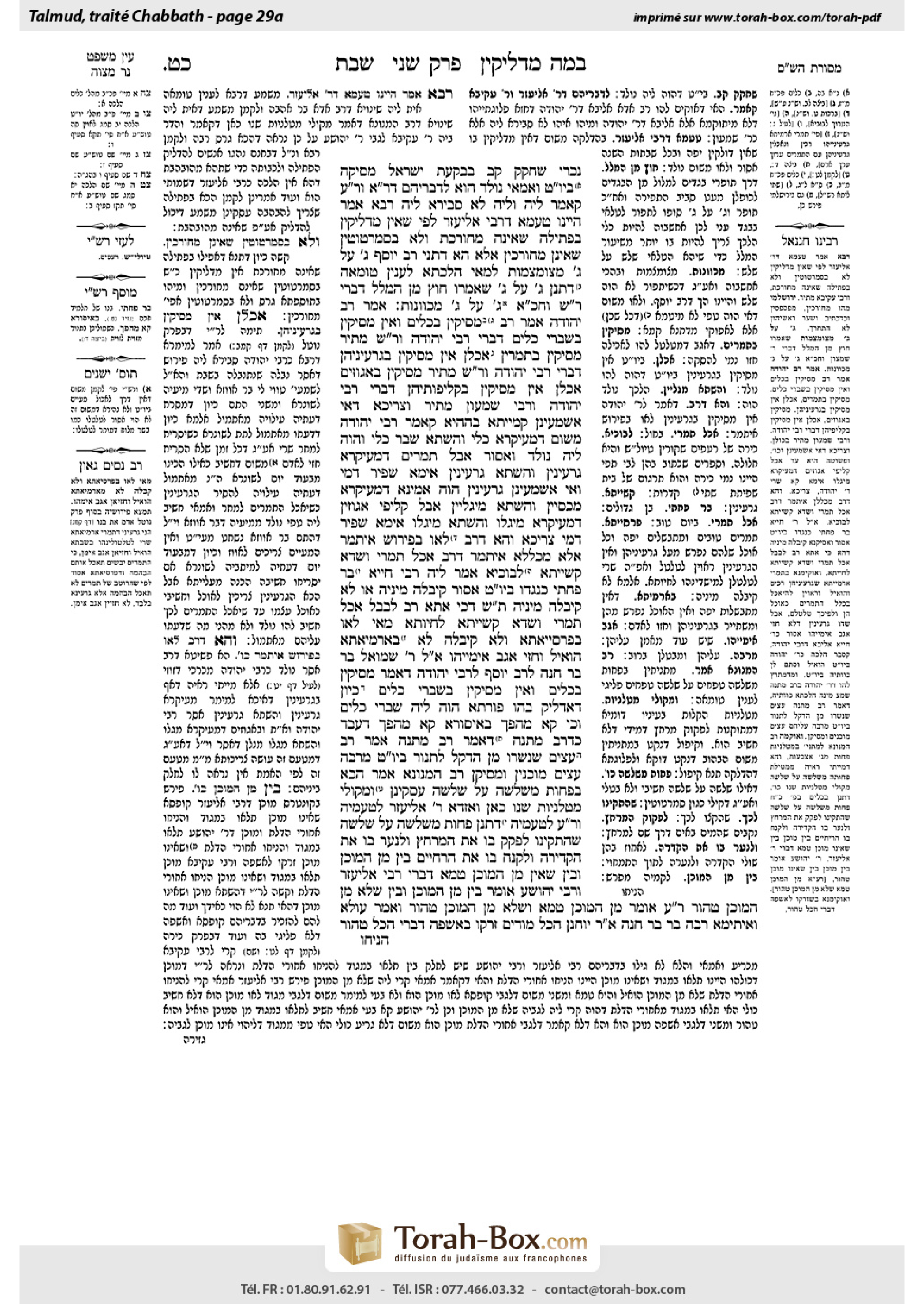
Shabbat 29a: Talmud study for Daf Yomi
Daf Yomi is the daily study of one Talmud folio. Explore 37 tractates with scans, Hebrew text, Sefaria English and AI-generated French translations where annotated.
Passage selection and English or AI-generated French translation are available where the scan has annotations. Daf Study is independent of Torah-Box and Sefaria.
Browse Shabbat · שבת · All tractatesShabbat 29a text and translations
This page of Shabbat includes the Aramaic text, an English translation and an AI-generated French translation, alongside the scan above.
שבת כ״ט א · Aramaic and Hebrew text
גּוֹי שֶׁחָקַק קַב בִּבְקַעַת — יִשְׂרָאֵל מַסִּיקָהּ בְּיוֹם טוֹב. וְאַמַּאי? נוֹלָד הוּא! לְדִבְרֵיהֶם דְּרַבִּי אֱלִיעֶזֶר וְרַבִּי עֲקִיבָא קָאָמַר לֵיהּ, וְלֵיהּ לָא סְבִירָא לֵיהּ.
רָבָא אָמַר, הַיְינוּ טַעְמָא דְּרַבִּי אֱלִיעֶזֶר: לְפִי שֶׁאֵין מַדְלִיקִין בִּפְתִילָה שֶׁאֵינָהּ מְחוֹרֶכֶת וְלֹא בִּסְמַרְטוּטִין שֶׁאֵינָן מְחוֹרָכִין. אֶלָּא הָא דְּתָנֵי רַב יוֹסֵף ״שָׁלֹשׁ עַל שָׁלֹשׁ מְצוּמְצָמוֹת״ לְמַאי הִלְכְתָא? לְעִנְיַן טוּמְאָה. דִּתְנַן: שָׁלֹשׁ עַל שָׁלֹשׁ שֶׁאָמְרוּ — חוּץ מִן הַמְּלָל, דִּבְרֵי רַבִּי שִׁמְעוֹן. וַחֲכָמִים אוֹמְרִים: שָׁלֹשׁ עַל שָׁלֹשׁ מְכֻוּוֹנוֹת.
אָמַר רַב יְהוּדָה אָמַר רַב: מַסִּיקִין בְּכֵלִים וְאֵין מַסִּיקִין בְּשִׁבְרֵי כֵלִים, דִּבְרֵי רַבִּי יְהוּדָה. וְרַבִּי שִׁמְעוֹן מַתִּיר. מַסִּיקִין בִּתְמָרִין, אֲכָלָן אֵין מַסִּיקִין בְּגַרְעִינֵיהֶן, דִּבְרֵי רַבִּי יְהוּדָה. וְרַבִּי שִׁמְעוֹן מַתִּיר. מַסִּיקִין בֶּאֱגוֹזִים, אֲכָלָן אֵין מַסִּיקִין בִּקְלִיפּוֹתֵיהֶן, דִּבְרֵי רַבִּי יְהוּדָה. וְרַבִּי שִׁמְעוֹן מַתִּיר.
וּצְרִיכָא. דְּאִי אַשְׁמְעִינַן קַמַּיְיתָא, בְּהַהִיא קָאָמַר רַבִּי יְהוּדָה, מִשּׁוּם דְּמֵעִיקָּרָא כְּלִי וְהַשְׁתָּא שֶׁבֶר כְּלִי, וְהָוֵה לֵיהּ נוֹלַד, וְאָסוּר. אֲבָל תְּמָרִים, דְּמֵעִיקָּרָא גַּרְעִינִין וְהַשְׁתָּא גַּרְעִינִין — אֵימָא שַׁפִּיר דָּמֵי. וְאִי אַשְׁמְעִינַן גַּרְעִינִין, הֲוָה אָמֵינָא דְּמֵעִיקָּרָא מִכַּסְּיָין וְהַשְׁתָּא מִיגַּלְּיָין. אֲבָל קְלִיפֵּי אֱגוֹזִין, דְּמֵעִיקָּרָא מִיגַּלּוּ וְהַשְׁתָּא מִיגַּלּוּ — אֵימָא שַׁפִּיר דָּמֵי. צְרִיכָא.
וְהָא דְּרַב לָאו בְּפֵירוּשׁ אִיתְּמַר, אֶלָּא מִכְּלָלָא אִיתְּמַר. דְּרַב אֲכַל תַּמְרֵי וּשְׁדָא קַשְׁיָיתָא לְבוּכְיָא. אֲמַר לֵיהּ רַבִּי חִיָּיא: בַּר פַּחֲתֵי, כְּנֶגְדּוֹ בְּיוֹם טוֹב אָסוּר. קַבְּלַהּ מִינֵּיהּ אוֹ לָא קַבְּלַהּ מִינֵּיהּ?
תָּא שְׁמַע: דְּכִי אֲתָא רַב לְבָבֶל, אֲכַל תַּמְרֵי וּשְׁדָא קַשְׁיָיתָא לְחֵיוָתָא. מַאי לָאו בְּפַרְסָיָיאתָא, וְלָא קַבְּלַהּ? — לָא, בַּאֲרַמָּיָאתָא — הוֹאִיל וַחֲזֵי אַגַּב אִימַּיְיהוּ.
אֲמַר לֵיהּ רַב שְׁמוּאֵל בַּר בַּר חָנָה לְרַב יוֹסֵף: לְרַבִּי יְהוּדָה דְּאָמַר מַסִּיקִין בְּכֵלִים וְאֵין מַסִּיקִין בְּשִׁבְרֵי כֵלִים, כֵּיוָן דְּאַדְלֵיק בְּהוּ פּוּרְתָּא הָוֵה לֵיהּ שִׁבְרֵי כֵלִים, וְכִי קָא מְהַפֵּךְ — בְּאִיסּוּרָא קָא מְהַפֵּךְ? — דַּעֲבַד כִּדְרַב מַתְנָה. דְּאָמַר רַב מַתְנָה אָמַר רַב: עֵצִים שֶׁנָּשְׁרוּ מִן הַדֶּקֶל לְתַנּוּר בְּיוֹם טוֹב, מַרְבֶּה עֵצִים מוּכָנִין וּמַסִּיקָן.
רַב הַמְנוּנָא אָמַר: הָכָא בְּפָחוֹת מִשְּׁלֹשָׁה עַל שְׁלֹשָׁה עָסְקִינַן, מִקּוּלֵּי מַטְלָנִיּוֹת שָׁנוּ כָּאן.
וְאָזְדָא רַבִּי אֱלִיעֶזֶר לְטַעְמֵיהּ וְרַבִּי עֲקִיבָא לְטַעְמֵיהּ. דִּתְנַן: פָּחוֹת מִשְּׁלֹשָׁה עַל שְׁלֹשָׁה שֶׁהִתְקִינוֹ לִפְקֹק בּוֹ אֶת הַמֶּרְחָץ וּלְנַעֵר בּוֹ אֶת הַקְּדֵירָה וּלְקַנֵּחַ בּוֹ אֶת הָרֵחַיִים — בֵּין מִן הַמּוּכָן וּבֵין שֶׁאֵין מִן הַמּוּכָן — טָמֵא, דִּבְרֵי רַבִּי אֱלִיעֶזֶר. וְרַבִּי יְהוֹשֻׁעַ אוֹמֵר: בֵּין מִן הַמּוּכָן וּבֵין שֶׁלֹּא מִן הַמּוּכָן — טָהוֹר. רַבִּי עֲקִיבָא אוֹמֵר: מִן הַמּוּכָן — טָמֵא, וְשֶׁלֹּא מִן הַמּוּכָן — טָהוֹר. וְאָמַר עוּלָּא, וְאִיתֵּימָא רַבָּה בַּר בַּר חָנָה אָמַר רַבִּי יוֹחָנָן: הַכֹּל מוֹדִים זְרָקוֹ בָּאַשְׁפָּה — דִּבְרֵי הַכֹּל טָהוֹר.
Shabbat 29a · English translation
When a gentile carved out a vessel the size of a kav from a piece of wood on a Festival and thereby rendered it a new vessel, a Jew may burn the vessel on a Festival ab initio. And why may he do so? This new vessel that was made from the wood is an object that came into being [nolad] on a Festival, and is set-aside [muktze]. Since Rav Adda bar Ahava permitted doing so, apparently he holds that the laws of set-aside do not apply on a Festival, contrary to the opinion of Rabbi Yehuda. The Gemara answers: Rav Adda bar Ahava said this statement in explanation of the statements of Rabbi Eliezer and Rabbi Akiva in the mishna; however, he himself does not hold that way. Although he explained the opinions in the mishna in accordance with the opinion of Rabbi Yehuda, he himself does not hold that that is the halakha.
Rava said, this is the reasoning behind Rabbi Eliezer’s opinion with regard to lighting the wick: Because he holds that one may neither light on Shabbat using a wick that is not slightly singed and prepared for lighting nor light with rags that were not singed before Shabbat. If a person singes the wick slightly before lighting it, it will burn well. A wick that has not been singed does not burn well and will not show the appropriate deference to Shabbat. The Gemara asks: If so, that which Rav Yosef taught: Three by three exactly, to what halakha is it relevant? According to Rava’s explanation, the precise size of the garment used in making the wick is irrelevant. The Gemara responds: Rav Yosef’s statement was with regard to another matter, the halakhot of ritual impurity. As we learned in a mishna in tractate Kelim: Three by three fingerbreadths that they stated as the smallest sized garment that can become ritually impure, excludes the portion used for the hem, i.e., those threads that emerge at the edge of the garment and are sewn into a hem; this is the statement of Rabbi Shimon. And the Rabbis say: Three by three exactly, even including the hem. That is the context of Rav Yosef’s statement: Three by three exactly.
With regard to the statement cited above, Rav Yehuda said that Rav said that there is a dispute between the tanna’im on this issue: One may only kindle a fire with whole vessels and one may not kindle a fire with broken vessels; this is the statement of Rabbi Yehuda. And Rabbi Shimon permits kindling a fire even with broken vessels. An additional halakha: One may kindle a fire with whole dates on a Festival, and if he ate them, he may not kindle a fire with their pits as they are set-aside; this is the statement of Rabbi Yehuda. And Rabbi Shimon permits kindling a fire with the pits. Furthermore, one may kindle a fire with whole nuts on a Festival, and if he ate them, he may not kindle a fire with their shells; this is the statement of Rabbi Yehuda. And Rabbi Shimon permits doing so.
The Gemara comments: And it was necessary to cite all three of these cases because each teaches a novel idea. As, had Rav taught us only the first halakha, we would have thought that it is specifically in that case, with regard to burning broken vessels, that Rabbi Yehuda said that it is prohibited, as initially it was a vessel and now it is a broken vessel, and therefore it is considered an object that came into being [nolad] and prohibited; however, dates, initially there were pits in the dates and now they remain pits, say that one may well do so. And had Rav taught us only with regard to date pits I would have said that they are prohibited because initially they were concealed within the fruit and now they are exposed, it is a case of an object that came into being and prohibited. However, nutshells, which initially were exposed and now are exposed, as they were before, say that one may well do so. Therefore, it was necessary to teach all of these cases.
And the Gemara adds: This halakha of Rav was not stated explicitly; rather, it was stated by inference based on conclusions drawn from Rav’s actions and not from his explicit statements. There was an instance where Rav ate dates on a weekday and threw the pits into the oven. Rabbi Ḥiyya said to him: Son of noblemen, the corresponding action, throwing pits into an oven, is prohibited on a Festival. The Gemara asks: Did Rav accept this halakha from him or did he not accept it from him?
Come and hear: When Rav came from Eretz Yisrael to Babylonia, he ate dates on a Festival and threw their pits to the animals so that they may eat them. Wasn’t it a case involving Persian dates, which are quality dates whose fruit comes completely off the pits, leaving the pits with no trace of fruit? Ostensibly, they are completely set-aside as they are of no use at all to people. And the fact that Rav threw the pits to the animals indicates that he did not accept this halakha from Rabbi Ḥiyya, and he holds that there is no prohibition in that case. The Gemara replies: No, this is a case involving Aramean dates whose fruit does not come off completely, and remnants of the date remain attached to the pit. These pits, since they are still fit for use due to their mother, i.e., the fruit itself, one is permitted to carry them.
Rav Shmuel bar bar Ḥana said to Rav Yosef: According to the opinion of Rabbi Yehuda, who said that one may kindle a fire with whole vessels, and one may not kindle a fire with broken vessels, how it is possible to use whole vessels? Once they are ignited a bit, they become broken vessels, and when one turns the wood over to accelerate their ignition, he turns them over in a prohibited manner, as it is prohibited to light with broken vessels. The Gemara answers: This is a case where he acted in accordance with the statement of Rav Mattana. As Rav Mattana said that Rav said: Branches that fell from a palm tree into an oven on a Festival, since these branches were attached to the tree at the onset of the Festival, they are set-aside and it is prohibited to move them. Nevertheless, he can remedy the situation if he adds wood that was prepared for burning prior to the Festival, until the majority of the wood in the oven is not set-aside, and then kindles them. Since the majority of the wood is permitted, he need not concern himself with the minority. One may do the same when burning vessels by adding wood that is not set-aside.
Rav Hamnuna said a different explanation of the dispute in the mishna. In his opinion, here we are dealing with a garment that is smaller than three by three handbreadths, and they taught here halakhot established by the Sages with regard to insignificant small cloths.
And Rabbi Eliezer followed his line of reasoning expressed elsewhere, and Rabbi Akiva followed his line of reasoning expressed elsewhere. As we learned in a mishna in tractate Kelim: A cloth smaller than three by three handbreadths that was utilized to plug the bath, and to pour from a boiling pot, and to wipe the millstone, whether this cloth was expressly prepared for that purpose or whether it was not prepared, it can become ritually impure; this is the statement of Rabbi Eliezer. And Rabbi Yehoshua says: Whether it was prepared or whether it was not prepared, it is ritually pure, i.e., it cannot become ritually impure. Rabbi Akiva distinguishes between the cases and says: If it was prepared it is ritually impure, and if it was not prepared it is ritually pure. And Ulla said, and some say that Rabba bar bar Ḥana said that Rabbi Yoḥanan said: Everyone agrees that a cloth this size, if one threw it into the garbage dump, it is ritually pure. His discarding of the cloth indicates that he no longer considers this cloth a garment and no longer considers it significant.
Shabbat 29a · Traduction française (IA)
Lorsqu’un non-Juif creusa, pendant un jour de fête, un récipient d’une capacité d’un kav dans un morceau de bois, créant ainsi un récipient neuf, un Juif peut brûler ce récipient pendant le jour de fête a priori. Pourquoi le peut-il ? Ce récipient neuf, fabriqué à partir du bois, est un objet apparu [nolad] pendant un jour de fête et est mouktsé [muktze]. Puisque Rav Adda bar Ahava a permis de le faire, il semble donc qu’il soutienne que les lois du mouktsé ne s’appliquent pas pendant un jour de fête, contrairement à l’opinion de Rabbi Yehuda. La Guemara répond : Rav Adda bar Ahava a formulé cette déclaration pour expliquer les propos de Rabbi Eliezer et de Rabbi Akiva dans la Michna ; toutefois, lui-même ne soutient pas cette opinion. Bien qu’il ait expliqué les opinions de la Michna conformément à celle de Rabbi Yehuda, il ne soutient pas lui-même que telle soit la halakha.
Rava dit : telle est la raison de l’avis de Rabbi Eliezer concernant l’allumage de la mèche : il considère que l’on ne peut, le Chabbat, allumer ni une mèche qui n’a pas été légèrement brûlée au préalable et préparée à l’allumage, ni des chiffons qui n’ont pas été brûlés avant le Chabbat. Si l’on brûle légèrement la mèche avant de l’allumer, elle brûlera bien. Une mèche qui n’a pas été brûlée ne brûle pas bien et ne témoignera pas de l’égard qui convient au Chabbat. La Guemara demande : Si tel est le cas, à quelle halakha s’applique l’enseignement de Rav Yossef : « Exactement trois sur trois » ? Selon l’explication de Rava, la taille précise du tissu utilisé pour confectionner la mèche n’a aucune importance. La Guemara répond : l’enseignement de Rav Yossef portait sur une autre question, les lois de l’impureté rituelle. En effet, nous avons appris dans une Michna du traité Kelim : « Trois sur trois doigts », la taille minimale indiquée pour un vêtement susceptible de contracter l’impureté rituelle, exclut la partie utilisée pour l’ourlet, c’est-à-dire les fils qui dépassent du bord du vêtement et sont cousus dans l’ourlet ; telle est la déclaration de Rabbi Shimon. Et les Sages disent : « Exactement trois sur trois », ourlet compris. Tel est le contexte de l’enseignement de Rav Yossef : « Exactement trois sur trois ».
À propos de la déclaration citée plus haut, Rav Yehuda a dit au nom de Rav qu’il existe une controverse entre les tannaïm sur cette question : on ne peut allumer un feu qu’avec des ustensiles entiers, et l’on ne peut pas allumer un feu avec des ustensiles brisés ; telle est la déclaration de Rabbi Yehuda. Rabbi Shimon, lui, permet d’allumer un feu même avec des ustensiles brisés. Autre halakha : on peut allumer un feu avec des dattes entières pendant un jour de fête ; mais si on les a mangées, on ne peut pas allumer un feu avec leurs noyaux, car ils sont mouktsé. Telle est la déclaration de Rabbi Yehuda. Rabbi Shimon permet, lui, d’allumer un feu avec les noyaux. De plus, on peut allumer un feu avec des noix entières pendant un jour de fête ; mais si on les a mangées, on ne peut pas allumer un feu avec leurs coquilles. Telle est la déclaration de Rabbi Yehuda. Rabbi Shimon le permet.
La Guemara fait remarquer : il était nécessaire de citer ces trois cas, car chacun apporte un enseignement nouveau. En effet, si Rav nous avait enseigné uniquement la première halakha, nous aurions pensé que Rabbi Yehuda n’interdit de brûler que des ustensiles brisés, car il s’agissait auparavant d’un ustensile et qu’il s’agit maintenant d’un ustensile brisé ; il est donc considéré comme un objet apparu [nolad] et interdit. Mais pour les dattes, les noyaux étaient déjà dans les dattes et restent maintenant des noyaux ; on aurait pu dire qu’on peut tout à fait le faire. Et si Rav nous avait enseigné uniquement le cas des noyaux de dattes, j’aurais dit qu’ils sont interdits parce qu’ils étaient auparavant cachés dans le fruit et qu’ils sont maintenant exposés : c’est un cas d’objet apparu [nolad], donc interdit. Mais pour les coquilles de noix, qui étaient exposées auparavant et le sont encore, comme avant, on aurait pu dire qu’on peut tout à fait le faire. Il était donc nécessaire d’enseigner tous ces cas.
Et la Guemara ajoute : cette halakha de Rav ne fut pas énoncée explicitement ; elle fut déduite des conclusions tirées de ses actes, et non de ses déclarations explicites. Un jour de semaine, Rav mangea des dattes et jeta les noyaux dans le four. Rabbi Ḥiyya lui dit : « Fils de nobles, un geste analogue, jeter des noyaux dans un four, est interdit un jour de fête. » La Guemara demande : Rav accepta-t-il cette halakha de lui, ou ne l’accepta-t-il pas ?
Viens et entends : lorsque Rav revint d’Eretz Israël en Babylonie, il mangea des dattes un jour de fête et jeta leurs noyaux aux animaux pour qu’ils les mangent. Ne s’agissait-il pas de dattes perses, des dattes de qualité dont la chair se détache entièrement des noyaux, sans y laisser la moindre trace ? Ces noyaux sont donc apparemment entièrement mouktsé, puisqu’ils ne sont d’aucune utilité pour les humains. Le fait que Rav ait jeté les noyaux aux animaux indique qu’il n’a pas accepté cette halakha de Rabbi Ḥiyya et qu’il estime qu’il n’y a pas d’interdiction dans ce cas. La Guemara répond : Non, il s’agissait de dattes araméennes, dont la chair ne se détache pas entièrement et dont des restes demeurent attachés au noyau. Ces noyaux étant encore utilisables grâce à leur « mère », c’est-à-dire le fruit lui-même, il est permis de les déplacer.
Rav Shmuel bar bar Ḥana dit à Rav Yossef : selon l’opinion de Rabbi Yehuda, qui dit que l’on peut allumer un feu avec des ustensiles entiers, mais pas avec des ustensiles brisés, comment peut-on se servir d’ustensiles entiers ? Dès qu’ils commencent à brûler, ils deviennent des ustensiles brisés ; et lorsqu’on retourne le bois pour accélérer leur combustion, on le fait d’une manière interdite, puisqu’il est interdit d’allumer un feu avec des ustensiles brisés. La Guemara répond : il s’agit d’un cas où l’on a procédé conformément à l’enseignement de Rav Mattana. En effet, Rav Mattana a dit au nom de Rav : des branches tombées d’un palmier dans un four un jour de fête, puisqu’elles étaient attachées à l’arbre au début de la fête, sont mouktsé et il est interdit de les déplacer. Néanmoins, on peut remédier à la situation en ajoutant du bois qui avait été préparé pour être brûlé avant la fête, jusqu’à ce que la majeure partie du bois dans le four ne soit pas mouktsé, puis en y mettant le feu. Puisque la majeure partie du bois est autorisée, il n’est pas nécessaire de tenir compte de la minorité. On peut agir de même en brûlant des ustensiles, en ajoutant du bois qui n’est pas mouktsé.
Rav Hamnouna donne une autre explication du désaccord dans la Michna. Selon lui, il s’agit ici d’un vêtement de moins de trois sur trois palmes, et les halakhot enseignées ici sont celles que les Sages ont établies concernant les petits morceaux de tissu insignifiants.
Rabbi Eliezer suit le raisonnement qu’il a exprimé ailleurs, et Rabbi Akiva suit le raisonnement qu’il a exprimé ailleurs. En effet, nous avons appris dans une Michna du traité Kelim : un morceau de tissu de moins de trois sur trois palmes, utilisé pour boucher la baignoire, pour verser le contenu d’une marmite bouillante ou pour essuyer la meule, qu’il ait été préparé expressément à cet effet ou non, peut devenir impur rituellement ; telle est la déclaration de Rabbi Eliezer. Rabbi Yehoshua dit : qu’il ait été préparé ou non, il est rituellement pur, c’est-à-dire qu’il ne peut pas devenir impur rituellement. Rabbi Akiva distingue les cas et dit : s’il a été préparé, il est impur rituellement ; s’il n’a pas été préparé, il est rituellement pur. Et Oula a dit — certains disent que c’est Rabba bar bar Ḥana qui a dit au nom de Rabbi Yoḥanan — : tous conviennent que, pour un morceau de tissu de cette taille, s’il a été jeté dans le dépotoir, il est rituellement pur. Le fait de s’en être débarrassé indique que l’on ne considère plus ce morceau comme un vêtement ni comme un objet important.
Traduction française générée par IA à partir de l’édition anglaise de Sefaria. Vérifie toujours un passage avec le texte source.
Text from Sefaria: William Davidson Edition - Vocalized Aramaic (CC BY NC); William Davidson Edition - English (CC BY NC).