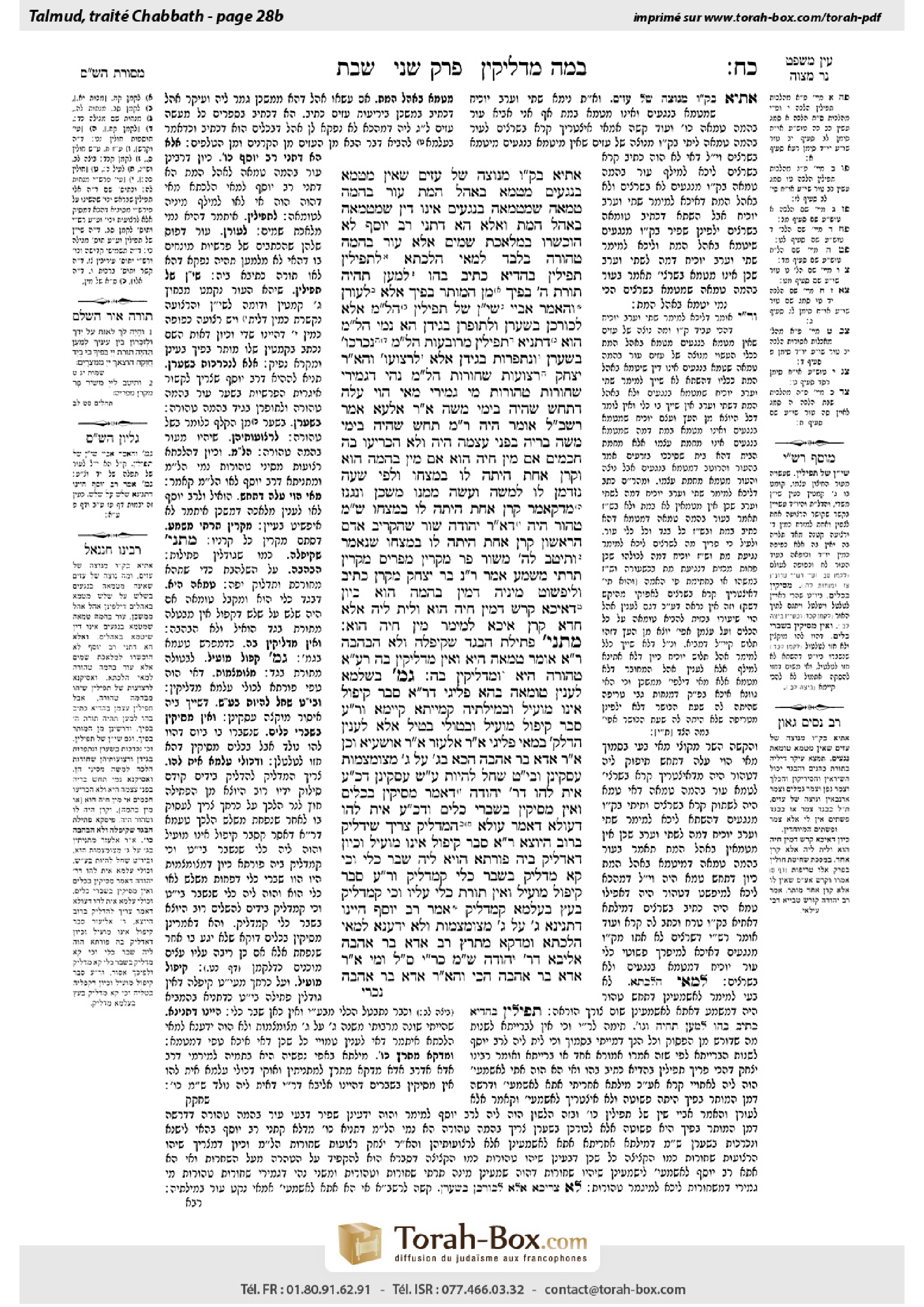
Shabbat 28b: Talmud study for Daf Yomi
Daf Yomi is the daily study of one Talmud folio. Explore 37 tractates with scans, Hebrew text, Sefaria English and AI-generated French translations where annotated.
Passage selection and English or AI-generated French translation are available where the scan has annotations. Daf Study is independent of Torah-Box and Sefaria.
Browse Shabbat · שבת · All tractatesShabbat 28b text and translations
This page of Shabbat includes the Aramaic text, an English translation and an AI-generated French translation, alongside the scan above.
שבת כ״ח ב · Aramaic and Hebrew text
אָתְיָא בְּקַל וָחוֹמֶר מִנּוֹצָה שֶׁל עִזִּים, שֶׁאֵין מִטַּמֵּא בִּנְגָעִים — מִטַּמֵּא בְּאֹהֶל הַמֵּת, עוֹר בְּהֵמָה טְמֵאָה שֶׁמִּטַּמְּאָה בִּנְגָעִים — אֵינוֹ דִּין שֶׁמִּטַּמְּאָה בְּאֹהֶל הַמֵּת.
וְאֶלָּא הָא דְּתָנֵי רַב יוֹסֵף לֹא הוּכְשְׁרוּ בִּמְלֶאכֶת שָׁמַיִם אֶלָּא עוֹר בְּהֵמָה טְהוֹרָה בִּלְבַד — לְמַאי הִלְכְתָא? לִתְפִילִּין. תְּפִילִּין בְּהֶדְיָא כְּתִיב בְּהוּ ״לְמַעַן תִּהְיֶה תּוֹרַת ה׳ בְּפִיךָ״, מִן הַמּוּתָּר בְּפִיךְ!
אֶלָּא לְעוֹרָן. וְהָאָמַר אַבָּיֵי: שִׁין שֶׁל תְּפִילִּין הֲלָכָה לְמֹשֶׁה מִסִּינַי!
אֶלָּא לְכוֹרְכָן בְּשַׂעֲרָן וּלְתוֹפְרָן בְּגִידָן. הָא נָמֵי הֲלָכָה לְמֹשֶׁה מִסִּינַי הוּא, דְּתַנְיָא: תְּפִילִּין מְרוּבָּעוֹת — הֲלָכָה לְמֹשֶׁה מִסִּינַי, נִכְרָכוֹת בְּשַׂעֲרָן וְנִתְפָּרוֹת בְּגִידָן!
אֶלָּא לִרְצוּעוֹת. וְהָאָמַר רַבִּי יִצְחָק רְצוּעוֹת שְׁחוֹרוֹת הֲלָכָה לְמֹשֶׁה מִסִּינַי? נְהִי דִּגְמִירִי שְׁחוֹרוֹת, טְהוֹרוֹת מִי גְּמִירִי?
מַאי הָוֵי עֲלֵהּ דְּתַחַשׁ שֶׁהָיָה בִּימֵי מֹשֶׁה? אָמַר רַבִּי אִלָּעָא אָמַר רַבִּי שִׁמְעוֹן בֶּן לָקִישׁ, אוֹמֵר הָיָה רַבִּי מֵאִיר: תַּחַשׁ שֶׁהָיָה בִּימֵי מֹשֶׁה בְּרִיָּה בִּפְנֵי עַצְמָהּ הָיָה, וְלֹא הִכְרִיעוּ בּוֹ חֲכָמִים אִם מִין חַיָּה הוּא, אִם מִין בְּהֵמָה הוּא. וְקֶרֶן אַחַת הָיְתָה לוֹ בְּמִצְחוֹ, וּלְפִי שָׁעָה נִזְדַּמֵּן לוֹ לְמֹשֶׁה וְעָשָׂה מִמֶּנּוּ מִשְׁכָּן וְנִגְנַז.
מִדְּקָאָמַר קֶרֶן אַחַת הָיְתָה לוֹ בְּמִצְחוֹ, שְׁמַע מִינַּהּ טָהוֹר הָיָה, דְּאָמַר רַב יְהוּדָה: שׁוֹר שֶׁהִקְרִיב אָדָם הָרִאשׁוֹן קֶרֶן אַחַת הָיְתָה לוֹ בְּמִצְחוֹ, שֶׁנֶּאֱמַר: ״וְתִיטַב לַה׳ מִשּׁוֹר פָּר מַקְרִין מַפְרִיס״. ״מַקְרִין״ תַּרְתֵּי מַשְׁמַע! אָמַר רַב נַחְמָן בַּר יִצְחָק — ״מַקְרָן״ כְּתִיב. וְלִיפְשׁוֹט מִינֵּיהּ דְּמִין בְּהֵמָה הוּא? כֵּיוָן דְּאִיכָּא ״קֶרֶשׁ״ דְּמִין חַיָּה הוּא וְלֵית לֵיהּ אֶלָּא חֲדָא קֶרֶן — אִיכָּא לְמֵימַר מִין חַיָּה הוּא.
מַתְנִי׳ פְּתִילַת הַבֶּגֶד שֶׁקִּיפְּלָהּ וְלֹא הִבְהֲבָהּ, רַבִּי אֱלִיעֶזֶר אוֹמֵר: טְמֵאָה הִיא, וְאֵין מַדְלִיקִין בָּהּ. רַבִּי עֲקִיבָא אוֹמֵר טְהוֹרָה הִיא, וּמַדְלִיקִין בָּהּ.
גְּמָ׳ בִּשְׁלָמָא לְעִנְיַן טוּמְאָה, בְּהָא פְּלִיגִי: דְּרַבִּי אֱלִיעֶזֶר סָבַר קִיפּוּל אֵינוֹ מוֹעִיל, וּבְמִילְּתַיהּ קַמָּיְיתָא קָיְימָא. וְרַבִּי עֲקִיבָא סָבַר קִיפּוּל מוֹעִיל, וּבַטּוֹלֵי בַּטְּלַהּ.
אֶלָּא לְעִנְיַן הַדְלָקָה בְּמַאי פְּלִיגִי? אָמַר רַבִּי אֶלְעָזָר אָמַר רַב אוֹשַׁעְיָא, וְכֵן אָמַר רַב אַדָּא בַּר אַהֲבָה: הָכָא בְּשָׁלֹשׁ עַל שָׁלֹשׁ מְצוּמְצָמוֹת עָסְקִינַן, וּבְיוֹם טוֹב שֶׁחָל לִהְיוֹת עֶרֶב שַׁבָּת עָסְקִינַן. דְּכוּלֵּי עָלְמָא אִית לְהוּ דְּרַבִּי יְהוּדָה דְּאָמַר: מַסִּיקִין בְּכֵלִים וְאֵין מַסִּיקִין בְּשִׁבְרֵי כֵלִים. וּדְכוּלֵּי עָלְמָא אִית לְהוּ דְּעוּלָּא, דְּאָמַר עוּלָּא: הַמַּדְלִיק צָרִיךְ שֶׁיַּדְלִיק בָּרוֹב הַיּוֹצֵא. רַבִּי אֱלִיעֶזֶר סָבַר קִיפּוּל אֵינוֹ מוֹעִיל, וְכֵיוָן דְּאַדְלֵיק בֵּיהּ פּוּרְתָּא הָוְיָא לֵיהּ שֶׁבֶר כְּלִי, וְכִי קָא מַדְלֵיק — בְּשֶׁבֶר כְּלִי קָמַדְלֵיק. וְרַבִּי עֲקִיבָא סָבַר קִיפּוּל מוֹעִיל, וְאֵין תּוֹרַת כְּלִי עָלָיו, וְכִי קָמַדְלֵיק — בְּעֵץ בְּעָלְמָא קָמַדְלֵיק.
אָמַר רַב יוֹסֵף, הַיְינוּ דְּתָנֵינָא: ״שָׁלֹשׁ עַל שָׁלֹשׁ מְצוּמְצָמוֹת״ וְלָא יָדַעְנָא לְמַאי הִלְכְתָא.
וּמִדְּקָא מְתָרֵץ רַב אַדָּא בַּר אַהֲבָה אַלִּיבָּא דְּרַבִּי יְהוּדָה, שְׁמַע מִינַּהּ כְּרַבִּי יְהוּדָה סְבִירָא לֵיהּ. וּמִי אָמַר רַב אַדָּא בַּר אַהֲבָה הָכִי? וְהָאָמַר רַב אַדָּא בַּר אַהֲבָה:
Shabbat 28b · English translation
It is derived through an a fortiori inference from goats’ hair. Although goats’ hair does not become ritually impure from leprosy, it does become ritually impure as a tent over a corpse; with regard to the hide of a non-kosher animal that becomes ritually impure from leprosy, is it not the case that it becomes ritually impure as a tent over a corpse?
Since the conclusion was that the hide of even a non-kosher animal can become ritually impure as a tent over a corpse, it is not necessary to assume that the covering of the Tabernacle was made specifically from the hide of a kosher animal. And, if so, that which Rav Yosef taught: Only the hide of a kosher animal was suitable for heavenly service, for what halakha is that relevant, as it is clearly not relevant to the Tabernacle? The Gemara replies: This halakha was stated with regard to phylacteries, which may be prepared only from the hide of a kosher animal. The Gemara asks: Phylacteries? Why did Rav Yosef need to state that halakha? It is written explicitly with regard to them: “And it shall be for a sign unto you upon your hand, and for a memorial between your eyes, that the law of the Lord may be in your mouth” (Exodus 13:9). The Sages derived from there that the phylacteries must be prepared from that which is permitted to be eaten in your mouth.
Rather, the Gemara explains that this halakha of Rav Yosef was said only with regard to the leather of the boxes that house the phylacteries, which must be crafted from the hide of a kosher animal. It was not referring to the parchment on which the portions of the Torah inserted into the phylacteries are written. The Gemara asks: Didn’t Abaye say: The obligation to make a letter shin protruding on the phylacteries of one’s head is a halakha transmitted to Moses from Sinai? Since Torah law addresses the boxes of the phylacteries, presumably their legal status is parallel to that of the parchment and the prohibition against preparing them from the hide of a non-kosher animal is by Torah law as well.
Rather, the Gemara explains that Rav Yosef’s halakha comes to teach that one must tie the parchments upon which the portions of the Torah are written in the phylacteries with a kosher animal’s hair, as well as sew the phylacteries with a kosher animal’s sinews. The Gemara asks: The source of these halakhot is also a halakha transmitted to Moses from Sinai, as it was taught in a baraita: The requirement that phylacteries must be square is a halakha transmitted to Moses from Sinai, as is the requirement that they must be tied with their hair and sewn with their sinews.
Rather, the Gemara says that Rav Yosef came to teach with regard to the halakha of the straps of the phylacteries. The Gemara asks: Didn’t Rabbi Yitzḥak say: The straps of the phylacteries must be black is a halakha transmitted to Moses from Sinai? The Gemara responds: Although we learned this halakha, which states that the straps must be black, did we also learn that they must be from kosher animals? Rav Yosef was certainly referring to straps when he said that all heavenly service must be performed with the hides of kosher animals.
The Gemara asks: What is the halakhic conclusion reached about this matter of the taḥash that existed in the days of Moses? Rabbi Ela said that Rabbi Shimon ben Lakish said that Rabbi Meir used to say: The taḥash that existed in the days of Moses was a creature unto itself, and the Sages did not determine whether it was a type of undomesticated animal or a type of domesticated animal. And it had a single horn on its forehead, and this taḥash happened to come to Moses for the moment while the Tabernacle was being built, and he made the covering for the Tabernacle from it. And from then on, the taḥash was suppressed and is no longer found.
The Gemara comments: From the fact that it is said that the taḥash had a single horn on its forehead, conclude from this that it was kosher, as Rav Yehuda said in a similar vein: The ox that Adam, the first man, sacrificed as a thanks-offering for his life being spared, had a single horn on its forehead, as it is stated: “And it shall please the Lord better than a horned [makrin] and hooved ox” (Psalms 69:32). The word makrin means one with a horn. The Gemara asks: On the contrary, makrin indicates that it has two horns. Rav Naḥman bar Yitzḥak said: Despite the fact that it is vocalized in the plural, it is written mikeren without the letter yod to indicate that it had only a single horn. The Gemara asks: If so, let us resolve from the same baraita that just as it was derived from the ox of Adam, the first man, that an animal with one horn is kosher, derive that an animal with one horn is a type of domesticated animal. The Gemara answers: Since there is the keresh which is a type of undomesticated animal, and it has only a single horn, it is also possible to say that the taḥash is a type of undomesticated animal. This dilemma was not resolved.
MISHNA: The wick of a garment, i.e., cloth made into a wick for a lamp, that one folded it into a size and shape suitable for a wick, but did not yet singe it slightly in order to facilitate its lighting, Rabbi Eliezer says: This wick is ritually impure. With regard to the laws of ritual impurity, it can, like other garments, still become ritually impure and one may not light with it on Shabbat. Rabbi Akiva says: It is ritually pure and one may even light with it on Shabbat.
GEMARA: The Gemara asks: Granted, with regard to ritual impurity, the reasons for their disagreement are clear and this is their dispute: Rabbi Eliezer holds that folding alone is ineffective in altering the identity of the garment and it retains its original status. It can become ritually impure like any other garment. Rabbi Akiva holds that folding is effective, and it negates its garment status, and therefore, it can no longer become ritually impure.
However, with regard to lighting on Shabbat what is at the crux of their dispute? Rabbi Elazar said that Rav Oshaya said, and Rav Adda bar Ahava said likewise: Here we are dealing with a cloth that is precisely three by three fingerbreadths and we are dealing with a Festival that occurred on Shabbat eve. And everyone is of the opinion that the halakha is in accordance with the opinion of Rabbi Yehuda, who said that on a Festival one may only kindle a fire with whole vessels, as it is permitted to carry them and they do not have set-aside [muktze] status; however, one may not kindle a fire using broken vessels, i.e., vessels that broke on the Festival. Since they broke on the Festival itself, they are classified as an entity that came into being [nolad] on the Festival, and the halakha prohibits moving them. And, similarly, everyone is of the opinion that the halakha is in accordance with the opinion of Ulla, as Ulla said: One who lights a lamp must light most of the wick that protrudes from the lamp. Based on these assumptions, the dispute in the mishna can be understood as follows: Rabbi Eliezer holds that folding alone is ineffective in negating the wick’s vessel status, and once one lights only a small part of it, it thereby becomes a broken vessel, as part of it burns and the remainder is less than three by three fingerbreadths. A smaller cloth is no longer considered significant. Since he is required to light most of the protruding wick and, as mentioned above, it is prohibited to light broken vessels, he may not light the folded garment. And Rabbi Akiva held that folding is effective and, immediately when he folded it, the garment no longer has the status of a vessel. It was not considered a vessel even before he lit it, and when he lights it, it is as if he were lighting plain wood, not a vessel that broke on the Festival.
Rav Yosef said, that is what I learned: Three by three exactly. And I did not know to what halakha this was relevant. Rav Yosef received from his teachers that the baraita is referring to a case of three by three exactly, and he did not know why it was significant to establish the baraita in a case of exactly three by three and no more.
The Gemara adds incidentally: And from the fact that Rav Adda bar Ahava interpreted this mishna in accordance with the opinion of Rabbi Yehuda, conclude from this that he holds in accordance with the opinion of Rabbi Yehuda. Did Rav Adda bar Ahava actually say this? Didn’t Rav Adda bar Ahava himself say:
Shabbat 28b · Traduction française (IA)
On le déduit par un raisonnement a fortiori à partir des poils de chèvre. Bien que les poils de chèvre ne deviennent pas rituellement impurs à cause de la lèpre, ils deviennent rituellement impurs lorsqu’ils servent de tente au-dessus d’un cadavre. À plus forte raison, la peau d’un animal non cachère, qui devient rituellement impure à cause de la lèpre, ne devient-elle pas rituellement impure lorsqu’elle sert de tente au-dessus d’un cadavre ?
Puisqu’on a conclu que même la peau d’un animal non cachère peut devenir rituellement impure lorsqu’elle sert de tente au-dessus d’un cadavre, il n’est pas nécessaire de supposer que la couverture du Tabernacle était faite exclusivement de la peau d’un animal cachère. Si tel est le cas, à quelle halakha s’applique l’enseignement de Rav Yossef selon lequel seule la peau d’un animal cachère convenait au service céleste, puisqu’il ne s’applique manifestement pas au Tabernacle ? La Guemara répond : Cette halakha a été énoncée à propos des téfilines, qui ne peuvent être fabriquées qu’à partir de la peau d’un animal cachère. La Guemara demande : Des téfilines ? Pourquoi Rav Yossef avait-il besoin d’énoncer cette halakha ? À leur sujet, il est pourtant écrit explicitement : « Ce sera pour toi un signe sur ta main et un souvenir entre tes yeux, afin que la Torah de l’Éternel soit dans ta bouche » (Exode 13, 9). Les Sages en ont déduit que les téfilines doivent être fabriquées à partir de ce qu’il est permis de manger, c’est-à-dire de ce qui peut entrer dans ta bouche.
La Guemara explique plutôt que cette halakha de Rav Yossef ne concernait que le cuir des boîtiers qui contiennent les téfilines, lesquels doivent être confectionnés à partir de la peau d’un animal cachère. Elle ne concernait pas le parchemin sur lequel sont écrits les passages de la Torah insérés dans les téfilines. La Guemara demande : Abayé n’a-t-il pas dit que l’obligation de faire apparaître une lettre shin en relief sur les téfilines de la tête est une halakha transmise à Moïse au Sinaï ? Puisque la Torah écrite traite des boîtiers des téfilines, leur statut juridique est vraisemblablement parallèle à celui du parchemin ; l’interdiction de les fabriquer à partir de la peau d’un animal non cachère relève donc, elle aussi, de la Torah.
La Guemara explique plutôt que la halakha de Rav Yossef enseigne qu’il faut attacher, avec des poils d’un animal cachère, les parchemins sur lesquels sont écrits les passages de la Torah contenus dans les téfilines, et qu’il faut également coudre les téfilines avec des tendons d’un animal cachère. La Guemara demande : Ces halakhot ne sont-elles pas elles aussi des halakhot transmises à Moïse au Sinaï ? En effet, il a été enseigné dans une baraïta : l’obligation que les téfilines soient carrées est une halakha transmise à Moïse au Sinaï, tout comme l’obligation de les attacher avec leurs poils et de les coudre avec leurs tendons.
La Guemara dit plutôt que Rav Yossef venait enseigner la halakha concernant les lanières des téfilines. La Guemara demande : Rabbi Yitsḥak n’a-t-il pas dit que l’obligation de faire les lanières des téfilines noires est une halakha transmise à Moïse au Sinaï ? La Guemara répond : Nous avons certes appris cette halakha, selon laquelle les lanières doivent être noires, mais avons-nous aussi appris qu’elles doivent provenir d’animaux cachères ? Lorsque Rav Yossef a dit que tout service céleste doit être accompli avec des peaux d’animaux cachères, il faisait certainement référence aux lanières.
La Guemara demande : Quelle conclusion halakhique a-t-on tirée à propos du taḥash qui existait à l’époque de Moïse ? Rabbi Ela a dit que Rabbi Shimon ben Lakish a dit que Rabbi Meïr avait coutume d’enseigner : Le taḥash qui existait à l’époque de Moïse était une créature à part, et les Sages n’ont pas déterminé s’il s’agissait d’une espèce d’animal sauvage ou d’une espèce d’animal domestique. Il avait une seule corne sur le front. Ce taḥash se trouva venir auprès de Moïse à ce moment-là, pendant la construction du Tabernacle, et celui-ci en fit la couverture du Tabernacle. À partir de ce moment, le taḥash fut caché et on ne le trouve plus.
La Guemara fait remarquer : Du fait qu’il est dit que le taḥash avait une seule corne au front, on peut conclure qu’il était cachère. En effet, Rav Yehouda a dit dans le même sens : Le taureau qu’Adam, le premier homme, offrit en sacrifice d’action de grâce pour avoir eu la vie sauve avait une seule corne au front, comme il est dit : « Il plaira davantage à l’Éternel qu’un taureau cornu [makrin] et pourvu de sabots » (Psaumes 69, 32). Le mot makrin signifie « pourvu d’une corne ». La Guemara demande : Au contraire, makrin indique qu’il avait deux cornes. Rav Naḥman bar Yitsḥak dit : Bien que le mot soit vocalisé au pluriel, il s’écrit mikeren, sans la lettre yod, pour indiquer qu’il n’avait qu’une seule corne. La Guemara demande : Dans ce cas, déduisons de cette même baraïta que, de même qu’on a établi à partir du taureau d’Adam, le premier homme, qu’un animal doté d’une seule corne est cachère, on peut aussi déduire qu’un animal doté d’une seule corne est une espèce d’animal domestique. La Guemara répond : Puisqu’il existe le keresh, qui est une espèce d’animal sauvage et ne possède qu’une seule corne, il est également possible de dire que le taḥash est une espèce d’animal sauvage. Ce dilemme n’a pas été résolu.
Michna : La mèche d’un vêtement, c’est-à-dire un morceau de tissu transformé en mèche pour une lampe, qu’on a plié pour lui donner la taille et la forme adaptées à une mèche, mais qu’on n’a pas encore légèrement roussi afin de faciliter son allumage : Rabbi Eliezer dit que cette mèche est rituellement impure. Au regard des lois de l’impureté rituelle, elle peut encore devenir impure comme les autres vêtements, et il est interdit de s’en servir pour allumer une lampe le Chabbat. Rabbi Akiva dit qu’elle est rituellement pure et que l’on peut même s’en servir pour allumer une lampe le Chabbat.
Guemara : La Guemara demande : S’agissant de l’impureté rituelle, les raisons de leur désaccord sont certes claires ; voici leur différend : Rabbi Eliezer considère que le simple fait de plier le tissu ne suffit pas à modifier son statut de vêtement, et qu’il conserve donc son statut initial. Il peut devenir rituellement impur comme n’importe quel autre vêtement. Rabbi Akiva considère que le pliage est efficace et lui fait perdre son statut de vêtement ; il ne peut donc plus devenir rituellement impur.
Cependant, en ce qui concerne l’allumage pendant Chabbat, quel est le fond du désaccord entre eux ? Rabbi Elazar a dit que Rav Oshaya a dit, et Rav Adda bar Ahava a dit de même : nous parlons ici d’un morceau de tissu mesurant exactement trois sur trois largeurs de doigt, et d’un jour de fête qui tombe la veille de Chabbat. Tout le monde est d’avis que la halakha suit l’opinion de Rabbi Yehouda, qui a dit que, pendant un jour de fête, on ne peut allumer un feu qu’avec des ustensiles entiers, car il est permis de les transporter et ils n’ont pas le statut d’objets mis à l’écart [mouktsé] ; en revanche, on ne peut pas allumer un feu avec des ustensiles brisés, c’est-à-dire des ustensiles qui se sont brisés pendant le jour de fête. Puisqu’ils se sont brisés pendant le jour de fête lui-même, ils sont considérés comme des objets nouvellement apparus [nolad], et la halakha interdit de les déplacer. De même, tout le monde est d’avis que la halakha suit l’opinion d’Oulla, car Oulla a dit : celui qui allume une lampe doit en allumer la majeure partie de la mèche qui dépasse de la lampe. Sur la base de ces présupposés, le désaccord de la Michna se comprend ainsi : Rabbi Eliezer estime que le simple fait de plier le tissu ne suffit pas à lui faire perdre son statut d’ustensile ; dès qu’on n’en allume qu’une petite partie, il devient donc un ustensile brisé, car une partie a brûlé et le reste mesure moins de trois sur trois largeurs de doigt. Un morceau de tissu plus petit n’est plus considéré comme ayant de l’importance. Puisqu’il faut allumer la majeure partie de la mèche qui dépasse et que, comme mentionné plus haut, il est interdit d’allumer des ustensiles brisés, il ne peut pas allumer le vêtement plié. Rabbi Akiva, lui, estime que le pliage est efficace et que, dès qu’il l’a plié, le vêtement n’a plus le statut d’ustensile. Il n’était déjà plus considéré comme un ustensile avant même qu’il ne l’allume ; lorsqu’il l’allume, c’est comme s’il allumait du simple bois, et non un ustensile brisé pendant le jour de fête.
Rav Yossef a dit : voilà ce que j’ai appris : exactement trois sur trois. Je ne savais pas à quelle halakha cela se rapportait. Rav Yossef avait reçu de ses maîtres que la baraïta évoque un cas où le tissu mesure exactement trois sur trois, et il ne savait pas pourquoi il était important de préciser que la baraïta parle d’un tissu mesurant exactement trois sur trois, et pas davantage.
La Guemara ajoute incidemment : Puisque Rav Adda bar Ahava a interprété cette Michna conformément à l’opinion de Rabbi Yehouda, déduis-en qu’il est lui-même de l’avis de Rabbi Yehouda. Rav Adda bar Ahava a-t-il réellement dit cela ? Rav Adda bar Ahava lui-même n’a-t-il pas dit :
Traduction française générée par IA à partir de l’édition anglaise de Sefaria. Vérifie toujours un passage avec le texte source.
Text from Sefaria: William Davidson Edition - Vocalized Aramaic (CC BY NC); William Davidson Edition - English (CC BY NC).