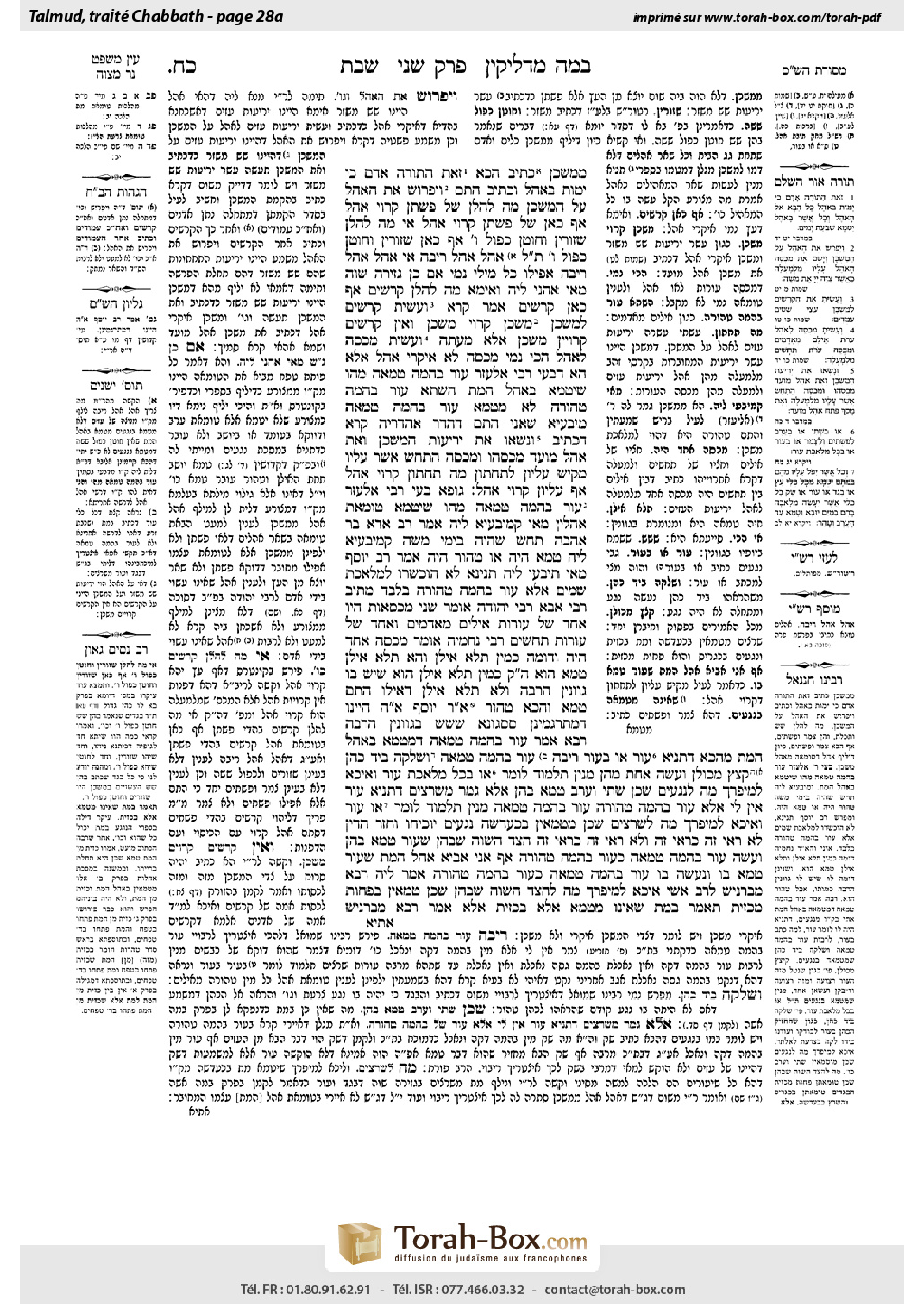
Shabbat 28a: Talmud study for Daf Yomi
Daf Yomi is the daily study of one Talmud folio. Explore 37 tractates with scans, Hebrew text, Sefaria English and AI-generated French translations where annotated.
Passage selection and English or AI-generated French translation are available where the scan has annotations. Daf Study is independent of Torah-Box and Sefaria.
Browse Shabbat · שבת · All tractatesShabbat 28a text and translations
This page of Shabbat includes the Aramaic text, an English translation and an AI-generated French translation, alongside the scan above.
שבת כ״ח א · Aramaic and Hebrew text
מִמִּשְׁכָּן. כְּתִיב הָכָא: ״זֹאת הַתּוֹרָה אָדָם כִּי יָמוּת בְּאֹהֶל״, וּכְתִיב הָתָם: ״וַיִּפְרוֹשׂ אֶת הָאֹהֶל עַל הַמִּשְׁכָּן״. מַה לְּהַלָּן שֶׁל פִּשְׁתָּן קָרוּי ״אֹהֶל״ — אַף כָּאן שֶׁל פִּשְׁתָּן קָרוּי ״אֹהֶל״. אִי מַה לְּהַלָּן שְׁזוּרִין וְחוּטָן כָּפוּל שִׁשָּׁה, אַף כָּאן שְׁזוּרִין וְחוּטָן כָּפוּל שִׁשָּׁה? — תַּלְמוּד לוֹמַר: ״אֹהֶל״ ״אֹהֶל״ רִיבָּה. אִי ״אֹהֶל״ ״אֹהֶל״ רִיבָּה, אֲפִילּוּ כׇּל מִילֵּי נָמֵי! אִם כֵּן גְּזֵירָה שָׁוָה מַאי אַהֲנִי לֵיהּ?!
וְאֵימָא: מַה לְּהַלָּן קְרָשִׁים, אַף כָּאן קְרָשִׁים! אָמַר קְרָא ״וְעָשִׂיתָ קְרָשִׁים לַמִּשְׁכָּן״. מִשְׁכָּן קָרוּי מִשְׁכָּן, וְאֵין קְרָשִׁים קְרוּיִין מִשְׁכָּן. אֶלָּא מֵעַתָּה, ״וְעָשִׂיתָ מִכְסֶה לָאֹהֶל״ — הָכִי נָמֵי מִכְסֶה לָא אִיקְּרִי ״אֹהֶל״. אֶלָּא הָא דְּבָעֵי רַבִּי אֶלְעָזָר: עוֹר בְּהֵמָה טְמֵאָה מַהוּ שֶׁיִּטַּמֵּא בְּאֹהֶל הַמֵּת. הַשְׁתָּא עוֹר בְּהֵמָה טְהוֹרָה לָא מִטַּמֵּא, עוֹר בְּהֵמָה טְמֵאָה מִיבַּעְיָא?! — שָׁאנֵי הָתָם דַּהֲדַר אַהְדְּרֵיהּ קְרָא, דִּכְתִיב: ״וְנָשְׂאוּ אֶת יְרִיעוֹת הַמִּשְׁכָּן וְאֶת אֹהֶל מוֹעֵד מִכְסֵהוּ וּמִכְסֵה הַתַּחַשׁ אֲשֶׁר עָלָיו״. מַקִּישׁ עֶלְיוֹן לְתַחְתּוֹן — מַה תַּחְתּוֹן קָרוּי ״אֹהֶל״, אַף עֶלְיוֹן קָרוּי ״אֹהֶל״.
גּוּפָא. בָּעֵי רַבִּי אֶלְעָזָר: עוֹר בְּהֵמָה טְמֵאָה מַהוּ שֶׁיִּטַּמֵּא טוּמְאַת אֹהָלִין. מַאי קָמִיבַּעְיָא לֵיהּ? אָמַר רַב אַדָּא בַּר אַהֲבָה: תַּחַשׁ שֶׁהָיָה בִּימֵי מֹשֶׁה קָמִיבַּעְיָא לֵיהּ — טָמֵא הָיָה אוֹ טָהוֹר הָיָה? אָמַר רַב יוֹסֵף: מַאי תִּיבְּעֵי לֵיהּ, תְּנֵינָא: לֹא הוּכְשְׁרוּ לִמְלֶאכֶת שָׁמַיִם אֶלָּא עוֹר בְּהֵמָה טְהוֹרָה בִּלְבַד!
מֵתִיב רַבִּי אַבָּא, רַבִּי יְהוּדָה אוֹמֵר: שְׁנֵי מִכְסָאוֹת הָיוּ, אֶחָד שֶׁל עוֹרוֹת אֵילִים מְאָדָּמִים וְאֶחָד שֶׁל עוֹרוֹת תְּחָשִׁים. רַבִּי נְחֶמְיָה אוֹמֵר: מִכְסֶה אֶחָד הָיָה, וְדוֹמֶה כְּמִין תְּלָא אִילָן. וְהָא תְּלָא אִילָן טָמֵא הוּא! הָכִי קָאָמַר: כְּמִין תְּלָא אִילָן הוּא, שֶׁיֵּשׁ בּוֹ גְּווֹנִין הַרְבֵּה, וְלֹא תְּלָא אִילָן. דְּאִילּוּ הָתָם טָמֵא, וְהָכָא טָהוֹר. אָמַר רַב יוֹסֵף: אִי הָכִי הַיְינוּ דִּמְתַרְגְּמִינַן ״סָסְגּוֹנָא״, שֶׁשָּׂשׂ בִּגְווֹנִין הַרְבֵּה.
רָבָא אָמַר: עוֹר בְּהֵמָה טְמֵאָה דְּמִטַּמֵּא בְּאֹהֶל הַמֵּת מֵהָכָא, דְּתַנְיָא: ״עוֹר״ ״אוֹ בְעוֹר״ — רִיבָּה עוֹר בְּהֵמָה טְמֵאָה. וְשֶׁלָּקָה בְּיַד כֹּהֵן, קָצַץ מִכּוּלָּן וְעָשָׂה אַחַת מֵהֶן, מִנַּיִן? — תַּלְמוּד לוֹמַר: ״אוֹ בְּכׇל מְלֶאכֶת עוֹר״. וְאִיכָּא לְמִיפְרַךְ, מָה לִנְגָעִים שֶׁכֵּן שְׁתִי וָעֵרֶב טָמֵא בָּהֶן.
אֶלָּא גָּמַר מִשְּׁרָצִים: דְּתַנְיָא: ״עוֹר״ — אֵין לִי אֶלָּא עוֹר בְּהֵמָה טְהוֹרָה, עוֹר בְּהֵמָה טְמֵאָה מִנַּיִן? תַּלְמוּד לוֹמַר ״אוֹ עוֹר״. וְאִיכָּא לְמִיפְרַךְ: מָה לִשְׁרָצִים שֶׁכֵּן מְטַמְּאִין בְּכַעֲדָשָׁה. נְגָעִים יוֹכִיחוּ. וְחָזַר הַדִּין, לֹא רְאִי זֶה כִּרְאִי זֶה וְלֹא רְאִי זֶה כִּרְאִי זֶה, הַצַּד הַשָּׁוֶה שֶׁבָּהֶן — שֶׁעוֹר טָמֵא בָּהֶן, וְעָשָׂה עוֹר בְּהֵמָה טְמֵאָה כְּעוֹר בְּהֵמָה טְהוֹרָה. אַף אֲנִי אָבִיא אֹהֶל הַמֵּת שֶׁעוֹר טָמֵא בּוֹ, וְנַעֲשֶׂה בּוֹ עוֹר בְּהֵמָה טְמֵאָה כְּעוֹר בְּהֵמָה טְהוֹרָה.
אֲמַר לֵיהּ רָבָא מִבַּרְנִישׁ לְרַב אָשֵׁי: אִיכָּא לְמִיפְרַךְ — מַה לְּהַצַּד הַשָּׁוֶה שֶׁבָּהֶן שֶׁכֵּן טְמֵאִין בְּפָחוֹת מִכְּזַיִת, תֹּאמַר בְּמֵת שֶׁאֵינוֹ מְטַמֵּא אֶלָּא בִּכְזַיִת.
אֶלָּא אָמַר רָבָא מִבַּרְנִישׁ:
Shabbat 28a · English translation
written in the context of the Tabernacle. It is written here, in the discussion of the laws of ritual impurity: “This is the law: When a man dies in a tent, every one that comes into the tent, and everything that is in the tent, shall be impure seven days” (Numbers 19:14), and it is written there: “And he spread the tent over the Tabernacle, and put the covering of the tent above upon it; as the Lord commanded Moses” (Exodus 40:19). Just as below, with regard to the Tabernacle, the tent was made of linen and is considered a tent, so too, here, with regard to the halakhot of ritual impurity imparted by a corpse, only a tent made of linen is considered a tent. The Gemara asks: If so, derive the following from that same verbal analogy: Just as below the linen threads in the Tabernacle were specifically threads that were twisted and the threads were folded six times, so too, here, in all of the halakhot pertaining to a tent over a corpse, the threads must be twisted and their threads folded six times. The verse states the word tent, tent several times to amplify and include even a tent made of linen not identical to the Tabernacle. The Gemara asks: If the repetition of the word tent, tent several times amplifies, even all things should be included among those items that can receive ritual impurity as a tent. The Gemara answers: This amplification cannot be that far-reaching, as, if so, the verbal analogy of tent, tent, that teaches us to derive the tent over a corpse from the Tabernacle, what purpose does it serve if everything is included? Rather, certainly the amplification is not absolute. Through the combination of the verbal analogy and the amplification, it is derived that this halakha applies specifically to linen.
And perhaps say: Just as below, in the Tabernacle, there were beams supporting the tent, so too, here, in the laws of ritual impurity, a tent made of beams should also be considered a tent. The Gemara responds that the verse said: “And you shall make the beams for the Tabernacle of acacia wood, standing up” (Exodus 26:15). From the language of the verse, it is derived that the Tabernacle, i.e., the curtains alone, is called Tabernacle, and the beams are not called Tabernacle, because they merely facilitate the Tabernacle. The Gemara rejects this: But if that is so, based on an analysis of the language of the verse, it says there: “And you shall make a covering for the tent of rams’ skins dyed red and a covering of teḥashim above” (Exodus 26:14), then in that case, too, say that the covering is not considered a tent. If so, however, what of the dilemma raised by Rabbi Elazar: With regard to the hide of a non-kosher animal over a corpse, what is the ruling? Can it become ritually impure as a tent over a corpse? If the covering of the Tabernacle is not considered a tent, now, the hide of a kosher animal that covered the Tabernacle cannot become ritually impure. If that is so, is it necessary to mention that the hide of a non-kosher animal cannot become ritually impure? The Gemara answers: The cases are not comparable because it is different there, in the case of the covering of animal hides, because the verse subsequently restored its status as a tent by uniting the tent and its covering, as it is written: “They shall bear the curtains of the Tabernacle, and the Tent of Meeting, its covering, and the covering of taḥash that is upon it” (Numbers 4:25). The verse juxtaposes the upper to the lower covering; just as the lower covering is considered a tent, so too, the upper covering is considered a tent.
Rabbi Elazar’s dilemma was mentioned above, and now the Gemara discusses the matter itself. Rabbi Elazar raised a dilemma: With regard to the hide of a non-kosher animal over a corpse, what is the ruling? Can it become ritually impure as a tent over a corpse? The Gemara clarifies: What is the essence of his dilemma? Rav Adda bar Ahava said: The taḥash that existed in the time of Moses is at the crux of Rabbi Elazar’s dilemma. Was it non-kosher or was it kosher? Rav Yosef said: What is his dilemma? Didn’t we learn explicitly: Only the hide of a kosher animal was deemed suitable for heavenly service? Certainly, the taḥash was a kosher species.
Rabbi Abba raised an objection. Rabbi Yehuda says: There were two coverings for the Tabernacle, one made of the reddened hides of rams and one of the hides of teḥashim. Rabbi Neḥemya says: There was only one covering for the Tabernacle, half of which was made of rams’ hides and half from the hides of teḥashim. And teḥashim were similar to the species of undomesticated animals called tela ilan. The Gemara asks: But isn’t a tela ilan a non-kosher creature? The Gemara emends this statement: This is what Rabbi Neḥemya intended to say: It was like a tela ilan in that it was multicolored; however, it was not an actual tela ilan. There, the tela ilan is non-kosher, and here, the covering of the tent was made from kosher animals. Rav Yosef said: If so, that is the reason that we translate the word taḥash as sasgona, which means that it rejoices [sas] in many colors [gevanim].
Rava said that the proof that the hide of a non-kosher animal becomes ritually impure in a tent over a corpse is derived from here, as it was taught in a baraita that it is stated in the halakhot of ritual impurity of leprosy that the leprosy could be: “Either in the warp, or in the woof, whether they be of linen, or of wool; or in a hide, or in any thing made of hide” (Leviticus 13:48). The verse could have simply stated: Or hide, and it said instead: Or in a hide. The Sages said: These words, or in a hide, amplify to include the hide of a non-kosher animal as well as hide that was afflicted in the hands of a priest, i.e., before the owner showed it to the priest there was no leprosy but it became leprous while in the hands of the priest, that they too become ritually impure. If one cut pieces from each of these types and made of them a single cloth, from where is it derived that it can become ritually impure? The verse states from the broader amplification: Or in anything made of hide. The Gemara remarks: There is room to refute this parallel, rendering it impossible to derive the laws of ritual impurity imparted by a corpse from the laws of leprosy. What is the comparison to leprosy with regard to which the Torah is stringent, as even the warp and woof that have not been woven into a garment can become ritually impure from it, which is not the case in impurity imparted by a corpse?
Rather, one could say that he derived it from the laws of the ritual impurity of creeping animals, as it is stated with regard to them: “And upon whatsoever any of them, when they are dead, does fall, it shall be impure; whether it be any vessel of wood, or garment, or hide, or sack, whatsoever vessel it be, with which any work is done” (Leviticus 11:32). As it was taught in a baraita: From the use of the word hide, I have derived nothing other than the fact that the hide of a kosher animal becomes ritually impure from contact with a creeping animal; however, from where is it derived that the hide of a non-kosher animal can become ritually impure? This is derived from the amplification, as the verse states: Or hide. Since, with regard to the ritual impurity of creeping animals the laws of the hides of kosher and non-kosher animals are identical, it is derived that this is also true with regard to the halakhot of ritual impurity imparted by a corpse. Once again, the Gemara says: There is room to refute this derivation and say: What is the comparison to creeping animals, as their legal status is stringent because they become ritually impure even if they are as small as a lentil-bulk, which is not true in the case of a corpse? In order for a corpse to transmit ritual impurity, it must be larger, an olive-bulk. Therefore, the Gemara says: If so, the case of leprosy can prove that the fact that creeping animals that are a lentil-bulk transmit impurity is not a factor in whether or not a non-kosher animal hide can become ritually impure. Leprosy that is a lentil-bulk does not transmit impurity and, nevertheless, the hide of a non-kosher animal becomes ritually impure from it. And the derivation has reverted to its starting point. The aspect of this case is not like the aspect of that case and the aspect of that case is not like the aspect of this case, as each case has its own unique stringencies. However, their common denominator is that hide, in general, is ritually impure in both cases, and the Torah rendered the hide of a non-kosher animal equal to the hide of a kosher animal in that it becomes ritually impure. I will also bring the additional halakha of a tent over a corpse made of the hide of a non-kosher animal, and in that case as well, the hide of a non-kosher animal will be rendered equal to the hide of a kosher animal.
Rava from Barnish said to Rav Ashi: There is still room to refute this statement and say: What is the comparison to leprosy and creeping animals? Their common denominator is that they both transmit ritual impurity when smaller than an olive-bulk. Can you say the same in the case of a corpse, which only transmits ritual impurity when it is at least an olive-bulk? Therefore, despite the differences between them, these two halakhot are both more stringent than the laws of ritual impurity imparted by a corpse, and the status of a non-kosher animal hide cannot be derived from them.
Rather, Rava from Barnish said it can be derived in the following manner:
Shabbat 28a · Traduction française (IA)
… est écrit dans le contexte du Tabernacle. Il est écrit ici, dans la discussion des lois de l’impureté rituelle : « Voici la loi : lorsqu’un homme meurt dans une tente, quiconque entre dans la tente et tout ce qui se trouve dans la tente sera impur pendant sept jours » (Nombres 19,14), et il est écrit là-bas : « Il étendit la tente sur le Tabernacle et plaça au-dessus d’elle la couverture de la tente, comme l’Éternel l’avait ordonné à Moïse » (Exode 40,19). De même que là-bas, à propos du Tabernacle, la tente était faite de lin et était considérée comme une tente, de même ici, concernant les halakhot de l’impureté rituelle transmise par un cadavre, seule une tente faite de lin est considérée comme une tente. La Guemara demande : Si tel est le cas, déduisons de cette même analogie verbale ce qui suit : de même que là-bas, dans le Tabernacle, les fils de lin étaient précisément des fils retors, dont les brins étaient repliés six fois, de même ici, dans toutes les halakhot concernant une tente au-dessus d’un cadavre, les fils doivent être retors et leurs brins repliés six fois. Le verset répète plusieurs fois le mot « tente » afin d’amplifier le sens et d’inclure même une tente faite de lin qui n’est pas identique à celle du Tabernacle. La Guemara demande : Si la répétition du mot « tente » à plusieurs reprises amplifie le sens, alors toutes les choses devraient être incluses parmi les éléments susceptibles de recevoir l’impureté rituelle en tant que tente. La Guemara répond : Cette amplification ne peut aller aussi loin, car, dans ce cas, à quoi servirait l’analogie verbale « tente, tente », qui nous enseigne à déduire les règles relatives à la tente au-dessus d’un cadavre de celles du Tabernacle, si tout était inclus ? Il faut donc conclure que l’amplification n’est pas absolue. C’est en combinant l’analogie verbale et l’amplification qu’on déduit que cette halakha s’applique spécifiquement au lin.
Et peut-être faudrait-il dire : de même que là-bas, dans le Tabernacle, des poutres soutenaient la tente, de même ici, dans les lois de l’impureté rituelle, une tente faite de poutres devrait également être considérée comme une tente. La Guemara répond que le verset dit : « Tu feras les poutres du Tabernacle en bois d’acacia, dressées » (Exode 26,15). On déduit de la formulation du verset que le Tabernacle, c’est-à-dire les tentures seules, est appelé « Tabernacle », tandis que les poutres ne le sont pas, car elles ne font que servir le Tabernacle. La Guemara rejette cette réponse : Mais si tel est le cas, en analysant la formulation du verset, on lit là-bas : « Tu feras une couverture pour la tente en peaux de béliers teintes en rouge, et une couverture de taḥashim au-dessus » (Exode 26,14). Il faudrait alors également dire que la couverture n’est pas considérée comme une tente. Mais dans ce cas, qu’en est-il de la question soulevée par Rabbi Elazar : quel est le statut de la peau d’un animal non cachère placée au-dessus d’un cadavre ? Peut-elle recevoir l’impureté rituelle en tant que tente au-dessus d’un cadavre ? Si la couverture du Tabernacle n’est pas considérée comme une tente, alors la peau d’un animal cachère qui couvrait le Tabernacle ne peut pas recevoir l’impureté rituelle. S’il en est ainsi, est-il nécessaire de préciser que la peau d’un animal non cachère ne peut pas recevoir l’impureté rituelle ? La Guemara répond : Les cas ne sont pas comparables, car là-bas, dans le cas de la couverture en peaux d’animaux, le verset lui a ensuite rendu son statut de tente en réunissant la tente et sa couverture, comme il est écrit : « Ils porteront les tentures du Tabernacle, la Tente de la Rencontre, sa couverture et la couverture de taḥash qui est au-dessus » (Nombres 4,25). Le verset met en parallèle la couverture supérieure et la couverture inférieure ; de même que la couverture inférieure est considérée comme une tente, de même la couverture supérieure est considérée comme une tente.
La question de Rabbi Elazar a été mentionnée plus haut ; la Guemara examine maintenant la question elle-même. Rabbi Elazar souleva une question : quel est le statut de la peau d’un animal non cachère placée au-dessus d’un cadavre ? Peut-elle recevoir l’impureté rituelle en tant que tente au-dessus d’un cadavre ? La Guemara précise : Quel est le fondement de sa question ? Rav Adda bar Ahava dit : Le taḥash qui existait à l’époque de Moïse est au cœur de la question de Rabbi Elazar. Était-il non cachère ou cachère ? Rav Yosef dit : Quelle est sa question ? N’avons-nous pas appris explicitement que seule la peau d’un animal cachère était considérée comme apte au service céleste ? Il est donc certain que le taḥash appartenait à une espèce cachère.
Rabbi Abba souleva une objection. Rabbi Yehouda dit : Il y avait deux couvertures pour le Tabernacle, l’une faite de peaux de béliers teintes en rouge et l’autre de peaux de taḥashim. Rabbi Neḥemya dit : Il n’y avait qu’une seule couverture pour le Tabernacle, dont une moitié était faite de peaux de béliers et l’autre moitié de peaux de taḥashim. Les taḥashim ressemblaient à l’espèce d’animaux sauvages appelée tela ilan. La Guemara demande : Mais le tela ilan n’est-il pas une créature non cachère ? La Guemara corrige cette déclaration : Voici ce que Rabbi Neḥemya voulait dire : le taḥash ressemblait au tela ilan en ce qu’il était multicolore ; cependant, ce n’était pas un véritable tela ilan. Là-bas, le tela ilan est non cachère, tandis qu’ici, la couverture de la tente était faite de peaux d’animaux cachères. Rav Yosef dit : Si tel est le cas, voilà pourquoi nous traduisons le mot taḥash par sasgona, ce qui signifie qu’il se réjouit [sas] de nombreuses couleurs [gevanim].
Rava dit que la preuve que la peau d’un animal non cachère reçoit l’impureté rituelle lorsqu’elle forme une tente au-dessus d’un cadavre se déduit de ce qui suit, comme il a été enseigné dans une baraïta : à propos des lois de l’impureté rituelle liée à la lèpre, il est dit que celle-ci peut se trouver « soit dans la chaîne, soit dans la trame, qu’elles soient de lin ou de laine ; soit dans une peau, soit dans tout objet fait de peau » (Lévitique 13,48). Le verset aurait pu simplement dire : « ou une peau », mais il dit : « dans une peau ». Les Sages ont enseigné : Ces mots, « dans une peau », amplifient le texte afin d’inclure également la peau d’un animal non cachère, ainsi qu’une peau atteinte de lèpre alors qu’elle se trouvait entre les mains d’un prêtre, c’est-à-dire qu’elle ne présentait pas de lèpre avant que son propriétaire ne la montre au prêtre, mais qu’elle en fut atteinte alors qu’elle était entre les mains du prêtre ; ces peaux aussi deviennent rituellement impures. Si l’on découpait des morceaux de chacun de ces types de peau pour en faire une seule étoffe, d’où déduit-on qu’elle peut recevoir l’impureté rituelle ? Le verset l’enseigne par son amplification plus large : « ou tout objet fait de peau ». La Guemara fait remarquer : Il y a lieu de réfuter cette comparaison, ce qui empêcherait de déduire les lois de l’impureté rituelle transmise par un cadavre des lois de la lèpre. En quoi la lèpre est-elle comparable, alors que la Torah est plus stricte à son égard, puisque même la chaîne et la trame qui n’ont pas été tissées en un vêtement peuvent recevoir son impureté rituelle, ce qui n’est pas le cas pour l’impureté transmise par un cadavre ?
On pourrait plutôt dire qu’il l’a déduit des lois de l’impureté rituelle des animaux rampants, à propos desquels il est dit : « Tout objet sur lequel tombera l’un d’eux, lorsqu’ils sont morts, sera impur : que ce soit un objet en bois, un vêtement, une peau ou un sac, tout objet servant à quelque ouvrage » (Lévitique 11,32). En effet, il a été enseigné dans une baraïta : De la mention du mot « peau », j’ai seulement déduit que la peau d’un animal cachère devient rituellement impure au contact d’un animal rampant ; mais d’où déduit-on que la peau d’un animal non cachère peut recevoir l’impureté rituelle ? On le déduit de l’amplification, car le verset dit : « ou une peau ». Puisque, en matière d’impureté rituelle transmise par les animaux rampants, les lois relatives aux peaux des animaux cachères et non cachères sont identiques, on en déduit qu’il en va de même pour les halakhot de l’impureté rituelle transmise par un cadavre. Une fois encore, la Guemara dit : Il y a lieu de réfuter cette déduction et de dire : En quoi la comparaison avec les animaux rampants est-elle pertinente, alors que leur statut est plus strict, puisqu’ils transmettent l’impureté rituelle même lorsqu’ils ne font qu’un volume égal à celui d’une lentille, ce qui n’est pas le cas d’un cadavre ? Pour qu’un cadavre transmette l’impureté rituelle, il doit être plus grand, du volume d’une olive. La Guemara dit donc : Si tel est le cas, le cas de la lèpre peut prouver que le fait que les animaux rampants transmettent l’impureté à partir du volume d’une lentille n’est pas déterminant pour savoir si la peau d’un animal non cachère peut recevoir l’impureté rituelle. Une lèpre d’un volume égal à celui d’une lentille ne transmet pas l’impureté rituelle ; néanmoins, la peau d’un animal non cachère reçoit l’impureté qu’elle transmet. Et la déduction revient à son point de départ. Les aspects de ces cas ne sont pas identiques, car chacun comporte ses propres rigueurs particulières. Cependant, leur dénominateur commun est que, dans les deux cas, la peau en général est sujette à l’impureté rituelle, et que la Torah a assimilé la peau d’un animal non cachère à celle d’un animal cachère, en ce qu’elle reçoit l’impureté rituelle. J’ajouterai également la halakha d’une tente au-dessus d’un cadavre faite de la peau d’un animal non cachère ; dans ce cas aussi, la peau d’un animal non cachère sera assimilée à celle d’un animal cachère.
Rava de Barnish dit à Rav Ashi : Il y a encore lieu de réfuter cette affirmation et de dire : En quoi la comparaison avec la lèpre et les animaux rampants est-elle pertinente ? Leur dénominateur commun est qu’ils transmettent tous deux l’impureté rituelle même lorsqu’ils sont d’un volume inférieur à celui d’une olive. Peut-on dire la même chose dans le cas d’un cadavre, qui ne transmet l’impureté rituelle que s’il a au moins le volume d’une olive ? Par conséquent, malgré leurs différences, ces deux halakhot sont toutes deux plus strictes que les lois de l’impureté rituelle transmise par un cadavre, et le statut de la peau d’un animal non cachère ne peut pas être déduit de ces cas.
Rava de Barnish dit plutôt que cela peut se déduire de la manière suivante :
Traduction française générée par IA à partir de l’édition anglaise de Sefaria. Vérifie toujours un passage avec le texte source.
Text from Sefaria: William Davidson Edition - Vocalized Aramaic (CC BY NC); William Davidson Edition - English (CC BY NC).