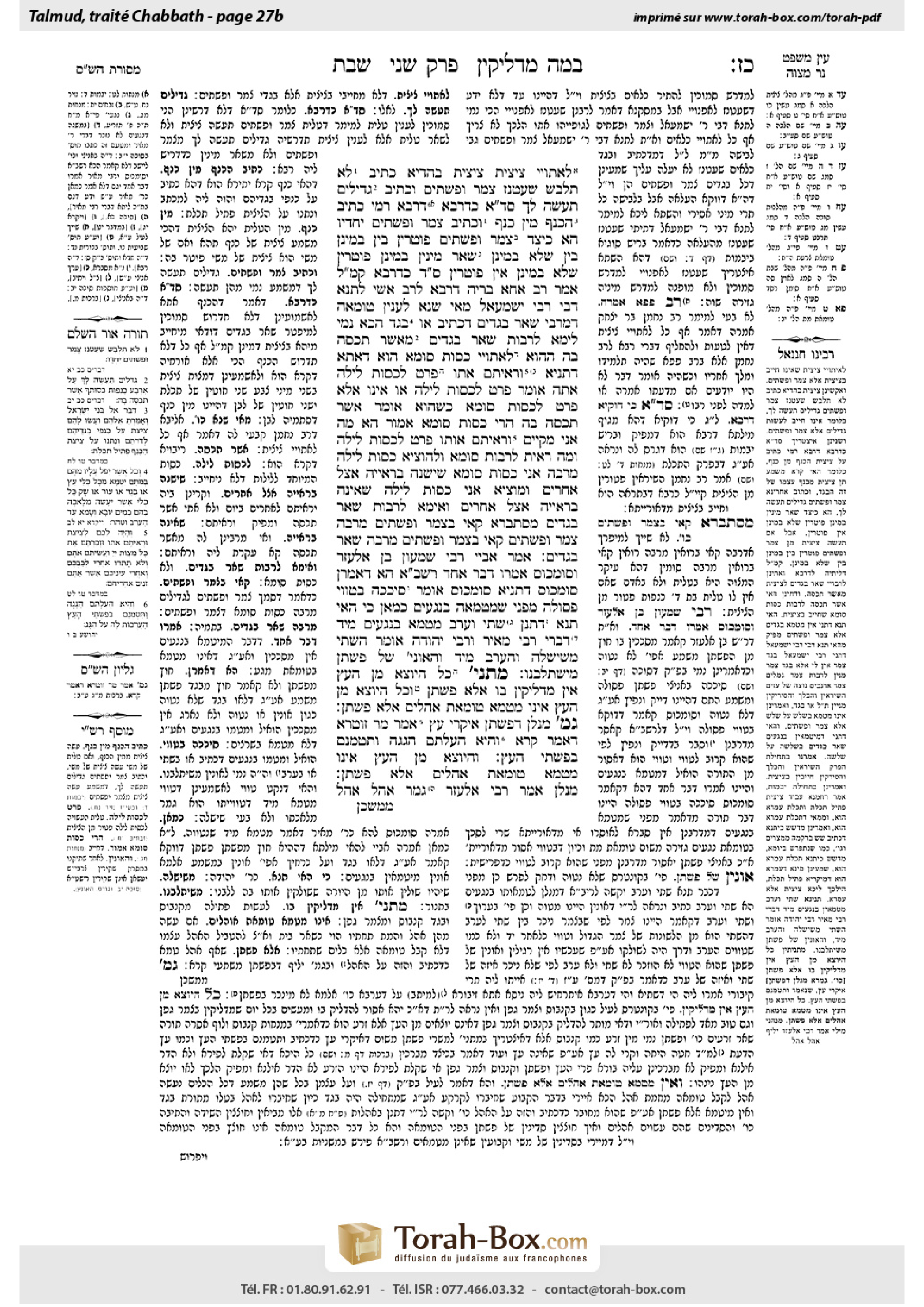
Shabbat 27b: Talmud study for Daf Yomi
Daf Yomi is the daily study of one Talmud folio. Explore 37 tractates with scans, Hebrew text, Sefaria English and AI-generated French translations where annotated.
Passage selection and English or AI-generated French translation are available where the scan has annotations. Daf Study is independent of Torah-Box and Sefaria.
Browse Shabbat · שבת · All tractatesShabbat 27b text and translations
This page of Shabbat includes the Aramaic text, an English translation and an AI-generated French translation, alongside the scan above.
שבת כ״ז ב · Aramaic and Hebrew text
לְאֵתוּיֵי צִיצִית. צִיצִית בְּהֶדְיָא כְּתִיב: ״לֹא תִלְבַּשׁ שַׁעַטְנֵז צֶמֶר וּפִשְׁתִּים״, וּכְתִיב: ״גְּדִילִים תַּעֲשֶׂה לָךְ״! סָלְקָא דַּעְתָּךְ אָמֵינָא כִּדְרָבָא. דְּרָבָא רָמֵי, כְּתִיב: ״הַכָּנָף״, מִין כָּנָף. וּכְתִיב: ״צֶמֶר וּפִשְׁתִּים יַחְדָּיו״, הָא כֵיצַד? צֶמֶר וּפִשְׁתִּים פּוֹטְרִין בֵּין בְּמִינָן, בֵּין שֶׁלֹּא בְּמִינָן. שְׁאָר מִינִין בְּמִינָן פּוֹטְרִין שֶׁלֹּא בְּמִינָן אֵין פּוֹטְרִין. סָלְקָא דַּעְתָּךְ כִּדְרָבָא קָא מַשְׁמַע לַן.
אָמַר רַב אַחָא בְּרֵיהּ דְּרָבָא לְרַב אָשֵׁי: לְתַנָּא דְּבֵי רַבִּי יִשְׁמָעֵאל, מַאי שְׁנָא לְעִנְיַן טוּמְאָה דִּמְרַבֵּי שְׁאָר בְּגָדִים, דִּכְתִיב — ״אוֹ בֶגֶד״, הָכָא נָמֵי לֵימָא לְרַבּוֹת שְׁאָר בְּגָדִים מֵ״אֲשֶׁר תְּכַסֶּה בָּהּ״? הַהוּא — לְאֵתוּיֵי כְּסוּת סוֹמֵא הוּא דַּאֲתָא. דְּתַנְיָא: ״וּרְאִיתֶם אוֹתוֹ״ — פְּרָט לִכְסוּת לַיְלָה. אַתָּה אוֹמֵר פְּרָט לִכְסוּת לַיְלָה, אוֹ אֵינוֹ אֶלָּא פְּרָט לִכְסוּת סוֹמֵא? כְּשֶׁהוּא אוֹמֵר ״אֲשֶׁר תְּכַסֶּה בָּהּ״, הֲרֵי כְּסוּת סוֹמֵא אָמוּר. הָא מָה אֲנִי מְקַיֵּים ״וּרְאִיתֶם אוֹתוֹ״ — פְּרָט לִכְסוּת לַיְלָה.
וּמָה רָאִיתָ לְרַבּוֹת סוֹמֵא וּלְהוֹצִיא כְּסוּת לַיְלָה? מְרַבֶּה אֲנִי כְּסוּת סוֹמֵא שֶׁיֶּשְׁנָהּ בִּרְאִיָּיה אֵצֶל אֲחֵרִים, וּמוֹצִיא אֲנִי כְּסוּת לַיְלָה שֶׁאֵינָהּ בִּרְאִיָּיה אֵצֶל אֲחֵרִים.
וְאֵימָא לְרַבּוֹת שְׁאָר בְּגָדִים? מִסְתַּבְּרָא קָאֵי בְּצֶמֶר וּפִשְׁתִּים מְרַבֵּה צֶמֶר וּפִשְׁתִּים. קָאֵי בְּצֶמֶר וּפִשְׁתִּים מְרַבֵּה שְׁאָר בְּגָדִים?!
אָמַר אַבָּיֵי: רַבִּי שִׁמְעוֹן בֶּן אֶלְעָזָר וְסוֹמְכוֹס אָמְרוּ דָּבָר אֶחָד. רַבִּי שִׁמְעוֹן בֶּן אֶלְעָזָר הָא דַּאֲמַרַן. סוֹמְכוֹס — דְּתַנְיָא: סוֹמְכוֹס אוֹמֵר סִיכְּכָהּ בִּטְוִוי פְּסוּלָה מִפְּנֵי שֶׁמִּטַּמְּאָה בִּנְגָעִים.
כְּמַאן — כִּי הַאי תַּנָּא, דִּתְנַן: שְׁתִי וָעֵרֶב מִטַּמֵּא בִּנְגָעִים מִיָּד, דִּבְרֵי רַבִּי מֵאִיר. וְרַבִּי יְהוּדָה אוֹמֵר: הַשְּׁתִי מִשֶּׁיִּשָּׁלֶה, וְהָעֵרֶב מִיָּד, וְהָאוּנִּין שֶׁל פִּשְׁתָּן מִשֶּׁיִּתְלַבְּנוּ.
מַתְנִי׳ כׇּל הַיּוֹצֵא מִן הָעֵץ אֵין מַדְלִיקִין בּוֹ, אֶלָּא פִּשְׁתָּן. וְכׇל הַיּוֹצֵא מִן הָעֵץ אֵינוֹ מִטַּמֵּא טוּמְאַת אֹהָלִים, אֶלָּא פִּשְׁתָּן.
גְּמָ׳ מְנָלַן דְּפִשְׁתָּן אִיקְּרִי ״עֵץ״? אָמַר מָר זוּטְרָא: דְּאָמַר קְרָא ״וְהִיא הֶעֱלָתַם הַגָּגָה וַתִּטְמְנֵם בְּפִשְׁתֵּי הָעֵץ״.
וְהַיּוֹצֵא מִן הָעֵץ אֵינוֹ מִטַּמֵּא טוּמְאַת אֹהָלִים, אֶלָּא פִּשְׁתָּן. מְנָלַן? אָמַר רַבִּי אֶלְעָזָר: גָּמַר ״אֹהֶל״ ״אֹהֶל״
Shabbat 27b · English translation
garments mentioned in the Torah are made from wool and linen. This comes to include the law of ritual fringes; the obligation of ritual fringes applies only to those materials. The Gemara asks: Why is that derivation necessary? With regard to ritual fringes it is written explicitly: “You shall not wear diverse kinds, wool and linen together” (Deuteronomy 22:11); and juxtaposed to it, it is written: “You shall make for you twisted fringes upon the four corners of your covering, with which you cover yourself” (Deuteronomy 22:12). From the juxtaposition of these two verses it is derived that the mitzva of ritual fringes applies only to garments to which the laws of diverse kinds apply. Rav Naḥman bar Yitzḥak responded that the matter is not so clear, as it could have entered your mind to say in accordance with the statement of Rava. As Rava raised a contradiction: On the one hand, it is written: “And that they put with the fringe of each corner a thread of sky blue” (Numbers 15:39); apparently, the threads of the ritual fringes must be of the same type of fabric as the corner of the garment. However, in Deuteronomy, in the laws of ritual fringes, it is written in juxtaposition to the laws of diverse kinds: Wool and linen together. The ritual fringes may only be made of those materials. How can that contradiction be resolved? Rather, Rava says: Ritual fringes made of wool and linen exempt the garment and fulfill the obligation of ritual fringes whether the garment is of their own type, wool or linen, whether it is not of their own type. Whereas with regard to other types, a garment of their own type, they exempt; a garment not of their own type, they do not exempt. It would have entered your mind to explain this in accordance with the approach of Rava. Therefore, the tanna taught us that the obligation of ritual fringes applies only to wool and linen and not to other materials.
Rav Aḥa, son of Rava, said to Rav Ashi: According to the tanna of the school of Rabbi Yishmael, what is different about ritual impurity that he includes other garments not made of wool and linen because it is written: Or a garment, which is a term of amplification? Here too, in the matter of ritual fringes, say that it comes to include other garments from the phrase: Of your covering, with which you cover yourself. Rav Ashi answered: That amplification is necessary to include the garment of a blind person in the obligation of ritual fringes. As it was taught in a baraita, with regard to ritual fringes it is stated: “And it shall be unto you for a fringe, that you may look upon it and remember all the mitzvot of the Lord” (Numbers 15:39). The phrase: That you may look, comes to exclude a night garment, which cannot be seen and is therefore exempt from the mitzva of ritual fringes. The tanna continues: Do you say that the verse comes to exclude a night garment? Or is it only to exclude the garment of a blind person who is also unable to fulfill the verse: That you may look upon it? The tanna explains: When it says in Deuteronomy: Of your covering, with which you cover yourself, the garment of a blind person is mentioned, as he too covers himself with a covering. If so, then how do I fulfill the exclusion: That you may look upon it? It comes to exclude a night garment.
The Gemara asks: Since there is one verse that includes and another verse that excludes, what did you see that led you to include a blind person and to exclude a night garment in the obligation of ritual fringes? The Gemara answers: I include the garment of a blind person because it is, at least, visible to others, and I exclude a night garment because it is not even visible to others.
The Gemara asks: And say that this amplification does not come to include a blind person’s garments, but rather, as Rava said, to include other garments not made from wool or linen in the obligation of ritual fringes. The Gemara answers: It is logical to say that since the Torah is standing and discussing a garment made of wool or linen, it is certainly including another garment made of wool or linen. Therefore, an amplification with regard to the garment of a blind person made of wool or linen is derived. However, when the Torah is standing and discussing a garment made from wool or linen, is it reasonable to say that it is including other garments with them? Rather, other garments are certainly not derived from there.
The Gemara returns to discuss the opinion of Rabbi Shimon ben Elazar, who disqualified even small cloths from being used as roofing in the sukka because they can become ritually impure. Abaye said: Rabbi Shimon ben Elazar and Sumakhos said the same thing. The Gemara specifies: Rabbi Shimon ben Elazar; that which we stated above. Sumakhos; as it was taught in a baraita: Sumakhos says: A sukka that he roofed with roofing made from spun thread is disqualified because spun thread can become ritually impure from leprosy.
In accordance with whose opinion is Sumakhos’ statement? It is in accordance with the opinion of this tanna, as we learned in a mishna: Warp and woof can become ritually impure from leprosy immediately after they are spun; this is the statement of Rabbi Meir. Rabbi Yehuda says: The warp can become ritually impure only after it is removed from the cauldron in which it is boiled, and it is only the woof that can become ritually impure immediately. However, the bundles of unprocessed flax can become ritually impure after they are bleached in the oven and their processing is at least half-completed. Sumakhos, the student of Rabbi Meir, adheres to his position.
MISHNA: Of all substances that emerge from the tree, one may light only with flax on Shabbat (Tosafot) because the other substances do not burn well. And of all substances that emerge from the tree, the only substance that becomes ritually impure with impurity transmitted by tents over a corpse is flax. If there is a dead body inside a house or a tent that is made from any materials that originate from a tree, everything in the house becomes ritually impure. However, only in the case of flax does the tent itself become impure.
GEMARA: The mishna mentioned flax as a material that comes from a tree. The Gemara asks: From where do we derive that flax is called a tree? Based on appearance, it does not resemble a tree at all. Mar Zutra said: It is derived from that which the verse said: “And she had taken them up to the roof and hidden them under the trees of flax” (Joshua 2:6).
And we also learned in the mishna that with regard to any substance that emerges from the tree, the only substance that becomes ritually impure with impurity transmitted by tents over a corpse is flax. The Gemara asks: From where do we derive this? Rabbi Elazar said: The tanna learned a verbal analogy [gezera shava] between the word tent, written in the context of ritual impurity, and the word tent,
Shabbat 27b · Traduction française (IA)
Les vêtements mentionnés dans la Torah sont faits de laine et de lin. Cela vient inclure la loi des franges rituelles : l’obligation de porter des franges rituelles ne s’applique qu’à ces matières. La Guemara demande : Pourquoi cette déduction est-elle nécessaire ? Au sujet des franges rituelles, il est explicitement écrit : « Tu ne porteras pas de mélange, de laine et de lin ensemble » (Deutéronome 22:11), et, par juxtaposition, il est écrit : « Tu te feras des franges torsadées aux quatre coins du vêtement dont tu te couvres » (Deutéronome 22:12). De la juxtaposition de ces deux versets, on déduit que la mitsva des franges rituelles ne s’applique qu’aux vêtements soumis aux lois du mélange. Rav Naḥman bar Yitzḥak répondit que la chose n’est pas si évidente, car on aurait pu penser conformément à l’avis de Rava. Rava avait soulevé une contradiction : d’une part, il est écrit : « Et ils mettront sur la frange de chaque coin un fil bleu ciel » (Nombres 15:39) ; il semble donc que les fils des franges rituelles doivent être de la même matière que le coin du vêtement. Cependant, dans le Deutéronome, les lois des franges rituelles sont juxtaposées aux lois du mélange : laine et lin ensemble. Les franges rituelles ne peuvent donc être faites que de ces matières. Comment résoudre cette contradiction ? Rava dit plutôt : Des franges rituelles faites de laine et de lin dispensent le vêtement de l’obligation des franges rituelles, que le vêtement soit fait de la même matière — laine ou lin — ou d’une autre matière. En revanche, pour les autres matières, elles dispensent un vêtement fait de la même matière, mais ne dispensent pas un vêtement fait d’une autre matière. On aurait pu penser interpréter cela selon l’approche de Rava. C’est pourquoi le tanna nous enseigne que l’obligation des franges rituelles ne s’applique qu’à la laine et au lin, et non aux autres matières.
Rav Aḥa, fils de Rava, dit à Rav Ashi : Selon le tanna de l’école de Rabbi Yishmael, en quoi l’impureté rituelle diffère-t-elle, pour qu’il inclue les autres vêtements qui ne sont pas faits de laine et de lin, au motif qu’il est écrit : « ou un vêtement », expression qui indique une extension ? Ici aussi, au sujet des franges rituelles, dis que l’expression « de ton vêtement dont tu te couvres » vient inclure les autres vêtements. Rav Ashi répondit : Cette extension est nécessaire pour inclure le vêtement d’un aveugle dans l’obligation des franges rituelles. En effet, il a été enseigné dans une baraïta qu’au sujet des franges rituelles, il est dit : « Elles seront pour vous une frange, afin que vous la regardiez et que vous vous souveniez de toutes les mitsvot de l’Éternel » (Nombres 15:39). L’expression « afin que vous la regardiez » vient exclure un vêtement de nuit, qu’on ne peut voir et qui est donc dispensé de la mitsva des franges rituelles. Le tanna poursuit : Dis-tu que le verset vient exclure un vêtement de nuit ? Ou vient-il seulement exclure le vêtement d’un aveugle, qui ne peut pas non plus accomplir l’injonction « afin que vous la regardiez » ? Le tanna explique : Lorsque le Deutéronome dit « de ton vêtement dont tu te couvres », le vêtement d’un aveugle est mentionné, car lui aussi se couvre d’un vêtement. Si tel est le cas, comment comprendre l’exclusion « afin que vous la regardiez » ? Elle vient exclure un vêtement de nuit.
La Guemara demande : Puisqu’un verset inclut et qu’un autre exclut, qu’est-ce qui t’a amené à inclure le vêtement d’un aveugle et à exclure un vêtement de nuit de l’obligation des franges rituelles ? La Guemara répond : J’inclus le vêtement d’un aveugle, car il est au moins visible par les autres, et j’exclus un vêtement de nuit, car il n’est même pas visible par les autres.
La Guemara demande : Et dis que cette extension ne vient pas inclure les vêtements d’un aveugle, mais plutôt, comme l’a dit Rava, les autres vêtements qui ne sont pas faits de laine ni de lin dans l’obligation des franges rituelles. La Guemara répond : Il est logique de dire que, puisque la Torah traite d’un vêtement fait de laine ou de lin, elle inclut certainement un autre vêtement fait de laine ou de lin. On déduit donc de cette extension l’inclusion du vêtement d’un aveugle fait de laine ou de lin. Cependant, puisque la Torah traite d’un vêtement fait de laine ou de lin, est-il raisonnable de dire qu’elle inclut aussi d’autres matières ? Les autres vêtements ne peuvent donc certainement pas être déduits de là.
La Guemara revient sur l’opinion de Rabbi Shimon ben Elazar, qui disqualifiait même les petits morceaux de tissu comme couverture de la soukka, car ils peuvent contracter l’impureté rituelle. Abaye dit : Rabbi Shimon ben Elazar et Sumakhos ont le même avis. La Guemara précise : Rabbi Shimon ben Elazar, selon ce que nous avons dit plus haut ; Sumakhos, comme il a été enseigné dans une baraïta : Sumakhos dit : Une soukka dont la couverture est faite de fils filés est disqualifiée, car ces fils peuvent contracter l’impureté rituelle due à la lèpre.
Selon l’avis de quel tanna s’exprime Sumakhos ? Selon celui de ce tanna, comme nous l’avons appris dans une Michna : La chaîne et la trame peuvent contracter l’impureté rituelle due à la lèpre dès qu’elles ont été filées ; telle est l’opinion de Rabbi Meir. Rabbi Yehuda dit : La chaîne ne peut contracter l’impureté rituelle qu’après avoir été retirée de la cuve où elle a bouilli, tandis que seule la trame peut la contracter immédiatement. Cependant, les bottes de lin non traité peuvent contracter l’impureté rituelle après avoir été blanchies au four, lorsque leur traitement est au moins à moitié achevé. Sumakhos, élève de Rabbi Meir, s’en tient à sa position.
MICHNA : Parmi toutes les matières qui proviennent d’un arbre, on ne peut allumer le feu pendant Chabbat qu’avec du lin (Tosafot), car les autres matières ne brûlent pas bien. Et, parmi toutes les matières qui proviennent d’un arbre, le lin est la seule qui contracte l’impureté rituelle transmise par les tentes recouvrant un cadavre. Si un cadavre se trouve dans une maison ou une tente faite de matières provenant d’un arbre, tout ce qui se trouve dans la maison contracte l’impureté rituelle. Toutefois, seul le lin fait que la tente elle-même devient impure.
GUEMARA : La Michna a mentionné le lin comme une matière provenant d’un arbre. La Guemara demande : D’où déduit-on que le lin est appelé un arbre ? À voir son apparence, il ne ressemble pas du tout à un arbre. Mar Zutra dit : Cela se déduit de ce que dit le verset : « Elle les avait fait monter sur le toit et les avait cachés sous les tiges de lin » (Josué 2:6).
Et nous avons également appris dans la Michna que, parmi toutes les matières qui proviennent d’un arbre, le lin est la seule qui contracte l’impureté rituelle transmise par les tentes recouvrant un cadavre. La Guemara demande : D’où déduit-on cela ? Rabbi Elazar dit : Le tanna a appris une analogie verbale [gezera shava] entre le mot « tente », employé dans le contexte de l’impureté rituelle, et le mot « tente »,
Traduction française générée par IA à partir de l’édition anglaise de Sefaria. Vérifie toujours un passage avec le texte source.
Text from Sefaria: William Davidson Edition - Vocalized Aramaic (CC BY NC); William Davidson Edition - English (CC BY NC).