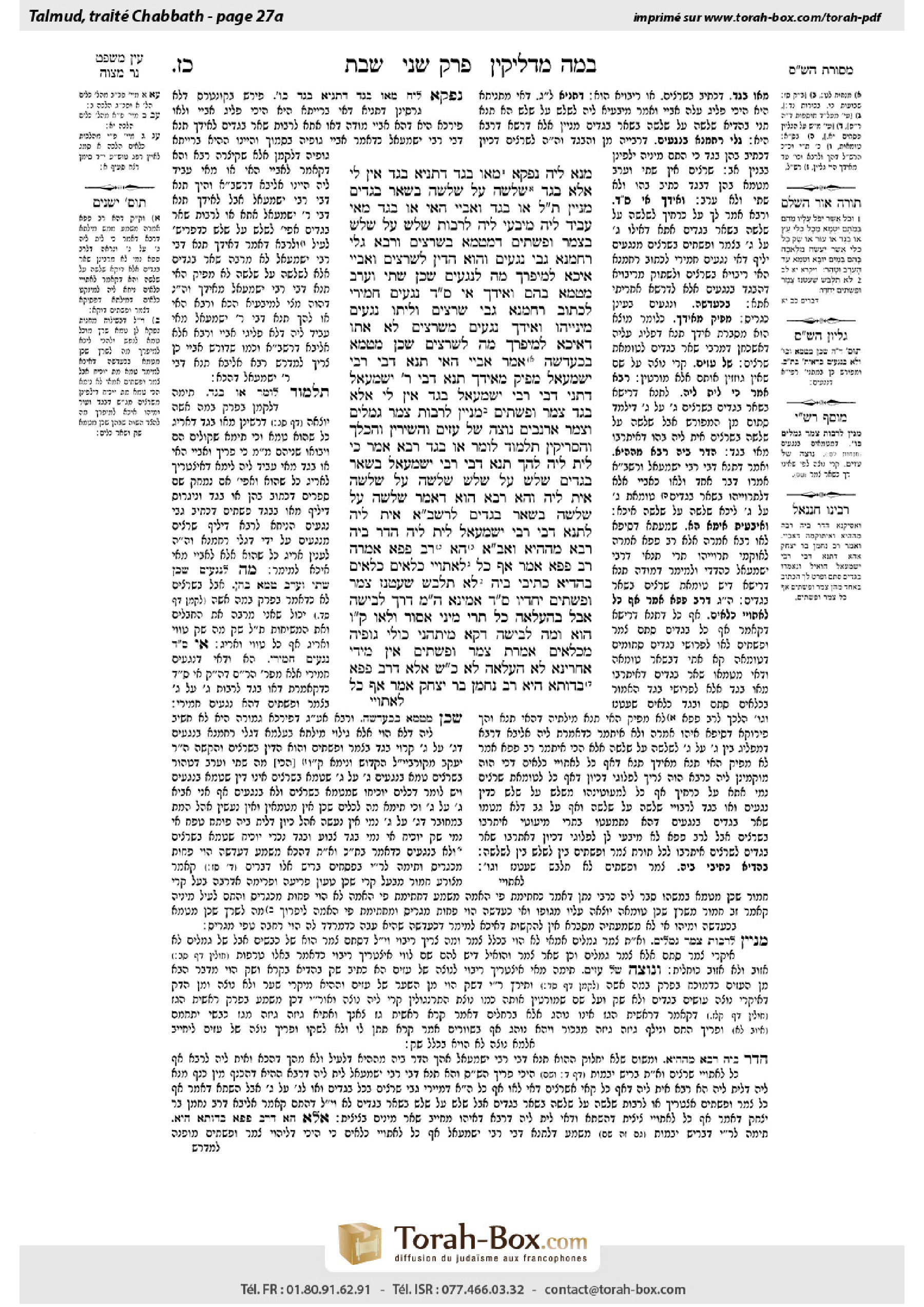
Shabbat 27a: Talmud study for Daf Yomi
Daf Yomi is the daily study of one Talmud folio. Explore 37 tractates with scans, Hebrew text, Sefaria English and AI-generated French translations where annotated.
Passage selection and English or AI-generated French translation are available where the scan has annotations. Daf Study is independent of Torah-Box and Sefaria.
Browse Shabbat · שבת · All tractatesShabbat 27a text and translations
This page of Shabbat includes the Aramaic text, an English translation and an AI-generated French translation, alongside the scan above.
שבת כ״ז א · Aramaic and Hebrew text
מְנָא לֵיהּ? נָפְקָא מֵ״אוֹ בֶגֶד״. דְּתַנְיָא: ״בֶּגֶד״ — אֵין לִי אֶלָּא בֶּגֶד, שְׁלֹשָׁה עַל שְׁלֹשָׁה בִּשְׁאָר בְּגָדִים מִנַּיִין? תַּלְמוּד לוֹמַר: ״אוֹ בֶגֶד״.
וְאַבָּיֵי, הַאי ״אוֹ בֶגֶד״ מַאי עָבֵיד לֵיהּ? מִיבְּעֵי לֵיהּ לְרַבּוֹת שָׁלֹשׁ עַל שָׁלֹשׁ בְּצֶמֶר וּפִשְׁתִּים דְּמִטַּמֵּא בִּשְׁרָצִים.
וְרָבָא, גַּלִּי רַחֲמָנָא גַּבֵּי נְגָעִים, וְהוּא הַדִּין לִשְׁרָצִים.
וְאַבָּיֵי, אִיכָּא לְמִיפְרַךְ: מַה לִּנְגָעִים שֶׁכֵּן שְׁתִי וָעֵרֶב מִטַּמֵּא בָּהֶם.
וְאִידַּךְ: אִי סָלְקָא דַּעְתָּךְ נְגָעִים חֲמִירִי, לִכְתּוֹב רַחֲמָנָא גַּבֵּי שְׁרָצִים וְלֵיתוּ נְגָעִים מִינַּיְיהוּ.
וְאִידַּךְ: נְגָעִים מִשְּׁרָצִים לָא אָתוּ, דְּאִיכָּא לְמִיפְרַךְ: מַה לִּשְׁרָצִים שֶׁכֵּן מְטַמְּאִין בְּכַעֲדָשָׁה.
אָמַר אַבָּיֵי: הַאי תַּנָּא דְּבֵי רַבִּי יִשְׁמָעֵאל מַפֵּיק מֵאִידָךְ תַּנָּא דְּבֵי רַבִּי יִשְׁמָעֵאל. דְּתָנֵי דְּבֵי רַבִּי יִשְׁמָעֵאל ״בֶּגֶד״ — אֵין לִי אֶלָּא בֶּגֶד צֶמֶר וּפִשְׁתִּים, מִנַּיִין לְרַבּוֹת צֶמֶר גְּמַלִּים וְצֶמֶר אַרְנָבִים, נוֹצָה שֶׁל עִזִּים וְהַשִּׁירִין וְהַכָּלָךְ וְהַסְּרִיקִין? — תַּלְמוּד לוֹמַר: ״אוֹ בֶגֶד״.
רָבָא אָמַר: כִּי לֵית לֵיהּ לְהַךְ תַּנָּא דְּבֵי רַבִּי יִשְׁמָעֵאל בִּשְׁאָר בְּגָדִים שָׁלֹשׁ עַל שָׁלֹשׁ, שְׁלֹשָׁה עַל שְׁלֹשָׁה אִית לֵיהּ.
וְהָא רָבָא הוּא דְּאָמַר שְׁלֹשָׁה עַל שְׁלֹשָׁה בִּשְׁאָר בְּגָדִים, לְרַבִּי שִׁמְעוֹן בֶּן אֶלְעָזָר אִית לֵיהּ, לְתַנָּא דְּבֵי רַבִּי יִשְׁמָעֵאל לֵית לֵיהּ! הֲדַר בֵּיהּ רָבָא מֵהַהִיא. וְאִי בָּעֵית אֵימָא, הָא רַב פָּפָּא אַמְרַהּ.
רַב פָּפָּא אָמַר: אַף כֹּל, לְאֵתוּיֵי כִּלְאַיִם. כִּלְאַיִם בְּהֶדְיָא כְּתִיבִי בֵּיהּ: ״לֹא תִלְבַּשׁ שַׁעַטְנֵז צֶמֶר וּפִשְׁתִּים יַחְדָּיו״! סָלְקָא דַּעְתָּךְ אָמֵינָא, הָנֵי מִילֵּי דֶּרֶךְ לְבִישָׁה, אֲבָל בְּהַעֲלָאָה כֹּל תְּרֵי מִינֵי אָסוּר.
וְלָאו קַל וָחוֹמֶר הוּא? וּמָה לְבִישָׁה דְּקָא מִיתְהֲנֵי כּוּלֵּי גּוּפֵיהּ מִכִּלְאַיִם, אָמְרַתְּ צֶמֶר וּפִשְׁתִּים — אֵין, מִידֵּי אַחֲרִינָא לָא. הַעֲלָאָה לֹא כׇּל שֶׁכֵּן? אֶלָּא דְּרַב פָּפָּא בְּדוּתָא הִיא.
רַב נַחְמָן בַּר יִצְחָק אָמַר: אַף כֹּל
Shabbat 27a · English translation
from where does Rabbi Shimon ben Elazar derive that it can become ritually impure? The Gemara answers: In his opinion, it is derived from the verse that speaks of the ritual impurity of creeping animals: “Or a garment, or skin, or sack” (Leviticus 11:32). The additional “or” comes to include items that are not generally included in the definition of garment. As it was taught in a baraita: From the fact that it says garment, I have derived nothing other than a whole garment; however, a swatch that is three by three handbreadths in other garments, from where is it derived that it can become ritually impure? The verse states: Or a garment.
The Gemara asks: And Abaye, who says that everyone agrees that other garments do not become ritually impure at all, this phrase: Or a garment, what does he do with it and what does it come to add? The Gemara answers: He needs it to include a small swatch of fabric that is three by three fingerbreadths made of wool or linen. Despite its size, it can become ritually impure from contact with creeping animals.
And Rava holds that there is no need for the verse to discuss that matter explicitly, as the Torah revealed in the case of leprosy that it is considered to be a garment, and the same is true with regard to the ritual impurity of creeping animals.
And Abaye holds that one cannot derive the halakhot of creeping animals from the halakhot of leprosy, as there is room to refute that comparison in the following manner: What comparison is there to leprosy, which has more stringent halakhot of ritual impurity, as even the warp and woof threads alone can become ritually impure from it, which is not the case with regard to ritual impurity from creeping animals? Therefore, even small scraps can become ritually impure from leprosy.
The other amora, Rava, says: If it should enter your mind to say that leprosy is more stringent, then the Torah should have written the halakha with regard to creeping animals, and let leprosy be derived from them. Ultimately, the two halakhot are paralleled to one another in the Torah. It would have been simpler to explicitly write the laws of creeping animals and to derive leprosy from them. Since that is not the case, it is proof that the halakhot of creeping animals can be derived from leprosy.
The other amora, Abaye, said that this contention is fundamentally unsound, as leprosy could not be derived from creeping animals because there is room to refute this idea and challenge: What is the comparison to the ritual impurity of creeping animals, which is more stringent than the ritual impurity of leprosy, as the creeping animal makes one ritually impure even in a case where it is a lentil-bulk, which is not true of other types of ritual impurity? Therefore, verses were necessary to teach about the ritual impurity of both creeping animals and leprosy.
Abaye said: This statement of the tanna of the school of Rabbi Yishmael diverges from another statement of the tanna of the school of Rabbi Yishmael, as the tanna of the school of Rabbi Yishmael taught: From the fact that the verse says garment, I have derived nothing other than the halakha that a garment of wool or linen can become ritually impure. However, from where is it derived to include garments made of camels’ hair and rabbits’ wool, goats’ hair or the types of silk, the shirayin, the kalakh, and the serikin among the fabrics that can become ritually impure? The verse states: Or a garment. The word “or” serves as an amplification to include all types of fabric.
Whereas Rava said: There is no need to say that there is a dispute in this case between two tanna’im from a single school. Rather, when this tanna from the school of Rabbi Yishmael, quoted above, is not of the opinion that there is ritual impurity in other garments, it is only with regard to a swatch that is three by three fingerbreadths; however, with regard to a cloth that is three by three handbreadths he is of the opinion that it becomes ritually impure. His previous statement came to exclude a small garment from becoming ritually impure. This statement is referring to a larger garment that is three by three handbreadths.
The Gemara asks: Isn’t Rava the one who said above that, in the case of three by three handbreadths in other garments, Rabbi Shimon ben Elazar is of the opinion that they can become ritually impure, whereas the tanna of the school of Rabbi Yishmael is not of the opinion that they become ritually impure? The Gemara answers: Rava retracted that opinion in order to reconcile the opinions of the tanna’im of the school of Rabbi Yishmael. And if you wish, say instead a different answer: Rav Pappa said this statement and not Rava. Since Rav Pappa was the primary disciple of Rava, the Gemara attributed his statement to Rava.
Rav Pappa himself understood the first statement of the tanna of the school of Rabbi Yishmael and stated it in a completely different manner. In his opinion, the derivation from the halakhot of leprosy, which concluded that even all nonspecific mentions of garments in the Torah refer to wool or linen, came to include the halakhot of diverse kinds, the Torah prohibition to wear clothing made from a mixture of wool and linen threads. He sought to prove that the halakhot of prohibited mixtures of threads apply only to wool and linen. The Gemara asks: Why does he require this derivation with regard to the prohibition of diverse kinds? The fact that the prohibition is limited to wool and linen is explicitly written, as it is stated: “You shall not wear diverse kinds, wool and linen together” (Deuteronomy 22:11). The Gemara answers: Nevertheless, an additional derivation was necessary, as it would have entered your mind to say that this, the restriction of the prohibition of diverse kinds to wool and linen, applies specifically to a case when one uses them together in the manner of wearing them; however, in merely placing the garments upon oneself, any two kinds are prohibited. Therefore, it was necessary to derive that the garment mentioned is restricted to wool and linen.
This claim is rejected: And is it not an a fortiori inference? Just as in the case of wearing the garment, where one’s entire body derives benefit from the diverse kinds, you said that wool and linen, yes, are included in the prohibition, other materials, no, are not included; in the case of merely placing the garment upon himself, all the more so that the halakha should not be more stringent. Rather, certainly the halakha that was attributed to Rav Pappa is a mistake, and he did not say it.
Rav Naḥman bar Yitzḥak also said that those statements of the tanna of the school of Rabbi Yishmael do not refer to the halakhot of ritual impurity. They refer to another topic. In his opinion, the tanna of the school of Rabbi Yishmael came to say that just as the halakhot of leprosy are limited to garments made from wool or linen, so too, all
Shabbat 27a · Traduction française (IA)
D’où Rabbi Shimon ben Elazar déduit-il que cela peut contracter l’impureté rituelle ? La Guemara répond : Selon lui, cela se déduit du verset qui traite de l’impureté rituelle des animaux rampants : « Ou un vêtement, ou une peau, ou un sac » (Lévitique 11, 32). Le « ou » supplémentaire vient inclure des objets qui ne sont généralement pas compris dans la définition d’un vêtement. Ainsi, il a été enseigné dans une baraïta : Du fait que le verset dit « vêtement », je n’ai déduit que le cas d’un vêtement entier. Mais d’où déduit-on qu’une pièce de tissu de trois sur trois téfaḥim, dans le cas d’autres vêtements, peut contracter l’impureté rituelle ? Le verset dit : « Ou un vêtement ».
La Guemara demande : Et Abaye, qui dit que tous s’accordent à dire que les autres vêtements ne contractent jamais l’impureté rituelle, que fait-il de cette expression « ou un vêtement », et qu’est-elle venue ajouter ? La Guemara répond : Il en a besoin pour inclure une petite pièce de tissu de trois sur trois doigts, faite de laine ou de lin. Malgré sa taille, elle peut contracter l’impureté rituelle au contact d’animaux rampants.
Rava, lui, considère qu’il n’est pas nécessaire que le verset traite explicitement de cette question, car la Torah a révélé, dans le cas de la lèpre, qu’il est considéré comme un vêtement ; il en va de même pour l’impureté rituelle due aux animaux rampants.
Abaye considère qu’on ne peut pas déduire les halakhot relatives aux animaux rampants de celles relatives à la lèpre, car cette comparaison peut être réfutée ainsi : Quelle comparaison peut-on faire avec la lèpre, dont les lois d’impureté rituelle sont plus rigoureuses, puisque même les seuls fils de chaîne et de trame peuvent contracter son impureté rituelle, contrairement à l’impureté rituelle due aux animaux rampants ? C’est pourquoi même de petits morceaux peuvent contracter l’impureté rituelle due à la lèpre.
L’autre amora, Rava, dit : Si l’on devait penser que la lèpre est plus rigoureuse, la Torah aurait dû écrire la halakha concernant les animaux rampants et laisser déduire celle de la lèpre à partir de celle-ci. En définitive, les deux halakhot sont mises en parallèle dans la Torah. Il aurait été plus simple d’écrire explicitement les lois relatives aux animaux rampants et d’en déduire celles relatives à la lèpre. Puisque ce n’est pas le cas, cela prouve que les halakhot concernant les animaux rampants peuvent être déduites de celles concernant la lèpre.
L’autre amora, Abaye, dit que cet argument est fondamentalement infondé, car on ne pourrait pas déduire les lois de la lèpre de celles des animaux rampants : cette idée peut être réfutée par l’objection suivante : Quelle comparaison peut-on faire avec l’impureté rituelle due aux animaux rampants, qui est plus rigoureuse que celle de la lèpre, puisque l’animal rampant rend impur même lorsqu’il n’a que le volume d’une lentille, ce qui n’est pas vrai pour les autres types d’impureté rituelle ? Il fallait donc des versets pour enseigner les lois de l’impureté rituelle aussi bien des animaux rampants que de la lèpre.
Abaye dit : Cette déclaration du tanna de l’école de Rabbi Yishmael diverge d’une autre déclaration du tanna de l’école de Rabbi Yishmael, car celui-ci a enseigné : Du fait que le verset dit « vêtement », je n’ai déduit que la halakha selon laquelle un vêtement de laine ou de lin peut contracter l’impureté rituelle. Mais d’où déduit-on que les vêtements faits de poils de chameau, de laine de lapin ou de poils de chèvre, ainsi que ceux faits de soie, de shirayin, de kalakh et de serikin, peuvent eux aussi contracter l’impureté rituelle ? Le verset dit : « Ou un vêtement ». Le mot « ou » sert à élargir la règle et à inclure toutes les sortes d’étoffes.
Rava dit : Il n’est pas nécessaire de dire qu’il y a ici un désaccord entre deux tannaïm d’une même école. En réalité, si le tanna de l’école de Rabbi Yishmael cité plus haut ne considère pas que les autres vêtements contractent l’impureté rituelle, cela ne concerne qu’une pièce de trois sur trois doigts ; mais, s’agissant d’un tissu de trois sur trois téfaḥim, il considère qu’il contracte l’impureté rituelle. Sa déclaration précédente visait à exclure les petites pièces de tissu de l’impureté rituelle. Cette déclaration-ci porte sur un vêtement plus grand, de trois sur trois téfaḥim.
La Guemara demande : N’est-ce pas Rava qui a dit plus haut que, pour les pièces de trois sur trois téfaḥim faites d’autres étoffes, Rabbi Shimon ben Elazar considère qu’elles peuvent contracter l’impureté rituelle, tandis que le tanna de l’école de Rabbi Yishmael considère qu’elles ne le peuvent pas ? La Guemara répond : Rava est revenu sur cette opinion afin de concilier les avis des tannaïm de l’école de Rabbi Yishmael. Et si tu préfères, dis plutôt une autre réponse : c’est Rav Pappa qui a formulé cette déclaration, et non Rava. Rav Pappa étant le principal disciple de Rava, la Guemara lui a attribué sa déclaration.
Rav Pappa lui-même a compris la première déclaration du tanna de l’école de Rabbi Yishmael d’une manière tout à fait différente. Selon lui, la déduction tirée des lois de la lèpre, qui concluait que même toutes les mentions non spécifiées de vêtements dans la Torah désignent la laine ou le lin, visait à inclure les lois du mélange interdit, c’est-à-dire l’interdiction de porter des vêtements faits d’un mélange de fils de laine et de lin. Il cherchait à prouver que les lois relatives aux mélanges interdits de fils ne s’appliquent qu’à la laine et au lin. La Guemara demande : Pourquoi a-t-il besoin de cette déduction concernant l’interdiction du mélange interdit ? Le fait que l’interdiction se limite à la laine et au lin est écrit explicitement, comme il est dit : « Tu ne porteras pas de mélange interdit, de laine et de lin ensemble » (Deutéronome 22, 11). La Guemara répond : Malgré tout, une déduction supplémentaire était nécessaire, car on aurait pu penser que la restriction de l’interdiction du mélange interdit à la laine et au lin ne s’applique que lorsqu’on les porte ensemble comme un vêtement ; mais que, lorsqu’on se contente de poser les vêtements sur soi, toutes les combinaisons de deux matières sont interdites. Il fallait donc déduire que le vêtement mentionné est limité à la laine et au lin.
Cette affirmation est rejetée : N’est-ce pas une déduction a fortiori ? De même que, lorsqu’on porte le vêtement et que tout le corps bénéficie du mélange interdit, tu as dit que la laine et le lin, oui, sont visés par l’interdiction, mais que les autres matières ne le sont pas, lorsqu’on se contente de poser le vêtement sur soi, à plus forte raison la halakha ne devrait-elle pas être plus rigoureuse. Par conséquent, la halakha attribuée à Rav Pappa est certainement erronée, et il ne l’a pas énoncée.
Rav Naḥman bar Yitzḥak a également dit que ces déclarations du tanna de l’école de Rabbi Yishmael ne portent pas sur les lois de l’impureté rituelle. Elles concernent un autre sujet. Selon lui, le tanna de l’école de Rabbi Yishmael est venu dire que, de même que les lois de la lèpre se limitent aux vêtements faits de laine ou de lin, de même, tous
Traduction française générée par IA à partir de l’édition anglaise de Sefaria. Vérifie toujours un passage avec le texte source.
Text from Sefaria: William Davidson Edition - Vocalized Aramaic (CC BY NC); William Davidson Edition - English (CC BY NC).