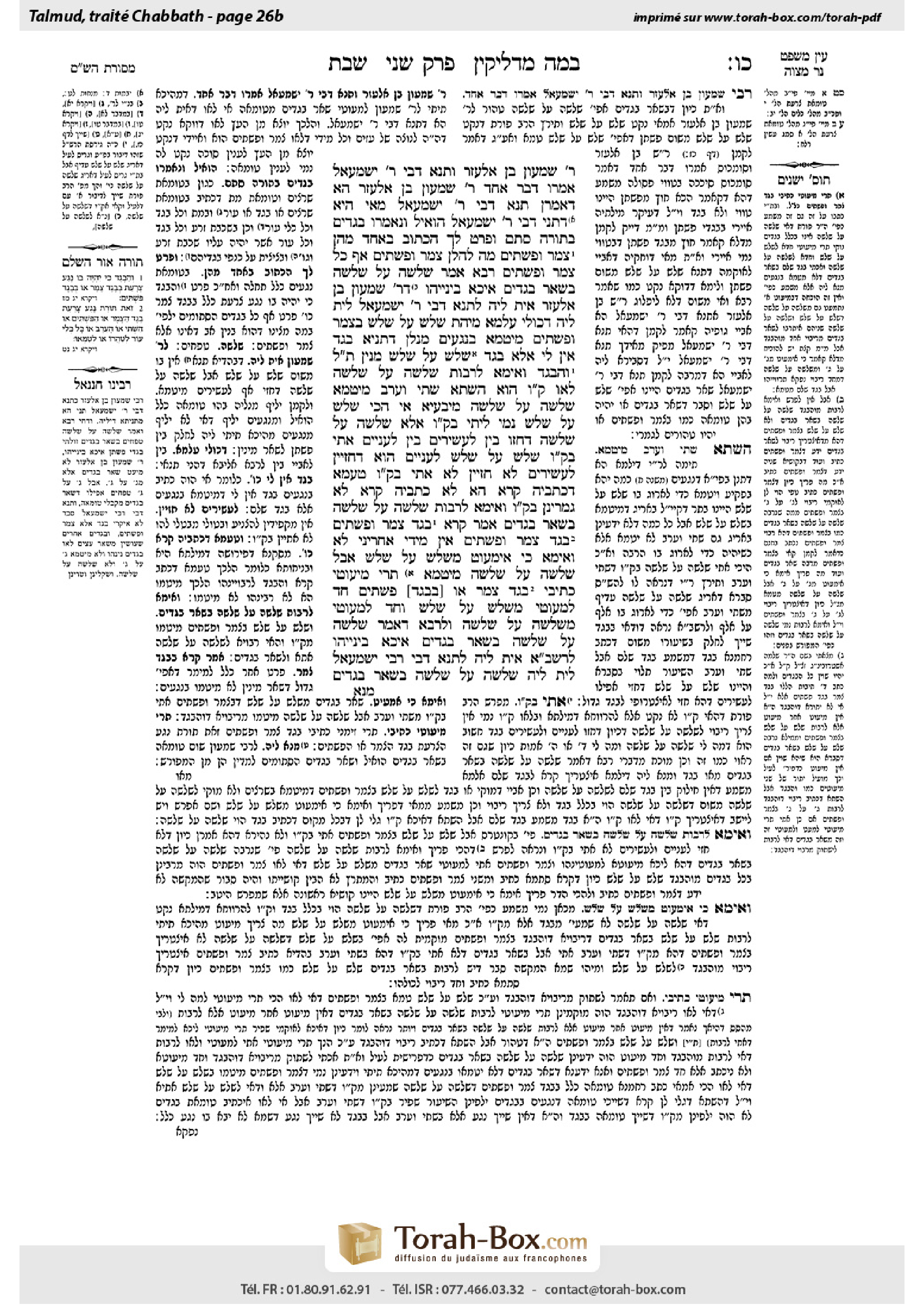
Shabbat 26b: Talmud study for Daf Yomi
Daf Yomi is the daily study of one Talmud folio. Explore 37 tractates with scans, Hebrew text, Sefaria English and AI-generated French translations where annotated.
Passage selection and English or AI-generated French translation are available where the scan has annotations. Daf Study is independent of Torah-Box and Sefaria.
Browse Shabbat · שבת · All tractatesShabbat 26b text and translations
This page of Shabbat includes the Aramaic text, an English translation and an AI-generated French translation, alongside the scan above.
שבת כ״ו ב · Aramaic and Hebrew text
רַבִּי שִׁמְעוֹן בֶּן אֶלְעָזָר וְתַנָּא דְּבֵי רַבִּי יִשְׁמָעֵאל אָמְרוּ דָּבָר אֶחָד. רַבִּי שִׁמְעוֹן בֶּן אֶלְעָזָר — הָא דַּאֲמַרַן. תַּנָּא דְּבֵי רַבִּי יִשְׁמָעֵאל מַאי הִיא? — דְּתָנֵי דְּבֵי רַבִּי יִשְׁמָעֵאל: הוֹאִיל וְנֶאֶמְרוּ ״בְּגָדִים״ בַּתּוֹרָה סְתָם, וּפָרַט לְךָ הַכָּתוּב בְּאֶחָד מֵהֶן צֶמֶר וּפִשְׁתִּים. מַה לְּהַלָּן צֶמֶר וּפִשְׁתִּים, אַף כֹּל צֶמֶר וּפִשְׁתִּים.
רָבָא אָמַר: שְׁלֹשָׁה עַל שְׁלֹשָׁה בִּשְׁאָר בְּגָדִים אִיכָּא בֵּינַיְיהוּ. דְּרַבִּי שִׁמְעוֹן בֶּן אֶלְעָזָר — אִית לֵיהּ. לְתַנָּא דְּבֵי רַבִּי יִשְׁמָעֵאל — לֵית לֵיהּ.
דְּכוּלֵּי עָלְמָא מִיהַת שָׁלֹשׁ עַל שָׁלֹשׁ בְּצֶמֶר וּפִשְׁתִּים מִיטַּמֵּא בִּנְגָעִים. מְנָלַן? דְּתַנְיָא: ״בֶּגֶד״ אֵין לִי אֶלָּא בֶּגֶד, שָׁלֹשׁ עַל שָׁלֹשׁ מִנַּיִן? — תַּלְמוּד לוֹמַר: ״וְהַבֶּגֶד״. וְאֵימָא לְרַבּוֹת שְׁלֹשָׁה עַל שְׁלֹשָׁה? לָאו קַל וָחוֹמֶר הוּא? הַשְׁתָּא שְׁתִי וָעֵרֶב מִיטַּמֵּא, שְׁלֹשָׁה עַל שְׁלֹשָׁה מִיבַּעְיָא?!
אִי הָכִי, שָׁלֹשׁ עַל שָׁלֹשׁ נָמֵי לֵיתֵי בְּקַל וָחוֹמֶר! אֶלָּא: שְׁלֹשָׁה עַל שְׁלֹשָׁה, דַּחֲזוּ בֵּין לַעֲשִׁירִים בֵּין לַעֲנִיִּים — אָתֵי בְּקַל וָחוֹמֶר. שָׁלֹשׁ עַל שָׁלֹשׁ, לַעֲנִיִּים הוּא דְּחַזְיָין לַעֲשִׁירִים לָא חַזְיָין — לָא אָתֵי בְּקַל וָחוֹמֶר. טַעְמָא דְּכַתְבֵיהּ קְרָא, הָא לָא כַּתְבֵיהּ קְרָא — לָא גָּמְרִינַן בְּקַל וָחוֹמֶר.
וְאֵימָא לְרַבּוֹת שְׁלֹשָׁה עַל שְׁלֹשָׁה בִּשְׁאָר בְּגָדִים? אָמַר קְרָא: ״בֶּגֶד צֶמֶר וּפִשְׁתִּים״. בֶּגֶד צֶמֶר וּפִשְׁתִּים — אִין, מִידֵּי אַחֲרִינֵי — לָא. וְאֵימָא כִּי אִימַּעוּט מִשָּׁלֹשׁ עַל שָׁלֹשׁ, אֲבָל שְׁלֹשָׁה עַל שְׁלֹשָׁה — מִיטַּמֵּא! תְּרֵי מִיעוּטֵי כְּתִיבִי: ״בֶּגֶד צֶמֶר אוֹ [בְּבֶגֶד] פִּשְׁתִּים״ — חַד לְמַעוֹטֵי מִשָּׁלֹשׁ עַל שָׁלֹשׁ, וְחַד לְמַעוֹטֵי מִשְּׁלֹשָׁה עַל שְׁלֹשָׁה.
וּלְרָבָא דְּאָמַר שְׁלֹשָׁה עַל שְׁלֹשָׁה בִּשְׁאָר בְּגָדִים אִיכָּא בֵּינַיְיהוּ, לְרַבִּי שִׁמְעוֹן בֶּן אֶלְעָזָר אִית לֵיהּ, לְתַנָּא דְּבֵי רַבִּי יִשְׁמָעֵאל לֵית לֵיהּ — שְׁלֹשָׁה עַל שְׁלֹשָׁה בִּשְׁאָר בְּגָדִים
Shabbat 26b · English translation
Rabbi Shimon ben Elazar and the tanna of the school of Rabbi Yishmael essentially said the same thing, even though they said it in different ways. The Gemara elaborates: The statement of Rabbi Shimon ben Elazar is that which we said: The only fabrics woven from plant materials that are considered bona fide fabrics are those made of linen. What is the statement of the tanna from the school of Rabbi Yishmael? As it was taught in the school of Rabbi Yishmael: Since the word garments is stated in the Torah unmodified, without stating from what materials those garments were made, and the verse specified in one of its references to garments, in the halakhot of ritual impurity of leprosy, wool and linen: “And the garment in which there will be the plague of leprosy, whether it be a woolen garment, or a linen garment” (Leviticus 13:47), the conclusion can be drawn: Just as below, when it mentions a garment in the case of leprosy, the Torah is referring to one made of wool or linen, so too, all garments mentioned in the Torah are those made from wool or linen. Other fabrics are not classified as garments.
In contrast to Abaye, who viewed the opinions expressed by Rabbi Shimon ben Elazar and the tanna of the school of Rabbi Yishmael as expressing the same idea, Rava said that the two opinions are not identical. There is a difference between them when the cloth is three by three handbreadths, with regard to other garments that are neither wool nor linen. As Rabbi Shimon ben Elazar says explicitly: If it is less than three by three fingerbreadths, indicating that he is of the opinion that a cloth that is three by three handbreadths that is suitable for use even by wealthy people can become ritually impure. In his opinion, the uniqueness of linen fabric is not that it can become ritually impure, but rather that a linen rag, even if it is very small, can become ritually impure. The tanna of the school of Rabbi Yishmael is not of the opinion that other garments can become ritually impure.
In any case, based on the above, everyone agrees that, clearly, three by three fingerbreadths in a wool or linen garment can become ritually impure with the impurity of leprosy. The Gemara asks: From where do we derive this? The Gemara responds that it is derived as it was taught in a baraita with regard to this matter. When the Torah states: Garment, unmodified, I have derived that nothing other than a whole garment can become ritually impure. However, with regard to a cloth that is three by three fingerbreadths, from where do I derive that it is also included in this halakha? The verse states: “And the garment in which there will be the plague of leprosy” (Leviticus 13:47). From the addition of the word: And the garment [vehabeged], it is derived that all woven swatches are subsumed within the category of garment in this matter. The Gemara asks: And perhaps say that it comes to include a woven garment that is three by three handbreadths? The Gemara answers: That is inconceivable. Is that not derived through an a fortiori inference? As, now, even the threads of the warp or the threads of the woof can become ritually impure, is it necessary to mention that a cloth three by three handbreadths can become ritually impure as well? A garment that is three by three handbreadths is comprised of several warp and woof threads that can themselves become ritually impure.
The Gemara rejects this: If so, then let us also derive a cloth that is three by three fingerbreadths through the same a fortiori inference from the warp and woof threads. Rather, it must be that this a fortiori inference is flawed. Threads woven into fabric do not maintain their previous status as they are no longer suitable to be used as warp and woof threads. Rather, cloths that are three by three handbreadths, which are suitable for use by both the wealthy and the poor as they are multipurpose cloths, can be derived through an a fortiori inference, as they are certainly more significant than the warp and woof threads and they become ritually impure. However, cloths that are three by three fingerbreadths, which are suitable for use by the poor but are unsuitable for use by the wealthy, are not derived through an a fortiori inference. Therefore, the reason that they can become ritually impure is specifically because it was written in the Torah. Had it not been written in the Torah, we would not derive it through an a fortiori inference.
The Gemara also asks: Indeed, there is amplification in the Torah, derived from the term: And the garment, which is a generalization that comes to expand upon the details that follow. And say that it comes to include the ruling that cloth that is three by three handbreadths in garments made of materials other than wool or linen can become ritually impure. The Gemara answers: That is inconceivable. The verse said: A garment of wool or linen, indicating that a garment made of wool or linen, yes, it becomes ritually impure; a garment made of other materials, no, it does not become ritually impure. The Gemara asks: And say that when the verse excluded, it excluded specifically a garment that is three by three fingerbreadths; however, a garment that is three by three handbreadths can become ritually impure. The Gemara replies: Two exclusions are written; once it is stated: “A garment of wool or linen” (Leviticus 13:59), and it is also stated: “Whether it be a woolen garment, or a linen garment” (Leviticus 13:47). One verse comes to exclude cloth of three by three fingerbreadths, and one verse comes to exclude cloth of three by three handbreadths, to emphasize that a garment made of a material that is neither wool nor linen cannot become ritually impure at all. This corresponds to Abaye’s opinion that garments not made of wool or linen cannot become ritually impure.
The Gemara asks: And according to the opinion of Rava, who said that the practical difference between the two opinions is with regard to cloth three by three handbreadths in other garments, that Rabbi Shimon ben Elazar is of the opinion that they can become ritually impure, whereas the tanna of the school of Rabbi Yishmael is not of the opinion that they can become ritually impure, in the case of a cloth that is three by three handbreadths in other garments,
Shabbat 26b · Traduction française (IA)
Rabbi Shimon ben Elazar et le tanna de l’école de Rabbi Yishmael ont, pour l’essentiel, exprimé la même idée, bien qu’ils l’aient formulée différemment. La Guemara développe : la déclaration de Rabbi Shimon ben Elazar est celle que nous avons rapportée : parmi les étoffes tissées à partir de matières végétales, seules celles qui sont faites de lin sont considérées comme de véritables étoffes. Quelle est la déclaration du tanna de l’école de Rabbi Yishmael ? Il a été enseigné dans l’école de Rabbi Yishmael : puisque le mot « vêtements » figure dans la Torah sans précision, sans indiquer de quelles matières ils sont faits, et que, dans l’une de ses occurrences concernant les vêtements, à propos des lois d’impureté rituelle de la lèpre, le verset précise qu’il s’agit de laine et de lin — « Le vêtement qui sera atteint de la plaie de lèpre, qu’il s’agisse d’un vêtement de laine ou d’un vêtement de lin » (Lévitique 13:47) —, on peut en conclure que, de même que, dans le passage relatif à la lèpre, le vêtement mentionné par la Torah est fait de laine ou de lin, de même, tous les vêtements mentionnés dans la Torah sont faits de laine ou de lin. Les autres étoffes ne sont pas considérées comme des vêtements.
Contrairement à Abayé, qui considérait que les opinions exprimées par Rabbi Shimon ben Elazar et le tanna de l’école de Rabbi Yishmael véhiculaient la même idée, Rava dit que les deux opinions ne sont pas identiques. Elles diffèrent dans le cas d’une étoffe de trois sur trois téfa’him, s’agissant des autres étoffes, qui ne sont faites ni de laine ni de lin. En effet, Rabbi Shimon ben Elazar dit explicitement : si elle mesure moins de trois sur trois doigts, ce qui indique qu’à son avis, une étoffe de trois sur trois téfa’him, utilisable même par les personnes aisées, peut contracter l’impureté rituelle. Selon lui, la particularité de l’étoffe de lin n’est pas qu’elle peut contracter l’impureté rituelle, mais qu’un chiffon de lin, même très petit, peut la contracter. Le tanna de l’école de Rabbi Yishmael, quant à lui, ne considère pas que les autres étoffes puissent contracter l’impureté rituelle.
Quoi qu’il en soit, d’après ce qui précède, tous s’accordent à dire qu’une étoffe de laine ou de lin de trois sur trois doigts peut assurément contracter l’impureté rituelle de la lèpre. La Guemara demande : D’où déduisons-nous cela ? Elle répond que cela se déduit de ce qui a été enseigné dans une baraïta à ce sujet. Lorsque la Torah dit « vêtement » sans autre précision, j’aurais déduit que seul un vêtement entier peut contracter l’impureté rituelle. Cependant, d’où déduisons-nous qu’une étoffe de trois sur trois doigts est également incluse dans cette halakha ? Le verset dit : « Le vêtement qui sera atteint de la plaie de lèpre » (Lévitique 13:47). L’ajout des mots « et le vêtement » [vehabeged] enseigne que tous les morceaux d’étoffe tissée sont inclus dans la catégorie des vêtements à cet égard. La Guemara demande : Peut-être faut-il dire que cela vient inclure une étoffe tissée de trois sur trois téfa’him ? Elle répond : C’est inconcevable. Cela ne se déduit-il pas par un raisonnement a fortiori ? En effet, puisque même les fils de chaîne ou les fils de trame peuvent contracter l’impureté rituelle, faut-il préciser qu’une étoffe de trois sur trois téfa’him peut elle aussi la contracter ? Une telle étoffe est composée de plusieurs fils de chaîne et de trame, qui peuvent eux-mêmes contracter l’impureté rituelle.
La Guemara rejette cette déduction : dans ce cas, déduisons également qu’une étoffe de trois sur trois doigts peut contracter l’impureté rituelle par le même raisonnement a fortiori, à partir des fils de chaîne et de trame. Il faut donc conclure que ce raisonnement a fortiori est erroné. Les fils tissés dans une étoffe ne conservent pas leur statut antérieur, puisqu’ils ne peuvent plus servir de fils de chaîne ou de trame. En revanche, les étoffes de trois sur trois téfa’him, qui peuvent être utilisées aussi bien par les personnes aisées que par les pauvres, car elles ont de multiples usages, peuvent être incluses par un raisonnement a fortiori : elles ont assurément plus d’importance que les fils de chaîne et de trame, et elles contractent l’impureté rituelle. Mais les étoffes de trois sur trois doigts, qui peuvent être utilisées par les pauvres mais ne conviennent pas aux personnes aisées, ne sont pas incluses par un raisonnement a fortiori. Par conséquent, si elles peuvent contracter l’impureté rituelle, c’est précisément parce que cela est écrit dans la Torah. Si cela n’avait pas été écrit dans la Torah, nous ne l’aurions pas déduit par un raisonnement a fortiori.
La Guemara demande également : Certes, la Torah comporte une amplification, déduite des mots « et le vêtement », qui constituent une généralité venant élargir la portée des détails qui suivent. Peut-on dire que cela vient inclure la règle selon laquelle une étoffe de trois sur trois téfa’him faite d’une matière autre que la laine ou le lin peut contracter l’impureté rituelle ? La Guemara répond : C’est inconcevable. Le verset dit « un vêtement de laine ou de lin », ce qui indique qu’un vêtement fait de laine ou de lin contracte l’impureté rituelle, mais qu’un vêtement fait d’autres matières ne la contracte pas. La Guemara demande : Peut-être faut-il dire que l’exclusion opérée par le verset concerne précisément une étoffe de trois sur trois doigts ; cependant, une étoffe de trois sur trois téfa’him peut contracter l’impureté rituelle. Elle répond : Deux exclusions sont écrites : « un vêtement de laine ou de lin » (Lévitique 13:59) et « qu’il s’agisse d’un vêtement de laine ou d’un vêtement de lin » (Lévitique 13:47). Un verset vient exclure une étoffe de trois sur trois doigts, et l’autre, une étoffe de trois sur trois téfa’him, pour souligner qu’un vêtement fait d’une matière qui n’est ni la laine ni le lin ne peut absolument pas contracter l’impureté rituelle. Cela correspond à l’opinion d’Abayé, selon laquelle les vêtements qui ne sont faits ni de laine ni de lin ne peuvent pas contracter l’impureté rituelle.
La Guemara demande : Et selon l’opinion de Rava, qui a dit que la différence pratique entre les deux opinions concerne les étoffes de trois sur trois téfa’him faites d’autres matières — Rabbi Shimon ben Elazar estimant qu’elles peuvent contracter l’impureté rituelle, tandis que le tanna de l’école de Rabbi Yishmael estime qu’elles ne le peuvent pas —, dans le cas d’une étoffe de trois sur trois téfa’him faite d’autres matières,
Traduction française générée par IA à partir de l’édition anglaise de Sefaria. Vérifie toujours un passage avec le texte source.
Text from Sefaria: William Davidson Edition - Vocalized Aramaic (CC BY NC); William Davidson Edition - English (CC BY NC).