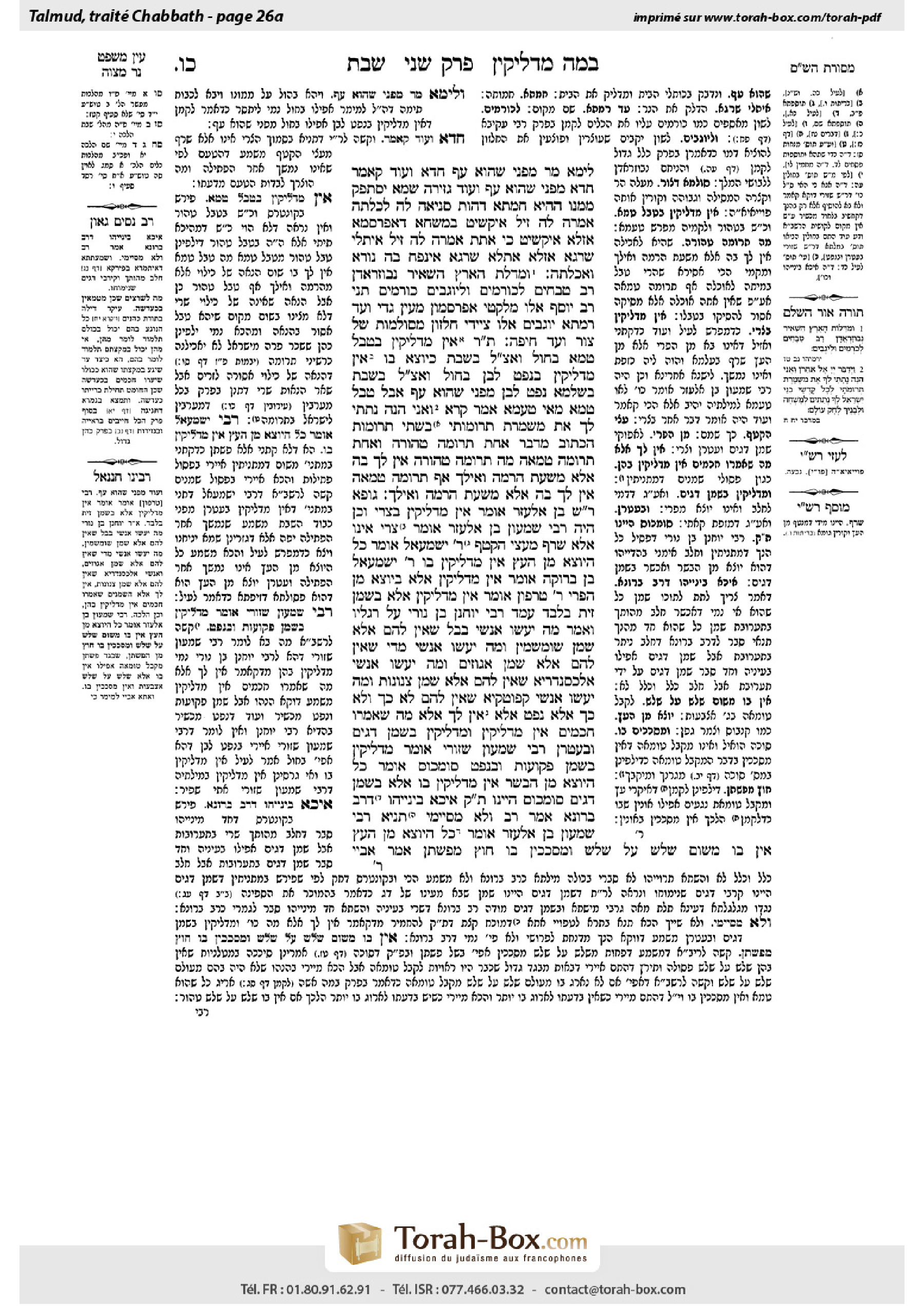
Shabbat 26a: Talmud study for Daf Yomi
Daf Yomi is the daily study of one Talmud folio. Explore 37 tractates with scans, Hebrew text, Sefaria English and AI-generated French translations where annotated.
Passage selection and English or AI-generated French translation are available where the scan has annotations. Daf Study is independent of Torah-Box and Sefaria.
Browse Shabbat · שבת · All tractatesShabbat 26a text and translations
This page of Shabbat includes the Aramaic text, an English translation and an AI-generated French translation, alongside the scan above.
שבת כ״ו א · Aramaic and Hebrew text
לֵימָא מָר: מִפְּנֵי שֶׁהוּא עָף. חֲדָא וְעוֹד קָאָמַר: חֲדָא — מִפְּנֵי שֶׁהוּא עָף. וְעוֹד — גְּזֵירָה שֶׁמָּא יִסְתַּפֵּק מִמֶּנּוּ.
הַהִיא חֲמָתָא דַּהֲוָת סָנְיָא לַהּ לְכַלְּתַהּ, אֲמַרָה לַהּ: זִיל אִיקַּשַּׁיט בְּמִשְׁחָא דַּאֲפַרְסְמָא. אֲזַלָא אִיקַּשַּׁיט. כִּי אֲתַא[י] אֲמַרָה לַהּ: זִיל אִיתְלַי שְׁרָגָא. אֲזַלָא אַתְלָא שְׁרָגָא. אִינְּפַח בַּהּ נוּרָא וַאֲכַלְתַּהּ.
״וּמִדַּלַּת הָאָרֶץ הִשְׁאִיר נְבוּזַרְאֲדָן רַב טַבָּחִים לְכוֹרְמִים וּלְיוֹגְבִים״. ״כּוֹרְמִים״ — תָּנֵי רַב יוֹסֵף אֵלּוּ מְלַקְּטֵי אֲפַרְסְמוֹן מֵעֵין גֶּדִי וְעַד רָמְתָא. ״יוֹגְבִים״ — אֵלּוּ צַיָּידֵי חִלָּזוֹן מִסּוּלָּמוֹת שֶׁל צוּר וְעַד חֵיפָה.
תָּנוּ רַבָּנַן: אֵין מַדְלִיקִין בְּטֶבֶל טָמֵא בַּחוֹל, וְאֵין צָרִיךְ לוֹמַר בְּשַׁבָּת. כַּיּוֹצֵא בוֹ: אֵין מַדְלִיקִין בְּנֵפְטְ לָבָן בַּחוֹל, וְאֵין צָרִיךְ לוֹמַר בְּשַׁבָּת. בִּשְׁלָמָא נֵפְטְ לָבָן — מִפְּנֵי שֶׁהוּא עָף, אֲבָל טֶבֶל טָמֵא מַאי טַעְמָא?
אָמַר קְרָא: ״וַאֲנִי הִנֵּה נָתַתִּי לְךָ אֶת מִשְׁמֶרֶת תְּרוּמוֹתָי״, בִּשְׁתֵּי תְרוּמוֹת הַכָּתוּב מְדַבֵּר: אַחַת תְּרוּמָה טְהוֹרָה וְאַחַת תְּרוּמָה טְמֵאָה. מָה תְּרוּמָה טְהוֹרָה אֵין לְךָ בָּהּ אֶלָּא מִשְּׁעַת הֲרָמָה וְאֵילָךְ, אַף תְּרוּמָה טְמֵאָה אֵין לְךָ בָּהּ אֶלָּא מִשְּׁעַת הֲרָמָה וְאֵילָךְ.
גּוּפָא. רַבִּי שִׁמְעוֹן בֶּן אֶלְעָזָר אוֹמֵר: אֵין מַדְלִיקִין בִּצְרִי, וְכֵן הָיָה רַבִּי שִׁמְעוֹן בֶּן אֶלְעָזָר אוֹמֵר: צֳרִי אֵינוֹ אֶלָּא שְׂרָף מֵעֲצֵי הַקְּטָף. רַבִּי יִשְׁמָעֵאל אוֹמֵר: כׇּל הַיּוֹצֵא מִן הָעֵץ אֵין מַדְלִיקִין בּוֹ. רַבִּי יִשְׁמָעֵאל בֶּן בְּרוֹקָה אוֹמֵר: אֵין מַדְלִיקִין אֶלָּא בַּיּוֹצֵא מִן הַפְּרִי. רַבִּי טַרְפוֹן אוֹמֵר: אֵין מַדְלִיקִין אֶלָּא בְּשֶׁמֶן זַיִת בִּלְבַד.
עָמַד רַבִּי יוֹחָנָן בֶּן נוּרִי עַל רַגְלָיו וְאָמַר: מַה יַּעֲשׂוּ אַנְשֵׁי בָבֶל שֶׁאֵין לָהֶם אֶלָּא שֶׁמֶן שׁוּמְשְׁמִין? וּמַה יַּעֲשׂוּ אַנְשֵׁי מָדַי שֶׁאֵין לָהֶם אֶלָּא שֶׁמֶן אֱגוֹזִים? וּמַה יַּעֲשׂוּ אַנְשֵׁי אֲלֶכְּסַנְדְּרִיָּא שֶׁאֵין לָהֶם אֶלָּא שֶׁמֶן צְנוֹנוֹת? וּמַה יַּעֲשׂוּ אַנְשֵׁי קַפּוֹטְקִיָּא שֶׁאֵין לָהֶם לֹא כָּךְ וְלֹא כָּךְ, אֶלָּא נֵפְטְ? — אֶלָּא אֵין לְךָ אֶלָּא מַה שֶּׁאָמְרוּ חֲכָמִים אֵין מַדְלִיקִין.
וּמַדְלִיקִין בְּשֶׁמֶן דָּגִים וּבְעִטְרָן. רַבִּי שִׁמְעוֹן שֵׁזוּרִי אוֹמֵר: מַדְלִיקִין בְּשֶׁמֶן פַּקּוּעוֹת וּבְנֵפְטְ. סוֹמְכוֹס אוֹמֵר: כׇּל הַיּוֹצֵא מִן הַבָּשָׂר אֵין מַדְלִיקִין בּוֹ, אֶלָּא בְּשֶׁמֶן דָּגִים. סוֹמְכוֹס הַיְינוּ תַּנָּא קַמָּא? אִיכָּא בֵּינַיְיהוּ דְּרַב בְּרוֹנָא אָמַר רַב, וְלָא מְסַיְּימִי.
תַּנְיָא, רַבִּי שִׁמְעוֹן בֶּן אֶלְעָזָר אוֹמֵר: כׇּל הַיּוֹצֵא מִן הָעֵץ אֵין בּוֹ מִשּׁוּם שָׁלֹשׁ עַל שָׁלֹשׁ, וּמְסַכְּכִין בּוֹ — חוּץ מִפִּשְׁתָּן. אָמַר אַבָּיֵי:
Shabbat 26a · English translation
Let the Master say a different reason: Because tar is volatile, i.e., it is liable to evaporate quickly and cause a fire. The Gemara answers: He stated one reason and another: One, because it is volatile and potentially dangerous; and, furthermore, due to a decree lest one take sap from it.
The Gemara relates: A mother-in-law who hated her daughter-in-law said to her: Go adorn yourself with balsam oil. She went and adorned herself. When she came, her mother-in-law said to her: Go light the lamp. She went and lit the lamp. She caught fire and was burned.
Since balsam oil was discussed, the Gemara cites the verse: “But Nebuzaradan the captain of the guard left of the poorest of the land to be vinedressers and husbandmen” (Jeremiah 52:16). The Gemara explains the verse: With regard to vinedressers, Rav Yosef taught: These poorest of the land were the balsam collectors in the south of Eretz Yisrael, in the expanse from Ein Gedi to Ramata. And the husbandmen; these are the trappers of the snail [ḥilazon], from which the sky blue dye is produced in the north of the country, in the area between the Promontory of Tyre and Ḥaifa. Only a small number of poor people could barely eke out a living from these tasks, which involved mere gathering.
The Sages taught: One may not light with ritually impure untithed produce [tevel] during the week, and needless to say one may not light with it on Shabbat. On a similar note, one may not light with white naphtha during the week, and needless to say one may not light with it on Shabbat. Granted, with regard to white naphtha, its prohibition is understandable because it is volatile and potentially dangerous. However, with regard to ritually impure tevel, what is the reason that the Sages prohibited lighting with it?
The Gemara answers that the verse said: “And I, behold, I have given you the charge of My terumot” (Numbers 18:8). From the fact that terumot is plural, the Sages derived that the verse is speaking of two terumot: Both teruma that is ritually pure and teruma that is ritually impure. Just as with regard to teruma that is ritually pure, you, the priest, have permission to benefit from it only from the time teruma was separated and onward, so too, with regard to teruma that is ritually impure, you have permission to benefit from it only from the time teruma was separated and onward. Since a portion of the untithed produce is teruma that has not yet been separated, it is prohibited even for a priest to use it.
The Gemara proceeds to discuss the matter of the Tosefta itself, the case of lighting with sap from balsam trees on Shabbat. Rabbi Shimon ben Elazar says: One may not light with tzori on Shabbat. And Rabbi Shimon ben Elazar would also say: Tzori, which is one of the component spices of the incense in the Temple, is merely the sap that emerges from balsam trees, and is not part of the balsam tree itself. Rabbi Yishmael says: Anything that originates from the tree, one may not light with it; only materials that do not come from trees may be used. Rabbi Yishmael ben Beroka says: One may only light with a substance that emerges from the fruit. Rabbi Tarfon says: One may only light with olive oil alone.
The Gemara relates: Rabbi Yoḥanan ben Nuri stood on his feet and, contrary to this statement, said: And what shall the people of Babylonia, who have only sesame oil, do? And what shall the people of Media, who have only nut oil, do? And what shall the people of Alexandria, who have only radish oil, do? And what shall the people of Cappadocia, who have neither this nor that but only naphtha, do? Rather, you have a prohibition only with regard to those substances with regard to which the Sages said: One may not light with them. All other oils are permitted.
And one may light with fish oil and tar. Rabbi Shimon Shezuri says: One may light with gourd oil and naphtha. Sumakhos says: Among the substances that emerge from the flesh of living beings, one may light only with fish oil. The Gemara asks: The opinion of Sumakhos is identical to the opinion of the first tanna, who also permits lighting with fish oil. The Gemara answers: There is a practical difference between them with regard to what Rav Beruna said that Rav said: One is permitted to use molten fat to which oil was added for lighting. They disagree with regard to this halakha; however, their opinions are not defined and it is unclear which of them permits using it and which prohibits using it.
It was taught in a baraita that Rabbi Shimon ben Elazar says: Anything that emerges from the tree does not have the legal status of an area of three by three fingerbreadths. Even if it is three by three fingerbreadths, it is not considered sufficiently large to become ritually impure. And, therefore, one may roof his sukka with it, as the roofing of his sukka may not be made from any material that can become ritually impure. This is the case for everything that originates from a tree with the exception of linen, which has a unique legal status. Abaye said:
Shabbat 26a · Traduction française (IA)
Que le Maître donne une autre raison : le goudron est volatil, c’est-à-dire qu’il risque de s’évaporer rapidement et de provoquer un incendie. La Guemara répond : il a donné une raison, puis une autre : d’abord, parce qu’il est volatil et potentiellement dangereux ; ensuite, en raison d’un décret, de peur que l’on ne prélève de la sève de cet arbre.
La Guemara rapporte : une belle-mère qui détestait sa belle-fille lui dit : « Va te parer d’huile de baumier. » Elle alla s’en parer. À son retour, sa belle-mère lui dit : « Va allumer la lampe. » Elle alla l’allumer. Elle prit feu et fut brûlée.
Puisqu’il a été question de l’huile de baumier, la Guemara cite le verset : « Mais Nebuzaradan, chef des gardes, laissa quelques-uns des plus pauvres du pays pour être vignerons et laboureurs » (Jérémie 52,16). La Guemara explique le verset : au sujet des vignerons, Rav Yosef enseignait que ces plus pauvres du pays étaient les cueilleurs de baumier dans le sud d’Eretz Israël, dans la région qui s’étend d’Ein Gedi à Ramata. Quant aux laboureurs, ce sont les chasseurs du mollusque [ḥilazon], dont on tire la teinture bleu ciel, dans le nord du pays, entre le cap de Tyr et Haïfa. Seul un petit nombre de pauvres pouvait à peine gagner sa vie grâce à ces activités, qui consistaient simplement à ramasser.
Les Sages ont enseigné : on ne peut pas allumer avec des produits non dîmés [tevel] rituellement impurs pendant la semaine, et à plus forte raison ne peut-on pas allumer avec eux le Chabbat. De même, on ne peut pas allumer avec du naphte blanc pendant la semaine, et à plus forte raison ne peut-on pas allumer avec lui le Chabbat. Pour le naphte blanc, l’interdiction se comprend, puisqu’il est volatil et potentiellement dangereux. Mais, pour le tevel rituellement impur, pourquoi les Sages ont-ils interdit de l’utiliser pour allumer ?
La Guemara répond que le verset dit : « Et moi, voici que je t’ai donné la charge de mes teroumot » (Nombres 18,8). Du fait que le mot teroumot est au pluriel, les Sages ont déduit que le verset parle de deux teroumot : la terouma rituellement pure et la terouma rituellement impure. De même que, pour la terouma rituellement pure, toi, le prêtre, n’es autorisé à en tirer profit qu’à partir du moment où la terouma a été séparée, de même, pour la terouma rituellement impure, tu n’es autorisé à en tirer profit qu’à partir du moment où la terouma a été séparée. Puisqu’une partie des produits non dîmés constitue de la terouma qui n’a pas encore été séparée, il est interdit même à un prêtre de l’utiliser.
La Guemara revient au sujet même de la Tosefta : le cas où l’on allume le Chabbat avec de la sève de baumiers. Rabbi Shimon ben Elazar dit : on ne peut pas allumer avec du tzori le Chabbat. Rabbi Shimon ben Elazar disait également : le tzori, qui est l’un des ingrédients de l’encens du Temple, n’est que la sève qui s’écoule des baumiers et ne fait pas partie de l’arbre lui-même. Rabbi Yishmael dit : on ne peut pas allumer avec quoi que ce soit qui provient de l’arbre ; seuls peuvent être utilisés des matériaux qui ne proviennent pas des arbres. Rabbi Yishmael ben Beroka dit : on ne peut allumer qu’avec une substance qui provient du fruit. Rabbi Tarfon dit : on ne peut allumer qu’avec de l’huile d’olive.
La Guemara rapporte : Rabbi Yoḥanan ben Nuri se leva et déclara, à l’encontre de cette affirmation : « Et que feront les habitants de Babylonie, qui n’ont que de l’huile de sésame ? Et que feront les habitants de Médie, qui n’ont que de l’huile de noix ? Et que feront les habitants d’Alexandrie, qui n’ont que de l’huile de radis ? Et que feront les habitants de Cappadoce, qui n’ont ni l’une ni l’autre, mais seulement du naphte ? » L’interdiction ne concerne donc que les substances au sujet desquelles les Sages ont dit : « On ne peut pas allumer avec elles. » Toutes les autres huiles sont permises.
Et l’on peut allumer avec de l’huile de poisson et du goudron. Rabbi Shimon Shezuri dit : on peut allumer avec de l’huile de coloquinte et du naphte. Sumakhos dit : parmi les substances qui proviennent de la chair des êtres vivants, on ne peut allumer qu’avec de l’huile de poisson. La Guemara demande : l’avis de Sumakhos est identique à celui du premier tanna, qui permet lui aussi d’allumer avec de l’huile de poisson. La Guemara répond : il existe entre eux une différence pratique concernant ce que Rav Beruna a dit au nom de Rav : il est permis d’utiliser pour allumer de la graisse fondue à laquelle on a ajouté de l’huile. Ils sont en désaccord sur cette halakha ; toutefois, leurs avis ne sont pas précisés et il n’est pas clair lequel d’entre eux en autorise l’utilisation et lequel l’interdit.
Il a été enseigné dans une baraïta que Rabbi Shimon ben Elazar dit : toute matière qui provient de l’arbre n’a pas le statut d’une surface de trois sur trois largeurs de doigt. Même si elle mesure trois sur trois largeurs de doigt, elle n’est pas considérée comme suffisamment grande pour devenir rituellement impure. Par conséquent, on peut en couvrir sa soukka, car la couverture de sa soukka ne peut pas être faite d’un matériau susceptible de devenir rituellement impur. Cela vaut pour toute matière provenant d’un arbre, à l’exception du lin, qui possède un statut juridique particulier. Abaye dit :
Traduction française générée par IA à partir de l’édition anglaise de Sefaria. Vérifie toujours un passage avec le texte source.
Text from Sefaria: William Davidson Edition - Vocalized Aramaic (CC BY NC); William Davidson Edition - English (CC BY NC).