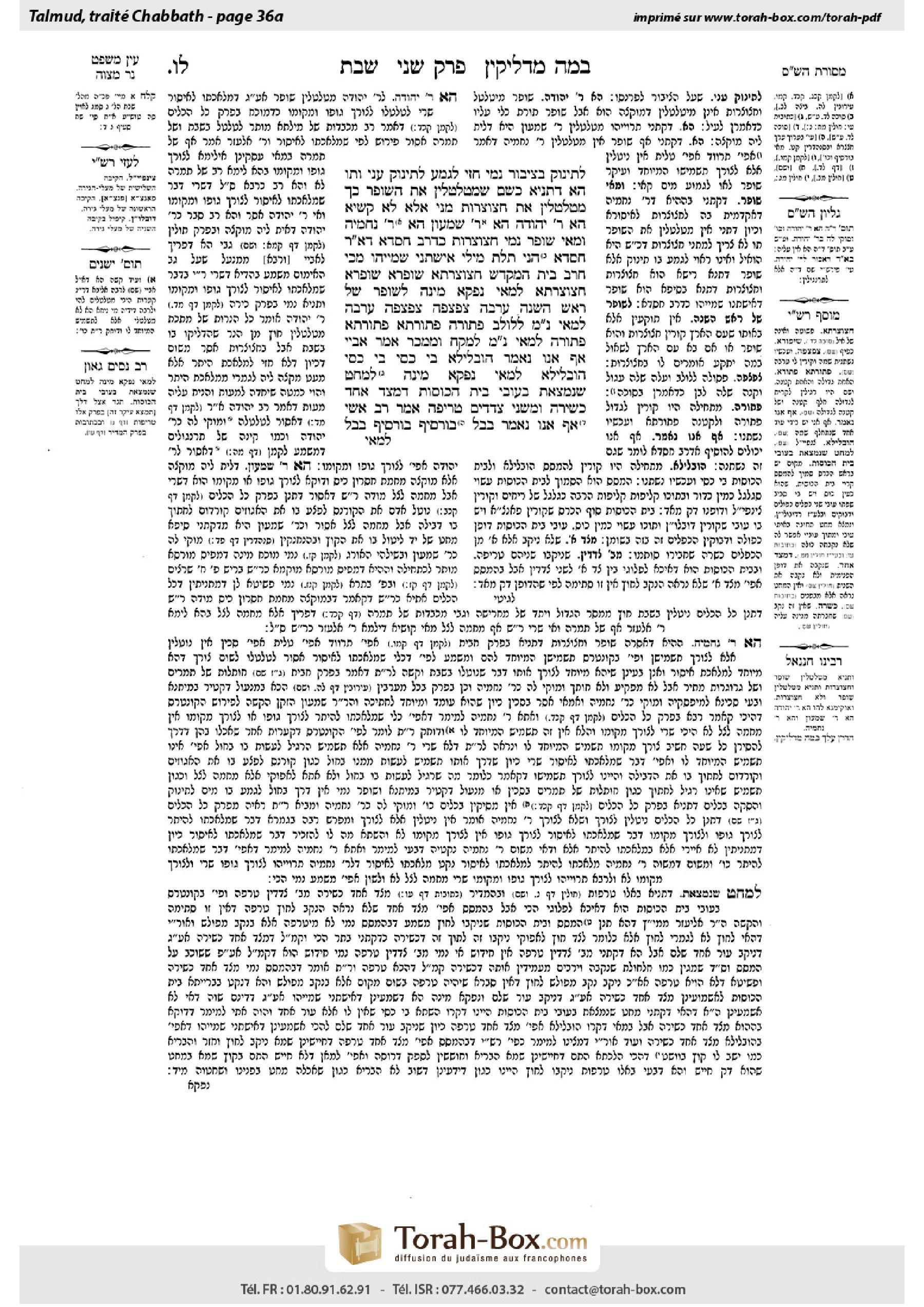
Shabbat 36a: Talmud study for Daf Yomi
Daf Yomi is the daily study of one Talmud folio. Explore 37 tractates with scans, Hebrew text, Sefaria English and AI-generated French translations where annotated.
Passage selection and English or AI-generated French translation are available where the scan has annotations. Daf Study is independent of Torah-Box and Sefaria.
Browse Shabbat · שבת · All tractatesShabbat 36a text and translations
This page of Shabbat includes the Aramaic text, an English translation and an AI-generated French translation, alongside the scan above.
שבת ל״ו א · Aramaic and Hebrew text
לְתִינוֹק. בְּצִיבּוּר נָמֵי, חֲזֵי לְגַמֵּעַ לְתִינוֹק עָנִי? וְתוּ, הָא דְּתַנְיָא: כְּשֵׁם שֶׁמְּטַלְטְלִין אֶת הַשּׁוֹפָר כָּךְ מְטַלְטְלִין אֶת הַחֲצוֹצְרוֹת. מַנִּי? אֶלָּא לָא קַשְׁיָא: הָא רַבִּי יְהוּדָה, הָא רַבִּי שִׁמְעוֹן, הָא רַבִּי נְחֶמְיָה.
וּמַאי שׁוֹפָר — נָמֵי חֲצוֹצְרוֹת. כִּדְרַב חִסְדָּא. דְּאָמַר רַב חִסְדָּא: הָנֵי תְּלָת מִילֵּי אִישְׁתַּנִּי שְׁמַיְיהוּ מִכִּי חֲרַב בֵּית הַמִּקְדָּשׁ: ״חֲצוֹצַרְתָּא״ — ״שׁוֹפָרָא״, ״שׁוֹפָרָא״ — ״חֲצוֹצַרְתָּא״. לְמַאי נָפְקָא מִינָּה? לְשׁוֹפָר שֶׁל רֹאשׁ הַשָּׁנָה.
״עֲרָבָה״ — ״צַפְצָפָה״, ״צַפְצָפָה״ — ״עֲרָבָה״. לְמַאי נָפְקָא מִינָּה? לְלוּלָב.
״פָּתוּרָה״ — ״פָּתוּרְתָּא״, ״פָּתוּרְתָּא״ — ״פָּתוּרָה״. לְמַאי נָפְקָא מִינָּה? לְמִקָּח וּמִמְכָּר.
אָמַר אַבָּיֵי, אַף אָנוּ נֹאמַר: ״הוּבְלִילָא״ — ״בֵּי כָסֵי״, ״בֵּי כָסֵי״ — ״הוּבְלִילָא״. לְמַאי נָפְקָא מִינָּה — לְמַחַט שֶׁנִּמְצֵאת בְּעוֹבִי בֵּית הַכּוֹסוֹת, דְּמִצַּד אֶחָד כְּשֵׁירָה, וּמִשְּׁנֵי צְדָדִים טְרֵיפָה.
אָמַר רַב אָשֵׁי, אַף אָנוּ נֹאמַר: ״בָּבֶל״ — ״בּוֹרְסִיף״, ״בּוֹרְסִיף״ — ״בָּבֶל״.
Shabbat 36a · English translation
to a child. Because the mouth of a shofar is bent, one can pour a little water at a time. If so, a shofar belonging to the community is also suitable to feed water to a poor infant whose sustenance is provided by the community. And furthermore, that halakha which was taught in a baraita: Just as one may move the shofar, so too one may move the trumpets, is contrary to that which was taught previously that there is a difference between moving the shofar and moving the trumpet. In accordance with whose opinion is that baraita? Rather, this is not difficult, as it can be explained that these three baraitot correspond to the three opinions with regard to these halakhot. This baraita, which permits moving the shofar but not the trumpet, is in accordance with the opinion of Rabbi Yehuda, who holds that the laws of set-aside apply to these items on Shabbat and one may not move a utensil whose only function is prohibited. Since a trumpet has no permitted use on Shabbat, it may not be moved. On the other hand, one is permitted to move a shofar, which can be used to feed a child. And that baraita, which permits moving both a shofar and a trumpet, is in accordance with the opinion of Rabbi Shimon, who holds that the halakhot of set-aside do not apply to utensils of this kind on Shabbat. Whereas this other baraita, which prohibits moving both a shofar and a trumpet, is in accordance with the opinion of Rabbi Neḥemya, who holds that one may not use a utensil whose primary function is prohibited on Shabbat, even for a permissible purpose.
However, this explanation raises a slight difficulty with regard to the statement that one may move neither a shofar nor a trumpet. There was no need to mention the trumpet. If one may not move a shofar, certainly he may not move a trumpet. However, it can be explained as follows: What is the shofar mentioned in this baraita? It refers to trumpets, in accordance with the statement of Rav Ḥisda, as Rav Ḥisda said: These three objects, their names changed since the Holy Temple was destroyed. That which was called trumpet was called shofar in later generations, and that which was called shofar was called trumpet in later generations. The baraita that was cited employed the style that switches trumpet and shofar, and they were mentioned in that order. Incidentally, the Gemara asks: What is the practical halakhic difference whether a shofar is called shofar or trumpet? The Gemara answers: It is significant with regard to the halakhot of shofar of Rosh HaShana. On Rosh HaShana one fulfills his obligation only by sounding a shofar. If one comes today and asks what instrument he should use to sound the requisite blasts, he should be told to use a trumpet.
The second object whose name was changed: That which was called willow [arava] was called in later generations tzaftzafa, and that which was called tzaftzafa was called willow. Here too the Gemara asks: What is the practical halakhic difference that emerges from the name change? The Gemara answers: With regard to the mitzva of the four species, referred to by the name of one of the species, as taking the palm branch, as one of the four species is a willow branch, not a tzaftzafa.
The third item whose name was changed: That which was called petora, originally meaning a large table, was called in later generations petorata, and that which was called petorata, orginally meaning a small table, was called petora in later generations. The Gemara asks: What is the practical halakhic difference that emerges from the change of name? The Gemara answers: With regard to the laws of buying and selling. A person who orders a petora should know that he ordered a small table and not a large one.
Abaye said: We too shall speak and comment on changes in the meaning of terms in our generation. What was called huvlila, the first stomach of animals that chew their cud, is, in recent generations, called bei kasei, the name of the animal’s second stomach. Similarly, what was once called in the past bei kasei is called huvlila in recent generations. What is the practical halakhic difference that emerges from this change of names? With regard to a needle that is found in the thick wall of the second stomach. In the halakhot of tereifot, one is prohibited to eat animals with a life expectancy of less than a year. It was established that if a needle punctured the wall of the second stomach from only one side, the animal is kosher. If the needle penetrated through the wall in a manner visible from both sides, the animal assumes the halakhic status of a tereifa. In the first stomach, even if the needle penetrated only one side of the wall, the animal assumes the halakhic status of a tereifa. Therefore, it is crucial to distinguish between the first and the second stomachs.
Rav Ashi said: We too shall speak of matters whose name changed over the generations. The city that, in biblical times, was called Babylon was called Bursif in later generations, and Bursif was called Babylon in later generations.
Shabbat 36a · Traduction française (IA)
à un enfant. Comme l’embouchure d’un chofar est courbée, on peut y verser de petites quantités d’eau à la fois. Si tel est le cas, un chofar appartenant à la communauté convient également pour donner à boire à un nourrisson pauvre dont la subsistance est assurée par la communauté. De plus, cette halakha enseignée dans une baraïta — de même qu’on peut déplacer le chofar, on peut aussi déplacer les trompettes — contredit ce qui a été enseigné précédemment, à savoir qu’il existe une différence entre déplacer le chofar et déplacer la trompette. Selon l’opinion de qui cette baraïta a-t-elle été enseignée ? En réalité, il n’y a pas de difficulté : on peut expliquer que ces trois baraïtot correspondent aux trois opinions concernant ces halakhot. Cette baraïta, qui permet de déplacer le chofar mais pas la trompette, suit l’opinion de Rabbi Yehouda, qui considère que les lois du mouqtsé s’appliquent à ces objets pendant Chabbat et qu’on ne peut pas déplacer un ustensile dont le seul usage est interdit. Puisqu’une trompette n’a aucun usage permis pendant Chabbat, on ne peut pas la déplacer. En revanche, on peut déplacer un chofar, qui peut servir à donner à boire à un enfant. L’autre baraïta, qui permet de déplacer aussi bien un chofar qu’une trompette, suit l’opinion de Rabbi Chimon, qui considère que les halakhot du mouqtsé ne s’appliquent pas à ce genre d’ustensiles pendant Chabbat. Quant à cette autre baraïta, qui interdit de déplacer aussi bien un chofar qu’une trompette, elle suit l’opinion de Rabbi Neḥemya, qui considère qu’on ne peut pas utiliser pendant Chabbat un ustensile dont l’usage principal est interdit, même à une fin autorisée.
Cette explication soulève toutefois une légère difficulté concernant l’affirmation selon laquelle on ne peut déplacer ni le chofar ni la trompette. Il n’était pas nécessaire de mentionner la trompette : si l’on ne peut déplacer un chofar, on ne peut certainement pas déplacer une trompette. On peut toutefois l’expliquer ainsi : que désigne ici le chofar mentionné dans cette baraïta ? Il désigne les trompettes, conformément à l’enseignement de Rav Ḥisda. Car Rav Ḥisda a dit : le nom de ces trois objets a changé depuis la destruction du Temple. Ce qui était appelé trompette fut appelé chofar dans les générations suivantes, et ce qui était appelé chofar fut appelé trompette dans les générations suivantes. La baraïta citée emploie une formulation qui intervertit les termes trompette et chofar, et les mentionne dans cet ordre. À ce propos, la Guemara demande : quelle différence halakhique pratique y a-t-il à savoir si un chofar est appelé chofar ou trompette ? La Guemara répond : cela a une incidence sur les halakhot du chofar de Roch Hachana. À Roch Hachana, on ne s’acquitte de son obligation qu’en sonnant du chofar. Si quelqu’un vient aujourd’hui demander quel instrument il doit utiliser pour sonner les sonneries requises, on doit lui dire d’utiliser une trompette.
Le deuxième objet dont le nom a changé : ce qui était appelé saule [arava] fut appelé tzaftzafa dans les générations suivantes, et ce qui était appelé tzaftzafa fut appelé saule dans les générations suivantes. Ici aussi, la Guemara demande : quelle différence halakhique pratique découle de ce changement de nom ? La Guemara répond : cela concerne la mitsva des quatre espèces, désignée par le nom de l’une des espèces, comme dans l’expression « prendre la branche de palmier », car l’une des quatre espèces est une branche de saule, et non une tzaftzafa.
Le troisième élément dont le nom a changé : ce qu’on appelait petora, qui désignait à l’origine une grande table, fut appelé petorata dans les générations suivantes ; et ce qu’on appelait petorata, qui désignait à l’origine une petite table, fut appelé petora dans les générations suivantes. La Guemara demande : quelle différence halakhique pratique découle de ce changement de nom ? La Guemara répond : cela concerne les règles de l’achat et de la vente. Celui qui commande une petora doit savoir qu’il a commandé une petite table et non une grande.
Abayé dit : Nous aussi, nous allons parler des changements de sens des termes dans notre génération. Ce qu’on appelait huvlila, le premier estomac des animaux qui ruminent, s’appelle, dans les générations récentes, bei kasei, nom du deuxième estomac de l’animal. De même, ce qu’on appelait autrefois bei kasei s’appelle huvlila dans les générations récentes. Quelle différence halakhique pratique découle de ce changement de noms ? Cela concerne une aiguille trouvée dans la paroi épaisse du deuxième estomac. Selon les lois des tereifot, il est interdit de consommer les animaux dont l’espérance de vie est inférieure à un an. Il a été établi que si une aiguille a percé la paroi du deuxième estomac d’un seul côté, l’animal est casher. Si l’aiguille a traversé la paroi, de sorte que la perforation est visible des deux côtés, l’animal prend le statut halakhique de tereifa. Dans le premier estomac, même si l’aiguille n’a percé qu’un seul côté de la paroi, l’animal prend le statut halakhique de tereifa. Il est donc essentiel de distinguer le premier estomac du deuxième.
Rav Ashi dit : Nous aussi, nous allons parler des choses dont le nom a changé au fil des générations. La ville qui, à l’époque biblique, s’appelait Babylone fut appelée Bursif dans les générations suivantes, et Bursif fut appelée Babylone dans les générations suivantes.
Traduction française générée par IA à partir de l’édition anglaise de Sefaria. Vérifie toujours un passage avec le texte source.
Text from Sefaria: William Davidson Edition - Vocalized Aramaic (CC BY NC); William Davidson Edition - English (CC BY NC).