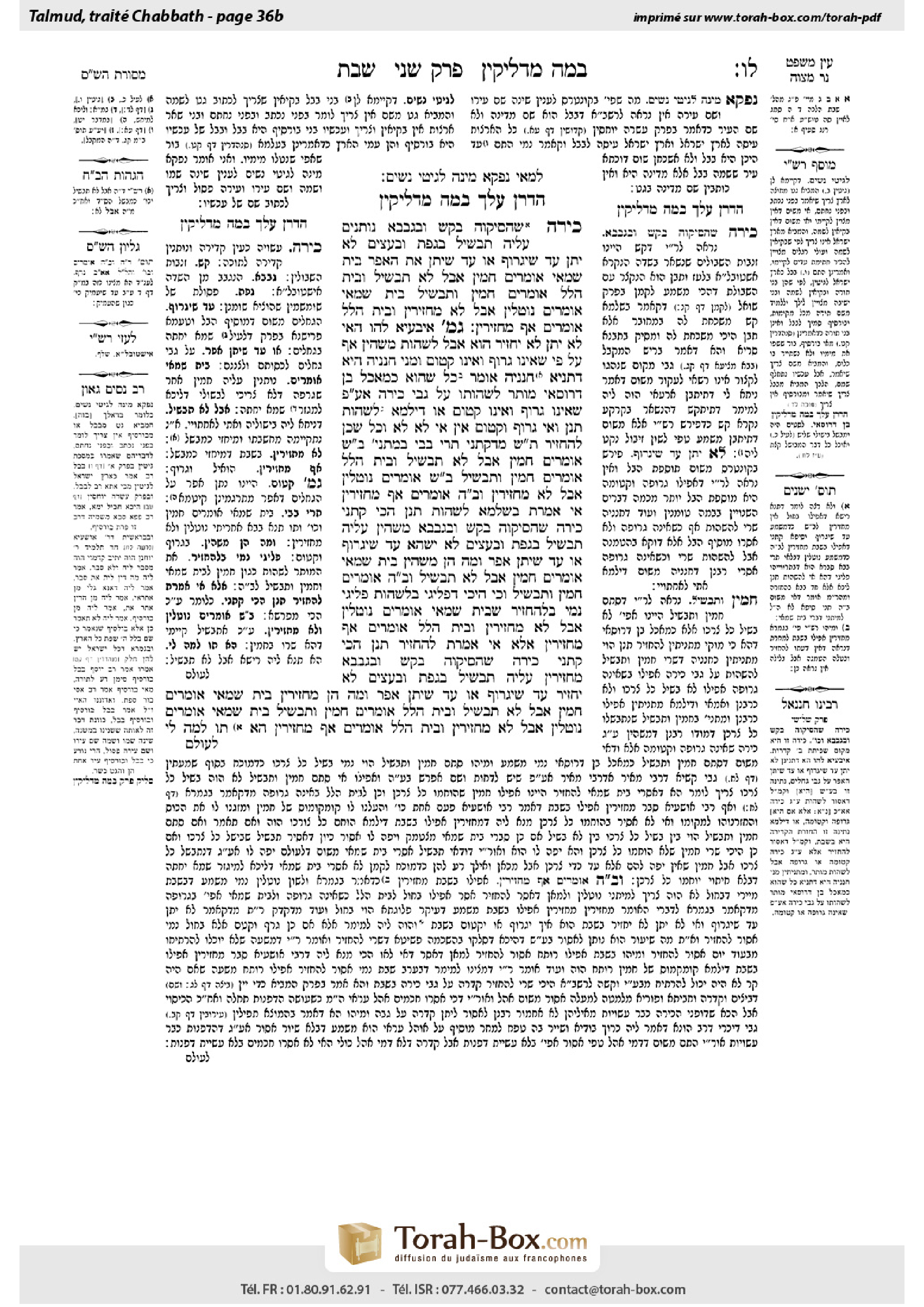
Shabbat 36b: Talmud study for Daf Yomi
Daf Yomi is the daily study of one Talmud folio. Explore 37 tractates with scans, Hebrew text, Sefaria English and AI-generated French translations where annotated.
Passage selection and English or AI-generated French translation are available where the scan has annotations. Daf Study is independent of Torah-Box and Sefaria.
Browse Shabbat · שבת · All tractatesShabbat 36b text and translations
This page of Shabbat includes the Aramaic text, an English translation and an AI-generated French translation, alongside the scan above.
שבת ל״ו ב · Aramaic and Hebrew text
לְמַאי נָפְקָא מִינָּה — לְגִיטֵּי נָשִׁים.
הדרן עלך במה מדליקין
מַתְנִי׳ כִּירָה שֶׁהִסִּיקוּהָ בְּקַשׁ וּבִגְבָבָא — נוֹתְנִים עָלֶיהָ תַּבְשִׁיל. בְּגֶפֶת וּבְעֵצִים — לֹא יִתֵּן עַד שֶׁיִּגְרוֹף, אוֹ עַד שֶׁיִּתֵּן אֶת הָאֵפֶר. בֵּית שַׁמַּאי אוֹמְרִים: חַמִּין, אֲבָל לֹא תַּבְשִׁיל. וּבֵית הִלֵּל אוֹמְרִים: חַמִּין וְתַבְשִׁיל. בֵּית שַׁמַּאי אוֹמְרִים: נוֹטְלִין, אֲבָל לֹא מַחֲזִירִין. וּבֵית הִלֵּל אוֹמְרִים: אַף מַחֲזִירִין.
גְּמָ׳ אִיבַּעְיָא לְהוּ: הַאי ״לֹא יִתֵּן״ — לֹא יַחֲזִיר הוּא, אֲבָל לְשַׁהוֹת — מְשַׁהִין, אַף עַל פִּי שֶׁאֵינוֹ גָּרוּף וְאֵינוֹ קָטוּם. וּמַנִּי — חֲנַנְיָה הִיא. דְּתַנְיָא, חֲנַנְיָה אוֹמֵר: כֹּל שֶׁהוּא כְּמַאֲכָל בֶּן דְּרוּסַאי — מוּתָּר לְשַׁהוֹתוֹ עַל גַּבֵּי כִּירָה, אַף עַל פִּי שֶׁאֵינוֹ גָּרוּף וְאֵינוֹ קָטוּם. אוֹ דִילְמָא — לְשַׁהוֹת תְּנַן, וְאִי גָרוּף וְקָטוּם — אֵין, אִי לָא — לָא, וְכָל שֶׁכֵּן לְהַחֲזִיר.
תָּא שְׁמַע מִדְּקָתָנֵי תְּרֵי בָבֵי בְּמַתְנִיתִין, בֵּית שַׁמַּאי אוֹמְרִים: חַמִּין אֲבָל לֹא תַּבְשִׁיל. וּבֵית הִלֵּל אוֹמְרִים חַמִּין וְתַבְשִׁיל. בֵּית שַׁמַּאי אוֹמְרִים: נוֹטְלִין אֲבָל לֹא מַחֲזִירִין, וּבֵית הִלֵּל אוֹמְרִים: אַף מַחֲזִירִין. אִי אָמְרַתְּ בִּשְׁלָמָא, לְשַׁהוֹת תְּנַן, הָכִי קָתָנֵי: כִּירָה שֶׁהִסִּיקוּהָ בְּקַשׁ וּבִגְבָבָא — מְשַׁהִין עָלֶיהָ תַּבְשִׁיל, בְּגֶפֶת וּבְעֵצִים — לֹא יְשַׁהֶא עַד שֶׁיִּגְרוֹף, אוֹ עַד שֶׁיִּתֵּן אֵפֶר. וּמָה הֵן מְשַׁהִין? — בֵּית שַׁמַּאי אוֹמְרִים: חַמִּין, אֲבָל לֹא תַּבְשִׁיל. וּבֵית הִלֵּל אוֹמְרִים: חַמִּין וְתַבְשִׁיל. וְכִי הֵיכִי דִּפְלִיגִי בִּלְשַׁהוֹת, פְּלִיגִי נָמֵי בִּלְהַחֲזִיר, שֶׁבֵּית שַׁמַּאי אוֹמְרִים: נוֹטְלִין, אֲבָל לֹא מַחֲזִירִין, וּבֵית הִלֵּל אוֹמְרִים: אַף מַחֲזִירִין.
אֶלָּא אִי אָמְרַתְּ לְהַחֲזִיר תְּנַן, הָכִי קָתָנֵי: כִּירָה שֶׁהִסִּיקוּהָ בְּקַשׁ וּבִגְבָבָא — מַחֲזִירִין עָלֶיהָ תַּבְשִׁיל. בְּגֶפֶת וּבְעֵצִים — לֹא יַחֲזִיר עַד שֶׁיִּגְרוֹף אוֹ עַד שֶׁיִּתֵּן אֵפֶר. וּמָה הֵן מַחֲזִירִין? — בֵּית שַׁמַּאי אוֹמְרִים: חַמִּין, אֲבָל לֹא תַּבְשִׁיל. וּבֵית הִלֵּל אוֹמְרִים: חַמִּין וְתַבְשִׁיל. בֵּית שַׁמַּאי אוֹמְרִים: נוֹטְלִין אֲבָל לֹא מַחֲזִירִין. וּבֵית הִלֵּל אוֹמְרִים: אַף מַחֲזִירִין. הָא תּוּ לְמָה לִי?
Shabbat 36b · English translation
What is the practical halakhic difference that emerges from this change of names? It is in the area of women’s bills of divorce. With regard to bills of divorce, special care is devoted to ensuring that the name of the place where the bill is written is not altered. Therefore, it is important to be aware that Babylon underwent a name change in later generations.
MISHNA: With regard to a stove that was lit on Shabbat eve with straw or with rakings, scraps collected from the field, one may place a pot of cooked food atop it on Shabbat. The fire in this stove was certainly extinguished while it was still day, as both straw and rakings are materials that burn quickly. However, if the stove was lit with pomace, pulp that remains from sesame seeds, olives, and the like after the oil is squeezed from them, and if it was lit with wood, one may not place a pot atop it on Shabbat until he sweeps the coals from the stove while it is still day or until he places ashes on the coals, so that the fire will not ignite on Shabbat. Beit Shammai say: Even after one has swept away the coals, it is only permitted to place hot water on it, as it is sufficiently hot and does not require additional cooking, but not cooked food. Since, in general, one prefers that food will cook more, there is concern lest he come to ignite the fire by stoking the coals. And Beit Hillel say: Both hot water and cooked food may be placed. Beit Shammai say: One may remove a pot from the stove on Shabbat but may not return it. And Beit Hillel say: One may even return it.
GEMARA: The students raised a dilemma with regard to the explanation of the mishna. That which we learned in the mishna: One may not place, does it mean that one may not return a pot that he took off the fire and wishes to return on Shabbat; however, to leave the pot from Shabbat eve into Shabbat, one may leave it even though this stove is not swept of its coals and its coals are not covered with ashes? And, according to this, whose opinion is it in this mishna? It is the opinion of Ḥananya. As it was taught in a baraita, Ḥananya says: Any food that has already been cooked to the extent of the food of ben Drosai, who would only cook his food the minimum amount necessary, one is permitted to leave it atop a stove on Shabbat even though the stove is not swept and not covered with ashes. Or perhaps, that which we learned in the mishna: One may not place, means one may not leave it on the fire from Shabbat eve. And if the coals in the stove were swept or covered with ashes, yes, one may leave the pot on the stove. And if not, no, one may not leave it, and all the more so one may not return it to the stove on Shabbat under any circumstances.
In order to resolve this dilemma, the Gemara suggests: Come and hear a resolution to this from the fact that two sections were taught in our mishna. In the first, Beit Shammai say: Hot water but not cooked food. And Beit Hillel say: Both hot water and cooked food. And in the second, Beit Shammai say: One may remove it but may not return it. And Beit Hillel say: One may even return it. Granted, if you say that when we learned in the mishna that one may not place it means that it is prohibited to leave it; in that case, the mishna is teaching as follows: With regard to a stove that was lit with straw or with rakings, one may leave cooked food on it. If it was lit with pomace or with wood, one may not leave the cooked food on it until he sweeps the coals out while it is still day or until he places ashes on it. And what may they leave? Beit Shammai say: Hot water but not cooked food. And Beit Hillel say: One may leave both hot water and cooked food on it. And just as they disagree with regard to leaving a pot on the stove, so too, they disagree with regard to whether or not it is permitted to return it to the stove. As Beit Shammai say: One may take the pot from the stove on Shabbat but may not return it to the stove at all. And Beit Hillel say: One may even return it.
However, if you say that when we learned in the mishna that one may not place, it means that it is prohibited to return it, then the mishna is teaching as follows: A stove that was lit with straw or with rakings, one may return cooked food onto it. If it was lit with pomace or with wood, one may not return cooked food to it until one sweeps the coals out while it is still day or until one places ashes on them. And what may they return? Beit Shammai say: Hot water but not cooked food. And Beit Hillel say: Both hot water and cooked food. Beit Shammai say: One may remove but may not return. And Beit Hillel say: One may even return. If in the first section the question of what may be returned was already addressed, why do I need this additional dispute in the second section? The gist of Beit Shammai’s statement that cooked food may not be returned to the stove is that one may remove but may not return. Apparently, the mishna can only be understood in accordance with the first explanation. The first clause discusses leaving and the latter clause discusses returning.
Shabbat 36b · Traduction française (IA)
Quelle différence pratique sur le plan de la halakha découle de ce changement de nom ? Elle concerne les actes de divorce des femmes. Pour les actes de divorce, on veille tout particulièrement à ce que le nom du lieu où l’acte est rédigé ne soit pas modifié. Il est donc important de savoir que Babylone a changé de nom au cours des générations suivantes.
MICHNA : À propos d’un fourneau allumé la veille de Chabbat avec de la paille ou des résidus ramassés dans les champs, on peut y déposer une marmite contenant un mets cuit pendant Chabbat. Le feu de ce fourneau s’est certainement éteint avant la tombée de la nuit, car la paille et les résidus brûlent rapidement. Toutefois, si le fourneau a été allumé avec du marc — la pulpe qui reste des graines de sésame, des olives et autres après en avoir extrait l’huile — ou avec du bois, on ne peut pas y déposer une marmite pendant Chabbat avant d’avoir retiré les braises du fourneau alors qu’il fait encore jour, ou d’avoir recouvert les braises de cendres, afin que le feu ne s’attise pas pendant Chabbat. Beit Chammaï disent : même après avoir retiré les braises, il n’est permis d’y déposer que de l’eau chaude, qui est déjà suffisamment chaude et ne nécessite pas de cuisson supplémentaire, mais pas un mets cuit. Comme, en général, on préfère que les aliments cuisent davantage, on craint qu’on ne vienne à attiser le feu en remuant les braises. Beit Hillel disent : on peut y déposer aussi bien de l’eau chaude qu’un mets cuit. Beit Chammaï disent : on peut retirer une marmite du fourneau pendant Chabbat, mais on ne peut pas l’y remettre. Beit Hillel disent : on peut même l’y remettre.
GUEMARA : Les élèves soulevèrent une question concernant l’explication de la Michna. Ce que nous avons appris dans la Michna — « on ne peut pas y déposer » — signifie-t-il qu’on ne peut pas remettre sur le feu, pendant Chabbat, une marmite qu’on en a retirée et qu’on souhaite y remettre, mais qu’on peut laisser la marmite sur le feu depuis la veille de Chabbat jusqu’à Chabbat, même si les braises de ce fourneau n’ont pas été retirées ni recouvertes de cendres ? Selon cette interprétation, de qui est l’opinion exprimée dans cette Michna ? De Ḥananya. Car il a été enseigné dans une baraïta que Ḥananya dit : tout mets déjà cuit au degré de cuisson du mets de ben Drosai, qui ne faisait cuire ses aliments que le minimum nécessaire, peut être laissé sur un fourneau pendant Chabbat, même si celui-ci n’a pas été débarrassé de ses braises ni recouvert de cendres. Ou bien ce que nous avons appris dans la Michna — « on ne peut pas y déposer » — signifie-t-il qu’on ne peut pas laisser la marmite sur le feu depuis la veille de Chabbat ? Si les braises du fourneau ont été retirées ou recouvertes de cendres, alors oui, on peut laisser la marmite sur le fourneau ; sinon, non, on ne peut pas la laisser, et à plus forte raison ne peut-on en aucun cas la remettre sur le fourneau pendant Chabbat.
Pour résoudre cette question, la Guemara propose : « Viens et écoute » une réponse tirée du fait que notre Michna enseigne deux passages. Dans le premier, Beit Chammaï disent : « De l’eau chaude, mais pas un mets cuit. » Beit Hillel disent : « Aussi bien de l’eau chaude qu’un mets cuit. » Dans le second, Beit Chammaï disent : « On peut la retirer, mais pas la remettre. » Beit Hillel disent : « On peut même la remettre. » Certes, si l’on dit que, dans la Michna, « on ne peut pas y déposer » signifie qu’il est interdit de l’y laisser, la Michna enseigne alors ceci : sur un fourneau allumé avec de la paille ou des résidus, on peut laisser un mets cuit. S’il a été allumé avec du marc ou du bois, on ne peut pas y laisser le mets cuit avant d’avoir retiré les braises alors qu’il fait encore jour ou de les avoir recouvertes de cendres. Et que peut-on y laisser ? Beit Chammaï disent : « De l’eau chaude, mais pas un mets cuit. » Beit Hillel disent qu’on peut y laisser aussi bien de l’eau chaude qu’un mets cuit. Et de même qu’ils sont en désaccord sur le fait de laisser une marmite sur le fourneau, ils sont également en désaccord sur le fait de la remettre ou non sur le fourneau. Beit Chammaï disent en effet : on peut retirer la marmite du fourneau pendant Chabbat, mais on ne peut en aucun cas l’y remettre. Beit Hillel disent : on peut même l’y remettre.
Cependant, si l’on dit que, dans la Michna, « on ne peut pas y déposer » signifie qu’il est interdit de l’y remettre, la Michna enseigne alors ceci : sur un fourneau allumé avec de la paille ou des résidus, on peut y remettre un mets cuit. S’il a été allumé avec du marc ou du bois, on ne peut pas y remettre le mets cuit avant d’avoir retiré les braises alors qu’il fait encore jour ou de les avoir recouvertes de cendres. Et que peut-on y remettre ? Beit Chammaï disent : « De l’eau chaude, mais pas un mets cuit. » Beit Hillel disent : « Aussi bien de l’eau chaude qu’un mets cuit. » Beit Chammaï disent : « On peut retirer, mais pas remettre. » Beit Hillel disent : « On peut même remettre. » Si la première partie a déjà traité la question de ce qu’on peut remettre, pourquoi ai-je besoin de ce désaccord supplémentaire dans la seconde partie ? L’essentiel de la déclaration de Beit Chammaï, selon laquelle on ne peut pas remettre un mets cuit sur le fourneau, est qu’on peut le retirer, mais pas le remettre. Il semble donc que la Michna ne puisse se comprendre que selon la première explication : la première clause traite du fait de laisser la marmite sur le fourneau, et la dernière, de celui de l’y remettre.
Traduction française générée par IA à partir de l’édition anglaise de Sefaria. Vérifie toujours un passage avec le texte source.
Text from Sefaria: William Davidson Edition - Vocalized Aramaic (CC BY NC); William Davidson Edition - English (CC BY NC).