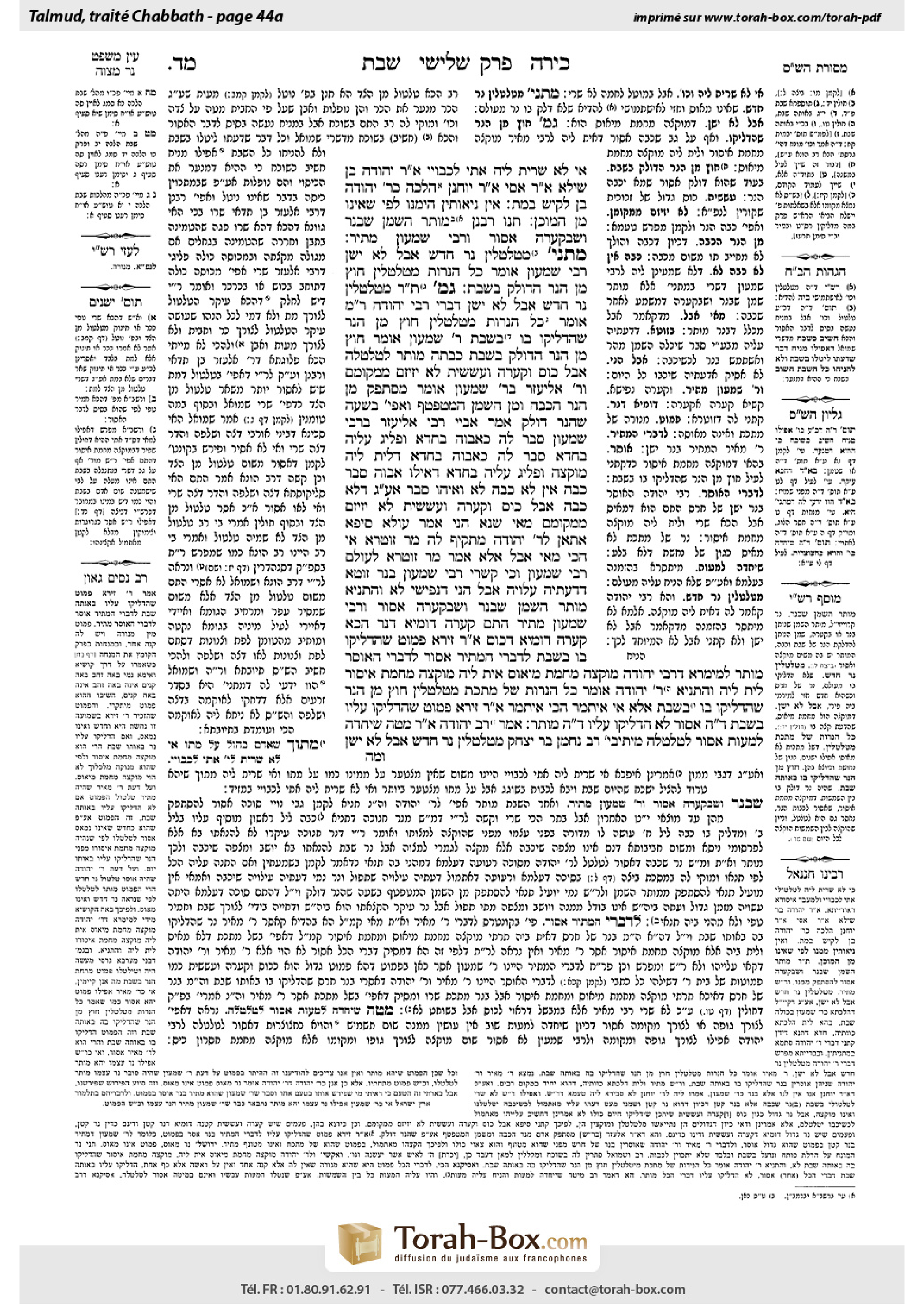
Shabbat 44a: Talmud study for Daf Yomi
Daf Yomi is the daily study of one Talmud folio. Explore 37 tractates with scans, Hebrew text, Sefaria English and AI-generated French translations where annotated.
Passage selection and English or AI-generated French translation are available where the scan has annotations. Daf Study is independent of Torah-Box and Sefaria.
Browse Shabbat · שבת · All tractatesShabbat 44a text and translations
This page of Shabbat includes the Aramaic text, an English translation and an AI-generated French translation, alongside the scan above.
שבת מ״ד א · Aramaic and Hebrew text
אִי לָא שָׁרֵית לֵיהּ, אָתֵי לְכַבּוֹיֵי. אָמַר רַבִּי יְהוּדָה בֶּן שֵׁילָא אָמַר רַב אַסִּי אָמַר רַבִּי יוֹחָנָן: הֲלָכָה כְּרַבִּי יְהוּדָה בֶּן לָקִישׁ בְּמֵת.
אֵין נֵיאוֹתִין הֵימֶנּוּ, לְפִי שֶׁאֵינוֹ מִן הַמּוּכָן. תָּנוּ רַבָּנַן: מוֹתַר הַשֶּׁמֶן שֶׁבַּנֵּר וְשֶׁבַּקְּעָרָה אָסוּר. וְרַבִּי שִׁמְעוֹן מַתִּיר.
מַתְנִי׳ מְטַלְטְלִין נֵר חָדָשׁ אֲבָל לֹא יָשָׁן. רַבִּי שִׁמְעוֹן אוֹמֵר: כׇּל הַנֵּרוֹת מִטַּלְטְלִין, חוּץ מִן הַנֵּר הַדּוֹלֵק בְּשַׁבָּת.
גְּמָ׳ תָּנוּ רַבָּנַן: מְטַלְטְלִין נֵר חָדָשׁ אֲבָל לֹא יָשָׁן, דִּבְרֵי רַבִּי יְהוּדָה. רַבִּי מֵאִיר אוֹמֵר: כׇּל הַנֵּרוֹת מִטַּלְטְלִין, חוּץ מִן הַנֵּר שֶׁהִדְלִיקוּ בּוֹ בְּשַׁבָּת. רַבִּי שִׁמְעוֹן אוֹמֵר: חוּץ מִן הַנֵּר הַדּוֹלֵק בְּשַׁבָּת. כָּבְתָה — מוּתָּר לְטַלְטְלָהּ. אֲבָל כּוֹס וּקְעָרָה וַעֲשָׁשִׁית לֹא יְזִיזֵם מִמְקוֹמָם. וְרַבִּי אֱלִיעֶזֶר בְּרַבִּי שִׁמְעוֹן אוֹמֵר: מִסְתַּפֵּק מִן הַנֵּר הַכָּבֶה וּמִן הַשֶּׁמֶן הַמְטַפְטֵף, וַאֲפִילּוּ בְּשָׁעָה שֶׁהַנֵּר דּוֹלֵק.
אָמַר אַבָּיֵי: רַבִּי אֱלִיעֶזֶר בְּרַבִּי שִׁמְעוֹן סָבַר לַהּ כַּאֲבוּהּ בַּחֲדָא, וּפְלִיג עֲלֵיהּ בַּחֲדָא. סָבַר לַהּ כַּאֲבוּהּ בַּחֲדָא — דְּלֵית לֵיהּ מוּקְצֶה. וּפְלִיג עֲלֵיהּ בַּחֲדָא — דְּאִילּוּ אֲבוּהּ סָבַר כָּבָה — אִין, לֹא כָּבָה — לָא, וְאִיהוּ סָבַר אַף עַל גַּב דְּלֹא כָּבָה.
אֲבָל כּוֹס וּקְעָרָה וַעֲשָׁשִׁית לֹא יְזִיזֵם מִמְקוֹמָם. מַאי שְׁנָא הָנֵי? אָמַר עוּלָּא: סֵיפָא אֲתָאן לְרַבִּי יְהוּדָה.
מַתְקִיף לַהּ מָר זוּטְרָא: אִי הָכִי, מַאי ״אֲבָל״? אֶלָּא אָמַר מָר זוּטְרָא: לְעוֹלָם רַבִּי שִׁמְעוֹן. וְכִי קָשָׁרֵי רַבִּי שִׁמְעוֹן — בְּנֵר זוּטָא דְּדַעְתֵּיהּ עִלָּוֵיהּ, אֲבָל הָנֵי דִּנְפִישִׁי — לָא.
וְהָתַנְיָא: מוֹתַר הַשֶּׁמֶן שֶׁבַּנֵּר וְשֶׁבַּקְּעָרָה — אָסוּר, וְרַבִּי שִׁמְעוֹן מַתִּיר! הָתָם קְעָרָה דּוּמְיָא דְנֵר, הָכָא קְעָרָה דּוּמְיָא דְכוֹס.
אָמַר רַבִּי זֵירָא: פָּמוֹט שֶׁהִדְלִיקוּ בּוֹ בְּשַׁבָּת, לְדִבְרֵי הַמַּתִּיר — אָסוּר. לְדִבְרֵי הָאוֹסֵר — מוּתָּר. לְמֵימְרָא דְּרַבִּי יְהוּדָה — מוּקְצֶה מֵחֲמַת מִיאוּס אִית לֵיהּ, מוּקְצֶה מֵחֲמַת אִיסּוּר לֵית לֵיהּ? וְהָתַנְיָא, רַבִּי יְהוּדָה אוֹמֵר: כׇּל הַנֵּרוֹת שֶׁל מַתֶּכֶת מִטַּלְטְלִין, חוּץ מִן הַנֵּר שֶׁהִדְלִיקוּ בּוֹ בְּשַׁבָּת! אֶלָּא, אִי אִיתְּמַר הָכִי אִיתְּמַר, אָמַר רַבִּי זֵירָא: פָּמוֹט שֶׁהִדְלִיקוּ עָלָיו בְּשַׁבָּת — דִּבְרֵי הַכֹּל אָסוּר. לֹא הִדְלִיקוּ עָלָיו — דִּבְרֵי הַכֹּל מוּתָּר.
אָמַר רַב יְהוּדָה אָמַר רַב: מִטָּה שֶׁיִּחֲדָהּ לְמָעוֹת אָסוּר לְטַלְטְלָהּ. מֵתִיב רַב נַחְמָן בַּר יִצְחָק: מְטַלְטְלִין נֵר חָדָשׁ אֲבָל לֹא יָשָׁן!
Shabbat 44a · English translation
if you do not permit him to move the corpse in an atypical manner, he will come to extinguish the fire. The Sages permitted performing an act prohibited by rabbinic law so that one will not come to transgress a Torah prohibition. Rabbi Yehuda ben Sheila said that Rav Asi said that Rabbi Yoḥanan said: The halakha is in accordance with the opinion of Rabbi Yehuda ben Lakish with regard to the issue of rescuing a corpse from a fire.
We learned in the mishna that one may not make use of the oil that drips from the candle on Shabbat because it is not among the oil prepared from Shabbat eve for use on Shabbat. With regard to this same issue, the Sages taught in a baraita: The remaining oil that is in the lamp or in a bowl in which a wick was burning is prohibited for use on Shabbat. However, Rabbi Shimon permits using the remaining oil as, according to his opinion, there is virtually nothing prohibited due to the prohibition of set-aside.
MISHNA: The dispute in this mishna seems to be a local one; however, it is the key to several halakhot in the area of the prohibition of set-aside [muktze]. One may move a new oil lamp on Shabbat but not an old one that was already used. A lamp that was used is covered with soot and unsuitable for use. It is therefore considered set aside from use due to its disgusting nature. Rabbi Shimon says: All oil lamps may be moved on Shabbat except for an oil lamp that is burning on Shabbat, due to the concern that it might be extinguished.
GEMARA: The Sages taught the dispute in the mishna in greater detail in a Tosefta: One may move a new oil lamp on Shabbat but not an old one; this is the statement of Rabbi Yehuda. Rabbi Meir says: All oil lamps may be moved on Shabbat except for an oil lamp that they kindled on that Shabbat. Rabbi Meir does not hold that one must distance himself from objects that are disgusting. However, since the lamp was burning on Shabbat, it may not be moved, as it is an object set aside due to prohibition for the entire Shabbat. Rabbi Shimon says: All lamps may be moved except for an oil lamp that is burning on Shabbat. If the flame was extinguished, one is permitted to move it. However, a cup and a bowl and a lantern that are full of oil with a wick lit in them, one may not move them from their place even after the flame is extinguished. And Rabbi Eliezer, son of Rabbi Shimon, says: One may supply himself with oil from an extinguished candle and from the oil that drips from the lamp, and even while the lamp is burning.
Abaye said: Rabbi Eliezer, son of Rabbi Shimon, holds in accordance with the opinion of his father in one matter and disagrees with him in one matter. He holds in accordance with the opinion of his father in one matter, as he is not of the opinion that moving set-aside objects is prohibited. And he disagrees with him in one matter; as his father holds that if the flame was extinguished, yes, he may move it, if it was not extinguished, no, he may not move it. And Rabbi Eliezer holds: Even though the flame was not extinguished, it is permitted to carry the lamp and to use the oil that drips from it. In his opinion, doing so in no way extinguishes the flame and it is in no way comparable to extinguishing the flame.
Following Rabbi Shimon’s statement, it was taught in the Tosefta: However, a cup, and a bowl, and a lantern, one may not move them from their place. The Gemara asks: What is different about these, that even Rabbi Shimon prohibits moving them? Ulla said: In the latter clause of this Tosefta, we came back to explain the opinion of Rabbi Yehuda, who prohibits moving items that are set-aside.
Mar Zutra strongly objects to Ulla’s explanation: If so, what is the meaning of the word however in the phrase: However, a cup and a bowl, etc.? Rabbi Yehuda prohibited moving an oil lamp as well. In what way could the legal status of a bowl be any different? Rather, Mar Zutra said: Actually, this must be explained differently. That phrase was stated by Rabbi Shimon. And when Rabbi Shimon permitted moving a lamp, that was in the case of a small lamp, which he has in mind, i.e., he is certain that the flame will be extinguished on Shabbat and that he will have the opportunity to use the remaining oil that day. However, these, the bowl and the lantern, which have much oil, no, he does not expect them to be extinguished and he sets them aside from use for the entire Shabbat.
The Gemara asks: Wasn’t it taught in a baraita: Using the remaining oil that is in an oil lamp or in a bowl is prohibited on Shabbat, and Rabbi Shimon permits using it. Apparently, Rabbi Shimon does not distinguish between a candle and a bowl. The Gemara answers: There, where Rabbi Shimon permitted a bowl, was specifically in a case where it is similar to a lamp, i.e., a small bowl in which the flame will quickly extinguish. Here, where Rabbi Shimon prohibited using the oil remaining in a bowl, it is referring to a bowl that is similar to a cup, which is large.
Rabbi Zeira said: A metal candlestick [pamot] that was kindled on Shabbat, according to Rabbi Shimon, who permits moving a lamp, it is prohibited because it is large. Whereas, according to Rabbi Yehuda, who prohibits moving a lamp, a metal candlestick is permitted because it does not become disgusting (Rabbeinu Ḥananel). The Gemara asks: Is that to say that Rabbi Yehuda is of the opinion that an object that is set-aside [muktze] due to repugnance may not be moved, and he is not of the opinion that an object that is set-aside due to prohibition may not be moved, and therefore permits moving the candlestick? Wasn’t it taught in a baraita that Rabbi Yehuda says: All metal candlesticks may be moved on Shabbat with the exception of a candlestick that was kindled on Shabbat itself? Apparently, he prohibits moving the metal candlestick, not because it is disgusting but because it is set-aside due to prohibition. Rather, if it was stated, it was stated as follows, Rabbi Zeira said: A metal candlestick that was kindled on Shabbat, everyone agrees that it is prohibited. One that was not kindled on Shabbat, everyone agrees that it is permitted because it is neither set aside due to prohibition nor set aside due to repugnance.
Rav Yehuda said that Rav said: A bed which one designated to place money upon it may not be moved on Shabbat because it is set-aside. It is prohibited even though it no longer has money upon it. Rav Naḥman bar Yitzḥak raised an objection to Rav Yehuda from our mishna: One may move a new oil lamp on Shabbat but not an old one.
Shabbat 44a · Traduction française (IA)
Si on ne lui permet pas de déplacer le cadavre de manière inhabituelle, il en viendra à éteindre le feu. Les Sages ont permis d’accomplir un acte interdit par décret rabbinique afin que l’on n’en vienne pas à transgresser une interdiction de la Torah. Rabbi Yehuda ben Sheila a dit que Rav Asi a dit que Rabbi Yoḥanan a dit : La halakha suit l’avis de Rabbi Yehuda ben Lakish concernant le sauvetage d’un cadavre d’un incendie.
Nous avons appris dans la Michna qu’il est interdit de se servir, le Chabbat, de l’huile qui goutte de la lampe, car elle ne fait pas partie de l’huile préparée depuis la veille de Chabbat pour être utilisée le Chabbat. À propos de cette même question, les Sages ont enseigné dans une baraïta : L’huile qui reste dans la lampe ou dans une coupe où brûlait une mèche est interdite à l’usage le Chabbat. Rabbi Shimon permet toutefois d’utiliser l’huile restante, car, selon lui, presque rien n’est interdit au titre de l’interdiction des objets mis à l’écart (mouktsé).
MICHNA : Le désaccord dans cette Michna semble porter sur un point limité ; pourtant, il est la clé de plusieurs halakhot relatives à l’interdiction des objets mis à l’écart [muktze]. On peut déplacer le Chabbat une lampe à huile neuve, mais pas une ancienne qui a déjà servi. Une lampe qui a servi est couverte de suie et ne convient pas à l’usage. Elle est donc considérée comme mise à l’écart en raison de son caractère répugnant. Rabbi Shimon dit : On peut déplacer le Chabbat toutes les lampes à huile, à l’exception d’une lampe à huile qui brûle le Chabbat, par crainte qu’elle ne s’éteigne.
GUEMARA : Les Sages ont exposé plus en détail le désaccord de la Michna dans une Tosefta : On peut déplacer le Chabbat une lampe à huile neuve, mais pas une ancienne ; telle est la déclaration de Rabbi Yehuda. Rabbi Meir dit : On peut déplacer le Chabbat toutes les lampes à huile, à l’exception d’une lampe à huile qu’on a allumée ce Chabbat. Rabbi Meir ne pense pas qu’il faille se tenir à l’écart des objets répugnants. Cependant, puisque la lampe brûlait le Chabbat, on ne peut pas la déplacer, car c’est un objet mis à l’écart en raison d’une interdiction pour toute la durée du Chabbat. Rabbi Shimon dit : On peut déplacer toutes les lampes, à l’exception d’une lampe à huile qui brûle le Chabbat. Si la flamme s’est éteinte, on a le droit de la déplacer. En revanche, une coupe, un bol et une lanterne remplis d’huile, avec une mèche allumée à l’intérieur, on ne peut pas les déplacer de leur place, même après que la flamme s’est éteinte. Rabbi Eliezer, fils de Rabbi Shimon, dit : On peut se procurer de l’huile d’une lampe éteinte ainsi que de l’huile qui goutte de la lampe, même lorsque celle-ci brûle.
Abaye a dit : Rabbi Eliezer, fils de Rabbi Shimon, suit l’avis de son père sur un point et s’en écarte sur un autre. Il suit l’avis de son père en ce qu’il ne pense pas qu’il soit interdit de déplacer des objets mis à l’écart. Il s’en écarte en ce que son père considère que si la flamme s’est éteinte, oui, on peut déplacer la lampe, mais que si elle ne s’est pas éteinte, non, on ne peut pas la déplacer. Rabbi Eliezer, lui, considère que même si la flamme ne s’est pas éteinte, il est permis de déplacer la lampe et d’utiliser l’huile qui en goutte. Selon lui, cela n’éteint nullement la flamme et ne s’apparente en rien à son extinction.
À la suite de la déclaration de Rabbi Shimon, il fut enseigné dans la Tosefta : Toutefois, une coupe, un bol et une lanterne, on ne peut pas les déplacer de leur place. La Guemara demande : En quoi ces objets diffèrent-ils, pour que même Rabbi Shimon interdise de les déplacer ? Ulla dit : Dans la dernière clause de cette Tosefta, nous sommes revenus expliquer l’opinion de Rabbi Yehuda, qui interdit de déplacer les objets mis à l’écart.
Mar Zutra s’oppose vivement à l’explication d’Ulla : Si c’est le cas, que signifie le mot « toutefois » dans la formule : « Toutefois, une coupe et un bol, etc. » ? Rabbi Yehuda interdisait également de déplacer une lampe à huile. En quoi le statut d’un bol pourrait-il être différent ? Mar Zutra dit plutôt : En réalité, il faut expliquer cela autrement. Cette formule a été énoncée par Rabbi Shimon. Lorsque Rabbi Shimon a autorisé à déplacer une lampe, il s’agissait d’une petite lampe, car il avait à l’esprit qu’il était certain que la flamme s’éteindrait pendant Chabbat et qu’il pourrait utiliser l’huile restante ce jour-là. En revanche, ces objets, le bol et la lanterne, qui contiennent beaucoup d’huile, non : il ne s’attend pas à ce qu’ils s’éteignent et les met à l’écart de tout usage pendant toute la durée du Chabbat.
La Guemara demande : N’a-t-il pas été enseigné dans une baraïta : Il est interdit, pendant Chabbat, d’utiliser l’huile restante dans une lampe à huile ou dans un bol, mais Rabbi Shimon permet de l’utiliser ? Apparemment, Rabbi Shimon ne fait pas de distinction entre une lampe et un bol. La Guemara répond : Là, lorsque Rabbi Shimon a autorisé l’usage d’un bol, il s’agissait précisément d’un bol semblable à une lampe, c’est-à-dire d’un petit bol dans lequel la flamme s’éteindra rapidement. Ici, lorsque Rabbi Shimon a interdit d’utiliser l’huile restant dans un bol, il s’agit d’un bol semblable à une coupe, qui est grande.
Rabbi Zeira a dit : Selon Rabbi Shimon, qui permet de déplacer une lampe, un chandelier en métal [pamot] allumé le Chabbat ne peut pas être déplacé, car il est grand. Selon Rabbi Yehuda, qui interdit de déplacer une lampe, un chandelier en métal peut être déplacé, car il ne devient pas répugnant (Rabbeinu Ḥananel). La Guemara demande : Faut-il en déduire que, selon Rabbi Yehuda, un objet mis à l’écart [muktze] en raison de son caractère répugnant ne peut pas être déplacé, mais qu’il ne pense pas qu’un objet mis à l’écart en raison d’une interdiction ne puisse pas être déplacé, et qu’il autorise donc à déplacer le chandelier ? N’a-t-il pas été enseigné dans une baraïta que Rabbi Yehuda dit : Tous les chandeliers en métal peuvent être déplacés le Chabbat, à l’exception d’un chandelier allumé ce Chabbat même ? Apparemment, il interdit de déplacer le chandelier en métal non parce qu’il est répugnant, mais parce qu’il est mis à l’écart en raison d’une interdiction. Il faut plutôt comprendre ainsi, si cette déclaration a été formulée : Rabbi Zeira a dit : Pour un chandelier en métal allumé le Chabbat, tous conviennent qu’il est interdit de le déplacer. Pour un chandelier qui n’a pas été allumé le Chabbat, tous conviennent qu’il est permis de le déplacer, car il n’est mis à l’écart ni en raison d’une interdiction ni en raison de son caractère répugnant.
Rav Yehuda a dit au nom de Rav : Un lit que l’on a destiné à y déposer de l’argent ne peut pas être déplacé le Chabbat, car il est mis à l’écart. Cela reste interdit même s’il n’y a plus d’argent dessus. Rav Naḥman bar Yitzḥak soulève une objection contre Rav Yehuda à partir de notre Michna : On peut déplacer une lampe à huile neuve le Chabbat, mais pas une ancienne.
Traduction française générée par IA à partir de l’édition anglaise de Sefaria. Vérifie toujours un passage avec le texte source.
Text from Sefaria: William Davidson Edition - Vocalized Aramaic (CC BY NC); William Davidson Edition - English (CC BY NC).