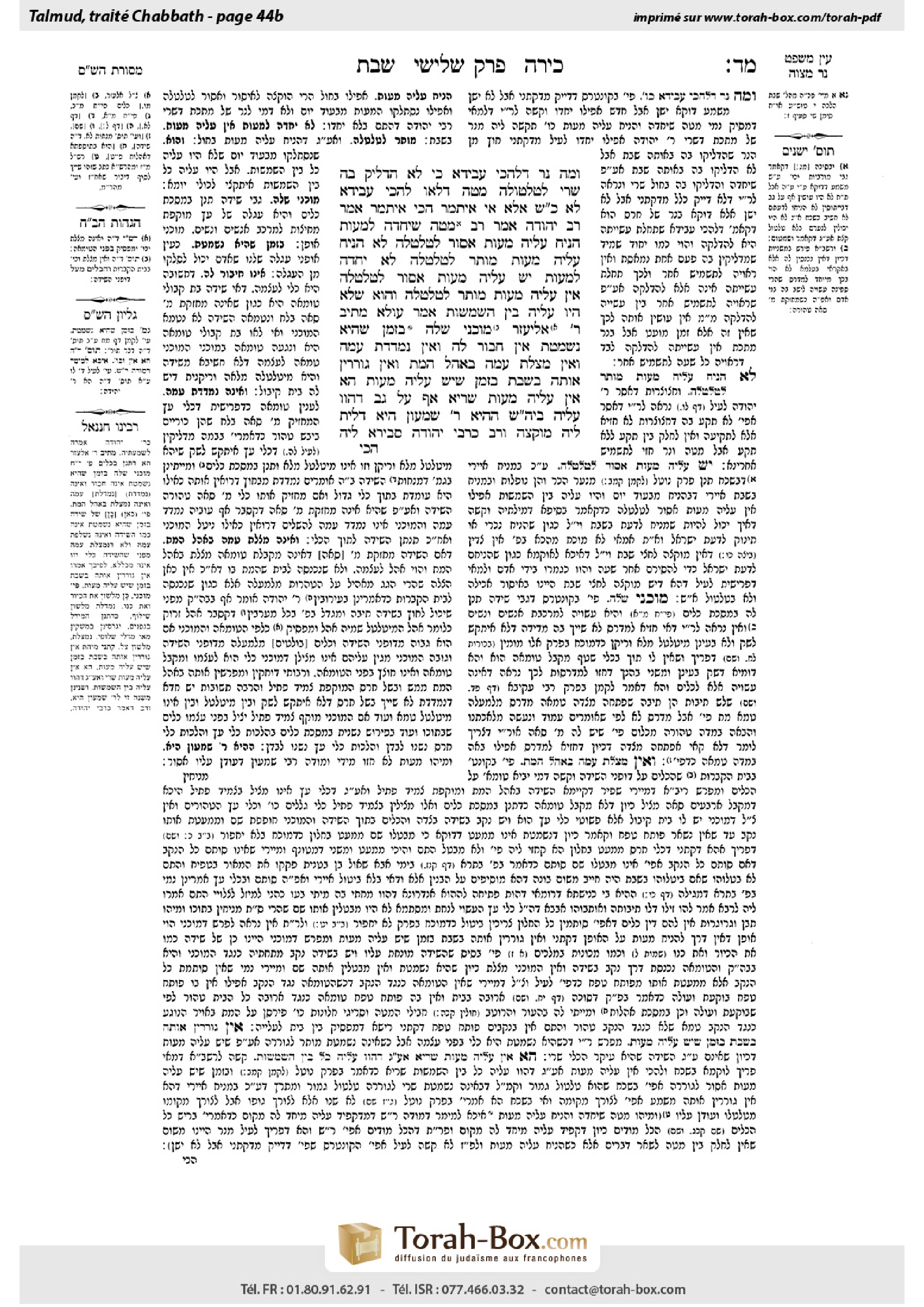
Shabbat 44b: Talmud study for Daf Yomi
Daf Yomi is the daily study of one Talmud folio. Explore 37 tractates with scans, Hebrew text, Sefaria English and AI-generated French translations where annotated.
Passage selection and English or AI-generated French translation are available where the scan has annotations. Daf Study is independent of Torah-Box and Sefaria.
Browse Shabbat · שבת · All tractatesShabbat 44b text and translations
This page of Shabbat includes the Aramaic text, an English translation and an AI-generated French translation, alongside the scan above.
שבת מ״ד ב · Aramaic and Hebrew text
וּמָה נֵר דִּלְהָכִי עֲבִידָא, כִּי לָא אַדְלֵיק בָּהּ שְׁרֵי לְטַלְטוֹלַהּ — מִטָּה דְּלָאו לְהָכִי עֲבִידָא לֹא כָל שֶׁכֵּן?! אֶלָּא אִי אִיתְּמַר, הָכִי אִיתְּמַר: אָמַר רַב יְהוּדָה אָמַר רַב: מִטָּה שֶׁיִּחֲדָהּ לְמָעוֹת, הִנִּיחַ עָלֶיהָ מָעוֹת — אָסוּר לְטַלְטְלָהּ, לֹא הִנִּיחַ עָלֶיהָ מָעוֹת — מוּתָּר לְטַלְטְלָהּ. לֹא יִחֲדָהּ לְמָעוֹת, יֵשׁ עָלֶיהָ מָעוֹת — אָסוּר לְטַלְטְלָהּ, אֵין עָלֶיהָ מָעוֹת — מוּתָּר לְטַלְטְלָהּ. וְהוּא שֶׁלֹּא הָיוּ עָלֶיהָ בֵּין הַשְּׁמָשׁוֹת.
אָמַר עוּלָּא, מֵתִיב רַבִּי אֱלִיעֶזֶר: מוּכְנִי שֶׁלָּהּ בִּזְמַן שֶׁהִיא נִשְׁמֶטֶת, אֵין חִבּוּר לָהּ וְאֵין נִמְדֶּדֶת עִמָּהּ וְאֵין מַצֶּלֶת עִמָּהּ בְּאֹהֶל הַמֵּת וְאֵין גּוֹרְרִין אוֹתָהּ בְּשַׁבָּת — בִּזְמַן שֶׁיֵּשׁ עָלֶיהָ מָעוֹת.
הָא אֵין עָלֶיהָ מָעוֹת — שַׁרְיָא, אַף עַל גַּב דַּהֲווֹ עָלֶיהָ בֵּין הַשְּׁמָשׁוֹת! הַהִיא רַבִּי שִׁמְעוֹן הִיא דְּלֵית לֵיהּ מוּקְצֶה, וְרַב כְּרַבִּי יְהוּדָה סְבִירָא לֵיהּ.
Shabbat 44b · English translation
He explains his objection: And just as a lamp, which is made for this purpose, for lighting, when he did not light it, he is permitted to move it, a bed, which is not made for that purpose, for placing money on it, all the more so moving it would be permitted. Rather, if it was stated, it was stated as follows: Rav Yehuda said that Rav said: A bed that one designated for money to be placed upon it, if one left money upon it one day, it becomes designated for that purpose and it is prohibited to move it on Shabbat. If one did not leave money upon it, it is permitted to move it on Shabbat. A bed, which one did not designate for money to be placed upon it, if there is money upon it on Shabbat itself, it is prohibited to move it on Shabbat. If there is not money on it, it is permitted to move it. And that is only when there was not money on it during the twilight period between Shabbat eve and Shabbat. If there was money on it at that time, the bed itself becomes set aside due to prohibition for the entire Shabbat, even if the money fell off the bed in the course of the day.
Ulla said: Rabbi Eliezer raised an objection to Rav’s statement from that which we learned in a mishna. This mishna deals primarily with the laws of ritual impurity and discusses the relationship between a wagon and its undercarriage [mukheni], the system of wheels and the frame at the base of the wagon. And the Sages said: The wagon’s undercarriage, when it is detachable from the wagon, it is not considered connected to it and they are considered independent units as far as the halakhot of ritual impurity are concerned. And it is not measured with it. This refers to calculating the volume of forty se’a, as a vessel with a volume larger than forty se’a does not have the legal status of a vessel and cannot become ritually impure. And the undercarriage likewise does not protect together with the wagon in a tent over the corpse. A large wagon is considered a tent in and of itself and the vessels inside the wagon do not become impure if the wagon is over a corpse. However, the undercarriage is not included with the wagon in this regard. If a hole in the wagon is sealed by the undercarriage, it is not considered sealed with regard to preventing ritual impurity. And, likewise, one may not pull the wagon on Shabbat when there is money upon it.
By inference: If there is not money on it, one is permitted to move the wagon even though there was money on it at twilight. In this mishna, the prohibition is contingent exclusively on whether or not there is money on the wagon at that time. The Gemara answers: That mishna is in accordance with the opinion of Rabbi Shimon, who is not of the opinion that there is a prohibition of set-aside. And Rav holds in accordance with the opinion of Rabbi Yehuda. Since according to Rabbi Yehuda there is a prohibition of set-aside, the wagon became set aside from use during the twilight period and remains prohibited for the entire Shabbat.
Shabbat 44b · Traduction française (IA)
Il explique son objection : de même qu’une lampe, qui est faite à cette fin, pour éclairer, peut être déplacée lorsqu’on ne l’a pas allumée, à plus forte raison peut-on déplacer un lit, qui n’est pas fait à cette fin, à savoir pour y déposer de l’argent. En réalité, si cette règle a été énoncée, elle l’a été ainsi : Rav Yehouda a dit au nom de Rav : un lit que l’on a réservé à l’usage d’y déposer de l’argent, si l’on y a laissé de l’argent un jour, est désormais réservé à cet usage et il est interdit de le déplacer pendant Chabbat. Si l’on n’y a pas laissé d’argent, il est permis de le déplacer pendant Chabbat. Un lit que l’on n’a pas réservé à l’usage d’y déposer de l’argent, s’il s’y trouve de l’argent pendant Chabbat même, il est interdit de le déplacer pendant Chabbat. S’il n’y a pas d’argent dessus, il est permis de le déplacer. Cela ne vaut que s’il n’y avait pas d’argent dessus pendant la période crépusculaire entre la veille de Chabbat et Chabbat. S’il y avait de l’argent dessus à ce moment-là, le lit lui-même est mis à l’écart en raison de l’interdit pour tout le Chabbat, même si l’argent tombe du lit au cours de la journée.
Oula a dit : Rabbi Eliezer a soulevé une objection à l’énoncé de Rav à partir de ce que nous avons appris dans une Michna. Cette Michna traite principalement des lois de l’impureté rituelle et aborde le rapport entre un chariot et son châssis [mukheni], le système de roues et le cadre situé à la base du chariot. Les Sages ont dit : le châssis du chariot, lorsqu’il peut en être détaché, n’est pas considéré comme solidaire du chariot ; ils sont considérés comme des unités indépendantes en ce qui concerne les halakhot de l’impureté rituelle. Il n’est pas non plus pris en compte avec lui pour la mesure. Il s’agit du calcul du volume de quarante séa, car un récipient dont le volume dépasse quarante séa n’a pas le statut juridique de récipient et ne peut pas devenir rituellement impur. De même, le châssis ne protège pas avec le chariot sous une tente au-dessus d’un cadavre. Un grand chariot est considéré comme une tente à lui seul, et les récipients qui se trouvent à l’intérieur ne deviennent pas impurs si le chariot est au-dessus d’un cadavre. Toutefois, le châssis n’est pas inclus avec le chariot à cet égard. Si le châssis bouche un trou dans le chariot, le trou n’est pas considéré comme bouché pour empêcher l’impureté rituelle. De même, on ne peut pas tirer le chariot pendant Chabbat lorsqu’il y a de l’argent dessus.
Il en découle que, s’il n’y a pas d’argent dessus, il est permis de déplacer le chariot, même s’il y avait de l’argent dessus au crépuscule. Dans cette Michna, l’interdiction dépend exclusivement de la présence ou de l’absence d’argent sur le chariot à ce moment-là. La Guemara répond : cette Michna suit l’opinion de Rabbi Shimon, qui ne reconnaît pas l’interdiction du mouktsé. Rav, lui, suit l’opinion de Rabbi Yehouda. Puisque, selon Rabbi Yehouda, l’interdiction du mouktsé existe, le chariot a été mis à l’écart de tout usage pendant la période crépusculaire et reste interdit pendant tout le Chabbat.
Traduction française générée par IA à partir de l’édition anglaise de Sefaria. Vérifie toujours un passage avec le texte source.
Text from Sefaria: William Davidson Edition - Vocalized Aramaic (CC BY NC); William Davidson Edition - English (CC BY NC).