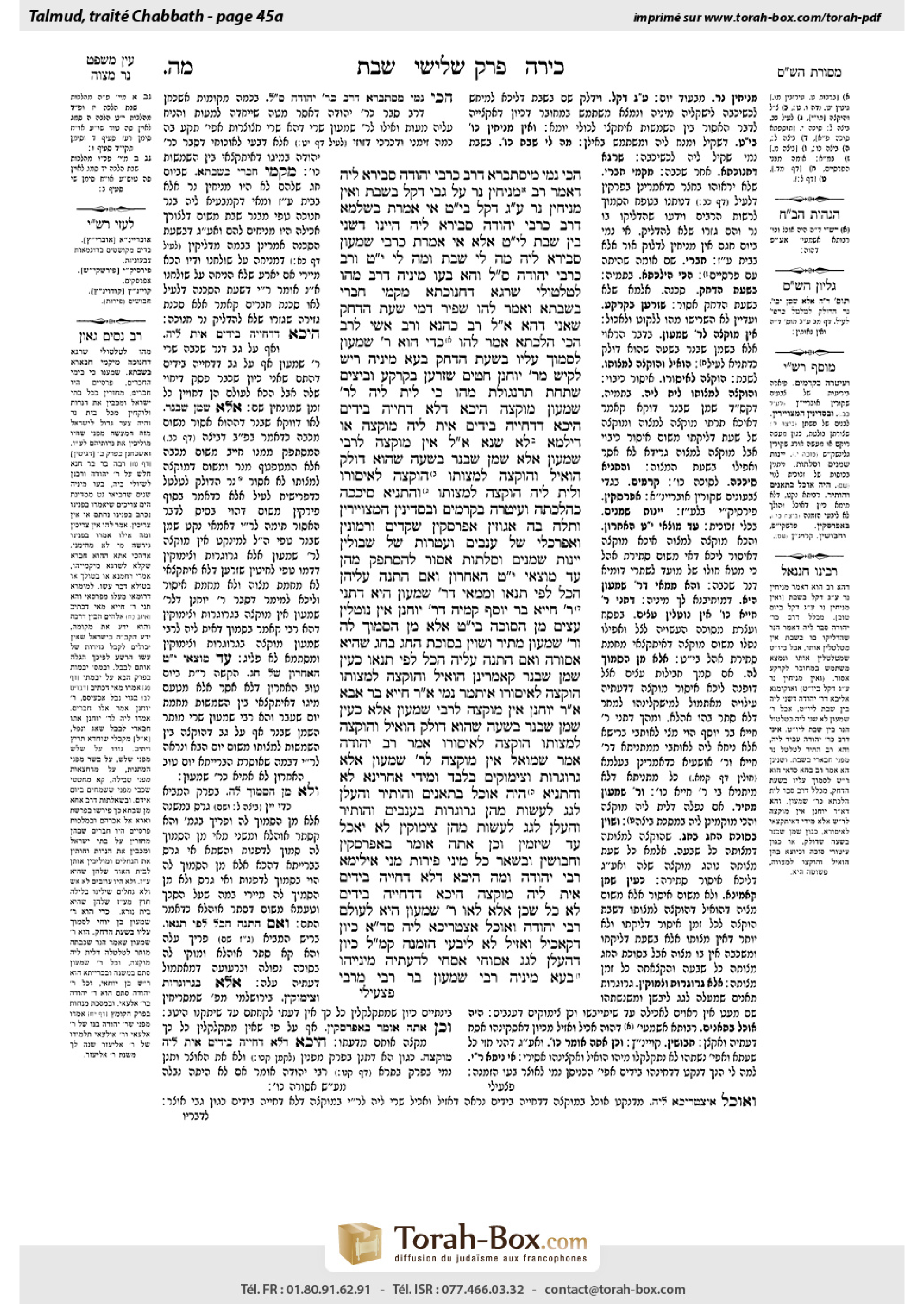
Shabbat 45a: Talmud study for Daf Yomi
Daf Yomi is the daily study of one Talmud folio. Explore 37 tractates with scans, Hebrew text, Sefaria English and AI-generated French translations where annotated.
Passage selection and English or AI-generated French translation are available where the scan has annotations. Daf Study is independent of Torah-Box and Sefaria.
Browse Shabbat · שבת · All tractatesShabbat 45a text and translations
This page of Shabbat includes the Aramaic text, an English translation and an AI-generated French translation, alongside the scan above.
שבת מ״ה א · Aramaic and Hebrew text
הָכִי נָמֵי מִיסְתַּבְּרָא דְּרַב כְּרַבִּי יְהוּדָה סְבִירָא לֵיהּ, דְּאָמַר רַב: מַנִּיחִין נֵר עַל גַּבֵּי דֶּקֶל בְּשַׁבָּת, וְאֵין מַנִּיחִין נֵר עַל גַּבֵּי דֶּקֶל בְּיוֹם טוֹב. אִי אָמְרַתְּ בִּשְׁלָמָא דְּרַב כְּרַבִּי יְהוּדָה סְבִירָא לֵיהּ — הַיְינוּ דְּשָׁנֵי בֵּין שַׁבָּת לְיוֹם טוֹב. אֶלָּא אִי אָמְרַתְּ כְּרַבִּי שִׁמְעוֹן סְבִירָא לֵיהּ, מָה לִי שַׁבָּת וּמָה לִי יוֹם טוֹב?
וְרַב כְּרַבִּי יְהוּדָה סְבִירָא לֵיהּ? וְהָא בְּעוֹ מִינֵּיהּ דְּרַב מַהוּ לְטַלְטוֹלֵי שְׁרָגָא דַחֲנוּכְּתָא מִקַּמֵּי חַבָּרֵי בְּשַׁבְּתָא, וַאֲמַר לְהוּ: שַׁפִּיר דָּמֵי! — שְׁעַת הַדְּחָק שָׁאנֵי. דְּהָא אֲמַרוּ לְהוּ רַב כָּהֲנָא וְרַב אָשֵׁי לְרַב: הָכִי הִלְכְתָא? אֲמַר לְהוּ: כְּדַי הוּא רַבִּי שִׁמְעוֹן לִסְמוֹךְ עָלָיו בִּשְׁעַת הַדְּחָק.
בְּעָא מִינֵּיהּ רֵישׁ לָקִישׁ מֵרַבִּי יוֹחָנָן: חִטִּים שֶׁזְּרָעָן בְּקַרְקַע, וּבֵיצִים שֶׁתַּחַת תַּרְנְגוֹלֶת — מַהוּ? כִּי לֵית לֵיהּ לְרַבִּי שִׁמְעוֹן מוּקְצֶה — הֵיכָא דְּלָא דַּחְיֵיהּ בְּיָדַיִם, הֵיכָא דְּדַחְיֵיהּ בְּיָדַיִם — אִית לֵיהּ מוּקְצֶה, אוֹ דִילְמָא לָא שְׁנָא. אֲמַר לֵיהּ: אֵין מוּקְצֶה לְרַבִּי שִׁמְעוֹן אֶלָּא שֶׁמֶן שֶׁבַּנֵּר בְּשָׁעָה שֶׁהוּא דּוֹלֵק, הוֹאִיל וְהוּקְצָה לְמִצְוָתוֹ הוּקְצָה לְאִיסּוּרוֹ.
וְלֵית לֵיהּ הוּקְצָה לְמִצְוָתוֹ? וְהָתַנְיָא: סִיכְּכָה כְּהִלְכָתָהּ וְעִיטְּרָה בִּקְרָמִים וּבִסְדִינִין הַמְצוּיָּירִין, וְתָלָה בָּהּ אֱגוֹזִין, אֲפַרְסְקִין, שְׁקֵדִים וְרִמּוֹנִין, וּפַרְכִּילֵי עֲנָבִים, וַעֲטָרוֹת שֶׁל שִׁבּוֹלִין, יֵינוֹת, שְׁמָנִים וּסְלָתוֹת — אָסוּר לְהִסְתַּפֵּק מֵהֶן עַד מוֹצָאֵי יוֹם טוֹב הָאַחֲרוֹן. וְאִם הִתְנָה עֲלֵיהֶן — הַכֹּל לְפִי תְנָאוֹ.
וּמִמַּאי דְּרַבִּי שִׁמְעוֹן הִיא — דְּתָנֵי רַבִּי חִיָּיא בַּר יוֹסֵף קַמֵּיהּ דְּרַבִּי יוֹחָנָן: אֵין נוֹטְלִין עֵצִים מִן הַסּוּכָּה בְּיוֹם טוֹב אֶלָּא מִן הַסָּמוּךְ לָהּ. וְרַבִּי שִׁמְעוֹן מַתִּיר. וְשָׁוִין בְּסוּכַּת הַחַג בֶּחָג שֶׁהִיא אֲסוּרָה, וְאִם הִתְנָה עָלֶיהָ — הַכֹּל לְפִי תְנָאוֹ. כְּעֵין שֶׁמֶן שֶׁבַּנֵּר קָאָמְרִינַן, הוֹאִיל וְהוּקְצָה לְמִצְוָתוֹ הוּקְצָה לְאִיסּוּרוֹ. אִיתְּמַר נָמֵי, אָמַר רַבִּי חִיָּיא בַּר אַבָּא אָמַר רַבִּי יוֹחָנָן: אֵין מוּקְצֶה לְרַבִּי שִׁמְעוֹן אֶלָּא כְּעֵין שֶׁמֶן שֶׁבַּנֵּר בְּשָׁעָה שֶׁהוּא דּוֹלֵק, הוֹאִיל וְהוּקְצָה לְמִצְוָתוֹ הוּקְצָה לְאִיסּוּרוֹ.
אָמַר רַב יְהוּדָה אָמַר שְׁמוּאֵל: אֵין מוּקְצֶה לְרַבִּי שִׁמְעוֹן אֶלָּא גְּרוֹגְרוֹת וְצִימּוּקִים בִּלְבַד. וּמִידִּי אַחֲרִינָא לָא? וְהָתַנְיָא: הָיָה אוֹכֵל בִּתְאֵנִים וְהוֹתִיר וְהֶעֱלָן לַגַּג לַעֲשׂוֹת מֵהֶן גְּרוֹגְרוֹת, בַּעֲנָבִים וְהוֹתִיר וְהֶעֱלָן לַגַּג לַעֲשׂוֹת מֵהֶן צִימּוּקִין — לֹא יֹאכַל עַד שֶׁיַּזְמִין. וְכֵן אַתָּה אוֹמֵר בַּאֲפַרְסְקִין וַחֲבוּשִׁין וּבִשְׁאָר כׇּל מִינֵי פֵּירוֹת.
מַנִּי? אִילֵימָא רַבִּי יְהוּדָה — וּמָה הֵיכָא דְּלָא דַּחְיֵיהּ בְּיָדַיִם אִית לֵיהּ מוּקְצֶה, הֵיכָא דְּדַחְיֵיהּ בְּיָדַיִם לֹא כׇּל שֶׁכֵּן?
אֶלָּא לָאו רַבִּי שִׁמְעוֹן הִיא! לְעוֹלָם רַבִּי יְהוּדָה, וְאוֹכֵל אִצְטְרִיכָא לֵיהּ. סָלְקָא דַעְתָּךְ אָמֵינָא, כֵּיוָן דְּקָאָכֵיל וְאָזֵיל לָא לִיבְעֵי הַזְמָנָה. קָמַשְׁמַע לַן, כֵּיוָן דְּהֶעֱלָן לַגַּג אַסּוֹחֵי אַסְּחֵהּ לְדַעְתֵּיהּ מִינַּיְיהוּ.
בְּעָא מִינֵּיהּ רַבִּי שִׁמְעוֹן בַּר רַבִּי מֵרַבִּי:
Shabbat 45a · English translation
The Gemara adds: So too, it is reasonable to say that Rav holds in accordance with the opinion of Rabbi Yehuda, as Rav said: One may place a lamp atop a palm tree on Shabbat eve to burn on Shabbat, and one may not place a lamp atop a palm tree on a Festival. Granted, if you say that Rav holds in accordance with the opinion of Rabbi Yehuda in this matter; that is why there is a distinction between Shabbat and a Festival. Since the lamp is set-aside [muktze] on Shabbat one will not come to carry it. Since one is permitted to carry a lamp on a Festival, there is concern that one might climb the palm tree or make use of the tree on the Festival and thereby transgress the rabbinic prohibition against making use of something connected to the ground on a Festival. However, if you say that Rav holds in accordance with the opinion of Rabbi Shimon, who maintains that the lamp is not set-aside even on Shabbat, what difference is there to me between Shabbat and a Festival? Ostensibly, there should be no distinction between the two.
The Gemara asks: And does Rav really hold in accordance with the opinion of Rabbi Yehuda that it is prohibited to move an object that is set-aside? Didn’t they raise a dilemma before Rav: What is the ruling with regard to moving a Hanukkah candle from before the ḥabarei, Persian Zoroastrian fire priests, on Shabbat? Those priests prohibited lighting fires on certain days. In order to prevent them from discovering that he lit Hanukkah candles it was necessary to quickly move them. And he said to them: One may well do so. Apparently, Rav does not hold that there is a prohibition of set-aside. The Gemara answers: This is not a proof, as exigent circumstances are different and Rav permitted this due to the danger involved. As Rav Kahana and Rav Ashi said to Rav on this matter: Is that the halakha? He said to them: Rabbi Shimon is worthy to rely upon in exigent circumstances like this one.
On this same matter Reish Lakish raised a dilemma before Rabbi Yoḥanan: Wheat kernels that he sowed in the ground that have not yet taken root and he could still gather them, and eggs that were placed beneath the hen and the incubation process has begun, what is the halakha in these cases? Would Rabbi Shimon agree that in these cases it is prohibited for use on Shabbat? One side of the dilemma is: When is Rabbi Shimon not of the opinion that there is a prohibition of set-aside? In a case where one did not reject the object with his own hands, i.e., he did not perform an action setting the object aside. However, in a case where he rejected it with his own hands, he is of the opinion that there is a prohibition of set-aside. When he sowed the wheat, he rejected it with his own hands. The same is true with regard to the egg; by placing it under the hen to hatch, he actively rejected it. The other side of the dilemma is: Or, perhaps there is no difference between the cases and Rabbi Shimon holds that there is no prohibition of set-aside in either case. Rabbi Yoḥanan said to him: There is only a prohibition of set-aside, according to Rabbi Shimon, in the case of oil that is in the lamp while it is burning. Since it was set aside for its mitzva, the lighting of Shabbat candles, and it was also set aside for its prohibition, it is prohibited due to the concern that one might inadvertently extinguish the flame if he moves it while it is burning.
The Gemara asks: And does he not hold that the prohibition of set-aside applies to an object set aside only for its mitzva without any prohibition? Wasn’t it taught in a baraita: One who roofed the sukka in accordance with its halakhic requirements and decorated it for aesthetic purposes with colored hangings and tapestries, and hung as decorations nuts, peaches, almonds and pomegranates, and grape branches, and wreaths made of stalks, wine, oils, and fine flour, it is prohibited to supply himself from them until the conclusion of the last day of the Festival. Since they were all set aside for the mitzva of sukka, all other uses are prohibited. And if one stipulated at the time that he hung them in the sukka that he is not designating them exclusively for this purpose, but he intends to use them for other purposes as well, their use is entirely in accordance with his stipulation. He is permitted to use them as he chooses.
And from where do we know that this unattributed baraita is in accordance with the opinion of Rabbi Shimon? We ascertained this from a comparison to a baraita that was taught by Rabbi Ḥiyya bar Yosef. As Rabbi Ḥiyya bar Yosef taught before Rabbi Yoḥanan: One may not take wood from the sukka that was constructed for shade on any Festival, even if the wood fell from the sukka on the Festival. Because it is prohibited to destroy the sukka on the Festival, it was set aside before the Festival for the entire duration of the Festival. Rather, one may take wood only from what is beside the sukka, i.e., bundles of wood that are not being used for the sukka. When he placed them there, his intention was to use them during the Festival. And Rabbi Shimon permits taking wood even from the sukka itself, since he holds that there is no prohibition of set-aside. And Rabbi Yehuda and Rabbi Shimon agree that taking wood from the sukka constructed for the Sukkot festival is prohibited during the Festival. And if one stipulated about the wood that he will be able to use it during the Festival, everything is in accordance with his stipulation. Apparently, Rabbi Shimon prohibits using an object that was set aside due only to a mitzva, even though it was not set aside due to a prohibition. Therefore, the Gemara emends Rabbi Yoḥanan’s statement: There is no halakha of set-aside according to Rabbi Shimon except in a case similar to oil in the candle. It is not necessary that there be both a prohibited labor and a prohibition due to the mitzva. Rather, since it was set aside for the mitzva alone, it is thereby set aside for the prohibition. It was also stated: Rabbi Ḥiyya bar Abba said that Rabbi Yoḥanan said: There is only a prohibition of set-aside according to Rabbi Shimon in a case similar to oil in the candle while it is burning; since it was set aside for its mitzva, it was set aside for its prohibition.
Rav Yehuda said that Shmuel said: There is only a prohibition of set-aside according to Rabbi Shimon in the cases of dried figs and raisins alone. The case of one who takes figs and raisins up to his roof in order to dry them in the sun is the only situation in which Rabbi Shimon holds that they are prohibited on Shabbat due to the prohibition of set-aside. Since in the initial stages of the process they emit a bad odor and are unfit for consumption, one consciously sets them aside. The Gemara challenges: And other items are not included in the prohibition of set-aside? Wasn’t it taught in a baraita: One who was eating figs and left some over and took them up to the roof to make them into dried figs, and likewise one who was eating grapes and left some over and took them up to the roof to make them into raisins, one may not eat them on Shabbat unless he designates them to be eaten before Shabbat. Otherwise, they are prohibited as set-aside. And you would say the same with regard to peaches, and quinces, and all other types of fruit that one left out to dry. It is prohibited to eat them all on Shabbat due to set-aside.
The Gemara seeks to clarify: Whose opinion is it in the baraita? If you say that it is the opinion of Rabbi Yehuda, this baraita is superfluous. If in a case where one did not reject it with his own hands, he holds that there is a prohibition of set-aside, in a case where he rejected it by his own hand, all the more so that it is prohibited. There is no need to articulate the halakha in this unique case.
Rather, isn’t this baraita in accordance with the opinion of Rabbi Shimon? Apparently, he expands the halakhot of set-aside beyond dried figs and raisins. The Gemara rejects this: Actually, this halakha is in accordance with Rabbi Yehuda who holds that there is a prohibition of set-aside. And the case cited here, where he was eating figs, is necessary in order to teach us a novel halakha. It may enter your mind to say that since one was in the course of eating, he does not require prior designation; and if he changed his mind he may immediately retrieve the dried figs that he placed on the roof. Therefore, the baraita teaches us that since he brought them up to the roof, he diverted his attention from them and they are completely set-aside.
On the same topic: Rabbi Shimon bar Rabbi Yehuda HaNasi, raised a dilemma before his father, Rabbi Yehuda HaNasi:
Shabbat 45a · Traduction française (IA)
La Guemara ajoute : De même, il est raisonnable de dire que Rav suit l’opinion de Rabbi Yehouda, car Rav a dit : On peut placer une lampe au sommet d’un palmier la veille de Chabbat afin qu’elle brûle pendant Chabbat, mais on ne peut pas placer une lampe au sommet d’un palmier la veille d’un jour de fête. Il est logique qu’il y ait une distinction entre Chabbat et un jour de fête si l’on dit que Rav suit l’opinion de Rabbi Yehouda sur ce point. Puisque la lampe est mise à l’écart [muktze] pendant Chabbat, on ne risque pas de la transporter. En revanche, puisqu’il est permis de transporter une lampe un jour de fête, on craint que l’on grimpe sur le palmier ou que l’on utilise l’arbre ce jour-là, transgressant ainsi l’interdiction rabbinique d’utiliser un élément rattaché au sol un jour de fête. Toutefois, si l’on dit que Rav suit l’opinion de Rabbi Chimon, selon laquelle la lampe n’est pas mise à l’écart même pendant Chabbat, quelle différence cela me fait-il entre Chabbat et un jour de fête ? Apparemment, il ne devrait y avoir aucune distinction entre les deux.
La Guemara demande : Rav suit-il vraiment l’opinion de Rabbi Yehouda, selon laquelle il est interdit de déplacer un objet mis à l’écart ? N’a-t-on pas soumis à Rav la question suivante : quelle est la halakha concernant le déplacement, pendant Chabbat, d’une lampe de Hanoucca pour la soustraire à la vue des ḥabarei, les prêtres perses zoroastriens du feu ? Ces prêtres interdisaient d’allumer des feux certains jours. Pour les empêcher de découvrir qu’il avait allumé des lampes de Hanoucca, il fallait les déplacer rapidement. Rav leur répondit : On peut tout à fait le faire. Apparemment, Rav ne considère pas que le déplacement d’objets mis à l’écart soit interdit. La Guemara répond : Cela ne constitue pas une preuve, car les circonstances pressantes sont différentes ; Rav l’a permis en raison du danger encouru. En effet, Rav Kahana et Rav Ashi lui dirent à ce sujet : Est-ce bien la halakha ? Il leur répondit : On peut s’appuyer sur Rabbi Chimon dans des circonstances pressantes comme celles-ci.
À ce même sujet, Rech Lakich soumit à Rabbi Yoḥanan la question suivante : quel est le statut de grains de blé qu’il a semés en terre, qui n’ont pas encore pris racine et qu’il pourrait encore ramasser, ainsi que d’œufs placés sous une poule dont la couvaison a commencé ? Rabbi Chimon conviendrait-il que, dans ces cas, il est interdit de les utiliser pendant Chabbat ? Une possibilité est que Rabbi Chimon ne considère pas qu’il y ait une interdiction de déplacer un objet mis à l’écart lorsque l’on n’a pas écarté l’objet de ses propres mains, c’est-à-dire que l’on n’a effectué aucune action pour le mettre à l’écart. En revanche, lorsqu’on l’a écarté de ses propres mains, il estime que cette interdiction s’applique. En semant le blé, il l’a écarté de ses propres mains. Il en va de même pour l’œuf : en le plaçant sous la poule pour qu’il éclose, il l’a activement écarté. L’autre possibilité est qu’il n’y ait peut-être aucune différence entre les cas et que Rabbi Chimon estime que cette interdiction ne s’applique dans aucun des deux cas. Rabbi Yoḥanan lui répondit : Selon Rabbi Chimon, l’interdiction ne s’applique qu’à l’huile qui se trouve dans la lampe pendant qu’elle brûle. Puisqu’elle a été mise à l’écart pour sa mitsva, l’allumage des lampes de Chabbat, et qu’elle a également été mise à l’écart en raison de son interdiction, son utilisation est interdite, par crainte que quelqu’un n’éteigne par inadvertance la flamme en la déplaçant alors qu’elle brûle.
La Guemara demande : Ne considère-t-il donc pas que l’interdiction de déplacer un objet mis à l’écart s’applique à un objet réservé uniquement à une mitsva, sans qu’aucune interdiction ne s’y attache ? N’a-t-on pas enseigné dans une baraïta : Celui qui a couvert la soukka conformément aux exigences de la halakha et l’a décorée à des fins esthétiques avec des tentures et des tapisseries colorées, puis y a suspendu comme décorations des noix, des pêches, des amandes et des grenades, des grappes de raisin ainsi que des guirlandes faites de tiges, de vin, d’huiles et de farine fine, ne peut rien en utiliser jusqu’à la fin du dernier jour de la fête. Puisque tous ces éléments ont été mis à l’écart pour la mitsva de la soukka, tout autre usage est interdit. Si, au moment de les suspendre dans la soukka, il a stipulé qu’il ne les réservait pas exclusivement à cette fin, mais entendait également les utiliser à d’autres fins, leur usage est entièrement régi par sa stipulation. Il peut les utiliser comme il le souhaite.
Et d’où savons-nous que cette baraïta anonyme suit l’opinion de Rabbi Shimon ? Nous l’avons établi en la comparant à une baraïta enseignée par Rabbi Ḥiyya bar Yosef. En effet, Rabbi Ḥiyya bar Yosef enseigna devant Rabbi Yoḥanan : Il est interdit de prendre du bois de la soukka construite pour servir d’abri lors de tout jour de fête, même si le bois est tombé de la soukka pendant le jour de fête. Comme il est interdit de détruire la soukka pendant le jour de fête, le bois a été mis à l’écart avant la fête pour toute sa durée. En revanche, on ne peut prendre du bois que parmi celui qui se trouve à côté de la soukka, c’est-à-dire des fagots qui ne servent pas à la soukka. Lorsqu’il les a placés là, il avait l’intention de les utiliser pendant la fête. Rabbi Shimon permet de prendre du bois même de la soukka elle-même, puisqu’il estime qu’il n’existe pas d’interdiction de mettre des objets à l’écart. Rabbi Yehuda et Rabbi Shimon conviennent qu’il est interdit, pendant la fête, de prendre du bois de la soukka construite pour la fête de Soukkot. Et si l’on a stipulé au sujet du bois qu’on pourrait l’utiliser pendant la fête, tout est conforme à cette stipulation. Apparemment, Rabbi Shimon interdit l’usage d’un objet mis à l’écart uniquement en raison d’une mitsva, même s’il n’a pas été mis à l’écart en raison d’une interdiction. La Guemara rectifie donc la déclaration de Rabbi Yoḥanan : selon Rabbi Shimon, il n’y a de règle concernant la mise à l’écart que dans un cas semblable à celui de l’huile dans la lampe. Il n’est pas nécessaire qu’il y ait à la fois un travail interdit et une interdiction liée à la mitsva. Au contraire, dès lors que l’objet a été mis à l’écart pour la mitsva seule, il est de ce fait mis à l’écart en raison de l’interdiction. Il a également été rapporté : Rabbi Ḥiyya bar Abba a dit au nom de Rabbi Yoḥanan : Selon Rabbi Shimon, il n’y a d’interdiction de mise à l’écart que dans un cas semblable à celui de l’huile dans la lampe pendant qu’elle brûle ; puisqu’elle a été mise à l’écart pour sa mitsva, elle a été mise à l’écart en raison de l’interdiction.
Rav Yehuda a dit au nom de Shmuel : Selon Rabbi Shimon, l’interdiction de mise à l’écart ne concerne que les figues et les raisins qu’on fait sécher. Le seul cas où Rabbi Shimon estime que ces fruits sont interdits pendant Chabbat en raison de la mise à l’écart est celui de quelqu’un qui monte des figues et des raisins sur son toit afin de les faire sécher au soleil. Comme, aux premières étapes du processus, ils dégagent une mauvaise odeur et sont impropres à la consommation, on les met consciemment à l’écart. La Guemara objecte : D’autres objets ne sont-ils donc pas concernés par l’interdiction de mise à l’écart ? N’a-t-on pas enseigné dans une baraïta : Si quelqu’un mangeait des figues, en a laissé quelques-unes et les a montées sur le toit pour les faire sécher, et de même, si quelqu’un mangeait du raisin, en a laissé quelques grains et les a montés sur le toit pour en faire des raisins secs, il ne peut pas les manger pendant Chabbat, à moins de les avoir désignés pour être mangés avant Chabbat. Sinon, leur consommation est interdite en raison de la mise à l’écart. Et l’on dirait la même chose des pêches, des coings et de toutes les autres sortes de fruits qu’on a laissés sécher. Il est interdit de les manger pendant Chabbat en raison de la mise à l’écart.
La Guemara cherche à préciser : De qui la baraïta exprime-t-elle l’opinion ? Si l’on dit qu’il s’agit de celle de Rabbi Yehuda, cette baraïta est superflue. S’il estime qu’il y a une interdiction de mise à l’écart même lorsqu’on n’a pas écarté les objets de ses propres mains, à plus forte raison leur usage est-il interdit lorsqu’on les a écartés de ses propres mains. Il n’est pas nécessaire d’énoncer la halakha dans ce cas particulier.
N’est-ce pas plutôt que cette baraïta suit l’opinion de Rabbi Shimon ? Apparemment, il étend les règles relatives à la mise à l’écart au-delà des seules figues et des raisins qu’on fait sécher. La Guemara rejette cette conclusion : en réalité, cette halakha suit l’opinion de Rabbi Yehuda, qui estime qu’il y a une interdiction de mise à l’écart. Le cas cité ici, celui de quelqu’un qui mangeait des figues, est nécessaire pour nous enseigner une halakha nouvelle. On pourrait penser que, puisqu’il était en train de manger, il n’a pas besoin de les désigner à l’avance pour être consommées ; s’il change d’avis, il peut immédiatement reprendre les figues qu’il a mises à sécher sur le toit. La baraïta nous enseigne donc que, dès lors qu’il les a montées sur le toit, il a détourné son attention d’elles et elles sont complètement mises à l’écart.
Sur le même sujet, Rabbi Shimon, fils de Rabbi Yehuda HaNassi, soumit une question à son père, Rabbi Yehuda HaNassi :
Traduction française générée par IA à partir de l’édition anglaise de Sefaria. Vérifie toujours un passage avec le texte source.
Text from Sefaria: William Davidson Edition - Vocalized Aramaic (CC BY NC); William Davidson Edition - English (CC BY NC).