Shabbat 45b: Talmud study for Daf Yomi
Daf Yomi is the daily study of one Talmud folio. Explore 37 tractates with scans, Hebrew text, Sefaria English and AI-generated French translations where annotated.
Passage selection and English or AI-generated French translation are available where the scan has annotations. Daf Study is independent of Torah-Box and Sefaria.
Browse Shabbat · שבת · All tractatesShabbat 45b text and translations
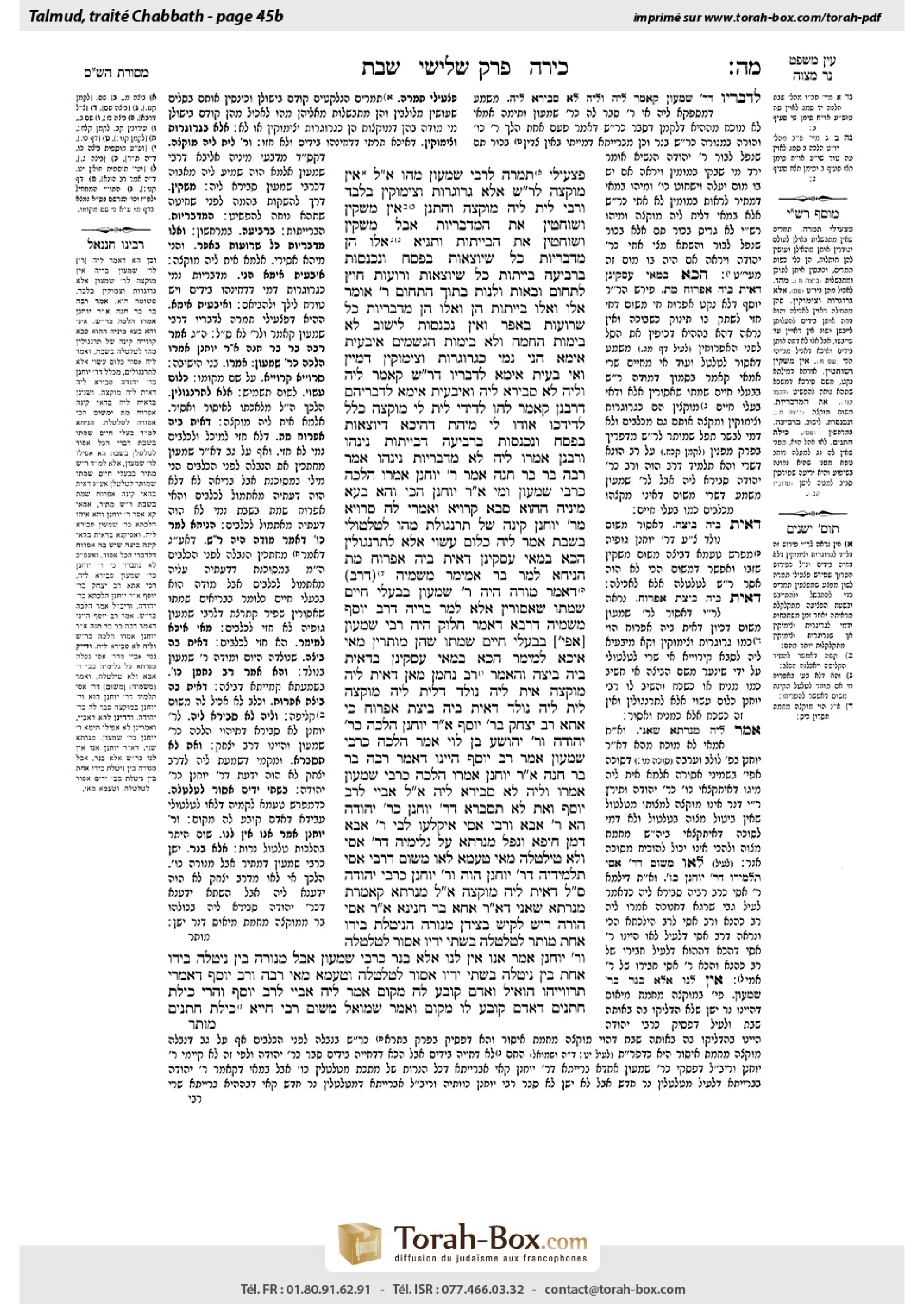
This page of Shabbat includes the Aramaic text, an English translation and an AI-generated French translation, alongside the scan above.
שבת מ״ה ב · Aramaic and Hebrew text
פַּצְעִילֵי תְמָרָה, לְרַבִּי שִׁמְעוֹן מַהוּ? אָמַר לוֹ: אֵין מוּקְצֶה לְרַבִּי שִׁמְעוֹן אֶלָּא גְּרוֹגְרוֹת וְצִימּוּקִין בִּלְבַד.
וְרַבִּי לֵית לֵיהּ מוּקְצֶה? וְהָתְנַן אֵין מַשְׁקִין וְשׁוֹחֲטִין אֶת הַמִּדְבָּרִיּוֹת, אֲבָל מַשְׁקִין וְשׁוֹחֲטִין אֶת הַבַּיָּיתוֹת. וְתַנְיָא: אֵלּוּ הֵן מִדְבָּרִיּוֹת? — כׇּל שֶׁיּוֹצְאוֹת בַּפֶּסַח וְנִכְנָסוֹת בָּרְבִיעָה. בַּיָּיתוֹת — כׇּל שֶׁיּוֹצְאוֹת וְרוֹעוֹת חוּץ לַתְּחוּם, וּבָאוֹת וְלָנוֹת בְּתוֹךְ הַתְּחוּם. רַבִּי אוֹמֵר: אֵלּוּ וְאֵלּוּ בַּיָּיתוֹת הֵן. וְאֵלּוּ הֵן מִדְבָּרִיּוֹת: כׇּל שֶׁרוֹעוֹת בָּאֲפָר, וְאֵין נִכְנָסוֹת לַיִּשּׁוּב לֹא בִּימוֹת הַחַמָּה וְלֹא בִּימוֹת הַגְּשָׁמִים.
אִיבָּעֵית אֵימָא: הָנֵי נָמֵי כִּגְרוֹגְרוֹת וְצִימּוּקִין דָּמְיָין. וְאִי בָּעֵית אֵימָא: לִדְבָרָיו דְּרַבִּי שִׁמְעוֹן קָאָמַר לֵיהּ, וְלֵיהּ לָא סְבִירָא לֵיהּ.
וְאִיבָּעֵית אֵימָא, לְדִבְרֵיהֶם דְּרַבָּנַן קָאָמַר לְהוּ: לְדִידִי לֵית לִי מוּקְצֶה כְּלָל, לְדִידְכוּ אוֹדוּ לִי מִיהַת דְּהֵיכָא דְּיוֹצְאוֹת בַּפֶּסַח וְנִכְנָסוֹת בָּרְבִיעָה דְּבַיָּיתוֹת נִינְהוּ. וְרַבָּנַן? — אָמְרוּ לֵיהּ: לָא, מִדְבָּרִיּוֹת נִינְהוּ.
אָמַר רַבָּה בַּר בַּר חָנָה אָמַר רַבִּי יוֹחָנָן: אָמְרוּ הֲלָכָה כְּרַבִּי שִׁמְעוֹן. וּמִי אָמַר רַבִּי יוֹחָנָן הָכִי? וְהָא בְּעָא מִינֵּיהּ הָהוּא סָבָא קָרוֹיָא, וְאָמְרִי לַהּ, סָרוֹיָא מֵרַבִּי יוֹחָנָן: קִינָּהּ שֶׁל תַּרְנְגוֹלֶת מַהוּ לְטַלְטוֹלֵי בְּשַׁבָּת? אֲמַר לֵיהּ: כְּלוּם עָשׂוּי אֶלָּא לְתַרְנְגוֹלִין! הָכָא בְמַאי עָסְקִינַן — דְּאִית בֵּיהּ אֶפְרוֹחַ מֵת.
הָנִיחָא לְמָר בַּר אַמֵּימָר מִשְּׁמֵיהּ (דְּרַב) [דְּרָבָא] דְּאָמַר: מוֹדֶה הָיָה רַבִּי שִׁמְעוֹן בְּבַעֲלֵי חַיִּים שֶׁמֵּתוּ שֶׁאֲסוּרִין. אֶלָּא לְמָר בְּרֵיהּ דְּרַב יוֹסֵף מִשְּׁמֵיהּ דְּרָבָא דְּאָמַר: חָלוּק הָיָה רַבִּי שִׁמְעוֹן [אֲפִילּוּ] בְּבַעֲלֵי חַיִּים שֶׁמֵּתוּ שֶׁהֵן מוּתָּרִין, מַאי אִיכָּא לְמֵימַר? הָכָא בְּמַאי עָסְקִינַן — בִּדְאִית בֵּיהּ בֵּיצָה.
וְהָאָמַר רַב נַחְמָן: מַאן דְּאִית לֵיהּ מוּקְצֶה — אִית לֵיהּ נוֹלָד, דְּלֵית לֵיהּ מוּקְצֶה — לֵית לֵיהּ נוֹלָד! דְּאִית בֵּיהּ בֵּיצַת אֶפְרוֹחַ.
כִּי אֲתָא רַב יִצְחָק בְּרַבִּי יוֹסֵף אָמַר רַבִּי יוֹחָנָן: הֲלָכָה כְּרַבִּי יְהוּדָה. וְרַבִּי יְהוֹשֻׁעַ בֶּן לֵוִי אָמַר: הֲלָכָה כְּרַבִּי שִׁמְעוֹן. אָמַר רַב יוֹסֵף: הַיְינוּ דְּאָמַר רַבָּה בַּר בַּר חָנָה אָמַר רַבִּי יוֹחָנָן: אָמְרוּ הֲלָכָה כְּרַבִּי שִׁמְעוֹן. אָמְרוּ, וְלֵיהּ לָא סְבִירָא לֵיהּ.
אָמַר לֵיהּ אַבָּיֵי לְרַב יוֹסֵף: וְאַתְּ לָא תִּסְבְּרַהּ דְּרַבִּי יוֹחָנָן כְּרַבִּי יְהוּדָה, הָא רַבִּי אַבָּא וְרַבִּי אַסִּי אִיקְּלַעוּ לְבֵי רַבִּי אַבָּא דְּמִן חֵיפָא, וּנְפַל מְנָרְתָּא עַל גְּלִימֵיהּ דְּרַבִּי אַסִּי וְלָא טַלְטְלַהּ. מַאי טַעְמָא? לָאו מִשּׁוּם דְּרַבִּי אַסִּי תַּלְמִידֵיהּ דְּרַבִּי יוֹחָנָן הֲוָה, וְרַבִּי יוֹחָנָן כְּרַבִּי יְהוּדָה סְבִירָא לֵיהּ, דְּאִית לֵיהּ מוּקְצֶה!
אֲמַר לֵיהּ: מְנָרְתָּא קָאָמְרַתְּ? מְנָרְתָּא שָׁאנֵי, דְּאָמַר רַבִּי אַחָא בַּר חֲנִינָא אָמַר רַבִּי אַסִּי: הוֹרָה רֵישׁ לָקִישׁ בְּצַיְדָּן: מְנוֹרָה הַנִּיטֶּלֶת בְּיָדוֹ אַחַת — מוּתָּר לְטַלְטְלָהּ, בִּשְׁתֵּי יָדָיו — אָסוּר לְטַלְטְלָהּ. וְרַבִּי יוֹחָנָן אָמַר: אָנוּ אֵין לָנוּ אֶלָּא בְּנֵר כְּרַבִּי שִׁמְעוֹן. אֲבָל מְנוֹרָה, בֵּין נִיטֶּלֶת בְּיָדוֹ אַחַת בֵּין נִיטֶּלֶת בִּשְׁתֵּי יָדָיו — אָסוּר לְטַלְטְלָהּ.
וְטַעְמָא מַאי? רַבָּה וְרַב יוֹסֵף דְּאָמְרִי תַּרְוַויְיהוּ: הוֹאִיל וְאָדָם קוֹבֵעַ לָהּ מָקוֹם. אֲמַר לֵיהּ אַבָּיֵי לְרַב יוֹסֵף: וַהֲרֵי כִּילַּת חֲתָנִים דְּאָדָם קוֹבֵעַ לוֹ מָקוֹם, וְאָמַר שְׁמוּאֵל מִשּׁוּם רַבִּי חִיָּיא: כִּילַּת חֲתָנִים
Shabbat 45b · English translation
Unripe dates that are placed in baskets to ripen and until they are ripe can only be eaten with difficulty, according to the opinion of Rabbi Shimon, what is their legal status as far as moving them on Shabbat is concerned? Are they considered set-aside? Rabbi Yehuda HaNasi said to him: There is only a prohibition of set-aside according to Rabbi Shimon in the cases of dried figs and raisins alone.
The Gemara challenges this: And does Rabbi Yehuda HaNasi not hold that there is a prohibition of set-aside? Didn’t we learn in a mishna that on a Festival, before they are slaughtered, one may neither give water to, in order to ease removal of their hides, nor slaughter non-domesticated, desert animals, animals that are always grazing in the fields? Since people do not generally tend to them, they are considered set-aside and may not be used. However, one may give water to and slaughter domesticated animals. And it was taught in a baraita that these are non-domesticated, desert animals: Any animals that leave their sheds on Passover and only enter their sheds with the advent of the rainy season. Domesticated animals are any animals that go out to graze beyond the city limits, and come and sleep within the city limits. Rabbi Yehuda HaNasi says: These and those are both domesticated. And these are the non-domesticated, desert animals that are prohibited due to the prohibition of set-aside: Any animals that graze in the grazing area and neither enter the town during the summer nor during the rainy season. It is these animals that it is prohibited to give water to or slaughter on a Festival. Apparently, Rabbi Yehuda HaNasi holds that there is a prohibition of set-aside even in the case of animals.
Several resolutions are proposed to this contradiction: If you wish, say that these non-domesticated animals that graze in the grazing areas throughout the year are also considered like dried figs and raisins. Even Rabbi Shimon would agree to this halakha. And if you wish, say instead: When Rabbi Yehuda HaNasi told his son that answer, he was saying it to him in accordance with the opinion of Rabbi Shimon, and he himself does not hold that way.
And if you wish, say instead: In that baraita, he spoke to them in accordance with the statement of the Rabbis, and this is how his statement must be understood: In my opinion I do not hold that there is a prohibition of set-aside at all. However, according to your opinion, at least agree with me that animals that leave their sheds on Passover and only enter their sheds with the advent of the rainy season are domesticated. And the Rabbis said to him: No, those are non-domesticated animals.
As to the essential dispute with regard to the laws of set-aside, Rabba bar bar Ḥana said that Rabbi Yoḥanan said: They said that the halakha is in accordance with the opinion of Rabbi Shimon who holds that there is no prohibition of set-aside. The Gemara asks: Did Rabbi Yoḥanan actually say this? Didn’t an Elder from Keruya, and some say that he was from Seruya, raise a dilemma before Rabbi Yoḥanan: With regard to a hen’s roost, what is its legal status as far as moving it on Shabbat is concerned? Rabbi Yoḥanan said to him: Isn’t the roost made exclusively for hens to be inside it? Since it is not designated for use by people, moving it is prohibited. Apparently, he holds in accordance with the opinion of Rabbi Yehuda with regard to set-aside. The Gemara answers: With what are we dealing here? With a special case, when there is a dead chick in the roost. Moving the roost is prohibited due to the dead chick, which is set-aside.
The Gemara continues to ask: This works out well according to the opinion of Mar bar Ameimar in the name of Rav, who said: Rabbi Shimon agreed in the case of animals that died on Shabbat, that they are prohibited on Shabbat due to set-aside. However, according to the opinion of Mar, son of Rav Yosef, in the name of Rava, who said: Rabbi Shimon was in disagreement even in the case of animals that died, and said that they are permitted and are not prohibited as set-aside, what can be said? The Gemara responds: With what are we dealing here? With a case where there is an egg that was laid on Shabbat in the roost. Because it was laid on Shabbat it is considered set-aside, and using the egg is prohibited. The thought of using it never entered anyone’s mind before Shabbat.
The Gemara asks: Didn’t Rav Naḥman say: One who is of the opinion that there is a prohibition of set-aside, is also of the opinion that there is a prohibition of an object that came into being on Shabbat or on a Festival; and one who is not of the opinion that there is a prohibition of set-aside, is also not of the opinion that there is a prohibition of an object that came into being. This case is no different than other cases of set-aside. The Gemara responds: This is referring to a case where the roost has an egg with a chick in it. Even Rabbi Shimon would agree that moving an egg of that sort is prohibited since it is fit for neither human nor animal consumption.
This explanation was cited to explain that Rabbi Yoḥanan could hold in accordance with the opinion of Rabbi Shimon. However, when Rav Yitzḥak, son of Rabbi Yosef, came from Eretz Yisrael to Babylonia, he said that Rabbi Yoḥanan said: The halakha is in accordance with the opinion of Rabbi Yehuda that there is a prohibition of set-aside. And Rabbi Yehoshua ben Levi said: The halakha is in accordance with the opinion of Rabbi Shimon, that there is no prohibition of set-aside. Rav Yosef said: That is what Rabba bar bar Ḥana said that Rabbi Yoḥanan said: They said that the halakha is in accordance with the opinion of Rabbi Shimon. The inference is: They said; however, he himself does not hold that this is the halakha.
Abaye said to Rav Yosef: And you yourself did not hold that Rabbi Yoḥanan rules in accordance with the opinion of Rabbi Yehuda, even before Rav Yitzḥak came and cited this statement in his name? Didn’t Rabbi Abba and Rabbi Asi happen to come to the house of Rabbi Abba who was from the city Haifa, and a candelabrum fell onto Rabbi Asi’s cloak and he did not move it? What is the reason that he did not lift it? Is it not because Rabbi Asi was a student of Rabbi Yoḥanan, and Rabbi Yoḥanan holds in accordance with the opinion of Rabbi Yehuda, who holds that there is a prohibition of set-aside? Apparently, Rabbi Yoḥanan holds in accordance with the opinion of Rabbi Yehuda.
Rav Yosef said to Abaye: Candelabrum you say; are you citing a proof from the case of a candelabrum? A candelabrum is different because there is a unique halakha in that case. As Rabbi Aḥa bar Rabbi Ḥanina said that Rabbi Asi said that Reish Lakish issued a ruling in the city of Sidon: A candelabrum that can be moved in one of his hands, one is permitted to move it on Shabbat. However, if it is so heavy that one must move it with his two hands, it is prohibited to move it. And Rabbi Yoḥanan said: We have permission to carry only in the case of an oil lamp, according to the opinion of Rabbi Shimon. However, with regard to a candelabrum, both one that is carried in one hand and one that is carried in two hands, it is prohibited to move it.
The Gemara asks: And what is the reason that there is a unique prohibition in the case of a candelabrum? Rabba and Rav Yosef both said: Since a person usually designates a fixed place for it due to its size and its use, it is considered a built-in part of the house, and moving the candelabrum is like dismantling the house. Abaye said to Rav Yosef: A groom’s canopy is an object for which a person designates a set place, and, nevertheless, Shmuel said in the name of Rabbi Ḥiyya: With regard to a groom’s canopy,
Shabbat 45b · Traduction française (IA)
Quel est, selon l’opinion de Rabbi Shimon, le statut des dattes vertes que l’on place dans des paniers pour les faire mûrir et qui, jusqu’à maturité, ne peuvent être consommées qu’avec difficulté, quant à leur déplacement pendant Chabbat ? Sont-elles considérées comme mises de côté ? Rabbi Yehouda haNassi lui dit : Selon Rabbi Shimon, l’interdiction liée aux objets mis de côté ne concerne que les figues sèches et les raisins secs.
La Guemara objecte : Rabbi Yehouda haNassi ne considère-t-il donc pas qu’il existe une interdiction liée aux objets mis de côté ? N’avons-nous pas appris dans une Michna que, lors d’un jour de fête, avant leur abattage, on ne peut ni faire boire les animaux sauvages du désert afin de faciliter le retrait de leur peau, ni les abattre ? Ce sont des animaux qui paissent constamment dans les champs. Comme les gens ne s’occupent généralement pas d’eux, ils sont considérés comme mis de côté et ne peuvent être utilisés. En revanche, on peut faire boire et abattre les animaux domestiques. Or, il a été enseigné dans une baraïta que les animaux sauvages du désert sont ceux qui sortent de leurs enclos à Pessa’h et n’y rentrent qu’à l’arrivée de la saison des pluies. Les animaux domestiques sont ceux qui vont paître au-delà des limites de la ville et reviennent dormir à l’intérieur de celles-ci. Rabbi Yehouda haNassi dit : Les uns comme les autres sont des animaux domestiques. Quant aux animaux sauvages du désert, dont l’utilisation est interdite en raison de l’interdiction liée aux objets mis de côté, ce sont ceux qui paissent dans les pâturages et ne rentrent en ville ni pendant l’été ni pendant la saison des pluies. Ce sont ces animaux qu’il est interdit de faire boire ou d’abattre un jour de fête. Il semble donc que Rabbi Yehouda haNassi considère qu’il existe une interdiction liée aux objets mis de côté, même dans le cas des animaux.
Plusieurs solutions sont proposées pour résoudre cette contradiction. Si tu le souhaites, dis que ces animaux sauvages qui paissent dans les pâturages toute l’année sont eux aussi considérés comme des figues sèches et des raisins secs. Même Rabbi Shimon conviendrait de cette halakha. Si tu le souhaites, dis plutôt que, lorsque Rabbi Yehouda haNassi a donné cette réponse à son fils, il la lui a donnée conformément à l’opinion de Rabbi Shimon, mais que lui-même ne partage pas cette opinion.
Si tu le souhaites, dis plutôt que, dans cette baraïta, il s’est adressé aux Sages conformément à leur enseignement, et qu’il faut comprendre sa déclaration ainsi : « Selon mon opinion, je ne considère pas qu’il existe la moindre interdiction liée aux objets mis de côté. Cependant, selon votre opinion, convenez au moins avec moi que les animaux qui sortent de leurs enclos à Pessa’h et n’y rentrent qu’à l’arrivée de la saison des pluies sont des animaux domestiques. » Les Sages lui dirent : « Non, ce sont des animaux sauvages. »
Quant au désaccord fondamental sur les lois des objets mis de côté, Rabba bar bar Ḥana dit au nom de Rabbi Yoḥanan : Ils ont dit que la halakha est conforme à l’opinion de Rabbi Shimon, qui considère qu’il n’existe pas d’interdiction liée aux objets mis de côté. La Guemara demande : Rabbi Yoḥanan a-t-il réellement dit cela ? Un ancien de Keruya — certains disent qu’il venait de Seruya — n’a-t-il pas posé à Rabbi Yoḥanan la question suivante : quel est le statut d’un perchoir à poules quant à son déplacement pendant Chabbat ? Rabbi Yoḥanan lui dit : Le perchoir n’est-il pas destiné exclusivement aux poules ? Puisqu’il n’est pas destiné à l’usage des gens, il est interdit de le déplacer. Il semble donc qu’il suive l’opinion de Rabbi Yehouda en matière d’objets mis de côté. La Guemara répond : De quoi s’agit-il ici ? D’un cas particulier où se trouve un poussin mort dans le perchoir. Il est interdit de déplacer le perchoir à cause du poussin mort, qui est mis de côté.
La Guemara poursuit son objection : Cela s’explique bien selon l’opinion de Mar bar Ameimar au nom de Rav, qui a dit que Rabbi Shimon a reconnu, dans le cas d’animaux morts pendant Chabbat, qu’ils sont interdits pendant Chabbat en raison de leur statut d’objets mis de côté. Mais que peut-on dire selon l’opinion de Mar, fils de Rav Yosef, au nom de Rava, qui a dit que Rabbi Shimon était en désaccord même dans le cas d’animaux morts et qu’il les autorisait, sans les interdire comme objets mis de côté ? La Guemara répond : De quoi s’agit-il ici ? D’un cas où un œuf a été pondu pendant Chabbat dans le perchoir. Comme il a été pondu pendant Chabbat, il est considéré comme mis de côté, et il est interdit de l’utiliser. Avant Chabbat, personne n’avait même envisagé de l’utiliser.
La Guemara demande : Rav Naḥman n’a-t-il pas dit que celui qui considère qu’il existe une interdiction liée aux objets mis de côté considère également qu’il est interdit d’utiliser un objet apparu pendant Chabbat ou un jour de fête, et que celui qui ne considère pas qu’il existe une telle interdiction ne considère pas non plus qu’il est interdit d’utiliser un objet apparu pendant Chabbat ou un jour de fête ? Ce cas ne diffère donc pas des autres cas d’objets mis de côté. La Guemara répond : Il s’agit ici d’un perchoir contenant un œuf avec un poussin à l’intérieur. Même Rabbi Shimon conviendrait qu’il est interdit de déplacer un tel œuf, car il ne convient à la consommation ni des humains ni des animaux.
Cette explication a été citée pour montrer que Rabbi Yoḥanan pouvait suivre l’opinion de Rabbi Shimon. Cependant, lorsque Rav Yitzḥak, fils de Rabbi Yosef, vint d’Erets Yisrael en Babylonie, il rapporta que Rabbi Yoḥanan avait dit que la halakha est conforme à l’opinion de Rabbi Yehouda, selon laquelle il existe une interdiction liée aux objets mis de côté. Et Rabbi Yehoshua ben Levi dit que la halakha est conforme à l’opinion de Rabbi Shimon, selon laquelle il n’existe pas d’interdiction liée aux objets mis de côté. Rav Yosef dit : C’est ce que Rabba bar bar Ḥana a rapporté au nom de Rabbi Yoḥanan : « Ils ont dit que la halakha est conforme à l’opinion de Rabbi Shimon. » Il faut en déduire que ce sont eux qui l’ont dit ; lui-même, cependant, ne considère pas que telle soit la halakha.
Abaye dit à Rav Yosef : Et toi-même, tu ne considérais pas que Rabbi Yoḥanan statuait conformément à l’opinion de Rabbi Yehouda, avant même que Rav Yitzḥak ne vienne citer cette déclaration en son nom ? Rabbi Abba et Rabbi Asi ne sont-ils pas arrivés par hasard chez Rabbi Abba, qui venait de la ville de Haïfa, et un candélabre n’est-il pas tombé sur le manteau de Rabbi Asi, sans qu’il le déplace ? Pourquoi ne l’a-t-il pas soulevé ? N’est-ce pas parce que Rabbi Asi était un élève de Rabbi Yoḥanan et que Rabbi Yoḥanan suit l’opinion de Rabbi Yehouda, qui considère qu’il existe une interdiction liée aux objets mis de côté ? Il semble donc que Rabbi Yoḥanan suive l’opinion de Rabbi Yehouda.
Rav Yosef dit à Abaye : « Tu parles d’un candélabre ? Tu apportes une preuve tirée du cas d’un candélabre ? » Le candélabre est différent, car il fait l’objet d’une halakha particulière. En effet, Rabbi Aḥa bar Rabbi Ḥanina dit au nom de Rabbi Asi que Reish Lakish a statué dans la ville de Sidon : il est permis de déplacer pendant Chabbat un candélabre que l’on peut porter d’une seule main. En revanche, s’il est si lourd qu’il faut le déplacer à deux mains, il est interdit de le déplacer. Et Rabbi Yoḥanan a dit : Nous avons la permission de déplacer uniquement une lampe à huile, conformément à l’opinion de Rabbi Shimon. Mais, pour un candélabre, qu’on le porte d’une main ou à deux mains, il est interdit de le déplacer.
La Guemara demande : Pourquoi existe-t-il une interdiction particulière dans le cas d’un candélabre ? Rabba et Rav Yosef ont tous deux dit : Comme on réserve généralement à cet objet une place fixe, en raison de sa taille et de son usage, il est considéré comme faisant partie intégrante de la maison, et déplacer le candélabre revient à démolir la maison. Abaye dit à Rav Yosef : Un dais nuptial est un objet auquel on réserve une place fixe ; pourtant, Shmuel a dit au nom de Rabbi Ḥiyya : au sujet d’un dais nuptial,
Traduction française générée par IA à partir de l’édition anglaise de Sefaria. Vérifie toujours un passage avec le texte source.
Text from Sefaria: William Davidson Edition - Vocalized Aramaic (CC BY NC); William Davidson Edition - English (CC BY NC).