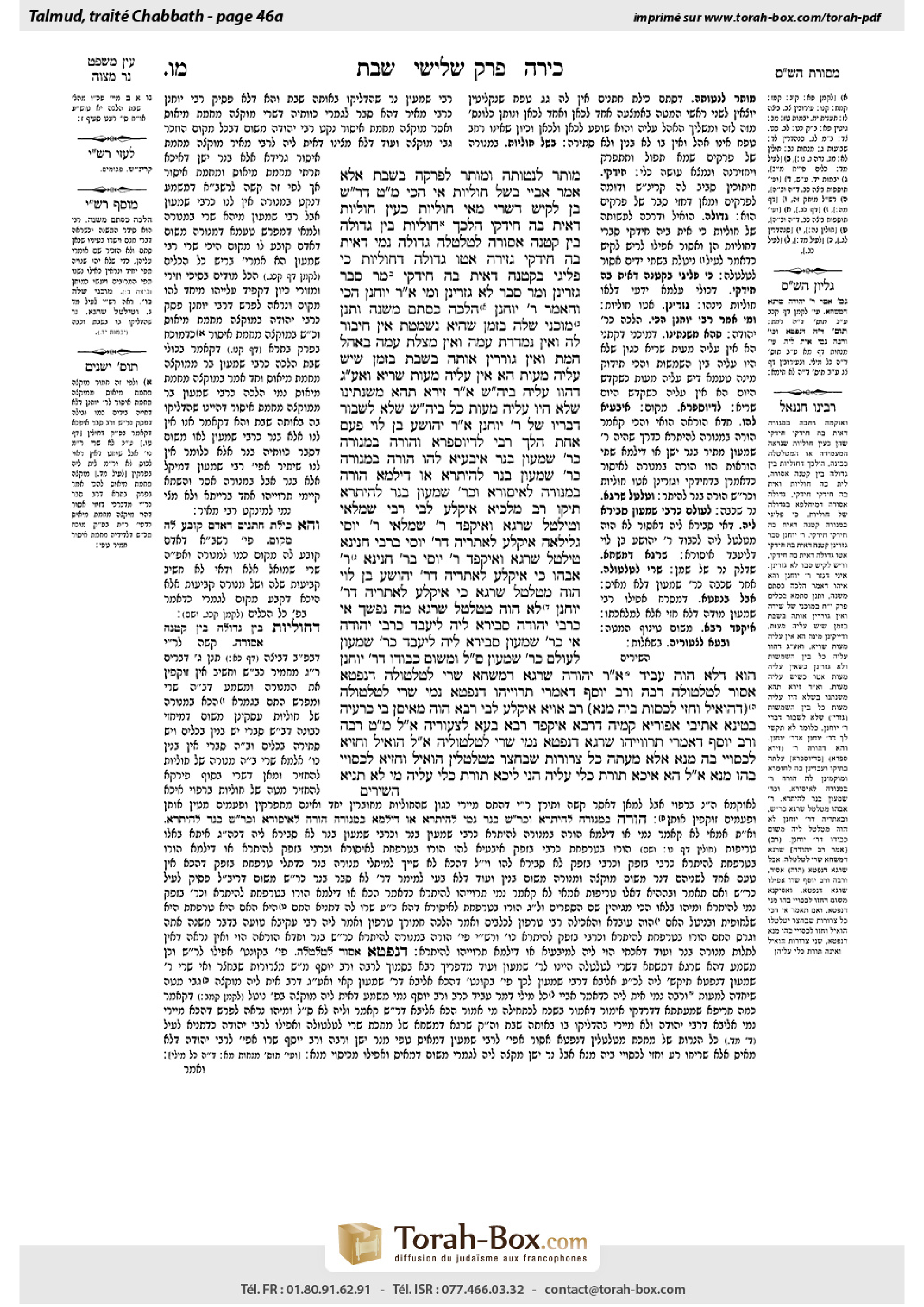
Shabbat 46a: Talmud study for Daf Yomi
Daf Yomi is the daily study of one Talmud folio. Explore 37 tractates with scans, Hebrew text, Sefaria English and AI-generated French translations where annotated.
Passage selection and English or AI-generated French translation are available where the scan has annotations. Daf Study is independent of Torah-Box and Sefaria.
Browse Shabbat · שבת · All tractatesShabbat 46a text and translations
This page of Shabbat includes the Aramaic text, an English translation and an AI-generated French translation, alongside the scan above.
שבת מ״ו א · Aramaic and Hebrew text
מוּתָּר לִנְטוֹתָהּ וּמוּתָּר לְפָרְקָה בְּשַׁבָּת. אֶלָּא אָמַר אַבָּיֵי: בְּשֶׁל חוּלְיוֹת. אִי הָכִי, מַאי טַעְמָא דְּרַבִּי שִׁמְעוֹן בֶּן לָקִישׁ דְּשָׁרֵי?
מַאי ״חוּלְיוֹת״ — כְּעֵין חוּלְיוֹת, דְּאִית בַּהּ חִידְקֵי. הִלְכָּךְ: חוּלְיוֹת, בֵּין גְּדוֹלָה בֵּין קְטַנָּה — אֲסוּרָה לְטַלְטְלָהּ. גְּדוֹלָה נָמֵי דְּאִית בָּהּ חִידְקֵי — גְּזֵירָה אַטּוּ גְּדוֹלָה דְּחוּלְיוֹת. כִּי פְּלִיגִי בִּקְטַנָּה דְּאִית בָּהּ חִידְקֵי: מָר סָבַר גָּזְרִינַן, וּמָר סָבַר לָא גָּזְרִינַן.
וּמִי אָמַר רַבִּי יוֹחָנָן הָכִי? וְהָאָמַר רַבִּי יוֹחָנָן: הֲלָכָה כִּסְתָם מִשְׁנָה. וּתְנַן, מוּכְנִי שֶׁלָּהּ בִּזְמַן שֶׁהִיא נִשְׁמֶטֶת — אֵין חִיבּוּר לָהּ, וְאֵין נִמְדֶּדֶת עִמָּהּ, וְאֵין מַצֶּלֶת עִמָּהּ בְּאֹהֶל הַמֵּת, וְאֵין גּוֹרְרִין אוֹתָהּ בְּשַׁבָּת בִּזְמַן שֶׁיֵּשׁ עָלֶיהָ מָעוֹת.
הָא אֵין עָלֶיהָ מָעוֹת — שַׁרְיָא, וְאַף עַל גַּב דַּהֲווֹ עָלֶיהָ בֵּין הַשְּׁמָשׁוֹת? אָמַר רַבִּי זֵירָא: תְּהֵא מִשְׁנָתֵינוּ שֶׁלֹּא הָיוּ עָלֶיהָ מָעוֹת כׇּל בֵּין הַשְּׁמָשׁוֹת, שֶׁלֹּא לִשְׁבּוֹר דְּבָרָיו שֶׁל רַבִּי יוֹחָנָן.
אָמַר רַבִּי יְהוֹשֻׁעַ בֶּן לֵוִי: פַּעַם אַחַת הָלַךְ רַבִּי לִדְיוֹסְפָרָא, וְהוֹרָה בִּמְנוֹרָה כְּרַבִּי שִׁמְעוֹן בְּנֵר. אִיבַּעְיָא לְהוּ: הוֹרָה בִּמְנוֹרָה כְּרַבִּי שִׁמְעוֹן בְּנֵר — לְהֶיתֵּרָא, אוֹ דִילְמָא: הוֹרָה בִּמְנוֹרָהּ לְאִיסּוּרָא — וּכְרַבִּי שִׁמְעוֹן בְּנֵר לְהֶיתֵּרָא. תֵּיקוּ.
רַב מַלְכִּיָּא אִיקְּלַע לְבֵי רַבִּי שִׂמְלַאי וְטַילְטֵל שְׁרָגָא, וְאִיקְּפַד רַבִּי שִׂמְלַאי. רַבִּי יוֹסֵי גָּלִילָאָה אִיקְּלַע לְאַתְרֵיהּ דְּרַבִּי יוֹסֵי בְּרַבִּי חֲנִינָא, טַילְטֵל שְׁרָגָא וְאִיקְּפַד רַבִּי יוֹסֵי בְּרַבִּי חֲנִינָא. רַבִּי אֲבָהוּ כִּי אִיקְּלַע לְאַתְרֵיהּ דְּרַבִּי יְהוֹשֻׁעַ בֶּן לֵוִי הֲוָה מְטַלְטֵל שְׁרָגָא. כִּי אִיקְּלַע לְאַתְרֵיהּ דְּרַבִּי יוֹחָנָן לָא הֲוָה מְטַלְטֵל שְׁרָגָא. מָה נַפְשָׁךְ? אִי כְּרַבִּי יְהוּדָה סְבִירָא לֵיהּ — לֶיעְבַּד כְּרַבִּי יְהוּדָה. אִי כְּרַבִּי שִׁמְעוֹן סְבִירָא לֵיהּ — לֶיעְבַּד כְּרַבִּי שִׁמְעוֹן! — לְעוֹלָם כְּרַבִּי שִׁמְעוֹן סְבִירָא לֵיהּ, וּמִשּׁוּם כְּבוֹדוֹ דְרַבִּי יוֹחָנָן הוּא דְּלָא הֲוָה עָבֵיד.
אָמַר רַב יְהוּדָה: שְׁרָגָא דְּמִשְׁחָא שְׁרֵי לְטַלְטוֹלַהּ, דְּנַפְטָא — אֲסִיר לְטַלְטוֹלַהּ. רַבָּה וְרַב יוֹסֵף דְּאָמְרִי תַּרְוַיְיהוּ: דְּנַפְטָא נָמֵי שְׁרֵי לְטַלְטוֹלַהּ, דְּהוֹאִיל וַחֲזֵי לְכַסּוֹת בֵּיהּ מָנָא.
רַב אַוְיָא אִיקְּלַע לְבֵי רָבָא. הֲוָה מְאִיסָן (בֵּי) כַּרְעֵיהּ בְּטִינָא. אִתֵּיב אַפּוּרְיָא קַמֵּיהּ דְּרָבָא. אִיקְּפַד רָבָא, בְּעָא לְצַעוֹרֵיהּ. אֲמַר לֵיהּ: מַאי טַעְמָא רַבָּה וְרַב יוֹסֵף דְּאָמְרִי תַּרְוַויְיהוּ שְׁרָגָא דְנַפְטָא נָמֵי שְׁרֵי לְטַלְטוֹלַהּ? אֲמַר לֵיהּ: הוֹאִיל וְחַזְיָא לְכַסּוֹיֵי בַּהּ מָנָא. אֶלָּא מֵעַתָּה, כׇּל צְרוֹרוֹת שֶׁבֶּחָצֵר מִטַּלְטְלִין, הוֹאִיל וְחַזְיִין לְכַסּוֹיֵי בְּהוּ מָנָא. אֲמַר לֵיהּ: הָא אִיכָּא תּוֹרַת כְּלִי עָלֶיהָ. הָנֵי לֵיכָּא תּוֹרַת כְּלִי עֲלֵיהֶן. מִי לָא תַּנְיָא:
Shabbat 46a · English translation
it is permitted to assemble it and it is permitted to dismantle it on Shabbat. If a permanent object like that one may be assembled on Shabbat and there is no concern for the prohibition of building, all the more so it should not be considered building and dismantling in the case of a candelabrum. Rather, Abaye said: Here it is referring to a special candelabrum made of joints, removable parts, and there is concern lest it fall and break into its component parts when it is moved, and one may come to reassemble it, which would be tantamount to crafting a vessel on Shabbat. The Gemara asks: If so, if it is referring to that type of candelabrum, what is the reason for the opinion of Rabbi Shimon ben Lakish who permits moving the candelabrum?
The Gemara replies: It is not referring to a candelabrum that can actually be dismantled. Rather, what is the meaning of joints? Similar to joints, i.e., there are grooves in it and it appears as if it is made of different components. Therefore, in summary: With regard to a candelabrum made of actual joints, both one that is large and one that is small, it is prohibited to move it. In addition, a large candelabrum that has grooves, everyone agrees that it is prohibited to move it by rabbinic decree, which was issued due to a large candelabrum made of joints. Because it is common for a large candelabrum to be made of joints, if one saw someone carrying a large, grooved candelabrum, he would mistakenly assume that it had joints due to the similarity between them, and would mistakenly permit carrying a large candelabrum actually composed of joints. Where Rabbi Yoḥanan and Reish Lakish disagree is in the case of a small candelabrum that has grooves. This Sage, Rabbi Yoḥanan, holds that we issue a decree prohibiting moving even a small, grooved candelabrum due to a large one. And this Sage, Reish Lakish, holds that we do not issue a decree. Because a small candelabrum is not typically made of joints, everyone realizes that the grooves are strictly decorative.
The Gemara questions: And did Rabbi Yoḥanan actually say that the halakha is in accordance with the opinion of Rabbi Yehuda? Didn’t Rabbi Yoḥanan state the following principle: The halakha is in accordance with an unattributed mishna? And we learned in the mishna that discusses ritual impurity of a wagon with a detachable undercarriage: The wagon’s undercarriage, when it is detachable from the wagon, it is not considered connected to it and they are considered independent units as far as the halakhot of ritual impurity are concerned. And it is not measured with it. This refers to calculating the volume of forty se’a, as a vessel with a volume larger than forty se’a does not have the legal status of a vessel and cannot become ritually impure. And the undercarriage likewise does not protect together with the wagon in a tent over the corpse. A large wagon is considered a tent in and of itself, and the vessels inside the wagon do not become impure if the wagon is over a dead body. However, the undercarriage is not included with the wagon in this regard. If a hole in the wagon is sealed by the undercarriage, it is not considered to be sealed with regard to preventing ritual impurity. And, likewise, one may not pull the wagon on Shabbat when there is money upon it.
By inference: If there is not money on it, one is permitted to move the wagon even though there was money on it at twilight. An object that was set aside at twilight is set aside for the entire Shabbat. In this mishna, moving the wagon is permitted. Clearly, the unattributed mishna is in accordance with the opinion of Rabbi Shimon, who holds that there is no prohibition of set-aside. Why, then, did Rabbi Yoḥanan, who always rules in accordance with an unattributed mishna, not rule in accordance with the opinion of Rabbi Shimon? Rabbi Zeira said: Let our mishna apply only to a case in which there was no money on the wagon throughout the entire duration of twilight. This strained interpretation is accepted so as not to contradict and reject Rabbi Yoḥanan’s statement.
Rabbi Yehoshua ben Levi said: One time, Rabbi Yehuda HaNasi went to the town of Deyosfera, and issued a ruling with regard to a candelabrum in accordance with the ruling that Rabbi Shimon made with regard to an oil lamp. This description is insufficiently clear, therefore a dilemma was raised before the Sages: Does this mean that he issued a ruling in the case of a candelabrum, like the ruling that Rabbi Shimon made in the case of an oil lamp, to permit moving it? Or, perhaps, he issued a ruling in the case of a candelabrum to prohibit moving it, and in another case he ruled in accordance with the ruling that Rabbi Shimon made in the case of an oil lamp, to permit moving it. There was no resolution found to this dilemma and therefore it stands unresolved.
It is told that Rav Malkiya happened to come to the house of Rabbi Simlai and moved an extinguished oil lamp, and Rabbi Simlai became angry, as in his opinion it is prohibited to move an oil lamp because it is set-aside. Likewise, Rabbi Yosei the Galilean happened to come to the place of Rabbi Yosei, son of Rabbi Ḥanina, and moved an oil lamp, and Rabbi Yosei, son of Rabbi Ḥanina, became angry. The Gemara also relates that Rabbi Abbahu, when he happened to come to the place of Rabbi Yehoshua ben Levi, he would move an oil lamp. However, when he happened to come to the place of Rabbi Yoḥanan, he would not move an oil lamp. The Gemara wondered: Whichever way you look at it there is a difficulty. If he holds in accordance with the opinion of Rabbi Yehuda, let him act in accordance with the opinion of Rabbi Yehuda everywhere and refrain from moving the lamp. And if he holds in accordance with the opinion of Rabbi Shimon, let him act in accordance with the opinion of Rabbi Shimon everywhere and move the oil lamp. The Gemara answers: Actually, it can be explained that Rabbi Abbahu holds in accordance with the opinion of Rabbi Shimon; however, in deference to Rabbi Yoḥanan he did not act accordingly, so as not to act contrary to his ruling in the place where he was the authority.
With regard to the halakhot of moving lamps on Shabbat, Rav Yehuda said: With regard to an extinguished oil lamp, it is permitted to move it, whereas a naphtha lamp, it is prohibited to move it. Since the smell of naphtha is unpleasant, the lamp is used exclusively for lighting. Therefore, moving it is prohibited. Rabba and Rav Yosef both said: With regard to a naphtha lamp, too, it is permitted to move it.
The Gemara relates: Rav Avya happened to come to Rava’s house. His feet were dirty with clay and he put them on the bed before Rava. Rava became angry at him for dirtying the bed and, therefore, sought to torment him with questions that he could not answer. Rava said to him: What is the reason that Rabba and Rav Yosef both said that with regard to a naphtha lamp, too, that it is permitted to move it? Rav Avya said to him: Since it is suitable to cover a vessel with it. Rava said to him: But if that is so, all pebbles in the yard may also be carried ab initio on Shabbat, since it is suitable to cover a vessel with them. Rav Avya said to him: There is a distinction between these cases. This, the lamp, the status of a vessel applies to it and there are leniencies that apply to vessels with regard to the halakhot of set-aside. These, the pebbles, the status of a vessel does not apply to it, as they are a raw material. Carrying them is prohibited unless designated for a specific purpose before Shabbat. Was it not taught in a baraita that
Shabbat 46a · Traduction française (IA)
Il est permis de l’assembler et il est permis de le démonter pendant Chabbat. Si un objet permanent comme celui-ci peut être assemblé pendant Chabbat sans qu’il y ait lieu de craindre une transgression de l’interdit de construire, à plus forte raison ne devrait-on pas considérer qu’il y a construction et démontage dans le cas d’un candélabre. Abaye dit plutôt : ici, il s’agit d’un candélabre particulier composé d’articulations, c’est-à-dire de pièces amovibles. On craint qu’il ne tombe et ne se brise en ses différentes pièces lorsqu’on le déplace, et que l’on en vienne à le remonter, ce qui équivaudrait à fabriquer un ustensile pendant Chabbat. La Guemara demande : si tel est le cas, s’il s’agit de ce type de candélabre, quelle est la raison de l’opinion de Rabbi Chimon ben Lakich, qui permet de déplacer le candélabre ?
La Guemara répond : il ne s’agit pas d’un candélabre qui peut réellement être démonté. Que signifie donc « articulations » ? Cela signifie qu’il ressemble à un candélabre articulé : il comporte des rainures et donne l’impression d’être composé de plusieurs pièces. En résumé, s’agissant d’un candélabre réellement composé d’articulations, qu’il soit grand ou petit, il est interdit de le déplacer. De plus, tous s’accordent à dire qu’il est interdit, par décret rabbinique, de déplacer un grand candélabre comportant des rainures ; ce décret a été pris à cause d’un grand candélabre composé d’articulations. Comme il est courant qu’un grand candélabre soit composé d’articulations, si quelqu’un voyait une personne transporter un grand candélabre à rainures, il pourrait croire à tort que celui-ci comporte des articulations, en raison de leur ressemblance, et autoriser par erreur le transport d’un grand candélabre réellement composé d’articulations. Le désaccord entre Rabbi Yoḥanan et Reish Lakish porte sur le cas d’un petit candélabre comportant des rainures. Rabbi Yoḥanan estime qu’on décrète l’interdiction de déplacer même un petit candélabre à rainures, à cause d’un grand. Reish Lakish estime, lui, qu’on ne prend pas un tel décret. Comme les petits candélabres ne sont généralement pas composés d’articulations, tout le monde comprend que les rainures sont purement décoratives.
La Guemara objecte : Rabbi Yoḥanan a-t-il vraiment dit que la halakha suit l’opinion de Rabbi Yehouda ? Rabbi Yoḥanan n’a-t-il pas énoncé le principe suivant : la halakha suit une Michna anonyme ? Or, nous avons appris dans la Michna qui traite de l’impureté rituelle d’un chariot dont le train inférieur est détachable : lorsque le train inférieur est détaché du chariot, il n’est pas considéré comme lui étant attaché ; ils constituent des unités indépendantes en ce qui concerne les lois de l’impureté rituelle. Il n’est pas non plus pris en compte avec le chariot pour le calcul du volume de quarante séa, car un ustensile d’un volume supérieur à quarante séa n’a pas le statut d’un ustensile et ne peut contracter l’impureté rituelle. De même, le train inférieur ne protège pas avec le chariot sous une tente au-dessus d’un cadavre. Un grand chariot est considéré comme une tente à lui seul, et les ustensiles qui se trouvent à l’intérieur ne deviennent pas rituellement impurs si le chariot se trouve au-dessus d’un cadavre. Toutefois, le train inférieur n’est pas pris en compte avec le chariot à cet égard. Si le train inférieur bouche un trou dans le chariot, celui-ci n’est pas considéré comme obturé pour empêcher l’impureté rituelle. De même, on ne peut pas tirer le chariot pendant Chabbat lorsqu’il y a de l’argent dessus.
On en déduit que, s’il n’y a pas d’argent dessus, il est permis de déplacer le chariot, même s’il y en avait dessus au crépuscule. Or, un objet qui a été mis à l’écart au crépuscule le reste pendant tout Chabbat. Dans cette Michna, il est permis de déplacer le chariot. Il est donc clair que la Michna anonyme suit l’opinion de Rabbi Chimon, qui estime qu’il n’existe pas d’interdit de mouqtsé. Pourquoi Rabbi Yoḥanan, qui statue toujours conformément à une Michna anonyme, n’a-t-il donc pas statué selon l’opinion de Rabbi Chimon ? Rabbi Zeïra dit : appliquons notre Michna uniquement au cas où il n’y avait pas d’argent sur le chariot pendant toute la durée du crépuscule. Cette interprétation forcée est retenue afin de ne pas contredire ni rejeter la déclaration de Rabbi Yoḥanan.
Rabbi Yehoshoua ben Lévi dit : une fois, Rabbi Yehouda HaNassi se rendit dans la ville de Deyosfera et statua au sujet d’un candélabre conformément à la décision de Rabbi Chimon concernant une lampe à huile. Cette description n’étant pas suffisamment claire, les Sages soulevèrent un doute : cela signifie-t-il qu’il statua, dans le cas d’un candélabre, comme Rabbi Chimon l’avait fait dans le cas d’une lampe à huile, en permettant de le déplacer ? Ou bien statua-t-il, dans le cas d’un candélabre, qu’il était interdit de le déplacer, et, dans un autre cas, conformément à la décision de Rabbi Chimon concernant une lampe à huile, en permettant de la déplacer ? Ce doute n’a pas été résolu et reste donc en suspens.
Il est rapporté que Rav Malkiya se rendit par hasard chez Rabbi Simlaï et déplaça une lampe à huile éteinte. Rabbi Simlaï se mit en colère, car selon lui, il est interdit de déplacer une lampe à huile, puisqu’elle est mouqtsé. De même, Rabbi Yosei le Galiléen se rendit par hasard chez Rabbi Yosei, fils de Rabbi Ḥanina, et déplaça une lampe à huile ; Rabbi Yosei, fils de Rabbi Ḥanina, se mit en colère. La Guemara rapporte également que Rabbi Abbahou, lorsqu’il se rendait par hasard chez Rabbi Yehoshoua ben Lévi, déplaçait une lampe à huile. En revanche, lorsqu’il se rendait par hasard chez Rabbi Yoḥanan, il ne déplaçait pas de lampe à huile. La Guemara s’interroge : quelle que soit l’interprétation, il y a une difficulté. S’il suit l’opinion de Rabbi Yehouda, qu’il agisse partout conformément à cette opinion et s’abstienne de déplacer la lampe. Et s’il suit l’opinion de Rabbi Chimon, qu’il agisse partout conformément à cette opinion et déplace la lampe à huile. La Guemara répond : en réalité, on peut expliquer que Rabbi Abbahou suit l’opinion de Rabbi Chimon ; toutefois, par déférence envers Rabbi Yoḥanan, il n’a pas agi ainsi, afin de ne pas agir à l’encontre de sa décision dans le lieu où celui-ci faisait autorité.
Concernant les lois du déplacement des lampes pendant Chabbat, Rav Yehouda dit : il est permis de déplacer une lampe à huile éteinte, tandis qu’il est interdit de déplacer une lampe au naphte. Comme l’odeur du naphte est désagréable, la lampe sert exclusivement à l’éclairage. Il est donc interdit de la déplacer. Rabba et Rav Yosef disent tous deux qu’il est également permis de déplacer une lampe au naphte.
La Guemara rapporte : Rav Avya se rendit par hasard chez Rava. Ses pieds étaient couverts de boue et il les posa sur le lit devant Rava. Rava se mit en colère contre lui parce qu’il avait sali le lit et chercha donc à le tourmenter en lui posant des questions auxquelles il ne saurait pas répondre. Rava lui dit : pour quelle raison Rabba et Rav Yosef ont-ils tous deux dit qu’il est également permis de déplacer une lampe au naphte ? Rav Avya lui répondit : parce qu’elle peut servir à couvrir un récipient. Rava lui dit : mais alors, on devrait aussi pouvoir déplacer d’emblée tous les cailloux de la cour pendant Chabbat, puisqu’ils peuvent servir à couvrir un récipient. Rav Avya lui répondit : il y a une différence entre ces cas. Cette lampe a le statut d’un ustensile ; les ustensiles bénéficient d’assouplissements concernant les lois du mouqtsé. Ces cailloux, eux, n’ont pas le statut d’un ustensile, car ils sont une matière première. Il est interdit de les transporter à moins de leur avoir assigné un usage précis avant Chabbat. N’a-t-il pas été enseigné dans une baraïta que
Traduction française générée par IA à partir de l’édition anglaise de Sefaria. Vérifie toujours un passage avec le texte source.
Text from Sefaria: William Davidson Edition - Vocalized Aramaic (CC BY NC); William Davidson Edition - English (CC BY NC).