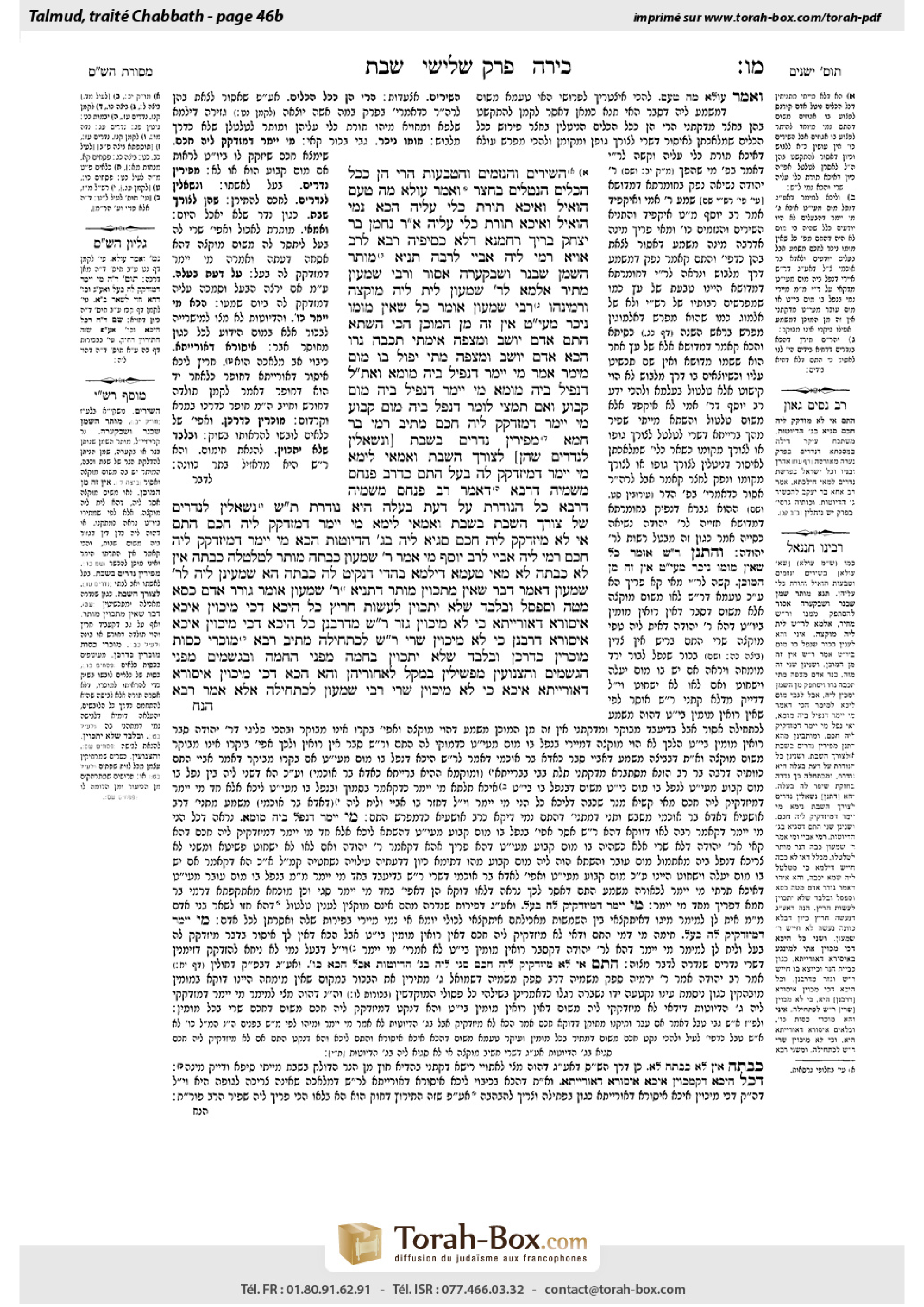
Shabbat 46b: Talmud study for Daf Yomi
Daf Yomi is the daily study of one Talmud folio. Explore 37 tractates with scans, Hebrew text, Sefaria English and AI-generated French translations where annotated.
Passage selection and English or AI-generated French translation are available where the scan has annotations. Daf Study is independent of Torah-Box and Sefaria.
Browse Shabbat · שבת · All tractatesShabbat 46b text and translations
This page of Shabbat includes the Aramaic text, an English translation and an AI-generated French translation, alongside the scan above.
שבת מ״ו ב · Aramaic and Hebrew text
הַשֵּׁירִים וְהַנְּזָמִים וְהַטַּבָּעוֹת, הֲרֵי הֵן כְּכׇל הַכֵּלִים הַנִּטָּלִים בֶּחָצֵר. וְאָמַר עוּלָּא: מַה טַּעַם? — הוֹאִיל וְאִיכָּא תּוֹרַת כְּלִי עֲלֵיהֶן. הָכָא נָמֵי הוֹאִיל וְאִיכָּא תּוֹרַת כְּלִי עֲלֵיהֶן. אָמַר רַב נַחְמָן בַּר יִצְחָק: בְּרִיךְ רַחֲמָנָא דְּלָא כַּסְּפֵיהּ רָבָא לְרַב אַוְיָא.
רָמֵי לֵיהּ אַבָּיֵי לְרַבָּה. תַּנְיָא: מוֹתַר הַשֶּׁמֶן שֶׁבַּנֵּר וְשֶׁבַּקְּעָרָה — אָסוּר, וְרַבִּי שִׁמְעוֹן מַתִּיר. אַלְמָא לְרַבִּי שִׁמְעוֹן לֵית לֵיהּ מוּקְצֶה. וּרְמִינְהוּ, רַבִּי שִׁמְעוֹן אוֹמֵר: כֹּל שֶׁאֵין מוּמוֹ נִיכָּר מֵעֶרֶב יוֹם טוֹב — אֵין זֶה מִן הַמּוּכָן!
הָכִי הַשְׁתָּא? הָתָם, אָדָם יוֹשֵׁב וּמְצַפֶּה אֵימָתַי תִּכְבֶּה נֵרוֹ. הָכָא, אָדָם יוֹשֵׁב וּמְצַפֶּה מָתַי יִפּוֹל בּוֹ מוּם? מֵימָר אָמַר: מִי יֵימַר דְּנָפֵיל בֵּיהּ מוּמָא, וְאִם תִּמְצֵי לוֹמַר דְּנָפֵיל בֵּיהּ מוּמָא — מִי יֵימַר דְּנָפֵיל בֵּיהּ מוּם קָבוּעַ. וְאִם תִּמְצֵי לוֹמַר דְּנָפֵל בֵּיהּ מוּם קָבוּעַ — מִי יֵימַר דְּמִזְדְּקֵק לֵיהּ חָכָם?
מֵתִיב רָמֵי בַּר חָמָא: מְפֵירִין נְדָרִים בְּשַׁבָּת, [וְנִשְׁאָלִין לִנְדָרִים שֶׁהֵן] לְצוֹרֶךְ הַשַּׁבָּת. וְאַמַּאי? — לֵימָא: מִי יֵימַר דְּמִיזְדְּקֵק לַהּ בַּעַל?
הָתָם כִּדְרַב פִּנְחָס מִשְּׁמֵיהּ דְּרָבָא. דְּאָמַר רַב פִּנְחָס מִשְּׁמֵיהּ דְּרָבָא: כׇּל הַנּוֹדֶרֶת — עַל דַּעַת בַּעְלָהּ הִיא נוֹדֶרֶת.
תָּא שְׁמַע: נִשְׁאָלִין לִנְדָרִים שֶׁל צוֹרֶךְ הַשַּׁבָּת בְּשַׁבָּת. וְאַמַּאי? לֵימָא: מִי יֵימַר דְּמִזְדְּקֵק לֵיהּ חָכָם? — הָתָם — אִי לָא מִיזְדְּקֵק לֵיהּ חָכָם סַגְיָא לֵיהּ בִּשְׁלֹשָׁה הֶדְיוֹטוֹת. הָכָא — מִי יֵימַר דְּמִיזְדְּקֵק לֵיהּ חָכָם.
רָמֵי לֵיהּ אַבָּיֵי לְרַב יוֹסֵף: מִי אָמַר רַבִּי שִׁמְעוֹן כָּבְתָה מוּתָּר לְטַלְטְלָהּ. כָּבְתָה — אִין, לֹא כָּבְתָה — לָא. מַאי טַעְמָא? — דִילְמָא בַּהֲדֵי דְּנָקֵיט לַהּ כָּבְיָא? הָא שָׁמְעִינַן לֵיהּ לְרַבִּי שִׁמְעוֹן דְּאָמַר דָּבָר שֶׁאֵין מִתְכַּוֵּין — מוּתָּר. דְּתַנְיָא רַבִּי שִׁמְעוֹן אוֹמֵר: גּוֹרֵר אָדָם כִּסֵּא מִטָּה וְסַפְסָל, וּבִלְבַד שֶׁלֹּא יִתְכַּוֵּין לַעֲשׂוֹת חָרִיץ!
כׇּל הֵיכָא דְּכִי מִיכַּוֵין אִיכָּא אִיסּוּרָא דְאוֹרָיְיתָא, כִּי לָא מִיכַּוֵין — גָּזַר רַבִּי שִׁמְעוֹן מִדְּרַבָּנַן. כׇּל הֵיכָא דְּכִי מִיכַּוֵין אִיכָּא אִיסּוּרָא דְרַבָּנַן — כִּי לָא מִיכַּוֵין שָׁרֵי רַבִּי שִׁמְעוֹן לְכַתְּחִילָּה.
מֵתִיב רָבָא: מוֹכְרֵי כְסוּת מוֹכְרִין כְּדַרְכָּן, וּבִלְבַד שֶׁלֹּא יִתְכַּוֵּין בַּחַמָּה מִפְּנֵי הַחַמָּה וּבַגְּשָׁמִים מִפְּנֵי הַגְּשָׁמִים, וְהַצְּנוּעִין מַפְשִׁילִין בְּמַקֵּל לַאֲחוֹרֵיהֶן. וְהָא הָכָא, דְּכִי מִיכַּוֵין — אִיסּוּרָא דְאוֹרָיְיתָא אִיכָּא, כִּי לָא מִיכַּוֵין — שָׁרֵי רַבִּי שִׁמְעוֹן לְכַתְּחִילָּה!
אֶלָּא אָמַר רָבָא:
Shabbat 46b · English translation
bracelets, nose-rings and rings, although it is prohibited to go out into the public domain wearing them on Shabbat, they are like all the vessels that may be moved in the courtyard; in the private domain, one may move them and they are not set-aside. And Ulla said: What is the reason that it is permitted to move nose-rings in the yard? It is because the status of a vessel applies to it. Apparently, vessel status is sufficient to permit moving it on Shabbat. Rav Naḥman bar Yitzḥak said: Thank God that Rava did not embarrass Rav Avya and Rav Avya managed to successfully answer Rava’s questions.
Abaye raised a contradiction before Rabba citing two sources with regard to set-aside on Shabbat. It was taught in a baraita: With regard to the remaining oil that is in an oil lamp and in a bowl in which a wick was lit, it is prohibited to use it on Shabbat and Rabbi Shimon permits using it. Apparently, Rabbi Shimon is not of the opinion that there is a prohibition of set-aside. And a contradiction is raised from a parallel source, in which the Sages discussed the halakha of the firstborn of a kosher animal that developed a blemish on a Festival. The firstborn must be examined to determine whether or not that type of blemish disqualifies the animal from being sacrificed as an offering. If it is disqualified, it may be redeemed, slaughtered, and eaten as non-sacred meat on the Festival. Rabbi Shimon says: Any firstborn animal whose blemish is not perceptible before the Festival is not among the animals prepared prior to the Festival for use on the Festival, and it is prohibited to slaughter it. Apparently, an item not prepared in advance has set-aside status according to Rabbi Shimon.
Rabba said to him: How can you compare these cases? There, in the case of the lamp, a person sits and anticipates when his candle will be extinguished. It is clear to him that it will be extinguished, and he can safely assume that a certain amount of oil will remain in the lamp or the bowl. Here, does a person sit and anticipate when a blemish will befall his animal? The owner of the animal says: Who says that a blemish will befall his animal? And even if you say that a blemish will befall it, who says that a permanent blemish that would enable it to be slaughtered will befall it? And even if you say that a permanent blemish will befall it, who says that a Sage will agree to engage in examining the blemish? Since there are so many uncertainties involved, if the blemish is not perceptible before the Festival, the possibility of the firstborn animal becoming available does not enter a person’s mind at all.
Rami bar Ḥama raised an objection to this last point from that which we learned in a mishna: One may nullify vows on Shabbat. A woman who vowed that certain food is prohibited to her, her husband can nullify her vow on Shabbat. And likewise one may request that a Sage find an opening to dissolve his vows, i.e., a factor that the one taking the vow failed to take into account or an element of regret, if that nullification or dissolution is for the purpose of Shabbat. The question arises: And why, after a man has nullified his wife’s vow, should she be permitted to eat that food? When the woman vowed not to eat that food, she consciously set it aside. Even if some way to dissolve the vow is found, the food should remain set-aside. On the basis of the same uncertainty that was raised above, say: Who says that her husband will agree to engage in nullifying her oath? Perhaps he will refuse to nullify it.
The Gemara answers: There, in the case of vows, it can be explained in accordance with that which Rav Pineḥas said in the name of Rava, who came to explain some of the fundamentals of the halakhot of vows, as Rav Pineḥas said in the name of Rava: Every woman who takes a vow, it is from the outset contingent on her husband’s consent that she takes the vow. Since she knows that her husband has the ability to nullify it, her vows are not absolute and their final validation comes only through her husband’s agreement. When a woman vows, she does not set aside the food absolutely from potential use.
Moreover, the Gemara cites proof for this from that which was taught: Come and hear: One may request that a Sage dissolve his vows for the purpose of Shabbat on Shabbat, i.e., one who vowed on Shabbat that eating on that day is prohibited for him. And why is he permitted to eat something that was prohibited to him by his vow? Say again: Who says that the Sage will agree to engage in dissolution of his vow? Consequently, one has certainly diverted his attention from the food, set it aside, and it should be prohibited to eat it. The Gemara answers: Nevertheless, there is a difference, as there, in the halakhot of vows, even if the Sage does not agree to engage in dissolution of his vow, he can suffice with renouncing the vow before three common people. Even though it is preferable to have a Sage dissolve his vow, in exigent circumstances one may turn to a court of three common people to dissolve it. He will certainly find a way to dissolve his vow. However, here, in the case of the firstborn animal, who says that the Sage will agree to engage in examination of the blemish? In the halakhot of firstborn animals only an ordained Sage, who received special license to do so, is authorized to verify that it is a permanent blemish and permit redemption and slaughter of the animal as a non-sacred animal.
Abaye raised a contradiction before Rav Yosef: Did Rabbi Shimon actually say that when a lamp is extinguished, it is permitted to move it on Shabbat? By inference: After it is extinguished, yes, moving it is permitted; so long as it is not extinguished, no, moving it is prohibited. What is the reason that it is prohibited to move a burning candle? It is due to concern that perhaps, as he moves the lamp, the flame will be extinguished. However, is Rabbi Shimon really concerned that a flame will be extinguished under those circumstances? Didn’t we learn that Rabbi Shimon stated a principle: An unintentional act, a permitted action from which an unintended prohibited labor ensues on Shabbat, since he did not intend to perform the prohibited action, is permitted? As it was taught in a baraita, Rabbi Shimon says: A person may drag a bed, chair, and bench on the ground, as long as he does not intend to make a furrow in the ground. Even if a furrow is formed inadvertently, one need not be concerned. Since that was not his intention, there is no prohibition according to Rabbi Shimon. Consequently, according to Rabbi Shimon there should be no prohibition in moving a burning candle, even though it may be extinguished. Since that is not the intention of the one moving it, no prohibition would be violated.
The Gemara answers that there is a distinction between the cases: In every case where if he intends to perform the action, there is a prohibition by Torah law, e.g., extinguishing a candle; even when he does not intend to do so, Rabbi Shimon issued a decree prohibiting it by rabbinic law. However, in every case where even if he intends to perform the action, there is merely a prohibition by rabbinic law, e.g., digging a furrow which is not a full-fledged act of plowing that is prohibited by Torah law, but is prohibited only by rabbinic law, when he does not intend to perform the action, Rabbi Shimon even permits performing this action ab initio.
Rava raised an objection to this distinction from that which we learned in a mishna: Clothing merchants who sell garments made of diverse kinds, a prohibited mixture of wool and linen, may sell them as they normally would to gentiles. A merchant may place the garments he is selling on his shoulders and need not be concerned about the prohibition against wearing diverse kinds, as long as the merchant does not intend to benefit from the garments in the sun as protection from the sun, or in the rain as protection from the rain. However, the modest people, those who are particularly meticulous in their performance of mitzvot, would suspend the wool and linen garments on a stick behind them. And here, isn’t it a case where if one intends to wear the clothing, there is a prohibition by Torah law, and even so when he does not intend to wear it, Rabbi Shimon permits it ab initio. Apparently, Rabbi Shimon does not distinguish between cases on that basis.
Rather, Rava said a different explanation for Rabbi Shimon’s prohibition in the case of an oil lamp:
Shabbat 46b · Traduction française (IA)
Les bracelets, les anneaux de nez et les bagues, bien qu’il soit interdit de sortir dans le domaine public en les portant pendant Chabbat, sont comme tous les ustensiles que l’on peut déplacer dans une cour : dans le domaine privé, on peut les déplacer et ils ne sont pas mouktsé. Ulla a dit : Pourquoi est-il permis de déplacer des anneaux de nez dans la cour ? Parce qu’ils ont le statut d’ustensiles. Il apparaît donc que le statut d’ustensile suffit à permettre de déplacer un objet pendant Chabbat. Rav Naḥman bar Yitzḥak a dit : Dieu merci, Rava n’a pas embarrassé Rav Avya, et Rav Avya a réussi à répondre aux questions de Rava.
Abayé souleva devant Rabba une contradiction entre deux sources concernant le mouktsé pendant Chabbat. Il a été enseigné dans une baraïta : Quant à l’huile restante dans une lampe et dans un récipient où une mèche a été allumée, il est interdit de l’utiliser pendant Chabbat, mais Rabbi Chimon permet de l’utiliser. Il apparaît donc que Rabbi Chimon ne considère pas qu’il existe une interdiction du mouktsé. Une contradiction est soulevée à partir d’une source parallèle, dans laquelle les Sages ont discuté de la halakha concernant le premier-né d’un animal pur qui a développé un défaut pendant une fête. Le premier-né doit être examiné afin de déterminer si ce type de défaut disqualifie l’animal comme offrande. Si le défaut le disqualifie, l’animal peut être racheté, abattu et consommé comme viande profane pendant la fête. Rabbi Chimon dit : Tout animal premier-né dont le défaut n’est pas perceptible avant la fête ne fait pas partie des animaux préparés avant la fête en vue d’y être utilisés ; il est donc interdit de l’abattre. Il apparaît ainsi que, selon Rabbi Chimon, un objet qui n’a pas été préparé à l’avance a le statut de mouktsé.
Rabba lui dit : Comment peux-tu comparer ces cas ? Là, dans le cas de la lampe, une personne attend que sa bougie s’éteigne. Elle sait bien qu’elle finira par s’éteindre et peut raisonnablement supposer qu’une certaine quantité d’huile restera dans la lampe ou le récipient. Mais ici, une personne attend-elle qu’un défaut survienne chez son animal ? Le propriétaire de l’animal dit : Qui affirme qu’un défaut surviendra chez son animal ? Et même si tu dis qu’un défaut surviendra, qui affirme qu’il s’agira d’un défaut permanent qui permettra de l’abattre ? Et même si tu dis qu’un défaut permanent surviendra, qui affirme qu’un Sage acceptera d’examiner le défaut ? Compte tenu de toutes ces incertitudes, si le défaut n’est pas perceptible avant la fête, la possibilité que le premier-né devienne disponible ne vient absolument pas à l’esprit de la personne.
Rami bar Ḥama souleva une objection à ce dernier point à partir de ce que nous avons appris dans une Michna : On peut annuler des vœux pendant Chabbat. Si une femme a fait le vœu de s’interdire certains aliments, son mari peut annuler son vœu pendant Chabbat. De même, on peut demander à un Sage de trouver un motif permettant de délier ses vœux, c’est-à-dire un élément que la personne qui a fait le vœu n’avait pas pris en considération, ou un motif de regret, si cette annulation ou cette dissolution vise à permettre l’observance de Chabbat. La question se pose : pourquoi, après que son mari a annulé son vœu, cette femme serait-elle autorisée à manger cet aliment ? Lorsqu’elle a fait le vœu de ne pas manger cet aliment, elle l’a consciemment mis de côté. Même si l’on trouve un moyen de délier le vœu, l’aliment devrait rester mouktsé. Sur la base de la même incertitude que celle évoquée plus haut, dis : qui affirme que son mari acceptera d’annuler son vœu ? Peut-être refusera-t-il de le faire.
La Guemara répond : Dans le cas des vœux, on peut expliquer la chose conformément à ce que Rav Pineḥas a dit au nom de Rava, lequel est venu exposer certains principes fondamentaux des halakhot des vœux. Rav Pineḥas a dit au nom de Rava : Toute femme qui fait un vœu le fait d’emblée sous réserve du consentement de son mari. Puisqu’elle sait que son mari a la possibilité de l’annuler, ses vœux ne sont pas absolus et ne sont définitivement validés qu’avec l’accord de son mari. Lorsqu’une femme fait un vœu, elle ne met donc pas définitivement l’aliment à l’écart de toute utilisation éventuelle.
De plus, la Guemara apporte une preuve à partir de ce qui a été enseigné : Viens et entends : On peut demander à un Sage de délier ses vœux pour les besoins de Chabbat, pendant Chabbat, c’est-à-dire lorsqu’une personne a fait, pendant Chabbat, le vœu de s’interdire de manger ce jour-là. Or, pourquoi est-elle autorisée à manger un aliment que son vœu lui interdisait ? Dis encore : qui affirme que le Sage acceptera de s’occuper de la dissolution de son vœu ? Par conséquent, cette personne a certainement cessé de penser à cet aliment et l’a mis de côté ; il devrait donc être interdit de le manger. La Guemara répond : Il y a néanmoins une différence. Dans le cas des halakhot des vœux, même si le Sage n’accepte pas de s’occuper de la dissolution du vœu, la personne peut se contenter de délier son vœu devant trois personnes ordinaires. Bien qu’il soit préférable qu’un Sage délie son vœu, en cas de nécessité, on peut s’adresser à un tribunal de trois personnes ordinaires pour le faire. Elle trouvera certainement un moyen de délier son vœu. En revanche, dans le cas du premier-né, qui affirme que le Sage acceptera d’examiner le défaut ? Dans les halakhot concernant les premiers-nés, seul un Sage ordonné, ayant reçu une autorisation spéciale à cet effet, est habilité à vérifier qu’il s’agit d’un défaut permanent et à autoriser le rachat et l’abattage de l’animal comme animal profane.
Abayé souleva une contradiction devant Rav Yossef : Rabbi Chimon a-t-il vraiment dit que, lorsqu’une lampe s’éteint, il est permis de la déplacer pendant Chabbat ? On en déduit qu’une fois éteinte, oui, il est permis de la déplacer ; tant qu’elle n’est pas éteinte, non, il est interdit de la déplacer. Pourquoi est-il interdit de déplacer une bougie allumée ? Par crainte que la flamme ne s’éteigne lorsqu’on déplace la lampe. Mais Rabbi Chimon craint-il vraiment que la flamme s’éteigne dans ces circonstances ? N’avons-nous pas appris que Rabbi Chimon a posé le principe suivant : un acte involontaire, c’est-à-dire une action permise dont découle involontairement un travail interdit pendant Chabbat, est permis si la personne n’a pas eu l’intention d’accomplir l’action interdite. En effet, une baraïta enseigne que Rabbi Chimon dit : Une personne peut traîner un lit, une chaise ou un banc sur le sol, à condition de ne pas avoir l’intention d’y creuser un sillon. Même si un sillon se forme involontairement, il n’y a pas lieu de s’en inquiéter. Puisque ce n’était pas son intention, cela n’est pas interdit selon Rabbi Chimon. Par conséquent, selon Rabbi Chimon, il ne devrait pas être interdit de déplacer une bougie allumée, même si elle risque de s’éteindre. Puisque telle n’est pas l’intention de celui qui la déplace, aucune interdiction ne serait enfreinte.
La Guemara répond qu’il y a une différence entre les cas : chaque fois que l’action, si elle était intentionnelle, serait interdite par la Torah, comme éteindre une bougie, Rabbi Chimon a également décrété une interdiction rabbinique lorsqu’elle est accomplie sans intention. En revanche, chaque fois que l’action, même intentionnelle, ne serait interdite que par décret rabbinique, comme creuser un sillon, qui n’est pas un véritable travail de labour interdit par la Torah mais seulement par décret rabbinique, Rabbi Chimon permet même de l’accomplir a priori lorsqu’on n’en a pas l’intention.
Rava souleva une objection à cette distinction à partir de ce que nous avons appris dans une Michna : Les marchands de vêtements qui vendent des habits faits de cha’atnez, mélange interdit de laine et de lin, peuvent les vendre comme ils le font habituellement à des non-Juifs. Un marchand peut poser les vêtements qu’il vend sur ses épaules sans avoir à se soucier de l’interdiction de porter du cha’atnez, à condition de ne pas avoir l’intention de profiter des vêtements au soleil pour se protéger du soleil, ou sous la pluie pour se protéger de la pluie. Toutefois, les personnes modestes, particulièrement scrupuleuses dans l’accomplissement des mitsvot, suspendaient les vêtements de laine et de lin à un bâton derrière elles. Or, ici, n’est-on pas dans un cas où porter intentionnellement le vêtement serait interdit par la Torah, et où pourtant Rabbi Chimon le permet a priori lorsqu’on n’a pas l’intention de le porter ? Il apparaît donc que Rabbi Chimon ne distingue pas les cas sur cette base.
Rava donna plutôt une autre explication de l’interdiction énoncée par Rabbi Chimon dans le cas d’une lampe à huile :
Traduction française générée par IA à partir de l’édition anglaise de Sefaria. Vérifie toujours un passage avec le texte source.
Text from Sefaria: William Davidson Edition - Vocalized Aramaic (CC BY NC); William Davidson Edition - English (CC BY NC).