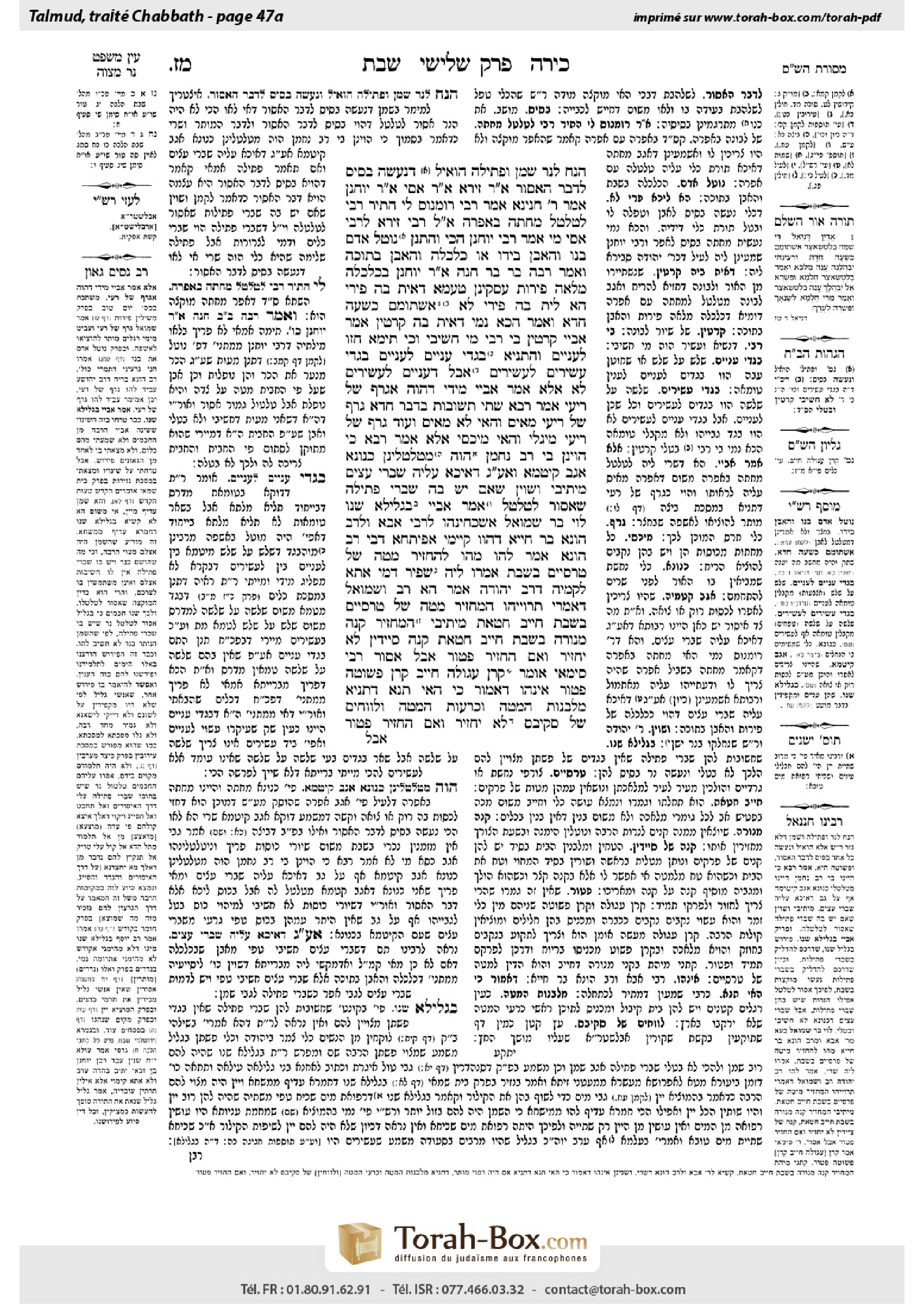
Shabbat 47a: Talmud study for Daf Yomi
Daf Yomi is the daily study of one Talmud folio. Explore 37 tractates with scans, Hebrew text, Sefaria English and AI-generated French translations where annotated.
Passage selection and English or AI-generated French translation are available where the scan has annotations. Daf Study is independent of Torah-Box and Sefaria.
Browse Shabbat · שבת · All tractatesShabbat 47a text and translations
This page of Shabbat includes the Aramaic text, an English translation and an AI-generated French translation, alongside the scan above.
שבת מ״ז א · Aramaic and Hebrew text
הַנַּח לְנֵר שֶׁמֶן וּפְתִילָה, הוֹאִיל דְּנַעֲשָׂה בָּסִיס לַדָּבָר הָאָסוּר.
אָמַר רַבִּי זֵירָא אָמַר רַבִּי אַסִּי אָמַר רַבִּי יוֹחָנָן אָמַר רַבִּי חֲנִינָא אָמַר רַבִּי רוֹמָנוֹס: לִי הִתִּיר רַבִּי לְטַלְטֵל מַחְתָּה בְּאֶפְרָהּ. אֲמַר לֵיהּ רַבִּי זֵירָא לְרַבִּי אַסִּי: מִי אָמַר רַבִּי יוֹחָנָן הָכִי? וְהָתְנַן: נוֹטֵל אָדָם בְּנוֹ וְהָאֶבֶן בְּיָדוֹ אוֹ כַּלְכַּלָּה וְהָאֶבֶן בְּתוֹכָהּ. וְאָמַר רַבָּה בַּר בַּר חָנָה אָמַר רַבִּי יוֹחָנָן: בְּכַלְכַּלָּה מְלֵאָה פֵּירוֹת עָסְקִינַן. טַעְמָא דְּאִית בַּהּ פֵּירֵי, הָא לֵית בַּהּ פֵּירֵי — לָא?
״אֶשְׁתּוֹמַם כְּשָׁעָה חֲדָא״, וַאֲמַר: הָכָא נָמֵי דְּאִית בַּהּ קְרָטִין. אָמַר אַבָּיֵי: קְרָטִין בֵּי רַבִּי מִי חֲשִׁיבִי?
וְכִי תֵימָא: חֲזוּ לַעֲנִיִּים — וְהָתַנְיָא, בִּגְדֵי עֲנִיִּים לַעֲנִיִּים, בִּגְדֵי עֲשִׁירִים לַעֲשִׁירִים, אֲבָל דַּעֲנִיִּים לַעֲשִׁירִים לָא. אֶלָּא אָמַר אַבָּיֵי: מִידֵּי דְּהָוֵה אַגְּרָף שֶׁל רֶיעִי.
אָמַר רָבָא, שְׁתֵּי תְּשׁוּבוֹת בַּדָּבָר: חֲדָא, גְּרָף שֶׁל רֶיעִי מְאִיס, וְהַאי לָא מְאִיס. וְעוֹד, גְּרָף שֶׁל רֶיעִי מִיגַּלֵּי, וְהַאי מִיכַּסֵּי. אֶלָּא אָמַר רָבָא: כִּי הֲוֵינַן בֵּי רַב נַחְמָן הֲוָה מְטַלְטְלִינַן כָּנוּנָא אַגַּב קִיטְמָא, וְאַף עַל גַּב דְּאִיכָּא עֲלֵיהּ שִׁבְרֵי עֵצִים. מֵיתִיבִי: וְשָׁוִין שֶׁאִם יֵשׁ בָּהּ שִׁבְרֵי פְּתִילָה שֶׁאָסוּר לְטַלְטֵל! אָמַר אַבָּיֵי: בְּגָלִילָא שָׁנוּ.
לֵוִי בַּר שְׁמוּאֵל אַשְׁכְּחִינְהוּ לְרַבִּי אַבָּא וּלְרַב הוּנָא בַּר חִיָּיא דַּהֲווֹ קָיְימִי אַפִּיתְחָא דְּבֵי רַב הוּנָא. אֲמַר לְהוּ: מַהוּ לְהַחֲזִיר מִטָּה שֶׁל טַרְסִיִּים בְּשַׁבָּת? אֲמַרוּ לֵיהּ: שַׁפִּיר דָּמֵי. אֲתָא לְקַמֵּיהּ דְּרַב יְהוּדָה, אָמַר: הָא רַב וּשְׁמוּאֵל דְּאָמְרִי תַּרְוַיְיהוּ: הַמַּחֲזִיר מִטָּה שֶׁל טַרְסִיִּים בְּשַׁבָּת — חַיָּיב חַטָּאת.
מֵיתִיבִי: הַמַּחֲזִיר קְנֵה מְנוֹרָה בְּשַׁבָּת — חַיָּיב חַטָּאת. קְנֵה סַיָּידִין — לֹא יַחֲזִיר, וְאִם הֶחֱזִיר — פָּטוּר, אֲבָל אָסוּר. רַבִּי סִימַאי אוֹמֵר: קֶרֶן עֲגוּלָּה — חַיָּיב. קֶרֶן פְּשׁוּטָה — פָּטוּר. אִינְהוּ דַּאֲמוּר כִּי הַאי תַּנָּא דְּתַנְיָא: מַלְבְּנוֹת הַמִּטָּה וְכַרְעֵי הַמִּטָּה וּלְווֹחִים שֶׁל סְקִיבָס — לֹא יַחֲזִיר, וְאִם הֶחֱזִיר — פָּטוּר,
Shabbat 47a · English translation
Leave the candle, oil, and wick, since they became a base for a prohibited object. Even Rabbi Shimon agrees that a flame burning on Shabbat is set-aside. Since it is prohibited to move the flame, moving the lamp, oil, and wick is also prohibited.
Rabbi Zeira said that Rabbi Asi said that Rabbi Yoḥanan said that Rabbi Ḥanina said that Rabbi Romanus said: Rabbi Yehuda HaNasi permitted me to carry a coal pan with its ashes. Rabbi Zeira said to Rabbi Asi: Did Rabbi Yoḥanan actually say that? Didn’t we learn in a mishna: A person may carry his son in his hands and even if the son has a stone, which is prohibited to carry, in his hands; or, one may carry a basket with a stone inside it? And Rabba bar bar Ḥana said that Rabbi Yoḥanan said: We are dealing with a basket that is full of fruit. Due to the fruit, carrying the stone is also permitted. The reason for the leniency is because there is fruit inside the basket; however, if there is no fruit inside it, no, one may not move it. With regard to the coal pan that is filled with ashes, how can moving it be permitted according to Rabbi Yoḥanan?
“He was astonished for a while” (Daniel 4:16) and could not find an answer. And, ultimately, Rabbi Asi said: Here, too, it is referring to a case where the coal pan has bits of frankincense that were not yet burned. Due to those bits, moving the pan is permitted. Abaye said: Are small bits in the house of Rabbi Yehuda HaNasi significant? Since they are not significant, they are nullified by the ashes and the mixture is entirely unsuitable for use.
And if you say: The bits are suitable for the poor. We will explain that the value of an object is determined not by its context, but by its intrinsic value. Wasn’t it taught in a baraita that there is a difference with regard to the halakhot of ritual impurity between garments belonging to poor people, which can become ritually impure even if they are very small, and garments belonging to the wealthy, which are not considered significant unless they contain a larger amount of fabric? Garments the size of poor people’s clothing are for the poor, and garments the size of rich people’s clothing are for the rich; however, clothes of the poor for the rich are not significant. Apparently, the significance of an object is determined by its context and its owner. Rather, Abaye said an alternative explanation: The halakha here is just as it is in the case of a chamber pot of feces. Since it is disgusting, removing it from the house is permitted, even though clearly there is no use for it.
Rava said: There are two answers to reject this analogy: One, a chamber pot with feces is disgusting, and the coal pan is not disgusting. And furthermore: A chamber pot with feces is uncovered and smells, and the coal pan is covered. Rather, Rava said an alternative explanation: When we were at the house of Rav Naḥman we would move a coal pan [kanuna] on account of the ashes, and we did this even though there were broken pieces of wood on it. Since the ashes can be used to cover filth, it is not set-aside and the coal pan may be moved due to the ashes. Even if there were also broken sticks on the pan that are useless, nevertheless they are nullified by the ashes. The Gemara raises an objection to this last remark from that which was cited previously: And Rabbi Yehuda and Rabbi Shimon agree that if there were fragments of a wick in the lamp, that it is prohibited to move it. Apparently, these fragments are not null and render the entire lamp set-aside. Abaye said: No proof can be cited from that baraita because they taught it in the Galilee, where oil is abundant and inexpensive. That is why broken wicks are not nullified relative to the oil (Rav Nissim Gaon).
The Gemara relates that Levi bar Shmuel found Rabbi Abba and Rav Huna bar Ḥiyya, who were standing at the entrance of Rav Huna’s house. Levi bar Shmuel said to them: What is the halakha with regard to reassembling a weaver’s loom, which was typically a collapsible frame, on Shabbat? He said to him: It may well be done. He came before Rav Yehuda, asking him the same question, and Rav Yehuda said to him that Rav and Shmuel both said: One who reassembles a weaver’s loom on Shabbat is liable to bring a sin-offering, as he performed a labor prohibited by Torah law on Shabbat.
The Gemara raises an objection to the statement of Levi bar Shmuel from the Tosefta: One who reassembles the branch of a disassembled candelabrum on Shabbat is liable to bring a sin-offering. With regard to the plasterer’s pole, which has several component parts, one may not reassemble it ab initio, and if he reassembled it, he is exempt from bringing a sin-offering, although it is prohibited. Rabbi Simai says: With regard to a rounded horn, which is a trumpet that can be dismantled and whose assembly is complicated, one who reassembled it is liable. However, a straight horn, which is easy to assemble, one who assembled it is exempt. Apparently, assembling an object that consists of several components on Shabbat is prohibited by Torah law, and one is liable to bring a sin-offering for doing so. The Gemara answers: They said that it is permitted in accordance with the opinion of this tanna, as it was taught in a baraita: A bed frame, which is a wooden frame through which the ropes of the bed were interlaced, and the legs of the bed, and the archer’s tablets [skibas], which refers to the part of a bow upon which one pulls the arrow back, if they were detached from the bed or from the bow, one may not reassemble them, and if he reassembled them he is exempt.
Shabbat 47a · Traduction française (IA)
Laisse la lampe, l’huile et la mèche, car elles sont devenues le support d’un objet interdit. Même Rabbi Shimon reconnaît qu’une flamme qui brûle pendant Chabbat est mouktsé. Puisqu’il est interdit de déplacer la flamme, il est également interdit de déplacer la lampe, l’huile et la mèche.
Rabbi Zeira dit que Rabbi Asi dit que Rabbi Yoḥanan dit que Rabbi Ḥanina dit que Rabbi Romanus dit : « Rabbi Yehuda HaNasi m’a permis de déplacer un brasero avec ses cendres. » Rabbi Zeira dit à Rabbi Asi : « Rabbi Yoḥanan a-t-il vraiment dit cela ? N’avons-nous pas appris dans une Michna : On peut porter son fils dans ses bras, même si celui-ci tient dans ses mains une pierre qu’il est interdit de déplacer ; on peut aussi porter une corbeille contenant une pierre. » Or, Rabba bar bar Ḥana dit que Rabbi Yoḥanan dit : « Il s’agit d’une corbeille pleine de fruits. » Grâce aux fruits, il est également permis de porter la pierre. La raison de cette indulgence est la présence de fruits dans la corbeille ; mais s’il n’y en a pas, alors on ne peut pas la déplacer. Comment, selon Rabbi Yoḥanan, peut-on donc permettre de déplacer le brasero rempli de cendres ?
« Il resta stupéfait pendant un moment » (Daniel 4,16), sans parvenir à trouver de réponse. Finalement, Rabbi Asi dit : Ici aussi, il s’agit d’un cas où le brasero contient des morceaux d’encens qui n’ont pas encore brûlé. Grâce à ces morceaux, il est permis de déplacer le brasero. Abaye dit : De petits morceaux ont-ils de l’importance dans la maison de Rabbi Yehuda HaNasi ? Puisqu’ils n’ont pas d’importance, ils sont annulés par les cendres, et le mélange est entièrement impropre à l’usage.
Et si tu dis que ces morceaux conviennent aux pauvres, nous répondrons que la valeur d’un objet se détermine non pas selon le contexte, mais selon sa valeur intrinsèque. N’a-t-on pas enseigné dans une baraïta qu’il existe, concernant les lois de l’impureté rituelle, une différence entre les vêtements des pauvres, qui peuvent devenir rituellement impurs même s’ils sont très petits, et ceux des riches, qui ne sont considérés comme importants que s’ils contiennent une plus grande quantité de tissu ? Les vêtements de la taille de ceux des pauvres sont destinés aux pauvres, et ceux de la taille de ceux des riches, aux riches ; mais les vêtements des pauvres ne sont pas importants pour les riches. Il apparaît donc que l’importance d’un objet dépend de son contexte et de son propriétaire. Abaye donne plutôt une autre explication : la halakha ici est semblable à celle du pot de chambre contenant des excréments. Parce qu’il est répugnant, il est permis de le sortir de la maison, même s’il est évident qu’il ne sert à rien.
Rava dit : Il y a deux raisons de rejeter cette comparaison. Premièrement, un pot de chambre contenant des excréments est répugnant, contrairement au brasero. De plus, le pot de chambre contenant des excréments est découvert et dégage une odeur, tandis que le brasero est couvert. Rava donne plutôt une autre explication : « Lorsque nous étions chez Rav Naḥman, nous déplacions un brasero [kanuna] à cause des cendres, même s’il y avait dessus des morceaux de bois cassés. » Puisque les cendres peuvent servir à recouvrir des saletés, elles ne sont pas mouktsé et le brasero peut être déplacé grâce à elles. Même s’il y avait aussi sur le brasero des morceaux de bois cassés qui ne servent à rien, ceux-ci sont néanmoins annulés par les cendres. La Guemara soulève une objection à cette dernière remarque à partir de ce qui a été cité précédemment : « Rabbi Yehuda et Rabbi Shimon conviennent que, s’il y a des fragments de mèche dans la lampe, il est interdit de la déplacer. » Il apparaît donc que ces fragments ne sont pas annulés et rendent toute la lampe mouktsé. Abaye dit : On ne peut tirer aucune preuve de cette baraïta, car elle a été enseignée en Galilée, où l’huile est abondante et bon marché. C’est pourquoi les mèches cassées ne sont pas annulées par rapport à l’huile (Rav Nissim Gaon).
La Guemara rapporte que Levi bar Shmuel trouva Rabbi Abba et Rav Huna bar Ḥiyya debout à l’entrée de la maison de Rav Huna. Levi bar Shmuel leur demanda : « Quelle est la halakha concernant le remontage, pendant Chabbat, d’un métier à tisser, qui était généralement un cadre pliant ? » On lui répondit : « Cela peut tout à fait se faire. » Il se présenta ensuite devant Rav Yehuda et lui posa la même question. Rav Yehuda lui répondit que Rav et Shmuel avaient tous deux dit : « Celui qui remonte un métier à tisser pendant Chabbat est passible d’un sacrifice expiatoire, car il a accompli pendant Chabbat un travail interdit par la Torah. »
La Guemara soulève une objection à la déclaration de Levi bar Shmuel à partir de la Tosefta : « Celui qui remonte la branche d’un candélabre démonté pendant Chabbat est passible d’un sacrifice expiatoire. Quant au manche du plâtrier, qui comporte plusieurs éléments, on ne peut pas le remonter a priori ; s’il l’a remonté, il est exempt de sacrifice expiatoire, bien que cela soit interdit. Rabbi Simai dit : Celui qui remonte une corne arrondie — une trompette qui peut être démontée et dont le remontage est compliqué — est passible. En revanche, celui qui remonte une corne droite, facile à assembler, est exempt. » Il apparaît donc que remonter pendant Chabbat un objet composé de plusieurs éléments est interdit par la Torah, et que celui qui le fait est passible d’un sacrifice expiatoire. La Guemara répond : « Ils ont dit que cela est permis conformément à l’opinion de ce tanna », comme il a été enseigné dans une baraïta : « Le cadre du lit — un cadre en bois dans lequel étaient entrelacées les cordes du lit —, les pieds du lit et les tablettes de l’archer [skibas] — la partie de l’arc sur laquelle on tire pour ramener la flèche —, s’ils ont été détachés du lit ou de l’arc, on ne peut pas les remonter ; et si quelqu’un les a remontés, il est exempt. »
Traduction française générée par IA à partir de l’édition anglaise de Sefaria. Vérifie toujours un passage avec le texte source.
Text from Sefaria: William Davidson Edition - Vocalized Aramaic (CC BY NC); William Davidson Edition - English (CC BY NC).