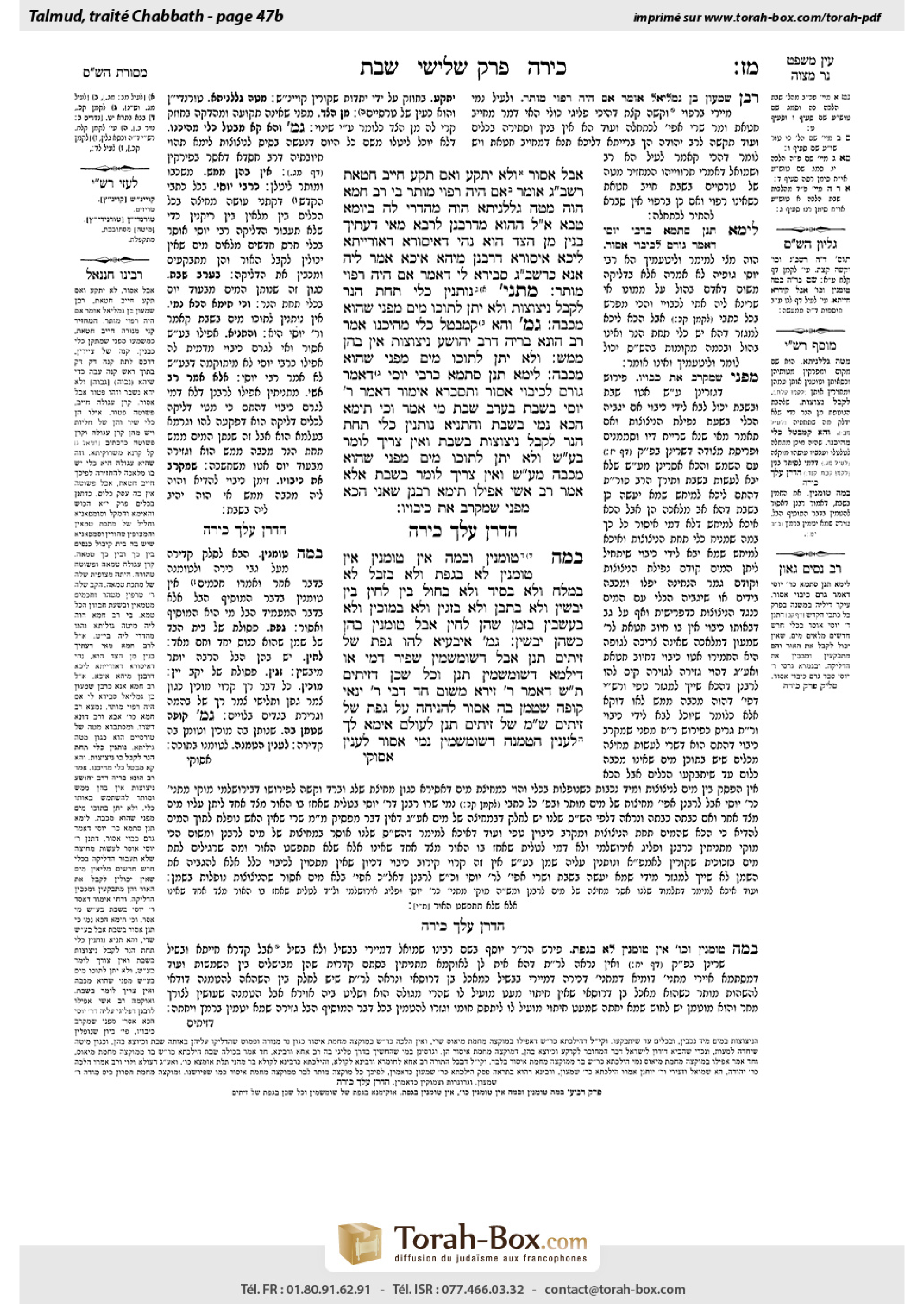
Shabbat 47b: Talmud study for Daf Yomi
Daf Yomi is the daily study of one Talmud folio. Explore 37 tractates with scans, Hebrew text, Sefaria English and AI-generated French translations where annotated.
Passage selection and English or AI-generated French translation are available where the scan has annotations. Daf Study is independent of Torah-Box and Sefaria.
Browse Shabbat · שבת · All tractatesShabbat 47b text and translations
This page of Shabbat includes the Aramaic text, an English translation and an AI-generated French translation, alongside the scan above.
שבת מ״ז ב · Aramaic and Hebrew text
אֲבָל אָסוּר. וְלֹא יִתְקַע, וְאִם תָּקַע — חַיָּיב חַטָּאת. רַבָּן שִׁמְעוֹן בֶּן גַּמְלִיאֵל אוֹמֵר: אִם הָיָה רָפוּי — מוּתָּר.
בֵּי רַב חָמָא הֲוָה מִטָּה גְּלָלְנִיתָא. הֲוָה מְהַדְּרִי לַהּ בְּיוֹמָא טָבָא. אֲמַר לֵיהּ הָהוּא מִדְּרַבָּנַן לְרָבָא: מַאי דַּעְתָּיךְ — בִּנְיָן מִן הַצַּד הוּא? נְהִי דְּאִיסּוּרָא דְּאוֹרָיְיתָא לֵיכָּא, אִיסּוּרָא דְּרַבָּנַן מִיהָא אִיכָּא! אָמַר לֵיהּ: אֲנָא כְּרַבָּן שִׁמְעוֹן בֶּן גַּמְלִיאֵל סְבִירָא לִי דְּאָמַר אִם הָיָה רָפוּי — מוּתָּר.
מַתְנִי׳ נוֹתְנִין כְּלִי תַּחַת הַנֵּר לְקַבֵּל נִיצוֹצוֹת, וְלֹא יִתֵּן לְתוֹכוֹ מַיִם מִפְּנֵי שֶׁהוּא מְכַבֶּה.
גְּמָ׳ וְהָא קָמְבַטֵּל כְּלִי מֵהֵיכָנוֹ! אָמַר רַב הוּנָא בְּרֵיהּ דְּרַב יְהוֹשֻׁעַ: נִיצוֹצוֹת אֵין בָּהֶן מַמָּשׁ.
וְלֹא יִתֵּן לְתוֹכוֹ מַיִם מִפְּנֵי שֶׁהוּא מְכַבֶּה: לֵימָא תְּנַן סְתָמָא כְּרַבִּי יוֹסֵי, דְּאָמַר גּוֹרֵם לְכִיבּוּי — אָסוּר.
וְתִסְבְּרָא? אֵימוֹר דְּאָמַר רַבִּי יוֹסֵי — בְּשַׁבָּת, בְּעֶרֶב שַׁבָּת מִי אָמַר? וְכִי תֵּימָא הָכָא נָמֵי בְּשַׁבָּת, וְהָתַנְיָא: נוֹתְנִין כְּלִי תַּחַת הַנֵּר לְקַבֵּל נִיצוֹצוֹת בְּשַׁבָּת, וְאֵין צָרִיךְ לוֹמַר בְּעֶרֶב שַׁבָּת. וְלֹא יִתֵּן לְתוֹכוֹ מַיִם מִפְּנֵי שֶׁהוּא מְכַבֶּה — מֵעֶרֶב שַׁבָּת, וְאֵין צָרִיךְ לוֹמַר בְּשַׁבָּת. אֶלָּא אָמַר רַב אָשֵׁי: אֲפִילּוּ תֵּימָא רַבָּנַן, שָׁאנֵי הָכָא — מִפְּנֵי שֶׁמְּקָרֵב אֶת כִּיבּוּיוֹ.
הדרן עלך כירה
מַתְנִי׳ בַּמֶּה טוֹמְנִין וּבַמָּה אֵין טוֹמְנִין? — אֵין טוֹמְנִין לֹא בַּגֶּפֶת וְלֹא בַּזֶּבֶל, לֹא בַּמֶּלַח וְלֹא בַּסִּיד וְלֹא בַּחוֹל — בֵּין לַחִין בֵּין יְבֵשִׁין.
וְלֹא בַּתֶּבֶן וְלֹא בַּזַּגִּין וְלֹא בַּמּוֹכִין וְלֹא בָּעֲשָׂבִין — בִּזְמַן שֶׁהֵן לַחִין, אֲבָל טוֹמְנִין בָּהֶן כְּשֶׁהֵן יְבֵשִׁין.
גְּמָ׳ אִיבַּעְיָא לְהוּ: גֶּפֶת שֶׁל זֵיתִים תְּנַן, אֲבָל דְּשׁוּמְשְׁמִין שַׁפִּיר דָּמֵי, אוֹ דִילְמָא דְּשׁוּמְשְׁמִין תְּנַן וְכָל שֶׁכֵּן דְּזֵיתִים?!
תָּא שְׁמַע, דְּאָמַר רַבִּי זֵירָא מִשּׁוּם חַד דְּבֵי רַבִּי יַנַּאי: קוּפָּה שֶׁטָּמַן בָּהּ — אָסוּר לְהַנִּיחָהּ עַל גֶּפֶת שֶׁל זֵיתִים. שְׁמַע מִינַּהּ שֶׁל זֵיתִים תְּנַן.
לְעוֹלָם אֵימָא לָךְ לְעִנְיַן הַטְמָנָה — דְּשׁוּמְשְׁמִין נָמֵי אָסוּר, לְעִנְיַן
Shabbat 47b · English translation
However, doing so is prohibited. And one may not fasten the pieces together forcefully, and if he fastens them, he is liable to bring a sin-offering for performing a labor prohibited by Torah law. Rabban Shimon ben Gamliel says: If it was loose and could be assembled with ease, it is permitted. Rabbi Abba and Rav Huna bar Ḥiyya relied on this opinion.
The Gemara relates: In the house of Rav Ḥama, Rava’s grandfather, there was a collapsible bed, similar to a weaver’s loom, and they would reassemble it on a Festival. One of the Sages said to Rava: What is your opinion? Do you hold that this is allowed because it is building in an atypical manner? In other words, one is not performing the prohibited labor of building since it is was not performed in the standard manner? Although there is no Torah prohibition, there is, in any case, a rabbinic prohibition. Rava said to him: I hold in accordance with the opinion of Rabban Shimon ben Gamliel who said that if it were loose, it is permitted even ab initio.
MISHNA: One may place a vessel beneath the oil lamp in order to receive burning sparks of oil that fall from the lamp so that they will not cause a fire. And he may not place water into the vessel because he thereby extinguishes the sparks.
GEMARA: The Gemara asks: How is it permitted to position this vessel to receive the sparks, doesn’t he thereby negate the vessel’s preparedness? It is no longer prepared for any use on Shabbat as the sparks accord it set-aside status. The opinion that negating the preparedness of a vessel is prohibited has already been stated. Rav Huna, son of Rav Yehoshua, said: Sparks have no substance. They burn immediately and do not leave behind any trace of oil in the vessel. Therefore, the vessel remains suitable to be moved.
And we also learned in the mishna that one may not place water into the vessel situated beneath the candle because he thereby extinguishes the sparks. The Gemara remarks: Is that to say that we learned an unattributed mishna in accordance with the opinion of Rabbi Yosei, who said that even an action that causes extinguishing indirectly is prohibited? The extinguishing in this case, where water was placed into a vessel, was not accomplished by means of a direct action. His action only caused it to extinguish indirectly.
The Gemara rejects this question in astonishment: And how can you understand it in that manner? Say that Rabbi Yosei said that indirectly causing extinguishing is prohibited on Shabbat; on Shabbat eve did he say this? And if you say that here, too, it is referring to a case where he placed water in the vessel on Shabbat, wasn’t it taught in a baraita: One may place a vessel underneath an oil lamp to receive sparks that fall from the lamp on Shabbat, and, needless to say, placing it there is permitted on Shabbat eve? And one may not put water into the vessel because he will thereby extinguish the spark, even if he placed it there on Shabbat eve, and, needless to say, doing so is prohibited on Shabbat itself. Apparently, the prohibition in the mishna is not at all connected to Rabbi Yosei’s approach. Rather, Rav Ashi said: Even if you say that this mishna is in accordance with the opinion of the Rabbis, it is different here because, in this case, he is not only causing the spark to extinguish. He is hastening its extinguishing, as the sparks are extinguished immediately when they fall into the water (Rabbeinu Ḥananel). In this matter even the Rabbis would prohibit doing so.
When a pot is removed from the fire on Shabbat eve it may be insulated in materials that preserve its heat, but not in materials that increase its heat. Raising the temperature of a pot is tantamount to cooking. The mishnayot that follow list those materials in which such a pot may be insulated on Shabbat eve and those materials in which it may not be insulated.
MISHNA: In what may one insulate a pot of cooked food on Shabbat eve, and in what may one not insulate it? One may neither insulate it in the solid residue of produce that has been pressed free of its oil, nor in manure, nor in salt, nor in lime, nor in sand, whether those materials are moist or whether they are dry. All of these materials spontaneously generate heat when piled for an extended period. Therefore, they add heat to a pot insulated in them.
And one may neither insulate a pot in straw, nor in the residue of grapes that have been pressed for their juice, nor in soft material, e.g., from tattered clothing, nor in grass, when these materials are moist. However, one may insulate a pot in them when they are dry.
GEMARA: A dilemma was raised before the Sages: Did we learn with regard to the residue of olives in the mishna, but the residue of sesame seeds that were pressed for their oil, which produces less heat, may well be used for insulating food on Shabbat eve? Or, perhaps, we learned with regard to the residue of sesame in the mishna, and all the more so insulating food in the residue of olives is prohibited?
Come and hear a resolution to this dilemma from what Rabbi Zeira said in the name of one of the Sages of the school of Rabbi Yannai: With regard to a basket in which one insulated food in a permissible manner, e.g., in dry soft material or the like, it is prohibited to place it upon the residue of olives. Conclude from this that we learned with regard to the residue of olives in our mishna; however, insulating food in the residue of sesame is permitted.
The Gemara rejects this proof: Actually, I can say to you that with regard to actual insulation, the residue of sesame is also prohibited. However, with regard to
Shabbat 47b · Traduction française (IA)
Toutefois, agir ainsi est interdit. On ne peut pas non plus emboîter les pièces en forçant ; s’il les emboîte ainsi, il est tenu d’apporter un sacrifice expiatoire pour avoir accompli un travail interdit par la Torah. Rabban Shimon ben Gamliel dit : « Si l’assemblage était lâche et pouvait se faire facilement, cela est permis. » Rabbi Abba et Rav Huna bar Ḥiyya se sont appuyés sur cet avis.
La Guemara rapporte : Dans la maison de Rav Ḥama, le grand-père de Rava, il y avait un lit pliant, semblable à un métier à tisser, qu’ils remontaient pendant un jour de fête. L’un des Sages dit à Rava : « Quelle est ton opinion ? Penses-tu que cela est permis parce qu’il s’agit d’une construction effectuée de manière inhabituelle ? » Autrement dit, on n’accomplit pas le travail interdit de construire puisque l’opération n’est pas effectuée de la manière habituelle. Bien qu’il n’y ait pas d’interdiction de la Torah, il y a néanmoins une interdiction rabbinique. Rava lui répondit : « Je suis l’avis de Rabban Shimon ben Gamliel, qui a dit que si l’assemblage était lâche, cela était permis d’emblée. »
MICHNA : On peut placer un récipient sous la lampe à huile afin de recueillir les étincelles d’huile brûlante qui en tombent, pour éviter qu’elles ne provoquent un incendie. On ne peut pas mettre d’eau dans le récipient, car on éteindrait ainsi les étincelles.
GUEMARA : La Guemara demande : Comment peut-on placer ce récipient pour recueillir les étincelles ? Ne rend-on pas ainsi le récipient impropre à tout usage ? Il n’est plus disponible pour aucun usage pendant Chabbat, puisque les étincelles lui confèrent le statut d’objet mouktsé. L’avis selon lequel il est interdit de rendre un récipient impropre à l’usage a déjà été énoncé. Rav Huna, fils de Rav Yehoshua, dit : Les étincelles n’ont pas de substance. Elles brûlent aussitôt et ne laissent aucune trace d’huile dans le récipient. Celui-ci reste donc déplaçable.
Nous avons aussi appris dans la Michna qu’on ne peut pas mettre d’eau dans le récipient placé sous la lampe, car on éteindrait ainsi les étincelles. La Guemara fait remarquer : Faut-il en conclure que nous avons appris une Michna anonyme conformément à l’avis de Rabbi Yosei, qui dit qu’il est interdit même de provoquer indirectement une extinction ? Dans ce cas, l’extinction n’est pas provoquée par une action directe : le fait de mettre de l’eau dans le récipient ne fait que provoquer indirectement l’extinction.
La Guemara rejette cette question avec étonnement : Comment peux-tu comprendre les choses ainsi ? Admettons que Rabbi Yosei ait dit qu’il est interdit de provoquer indirectement une extinction pendant Chabbat ; l’a-t-il dit au sujet de la veille de Chabbat ? Et si tu dis qu’ici aussi, il s’agit d’un cas où l’on a mis de l’eau dans le récipient pendant Chabbat, n’a-t-on pas enseigné dans une baraïta : On peut placer un récipient sous une lampe à huile pour recueillir les étincelles qui en tombent pendant Chabbat, et, à plus forte raison, cela est permis la veille de Chabbat. On ne peut pas mettre d’eau dans le récipient, car on éteindrait ainsi l’étincelle, même si on l’y a mise la veille de Chabbat ; à plus forte raison, cela est interdit pendant Chabbat même. Il apparaît que l’interdiction de la Michna n’a aucun lien avec la position de Rabbi Yosei. Rav Ashi dit plutôt : Même si tu dis que cette Michna est conforme à l’avis des Rabbins, le cas présent est différent, car ici, on ne se contente pas de provoquer l’extinction de l’étincelle : on en hâte l’extinction, puisque les étincelles s’éteignent aussitôt qu’elles tombent dans l’eau (Rabbeinu Ḥananel). Sur ce point, même les Rabbins interdiraient cette action.
Lorsqu’on retire une marmite du feu la veille de Chabbat, on peut l’envelopper dans des matières qui conservent sa chaleur, mais pas dans des matières qui l’augmentent. Élever la température d’une marmite équivaut à cuire. Les Michnayot qui suivent énumèrent les matières dans lesquelles on peut envelopper une telle marmite la veille de Chabbat et celles dans lesquelles cela est interdit. MICHNA : Dans quoi peut-on envelopper une marmite contenant des aliments cuits la veille de Chabbat, et dans quoi ne le peut-on pas ? On ne peut l’envelopper ni dans le résidu solide des produits dont on a extrait l’huile par pression, ni dans du fumier, ni dans du sel, ni dans de la chaux, ni dans du sable, que ces matières soient humides ou sèches. Toutes ces matières produisent spontanément de la chaleur lorsqu’elles sont entassées pendant une longue période. Elles ajoutent donc de la chaleur à la marmite qu’elles enveloppent.
On ne peut pas non plus envelopper une marmite dans de la paille, dans le résidu de raisins pressés pour en extraire le jus, dans une matière molle, par exemple des vêtements en lambeaux, ni dans de l’herbe, lorsque ces matières sont humides. En revanche, on peut y envelopper une marmite lorsqu’elles sont sèches.
GUEMARA : Une question fut soumise aux Sages : La Michna parle-t-elle du résidu des olives, tandis que le résidu des graines de sésame pressées pour en extraire l’huile, qui produit moins de chaleur, peut tout à fait servir à envelopper des aliments la veille de Chabbat ? Ou bien la Michna parle-t-elle du résidu du sésame, auquel cas, à plus forte raison, il est interdit d’envelopper des aliments dans le résidu des olives ?
Viens et écoute une réponse à cette question, tirée de ce que Rabbi Zeira a dit au nom de l’un des Sages de l’école de Rabbi Yannai : S’agissant d’un panier dans lequel on a enveloppé des aliments de manière permise, par exemple dans une matière molle sèche ou quelque chose de semblable, il est interdit de le poser sur le résidu des olives. Déduis-en que, dans notre Michna, il s’agit du résidu des olives ; en revanche, il est permis d’envelopper des aliments dans le résidu du sésame.
La Guemara rejette cette preuve : En réalité, je peux te dire que, pour ce qui est de l’enveloppement proprement dit, le résidu du sésame est lui aussi interdit. Toutefois, en ce qui concerne
Traduction française générée par IA à partir de l’édition anglaise de Sefaria. Vérifie toujours un passage avec le texte source.
Text from Sefaria: William Davidson Edition - Vocalized Aramaic (CC BY NC); William Davidson Edition - English (CC BY NC).