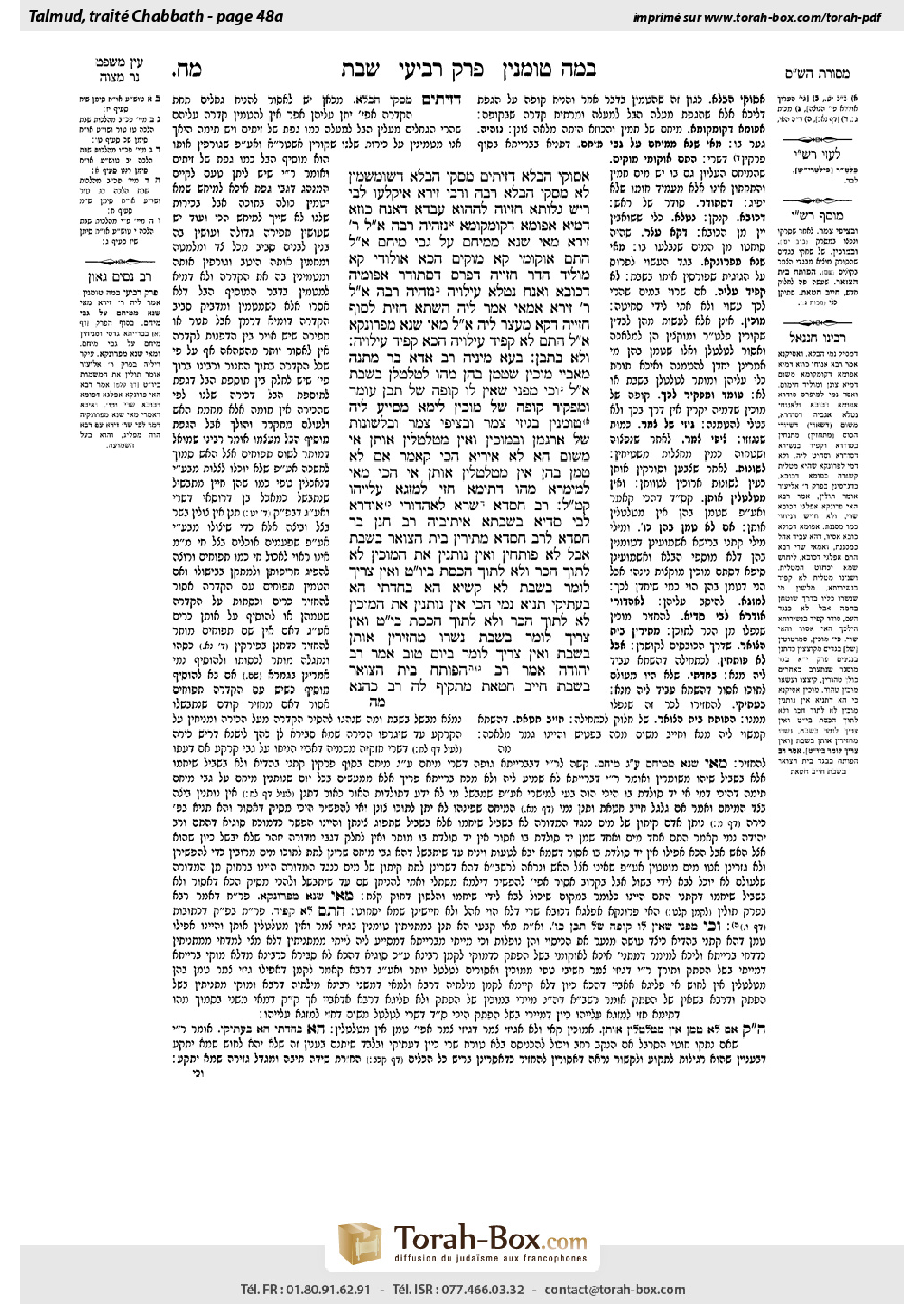
Shabbat 48a: Talmud study for Daf Yomi
Daf Yomi is the daily study of one Talmud folio. Explore 37 tractates with scans, Hebrew text, Sefaria English and AI-generated French translations where annotated.
Passage selection and English or AI-generated French translation are available where the scan has annotations. Daf Study is independent of Torah-Box and Sefaria.
Browse Shabbat · שבת · All tractatesShabbat 48a text and translations
This page of Shabbat includes the Aramaic text, an English translation and an AI-generated French translation, alongside the scan above.
שבת מ״ח א · Aramaic and Hebrew text
אַסּוֹקֵי הַבְלָא — דְּזֵיתִים מַסְּקִי הַבְלָא, דְּשׁוּמְשְׁמִין לָא מַסְּקִי הַבְלָא.
רַבָּה וְרַבִּי זֵירָא אִיקְּלַעוּ לְבֵי רֵישׁ גָּלוּתָא. חַזְיוּהּ לְהָהוּא עַבְדָּא דְּאַנַּח כּוּזָא דְמַיָּא אַפּוּמָּא דְקוּמְקוּמָא. נַזְהֵיהּ רַבָּה. אֲמַר לֵיהּ רַבִּי זֵירָא: מַאי שְׁנָא מִמֵּיחַם עַל גַּבֵּי מֵיחַם? אֲמַר לֵיהּ: הָתָם אוֹקוֹמֵי קָא מוֹקֵים, הָכָא אוֹלוֹדֵי קָא מוֹלֵיד.
הֲדַר חַזְיֵיהּ דִּפְרַס דַּסְתּוֹדַר אַפּוּמֵּיהּ דְּכוּבָּא וְאַנַּח נַטְלָא עִילָּוֵיהּ. נַזְהֵיהּ רַבָּה. אֲמַר לֵיהּ רַבִּי זֵירָא: אַמַּאי? אֲמַר לֵיהּ: הַשְׁתָּא חָזֵית. לְסוֹף חַזְיֵיהּ דְּקָא מְעַצַּר לֵיהּ. אֲמַר לֵיהּ: מַאי שְׁנָא מִפְּרוֹנְקָא? אָמַר לֵיהּ: הָתָם לָא קָפֵיד עִילָּוֵיהּ, הָכָא קָפֵיד עִילָּוֵיהּ.
וְלֹא בַּתֶּבֶן. בְּעָא מִינֵּיהּ רַב אַדָּא בַּר מַתְנָה מֵאַבָּיֵי: מוֹכִין שֶׁטָּמַן בָּהֶן, מַהוּ לְטַלְטְלָן בְּשַׁבָּת?
אֲמַר לֵיהּ: וְכִי מִפְּנֵי שֶׁאֵין לוֹ קוּפָּה שֶׁל תֶּבֶן, עוֹמֵד וּמַפְקִיר קוּפָּה שֶׁל מוֹכִין?
לֵימָא מְסַיַּיע לֵיהּ: טוֹמְנִין בְּגִיזֵּי צֶמֶר וּבְצִיפֵּי צֶמֶר וּבִלְשׁוֹנוֹת שֶׁל אַרְגָּמָן וּבְמוֹכִין, וְאֵין מְטַלְטְלִין אוֹתָן.
אִי מִשּׁוּם הָא — לָא אִירְיָא, הָכִי קָאָמַר: אִם לֹא טָמַן בָּהֶן אֵין מְטַלְטְלִין אוֹתָן.
אִי הָכִי מַאי לְמֵימְרָא! מַהוּ דְתֵימָא חֲזֵי לְמִזְגָּא עֲלַיְיהוּ, קָמַשְׁמַע לַן.
רַב חִסְדָּא שְׁרָא לְאַהְדּוֹרֵי אוּדְרָא לְבֵי סַדְיָא בְּשַׁבְּתָא. אֵיתִיבֵיהּ רַב חָנָן בַּר חִסְדָּא לְרַב חִסְדָּא: מַתִּירִין בֵּית הַצַּוָּאר בְּשַׁבָּת, אֲבָל לֹא פּוֹתְחִין. וְאֵין נוֹתְנִין אֶת הַמּוֹכִין לֹא לְתוֹךְ הַכַּר וְלֹא לְתוֹךְ הַכֶּסֶת בְּיוֹם טוֹב, וְאֵין צָרִיךְ לוֹמַר בְּשַׁבָּת.
לָא קַשְׁיָא, הָא בְּחַדְתֵי הָא בְּעַתִּיקֵי.
תַּנְיָא נָמֵי הָכִי: אֵין נוֹתְנִין אֶת הַמּוֹכִין לֹא לְתוֹךְ הַכַּר וְלֹא לְתוֹךְ הַכֶּסֶת בְּיוֹם טוֹב, וְאֵין צָרִיךְ לוֹמַר בְּשַׁבָּת. נָשְׁרוּ, מַחֲזִירִין אוֹתָן בְּשַׁבָּת, וְאֵין צָרִיךְ לוֹמַר בְּיוֹם טוֹב.
אָמַר רַב יְהוּדָה אָמַר רַב: הַפּוֹתֵחַ בֵּית הַצַּוָּאר בְּשַׁבָּת — חַיָּיב חַטָּאת.
מַתְקִיף לַהּ רַב כָּהֲנָא:
Shabbat 48a · English translation
causing heat to rise, i.e., heating food that is not actually insulated in it, but merely resting upon it, the residue of olives causes heat to rise. Therefore, it is prohibited even to place cooked food upon it. However, the residue of sesame does not cause heat to rise to that extent. Therefore, it is permitted to place food upon it.
The Gemara relates an anecdote somewhat relevant to the previous discussion: Rabba and Rabbi Zeira happened to come to the house of the Exilarch on Shabbat, and saw this servant who placed a jug [kuza] of cold water on the mouth of a kettle filled with hot water. Rabba rebuked him for having acted contrary to the halakha. Rabbi Zeira said to Rabba: How is this case different from placing an urn on top of another urn, which is permitted on Shabbat? Rabba said to him: There, when he places one urn on top of another urn, he merely preserves the heat in the upper urn; therefore, it is permitted. Here, in the case where he places the jug of cold water on the mouth of a kettle, he is generating heat in the water in the upper vessel; therefore, it is prohibited.
The Gemara continues: Rabba then saw that same servant spread a kerchief [dastodar] over a vat of water and place a cup used to draw water from the vat, on the kerchief. Once again, Rabba rebuked him for having acted improperly. Rabbi Zeira said to him: Why did you rebuke him? Rabba said to him: Now, see what will happen. Ultimately, he saw that the servant was squeezing out the water that was absorbed by the kerchief, thereby violating a Torah prohibition. Nevertheless, Rabbi Zeira said to him: How is this case different from that of a cloth [parvanka], which one is permitted to spread over a vat even on Shabbat? Rabba said to him: There is a distinction between the two cases: There, in the case of the cloth, he is not particular about it; even if it gets wet, he will not come to squeeze it dry. Here, with regard to the kerchief, he is particular about it, and he will wring it so that it will not remain wet.
We learned in the mishna: And one may neither insulate a pot in straw, nor in the residue of grapes that were pressed for their juice, nor in soft material. Rav Adda bar Mattana raised a dilemma before Abaye: With regard to swatches of soft material in which he insulated a pot, what is the halakha with regard to moving that material on Shabbat? Ordinarily, swatches of materials of that kind are set-aside because they have no use. Therefore, moving them on Shabbat is prohibited. Do we say that since they are now being used to insulate a pot, they assume the legal status of a utensil, which may be moved on Shabbat?
Abaye said to him: Just because he does not now have a basket of straw in which to insulate his food, does he stand up and renounce his basket of soft material? Obviously, he would have preferred to insulate his food in straw, as it is less expensive. The only reason that he used that material was because there was no straw available at the time. However, he does not want the swatches of material to be used for any other purpose, lest it be ruined. Therefore, it remains set-aside.
The Gemara asks: Let us say that the following baraita supports him: One may insulate a pot of food on Friday afternoon in woolen fleece, in combed wool, in tabs of wool dyed purple, and in swatches of soft material; however, he may not move them. Apparently, this is in accordance with the opinion of Abaye.
The Gemara rejects this proof: If that is the reason, there is no conclusive argument, as it is saying in the baraita as follows: If, however, he did not insulate a pot in them, he may not move them on Shabbat. In that case, they remain earmarked for their own purpose and are therefore set-aside [muktze].
The Gemara questions this last assertion: If so, what is the reason to say that? Obviously, those materials are set-aside. The Gemara explains: Lest you say that all these materials are suitable for one to sit on them, and, consequently, their legal status is that of utensils, which may be moved. Therefore, the baraita teaches us that this is not so, and they may not be moved due to the prohibition of set-aside.
The Gemara relates that Rav Ḥisda permitted returning stuffing to the pillow from which it had fallen on Shabbat. Rav Ḥanan bar Ḥisda raised an objection to the opinion of Rav Ḥisda from a baraita: One may untie the neck opening of a shirt on Shabbat if it had been tied by the launderer; however, one may not open a new neck opening for the first time on Shabbat. And one may not place soft material into a pillow or into a cushion on a Festival, and, needless to say, one may not do so on Shabbat. This baraita contradicts the ruling issued by Rav Ḥisda.
The Gemara answers: This is not difficult. This, the baraita is referring to new pillows, whereas that, the statement of Rav Ḥisda is referring to old pillows. Stuffing a pillow for the first time on Shabbat is prohibited because by so doing one fashions a new utensil. However, if the stuffing fell out of the pillow, refilling the pillow is permitted even on Shabbat.
The Gemara notes: That opinion was also taught in a baraita: One may not place soft material as stuffing into a pillow or into a cushion on a Festival, and needless to say one may not do so on Shabbat. However, if the stuffing fell out, it may be replaced even on Shabbat, and needless to say that doing so is permitted on a Festival.
Having raised the issue of opening a collar, the Gemara cites that Rav Yehuda said that Rav said: One who opens a new neck opening in a shirt on Shabbat, by cutting through the fabric and threads that kept it closed, is liable to bring a sin-offering. By creating the opening, he renders the shirt fit to wear, thereby fashioning a utensil on Shabbat.
Rav Kahana strongly objects to this:
Shabbat 48a · Traduction française (IA)
En provoquant une montée de chaleur, c’est-à-dire en chauffant un aliment qui n’y est pas réellement isolé, mais repose simplement dessus, le résidu d’olives provoque une montée de chaleur. Il est donc interdit d’y poser même un aliment déjà cuit. En revanche, le résidu de sésame ne provoque pas une montée de chaleur aussi importante. Il est donc permis d’y poser un aliment.
La Guemara rapporte un épisode quelque peu lié à la discussion précédente : Rabba et Rabbi Zeira se rendirent par hasard chez l’Exilarque un Chabbat et virent un serviteur poser une cruche [kuza] d’eau froide sur l’ouverture d’une marmite remplie d’eau chaude. Rabba le réprimanda pour avoir agi contrairement à la halakha. Rabbi Zeira lui dit : « En quoi ce cas diffère-t-il du fait de poser une urne sur une autre urne, ce qui est permis le Chabbat ? » Rabba lui répondit : « Là, lorsqu’on pose une urne sur une autre urne, on ne fait que préserver la chaleur de l’urne supérieure ; c’est pourquoi cela est permis. Ici, en revanche, lorsqu’on pose la cruche d’eau froide sur l’ouverture d’une marmite, on chauffe l’eau du récipient supérieur ; c’est pourquoi cela est interdit. »
La Guemara poursuit : Rabba vit ensuite ce même serviteur étendre un foulard [dastodar] sur une cuve d’eau et poser sur le foulard une coupe servant à puiser l’eau de la cuve. Rabba le réprimanda de nouveau pour avoir agi de façon inappropriée. Rabbi Zeira lui dit : « Pourquoi l’as-tu réprimandé ? » Rabba lui répondit : « Attends de voir ce qui va se passer. » Finalement, il vit le serviteur essorer l’eau absorbée par le foulard, transgressant ainsi une interdiction de la Torah. Rabbi Zeira lui dit néanmoins : « En quoi ce cas diffère-t-il de celui d’un tissu [parvanka], qu’il est permis d’étendre sur une cuve même le Chabbat ? » Rabba lui répondit : « Il y a une différence entre les deux cas. Là, à propos du tissu, on n’y tient pas particulièrement ; même s’il est mouillé, on ne risque pas de l’essorer pour le sécher. Ici, en revanche, à propos du foulard, on y tient particulièrement et on l’essorera pour qu’il ne reste pas mouillé. »
Nous avons appris dans la Michna : On ne peut isoler une marmite ni dans de la paille, ni dans le résidu de raisins pressés pour en extraire le jus, ni dans des étoffes souples. Rav Adda bar Mattana posa une question à Abaye : Concernant les morceaux d’étoffe souple dans lesquels on a isolé une marmite, quelle est la halakha quant au fait de les déplacer le Chabbat ? En temps normal, les morceaux de ce genre sont mis de côté parce qu’ils n’ont pas d’usage. Il est donc interdit de les déplacer le Chabbat. Doit-on dire que, puisqu’ils servent maintenant à isoler une marmite, ils acquièrent le statut juridique d’un ustensile, qu’il est permis de déplacer le Chabbat ?
Abaye lui dit : « Est-ce que, simplement parce qu’il n’a pas de panier de paille pour isoler ses aliments, il renonce à son panier d’étoffes souples ? De toute évidence, il aurait préféré isoler ses aliments dans de la paille, qui coûte moins cher. Il n’a utilisé ces étoffes que parce qu’il n’y avait pas de paille disponible à ce moment-là. Toutefois, il ne veut pas que ces morceaux d’étoffe servent à un autre usage, de peur qu’ils ne s’abîment. Ils restent donc mis de côté. »
La Guemara demande : « Peut-on dire que la baraïta suivante appuie son opinion ? On peut isoler une marmite contenant de la nourriture le vendredi après-midi avec de la laine en suint, de la laine cardée, des mèches de laine teintes en pourpre et des morceaux d’étoffe souple ; cependant, on ne peut pas les déplacer. » Apparemment, cela correspond à l’opinion d’Abaye.
La Guemara rejette cette preuve : « Si telle est la raison, il n’y a pas de démonstration concluante, car la baraïta dit en réalité ceci : Toutefois, s’il n’a pas isolé une marmite avec ces matériaux, il ne peut pas les déplacer le Chabbat. » Dans ce cas, ils restent réservés à leur usage propre et sont donc mis de côté [muktze].
La Guemara remet en question cette dernière affirmation : « Si c’est ainsi, pourquoi le préciser ? De toute évidence, ces matériaux sont mis de côté. » La Guemara explique : « De peur que tu ne dises que tous ces matériaux peuvent servir à s’asseoir dessus et qu’ils ont donc le statut juridique d’ustensiles, qu’il est permis de déplacer. » La baraïta nous enseigne donc qu’il n’en est pas ainsi et qu’on ne peut pas les déplacer en raison de l’interdiction relative aux objets mis de côté.
La Guemara rapporte que Rav Ḥisda autorisa à remettre le rembourrage dans l’oreiller dont il était tombé le Chabbat. Rav Ḥanan bar Ḥisda objecta à l’opinion de Rav Ḥisda à partir d’une baraïta : « On peut dénouer l’ouverture du col d’une chemise le Chabbat si le blanchisseur l’a nouée ; cependant, on ne peut pas ouvrir pour la première fois une nouvelle ouverture de col le Chabbat. On ne peut pas non plus mettre de matière souple dans un oreiller ou un coussin pendant un jour de fête ; à plus forte raison, on ne peut pas le faire le Chabbat. » Cette baraïta contredit la décision de Rav Ḥisda.
La Guemara répond : « Il n’y a pas de difficulté. Ici, la baraïta parle d’oreillers neufs, tandis que là, la déclaration de Rav Ḥisda parle d’oreillers anciens. » Remplir un oreiller pour la première fois le Chabbat est interdit, car on fabrique ainsi un nouvel ustensile. Toutefois, si le rembourrage est tombé de l’oreiller, il est permis de le remplir à nouveau, même le Chabbat.
La Guemara relève que cette opinion a également été enseignée dans une baraïta : « On ne peut pas mettre de matière souple comme rembourrage dans un oreiller ou un coussin pendant un jour de fête ; à plus forte raison, on ne peut pas le faire le Chabbat. Toutefois, si le rembourrage est tombé, on peut le remettre, même le Chabbat ; à plus forte raison, cela est permis un jour de fête. »
Puisqu’il a été question d’ouvrir un col, la Guemara cite ce que Rav Yehouda a dit au nom de Rav : Celui qui ouvre une nouvelle ouverture de col dans une chemise le Chabbat, en coupant le tissu et les fils qui la maintenaient fermée, est passible d’apporter un sacrifice expiatoire. En créant cette ouverture, il rend la chemise apte à être portée et fabrique ainsi un ustensile le Chabbat.
Rav Kahana objecte vigoureusement à cela :
Traduction française générée par IA à partir de l’édition anglaise de Sefaria. Vérifie toujours un passage avec le texte source.
Text from Sefaria: William Davidson Edition - Vocalized Aramaic (CC BY NC); William Davidson Edition - English (CC BY NC).