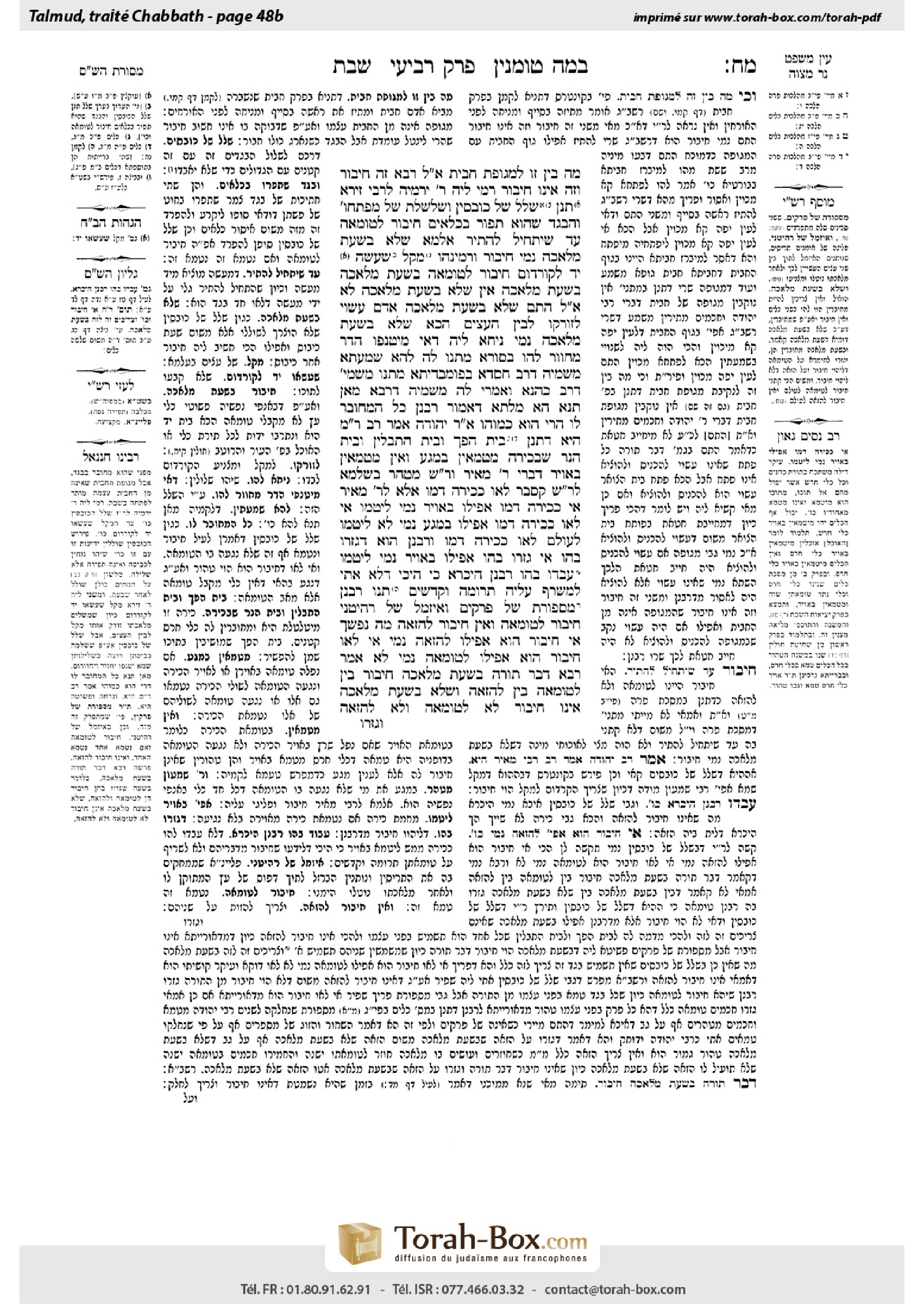
Shabbat 48b: Talmud study for Daf Yomi
Daf Yomi is the daily study of one Talmud folio. Explore 37 tractates with scans, Hebrew text, Sefaria English and AI-generated French translations where annotated.
Passage selection and English or AI-generated French translation are available where the scan has annotations. Daf Study is independent of Torah-Box and Sefaria.
Browse Shabbat · שבת · All tractatesShabbat 48b text and translations
This page of Shabbat includes the Aramaic text, an English translation and an AI-generated French translation, alongside the scan above.
שבת מ״ח ב · Aramaic and Hebrew text
מָה בֵּין זוֹ לִמְגוּפַת חָבִית. אֲמַר לֵיהּ רָבָא: זֶה חִיבּוּר, וְזֶה אֵינוֹ חִיבּוּר.
רָמֵי לֵיהּ רַבִּי יִרְמְיָה לְרַבִּי זֵירָא: תְּנַן: שְׁלָל שֶׁל כּוֹבְסִין, וְשַׁלְשֶׁלֶת שֶׁל מַפְתְּחוֹת, וְהַבֶּגֶד שֶׁהוּא תָּפוּר בְּכִלְאַיִם חִיבּוּר לַטּוּמְאָה — עַד שֶׁיַּתְחִיל לְהַתִּיר. אַלְמָא שֶׁלֹּא בִּשְׁעַת מְלָאכָה נָמֵי חִיבּוּר.
וּרְמִינְהוּ: מַקֵּל שֶׁעֲשָׂאוֹ יָד לְקוּרְדּוֹם — חִיבּוּר לַטּוּמְאָה בִּשְׁעַת מְלָאכָה. בִּשְׁעַת מְלָאכָה — אִין, שֶׁלֹּא בִּשְׁעַת מְלָאכָה — לָא!
אֲמַר לֵיהּ: הָתָם שֶׁלֹּא בִּשְׁעַת מְלָאכָה אָדָם עָשׂוּי לְזוֹרְקוֹ לְבֵין הָעֵצִים, הָכָא שֶׁלֹּא בִּשְׁעַת מְלָאכָה נָמֵי נִיחָא לֵיהּ, דְּאִי מִיטַּנְּפוּ הָדַר מְחַוַּור לְהוּ.
בְּסוּרָא מַתְנוּ לַהּ לְהָא שְׁמַעְתָּא מִשְּׁמֵיהּ דְּרַב חִסְדָּא, בְּפוּמְבְּדִיתָא מַתְנוּ מִשְּׁמֵיהּ דְּרַב כָּהֲנָא, וְאָמְרִי לַהּ מִשְּׁמֵיהּ דְּרָבָא: מַאן תְּנָא הָא מִלְּתָא דַּאֲמוּר רַבָּנַן כׇּל הַמְחוּבָּר לוֹ הֲרֵי הוּא כָּמוֹהוּ?
אָמַר רַב יְהוּדָה אָמַר רַב: רַבִּי מֵאִיר הִיא. דִּתְנַן: בֵּית הַפַּךְ וּבֵית הַתַּבְלִין וּבֵית הַנֵּר שֶׁבַּכִּירָה מְטַמְּאִין בְּמַגָּע וְאֵין מְטַמְּאִין בָּאֲוִיר, דִּבְרֵי רַבִּי מֵאִיר. וְרַבִּי שִׁמְעוֹן מְטַהֵר.
בִּשְׁלָמָא לְרַבִּי שִׁמְעוֹן — קָסָבַר לָאו כְּכִירָה דָּמוּ. אֶלָּא לְרַבִּי מֵאִיר, אִי כְּכִירָה דָּמוּ — אֲפִילּוּ בַּאֲוִיר נָמֵי לִיטַּמּוּ. אִי לָאו כְּכִירָה דָּמוּ — אֲפִילּוּ בְּמַגָּע נָמֵי לָא לִיטַּמּוּ!
לְעוֹלָם לָאו כְּכִירָה דָּמוּ וְרַבָּנַן הוּא דִּגְזַרוּ בְּהוּ. אִי גְּזַרוּ בְּהוּ, אֲפִילּוּ בָּאֲוִיר נָמֵי לִיטַּמּוּ!
עֲבַדוּ בְּהוּ רַבָּנַן הֶיכֵּרָא כִּי הֵיכִי דְּלָא אָתֵי לְמִשְׂרַף עֲלֵיהּ תְּרוּמָה וְקׇדָשִׁים.
תָּנוּ רַבָּנַן: מַסְפּוֹרֶת שֶׁל פְּרָקִים וְאִיזְמֵל שֶׁל רָהִיטְנֵי חִיבּוּר לַטּוּמְאָה, וְאֵין חִיבּוּר לַהַזָּאָה.
מָה נַפְשָׁךְ: אִי חִיבּוּר הוּא — אֲפִילּוּ לְהַזָּאָה נָמֵי, אִי לָאו חִיבּוּר הוּא — אֲפִילּוּ לְטוּמְאָה נָמֵי לָא! אָמַר רָבָא: דְּבַר תּוֹרָה בִּשְׁעַת מְלָאכָה חִיבּוּר — בֵּין לְטוּמְאָה בֵּין לְהַזָּאָה. וְשֶׁלֹּא בִּשְׁעַת מְלָאכָה — אֵינוֹ חִיבּוּר לֹא לְטוּמְאָה וְלֹא לְהַזָּאָה.
Shabbat 48b · English translation
What is the difference between this and the stopper of a wine barrel, which the Sages permitted piercing on Shabbat in order to serve wine to guests? There, too, by piercing the stopper, he fashions a utensil. Rava said to him: The cases are not comparable: In this case, the neck opening of a shirt, it is considered a connection, i.e., it is an organic part of the weave of the fabric; whereas in that case, the stopper of the barrel, it is not considered a connection. Even though the stopper is sealed in place in the barrel, it is a separate entity. When the stopper is pierced, no new vessel is fashioned.
Rabbi Yirmeya raised a contradiction before Rabbi Zeira. We learned in a mishna: The basting of launderers, garments that a launderer sewed together with loose, temporary stitches to avoid losing them; and a ring of keys; and a garment that was sewn with a thread of diverse kinds, e.g., a woolen garment that was stitched with linen thread, which must be pulled out; even though they are attached only temporarily, as they will all eventually be separated, it is considered a connection with regard to issues of ritual impurity. If a source of ritual impurity comes into contact with one of the garments, they all become ritually impure, until one actually begins to untie them, thereby indicating that he does not want them attached. Apparently, even when these items are not in use, e.g., after the launderer finished laundering the clothes, it is also considered a connection.
And the Gemara raises a contradiction from a different mishna: With regard to a stick that one made into an axe handle, it is considered a connection between the stick and the axe with regard to issues of ritual impurity when in use. If the axe comes into contact with a source of ritual impurity, the stick also becomes ritually impure, and vice versa. By inference: Only when the axe is actually in use, yes, it is considered a connection; when the axe is not in use, no, it is not considered a connection.
Rabbi Zeira said to Rabbi Yirmeya: There, in the case of the axe, when not in use, a person is likely to throw the stick into the wood pile, as he is not particular about keeping them together. Therefore, it is not considered a connection with regard to ritual impurity. Here, with regard to the items listed in the first mishna, even when not in use, he prefers that they remain attached. In that way, if they get dirty, he can launder them again, as it is easier to wash one connected unit than several smaller swatches of fabric. Therefore, it is considered a connection with regard to ritual impurity.
In Sura, they taught this following halakha in the name of Rav Ḥisda; in Pumbedita, they taught it in the name of Rav Kahana, and some say, it was taught in the name of Rava: Who is the tanna who taught this matter stated by the Sages: The status of anything connected to an object is like that of the object with regard to ritual impurity?
Rav Yehuda said that Rav said: The tanna in question is Rabbi Meir, as we learned in a mishna: The receptacle for the cruse of oil, and the receptacle for the spices, and the receptacle for the lamp that are in the stove become ritually impure through contact, i.e., if the wall of the stove becomes ritually impure through contact with a creeping animal, the receptacles also become ritually impure. However, these receptacles do not become ritually impure through air space, i.e., if the creeping animal were inside the stove but did not come into contact with its walls, the stove itself becomes ritually impure, but the receptacles do not; this is the statement of Rabbi Meir. And Rabbi Shimon deems the receptacles ritually pure, even if the creeping animal came into actual contact with the stove.
The Gemara analyzes this dispute: Granted, according to the opinion of Rabbi Shimon; he holds that these receptacles are not considered like the stove itself, and therefore they do not become ritually impure when the stove becomes ritually impure. However, according to the opinion of Rabbi Meir, it is difficult. If he holds that they are considered like the stove itself, then even if the creeping animal was in the stove’s air space, the receptacles should also become ritually impure. If he holds that they are not considered like the stove itself, then even if the creeping animal came into contact with the stove, the receptacles should also not become ritually impure.
The Gemara answers: Actually, by Torah law, the receptacles are not considered like the stove itself, and the Sages are the ones who issued a decree that they become ritually impure due to their proximity to the stove. The Gemara asks: If the Sages issued a decree that they become ritually impure, then even in the case where the creeping animal does not come into contact with the walls of the oven, but is merely in its air space, the receptacles should also become ritually impure.
The Gemara answers: The Sages made a conspicuous distinction, so that one will not come to burn his teruma and other consecrated items because of it. There is a severe prohibition to destroy teruma or consecrated items. If teruma becomes ritually impure, there is an obligation by Torah law to burn it; however, teruma that is ritually impure only by rabbinic decree is still fit by Torah law and may not be destroyed. Since there is concern that people will come to burn teruma even when doing so is prohibited, the Sages made a distinction, imposing ritual impurity on the receptacles only if the source of impurity came into physical contact with the walls of the stove, and not if it merely entered the stove’s airspace. In that way, it is clear that the ritual impurity is by rabbinic decree, and one will not come to burn teruma and consecrated objects due to that impurity.
The Sages taught in a baraita: With regard to scissors made of component parts that are made to come apart and the blade of a carpenter’s plane, which can be removed from its handle, it is considered a connection between the components with regard to contracting ritual impurity. If one part becomes ritually impure, the other part becomes ritually impure as well. However, it is not considered a connection with regard to the sprinkling of the water of a purification offering. When water of purification is sprinkled on these implements in order to purify them from ritual impurity contracted through contact with a corpse (see Numbers 19:17–19), the water must be sprinkled on each part individually.
The Gemara asks: Whichever way you look at it, there is a difficulty: If it is considered a connection, it should be so considered even with regard to sprinkling; and if it is not considered a connection, it should not be so considered even with regard to ritual impurity. Rava said: By Torah law, when in use, it is considered a connection, both with regard to ritual impurity and with regard to sprinkling. And when not in use, even if the parts are now together, since they are made to eventually come apart and are typically dismantled, it is neither considered a connection with regard to ritual impurity nor with regard to sprinkling.
Shabbat 48b · Traduction française (IA)
Quelle différence y a-t-il entre ce cas et celui du bouchon d’un tonneau de vin, que les Sages ont permis de percer pendant Chabbat afin de servir du vin aux invités ? Là aussi, en perçant le bouchon, on façonne un ustensile. Rava lui dit : Ces cas ne sont pas comparables. Dans le cas présent, celui de l’ouverture du col d’un vêtement, celle-ci est considérée comme faisant corps avec le tissu, c’est-à-dire comme une partie intégrante de son tissage ; tandis que dans l’autre cas, le bouchon du tonneau n’est pas considéré comme faisant corps avec celui-ci. Bien qu’il soit scellé en place dans le tonneau, il constitue une entité distincte. Quand on perce le bouchon, aucun nouvel ustensile n’est façonné.
Rabbi Yirmeya souleva une contradiction devant Rabbi Zeira. Nous avons appris dans une Michna : les vêtements que les blanchisseurs ont faufilés ensemble avec des points lâches et provisoires afin de ne pas les perdre ; un anneau de clés ; et un vêtement cousu avec un fil de mélange d’espèces — par exemple un vêtement de laine cousu avec du fil de lin, qu’il faut retirer —, bien qu’ils ne soient attachés que provisoirement, puisqu’ils seront tous finalement séparés, sont considérés comme formant un tout pour les questions d’impureté rituelle. Si une source d’impureté rituelle entre en contact avec l’un des vêtements, ils deviennent tous impurs, jusqu’à ce que l’on commence effectivement à les découdre, indiquant ainsi qu’on ne veut pas qu’ils restent attachés. Apparemment, même lorsque ces objets ne sont pas utilisés — par exemple, après que le blanchisseur a fini de laver les vêtements —, ils sont également considérés comme formant un tout.
Et la Guemara soulève une contradiction à partir d’une autre Michna : un bâton transformé en manche de hache est considéré comme formant un tout avec la hache pour les questions d’impureté rituelle lorsqu’il est utilisé. Si la hache entre en contact avec une source d’impureté rituelle, le bâton devient lui aussi impur, et inversement. On en déduit que c’est seulement lorsque la hache est effectivement utilisée qu’elle est considérée comme formant un tout avec le bâton ; lorsque la hache n’est pas utilisée, ils ne sont pas considérés comme formant un tout.
Rabbi Zeira dit à Rabbi Yirmeya : Dans le cas de la hache, lorsqu’elle n’est pas utilisée, une personne est susceptible de jeter le bâton dans le tas de bois, car elle ne tient pas particulièrement à les garder ensemble. Par conséquent, ils ne sont pas considérés comme formant un tout pour les questions d’impureté rituelle. Ici, pour les objets énumérés dans la première Michna, même lorsqu’ils ne sont pas utilisés, on préfère qu’ils restent attachés. Ainsi, s’ils se salissent, on peut les laver à nouveau, car il est plus facile de laver un seul ensemble que plusieurs petits morceaux de tissu. Ils sont donc considérés comme formant un tout pour les questions d’impureté rituelle.
À Soura, on enseignait cette halakha au nom de Rav Ḥisda ; à Poumbedita, on l’enseignait au nom de Rav Kahana, et certains disent qu’elle était enseignée au nom de Rava : Quel est le tanna qui a enseigné cette règle énoncée par les Sages, selon laquelle tout ce qui est attaché à un objet a le même statut que cet objet en matière d’impureté rituelle ?
Rav Yehouda dit au nom de Rav : Le tanna en question est Rabbi Meïr, comme nous l’avons appris dans une Michna : le réceptacle de la fiole d’huile, le réceptacle des épices et le réceptacle de la lampe qui se trouvent dans le four deviennent impurs par contact ; autrement dit, si la paroi du four devient impure au contact d’un animal rampant, les réceptacles deviennent eux aussi impurs. Cependant, ces réceptacles ne deviennent pas impurs par l’espace intérieur : si l’animal rampant se trouvait à l’intérieur du four sans toucher ses parois, le four lui-même devient impur, mais les réceptacles ne le deviennent pas. Telle est la déclaration de Rabbi Meïr. Rabbi Shimon, lui, considère les réceptacles comme purs, même si l’animal rampant a effectivement touché le four.
La Guemara analyse cette controverse : selon l’opinion de Rabbi Shimon, il est compréhensible que les réceptacles ne soient pas considérés comme faisant partie du four lui-même et ne deviennent donc pas impurs lorsque le four devient impur. Mais l’opinion de Rabbi Meïr pose une difficulté. S’il considère que les réceptacles sont comme le four lui-même, alors, même si l’animal rampant se trouvait dans l’espace intérieur du four, les réceptacles devraient eux aussi devenir impurs. S’il considère qu’ils ne sont pas comme le four lui-même, alors, même si l’animal rampant a touché le four, les réceptacles ne devraient pas non plus devenir impurs.
La Guemara répond : En réalité, selon la Torah, les réceptacles ne sont pas considérés comme faisant partie du four lui-même ; ce sont les Sages qui ont décrété qu’ils deviennent impurs en raison de leur proximité avec le four. La Guemara demande : Si les Sages ont décrété qu’ils deviennent impurs, alors, même dans le cas où l’animal rampant ne touche pas les parois du four mais se trouve simplement dans son espace intérieur, les réceptacles devraient eux aussi devenir impurs.
La Guemara répond : Les Sages ont établi une distinction manifeste, afin que l’on n’en vienne pas à brûler sa terouma ou d’autres objets consacrés en raison de cette règle. Il est strictement interdit de détruire de la terouma ou des objets consacrés. Si la terouma devient impure, la Torah impose de la brûler ; toutefois, une terouma qui n’est impure qu’en vertu d’un décret rabbinique reste apte selon la Torah et ne peut pas être détruite. Comme on craint que des gens en viennent à brûler de la terouma alors que cela est interdit, les Sages ont établi une distinction : les réceptacles ne deviennent impurs que si la source d’impureté a physiquement touché les parois du four, et non si elle est seulement entrée dans son espace intérieur. Ainsi, il est clair que l’impureté découle d’un décret rabbinique, et l’on n’en viendra pas à brûler de la terouma ou des objets consacrés à cause de cette impureté.
Les Sages ont enseigné dans une baraïta : des ciseaux constitués de pièces conçues pour être séparées, ainsi que la lame d’un rabot de menuisier, que l’on peut retirer de son manche, sont considérés comme formant un tout en ce qui concerne la contraction de l’impureté rituelle. Si une pièce devient impure, l’autre le devient elle aussi. Cependant, ils ne sont pas considérés comme formant un tout en ce qui concerne l’aspersion de l’eau d’un sacrifice de purification. Lorsque l’eau de purification est aspergée sur ces ustensiles afin de les purifier de l’impureté rituelle contractée au contact d’un cadavre (voir Nombres 19,17–19), il faut asperger chaque pièce séparément.
La Guemara demande : Quelle que soit la façon dont on considère les choses, une difficulté se présente : s’ils sont considérés comme formant un tout, ils devraient l’être également en ce qui concerne l’aspersion ; et s’ils ne le sont pas, ils ne devraient pas l’être non plus en ce qui concerne l’impureté rituelle. Rava dit : Selon la Torah, lorsqu’ils sont utilisés, ils sont considérés comme formant un tout, aussi bien en ce qui concerne l’impureté rituelle qu’en ce qui concerne l’aspersion. Lorsqu’ils ne sont pas utilisés, même si les pièces sont actuellement assemblées, puisqu’elles sont conçues pour être finalement séparées et qu’on les démonte habituellement, elles ne sont considérées comme formant un tout ni en ce qui concerne l’impureté rituelle ni en ce qui concerne l’aspersion.
Traduction française générée par IA à partir de l’édition anglaise de Sefaria. Vérifie toujours un passage avec le texte source.
Text from Sefaria: William Davidson Edition - Vocalized Aramaic (CC BY NC); William Davidson Edition - English (CC BY NC).