Shabbat 49a: Talmud study for Daf Yomi
Daf Yomi is the daily study of one Talmud folio. Explore 37 tractates with scans, Hebrew text, Sefaria English and AI-generated French translations where annotated.
Passage selection and English or AI-generated French translation are available where the scan has annotations. Daf Study is independent of Torah-Box and Sefaria.
Browse Shabbat · שבת · All tractatesShabbat 49a text and translations
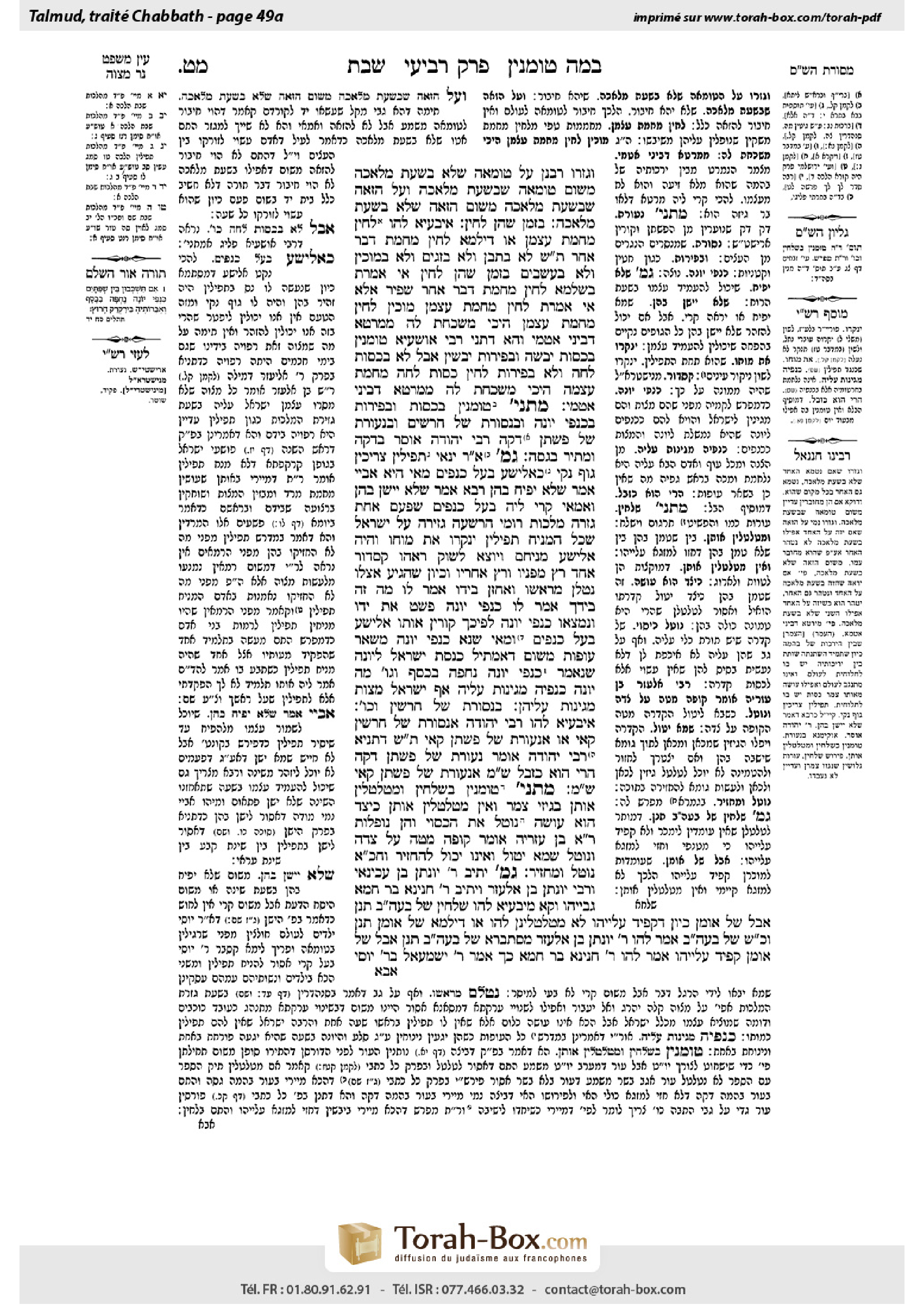
This page of Shabbat includes the Aramaic text, an English translation and an AI-generated French translation, alongside the scan above.
שבת מ״ט א · Aramaic and Hebrew text
וְגָזְרוּ רַבָּנַן עַל טוּמְאָה שֶׁלֹּא בִּשְׁעַת מְלָאכָה מִשּׁוּם טוּמְאָה שֶׁבִּשְׁעַת מְלָאכָה, וְעַל הַזָּאָה שֶׁבִּשְׁעַת מְלָאכָה מִשּׁוּם הַזָּאָה שֶׁלֹּא בִּשְׁעַת מְלָאכָה.
בִּזְמַן שֶׁהֵן לַחִין. אִיבַּעְיָא לְהוּ: לַחִין מֵחֲמַת עַצְמָן, אוֹ דִילְמָא לַחִין מֵחֲמַת דָּבָר אַחֵר.
תָּא שְׁמַע: לֹא בַּתֶּבֶן וְלֹא בַּזַּגִּים וְלֹא בַּמּוֹכִין וְלֹא בָּעֲשָׂבִים בִּזְמַן שֶׁהֵן לַחִין. אִי אָמְרַתְּ בִּשְׁלָמָא לַחִין מֵחֲמַת דָּבָר אַחֵר — שַׁפִּיר. אֶלָּא אִי אָמְרַתְּ לַחִין מֵחֲמַת עַצְמָן, מוֹכִין לַחִין מֵחֲמַת עַצְמָן הֵיכִי מַשְׁכַּחַתְּ לַהּ? — מִמִּרְטָא דְּבֵינֵי אַטְמֵי.
וְהָא דְתָנֵי רַבִּי אוֹשַׁעְיָא: טוֹמְנִין בִּכְסוּת יְבֵשָׁה וּבְפֵירוֹת יְבֵשִׁין, אֲבָל לֹא בִּכְסוּת לַחָה וְלֹא בְּפֵירוֹת לַחִין. כְּסוּת לַחָה מֵחֲמַת עַצְמָהּ הֵיכִי מַשְׁכַּחַתְּ לַהּ? — מִמִּרְטָא דְּבֵינֵי אַטְמֵי.
מַתְנִי׳ טוֹמְנִין בִּכְסוּת וּבְפֵירוֹת, בְּכַנְפֵי יוֹנָה וּבִנְסוֹרֶת שֶׁל חָרָשִׁים וּבִנְעוֹרֶת שֶׁל פִּשְׁתָּן דַּקָּה. רַבִּי יְהוּדָה אוֹסֵר בַּדַּקָּה וּמַתִּיר בַּגַּסָּה.
גְּמָ׳ אָמַר רַבִּי יַנַּאי: תְּפִילִּין צְרִיכִין גּוּף נָקִי כֶּאֱלִישָׁע ״בַּעַל כְּנָפַיִם״. מַאי הִיא? אַבָּיֵי אָמַר: שֶׁלֹּא יָפִיחַ בָּהֶן. רָבָא אָמַר: שֶׁלֹּא יִישַׁן בָּהֶן.
וְאַמַּאי קָרֵי לֵיהּ ״בַּעַל כְּנָפַיִם״? — שֶׁפַּעַם אַחַת גָּזְרָה מַלְכוּת רוֹמִי הָרְשָׁעָה שְׁמָד עַל יִשְׂרָאֵל שֶׁכָּל הַמַּנִּיחַ תְּפִילִּין יְנַקְּרוּ אֶת מוֹחוֹ, וְהָיָה אֱלִישָׁע מַנִּיחָם וְיוֹצֵא לַשּׁוּק. רָאָהוּ קַסְדּוֹר אֶחָד רָץ מִפָּנָיו וְרָץ אַחֲרָיו. וְכֵיוָן שֶׁהִגִּיעַ אֶצְלוֹ נְטָלָן מֵרֹאשׁוֹ וַאֲחָזָן בְּיָדוֹ. אָמַר לוֹ: מַה זֶּה בְּיָדְךָ? אָמַר לוֹ: כַּנְפֵי יוֹנָה. פָּשַׁט אֶת יָדוֹ וְנִמְצְאוּ כַּנְפֵי יוֹנָה. לְפִיכָךְ קוֹרִין אוֹתוֹ ״אֱלִישָׁע בַּעַל כְּנָפַיִם״.
וּמַאי שְׁנָא כַּנְפֵי יוֹנָה מִשְּׁאָר עוֹפוֹת? מִשּׁוּם דְּאִמְּתִיל כְּנֶסֶת יִשְׂרָאֵל לְיוֹנָה, שֶׁנֶּאֱמַר: ״כַּנְפֵי יוֹנָה נֶחְפָּה בַכֶּסֶף וְגוֹ׳״ — מַה יּוֹנָה כְּנָפֶיהָ מְגִינּוֹת עָלֶיהָ, אַף יִשְׂרָאֵל מִצְוֹת מְגִינּוֹת עֲלֵיהֶן.
בִּנְסוֹרֶת שֶׁל חָרָשִׁין כּוּ׳. אִיבַּעְיָא לְהוּ: רַבִּי יְהוּדָה אַנְּסוֹרֶת שֶׁל חָרָשִׁין קָאֵי, אוֹ אַנְּעוֹרֶת שֶׁל פִּשְׁתָּן קָאֵי?
תָּא שְׁמַע, דְּתַנְיָא רַבִּי יְהוּדָה אוֹמֵר: נְעוֹרֶת שֶׁל פִּשְׁתָּן דַּקָּה הֲרֵי הִיא כְּזֶבֶל. שְׁמַע מִינַּהּ אַנְּעוֹרֶת שֶׁל פִּשְׁתָּן קָאֵי. שְׁמַע מִינַּהּ.
מַתְנִי׳ טוֹמְנִין בְּשִׁלְחִין וּמְטַלְטְלִין אוֹתָן, בְּגִיזֵּי צֶמֶר וְאֵין מְטַלְטְלִין אוֹתָן. כֵּיצַד הוּא עוֹשֶׂה? נוֹטֵל אֶת הַכִּסּוּי, וְהֵן נוֹפְלוֹת.
רַבִּי אֶלְעָזָר בֶּן עֲזַרְיָה אוֹמֵר: קוּפָּה, מַטָּהּ עַל צִדָּהּ וְנוֹטֵל, שֶׁמָּא יִטּוֹל וְאֵינוֹ יָכוֹל לְהַחֲזִיר. וַחֲכָמִים אוֹמְרִים: נוֹטֵל וּמַחֲזִיר.
גְּמָ׳ יָתֵיב רַבִּי יוֹנָתָן בֶּן עֲכִינַאי וְרַבִּי יוֹנָתָן בֶּן אֶלְעָזָר, וְיָתֵיב רַבִּי חֲנִינָא בַּר חָמָא גַּבַּיְיהוּ, וְקָא מִיבַּעְיָא לְהוּ: שְׁלָחִין שֶׁל בַּעַל הַבַּיִת תְּנַן, אֲבָל שֶׁל אוּמָּן כֵּיוָן דְּקָפֵיד עֲלַיְיהוּ לָא מְטַלְטְלִינַן לְהוּ. אוֹ דִילְמָא שֶׁל אוּמָּן תְּנַן, וְכָל שֶׁכֵּן שֶׁל בַּעַל הַבַּיִת?
אֲמַר לְהוּ רַבִּי יוֹנָתָן בֶּן אֶלְעָזָר: מִסְתַּבְּרָא שֶׁל בַּעַל הַבַּיִת תְּנַן, אֲבָל שֶׁל אוּמָּן קָפֵיד עֲלַיְיהוּ. אֲמַר לְהוּ רַבִּי חֲנִינָא בַּר חָמָא, כָּךְ אָמַר רַבִּי יִשְׁמָעֵאל בְּרַבִּי יוֹסֵי:
Shabbat 49a · English translation
And the Sages issued a decree that it should be considered a connection with regard to ritual impurity even when not in use, due to ritual impurity when in use. If one component becomes ritually impure, the other component becomes ritually impure as well. And, as a further stringency, they issued a decree that it is not considered a connection with regard to sprinkling even when in use, due to sprinkling when not in use. The water of purification must be sprinkled on each part individually.
The mishna listed several materials in which food may not be insulated on Shabbat eve when those materials are moist. A dilemma was raised before the Sages: Is the mishna referring specifically to materials that are moist due to their own natural state, or is it referring perhaps even to materials that are now moist due to something else, e.g., because they were soaked by liquid?
Come and hear a resolution to this dilemma from the materials listed in the mishna: And one may neither insulate a pot in straw, nor in the residue of grapes that have been pressed for their juice, nor in soft materials, nor in grass, when these materials are moist. Granted, if you say that the mishna is referring to materials that are moist due to something else, this can be well understood, as all of these materials can get wet. However, if you say that it is referring to materials that are moist due to their own natural state, where do you find soft materials that are moist due to their own natural state? Wool is dry in its natural state. The Gemara rejects this argument: The mishna is referring to a case where the material is made from wool plucked from between the thighs of the animal, as that wool is usually damp from sweat.
The Gemara continues with a similar question: And that which Rabbi Oshaya taught in a baraita: One may insulate a pot of hot food on Shabbat eve in a dry garment and in dry produce, but not in a moist garment or in moist produce. Where do you find a ruling pertaining to a cloth that is moist due to its own natural state? The Gemara answers: Here too, the baraita is referring to a case where the cloth was made from wool plucked from between the thighs of the animal. The wool was spun and the cloth was woven while the wool was still moist. Consequently, there is no conclusive proof whether the materials listed in the mishna are prohibited only when naturally moist or even if they are moist due to another source.
MISHNA: One may insulate a pot of hot food on Shabbat eve in clothing, in produce, in doves’ wings, in a carpenter’s wood-shavings, and in the chaff of fine flax. Rabbi Yehuda prohibits doing so when it is fine, and permits doing so when it is coarse.
GEMARA: Since doves’ wings were mentioned in the mishna, the Gemara cites a related story: Rabbi Yannai said: Donning phylacteries requires a clean body, like that of Elisha, Man of Wings. The Gemara asks: What is the meaning of the statement that donning phylacteries requires a clean body? Abaye said: It means that one may not break wind while donning them. Rava said: It means that one may not sleep in them.
The Gemara asks: And why did they call Elisha Man of Wings? Because on one occasion the evil kingdom of Rome issued a decree against Israel that, as punishment, they would pierce the brain of anyone who dons phylacteries. Nevertheless, Elisha would don them and defiantly go out to the marketplace. One day, an official [kasdor] who was appointed to enforce the decree saw him; Elisha ran away from him, and the official ran after him. When the official reached him, Elisha removed the phylacteries from his head and held them in his hand. The officer asked him: What is that in your hand? Elisha said to him: It is merely a dove’s wings. A miracle was performed: He opened his hand, and, indeed, it was found to be a dove’s wings. Therefore, in commemoration of this miracle, they would call him Elisha, Man of Wings.
The Gemara asks: And what is different about doves’ wings from those of other birds that led Elisha to say that he had doves’ wings in his hand? The Gemara answers: Because the congregation of Israel is likened to a dove, as it is stated: “You shall shine as the wings of a dove covered with silver and her pinions with yellow gold” (Psalms 68:14). Just as this dove, only its wings protect it and it has no other means of protection, so too the Jewish people, only mitzvot protect them.
We learned in the mishna: One may insulate food on Shabbat eve in a carpenter’s wood-shavings, and in the chaff of fine flax. Rabbi Yehuda prohibits doing so when it is fine, and permits doing so when it is coarse. A dilemma was raised before the Sages: Is the statement of Rabbi Yehuda referring to the carpenter’s wood-shavings, or is it referring to the chaff of flax?
The Gemara answers: Come and hear proof as it was taught in a baraita: Rabbi Yehuda says: The legal status of the chaff of fine flax is like that of manure, i.e., it adds heat. The Gemara comments: Conclude from it that Rabbi Yehuda is referring to the chaff of flax. The Gemara concludes: Indeed, conclude from it.
MISHNA: One may insulate cooked food on Shabbat eve in animal hides and may move those hides on Shabbat. So too, one may insulate food in wool fleece and, in contrast to hides, one may not move the fleece. How, then, does one act if he insulated food in fleece, and now wishes to remove the pot? He lifts the cover, which he is permitted to move, and the fleece falls by itself. He need not even touch it.
Rabbi Elazar ben Azarya says: If he placed the pot in a basket filled with fleece, he leans the basket on its side so that the fleece will fall to the side and takes the pot. Otherwise, there is concern lest the wool collapse when he lifts the pot from the basket. And then, he will be unable to replace the pot, as it is prohibited to move the wool to make room for the pot, since the wool is set-aside. And the Rabbis disagree and say: He may take the pot and afterward replace it.
GEMARA: The Gemara relates that Rabbi Yonatan ben Akhinai and Rabbi Yonatan ben Elazar sat, and Rabbi Ḥanina bar Ḥama sat with them, and they raised the following dilemma: Did we learn the halakha in the mishna that only the hides of a common homeowner may be moved; however, the hides of a craftsman, whose profession is processing hides, since he is particular that they not be ruined because they are essential to his work, one may not move them on Shabbat? Or, perhaps, we learned the halakha in the mishna that even the hides of a craftsman may be moved, and all the more so that hides of a common homeowner may be moved.
Rabbi Yonatan ben Elazar said to them: It stands to reason that we learned the halakha in the mishna with regard to the hides of a common homeowner; however, hides of a craftsman may not be moved, since he is particular about them. Rabbi Ḥanina bar Ḥama said to them that Rabbi Yishmael, son of Rabbi Yosei, said as follows:
Shabbat 49a · Traduction française (IA)
Les Sages décrétèrent qu’ils seraient considérés comme reliés en matière d’impureté rituelle même lorsqu’ils ne sont pas utilisés, en raison du cas où ils le sont. Si l’un des éléments devient rituellement impur, l’autre le devient également. À titre de rigueur supplémentaire, ils décrétèrent qu’ils ne seraient pas considérés comme reliés en matière d’aspersion, même lorsqu’ils sont utilisés, en raison du cas où ils ne le sont pas. L’eau de purification doit être aspergée sur chaque élément séparément.
La Michna a énuméré plusieurs matériaux dans lesquels il est interdit d’isoler des aliments pendant la veille de Chabbat lorsqu’ils sont humides. Les Sages soulevèrent une question : la Michna parle-t-elle précisément de matériaux humides par nature, ou peut-être aussi de matériaux qui sont humides pour une autre raison, par exemple parce qu’ils ont été trempés dans un liquide ?
Venez et entendez une réponse à cette question à partir des matériaux énumérés dans la Michna : on ne peut isoler une marmite ni dans de la paille, ni dans le résidu de raisins pressés pour en extraire le jus, ni dans des matières molles, ni dans de l’herbe, lorsque ces matériaux sont humides. Il est compréhensible que tous ces matériaux puissent être mouillés si l’on dit que la Michna parle de matériaux humides pour une autre raison. Mais si l’on dit qu’elle parle de matériaux humides par nature, où trouve-t-on des matières molles humides par nature ? La laine est sèche par nature. La Guemara rejette cet argument : la Michna parle d’un cas où le matériau est fait de laine arrachée entre les cuisses de l’animal, car cette laine est généralement humide de sueur.
La Guemara poursuit avec une question similaire : et ce que Rabbi Oshaya a enseigné dans une baraïta — on peut isoler une marmite contenant un aliment chaud, à la veille de Chabbat, dans un vêtement sec et dans des produits agricoles secs, mais pas dans un vêtement humide ni dans des produits agricoles humides —, où trouve-t-on une règle concernant un tissu humide par nature ? La Guemara répond : ici aussi, la baraïta parle d’un cas où le tissu a été fabriqué à partir de laine arrachée entre les cuisses de l’animal. La laine a été filée et le tissu tissé alors qu’elle était encore humide. Par conséquent, il n’y a pas de preuve concluante permettant de déterminer si les matériaux énumérés dans la Michna sont interdits uniquement lorsqu’ils sont humides par nature, ou même lorsqu’ils sont humides pour une autre raison.
MICHNA : On peut isoler une marmite contenant un aliment chaud, à la veille de Chabbat, dans des vêtements, des produits agricoles, des ailes de colombes, des copeaux de menuisier et la balle de lin fin. Rabbi Yehouda l’interdit lorsque celle-ci est fine et le permet lorsqu’elle est grossière.
GUEMARA : Puisque les ailes de colombes sont mentionnées dans la Michna, la Guemara rapporte une histoire à ce sujet : Rabbi Yannai dit que le port des téfilines exige un corps propre, comme celui d’Élisha, l’Homme aux Ailes. La Guemara demande : que signifie l’affirmation selon laquelle le port des téfilines exige un corps propre ? Abayé dit : cela signifie qu’on ne doit pas émettre de gaz pendant qu’on les porte. Rava dit : cela signifie qu’on ne doit pas dormir avec elles.
La Guemara demande : pourquoi l’appelait-on Élisha, l’Homme aux Ailes ? Parce qu’un jour, le royaume malfaisant de Rome décréta contre Israël qu’en guise de punition, le cerveau de quiconque porterait des téfilines serait transpercé. Malgré cela, Élisha les portait et sortait bravement sur la place du marché. Un jour, un fonctionnaire [kasdor] chargé de faire appliquer le décret le vit ; Élisha s’enfuit et le fonctionnaire le poursuivit. Lorsque celui-ci le rattrapa, Élisha ôta les téfilines de sa tête et les tint dans sa main. Le fonctionnaire lui demanda : « Qu’as-tu dans la main ? » Élisha lui répondit : « Ce ne sont que des ailes de colombe. » Un miracle se produisit : il ouvrit la main et l’on constata qu’il s’agissait bien d’ailes de colombe. En souvenir de ce miracle, on l’appelait donc Élisha, l’Homme aux Ailes.
La Guemara demande : en quoi les ailes de colombes diffèrent-elles de celles des autres oiseaux, pour qu’Élisha ait dit qu’il tenait des ailes de colombes dans sa main ? La Guemara répond : c’est parce que l’assemblée d’Israël est comparée à une colombe, comme il est dit : « Tu resplendis comme les ailes d’une colombe couvertes d’argent, et ses pennes d’or jaune » (Psaumes 68, 14). De même que cette colombe n’a que ses ailes pour la protéger et ne dispose d’aucun autre moyen de protection, de même le peuple juif n’est protégé que par les mitsvot.
Nous avons appris dans la Michna : on peut isoler des aliments, à la veille de Chabbat, dans des copeaux de menuisier et dans la balle de lin fin. Rabbi Yehouda l’interdit lorsque celle-ci est fine et le permet lorsqu’elle est grossière. Les Sages soulevèrent une question : la déclaration de Rabbi Yehouda concerne-t-elle les copeaux de menuisier ou la balle de lin ?
La Guemara répond : venez et entendez une preuve, comme cela a été enseigné dans une baraïta : Rabbi Yehouda dit que le statut juridique de la balle de lin fin est celui du fumier, c’est-à-dire qu’elle produit de la chaleur. La Guemara remarque : déduis-en que Rabbi Yehouda parle de la balle de lin. La Guemara conclut : en effet, déduis-en cela.
MICHNA : On peut isoler des aliments cuits, à la veille de Chabbat, dans des peaux d’animaux, et l’on peut déplacer ces peaux pendant Chabbat. De même, on peut isoler des aliments dans de la laine brute, mais, contrairement aux peaux, il est interdit de déplacer cette laine. Comment agir si l’on a isolé des aliments dans de la laine brute et que l’on veut maintenant retirer la marmite ? On soulève le couvercle, qu’il est permis de déplacer, et la laine tombe d’elle-même. Il n’est même pas nécessaire de la toucher.
Rabbi Elazar ben Azarya dit : s’il a placé la marmite dans un panier rempli de laine brute, il incline le panier sur le côté afin que la laine tombe de ce côté, puis il prend la marmite. Sinon, on craindrait que la laine ne s’affaisse lorsqu’il soulèvera la marmite du panier. Il ne pourrait alors pas remettre la marmite à sa place, car il est interdit de déplacer la laine pour lui faire de la place, puisque la laine est mouktsé. Les Sages ne sont pas d’accord et disent : il peut prendre la marmite, puis la remettre à sa place.
GUEMARA : La Guemara rapporte que Rabbi Yonatan ben Akhinai et Rabbi Yonatan ben Elazar étaient assis, et que Rabbi Ḥanina bar Ḥama était assis avec eux. Ils soulevèrent la question suivante : avons-nous appris dans la Michna la halakha selon laquelle seules les peaux d’un particulier peuvent être déplacées, tandis que les peaux d’un artisan, dont le métier consiste à travailler les peaux, ne peuvent pas être déplacées pendant Chabbat, puisqu’il veille à ce qu’elles ne soient pas abîmées, car elles sont indispensables à son travail ? Ou bien avons-nous appris dans la Michna que même les peaux d’un artisan peuvent être déplacées, et à plus forte raison celles d’un particulier ?
Rabbi Yonatan ben Elazar leur dit : il est logique que la halakha apprise dans la Michna concerne les peaux d’un particulier ; en revanche, les peaux d’un artisan ne peuvent pas être déplacées, puisqu’il y tient particulièrement. Rabbi Ḥanina bar Ḥama leur dit que Rabbi Yishmael, fils de Rabbi Yosei, a dit ce qui suit :
Traduction française générée par IA à partir de l’édition anglaise de Sefaria. Vérifie toujours un passage avec le texte source.
Text from Sefaria: William Davidson Edition - Vocalized Aramaic (CC BY NC); William Davidson Edition - English (CC BY NC).