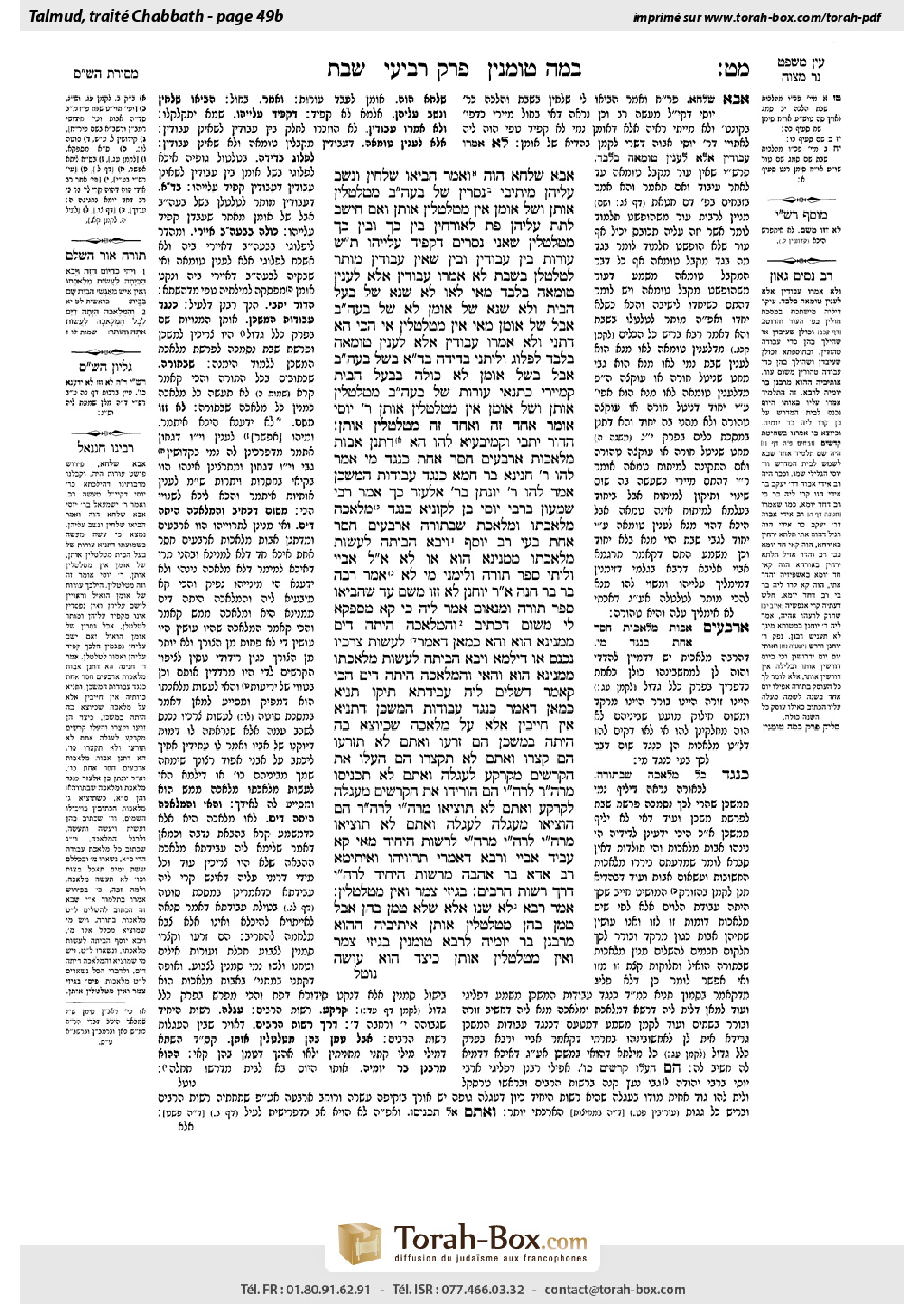
Shabbat 49b: Talmud study for Daf Yomi
Daf Yomi is the daily study of one Talmud folio. Explore 37 tractates with scans, Hebrew text, Sefaria English and AI-generated French translations where annotated.
Passage selection and English or AI-generated French translation are available where the scan has annotations. Daf Study is independent of Torah-Box and Sefaria.
Browse Shabbat · שבת · All tractatesShabbat 49b text and translations
This page of Shabbat includes the Aramaic text, an English translation and an AI-generated French translation, alongside the scan above.
שבת מ״ט ב · Aramaic and Hebrew text
אַבָּא — שַׁלָּחָא הֲוָה, וְאָמַר הָבִיאוּ שְׁלָחִין וְנֵשֵׁב עֲלֵיהֶן.
מֵיתִיבִי: נְסָרִין שֶׁל בַּעַל הַבַּיִת מְטַלְטְלִין אוֹתָן, וְשֶׁל אוּמָּן אֵין מְטַלְטְלִין אוֹתָן. וְאִם חִישֵּׁב לָתֵת עֲלֵיהֶן פַּת לָאוֹרְחִין — בֵּין כָּךְ וּבֵין כָּךְ מְטַלְטְלִין! שָׁאנֵי נְסָרִים דְּקָפֵיד עֲלַיְיהוּ.
תָּא שְׁמַע: עוֹרוֹת, בֵּין עֲבוּדִין וּבֵין שֶׁאֵין עֲבוּדִין, מוּתָּר לְטַלְטְלָן בְּשַׁבָּת. לֹא אָמְרוּ עֲבוּדִין אֶלָּא לְעִנְיַן טוּמְאָה בִּלְבַד. מַאי לַָאו לָא שְׁנָא שֶׁל בַּעַל הַבַּיִת, וְלָא שְׁנָא שֶׁל אוּמָּן? לָא, שֶׁל בַּעַל הַבַּיִת.
אֲבָל שֶׁל אוּמָּן מַאי? אֵין מְטַלְטְלִין — אִי הָכִי הָא דְתָנֵי: וְלֹא אָמְרוּ עֲבוּדִין אֶלָּא לְעִנְיַן טוּמְאָה בִּלְבַד, לִפְלוֹג וְלִיתְנֵי בְּדִידַהּ: בַּמֶּה דְּבָרִים אֲמוּרִים — בְּשֶׁל בַּעַל הַבַּיִת, אֲבָל בְּשֶׁל אוּמָּן — לֹא! כּוּלַּהּ בְּבַעַל הַבַּיִת קָמַיְירֵי.
כְּתַנָּאֵי: עוֹרוֹת שֶׁל בַּעַל הַבַּיִת מְטַלְטְלִין אוֹתָן, וְשֶׁל אוּמָּן אֵין מְטַלְטְלִין אוֹתָן. רַבִּי יוֹסֵי אוֹמֵר: אֶחָד זֶה וְאֶחָד זֶה מְטַלְטְלִין אוֹתָן.
הֲדוּר יָתְבִי וְקָמִיבַּעְיָא לְהוּ: הָא דִּתְנַן אֲבוֹת מְלָאכוֹת אַרְבָּעִים חָסֵר אַחַת, כְּנֶגֶד מִי?
אָמַר לְהוּ רַבִּי חֲנִינָא בַּר חָמָא: כְּנֶגֶד עֲבוֹדוֹת הַמִּשְׁכָּן. אֲמַר לְהוּ רַבִּי יוֹנָתָן בְּרַבִּי אֶלְעָזָר, כָּךְ אָמַר רַבִּי שִׁמְעוֹן בְּרַבִּי יוֹסֵי בֶּן לָקוֹנְיָא: כְּנֶגֶד ״מְלָאכָה״ ״מְלַאכְתּוֹ״ וּ״מְלֶאכֶת״ שֶׁבַּתּוֹרָה אַרְבָּעִים חָסֵר אַחַת.
בָּעֵי רַב יוֹסֵף: ״וַיָּבֹא הַבַּיְתָה לַעֲשׂוֹת מְלַאכְתּוֹ״, מִמִּנְיָנָא הוּא, אוֹ לָא? אֲמַר לֵיהּ אַבָּיֵי: וְלַיְתֵי סֵפֶר תּוֹרָה וְלִימְנֵי. מִי לָא אָמַר רַבָּה בַּר בַּר חָנָה אָמַר רַבִּי יוֹחָנָן לֹא זָזוּ מִשָּׁם עַד שֶׁהֵבִיאוּ סֵפֶר תּוֹרָה וּמְנָאוּם!
אֲמַר לֵיהּ: כִּי קָא מְסַפְּקָא לִי מִשּׁוּם דִּכְתִיב: ״וְהַמְּלָאכָה הָיְתָה דַיָּם״ מִמִּנְיָנָא הוּא — וְהָא כְּמַאן דְּאָמַר לַעֲשׂוֹת צְרָכָיו נִכְנַס.
אוֹ דִילְמָא ״וַיָּבֹא הַבַּיְתָה לַעֲשׂוֹת מְלַאכְתּוֹ״ מִמִּנְיָנָא הוּא, וְהַאי ״וְהַמְּלָאכָה הָיְתָה דַיָּם״ — הָכִי קָאָמַר: דִּשְׁלִימָא לֵיהּ עֲבִידְתָּא. תֵּיקוּ.
תַּנְיָא כְּמַאן דְּאָמַר כְּנֶגֶד עֲבוֹדוֹת הַמִּשְׁכָּן. דְּתַנְיָא: אֵין חַיָּיבִין אֶלָּא עַל מְלָאכָה שֶׁכַּיּוֹצֵא בָּהּ הָיְתָה בַּמִּשְׁכָּן. הֵם זָרְעוּ, וְאַתֶּם לֹא תִּזְרְעוּ. הֵם קָצְרוּ, וְאַתֶּם לֹא תִּקְצְרוּ.
הֵם הֶעֱלוּ אֶת הַקְּרָשִׁים מִקַּרְקַע לַעֲגָלָה, וְאַתֶּם לֹא תַּכְנִיסוּ מֵרְשׁוּת הָרַבִּים לִרְשׁוּת הַיָּחִיד. הֵם הוֹרִידוּ אֶת הַקְּרָשִׁים מֵעֲגָלָה לְקַרְקַע, וְאַתֶּם לֹא תּוֹצִיאוּ מֵרְשׁוּת הַיָּחִיד לִרְשׁוּת הָרַבִּים. הֵם הוֹצִיאוּ מֵעֲגָלָה לַעֲגָלָה, וְאַתֶּם לֹא תּוֹצִיאוּ מֵרְשׁוּת הַיָּחִיד לִרְשׁוּת הַיָּחִיד.
מֵרְשׁוּת הַיָּחִיד לִרְשׁוּת הַיָּחִיד מַאי קָא עָבֵיד? אַבָּיֵי וְרָבָא דְּאָמְרִי תַּרְוַויְהוּ, וְאִיתֵּימָא רַב אַדָּא בַּר אַהֲבָה: מֵרְשׁוּת הַיָּחִיד לִרְשׁוּת הַיָּחִיד דֶּרֶךְ רְשׁוּת הָרַבִּים.
בְּגִיזֵּי צֶמֶר וְאֵין מְטַלְטְלִין. אָמַר רָבָא: לֹא שָׁנוּ אֶלָּא שֶׁלֹּא טָמַן בָּהֶן, אֲבָל טָמַן בָּהֶן — מְטַלְטְלִין אוֹתָן.
אֵיתִיבֵיהּ הַהוּא מֵרַבָּנָן בַּר יוֹמֵיהּ לְרָבָא: טוֹמְנִין בְּגִיזֵּי צֶמֶר וְאֵין מְטַלְטְלִין אוֹתָן. כֵּיצַד הוּא עוֹשֶׂה?
Shabbat 49b · English translation
My father was a tanner, and one Shabbat he said: Bring me hides and we will sit on them (Rabbeinu Ḥananel). In other words, even the hides of a craftsman may be moved on Shabbat.
The Gemara raises an objection from a baraita: With regard to wooden boards belonging to a homeowner, one may move them on Shabbat; however, those belonging to a craftsman, one may not move them. And if, however, he thought to place bread upon them for guests, both these, the boards of the homeowner, and those, the boards of the craftsman, may be moved. Apparently, the raw materials of a craftsman may not be moved on Shabbat. The Gemara answers: Wooden boards are different in that one is particular about them that they not be damaged. Hides, on the other hand, are not damaged when one sits on them.
The Gemara cites another proof. Come and hear that which was taught in a different baraita: With regard to hides, whether they are tanned or whether they are not tanned, it is permitted to move them on Shabbat. The Sages said that tanned hides have a unique legal status, distinct from the status of hides that have not been tanned only with regard to ritual impurity. Only tanned hides become ritually impure. What, is it not saying that there is no difference whether they are hides belonging to a homeowner and there is no difference whether they are hides belonging to a craftsman; in both cases they may be moved on Shabbat? The Gemara rejects this argument: No, the baraita is referring exclusively to hides belonging to a homeowner.
The Gemara asks: But with regard to hides belonging to a craftsman, what is the halakha? Is it true that they may not be moved on Shabbat? If so, that which was taught in the baraita: The Sages said that the legal status of tanned hides is distinct from the status of hides that have not been tanned only with regard to ritual impurity; let the tanna of the baraita distinguish and teach within the halakhot of Shabbat itself, and say: In what case is this statement, that there is no distinction between whether or not the hides were tanned, said? It was stated specifically with regard to hides belonging to a homeowner. However, with regard to hides belonging to a craftsman, no, if they were tanned they may not be moved. The Gemara answers: Since the entire baraita is speaking with regard to hides of a homeowner, it would have been forced to elaborate at greater length to introduce the distinction with regard to the hides of a craftsman than it did to introduce the distinction with regard to ritual impurity.
The Gemara notes that this issue is parallel to a dispute between tanna’im, as it was taught in a baraita: With regard to hides belonging to a homeowner, one may move them on Shabbat, and those of a craftsman, one may not move them. Rabbi Yosei says: With regard to both these, the hides of a homeowner, and those, the hides of a craftsman, one may move them.
The Gemara relates that those same Sages who sat and discussed the issue of hides, sat again and they raised a dilemma: That which we learned in the mishna: The primary categories of labor, which are prohibited by Torah law on Shabbat, are forty-less-one; to what does this number correspond? That is to say, what is the source of this number?
Rabbi Ḥanina bar Ḥama said to them: They correspond to the labors in the Tabernacle. All types of labor that were performed in the Tabernacle are enumerated as primary categories of labor with respect to Shabbat. However, other labors, even if they are significant, are not enumerated among the primary categories of labor since they were not performed in the Tabernacle. Rabbi Yonatan, son of Rabbi Elazar, said to them that so said Rabbi Shimon, son of Rabbi Yosei ben Lakonya: They correspond to the instances of the words labor, his labor, and the labor of, that appear in the Torah a total of forty-less-one times.
Rav Yosef raised a dilemma: The term his labor is written with regard to Joseph: “And it came to pass about this time, that he came into the house to do his labor; and there was none of the men of the house there within” (Genesis 39:11). Is it included in the count of the thirty-nine instances or not? Abaye said to him: And let us bring a Torah scroll and count the instances of the word labor and thereby determine whether or not there are thirty-nine instances without that one. Didn’t Rabba bar bar Ḥana say that Rabbi Yoḥanan said in a case of similar uncertainty: They did not move from there until they brought a Torah scroll and counted them?
Rav Yosef said to Abaye: I cannot reach a conclusion relying solely on a count because there is another instance of the term labor, whose meaning is not clear to me. The reason I am uncertain is because it is written with regard to the Tabernacle: “For the labor they had was sufficient for all the work to do it, and too much” (Exodus 36:7). The question arises whether or not this mention of labor is included in the count of thirty-nine instances, i.e., whether or not it refers to actual labor. And if it does, that verse with regard to Joseph should be understood in accordance with the opinion of the one who said that the expression, to do his labor, is a euphemism. It means that it was to attend to his needs and engage in relations with Potiphar’s wife that he entered.
Or, perhaps, the verse relating to Joseph: “He came into the house to do his labor,” is included in the count, and it refers to actual labor. And this verse: “The labor they had was sufficient,” is saying the following: That they completed the preparatory labor, i.e., they brought all the materials, not that they engaged in the actual labor. Let the uncertainty stand unresolved.
With regard to the matter itself, it was taught in a baraita in accordance with the opinion of the one who said that the thirty-nine labors of Shabbat correspond to the labors performed in the Tabernacle. As it was taught in a baraita: One is only liable for performing a labor to which there was a corresponding labor in the Tabernacle. They sowed in order to grow dyes for the Tabernacle, and therefore you may not sow on Shabbat. They reaped, and therefore you may not reap on Shabbat.
They lifted the boards from the ground in the wilderness, which is a public domain, and placed them into the wagon, which is a private domain, and therefore you shall not carry objects in from the public domain to the private domain on Shabbat. They lowered the boards from the wagon to the ground, and therefore you shall not carry objects out from the private domain to the public domain on Shabbat. They took boards and other objects out and passed them from wagon to wagon, i.e., from one private domain to another private domain, and therefore you shall not take objects out from one private domain to another private domain on Shabbat.
The Gemara expresses astonishment with regard to the last clause of the baraita: One who takes an object out from one private domain to another private domain, what prohibited labor is he thereby performing? The Gemara answers: It was Abaye and Rava who both said, and some say that it was Rav Adda bar Ahava who said: This is referring to taking an object out from one private domain to another private domain via the public domain, as the space between the two wagons in the wilderness was a public domain.
We learned in the mishna: One may insulate food in wool fleece, and he may not move it. Rava said: This halakha that fleece may not be moved on Shabbat applies only to a case where one did not insulate food in it. Only in that case is it set-aside. However, if one insulated cooked food in it, he may move it. By insulating food in the fleece, he indicated that he intends to use it on Shabbat.
A certain Sage for whom it was his first day in that study hall raised an objection to Rava from our mishna: One may insulate food in wool fleece, and one may not move it. How, then, does he act if he insulated food in wool fleece and now wishes to remove the pot?
Shabbat 49b · Traduction française (IA)
Mon père était tanneur et, un Chabbat, il dit : « Apportez-moi des peaux et nous nous assiérons dessus » (Rabbeinu Ḥananel). Autrement dit, même les peaux d’un artisan peuvent être déplacées pendant Chabbat.
La Guemara soulève une objection à partir d’une baraïta : les planches de bois appartenant à un particulier peuvent être déplacées pendant Chabbat, tandis que celles d’un artisan ne le peuvent pas. Toutefois, s’il a eu l’intention d’y poser du pain pour ses invités, aussi bien celles-ci, les planches du particulier, que celles-là, les planches de l’artisan, peuvent être déplacées. Il semble donc que les matières premières d’un artisan ne peuvent pas être déplacées pendant Chabbat. La Guemara répond : les planches de bois sont différentes, car on tient à ce qu’elles ne soient pas abîmées. Les peaux, en revanche, ne s’abîment pas lorsqu’on s’assied dessus.
La Guemara apporte une autre preuve. Voyons ce qui a été enseigné dans une autre baraïta : les peaux, qu’elles soient tannées ou non, peuvent être déplacées pendant Chabbat. Les Sages ont dit que les peaux tannées ont un statut juridique distinct de celui des peaux non tannées uniquement en matière d’impureté rituelle. Seules les peaux tannées deviennent rituellement impures. Ne dit-elle pas qu’il n’y a pas de différence entre les peaux d’un particulier et celles d’un artisan, et que dans les deux cas elles peuvent être déplacées pendant Chabbat ? La Guemara rejette cet argument : non, la baraïta parle exclusivement des peaux d’un particulier.
La Guemara demande : mais quelle est la halakha concernant les peaux d’un artisan ? Est-il vrai qu’elles ne peuvent pas être déplacées pendant Chabbat ? Si tel est le cas, à propos de ce qui a été enseigné dans la baraïta — les Sages ont dit que le statut juridique des peaux tannées est distinct de celui des peaux non tannées uniquement en matière d’impureté rituelle —, le tanna de la baraïta aurait dû établir une distinction dans les halakhot de Chabbat elles-mêmes et enseigner : dans quel cas a-t-on dit qu’il n’y a pas de distinction selon que les peaux sont tannées ou non ? Cela concerne spécifiquement les peaux d’un particulier. En revanche, pour les peaux d’un artisan, non : si elles sont tannées, elles ne peuvent pas être déplacées. La Guemara répond : puisque toute la baraïta traite des peaux d’un particulier, il aurait fallu davantage développer pour introduire la distinction concernant les peaux d’un artisan que pour introduire celle concernant l’impureté rituelle.
La Guemara relève que cette question correspond à une controverse entre des tannaïm, comme cela a été enseigné dans une baraïta : les peaux d’un particulier peuvent être déplacées pendant Chabbat, tandis que celles d’un artisan ne le peuvent pas. Rabbi Yosei dit : aussi bien celles-ci, les peaux d’un particulier, que celles-là, les peaux d’un artisan, peuvent être déplacées.
La Guemara rapporte que ces mêmes Sages qui s’étaient assis pour discuter de la question des peaux se réunirent de nouveau et soulevèrent une question : à quoi correspond le nombre indiqué dans la Michna — les catégories principales de travaux interdits par la Torah pendant Chabbat sont au nombre de trente-neuf ? Autrement dit, quelle est la source de ce nombre ?
Rabbi Ḥanina bar Ḥama leur dit : cela correspond aux travaux effectués dans le Tabernacle. Tous les types de travaux accomplis dans le Tabernacle sont énumérés parmi les catégories principales de travaux relatives à Chabbat. En revanche, les autres travaux, même s’ils sont importants, ne sont pas comptés parmi ces catégories principales, puisqu’ils n’étaient pas accomplis dans le Tabernacle. Rabbi Yonatan, fils de Rabbi Elazar, leur dit que Rabbi Shimon, fils de Rabbi Yosei ben Lakonya, avait enseigné ceci : cela correspond aux occurrences des termes « travail », « son travail » et « le travail de », qui apparaissent dans la Torah au nombre total de trente-neuf.
Rav Yosef souleva une question : l’expression « son travail » apparaît à propos de Joseph : « Or, vers ce temps-là, il entra dans la maison pour faire son travail ; et il n’y avait là, dans la maison, aucun des hommes » (Genèse 39,11). Est-elle incluse dans le décompte des trente-neuf occurrences ou non ? Abaye lui dit : apportons donc un rouleau de la Torah et comptons les occurrences du mot « travail » ; nous déterminerons ainsi s’il y en a trente-neuf sans celle-ci. Rabba bar bar Ḥana n’a-t-il pas dit que Rabbi Yoḥanan avait dit, dans un cas d’incertitude semblable : ils ne quittèrent pas les lieux avant d’avoir apporté un rouleau de la Torah et de les avoir comptées ?
Rav Yosef dit à Abaye : je ne peux pas trancher en me fondant uniquement sur un décompte, car il existe une autre occurrence du terme « travail » dont le sens ne m’apparaît pas clairement. Mon incertitude vient du fait qu’il est écrit au sujet du Tabernacle : « Car le travail qu’ils avaient était suffisant pour tout le travail à faire, et il y en avait de reste » (Exode 36,7). La question se pose de savoir si cette occurrence du mot « travail » est incluse dans le décompte des trente-neuf, c’est-à-dire si elle désigne ou non un travail effectif. Et si elle l’est, le verset à propos de Joseph doit être compris selon l’opinion de celui qui dit que l’expression « faire son travail » est un euphémisme. Elle signifie qu’il était entré pour s’occuper de ses besoins et avoir des relations avec la femme de Potiphar.
Ou peut-être le verset concernant Joseph — « il entra dans la maison pour faire son travail » — est-il inclus dans le décompte et désigne-t-il un travail effectif. Et ce verset — « le travail qu’ils avaient était suffisant » — signifie alors qu’ils avaient achevé le travail préparatoire, c’est-à-dire qu’ils avaient apporté tous les matériaux, et non qu’ils avaient accompli le travail proprement dit. La question reste sans réponse.
À propos de la question elle-même, une baraïta a été enseignée conformément à l’opinion de celui qui dit que les trente-neuf travaux de Chabbat correspondent aux travaux accomplis dans le Tabernacle. En effet, il a été enseigné dans une baraïta : on n’est passible que pour l’accomplissement d’un travail correspondant à un travail effectué dans le Tabernacle. Ils semaient afin de faire pousser des plantes destinées aux teintures du Tabernacle ; c’est pourquoi il est interdit de semer pendant Chabbat. Ils moissonnaient ; c’est pourquoi il est interdit de moissonner pendant Chabbat.
Ils soulevaient les planches du sol, dans le désert, qui était un domaine public, et les plaçaient dans le chariot, qui était un domaine privé ; c’est pourquoi il est interdit de transporter des objets du domaine public au domaine privé pendant Chabbat. Ils descendaient les planches du chariot jusqu’au sol ; c’est pourquoi il est interdit de transporter des objets du domaine privé au domaine public pendant Chabbat. Ils sortaient des planches et d’autres objets et les faisaient passer d’un chariot à l’autre, c’est-à-dire d’un domaine privé à un autre domaine privé ; c’est pourquoi il est interdit de transporter des objets d’un domaine privé à un autre domaine privé pendant Chabbat.
À propos de la dernière clause de la baraïta, la Guemara s’étonne : celui qui transporte un objet d’un domaine privé à un autre domaine privé, quel travail interdit accomplit-il ainsi ? La Guemara répond : Abaye et Rava ont tous deux dit — et certains disent que c’est Rav Adda bar Ahava qui l’a dit — qu’il s’agit de transporter un objet d’un domaine privé à un autre en passant par le domaine public, car l’espace entre les deux chariots, dans le désert, était un domaine public.
Nous avons appris dans la Michna : on peut isoler des aliments dans de la laine brute, mais on ne peut pas la déplacer. Rava dit : cette halakha selon laquelle la laine brute ne peut pas être déplacée pendant Chabbat ne s’applique que si l’on n’y a pas isolé d’aliments. Ce n’est que dans ce cas qu’elle est mise à l’écart. En revanche, si l’on y a isolé des aliments cuits, on peut la déplacer. En isolant les aliments dans la laine, on a manifesté l’intention de s’en servir pendant Chabbat.
Un certain Sage, qui venait pour la première fois dans cette salle d’étude, souleva contre Rava une objection tirée de notre Michna : on peut isoler des aliments dans de la laine brute, mais on ne peut pas la déplacer. Que doit-on faire, alors, si l’on a isolé des aliments dans de la laine brute et que l’on souhaite maintenant retirer la marmite ?
Traduction française générée par IA à partir de l’édition anglaise de Sefaria. Vérifie toujours un passage avec le texte source.
Text from Sefaria: William Davidson Edition - Vocalized Aramaic (CC BY NC); William Davidson Edition - English (CC BY NC).