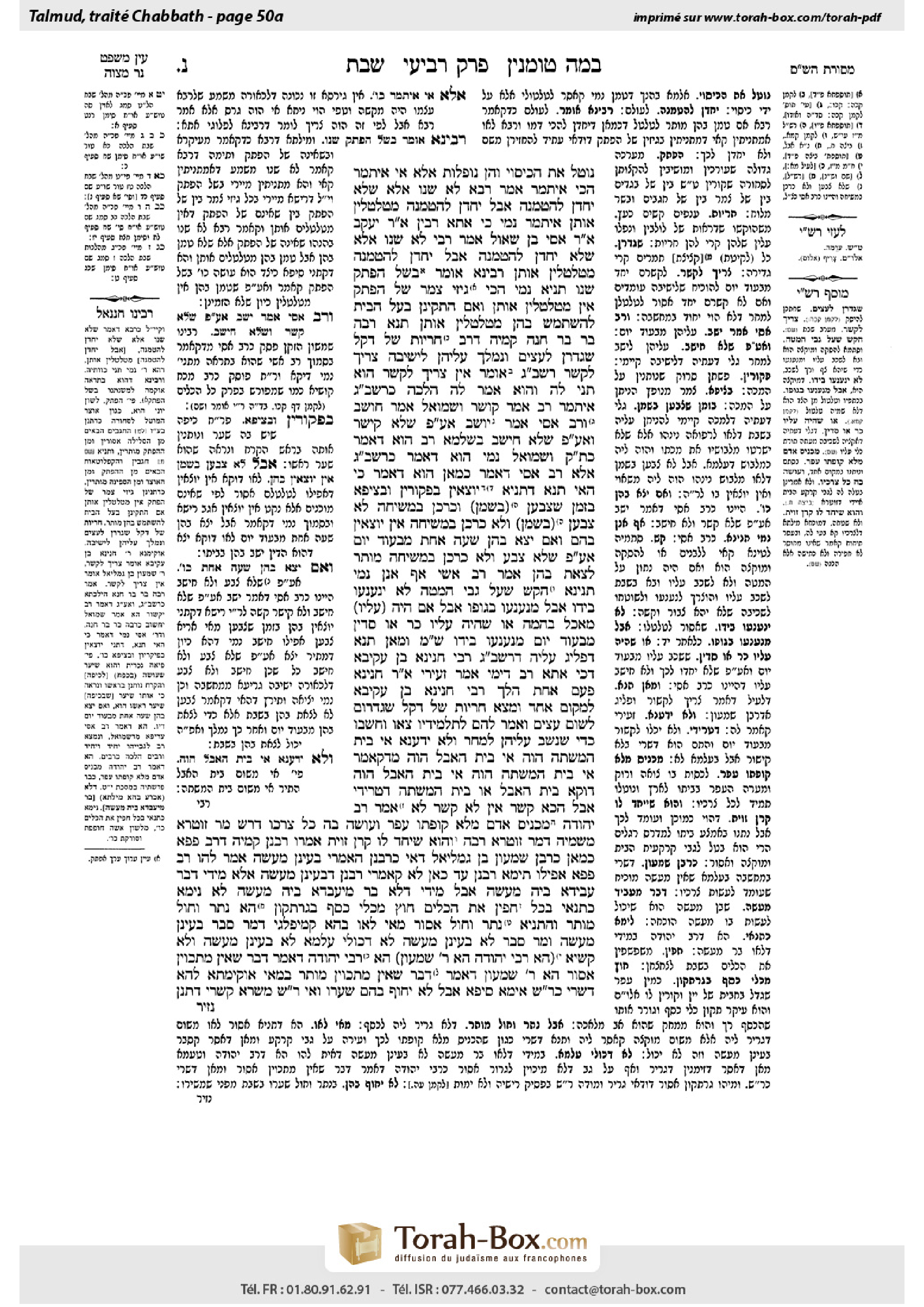
Shabbat 50a: Talmud study for Daf Yomi
Daf Yomi is the daily study of one Talmud folio. Explore 37 tractates with scans, Hebrew text, Sefaria English and AI-generated French translations where annotated.
Passage selection and English or AI-generated French translation are available where the scan has annotations. Daf Study is independent of Torah-Box and Sefaria.
Browse Shabbat · שבת · All tractatesShabbat 50a text and translations
This page of Shabbat includes the Aramaic text, an English translation and an AI-generated French translation, alongside the scan above.
שבת נ׳ א · Aramaic and Hebrew text
נוֹטֵל אֶת הַכִּיסּוּי, וְהֵן נוֹפְלוֹת.
אֶלָּא אִי אִיתְּמַר, הָכִי אִיתְּמַר: אָמַר רָבָא לֹא שָׁנוּ אֶלָּא שֶׁלֹּא יִחֲדָן לְהַטְמָנָה. אֲבָל יִחֲדָן לְהַטְמָנָה — מְטַלְטְלִין אוֹתָן.
אִיתְּמַר נָמֵי, כִּי אֲתָא רָבִין אָמַר רַבִּי יַעֲקֹב אָמַר רַבִּי אַסִּי בֶּן שָׁאוּל אָמַר רַבִּי: לֹא שָׁנוּ אֶלָּא שֶׁלֹּא יִחֲדָן לְהַטְמָנָה, אֲבָל יִחֲדָן לְהַטְמָנָה — מְטַלְטְלִין אוֹתָן.
רָבִינָא אוֹמֵר: בְּשֶׁל הֶפְתֵּק שָׁנוּ. תַּנְיָא נָמֵי הָכִי, גִּיזֵּי צֶמֶר שֶׁל הֶפְתֵּק אֵין מְטַלְטְלִין אוֹתָן. וְאִם הִתְקִינָן בַּעַל הַבַּיִת לְהִשְׁתַּמֵּשׁ בָּהֶן — מְטַלְטְלִין אוֹתָן.
תָּנָא רַבָּה בַּר בַּר חַנָּה קַמֵּיהּ דְּרַב: חֲרִיּוֹת שֶׁל דֶּקֶל שֶׁגְּדָרָן לְעֵצִים, וְנִמְלַךְ עֲלֵיהֶן לִישִׁיבָה — צָרִיךְ לְקַשֵּׁר. רַבָּן שִׁמְעוֹן בֶּן גַּמְלִיאֵל אוֹמֵר: אֵין צָרִיךְ לְקַשֵּׁר. הוּא תָּנֵי לַהּ וְהוּא אָמַר לַהּ: הֲלָכָה כְּרַבָּן שִׁמְעוֹן בֶּן גַּמְלִיאֵל.
אִיתְּמַר רַב אָמַר: קוֹשֵׁר, וּשְׁמוּאֵל אָמַר: חוֹשֵׁב, וְרַב אַסִּי אָמַר: יוֹשֵׁב, אַף עַל פִּי שֶׁלֹּא קִישֵּׁר וְאַף עַל פִּי שֶׁלֹּא חִישֵּׁב.
בִּשְׁלָמָא רַב הוּא דְּאָמַר כְּתַנָּא קַמָּא, וּשְׁמוּאֵל נָמֵי הוּא דְּאָמַר כְּרַבָּן שִׁמְעוֹן בֶּן גַּמְלִיאֵל. אֶלָּא רַב אַסִּי דְּאָמַר כְּמַאן?
הוּא דְּאָמַר כִּי הַאי תַּנָּא דְּתַנְיָא: יוֹצְאִין בְּפָקוֹרִין וּבְצִיפָא, בִּזְמַן שֶׁצְּבָעָן בְּשֶׁמֶן וּכְרָכָן בִּמְשִׁיחָה. לֹא צְבָעָן בְּשֶׁמֶן וְלֹא כְּרָכָן בִּמְשִׁיחָה — אֵין יוֹצְאִין בָּהֶם. וְאִם יָצָא בָּהֶן שָׁעָה אַחַת מִבְּעוֹד יוֹם, אַף עַל פִּי שֶׁלֹּא צָבַע וְלֹא כְּרָכָן בִּמְשִׁיחָה מוּתָּר לָצֵאת בָּהֶן.
אָמַר רַב אָשֵׁי, אַף אֲנַן נָמֵי תְּנֵינָא: הַקַּשׁ שֶׁעַל גַּבֵּי הַמִּטָּה לֹא יְנַעְנְעֶנּוּ בְּיָדוֹ, אֲבָל מְנַעַנְעוֹ בְּגוּפוֹ. אֲבָל אִם הָיָה עָלָיו מַאֲכַל בְּהֵמָה, אוֹ שֶׁהָיָה עָלָיו כַּר אוֹ סָדִין מִבְּעוֹד יוֹם — מְנַעַנְעוֹ בְּיָדוֹ. שְׁמַע מִינָּה.
וּמַאן תְּנָא דִּפְלִיג עֲלֵיהּ דְּרַבָּן שִׁמְעוֹן בֶּן גַּמְלִיאֵל — רַבִּי חֲנִינָא בֶּן עֲקִיבָא. דְּכִי אֲתָא רַב דִּימִי, אָמַר זְעֵירִי אָמַר רַבִּי חֲנִינָא: פַּעַם אַחַת הָלַךְ רַבִּי חֲנִינָא בֶּן עֲקִיבָא לְמָקוֹם אֶחָד, וּמָצָא חֲרִיּוֹת שֶׁל דֶּקֶל שֶׁגְּדָרוּם לְשׁוּם עֵצִים, וְאָמַר לָהֶם לְתַלְמִידָיו: צְאוּ וְחַשְּׁבוּ כְּדֵי שֶׁנֵּשֵׁב עֲלֵיהֶן לְמָחָר. וְלָא יָדַעְנָא אִי בֵּית הַמִּשְׁתֶּה הֲוָה, אִי בֵּית הָאֵבֶל הֲוָה.
מִדְּקָאָמַר אִי בֵּית הַמִּשְׁתֶּה הֲוָה אִי בֵּית הָאֵבֶל הֲוָה — דַּוְקָא בֵּית הָאֵבֶל אוֹ בֵּית הַמִּשְׁתֶּה דִּטְרִידִי, אֲבָל הָכָא קָשַׁר — אִין, לֹא קָשַׁר — לָא.
אָמַר רַב יְהוּדָה: מַכְנִיס אָדָם מְלֹא קוּפָּתוֹ עָפָר, וְעוֹשֶׂה בָּהּ כׇּל צָרְכּוֹ. דָּרֵשׁ מָר זוּטְרָא מִשְּׁמֵיהּ דְּמָר זוּטְרָא רַבָּה: וְהוּא שֶׁיִּחֵד לוֹ קֶרֶן זָוִית.
אֲמַרוּ רַבָּנַן קַמֵּיהּ דְּרַב פָּפָּא: כְּמַאן — כְּרַבָּן שִׁמְעוֹן בֶּן גַּמְלִיאֵל. דְּאִי כְּרַבָּנַן — הָאָמְרִי בָּעֵינַן מַעֲשֶׂה.
אֲמַר לְהוּ רַב פָּפָּא: אֲפִילּוּ תֵּימָא רַבָּנַן, עַד כָּאן לָא קָאָמְרִי רַבָּנַן דְּבָעֵינַן מַעֲשֶׂה אֶלָּא מִידֵּי דְּבַר מֶיעְבַּד בֵּיהּ מַעֲשֶׂה, אֲבָל מִידֵּי דְּלָא בַּר מֶיעְבַּד בֵּיהּ מַעֲשֶׂה — לָא.
נֵימָא כְּתַנָּאֵי: בַּכֹּל חֹפִין אֶת הַכֵּלִים חוּץ מִכְּלֵי כֶסֶף בִּגְרַתְקוֹן. הָא נֶתֶר וָחוֹל מוּתָּר.
וְהָתַנְיָא: נֶתֶר וָחוֹל — אָסוּר. מַאי לָאו בְּהָא קָמִיפַּלְגִי: דְּמָר סָבַר בָּעֵינַן מַעֲשֶׂה, וּמָר סָבַר לָא בָּעֵינַן מַעֲשֶׂה.
לָא, דְּכוּלֵּי עָלְמָא לָא בָּעֵינַן מַעֲשֶׂה, וְלָא קַשְׁיָא: הָא רַבִּי יְהוּדָה, הָא רַבִּי שִׁמְעוֹן.
הָא רַבִּי יְהוּדָה, דְּאָמַר: דָּבָר שֶׁאֵין מִתְכַּוֵּין — אָסוּר. הָא רַבִּי שִׁמְעוֹן, דְּאָמַר: דָּבָר שֶׁאֵין מִתְכַּוֵּין — מוּתָּר.
בְּמַאי אוֹקֵימְתָּא לְהָא דְּשָׁרֵי — כְּרַבִּי שִׁמְעוֹן, אֵימָא סֵיפָא: אֲבָל לֹא יָחוֹף בָּהֶם שְׂעָרוֹ, וְאִי רַבִּי שִׁמְעוֹן — מִשְׁרָא קָשָׁרֵי. דִּתְנַן:
Shabbat 50a · English translation
He lifts the cover, which he is permitted to move, and the wool fleece falls by itself. Contrary to Rava’s statement, even wool fleece in which a person insulated food may not be moved on Shabbat.
Rather, if it was stated, it was stated as follows: Rava said: This halakha that wool fleece may not be moved on Shabbat applies only in a case where one did not designate it for insulating food. However, if he designated it for insulating food, one may move it, as in that case, it is no longer set-aside.
It was also stated that when Ravin came from Eretz Yisrael to Babylonia, he said that Rabbi Ya’akov said that Rabbi Asi ben Shaul said that Rabbi Yehuda HaNasi said: This halakha that wool fleece may not be moved on Shabbat applies only in a case where one did not designate it for insulating food. However, if one designated it for insulating food, he may move it.
Ravina said: In fact, Rava’s statement can be understood as it was originally understood, i.e., one who insulated food in wool fleece may move it because it is considered designated for insulating food. In the mishna that indicates otherwise they taught about wool fleece taken from a merchant’s shelves [heftek]. That wool was certainly not designated for insulating food. It will be returned to those shelves to be sold. Therefore, it is set-aside for that purpose and may not be moved on Shabbat, even if it is used to insulate food. That was also taught in a baraita: With regard to wool fleece taken from a merchant’s shelves, one may not move it on Shabbat. And if a homeowner prepared the fleece to use it, one may move it.
With regard to the question of what can be done to permit use of items ordinarily set-aside on Shabbat, Rabba bar bar Ḥana taught the following baraita before Rav: With regard to hard branches of a palm tree that one cut for fire wood or for construction, and then he reconsidered their designation and decided to use them for sitting, he must tie the branches together on Shabbat eve. This allows him to move them on Shabbat like any other household utensil. Rabban Shimon ben Gamliel says: He need not tie them together and, nevertheless, he is permitted to move them. Rabba bar bar Ḥana taught the baraita, and he said about it that the halakha is in accordance with the opinion of Rabban Shimon ben Gamliel.
On that same topic, it was stated that Rav said: He ties the branches together on Shabbat eve. And Shmuel said: If he merely has in mind on Shabbat eve that he wishes to sit on them on Shabbat, he need not tie them together. And Rav Asi said: If he even briefly sits on them on Shabbat eve, sitting on the branches is permitted the next day, even though he did not tie them together and even though he did not have that in mind.
The Gemara comments: Granted, Rav, he stated his opinion in accordance with the unattributed opinion of the first tanna of the baraita, and Shmuel, too, he stated his opinion in accordance with the opinion of Rabban Shimon ben Gamliel. However, in accordance with whose opinion did Rav Asi state his opinion? Apparently, he disagrees with both tanna’im who expressed an opinion on the issue.
The Gemara explains: Rav Asi stated his opinion in accordance with the opinion of this tanna, as it was taught in the Tosefta: One may go out into a public domain on Shabbat with combed flax [pakorin] or combed wool covering a wound, when he previously dipped them in oil and tied them to the wound with twine. If he did not dip them in oil or tie them with twine, he may not go out into the public domain with them. And if he went out with them for a brief period on Shabbat eve while it was still day, even if he did not dip them in oil or tie them with twine, he is permitted to go out with them on Shabbat. Apparently, there is a tanna who maintains that using an item before Shabbat enables one to use it on Shabbat as well. No additional steps are necessary.
Rav Ashi said: We too have also learned in a mishna: Straw that is piled on a bed to be used for fuel or mixed with clay is set aside for that purpose and may not be moved. Therefore, one who seeks to lie on the bed may not move the straw with his hand, but he may move it with his body, as this is not the typical way of moving straw. However, if that straw had been designated as animal feed, or if there was a pillow or sheet spread over it on Shabbat eve while it was still day and he lay on it before Shabbat, he may move it with his hand. Apparently, even brief use before Shabbat suffices to permit use on Shabbat as well. The Gemara concludes: Indeed, conclude from it that there is a tannaitic opinion in accordance with which Rav Asi stated his opinion.
The Gemara asks: And who is the unnamed tanna who disagrees with Rabban Shimon ben Gamliel in the baraita cited above? He holds that in order to use palm branches for sitting, one must perform an action, e.g., tie them together, before Shabbat? The Gemara answers: It is Rabbi Ḥanina ben Akiva, as when Rav Dimi came from Eretz Yisrael to Babylonia, he said that Ze’iri said that Rabbi Ḥanina said: Rabbi Ḥanina ben Akiva once went to a certain place on Shabbat eve and found there hard branches of a palm tree that they had cut for fire wood. And he said to his disciples: Go out and have in mind that you will use them so that we will be permitted to sit on them tomorrow, on Shabbat. And, Ze’iri added, I do not know if the house where Rabbi Ḥanina ben Akiva went was the house of a wedding feast or if it was the house of mourning.
The Gemara explains: From the fact that Ze’iri said: I do not know whether it was the house of a wedding feast or the house of mourning, it may be inferred that this halakha applies specifically to the house of mourning or the house of a feast because they are preoccupied with other matters and do not have time to tie the wood. However, here, in ordinary circumstances, if he tied the branches together, yes, it is permitted to sit on them on Shabbat; if he did not tie them together, no, it is not permitted.
Rav Yehuda said: A person may bring a basket full of earth into his house on Shabbat eve, pour it on the floor, and use it for all his needs on Shabbat, e.g., to cover excrement. Mar Zutra taught in the name of Mar Zutra Rabba: That applies only if he designated a specific corner in his house for the earth.
The Sages said before Rav Pappa: In accordance with whose opinion was this last ruling taught, that designating a place for the earth is sufficient to permit its use on Shabbat? It must have been taught in accordance with the opinion of Rabban Shimon ben Gamliel with respect to palm branches, as if it was taught in accordance with the opinion of the Rabbis, didn’t they say that in order to permit use of an object that is set-aside on Shabbat, we require an action, e.g., tying the palm branches together? Thought alone is insufficient.
Rav Pappa said to them: Even if you say that the halakha was taught in accordance with the opinion of the Rabbis, the Rabbis stated their opinion that we require an action, only with regard to something with which it is possible to perform a preparatory action. However, with regard to something with which it is not possible to perform a preparatory action, no, they did not require an action. Since it is not possible to perform a preparatory action with the earth, one is permitted to use the earth by means of thought alone.
The Gemara asks: Let us say that this issue, whether or not an action is required in that case, is parallel to a dispute among the tanna’im. As it was taught in one baraita: One may clean utensils on Shabbat with any type of cleaning agent, except for silver utensils with cream of tartar [gartekon], as that not only polishes the silver, but also smooths it. By inference: Cleaning with natron and sand is permitted.
Wasn’t it taught in the Tosefta: Cleaning with natron and sand is prohibited on Shabbat? What, is it not that they disagree with regard to this following point? That one Sage, who prohibits use of sand on Shabbat, holds that an action is required in order to permit the use of items that would otherwise be set-aside on Shabbat. Since it is impossible to perform an action with sand, its use is prohibited. And the other Sage, who permits use of sand, holds that an action is not required.
The Gemara rejects this argument: No, everyone agrees that an action is not required; and, nevertheless, it is not difficult. This baraita, which prohibits use of sand and natron, is in accordance with the opinion of Rabbi Yehuda; that baraita, which permits their use, is in accordance with the opinion of Rabbi Shimon.
The Gemara elaborates: This baraita, which prohibits use of sand and natron, is in accordance with the opinion of Rabbi Yehuda, who said with regard to the laws of Shabbat in general that an unintentional act is prohibited. It is prohibited to perform an otherwise permitted action from which an unintended prohibited labor ensues. Therefore, cleaning a silver utensil with sand or natron is prohibited because he thereby unintentionally smooths the utensil, which is prohibited on Shabbat. That baraita, which permits the use of sand and natron, is in accordance with the opinion of Rabbi Shimon, who said that an unintentional act is permitted.
The Gemara raises an objection: In what manner did you establish that baraita, which permits the use of sand and natron? You established it in accordance with the opinion of Rabbi Shimon. If so, say the latter clause of that same baraita: However, one may not wash his hair with them on Shabbat. And, if it is in accordance with the opinion of Rabbi Shimon, he permits doing so. As we learned in a mishna:
Shabbat 50a · Traduction française (IA)
Il soulève le couvercle, qu’il est autorisé à déplacer, et la toison de laine tombe d’elle-même. Contrairement à ce qu’affirme Rava, même une toison de laine dans laquelle on a isolé des aliments ne peut pas être déplacée pendant Chabbat.
En réalité, si cette opinion a été rapportée, elle l’a été sous la forme suivante : Rava a dit : Cette halakha selon laquelle une toison de laine ne peut pas être déplacée pendant Chabbat ne s’applique que si on ne l’a pas destinée à isoler des aliments. En revanche, si on l’a destinée à cet usage, on peut la déplacer, car elle n’est alors plus mouktsé.
On a également rapporté que, lorsque Ravin vint d’Eretz Israël en Babylonie, il dit que Rabbi Ya’akov avait dit que Rabbi Asi ben Shaul avait dit que Rabbi Yehuda HaNassi avait dit : Cette halakha selon laquelle une toison de laine ne peut pas être déplacée pendant Chabbat ne s’applique que si on ne l’a pas destinée à isoler des aliments. En revanche, si on l’a destinée à cet usage, on peut la déplacer.
Ravina dit : En réalité, on peut comprendre la déclaration de Rava comme on l’avait comprise initialement, c’est-à-dire que celui qui a isolé des aliments dans une toison de laine peut déplacer celle-ci, puisqu’elle est considérée comme destinée à isoler des aliments. Dans la Michna qui semble indiquer le contraire, il s’agit de laine provenant du stock d’un marchand [heftek]. Cette laine n’était certainement pas destinée à isoler des aliments. Elle sera remise en stock pour être vendue. Elle est donc réservée à cet usage et ne peut pas être déplacée pendant Chabbat, même si on l’utilise pour isoler des aliments. Cela a également été enseigné dans une baraïta : la laine provenant du stock d’un marchand ne peut pas être déplacée pendant Chabbat. Mais si un particulier a préparé cette laine pour s’en servir, il peut la déplacer.
Au sujet de la question de savoir ce qu’on peut faire pour autoriser, pendant Chabbat, l’usage d’objets habituellement mouktsé, Rabba bar bar Ḥana enseigna la baraïta suivante devant Rav : lorsqu’on a coupé des branches dures de palmier pour en faire du bois de chauffage ou pour la construction, puis qu’on a changé leur destination et décidé de les utiliser comme sièges, il faut attacher les branches ensemble la veille de Chabbat. Cela permet de les déplacer pendant Chabbat comme tout autre ustensile domestique. Rabban Shimon ben Gamliel dit : il n’est pas nécessaire de les attacher et, néanmoins, il est permis de les déplacer. Rabba bar bar Ḥana enseigna cette baraïta et précisa que la halakha est conforme à l’avis de Rabban Shimon ben Gamliel.
Sur ce même sujet, on a rapporté que Rav a dit : il attache les branches ensemble la veille de Chabbat. Shmuel a dit : s’il a simplement l’intention, la veille de Chabbat, de s’asseoir dessus pendant Chabbat, il n’est pas nécessaire de les attacher. Rav Asi a dit : s’il s’assoit dessus, ne serait-ce qu’un bref instant, la veille de Chabbat, il est permis de s’asseoir sur les branches le lendemain, même s’il ne les a pas attachées et même s’il n’en avait pas eu l’intention.
La Guemara fait remarquer : Rav, certes, a exprimé son avis conformément à l’opinion anonyme du premier tanna de la baraïta ; Shmuel, lui aussi, a exprimé son avis conformément à celui de Rabban Shimon ben Gamliel. Mais conformément à l’avis de qui Rav Asi a-t-il exprimé le sien ? Il semble qu’il soit en désaccord avec les deux tannaïm qui se sont prononcés sur la question.
La Guemara explique : Rav Asi a exprimé son avis conformément à celui de ce tanna, comme on l’a enseigné dans la Tossefta : on peut sortir dans le domaine public pendant Chabbat avec du lin peigné [pakorin] ou de la laine peignée recouvrant une plaie, si on les a préalablement trempés dans de l’huile et attachés à la plaie avec une ficelle. Si on ne les a pas trempés dans de l’huile ou attachés avec une ficelle, on ne peut pas sortir dans le domaine public avec eux. Mais si on les a portés brièvement la veille de Chabbat, alors qu’il faisait encore jour, même sans les avoir trempés dans de l’huile ni attachés avec une ficelle, il est permis de sortir avec eux pendant Chabbat. Il semble donc qu’un tanna soutienne que l’usage d’un objet avant Chabbat permet également de s’en servir pendant Chabbat. Aucune autre préparation n’est nécessaire.
Rav Ashi a dit : Nous aussi, nous avons appris dans une Michna : la paille entassée sur un lit pour servir de combustible ou être mélangée à de l’argile est réservée à cet usage et ne peut pas être déplacée. Par conséquent, celui qui veut s’allonger sur le lit ne peut pas déplacer la paille avec la main, mais il peut la déplacer avec son corps, car ce n’est pas la manière habituelle de déplacer de la paille. Cependant, si cette paille était destinée à l’alimentation des animaux, ou si un oreiller ou un drap avait été étendu dessus la veille de Chabbat, alors qu’il faisait encore jour, et qu’on s’était allongé dessus avant Chabbat, on peut la déplacer avec la main. Il semble donc qu’un bref usage avant Chabbat suffise à autoriser son usage pendant Chabbat. La Guemara conclut : En effet, déduis-en qu’il existe une opinion tannaïtique conforme à celle sur laquelle Rav Asi a fondé son avis.
La Guemara demande : Et qui est le tanna anonyme qui contredit Rabban Shimon ben Gamliel dans la baraïta citée plus haut ? Il soutient que, pour utiliser des branches de palmier comme sièges, il faut accomplir un acte, par exemple les attacher ensemble, avant Chabbat. La Guemara répond : c’est Rabbi Ḥanina ben Akiva. En effet, lorsque Rav Dimi vint d’Eretz Israël en Babylonie, il dit que Ze’iri avait rapporté que Rabbi Ḥanina avait dit : Rabbi Ḥanina ben Akiva se rendit un jour, la veille de Chabbat, dans un certain endroit et y trouva des branches dures de palmier qu’on avait coupées pour en faire du bois de chauffage. Il dit à ses disciples : « Sortez et ayez l’intention de vous en servir, afin que nous soyons autorisés à nous y asseoir demain, pendant Chabbat. » Ze’iri ajouta : « Je ne sais pas si la maison où Rabbi Ḥanina ben Akiva s’était rendu était celle d’un festin de noces ou celle d’un deuil. »
La Guemara explique : du fait que Ze’iri a dit : « Je ne sais pas si c’était la maison d’un festin de noces ou celle d’un deuil », on peut déduire que cette halakha s’applique spécifiquement à une maison où se tient un deuil ou un festin, car les gens y sont occupés par d’autres affaires et n’ont pas le temps d’attacher le bois. En revanche, dans des circonstances ordinaires, s’il a attaché les branches ensemble, alors oui, il est permis de s’y asseoir pendant Chabbat ; s’il ne les a pas attachées, alors non, ce n’est pas permis.
Rav Yehuda a dit : une personne peut apporter chez elle, la veille de Chabbat, un panier rempli de terre, la verser sur le sol et s’en servir pour tous ses besoins pendant Chabbat, par exemple pour recouvrir des excréments. Mar Zutra enseigna au nom de Mar Zutra Rabba : cela ne s’applique que si la personne a réservé un endroit précis de sa maison pour cette terre.
Les Sages dirent devant Rav Pappa : conformément à l’avis de qui cette dernière décision a-t-elle été enseignée, selon laquelle réserver un endroit pour la terre suffit à en autoriser l’usage pendant Chabbat ? Elle a nécessairement été enseignée conformément à l’avis de Rabban Shimon ben Gamliel concernant les branches de palmier. Car, si elle avait été enseignée conformément à l’avis des Rabbins, n’ont-ils pas dit que, pour autoriser pendant Chabbat l’usage d’un objet qui serait autrement mouktsé, il faut accomplir un acte, par exemple attacher les branches de palmier ensemble ? La seule intention ne suffit pas.
Rav Pappa leur dit : même si vous dites que la halakha a été enseignée conformément à l’avis des Rabbins, ceux-ci n’ont exigé un acte que pour un objet auquel il est possible d’appliquer une préparation. Mais, pour un objet auquel il est impossible d’appliquer une préparation, non, ils n’ont pas exigé d’acte. Comme il est impossible de préparer la terre de cette façon, on peut s’en servir sur la seule base de l’intention.
La Guemara demande : Ne pourrait-on pas dire que cette question, à savoir si un acte est nécessaire dans ce cas, correspond à un désaccord entre les tannaïm ? En effet, on a enseigné dans une baraïta : on peut nettoyer des ustensiles pendant Chabbat avec n’importe quel produit nettoyant, sauf les ustensiles en argent avec de la crème de tartre [gartekon], car celle-ci ne se contente pas de polir l’argent : elle le lisse aussi. On en déduit que le nettoyage avec du natron et du sable est permis.
N’a-t-on pas enseigné dans la Tossefta que le nettoyage avec du natron et du sable est interdit pendant Chabbat ? N’est-ce pas qu’ils sont en désaccord sur le point suivant : le Sage qui interdit l’usage du sable pendant Chabbat soutient qu’il faut accomplir un acte pour autoriser l’usage, pendant Chabbat, d’objets qui seraient autrement mouktsé. Comme il est impossible d’accomplir un acte avec le sable, son usage est interdit. L’autre Sage, qui autorise l’usage du sable, soutient qu’aucun acte n’est nécessaire.
La Guemara rejette cet argument : non, tous sont d’accord qu’aucun acte n’est nécessaire ; et pourtant, il n’y a pas de difficulté. Cette baraïta, qui interdit l’usage du sable et du natron, est conforme à l’avis de Rabbi Yehuda ; cette baraïta, qui en autorise l’usage, est conforme à l’avis de Rabbi Shimon.
La Guemara développe : cette baraïta, qui interdit l’usage du sable et du natron, est conforme à l’avis de Rabbi Yehuda, qui a dit, au sujet des lois de Chabbat en général, qu’un acte involontaire est interdit. Il est interdit d’accomplir une action par ailleurs permise si elle entraîne une activité interdite non voulue. Par conséquent, nettoyer un ustensile en argent avec du sable ou du natron est interdit, car on lisse ainsi involontairement l’ustensile, ce qui est interdit pendant Chabbat. Cette baraïta, qui autorise l’usage du sable et du natron, est conforme à l’avis de Rabbi Shimon, qui a dit qu’un acte involontaire est permis.
La Guemara soulève une objection : comment avez-vous établi cette baraïta, qui autorise l’usage du sable et du natron ? Vous l’avez établie conformément à l’avis de Rabbi Shimon. Si tel est le cas, examinons la dernière partie de cette même baraïta : « Toutefois, on ne peut pas se laver les cheveux avec ces produits pendant Chabbat. » Or, si elle est conforme à l’avis de Rabbi Shimon, celui-ci l’autorise. En effet, nous avons appris dans une Michna :
Traduction française générée par IA à partir de l’édition anglaise de Sefaria. Vérifie toujours un passage avec le texte source.
Text from Sefaria: William Davidson Edition - Vocalized Aramaic (CC BY NC); William Davidson Edition - English (CC BY NC).