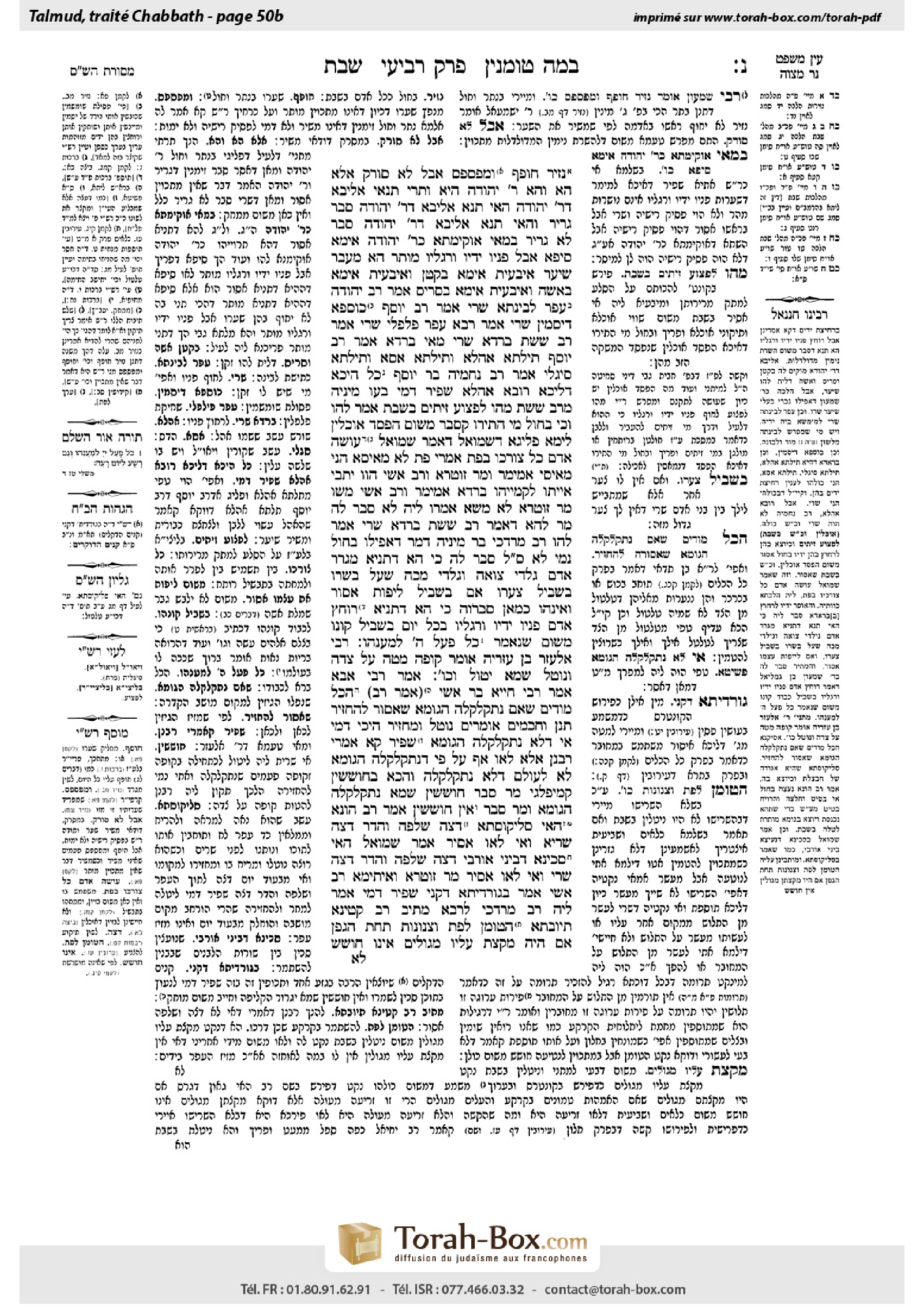
Shabbat 50b: Talmud study for Daf Yomi
Daf Yomi is the daily study of one Talmud folio. Explore 37 tractates with scans, Hebrew text, Sefaria English and AI-generated French translations where annotated.
Passage selection and English or AI-generated French translation are available where the scan has annotations. Daf Study is independent of Torah-Box and Sefaria.
Browse Shabbat · שבת · All tractatesShabbat 50b text and translations
This page of Shabbat includes the Aramaic text, an English translation and an AI-generated French translation, alongside the scan above.
שבת נ׳ ב · Aramaic and Hebrew text
נָזִיר חוֹפֵף וּמְפַסְפֵּס, אֲבָל לֹא סוֹרֵק!
אֶלָּא הָא וְהָא רַבִּי יְהוּדָה הִיא, וּתְרֵי תַנָּאֵי אַלִּיבָּא דְּרַבִּי יְהוּדָה. הַאי תַּנָּא אַלִּיבָּא דְּרַבִּי יְהוּדָה סָבַר גָּרֵיר, וְהַאי תַּנָּא אַלִּיבָּא דְּרַבִּי יְהוּדָה סָבַר לָא גָּרֵיר.
בְּמַאי אוֹקֵימְתָּא — כְּרַבִּי יְהוּדָה, אֵימָא סֵיפָא: אֲבָל פָּנָיו יָדָיו וְרַגְלָיו מוּתָּר. הָא מְעַבַּר שֵׂיעָר!
אִיבָּעֵית אֵימָא בְּקָטָן, וְאִיבָּעֵית אֵימָא בָּאִשָּׁה, וְאִיבָּעֵית אֵימָא בְּסָרִיס.
אָמַר רַב יְהוּדָה: עֲפַר לְבֵינְתָּא שְׁרֵי. אָמַר רַב יוֹסֵף: כּוּסְפָּא דְיַסְמִין שְׁרֵי. אָמַר רָבָא: עֲפַר פִּלְפְּלֵי שְׁרֵי. אָמַר רַב שֵׁשֶׁת: בַּרְדָּא שְׁרֵי.
מַאי בַּרְדָּא? אָמַר רַב יוֹסֵף: תִּילְּתָא אַהֲלָא וְתִילְתָּא אָסָא וְתִילְתָּא סִיגְלֵי. אָמַר רַב נְחֶמְיָה בַּר יוֹסֵף: כׇּל הֵיכָא דְּלֵיכָּא רוּבָּא אַהֲלָא — שַׁפִּיר דָּמֵי.
בְּעוֹ מִינֵּיהּ מֵרַב שֵׁשֶׁת: מַהוּ לִפְצוֹעַ זֵיתִים בְּשַׁבָּת? אֲמַר לְהוּ וְכִי בְּחוֹל מִי הִתִּירוּ? קָסָבַר מִשּׁוּם הֶפְסֵד אוֹכָלִין.
לֵימָא פְּלִיגָא דִּשְׁמוּאֵל, דְּאָמַר שְׁמוּאֵל: עוֹשֶׂה אָדָם כׇּל צוֹרְכּוֹ בְּפַת! אָמְרִי: פַּת לָא מְאִיסָא, הָנֵי מְאִיסֵי.
אַמֵּימָר וּמָר זוּטְרָא וְרַב אָשֵׁי הֲווֹ יָתְבִי, אַיְיתוֹ לְקַמַּיְיהוּ בַּרְדָּא. אַמֵּימָר וְרַב אָשֵׁי מְשׁוֹ, מָר זוּטְרָא לָא מְשָׁא. אֲמַרוּ לֵיהּ: לָא סָבַר לַהּ מָר לְהָא דְּאָמַר רַב שֵׁשֶׁת בַּרְדָּא שְׁרֵי?! אֲמַר לְהוּ רַב מָרְדֳּכַי: בַּר מִינֵּיהּ דְּמָר, דַּאֲפִילּוּ בְּחוֹל נָמֵי לָא סְבִירָא לֵיהּ.
סָבַר לַהּ כִּי הָא דְּתַנְיָא: מְגָרֵר אָדָם גִּלְדֵי צוֹאָה וְגִלְדֵי מַכָּה שֶׁעַל בְּשָׂרוֹ בִּשְׁבִיל צַעֲרוֹ, אִם בִּשְׁבִיל לְיַפּוֹת — אָסוּר.
וְאִינְהוּ כְּמַאן סַבְרוּהָ? — כִּי הָא דְּתַנְיָא: רוֹחֵץ אָדָם פָּנָיו יָדָיו וְרַגְלָיו בְּכׇל יוֹם בִּשְׁבִיל קוֹנוֹ, מִשּׁוּם שֶׁנֶּאֱמַר: ״כֹּל פָּעַל ה׳ לַמַּעֲנֵהוּ״.
רַבִּי אֶלְעָזָר בֶּן עֲזַרְיָה אוֹמֵר: קוּפָּה, מַטָּהּ עַל צִדָּהּ וְנוֹטֵל, שֶׁמָּא יִטּוֹל וְכוּ׳. אָמַר רַבִּי אַבָּא אָמַר רַבִּי חִיָּיא בַּר אָשֵׁי אָמַר רַב: הַכֹּל מוֹדִים שֶׁאִם נִתְקַלְקְלָה הַגּוּמָּא — שֶׁאָסוּר לְהַחֲזִיר.
תְּנַן, וַחֲכָמִים אוֹמְרִים: נוֹטֵל וּמַחֲזִיר. הֵיכִי דָמֵי? אִי דְּלָא נִתְקַלְקְלָה הַגּוּמָּא — שַׁפִּיר קָא אָמְרִי רַבָּנַן. אֶלָּא לָאו, אַף עַל פִּי דְּנִתְקַלְקְלָה הַגּוּמָּא.
לָא, לְעוֹלָם דְּלָא נִתְקַלְקְלָה, וְהָכָא בְּחוֹשְׁשִׁין קָמִיפַּלְגִי. מָר סָבַר חוֹשְׁשִׁין שֶׁמָּא נִתְקַלְקְלָה הַגּוּמָּא, וּמָר סָבַר אֵין חוֹשְׁשִׁין.
אָמַר רַב הוּנָא: הַאי סְלִיקוּסְתָּא — דָּצַהּ, שָׁלְפָה, וַהֲדַר דָּצַהּ — שְׁרֵי. וְאִי לָאו, אֲסִיר.
אָמַר שְׁמוּאֵל: הַאי סַכִּינָא דְּבֵינֵי אוּרְבֵי — דָּצַהּ, שַׁלְפָהּ, וַהֲדַר דָּצַהּ — שְׁרֵי. וְאִי לָאו אֲסִיר.
מָר זוּטְרָא, וְאִיתֵּימָא רַב אָשֵׁי אָמַר: בְּגוּרְדְּיָתָא דִּקְנֵי שַׁפִּיר דָּמֵי.
אֲמַר לֵיהּ רַב מָרְדֳּכַי לְרָבָא, מֵתִיב רַב קַטִּינָא תְּיוּבְתָּא: הַטּוֹמֵן לֶפֶת וּצְנוֹנוֹת תַּחַת הַגֶּפֶן, אִם הָיָה מִקְצָת עָלָיו מְגוּלִּים — אֵינוֹ חוֹשֵׁשׁ
Shabbat 50b · English translation
A nazirite, for whom it is prohibited to cut his hair, may wash his hair with sand and natron and separate it with his fingers; however, he may not comb it, as combing will certainly cause hair to fall out. Apparently, Rabbi Shimon permits washing hair even in a case where it is prohibited to cause hair to fall out; in his opinion, the fact that washing one’s hair might inadvertently cause that to happen is not a source of concern.
Rather, both this baraita and that baraita, which disagree with regard to cleaning silver utensils with sand and natron, are in accordance with the opinion of Rabbi Yehuda, who holds that an unintentional act is prohibited. And there are two tanna’im in accordance with the opinion of Rabbi Yehuda. They disagree with regard to Rabbi Yehuda’s opinion. This tanna, in accordance with the opinion of Rabbi Yehuda, holds that sand and natron scrape and smooth the utensils. Therefore, their use on Shabbat is prohibited. And that tanna, also in accordance with the opinion of Rabbi Yehuda, holds that sand and natron do not scrape and smooth the utensils. Therefore, their use on Shabbat is permitted.
The Gemara raises an objection: How did you establish that baraita? It was in accordance with the opinion of Rabbi Yehuda. If so, say the latter clause of the baraita: But his face, his hands, and his feet, it is permitted to wash with sand and natron. Doesn’t he thereby cause hair to fall out? It should be prohibited according to Rabbi Yehuda.
The Gemara answers: If you wish, say that the permission to wash one’s face with sand and natron refers to a child; and if you wish, say instead that it refers to a woman; and if you wish, say instead that it refers to a eunuch. All of them have no facial hair, and that is why there is no concern that use of sand and natron to clean their faces will cause hair to fall out.
The Gemara continues: Rav Yehuda said: Washing one’s face with powdered frankincense (Rav Hai Gaon) is permitted on Shabbat, even if he has a beard, as it does not cause hair to fall out. Rav Yosef said: Washing with the solid residue of jasmine from which its fragrant oil was squeezed is permitted. Rava said: Washing with ground pepper is permitted. Rav Sheshet said: Washing with berada is permitted on Shabbat.
The Gemara asks: What is berada? Rav Yosef said: It is a mixture of one-third aloe, one-third myrtle, and one-third violets. Rav Neḥemya bar Yosef said: Everywhere that there is a mixture with no majority of aloe, it may well be used. Even if the mixture contains more than a third aloe, as long as it constitutes less than a majority, it does not cause hair to fall out.
The Sages raised a dilemma before Rav Sheshet: What is the halakha with regard to splitting olives on a rock on Shabbat in order to wash with the oil that oozes from them (ge’onim)? He said to them: And did they permit doing so on a weekday? Rav Sheshet holds that crushing olives in that manner is prohibited even during the week because it involves ruining food. After the olives are split in that manner, they are no longer fit for consumption.
The Gemara comments: Let us say that Rav Sheshet disagrees with the opinion of Shmuel. As Shmuel said: A person may perform all his needs with bread, and he need not be concerned that it might be ruined. The Sages said in response: Rav Sheshet does not necessarily disagree with Shmuel. Using bread does not render it disgusting and inedible; splitting these olives renders them disgusting and inedible.
The Gemara relates that Ameimar, Mar Zutra, and Rav Ashi were sitting on Shabbat, and they brought berada before them for washing. Ameimar and Rav Ashi washed with it; Mar Zutra did not wash. They said to him: Doesn’t the Master hold in accordance with that which Rav Sheshet said: Washing with berada is permitted on Shabbat? Rav Mordekhai, who was also there, said to them: Except for him, the Master; i.e., do not draw conclusions from Mar Zutra, as he does not hold that one is permitted to use berada, even on a weekday.
Mar Zutra holds in accordance with that which was taught in a baraita: A person may scrape off dried excrement crusts and scabs of a wound that are on his flesh because of the pain that they are causing him. However, if he does so in order to clean and beautify himself, it is prohibited. According to the tanna of this baraita, it is prohibited to adorn or beautify oneself, as the verse: “Neither shall a man put on a woman’s garment” (Deuteronomy 22:5) prohibits dressing or conducting oneself in the manner of women.
The Gemara asks: And Ameimar and Rav Ashi, who permit use of berada, in accordance with whose opinion do they hold? They hold in accordance with that which was taught in a baraita: A person must wash his face, his hands, and his feet every day for the sake of his Maker, as it is stated: “The Lord has made everything for His own purpose” (Proverbs 16:4). Every beautiful thing that exists in the world sings the praise of God Who created beautiful things. Therefore, it is appropriate for one to beautify himself in praise of God.
We learned in the mishna: Rabbi Elazar ben Azarya says: If he placed the pot in a basket filled with fleece, he leans the basket on its side so that the fleece will fall to the side of the pot, and takes the pot. Otherwise, there is room for concern lest the wool collapse when he lifts the pot from the basket. Then he will be unable to replace the pot. It is prohibited to move the fleece to make room for the pot, since the fleece is set-aside. However, the Rabbis disagree and say: He may lift the pot and afterward replace it. Rabbi Abba said that Rabbi Ḥiyya bar Ashi said that Rav said: Everyone agrees, even the Rabbis, that if the cavity in which the pot had been placed was destroyed, its walls having collapsed inward, it is prohibited to return the pot to the basket.
The Gemara asks, based on what we learned in the mishna. And the Rabbis say: He may lift the pot and afterward replace it. The Gemara elaborates: What are the circumstances? If the cavity in which the pot had been placed was not destroyed, the Rabbis say fittingly that it is permitted to replace the pot; why would Rabbi Elazar ben Azarya prohibit the practice? Rather, is it not that the Rabbis permit returning the pot even though the cavity was destroyed? Apparently, that is the subject of the dispute in the mishna.
The Gemara rejects this: No, actually, everyone agrees that if the cavity was destroyed, it is prohibited to return the pot to the basket. The mishna is dealing with a case where the cavity was not destroyed, and here the tanna’im disagree with regard to whether or not one need be concerned lest, if one is allowed to remove the pot from the basket without tilting it to the side, the cavity be destroyed and he will come to return the pot to the basket anyway. One Sage, Rabbi Elazar ben Azarya, holds that one need be concerned lest the cavity be destroyed and he return the pot anyway; and the other Sage, a reference to the Rabbis, holds that one need not be concerned about that.
The Gemara records several rulings with regard to placing an object into another object that is set-aside. Rav Huna said: With regard to this fragrant daffodil branch that was kept in a pot of moist earth in the house; if on Shabbat eve one inserted it into the earth, then pulled it out, and then inserted it again into the earth, it is permitted to pull it out again on Shabbat. By inserting it and then pulling it out, he has already widened the cavity in which the branch was placed. There is no room for concern that when he pulls it out again on Shabbat he will cause earth to shift from its place. And if he did not do so on Shabbat eve, it is prohibited to pull it out on Shabbat.
Shmuel said: This knife that is stored between bricks; if one stuck it between the bricks on Shabbat eve, pulled it out, and then stuck it between the bricks, it is permitted to pull it out on Shabbat. And if he did not do so on Shabbat eve, it is prohibited to pull it out on Shabbat.
Mar Zutra, and some say Rav Ashi, said: Placing a knife between the branches of a hedge of reeds (ge’onim) may well be done and there is no concern lest one come to cut the reeds when he removes it.
Rav Mordekhai said to Rava: Rav Ketina raised a conclusive refutation of the opinions of Rav Huna and Shmuel from that which we learned in a mishna: With regard to one who conceals a turnip or radish in the ground beneath a vine for safekeeping, if some of its leaves were showing, allowing access to pull the turnip or the radish from the ground, he need neither be concerned;
Shabbat 50b · Traduction française (IA)
Un nazir, à qui il est interdit de se couper les cheveux, peut se laver les cheveux avec du sable et du natron et les séparer avec les doigts ; en revanche, il ne peut pas les peigner, car le peigne fera certainement tomber des cheveux. Il semble donc que Rabbi Shimon autorise à se laver les cheveux même dans un cas où il est interdit de provoquer leur chute ; selon lui, il n’y a pas lieu de craindre que le lavage des cheveux entraîne involontairement leur chute.
Il faut plutôt dire que les deux baraïtot, qui divergent au sujet du nettoyage des ustensiles en argent avec du sable et du natron, suivent l’opinion de Rabbi Yehouda, qui considère qu’un acte accompli sans intention est interdit. Deux tannaïm suivent donc l’opinion de Rabbi Yehouda, mais divergent quant à ce que cette opinion implique. Ce tanna, conformément à l’opinion de Rabbi Yehouda, considère que le sable et le natron raclent et lissent les ustensiles ; leur utilisation est donc interdite pendant Chabbat. L’autre tanna, lui aussi conformément à l’opinion de Rabbi Yehouda, considère que le sable et le natron ne raclent ni ne lissent les ustensiles ; leur utilisation est donc permise pendant Chabbat.
La Guemara soulève une objection : comment avez-vous établi cette baraïta ? Comme étant conforme à l’opinion de Rabbi Yehouda. Dans ce cas, examinons la dernière partie de la baraïta : « Mais il est permis de se laver le visage, les mains et les pieds avec du sable et du natron. » N’est-ce pas provoquer ainsi la chute des poils ? Selon Rabbi Yehouda, cela devrait être interdit.
La Guemara répond : si tu veux, dis que l’autorisation de se laver le visage avec du sable et du natron concerne un enfant ; si tu veux, dis plutôt qu’elle concerne une femme ; et si tu veux, dis plutôt qu’elle concerne un eunuque. Aucun d’eux n’a de poils au visage ; c’est pourquoi on ne craint pas que l’utilisation du sable et du natron pour se nettoyer le visage fasse tomber des poils.
La Guemara poursuit : Rav Yehouda a dit : il est permis de se laver le visage avec de l’encens réduit en poudre (Rav Hai Gaon) pendant Chabbat, même si l’on a une barbe, car cela ne provoque pas la chute des poils. Rav Yossef a dit : il est permis de se laver avec le résidu solide du jasmin dont on a extrait l’huile parfumée. Rava a dit : il est permis de se laver avec du poivre moulu. Rav Sheshet a dit : il est permis de se laver avec du berada pendant Chabbat.
La Guemara demande : qu’est-ce que le berada ? Rav Yossef a dit : c’est un mélange composé d’un tiers d’aloès, d’un tiers de myrte et d’un tiers de violettes. Rav Neḥemya bar Yossef a dit : tout mélange qui ne contient pas une majorité d’aloès peut être utilisé. Même si le mélange contient plus d’un tiers d’aloès, tant que celui-ci représente moins de la moitié, il ne provoque pas la chute des poils.
Les Sages posèrent à Rav Sheshet la question suivante : quelle est la halakha concernant le fait de fendre des olives sur une pierre pendant Chabbat afin de se laver avec l’huile qui en suinte (ge’onim) ? Il leur dit : « En ont-ils donc permis l’usage même en semaine ? » Rav Sheshet considère qu’écraser ainsi des olives est interdit même en semaine, car cela revient à gâcher de la nourriture. Une fois fendues de cette manière, les olives ne sont plus propres à la consommation.
La Guemara fait remarquer : faut-il donc dire que Rav Sheshet est en désaccord avec l’opinion de Shmuel ? Shmuel a en effet dit : « Une personne peut utiliser le pain pour tous ses besoins et n’a pas à craindre de le gâcher. » Les Sages répondirent : Rav Sheshet n’est pas nécessairement en désaccord avec Shmuel. L’usage du pain ne le rend pas répugnant ni impropre à la consommation, tandis que fendre ces olives les rend répugnantes et impropres à la consommation.
La Guemara rapporte qu’Ameimar, Mar Zoutra et Rav Ashi étaient assis pendant Chabbat, et qu’on leur apporta du berada pour se laver. Ameimar et Rav Ashi s’en lavèrent ; Mar Zoutra, lui, ne se lava pas. Ils lui dirent : « Le Maître ne suit-il pas l’avis de Rav Sheshet, selon lequel il est permis de se laver avec du berada pendant Chabbat ? » Rav Mordekhaï, qui était également présent, leur dit : « Sauf lui, le Maître » ; c’est-à-dire : ne tirez pas de conclusion du comportement de Mar Zoutra, car il considère que l’usage du berada n’est pas permis, même en semaine.
Mar Zoutra suit l’enseignement d’une baraïta : une personne peut gratter les croûtes de matières fécales séchées et les croûtes d’une plaie qui se trouvent sur son corps, en raison de la douleur qu’elles lui causent. En revanche, si elle le fait pour se nettoyer et s’embellir, cela est interdit. Selon le tanna de cette baraïta, il est interdit de se parer ou de s’embellir, car le verset « Une femme ne portera pas un vêtement d’homme » (Deutéronome 22,5) interdit de s’habiller ou de se conduire à la manière des femmes.
La Guemara demande : et Ameimar et Rav Ashi, qui autorisent l’usage du berada, selon l’opinion de qui se prononcent-ils ? Ils suivent l’enseignement d’une baraïta : une personne doit se laver le visage, les mains et les pieds chaque jour en l’honneur de son Créateur, comme il est dit : « L’Éternel a tout fait pour sa finalité » (Proverbes 16,4). Toute belle chose qui existe dans le monde chante la louange de Dieu, qui a créé de belles choses. Il convient donc que chacun s’embellisse à la louange de Dieu.
Nous avons appris dans la Michna : Rabbi Elazar ben Azarya dit : si l’on a placé la marmite dans un panier rempli de laine, on incline le panier sur le côté afin que la laine tombe à côté de la marmite, puis on prend celle-ci. Autrement, on pourrait craindre que la laine s’affaisse lorsqu’on soulève la marmite du panier. On ne pourrait alors pas remettre la marmite à sa place. Il est interdit de déplacer la laine pour faire de la place à la marmite, car la laine est mouktse. Les Sages, toutefois, sont en désaccord et disent : on peut soulever la marmite, puis la remettre à sa place. Rav Abba a dit que Rabbi Ḥiyya bar Ashi a dit que Rav a dit : tous sont d’accord, même les Sages, que si la cavité où se trouvait la marmite s’est effondrée, ses parois s’étant affaissées vers l’intérieur, il est interdit de remettre la marmite dans le panier.
La Guemara soulève une question à partir de ce que nous avons appris dans la Michna : « Les Sages disent qu’on peut soulever la marmite, puis la remettre à sa place. » La Guemara précise : dans quelles circonstances ? Si la cavité où se trouvait la marmite ne s’est pas effondrée, les Sages ont raison de dire qu’il est permis de remettre la marmite à sa place ; pourquoi Rabbi Elazar ben Azarya l’interdirait-il ? N’est-ce pas plutôt que les Sages autorisent à remettre la marmite même si la cavité s’est effondrée ? Apparemment, c’est là l’objet du désaccord dans la Michna.
La Guemara rejette cette interprétation : non, en réalité, tous sont d’accord que si la cavité s’est effondrée, il est interdit de remettre la marmite dans le panier. La Michna traite d’un cas où la cavité ne s’est pas effondrée ; les tannaïm divergent ici sur la question de savoir s’il faut craindre que, si l’on est autorisé à retirer la marmite du panier sans incliner celui-ci sur le côté, la cavité s’effondre et que l’on finisse malgré tout par remettre la marmite dans le panier. L’un des Sages, Rabbi Elazar ben Azarya, considère qu’il faut craindre que la cavité s’effondre et que l’on remette quand même la marmite à sa place ; l’autre Sage, c’est-à-dire les Sages, considère qu’il n’y a pas lieu de le craindre.
La Guemara consigne plusieurs décisions concernant le fait de placer un objet dans un autre objet qui est mouktse. Rav Houna a dit : pour cette branche de narcisse parfumée qui était conservée dans la terre humide d’un pot, dans la maison, si, la veille de Chabbat, on l’a enfoncée dans la terre, retirée, puis enfoncée de nouveau dans la terre, il est permis de la retirer encore pendant Chabbat. En l’enfonçant puis en la retirant, on a déjà élargi la cavité où la branche était placée. Il n’y a donc pas lieu de craindre qu’en la retirant de nouveau pendant Chabbat, on déplace de la terre. Si l’on ne l’a pas fait la veille de Chabbat, il est interdit de la retirer pendant Chabbat.
Shmuel a dit : pour ce couteau rangé entre des briques, si on l’a enfoncé entre les briques la veille de Chabbat, retiré, puis enfoncé à nouveau entre les briques, il est permis de le retirer pendant Chabbat. Si l’on ne l’a pas fait la veille de Chabbat, il est interdit de le retirer pendant Chabbat.
Mar Zoutra, et certains disent Rav Ashi, a dit : on peut tout à fait placer un couteau entre les branches d’une haie de roseaux (ge’onim), sans craindre que l’on finisse par couper les roseaux en le retirant.
Rav Mordekhaï dit à Rava : Rav Ketina a apporté une réfutation décisive des opinions de Rav Houna et de Shmuel, à partir de ce que nous avons appris dans une Michna : celui qui enfouit un navet ou un radis dans la terre, sous une vigne, pour le conserver, si certaines de ses feuilles dépassent et permettent de tirer le navet ou le radis hors de terre, n’a pas à s’inquiéter ;
Traduction française générée par IA à partir de l’édition anglaise de Sefaria. Vérifie toujours un passage avec le texte source.
Text from Sefaria: William Davidson Edition - Vocalized Aramaic (CC BY NC); William Davidson Edition - English (CC BY NC).