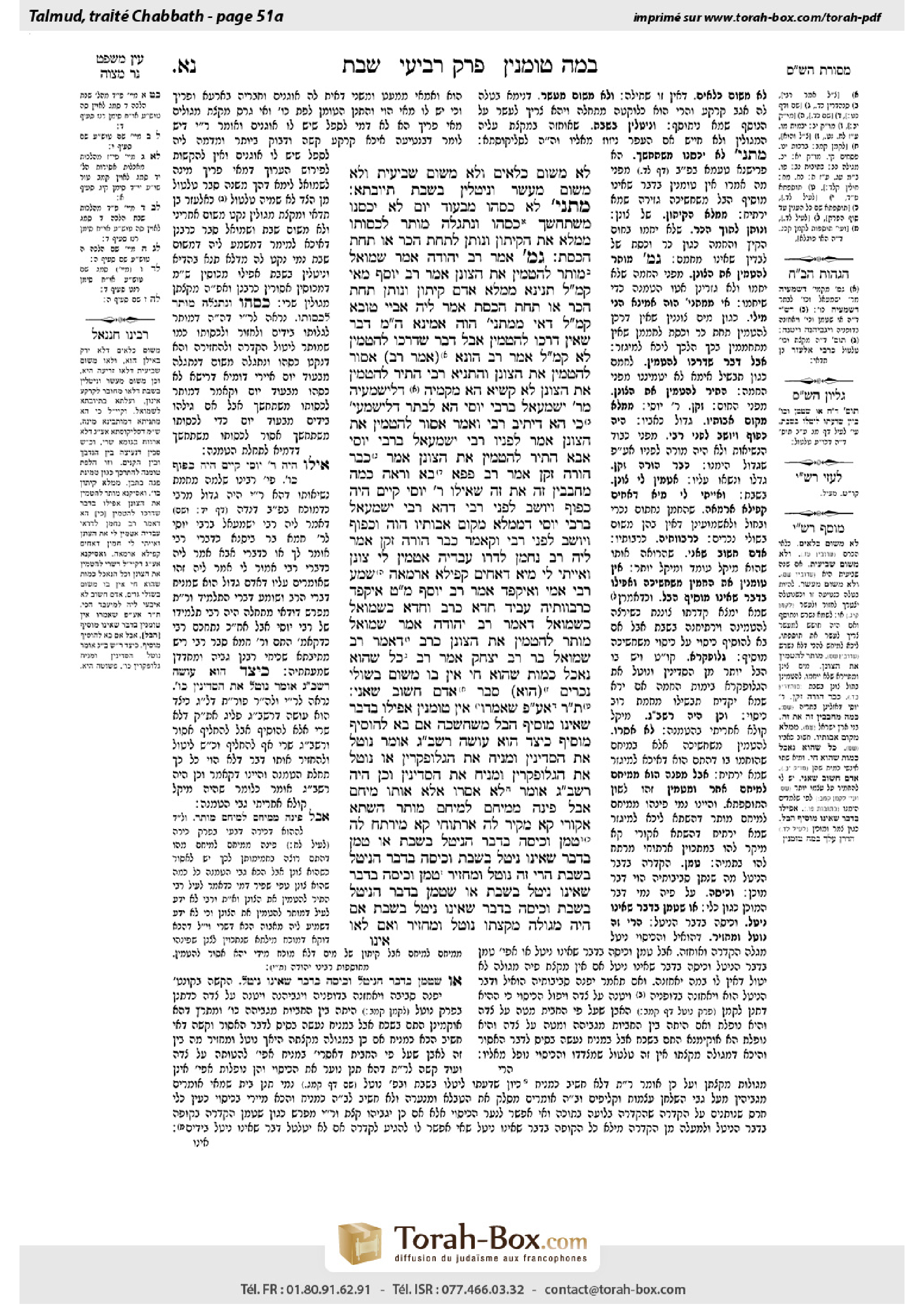
Shabbat 51a: Talmud study for Daf Yomi
Daf Yomi is the daily study of one Talmud folio. Explore 37 tractates with scans, Hebrew text, Sefaria English and AI-generated French translations where annotated.
Passage selection and English or AI-generated French translation are available where the scan has annotations. Daf Study is independent of Torah-Box and Sefaria.
Browse Shabbat · שבת · All tractatesShabbat 51a text and translations
This page of Shabbat includes the Aramaic text, an English translation and an AI-generated French translation, alongside the scan above.
שבת נ״א א · Aramaic and Hebrew text
לֹא מִשּׁוּם כִּלְאַיִם, וְלֹא מִשּׁוּם שְׁבִיעִית, וְלֹא מִשּׁוּם מַעֲשֵׂר, וְנִיטָּלִין בְּשַׁבָּת! תְּיוּבְתָּא.
מַתְנִי׳ לֹא כִּסָּהוּ מִבְּעוֹד יוֹם — לֹא יְכַסֶּנּוּ מִשֶּׁתֶּחְשַׁךְ. כִּסָּהוּ וְנִתְגַּלָּה, מוּתָּר לְכַסּוֹתוֹ. מְמַלֵּא אֶת הַקִּיתוֹן וְנוֹתֵן לְתַחַת הַכַּר אוֹ תַּחַת הַכֶּסֶת.
גְּמָ׳ אָמַר רַב יְהוּדָה אָמַר שְׁמוּאֵל: מוּתָּר לְהַטְמִין אֶת הַצּוֹנֵן. אָמַר רַב יוֹסֵף: מַאי קָמַשְׁמַע לַן? תְּנֵינָא: מְמַלֵּא אָדָם קִיתוֹן וְנוֹתֵן תַּחַת הַכַּר אוֹ תַּחַת הַכֶּסֶת!
אָמַר לֵיהּ אַבָּיֵי: טוּבָא קָמַשְׁמַע לַן, דְּאִי מִמַּתְנִי׳ הֲוָה אָמֵינָא הָנֵי מִילֵּי — דָּבָר שֶׁאֵין דַּרְכּוֹ לְהַטְמִין, אֲבָל דָּבָר שֶׁדַּרְכּוֹ לְהַטְמִין לָא — קָמַשְׁמַע לַן.
אָמַר רַב הוּנָא אָמַר רַב: אָסוּר לְהַטְמִין אֶת הַצּוֹנֵן. וְהָתַנְיָא: רַבִּי הִתִּיר לְהַטְמִין אֶת הַצּוֹנֵן! לָא קַשְׁיָא, הָא מִקַּמֵּיהּ דְּלִישְׁמְעֵיהּ מֵרַבִּי יִשְׁמָעֵאל בְּרַבִּי יוֹסֵי, הָא לְבָתַר דְּלִישְׁמְעֵיהּ. כִּי הָא דְּיָתֵיב רַבִּי וְאָמַר: אָסוּר לְהַטְמִין אֶת הַצּוֹנֵן. אָמַר לְפָנָיו רַבִּי יִשְׁמָעֵאל בְּרַבִּי יוֹסֵי: אַבָּא הִתִּיר לְהַטְמִין אֶת הַצּוֹנֵן. אָמַר: כְּבָר הוֹרָה זָקֵן.
אָמַר רַב פָּפָּא: בֹּא וּרְאֵה כַּמָּה מְחַבְּבִין זֶה אֶת זֶה. שֶׁאִילּוּ רַבִּי יוֹסֵי קַיָּים, הָיָה כָּפוּף וְיוֹשֵׁב לִפְנֵי רַבִּי. דְּהָא רַבִּי יִשְׁמָעֵאל בְּרַבִּי יוֹסֵי דִּמְמַלֵּא מְקוֹם אֲבוֹתָיו הֲוָה, וְכָפוּף וְיוֹשֵׁב לִפְנֵי רַבִּי, וְקָאָמַר: כְּבָר הוֹרָה זָקֵן.
אֲמַר לֵיהּ רַב נַחְמָן לְדָרוּ עַבְדֵּיהּ: אַטְמֵין לִי צוֹנֵן, וְאַיְיתִי לִי מַיָּא דְּאַחֵים קַפִּילָא אֲרַמָּאָה. שְׁמַע רַבִּי אַמֵּי וְאִיקְּפַד. אֲמַר רַב יוֹסֵף: מַאי טַעְמָא אִיקְּפַד? כְּרַבְּווֹתֵיהּ עָבֵיד — חֲדָא כְּרַב, וַחֲדָא כִּשְׁמוּאֵל.
כִּשְׁמוּאֵל — דְּאָמַר רַב יְהוּדָה אָמַר שְׁמוּאֵל: מוּתָּר לְהַטְמִין אֶת הַצּוֹנֵן. כְּרַב — דְּאָמַר רַב שְׁמוּאֵל בַּר רַב יִצְחָק אָמַר רַב: כֹּל שֶׁהוּא נֶאֱכָל כְּמוֹת שֶׁהוּא חַי — אֵין בּוֹ מִשּׁוּם בִּשּׁוּלֵי גּוֹיִם.
(הוּא) סָבַר אָדָם חָשׁוּב שָׁאנֵי.
תָּנוּ רַבָּנַן: אַף עַל פִּי שֶׁאָמְרוּ אֵין טוֹמְנִין אֲפִילּוּ בְּדָבָר שֶׁאֵינוֹ מוֹסִיף הֶבֶל מִשֶּׁחָשֵׁכָה, אִם בָּא לְהוֹסִיף — מוֹסִיף. כֵּיצַד הוּא עוֹשֶׂה? רַבָּן שִׁמְעוֹן בֶּן גַּמְלִיאֵל אוֹמֵר: נוֹטֵל אֶת הַסְּדִינִין וּמַנִּיחַ אֶת הַגְּלוּפְקְרִין, אוֹ נוֹטֵל אֶת הַגְּלוּפְקְרִין וּמַנִּיחַ אֶת הַסְּדִינִין.
וְכֵן הָיָה רַבָּן שִׁמְעוֹן בֶּן גַּמְלִיאֵל אוֹמֵר: לֹא אָסְרוּ אֶלָּא אוֹתוֹ מֵיחַם, אֲבָל פִּינָּה מִמֵּיחַם לְמֵיחַם — מוּתָּר. הַשְׁתָּא אוֹקוֹרֵי קָא מֵקֵיר לְהוּ, אַרְתּוֹחֵי קָא מַרְתַּח לְהוּ?!
טָמַן וְכִיסָּה בְּדָבָר הַנִּיטָּל בְּשַׁבָּת, אוֹ טָמַן בְּדָבָר שֶׁאֵינוֹ נִיטָּל בְּשַׁבָּת וְכִיסָּה בְּדָבָר הַנִּיטָּל בְּשַׁבָּת — הֲרֵי זֶה נוֹטֵל וּמַחֲזִיר.
טָמַן וְכִיסָּה בְּדָבָר שֶׁאֵינוֹ נִיטָּל בְּשַׁבָּת אוֹ שֶׁטָּמַן בְּדָבָר הַנִּיטָּל בְּשַׁבָּת, וְכִיסָּה בְּדָבָר שֶׁאֵינוֹ נִיטָּל בְּשַׁבָּת, אִם הָיָה מְגוּלֶּה מִקְצָתוֹ נוֹטֵל וּמַחֲזִיר. וְאִם לָאו —
Shabbat 51a · English translation
due to diverse kinds, i.e., that he violated the prohibition of planting food crops in a vineyard, as he did not commit an act of planting; nor due to concern that he violated the prohibition against working the land during the Sabbatical Year; nor due to tithes, i.e., that it would be considered as if he picked it from the ground and would be obligated to tithe it; and they may be taken from the ground on Shabbat. Even if most of the turnip or radish is underground, it is permitted to pull it from the ground on Shabbat. One need not be concerned about causing the earth to move. Apparently, this contradicts the opinions of Rav Huna and Shmuel, who were concerned about causing earth to move on Shabbat. The Gemara concludes: Indeed, this is a conclusive refutation of the opinions of Rav Huna and Shmuel.
MISHNA: If one did not cover a pot of cooked food on Shabbat eve while it was still day, he may not cover it after dark. However, if one covered it while it was still day and it was uncovered on Shabbat, he is permitted to cover it even on Shabbat. One may fill a jug with cold water on Shabbat and place it beneath a pillow or a cushion to prevent it from getting warm.
GEMARA: Rav Yehuda said that Shmuel said: It is permitted to insulate the cold food on Shabbat to keep it cold. There is no concern that this will lead one to insulate hot food on Shabbat to keep it hot. Rav Yosef said: What is Shmuel teaching us with this statement? We already learned in our mishna: One may fill a jug with cold water on Shabbat and place it beneath a pillow or a mattress to prevent it from getting warm.
Abaye said to him: He teaches us a great deal. As, if it had been learned from the mishna alone, I would have said that the ruling that one is permitted to insulate cold food applies only to something that is not ordinarily insulated when it is hot. However, something that is commonly insulated when it is hot, no, it may not be insulated even when it is cold. Therefore, Shmuel teaches us that this is allowed even in the case of something which is commonly insulated when it is hot.
Rav Huna said that Rabbi Yehuda HaNasi said: It is prohibited to insulate cold food on Shabbat to keep it cold. The Gemara raises an objection: Wasn’t it taught in a baraita that Rabbi Yehuda HaNasi permitted cold food to be insulated on Shabbat? The Gemara answers: This is not difficult. This statement was made before he heard the ruling of Rabbi Yishmael, son of Rabbi Yosei; that statement in the baraita was made after he heard it. As in that incident where Rabbi Yehuda HaNasi sat and said: It is prohibited to insulate cold food on Shabbat to keep it cold, Rabbi Yishmael, son of Rabbi Yosei, said before him: Father permitted insulating cold food on Shabbat. Rabbi Yehuda HaNasi said: I retract my previous statement, as the Elder, Rabbi Yosei, has already issued a ruling on this topic, and I defer to his ruling.
Rav Pappa said: Come and see how much they loved each other. Had Rabbi Yosei still been alive, he would have been subordinate to and sitting before Rabbi Yehuda HaNasi as his student, as Rabbi Yishmael, son of Rabbi Yosei, who took his father’s place and was as great a Torah scholar as his father, was subordinate to and sitting before Rabbi Yehuda HaNasi as his student. And, nevertheless, Rabbi Yehuda HaNasi says: The Elder has already issued a ruling on this topic, and he deferred to Rabbi Yosei’s ruling.
Rav Naḥman said to Daru, his slave: Insulate cold food for me on Shabbat, so that it will not become warm, and bring me water that a gentile cook [kappeila] heated on a weekday, as the prohibition to eat food cooked by a gentile does not apply to water. When Rabbi Ami heard this, he became angry. Rav Yosef said: What is the reason that Rabbi Ami become angry? Rav Naḥman acted in accordance with the rulings of his teachers; in one matter in accordance with the ruling of Rav, and in one matter in accordance with the ruling of Shmuel.
The Gemara explains: In one matter in accordance with the ruling of Shmuel, as Rav Yehuda said that Shmuel said: It is permitted to insulate cold food on Shabbat to keep it cold. In one matter in accordance with the ruling of Rav, as Rav Shmuel bar Rav Yitzḥak said that Rav said: Anything that is eaten as it is, raw, and cooking it is unnecessary, even if it was cooked it is not subject to the prohibition of food cooked by gentiles. Since water is commonly drunk uncooked, one may drink it even if it was boiled by a gentile.
The Gemara answers: Rabbi Ami became angry because he held that an important person is different. A distinguished person like Rav Naḥman should be stringent and distance himself from conduct that could be perceived, even mistakenly, as a prohibited act.
The Sages taught in the Tosefta: Although the Sages said that one may not insulate hot food, even in something that does not add heat after nightfall on Shabbat, if he comes to add to the material in which he insulated the food on Shabbat eve, he may add to it even on Shabbat. How should he do it? Rabban Shimon ben Gamliel said: He takes the sheets with which he insulated a pot and places the heavy blankets, which provide better insulation, in their place. Or, if he is concerned about excessive heat, he takes the heavy blankets in which the pot had been insulated and places the lighter sheets in their place.
And likewise, Rabban Shimon ben Gamliel, in teaching an additional leniency, said: They prohibited insulating a pot on Shabbat to keep its contents warm when the food remains only in the same urn in which the water was boiled. However, if one emptied the water from that urn into another urn, it is permitted to insulate the second urn to keep the water warm. The reason for the ruling of Rabban Shimon ben Gamliel is: It is prohibited to insulate a pot on Shabbat, due to concern lest one heat the food beforehand. Now that he has already taken steps to cool the water by pouring it from one urn to another, is there concern that he will boil it again on Shabbat?
And Rabban Shimon ben Gamliel said: If he insulated the pot and covered it with something that may be moved on Shabbat, or if he insulated it with something that may not be moved on Shabbat because it is set-aside and covered it with something that may be moved on Shabbat, he may take the pot to remove food and return it to its place and not be concerned.
However, if he both insulated it and covered it with something that may not be moved on Shabbat, or if he insulated it in something that may be moved on Shabbat and covered it with something that may not be moved on Shabbat, if the pot was partially exposed, he may remove the pot and the cover will fall on its own and then return it to its place. And if the pot was not partially exposed,
Shabbat 51a · Traduction française (IA)
en raison des espèces mélangées, c’est-à-dire qu’il aurait transgressé l’interdiction de planter des cultures vivrières dans une vigne, puisqu’il n’a commis aucun acte de plantation ; ni par crainte d’avoir transgressé l’interdiction de travailler la terre pendant l’année de la Chemita ; ni en raison des dîmes, c’est-à-dire qu’on considérerait qu’il l’a cueilli du sol et qu’il serait donc tenu de le dîmer. On peut les retirer du sol pendant Chabbat. Même si la majeure partie du navet ou du radis se trouve sous terre, il est permis de l’arracher pendant Chabbat. Il n’y a pas lieu de craindre que la terre soit déplacée. Apparemment, cela contredit les opinions de Rav Houna et de Chmouel, qui craignaient que la terre soit déplacée pendant Chabbat. La Guemara conclut : En effet, c’est une réfutation définitive des opinions de Rav Houna et de Chmouel.
MICHNA : Si quelqu’un n’a pas couvert une marmite contenant un plat cuit à la veille de Chabbat, alors qu’il faisait encore jour, il ne peut pas la couvrir une fois la nuit tombée. Toutefois, s’il l’a couverte alors qu’il faisait encore jour et qu’elle a été découverte pendant Chabbat, il est permis de la couvrir même pendant Chabbat. On peut remplir une cruche d’eau froide pendant Chabbat et la placer sous un oreiller ou un coussin afin d’éviter qu’elle ne se réchauffe.
GUEMARA : Rav Yehouda a dit au nom de Chmouel : Il est permis d’isoler un aliment froid pendant Chabbat afin de le garder froid. Il n’y a pas lieu de craindre que cela conduise à isoler un aliment chaud pendant Chabbat afin de le garder chaud. Rav Yossef a dit : Que nous apprend Chmouel par cette déclaration ? Nous l’avons déjà appris dans notre Michna : On peut remplir une cruche d’eau froide pendant Chabbat et la placer sous un oreiller ou un matelas afin d’éviter qu’elle ne se réchauffe.
Abayé lui dit : Il nous apprend beaucoup. En effet, si nous l’avions appris de la Michna seule, j’aurais dit que la règle autorisant à isoler un aliment froid ne s’applique qu’à un aliment qu’on n’a pas coutume d’isoler lorsqu’il est chaud. Mais un aliment qu’on a coutume d’isoler lorsqu’il est chaud, on ne pourrait pas l’isoler même lorsqu’il est froid. Chmouel nous apprend donc que cela est permis même dans le cas d’un aliment qu’on a coutume d’isoler lorsqu’il est chaud.
Rav Houna a dit au nom de Rabbi Yehouda HaNassi : Il est interdit d’isoler un aliment froid pendant Chabbat afin de le garder froid. La Guemara soulève une objection : N’a-t-il pas été enseigné dans une baraïta que Rabbi Yehouda HaNassi a permis d’isoler un aliment froid pendant Chabbat ? La Guemara répond : Il n’y a pas de difficulté. Cette déclaration a été faite avant qu’il entende la décision de Rabbi Yichmaël, fils de Rabbi Yossi ; celle de la baraïta a été faite après qu’il l’a entendue. Ainsi, dans cet épisode, Rabbi Yehouda HaNassi était assis et disait : Il est interdit d’isoler un aliment froid pendant Chabbat afin de le garder froid. Rabbi Yichmaël, fils de Rabbi Yossi, lui dit alors : Mon père a permis d’isoler un aliment froid pendant Chabbat. Rabbi Yehouda HaNassi dit : Je reviens sur ma déclaration précédente, car l’Ancien, Rabbi Yossi, a déjà rendu une décision sur cette question, et je m’en remets à sa décision.
Rav Pappa dit : Venez voir combien ils s’aimaient. Si Rabbi Yossi avait encore été en vie, il aurait été subordonné à Rabbi Yehouda HaNassi et se serait assis devant lui comme son élève, tout comme Rabbi Yichmaël, fils de Rabbi Yossi, qui avait pris la place de son père et était un aussi grand érudit de Torah que lui, était subordonné à Rabbi Yehouda HaNassi et s’asseyait devant lui comme son élève. Et pourtant, Rabbi Yehouda HaNassi dit : L’Ancien a déjà rendu une décision sur cette question, et il s’en remet à la décision de Rabbi Yossi.
Rav Na’hman dit à Darou, son esclave : Isole pour moi un aliment froid pendant Chabbat, afin qu’il ne se réchauffe pas, et apporte-moi de l’eau chauffée un jour de semaine par un cuisinier non juif [kappeila], car l’interdiction de consommer des aliments cuits par un non-Juif ne s’applique pas à l’eau. Lorsque Rabbi Ami l’apprit, il se mit en colère. Rav Yossef dit : Pourquoi Rabbi Ami s’est-il mis en colère ? Rav Na’hman a agi conformément aux décisions de ses maîtres : sur un point, conformément à la décision de Rav, et sur un autre, conformément à celle de Chmouel.
La Guemara explique : sur un point, conformément à la décision de Chmouel, car Rav Yehouda a dit au nom de Chmouel : Il est permis d’isoler un aliment froid pendant Chabbat afin de le garder froid. Sur un autre point, conformément à la décision de Rav, car Rav Chmouel bar Rav Yitz’hak a dit au nom de Rav : Tout aliment qui se consomme tel quel, cru, et qu’il n’est pas nécessaire de cuire, n’est pas soumis à l’interdiction des aliments cuits par des non-Juifs, même s’il a été cuit. Puisque l’eau se boit couramment sans être cuite, on peut la boire même si elle a été bouillie par un non-Juif.
La Guemara répond : Rabbi Ami s’était mis en colère parce qu’il estimait qu’un personnage important fait exception. Une personnalité éminente comme Rav Na’hman devrait être rigoureuse et s’abstenir de toute conduite qui pourrait être perçue, même à tort, comme un acte interdit.
Les Sages ont enseigné dans la Tossefta : Bien que les Sages aient dit qu’on ne peut pas isoler un aliment chaud, même dans un matériau qui n’ajoute pas de chaleur après la tombée de la nuit pendant Chabbat, si quelqu’un souhaite ajouter du matériau à celui dans lequel il a isolé l’aliment à la veille de Chabbat, il peut en ajouter même pendant Chabbat. Comment doit-il procéder ? Rabban Chimon ben Gamliel dit : Il retire les draps dont il avait enveloppé une marmite et met à leur place les couvertures épaisses, qui isolent mieux. Ou bien, s’il craint une chaleur excessive, il retire les couvertures épaisses dont la marmite avait été enveloppée et met à leur place les draps plus légers.
De même, Rabban Chimon ben Gamliel, enseignant une permission supplémentaire, dit : On a interdit d’isoler une marmite pendant Chabbat pour en garder le contenu chaud lorsque celui-ci reste dans la même marmite que celle où l’eau a bouilli. Toutefois, si l’on a transvasé l’eau de cette marmite dans une autre, il est permis d’isoler la seconde marmite afin de garder l’eau chaude. La raison de la décision de Rabban Chimon ben Gamliel est la suivante : il est interdit d’isoler une marmite pendant Chabbat, de crainte qu’on ne réchauffe d’abord la nourriture. Or, maintenant qu’il a déjà pris des mesures pour refroidir l’eau en la transvasant d’une marmite à une autre, peut-on craindre qu’il la fasse bouillir de nouveau pendant Chabbat ?
Et Rabban Chimon ben Gamliel dit : Si quelqu’un a isolé la marmite et l’a couverte d’un objet qu’il est permis de déplacer pendant Chabbat, ou s’il l’a isolée avec un objet qu’il est interdit de déplacer pendant Chabbat parce qu’il est mouktsé et l’a couverte d’un objet qu’il est permis de déplacer pendant Chabbat, il peut prendre la marmite pour en retirer de la nourriture, la remettre à sa place et ne pas s’en inquiéter.
Toutefois, s’il l’a à la fois isolée et couverte avec un objet qu’il est interdit de déplacer pendant Chabbat, ou s’il l’a isolée avec un objet qu’il est permis de déplacer pendant Chabbat et l’a couverte avec un objet qu’il est interdit de déplacer pendant Chabbat, si la marmite était partiellement découverte, il peut la retirer ; la couverture tombera alors d’elle-même, puis il pourra la remettre à sa place. Et si la marmite n’était pas partiellement découverte,
Traduction française générée par IA à partir de l’édition anglaise de Sefaria. Vérifie toujours un passage avec le texte source.
Text from Sefaria: William Davidson Edition - Vocalized Aramaic (CC BY NC); William Davidson Edition - English (CC BY NC).