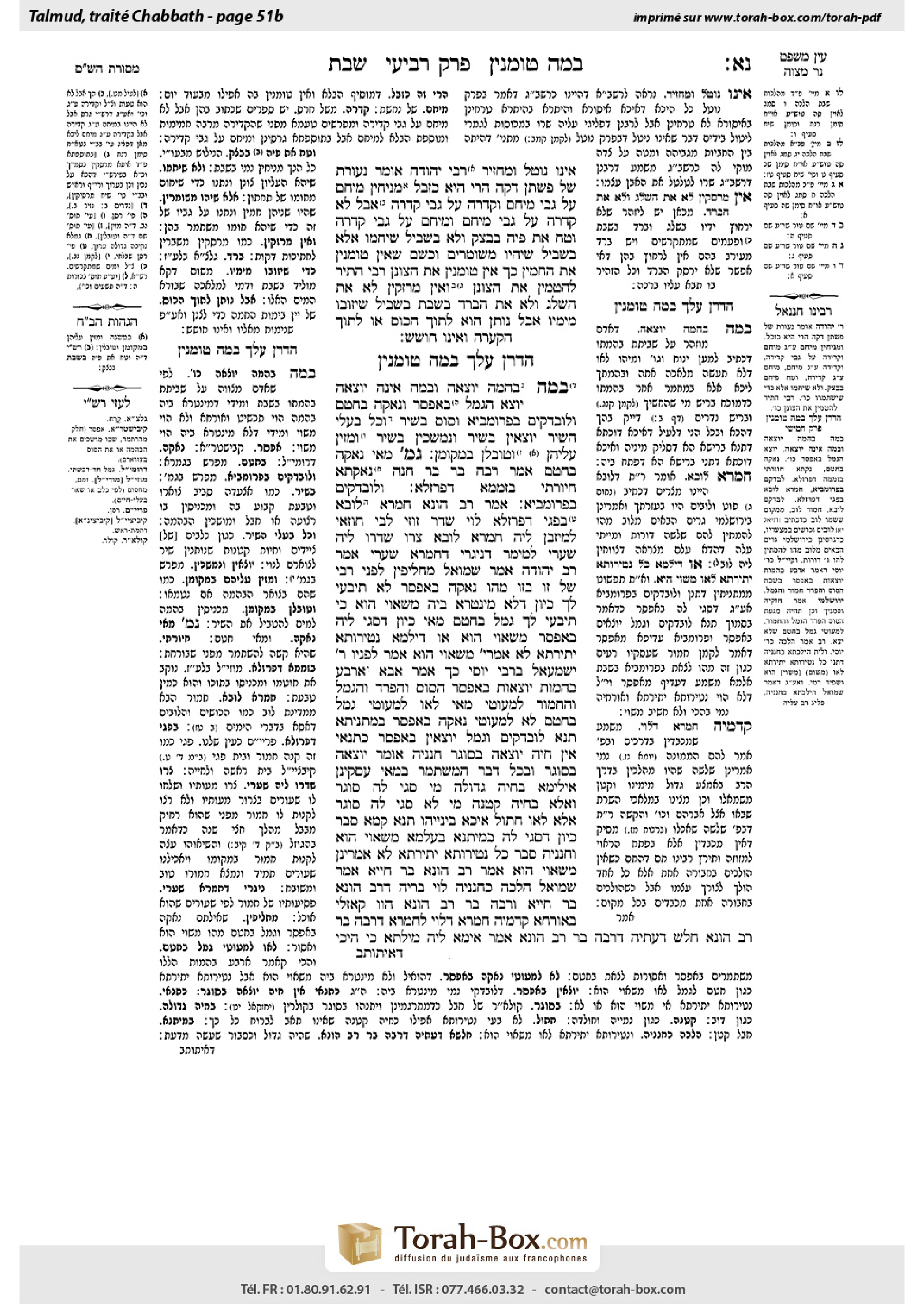
Shabbat 51b: Talmud study for Daf Yomi
Daf Yomi is the daily study of one Talmud folio. Explore 37 tractates with scans, Hebrew text, Sefaria English and AI-generated French translations where annotated.
Passage selection and English or AI-generated French translation are available where the scan has annotations. Daf Study is independent of Torah-Box and Sefaria.
Browse Shabbat · שבת · All tractatesShabbat 51b text and translations
This page of Shabbat includes the Aramaic text, an English translation and an AI-generated French translation, alongside the scan above.
שבת נ״א ב · Aramaic and Hebrew text
אֵינוֹ נוֹטֵל וּמַחֲזִיר.
רַבִּי יְהוּדָה אוֹמֵר: נְעוֹרֶת שֶׁל פִּשְׁתָּן דַּקָּה הֲרֵי הִיא כְּזֶבֶל.
מַנִּיחִין מֵיחַם עַל גַּבֵּי מֵיחַם וּקְדֵרָה עַל גַּבֵּי קְדֵרָה, אֲבָל לֹא קְדֵרָה עַל גַּבֵּי מֵיחַם, וּמֵיחַם עַל גַּבֵּי קְדֵרָה. וְטָח אֶת פִּיהָ בְּבָצֵק, וְלֹא בִּשְׁבִיל שֶׁיֵּחַמּוּ, אֶלָּא בִּשְׁבִיל שֶׁיִּהְיוּ מְשׁוּמָּרִים.
וּכְשֵׁם שֶׁאֵין טוֹמְנִין אֶת הַחַמִּין כָּךְ אֵין טוֹמְנִין אֶת הַצּוֹנֵן. רַבִּי הִתִּיר לְהַטְמִין אֶת הַצּוֹנֵן.
וְאֵין מְרַזְּקִין לֹא אֶת הַשֶּׁלֶג וְלֹא אֶת הַבָּרָד בְּשַׁבָּת בִּשְׁבִיל שֶׁיָּזוּבוּ מֵימָיו, אֲבָל נוֹתֵן הוּא לְתוֹךְ הַכּוֹס אוֹ לְתוֹךְ הַקְּעָרָה וְאֵינוֹ חוֹשֵׁשׁ.
הדרן עלך במה טומנין
מַתְנִי׳ בַּמֶּה בְּהֵמָה יוֹצְאָה וּבַמָּה אֵינָהּ יוֹצְאָה? — יוֹצֵא הַגָּמָל בְּאַפְסָר, וְנָאֲקָה בַּחֲטָם, וְלוּבְדְּקִים בִּפְרוּמְבְּיָא, וְסוּס בְּשֵׁיר.
וְכָל בַּעֲלֵי הַשֵּׁיר יוֹצְאִין בְּשֵׁיר וְנִמְשָׁכִין בְּשֵׁיר.
וּמַזִּין עֲלֵיהֶן, וְטוֹבְלָן בִּמְקוֹמָן.
גְּמָ׳ מַאי ״נָאקָה בַּחֲטָם״? אָמַר רַבָּה בַּר בַּר חָנָה: נָאקְתָּא חִיוָּרְתִּי בִּזְמָמָא דְפַרְזְלָא. ״וְלוּבְדְּקִים בִּפְרוּמְבְּיָא״ — אָמַר רַב הוּנָא: חֲמָרָא לוּבָא בְּפַגֵּי דְפַרְזְלָא.
לֵוִי שַׁדַּר זוּזֵי לְבֵי חוֹזָאֵי לְמִיזְבַּן לֵיהּ חֲמָרָא לוּבָא. צָרוּ שַׁדַּרוּ לֵיהּ שְׂעָרֵי, לְמֵימַר דְּנִיגְרֵי דַחֲמָרָא שְׂעָרֵי.
אָמַר רַב יְהוּדָה אָמַר שְׁמוּאֵל: מַחְלִיפִין לִפְנֵי רַבִּי, שֶׁל זוֹ בָּזוֹ מַהוּ?
נָאקָה בְּאַפְסָר לָא תִּיבְּעֵי לָךְ, כֵּיוָן דְּלָא מִינַּטְרָא בֵּיהּ — מַשּׂאוֹי הוּא. כִּי תִּיבְּעֵי לָךְ גָּמָל בַּחֲטָם מַאי? כֵּיוָן דְּסַגִּי לֵיהּ בְּאַפְסָר — מַשּׂאוֹי הוּא, אוֹ דִילְמָא נְטִירוּתָא יַתִּירְתָּא לָא אָמְרִינַן מַשּׂאוֹי הוּא?
אָמַר לְפָנָיו רַבִּי יִשְׁמָעֵאל בְּרַבִּי יוֹסֵי: כָּךְ אָמַר אַבָּא: אַרְבַּע בְּהֵמוֹת יוֹצְאוֹת בְּאַפְסָר, הַסּוּס וְהַפֶּרֶד וְהַגָּמָל וְהַחֲמוֹר. לְמַעוֹטֵי מַאי? לַָאו לְמַעוֹטֵי גָּמָל בַּחֲטָם! לָא, לְמַעוֹטֵי נָאקָה בְּאַפְסָר.
בְּמַתְנִיתָא תָּנָא: לוּבְדְּקִים וְגָמָל יוֹצְאִין בְּאַפְסָר. כְּתַנָּאֵי: אֵין חַיָּה יוֹצְאָה בְּסוּגַר, חֲנַנְיָה אוֹמֵר: יוֹצְאָה בְּסוּגַר וּבְכׇל דָּבָר הַמִּשְׁתַּמֵּר.
בְּמַאי עָסְקִינַן? אִילֵּימָא בְּחַיָּה גְּדוֹלָה — מִי סַגִּי לַהּ סוּגַר? וְאֶלָּא בְּחַיָּה קְטַנָּה — מִי לָא סַגִּי לַהּ סוּגַר?
אֶלָּא לָאו חָתוּל אִיכָּא בֵּינַיְיהוּ: תַּנָּא קַמָּא סָבַר כֵּיוָן דְּסַגִּי לַהּ בְּמִיתְנָא בְּעָלְמָא מַשּׂאוֹי הוּא, וַחֲנַנְיָה סָבַר כׇּל נְטִירוּתָא יַתִּירְתָּא לָא אָמְרִינַן מַשּׂאוֹי הוּא. אָמַר רַב הוּנָא בַּר חִיָּיא אָמַר שְׁמוּאֵל: הֲלָכָה כַּחֲנַנְיָה.
לֵוִי בְּרֵיהּ דְּרַב הוּנָא בַּר חִיָּיא וְרַבָּה בַּר רַב הוּנָא הֲווֹ קָאָזְלִי בְּאוֹרְחָא. קַדְמֵיהּ חֲמָרָא דְלֵוִי לַחֲמָרָא דְּרַבָּהּ בַּר רַב הוּנָא. חֲלַשׁ דַּעְתֵּיהּ דְּרַבָּה בַּר רַב הוּנָא, אֲמַר: אֵימָא לֵיהּ מִילְּתָא כִּי הֵיכִי
Shabbat 51b · English translation
he may not remove the pot and then return it to its place.
Rabbi Yehuda says: The chaff of fine flax is like manure. Therefore, one may not insulate food in it even on Shabbat eve.
One may place a copper urn upon a copper urn, and one may place an earthenware pot upon an earthenware pot because the lower utensil will not heat the upper one. However, one may not place an earthenware pot upon a copper urn, or a copper urn upon an earthenware pot, as in that case there is concern that the upper utensil will be heated by the lower one. And one may seal the mouth of a pot with dough. All of the above may not be undertaken in order to heat the water, but only so that its heat will be maintained and it will not cool down.
And just as one may not insulate hot food to keep it warm, so too, one may not insulate cold food to keep it cold. Rabbi Yehuda HaNasi permitted insulating cold food on Shabbat.
And one may neither crush snow nor hail on Shabbat so that its water will flow and he will be able to drink it. That act involves creation of a new entity, water from ice, on Shabbat, which is prohibited. However, he may place the snow or the hail into a cup or a dish and allow it to melt on its own, and he need not be concerned.
Due to the mitzva to rest one’s animals on Shabbat, one’s animal may not go out into the public domain bearing a burden. However, an object designated to protect the animal or to prevent it from fleeing is not considered a burden; therefore, an animal bearing objects that serve that purpose may go out into the public domain.
MISHNA: The mishna asks: With what may an animal go out into the public domain on Shabbat and with what may it not go out? A camel may go out on Shabbat with an afsar, and a naka may go out with a ḥatam, and a luvdekim may go out with a perumbiya. All these terms will be defined in the Gemara. And a horse may go out with a chain around its neck.
And, in general, all animals that typically have a chain around their necks when they go out to the public domain may go out with a chain on Shabbat and may be pulled by the chain.
If these chains contracted ritual impurity, one may sprinkle waters of purification on them and immerse them in their place on the animal, and they need not first be removed.
GEMARA: Several terms in the mishna were not clear to the Sages, and the Gemara asks: What is the meaning of naka with a ḥatam? Rabba bar bar Ḥana said: A white female camel (ge’onim) with an iron nose ring. And what is the meaning of luvdekim with a perumbiya? Rav Huna said: A Libyan donkey with an iron halter.
Having mentioned a Libyan donkey, the Gemara relates that Levi once sent money to Bei Ḥozai to procure for himself a Libyan donkey, which is reputed to be of superior quality. They bound his money, returned it, and sent him barley, to say that the strides of a donkey depend on the barley that it eats. If one provides his donkey with better feed, its performance will be as good as that of a Libyan donkey.
Rav Yehuda said that Shmuel said: The students switched the details in the mishna before Rabbi Yehuda HaNasi and asked: What is the halakha with regard to this animal going out into the public domain with that which is permitted for that animal? For example, may a white female camel go out with a bit or a camel with an iron nose ring?
The Gemara explains: The case of a white female camel going out with a bit should not be a dilemma for you; since it is not sufficiently secured by a bit, it is regarded as a burden with which the animal may not go out. The case where there should be a dilemma for you is that of a camel going out to the public domain with a nose ring. What is the halakha in that case? The Gemara explains the dilemma: Is the halakha that since a bit alone suffices to secure a camel, an iron nose ring is considered a burden? Or, is the halakha perhaps that with regard to a device that provides excessive security we do not say that it is a burden?
Rabbi Yishmael, son of Rabbi Yosei, said before Rabbi Yehuda HaNasi that so said father, Rabbi Yosei: Four animals may go out with a bit: The horse, and the mule, and the camel, and the donkey. What does this list come to exclude? Is it not coming to exclude a camel going out with a nose ring? Apparently, the dilemma is resolved. The camel may go out only with a bit. The Gemara rejects this proof: No, the list comes to exclude a white female camel going out with a bit.
It was taught in a baraita: A Libyan donkey and a camel may go out with a bit. The Gemara notes that the question whether or not an animal may go out into the public domain with excessive security is parallel to a dispute between the tanna’im, as it was taught in a baraita: A non-domesticated animal may not go out with a collar. Ḥananya says: It may go out with a collar and with anything that secures it.
The Gemara clarifies the case: With what are we dealing here? If you say that we are dealing with a large non-domesticated animal, does a collar suffice for it? Since it does not sufficiently secure the animal, it is considered a burden, and it is prohibited for the animal to go out with it on Shabbat. Rather, it must be dealing with a small non-domesticated animal. In that case, doesn’t a collar suffice for it? Why then does the anonymous first tanna hold that the animal may not go out with it?
Rather, is it not that the practical difference between their opinions is with regard to a cat? The anonymous first tanna of the baraita holds that since a small rope suffices for the cat, a collar is considered a burden with which the cat may not go out into the public domain. And Ḥananya holds that with regard to a device that provides excessive security, we do not say that it is a burden. The tanna’im disagree whether or not a device that provides excessive security is considered a burden. The Gemara concludes: Rav Huna bar Ḥiyya said that Shmuel said: The halakha is in accordance with the opinion of Ḥananya. A device that provides excessive security is not considered a burden.
The Gemara relates that Levi, son of Rav Huna bar Ḥiyya, and Rabba bar Rav Huna were once going together on a road. Levi’s donkey on its own initiative went ahead of the donkey of Rabba bar Rav Huna. Rabba bar Rav Huna was offended because he was the greater Torah scholar, and he thought that Levi went first to assert that he considered himself the greater scholar. Levi said to himself: I will say something to him, so that
Shabbat 51b · Traduction française (IA)
Il ne peut pas retirer la marmite puis la remettre à sa place.
Rabbi Yehuda dit : La balle de lin fin est comme du fumier. Par conséquent, on ne peut pas y isoler des aliments, même la veille de Chabbat.
On peut poser une urne en cuivre sur une urne en cuivre, et une marmite en terre cuite sur une marmite en terre cuite, car l’ustensile inférieur ne chauffera pas l’ustensile supérieur. En revanche, on ne peut pas poser une marmite en terre cuite sur une urne en cuivre, ni une urne en cuivre sur une marmite en terre cuite, car on craindrait alors que l’ustensile supérieur soit chauffé par l’ustensile inférieur. On peut aussi sceller l’ouverture d’une marmite avec de la pâte. Toutes ces opérations ne peuvent pas être entreprises pour chauffer l’eau, mais seulement pour en conserver la chaleur et l’empêcher de refroidir.
De même qu’on ne peut pas isoler un aliment chaud pour le garder chaud, on ne peut pas non plus isoler un aliment froid pour le garder froid. Rabbi Yehuda HaNasi a permis d’isoler des aliments froids pendant Chabbat.
On ne peut ni broyer de la neige ni de la grêle pendant Chabbat pour en faire couler l’eau et pouvoir la boire. Cet acte consiste à créer une nouvelle substance — de l’eau à partir de glace — pendant Chabbat, ce qui est interdit. Toutefois, on peut mettre la neige ou la grêle dans une tasse ou un plat et la laisser fondre d’elle-même, sans avoir à s’en inquiéter.
En raison de la mitsva de laisser ses animaux se reposer pendant Chabbat, son animal ne peut pas sortir dans le domaine public en portant une charge. Cependant, un objet destiné à protéger l’animal ou à l’empêcher de s’enfuir n’est pas considéré comme une charge ; un animal portant des objets à cette fin peut donc sortir dans le domaine public. MICHNA : La Michna demande : Avec quoi un animal peut-il sortir dans le domaine public pendant Chabbat, et avec quoi ne le peut-il pas ? Un chameau peut sortir pendant Chabbat avec un afsar, une naka avec un ḥatam, et un luvdekim avec un perumbiya. La Guemara définira tous ces termes. Un cheval peut sortir avec une chaîne autour du cou.
De manière générale, tous les animaux qui portent habituellement une chaîne autour du cou lorsqu’ils sortent dans le domaine public peuvent sortir avec une chaîne pendant Chabbat et être conduits par celle-ci.
Si ces chaînes ont contracté l’impureté rituelle, on peut les asperger d’eau de purification et les immerger sur l’animal, sans devoir les retirer auparavant.
GUEMARA : Plusieurs termes de la Michna n’étaient pas clairs pour les Sages. La Guemara demande : Que signifie « une naka avec un ḥatam » ? Rabba bar bar Ḥana a dit : Une chamelle blanche (ge’onim) munie d’un anneau de fer au nez. Et que signifie « un luvdekim avec un perumbiya » ? Rav Huna a dit : Un âne libyen muni d’un licol en fer.
À propos de l’âne libyen, la Guemara rapporte que Levi envoya un jour de l’argent à Bei Ḥozai pour s’en procurer un, réputé de qualité supérieure. On lui renvoya son argent et on lui envoya de l’orge, pour lui faire comprendre que les foulées d’un âne dépendent de l’orge qu’il mange. Si l’on donne à son âne une meilleure nourriture, il sera aussi performant qu’un âne libyen.
Rav Yehuda a dit au nom de Shmuel : Les élèves ont interverti les détails de la Michna devant Rabbi Yehuda HaNasi, puis ont demandé : Quelle est la halakha concernant cet animal qui sortirait dans le domaine public avec l’objet autorisé pour cet autre animal ? Par exemple, une chamelle blanche peut-elle sortir avec un mors, ou un chameau avec un anneau de fer au nez ?
La Guemara explique : Le cas d’une chamelle blanche qui sortirait avec un mors ne devrait pas vous poser de difficulté ; puisqu’un mors ne la retient pas suffisamment, il est considéré comme une charge avec laquelle l’animal ne peut pas sortir. Le cas qui devrait vous poser une difficulté est celui d’un chameau sortant dans le domaine public avec un anneau au nez. Quelle est la halakha dans ce cas ? La Guemara expose la question : La halakha est-elle que, puisqu’un mors suffit à retenir un chameau, un anneau de fer au nez est considéré comme une charge ? Ou bien, lorsqu’un dispositif assure une sécurité excessive, ne dit-on pas qu’il s’agit d’une charge ?
Rabbi Yishmael, fils de Rabbi Yosei, a dit devant Rabbi Yehuda HaNasi que son père, Rabbi Yosei, avait enseigné ceci : Quatre animaux peuvent sortir avec un mors : le cheval, le mulet, le chameau et l’âne. Qu’est-ce que cette liste vient exclure ? N’exclut-elle pas un chameau qui sortirait avec un anneau au nez ? Apparemment, la question est résolue : le chameau ne peut sortir qu’avec un mors. La Guemara rejette cette preuve : Non, la liste vient exclure une chamelle blanche qui sortirait avec un mors.
Il a été enseigné dans une baraïta : Un âne libyen et un chameau peuvent sortir avec un mors. La Guemara relève que la question de savoir si un animal peut sortir dans le domaine public avec un dispositif de sécurité excessive correspond à un désaccord entre les tannaïm. En effet, il a été enseigné dans une baraïta : Un animal non domestique ne peut pas sortir avec un collier. Ḥananya dit : Il peut sortir avec un collier et avec tout ce qui le retient.
La Guemara précise le cas : De quoi s’agit-il ici ? Si vous dites qu’il s’agit d’un grand animal non domestique, un collier suffit-il à le retenir ? Puisqu’il ne retient pas suffisamment l’animal, il est considéré comme une charge, et il est interdit à l’animal de sortir avec pendant Chabbat. Il doit donc s’agir d’un petit animal non domestique. Dans ce cas, un collier ne suffit-il pas à le retenir ? Pourquoi alors le premier tanna anonyme soutient-il que l’animal ne peut pas sortir avec ?
Ne s’agit-il pas plutôt d’un désaccord pratique concernant un chat ? Le premier tanna anonyme de la baraïta soutient que, puisqu’une petite corde suffit au chat, un collier est considéré comme une charge avec laquelle le chat ne peut pas sortir dans le domaine public. Ḥananya soutient que, lorsqu’un dispositif assure une sécurité excessive, on ne dit pas qu’il s’agit d’une charge. Les tannaïm sont en désaccord sur la question de savoir si un dispositif qui assure une sécurité excessive est considéré comme une charge. La Guemara conclut : Rav Huna bar Ḥiyya a dit au nom de Shmuel : La halakha suit l’opinion de Ḥananya. Un dispositif qui assure une sécurité excessive n’est pas considéré comme une charge.
La Guemara rapporte que Levi, fils de Rav Huna bar Ḥiyya, et Rabba bar Rav Huna cheminaient un jour ensemble. L’âne de Levi prit de lui-même de l’avance sur l’âne de Rabba bar Rav Huna. Rabba bar Rav Huna en fut vexé, car il était le plus grand érudit en Torah, et il pensa que Levi était passé devant pour affirmer qu’il se considérait comme le plus grand érudit. Levi se dit : « Je vais lui dire quelque chose, afin que
Traduction française générée par IA à partir de l’édition anglaise de Sefaria. Vérifie toujours un passage avec le texte source.
Text from Sefaria: William Davidson Edition - Vocalized Aramaic (CC BY NC); William Davidson Edition - English (CC BY NC).