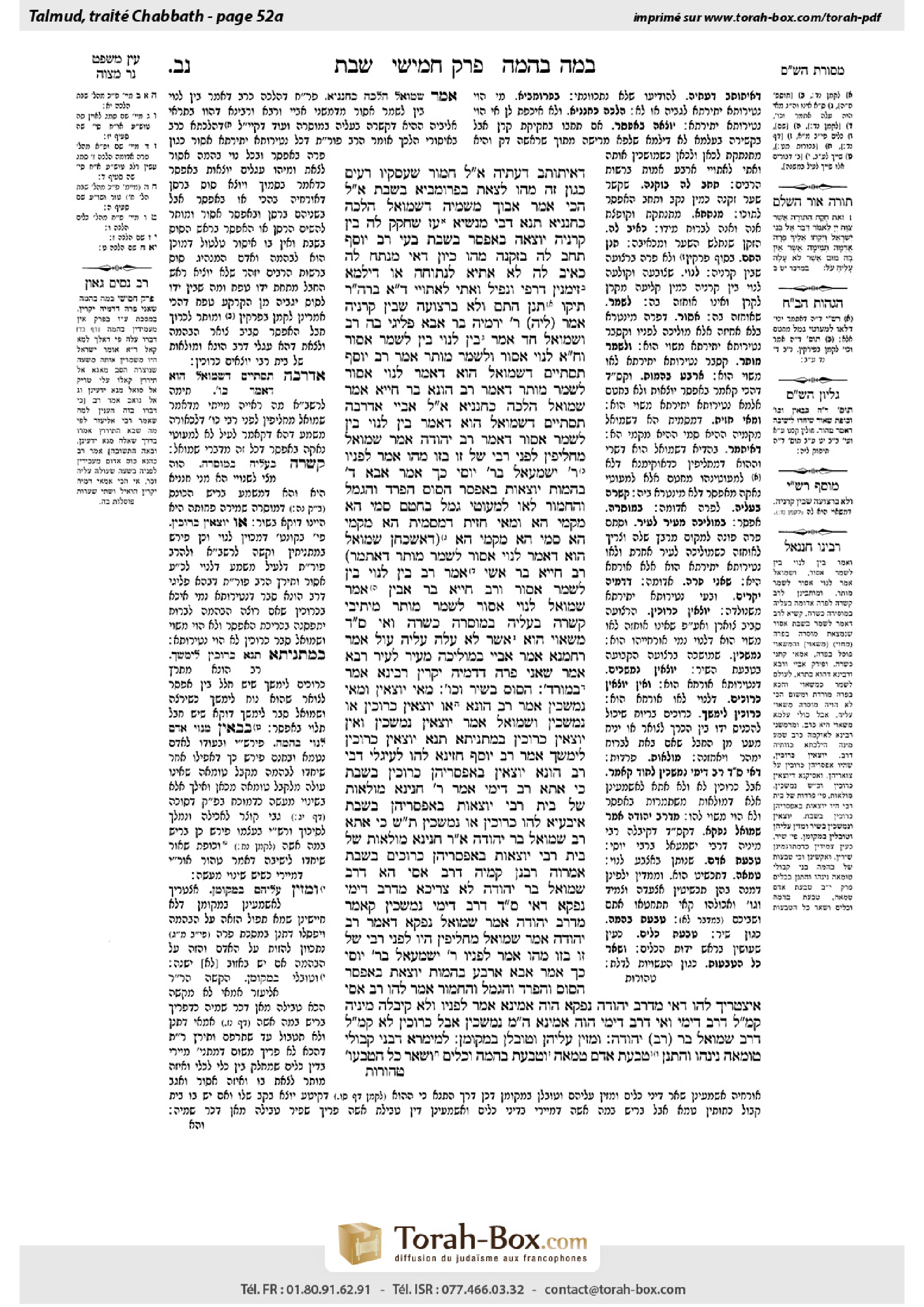
Shabbat 52a: Talmud study for Daf Yomi
Daf Yomi is the daily study of one Talmud folio. Explore 37 tractates with scans, Hebrew text, Sefaria English and AI-generated French translations where annotated.
Passage selection and English or AI-generated French translation are available where the scan has annotations. Daf Study is independent of Torah-Box and Sefaria.
Browse Shabbat · שבת · All tractatesShabbat 52a text and translations
This page of Shabbat includes the Aramaic text, an English translation and an AI-generated French translation, alongside the scan above.
שבת נ״ב א · Aramaic and Hebrew text
דְּתִיתּוֹתַב דַּעְתֵּיהּ. אֲמַר לֵיהּ: חֲמוֹר שֶׁעֲסָקָיו רָעִים כְּגוֹן זֶה, מַהוּ לָצֵאת בִּפְרוּמְבְּיָא בְּשַׁבָּת? אֲמַר לֵיהּ: הָכִי אֲמַר אֲבוּךְ מִשְּׁמֵיהּ דִּשְׁמוּאֵל: הֲלָכָה כַּחֲנַנְיָא.
תָּנָא דְּבֵי מְנַשְּׁיָא: עֵז שֶׁחָקַק לָהּ בֵּין קַרְנֶיהָ יוֹצְאָה בְּאַפְסָר בְּשַׁבָּת. בָּעֵי רַב יוֹסֵף: תָּחַב לָהּ בִּזְקָנָהּ מַהוּ? כֵּיוָן דְּאִי מְנַתַּח לַהּ כָּאֵיב לַהּ לָא אָתְיָא לְנַתּוֹחֵהּ, אוֹ דִילְמָא זִימְנִין דְּרָפֵי וְנָפֵיל, וְאָתֵי לְאֵתוּיֵי אַרְבַּע אַמּוֹת בִּרְשׁוּת הָרַבִּים. תֵּיקוּ.
תְּנַן הָתָם: וְלֹא בִּרְצוּעָה שֶׁבֵּין קַרְנֶיהָ. אָמַר (לֵיהּ) רַבִּי יִרְמְיָה בַּר אַבָּא: פְּלִיגִי בַּהּ רַב וּשְׁמוּאֵל. חַד אָמַר: בֵּין לְנוֹי בֵּין לְשַׁמֵּר — אָסוּר. וְחַד אָמַר: לְנוֹי — אָסוּר, וּלְשַׁמֵּר — מוּתָּר.
אָמַר רַב יוֹסֵף: תִּסְתַּיֵּים דִּשְׁמוּאֵל הוּא דְּאָמַר לְנוֹי אָסוּר, לְשַׁמֵּר מוּתָּר. דְּאָמַר רַב הוּנָא בַּר חִיָּיא אָמַר שְׁמוּאֵל: הֲלָכָה כַּחֲנַנְיָא.
אֲמַר לֵיהּ אַבָּיֵי: אַדְּרַבָּה, תִּסְתַּיֵּים דִּשְׁמוּאֵל הוּא דְּאָמַר בֵּין לְנוֹי בֵּין לְשַׁמֵּר — אָסוּר. דְּאָמַר רַב יְהוּדָה אָמַר שְׁמוּאֵל: מַחְלִיפִין לִפְנֵי רַבִּי, שֶׁל זוֹ בְּזוֹ מַהוּ? אָמַר לְפָנָיו רַבִּי יִשְׁמָעֵאל בְּרַבִּי יוֹסֵי, כָּךְ אָמַר אַבָּא: אַרְבַּע בְּהֵמוֹת יוֹצְאוֹת בְּאַפְסָר — הַסּוּס הַפֶּרֶד וְהַגָּמָל וְהַחֲמוֹר. לָאו לְמַעוֹטֵי גָּמָל בַּחֲטָם? סָמִי הָא מִקַּמֵּי הָא.
וּמַאי חֲזֵית דִּמְסַמֵּית הָא מִקַּמֵּי הָא? סָמִי הָא מִקַּמֵּי הָא! (דְּאַשְׁכְּחַן שְׁמוּאֵל הוּא דְּאָמַר לְנוֹי אָסוּר לְשַׁמֵּר מוּתָּר. דְּאִתְּמַר:) רַב חִיָּיא בַּר אָשֵׁי אָמַר רַב: בֵּין לְנוֹי בֵּין לְשַׁמֵּר — אָסוּר. וְרַב חִיָּיא בַּר אָבִין אָמַר שְׁמוּאֵל: לְנוֹי — אָסוּר, לְשַׁמֵּר — מוּתָּר.
מֵיתִיבִי: קְשָׁרָהּ בְּעָלֶיהָ בְּמוֹסֵרָה — כְּשֵׁרָה. וְאִי סָלְקָא דַעְתָּךְ מַשּׂאוֹי הוּא, ״אֲשֶׁר לֹא עָלָה עָלֶיהָ עוֹל״ אָמַר רַחֲמָנָא!
אָמַר אַבָּיֵי: בְּמוֹלִיכָהּ מֵעִיר לָעִיר. רָבָא אָמַר: שָׁאנֵי פָּרָה דְּדָמֶיהָ יְקָרִין. רָבִינָא אָמַר: בְּמוֹרֶדֶת.
הַסּוּס בְּשֵׁיר וְכוּ׳. מַאי ״יוֹצְאִין״? וּמַאי ״נִמְשָׁכִין״? אָמַר רַב הוּנָא: אוֹ יוֹצְאִין כְּרוּכִין, אוֹ נִמְשָׁכִין. וּשְׁמוּאֵל אָמַר: יוֹצְאִין נִמְשָׁכִין, וְאֵין יוֹצְאִין כְּרוּכִין.
בְּמַתְנִיתָא תָּנָא: יוֹצְאִין כְּרוּכִין לִימָּשֵׁךְ. אָמַר רַב יוֹסֵף: חֲזֵינָא לְהוּ לְעִיגְלֵי דְּבֵי רַב הוּנָא יוֹצְאִין בְּאַפְסְרֵיהֶן כְּרוּכִין בְּשַׁבָּת.
כִּי אֲתָא רַב דִּימִי אָמַר רַבִּי חֲנִינָא: מוּלָאוֹת שֶׁל בֵּית רַבִּי יוֹצְאוֹת בְּאַפְסְרֵיהֶן בְּשַׁבָּת. אִיבַּעְיָא לְהוּ: כְּרוּכִין אוֹ נִמְשָׁכִין?
תָּא שְׁמַע, כִּי אֲתָא רַב שְׁמוּאֵל בַּר יְהוּדָה אֲמַר רַבִּי חֲנִינָא: מוּלָאוֹת שֶׁל בֵּית רַבִּי יוֹצְאוֹת בְּאַפְסְרֵיהֶן כְּרוּכִים בְּשַׁבָּת.
אַמְרוּהָ רַבָּנַן קַמֵּיהּ דְּרַב אַסִּי: הָא דְּרַב שְׁמוּאֵל בַּר יְהוּדָה לָא צְרִיכָא, מִדְּרַב דִּימִי נָפְקָא. דְּאִי סָלְקָא דַעְתָּךְ דְּרַב דִּימִי ״נִמְשָׁכִין״ קָאָמַר, מִדְּרַב יְהוּדָה אָמַר שְׁמוּאֵל נָפְקָא.
דְּאָמַר רַב יְהוּדָה אָמַר שְׁמוּאֵל: מַחְלִיפִין הָיוּ לִפְנֵי רַבִּי, שֶׁל זוֹ בָּזוֹ מַהוּ? אָמַר לְפָנָיו רַבִּי יִשְׁמָעֵאל בְּרַבִּי יוֹסֵי, כָּךְ אָמַר אַבָּא: אַרְבַּע בְּהֵמוֹת יוֹצֵאת בָּאַפְסָר, הַסּוּס וְהַפֶּרֶד וְהַגָּמָל וְהַחֲמוֹר.
אֲמַר לְהוּ רַב אַסִּי: אִיצְטְרִיךְ לְהוּ. דְּאִי מִדְּרַב יְהוּדָה נָפְקָא, הֲוָה אָמֵינָא: אָמַר לְפָנָיו וְלָא קַיבְּלַהּ מִינֵּיהּ. קָא מַשְׁמַע לַן דְּרַב דִּימִי.
וְאִי דְּרַב דִּימִי, הֲוָה אָמֵינָא: הָנֵי מִילֵּי נִמְשָׁכִין, אֲבָל כְּרוּכִין — לָא, קָא מַשְׁמַע לַן דְּרַב שְׁמוּאֵל בַּר רַב יְהוּדָה.
וּמַזִּין עֲלֵיהֶן וְטוֹבְלָן בִּמְקוֹמָן. לְמֵימְרָא דִּבְנֵי קַבּוֹלֵי טוּמְאָה נִינְהוּ? וְהָתְנַן: טַבַּעַת אָדָם — טְמֵאָה, וְטַבַּעַת בְּהֵמָה וְכֵלִים וּשְׁאָר כׇּל הַטַּבָּעוֹת —
Shabbat 52a · English translation
he will be placated and will understand that it was not my intention to disrespect him. He said to him: An undisciplined donkey whose conduct is wicked like this one that I am riding, what is the ruling with regard to having it go out with a halter on Shabbat? Typically, in order to secure a donkey, a bit suffices and it does not require a halter. A halter constitutes excessive security. However, the question is whether or not a halter that provides excessive security for a wild donkey like this one is considered a burden with which it is prohibited to go out to the public domain on Shabbat. Rabba bar Rav Huna said to him: Even if the security is considered extraneous, your father said the following in the name of Shmuel: The halakha is in accordance with the opinion of Ḥananya, who said that a device that provides excessive security is not considered a burden.
A Sage of the school of Menashiya taught a baraita: A goat in which one carved out a hole between its horns may go out with a bit on Shabbat. Because the bit is inserted through the hole, it will not become detached. Rav Yosef raised a dilemma: What is the ruling in a case where one inserted the bit through the goat’s beard? The Gemara explains the dilemma: Is the halakha that since, if the goat attempts to sever itself from the bit, it would cause it pain because the bit is attached to its beard, and therefore it will not come to sever it and the bit will remain in place? Or perhaps is the halakha that sometimes the knot will loosen and the bit will fall, and the goat’s owner will come to bring the bit and carry it four cubits in the public domain? No resolution was found to this dilemma. Let it stand unresolved.
We learned there in a mishna: And neither may a cow go out with a strap between its horns. Rabbi Yirmeya bar Abba said: Rav and Shmuel disagreed about this: One said: Whether it was placed for beauty, as an ornament, or whether it was placed to secure the cow, it is prohibited for the cow to go out with the strap between its horns. And the other one said: For beauty, it is prohibited; however, if it was placed to secure the cow, it is permitted.
Rav Yosef said: Conclude that Shmuel is the one who said that if the strap was placed for beauty it is prohibited; however, if it was placed to secure the cow it is permitted. As Rav Huna bar Ḥiyya said that Shmuel said: The halakha is in accordance with the opinion of Ḥananya: A device that provides excessive security is not considered a burden. Therefore, an animal may go out on Shabbat with straps that provide excessive security.
Abaye said to him: On the contrary, conclude that Shmuel is the one who said that whether it was placed for beauty, as an ornament, or whether it was placed to secure the cow, it is prohibited. As Rav Yehuda said that Shmuel said: The students exchanged the details in the mishna before Rabbi Yehuda HaNasi and asked: What is the halakha with regard to this animal going out into the public domain with that which is permitted for that animal? And Rabbi Yishmael, son of Rabbi Yosei, said before Rabbi Yehuda HaNasi: So said father, Rabbi Yosei: Four animals may go out with a bit: The horse, the mule, and the camel, and the donkey. Does this list not come to exclude a camel going out with a nose ring, as a nose ring provides excessive security beyond that required for a camel? Apparently, according to Shmuel, an animal may not go out on Shabbat with a device that provides excessive security, as it is considered a burden. Rav Yosef said to him: Delete this latter statement of Shmuel due to that first one.
The Gemara asks: And what did you see that led you to delete this latter statement due that first one? Delete that first statement due to this latter one. The Gemara explains: The first statement is supported as we find that Shmuel is the one who said : For beauty, it is prohibited; however, if it was placed to secure the cow, it is permitted, as it was stated that Rav Ḥiyya bar Ashi said that Rav said: Whether the strap was placed for beauty, or whether it was placed to secure the cow, it is prohibited. And Rav Ḥiyya bar Avin said that Shmuel said: For beauty, it is prohibited; however, if it was placed to secure the cow, it is permitted.
The Gemara raises an objection from a baraita: If its owner tied a red heifer with its reins that are attached to the bit, it remains fit for use in the purification ritual. And if it should enter your mind to say that a bit is considered a burden, why does a red heifer remain fit for use? The Torah explicitly stated: “Speak to the children of Israel, that they bring you a red heifer without defect, in which there is no blemish, and upon which never came a yoke” (Numbers 19:2). A red heifer is disqualified by a burden.
Abaye said: There, the baraita is referring to the case of a red heifer whose owner is leading it from city to city. When the animal is removed from its habitat, it requires additional security. In that case, tying the heifer with its reins is conventional rather than excessive security. Therefore, the bit is not considered a burden. Rava said: A red heifer, whose monetary value is high, is different and therefore secured more carefully than other cows. Ravina said: The baraita is referring to a red heifer that is rebellious and headstrong. Therefore, it requires added security.
We learned in the mishna: A horse may go out with a chain around its neck, and so too, all animals that typically have chains around their necks when they go out to the public domain may go out with chains on Shabbat and may be pulled by the chains. The Gemara asks: What is the meaning of: May go out, and what is the meaning of: May be pulled? Rav Huna said: These animals may go out either with the chain wrapped around their necks as an ornament, or they may be pulled by the chain. And Shmuel said: These animals may go out pulled by the chain; however, they may not go out with the chain wrapped around their necks as an ornament.
It was taught in a baraita: They may go out with the chains loosely wrapped around their necks, so that if the need arises, the animals will be able to be pulled by their chains. Rav Yosef said: I saw the calves of the house of Rav Huna go out into the public domain on Shabbat with their bits and with the reins wrapped around their necks.
When Rav Dimi came from Eretz Yisrael to Babylonia, he said that Rabbi Ḥanina said: The mules of the house of Rabbi Yehuda HaNasi go out into the public domain with their bits on Shabbat. A dilemma was raised before the Sages: Does this mean that the mules went out with their bits and reins wrapped around their necks; or, does it mean that they were pulled by the reins?
Come and hear a resolution to this dilemma from the following incident: When Rav Shmuel bar Yehuda came from Eretz Yisrael to Babylonia, he said that Rabbi Ḥanina said: The mules [molaot] of the house of Rabbi Yehuda HaNasi went out on Shabbat with their bits with the reins wrapped around their necks.
The Sages said before Rav Asi: That statement of Rav Shmuel bar Yehuda is not necessary. It may be derived from the statement of Rav Dimi. As, if it would enter your mind to say that Rav Dimi said that the mules of the house of Rabbi Yehuda HaNasi went out on Shabbat pulled by their bits, it is difficult. There is nothing novel in that statement, as it may be derived from the statement that Rav Yehuda said that Shmuel said.
As Rav Yehuda said that Shmuel said: The students switched the details in the mishna before Rabbi Yehuda HaNasi, and asked: What is the halakha with regard to this animal going out into the public domain with that which is permitted for that animal? And Rabbi Yishmael, son of Rabbi Yosei, said before Rabbi Yehuda HaNasi: So said father, four animals may go out with a bit: The horse, and the mule, and the camel, and the donkey. Apparently, according to Rabbi Yehuda HaNasi, a mule may go out on Shabbat pulled by its bit.
Rav Asi said to them: This statement of Rav Shmuel bar Yehuda is necessary, as if it were derived from the statement of Rav Yehuda, who related that which Rabbi Yishmael, son of Rabbi Yosei, said before Rabbi Yehuda HaNasi, I would have said that Rabbi Yishmael, son of Rabbi Yosei, said that before him, and Rabbi Yehuda HaNasi did not accept it from him. Therefore, that statement of Rav Dimi teaches us that Rabbi Yehuda HaNasi indeed accepted it from Rabbi Yishmael and his mules went out with their bits on Shabbat.
And if it had been derived only from the statement of Rav Dimi, I would have said that this applies only when the mule is pulled by its bit; however, if the reins are merely wrapped around the animal’s neck, no, the animal may not go out with it. Therefore, that statement of Rav Shmuel bar Rav Yehuda teaches us that the mules of the house of Rabbi Yehuda HaNasi went out on Shabbat with their reins wrapped around their necks.
It was further taught in our mishna: If these chains contracted ritual impurity, one may sprinkle water of purification on them and immerse them in their place on the animal. The Gemara asks: Is that to say that these chains are fit to contract ritual impurity? Didn’t we learn in a mishna: A ring worn by a person is ritually impure. However, the ring of an animal, and rings of utensils, and all other rings not worn by people
Shabbat 52a · Traduction française (IA)
Il sera apaisé et comprendra que je n’avais pas l’intention de lui manquer de respect. Il lui demanda : « Un âne indiscipliné, aussi mauvais que celui que je monte, quelle est la halakha quant au fait de le faire sortir avec un licol pendant Chabbat ? » En général, un mors suffit pour retenir un âne, qui n’a pas besoin de licol. Un licol constitue un dispositif de sécurité excessif. La question est toutefois de savoir si un licol qui assure une sécurité excessive à un âne aussi sauvage que celui-ci est considéré comme une charge qu’il est interdit de porter dans le domaine public pendant Chabbat. Rabba bar Rav Huna lui répondit : « Même si cette sécurité est considérée comme superflue, ton père a dit ceci au nom de Shmuel : la halakha suit l’opinion de Ḥananya, selon laquelle un dispositif assurant une sécurité excessive n’est pas considéré comme une charge. »
Un sage de l’école de Menashiya enseigna une baraïta : une chèvre à laquelle on a percé un trou entre les cornes peut sortir avec un mors pendant Chabbat. Comme le mors passe dans le trou, il ne se détachera pas. Rav Yosef souleva un dilemme : quelle est la halakha si l’on a passé le mors dans la barbe de la chèvre ? La Guemara expose le dilemme : la halakha est-elle que, puisque la chèvre aurait mal si elle tentait de se dégager du mors, celui-ci étant attaché à sa barbe, elle ne tentera pas de le faire et le mors restera donc en place ? Ou bien la halakha est-elle que le nœud peut parfois se desserrer et le mors tomber, auquel cas le propriétaire de la chèvre viendrait le ramasser et le transporterait sur une distance de quatre coudées dans le domaine public ? Ce dilemme n’a pas été résolu. Qu’il reste donc sans réponse.
Nous avons appris dans une Michna, là-bas : une vache ne peut pas non plus sortir avec une sangle entre les cornes. Rabbi Yirmeya bar Abba dit : Rav et Shmuel sont en désaccord à ce sujet. L’un dit : que la sangle ait été mise pour la beauté, comme ornement, ou pour retenir la vache, il lui est interdit de sortir avec. L’autre dit : si elle a été mise pour la beauté, c’est interdit ; mais si elle a été mise pour retenir la vache, c’est permis.
Rav Yosef dit : on peut conclure que Shmuel est celui qui a dit que, si la sangle a été mise pour la beauté, c’est interdit, mais que, si elle a été mise pour retenir la vache, c’est permis. En effet, Rav Huna bar Ḥiyya a dit au nom de Shmuel : la halakha suit l’opinion de Ḥananya, selon laquelle un dispositif assurant une sécurité excessive n’est pas considéré comme une charge. Par conséquent, un animal peut sortir pendant Chabbat avec des sangles qui assurent une sécurité excessive.
Abaye lui dit : « Au contraire, on peut conclure que Shmuel est celui qui a dit que, que la sangle ait été mise pour la beauté, comme ornement, ou pour retenir la vache, il est interdit à celle-ci de sortir avec. » En effet, Rav Yehuda a dit au nom de Shmuel : les élèves échangèrent les détails de la Michna devant Rabbi Yehuda HaNassi et demandèrent : « Quelle est la halakha quant au fait que cet animal sorte dans le domaine public avec ce qui est permis pour cet animal ? » Rabbi Yishmael, fils de Rabbi Yosei, dit devant Rabbi Yehuda HaNassi : « Mon père, Rabbi Yosei, a dit ceci : quatre animaux peuvent sortir avec un mors : le cheval, le mulet, le chameau et l’âne. » Cette liste n’a-t-elle pas pour but d’exclure le chameau qui sortirait avec un anneau nasal, puisque celui-ci assure une sécurité excessive par rapport à celle dont un chameau a besoin ? Apparemment, selon Shmuel, un animal ne peut pas sortir pendant Chabbat avec un dispositif assurant une sécurité excessive, car il est considéré comme une charge. Rav Yosef lui dit : « Écarte cette dernière déclaration de Shmuel à cause de la première. »
La Guemara demande : qu’est-ce qui t’a amené à écarter cette dernière déclaration à cause de la première ? Écarte plutôt la première à cause de la dernière. La Guemara explique : la première déclaration est étayée, car nous constatons que Shmuel est celui qui a dit : « Si la sangle a été mise pour la beauté, c’est interdit ; mais si elle a été mise pour retenir la vache, c’est permis. » En effet, Rav Ḥiyya bar Ashi a dit au nom de Rav : « Que la sangle ait été mise pour la beauté ou pour retenir la vache, il est interdit de sortir avec. » Et Rav Ḥiyya bar Avin a dit au nom de Shmuel : « Si elle a été mise pour la beauté, c’est interdit ; mais si elle a été mise pour retenir la vache, c’est permis. »
La Guemara soulève une objection à partir d’une baraïta : si le propriétaire a attaché une génisse rousse avec ses rênes fixées au mors, elle reste apte au rituel de purification. Et si l’on devait penser qu’un mors est considéré comme une charge, pourquoi la génisse rousse resterait-elle apte ? La Torah a explicitement dit : « Parle aux enfants d’Israël afin qu’ils t’amènent une génisse rousse sans défaut, sans imperfection, et qui n’a jamais porté de joug » (Nombres 19:2). Une génisse rousse est disqualifiée par une charge.
Abaye dit : là, la baraïta parle du cas d’une génisse rousse que son propriétaire conduit d’une ville à une autre. Lorsqu’on éloigne l’animal de son habitat, il a besoin d’une sécurité supplémentaire. Dans ce cas, attacher la génisse avec ses rênes est une pratique habituelle, et non une sécurité excessive. Le mors n’est donc pas considéré comme une charge. Rava dit : la génisse rousse, dont la valeur monétaire est élevée, est un cas particulier et est donc sécurisée plus soigneusement que les autres vaches. Ravina dit : la baraïta parle d’une génisse rousse rebelle et entêtée ; elle a donc besoin d’une sécurité supplémentaire.
Nous avons appris dans la Michna : un cheval peut sortir avec une chaîne autour du cou ; de même, tous les animaux qui portent habituellement une chaîne autour du cou lorsqu’ils sortent dans le domaine public peuvent sortir avec une chaîne pendant Chabbat et être tirés par elle. La Guemara demande : que signifie « peuvent sortir », et que signifie « être tirés » ? Rav Huna dit : ces animaux peuvent sortir avec la chaîne enroulée autour du cou comme ornement, ou être tirés par la chaîne. Shmuel dit : ces animaux peuvent sortir lorsqu’on les tire par la chaîne, mais ils ne peuvent pas sortir avec la chaîne enroulée autour du cou comme ornement.
Il a été enseigné dans une baraïta : ils peuvent sortir avec les chaînes lâchement enroulées autour du cou, afin que, si le besoin s’en présente, on puisse les tirer par leurs chaînes. Rav Yosef dit : « J’ai vu les veaux de la maison de Rav Huna sortir dans le domaine public pendant Chabbat avec leurs mors et les rênes enroulées autour du cou. »
Lorsque Rav Dimi vint d’Eretz Israël en Babylonie, il rapporta que Rabbi Ḥanina avait dit : « Les mulets de la maison de Rabbi Yehuda HaNassi sortent dans le domaine public avec leurs mors pendant Chabbat. » Les Sages soulevèrent un dilemme : cela signifie-t-il que les mulets sortaient avec leurs mors et les rênes enroulées autour du cou, ou bien qu’on les tirait par les rênes ?
Viens et entends la résolution de ce dilemme à partir de l’incident suivant : lorsque Rav Shmuel bar Yehuda vint d’Eretz Israël en Babylonie, il rapporta que Rabbi Ḥanina avait dit : « Les mulets [molaot] de la maison de Rabbi Yehuda HaNassi sortaient pendant Chabbat avec leurs mors et les rênes enroulées autour du cou. »
Les Sages dirent devant Rav Asi : « Cette déclaration de Rav Shmuel bar Yehuda n’est pas nécessaire ; on peut la déduire de la déclaration de Rav Dimi. En effet, si l’on devait penser que Rav Dimi a dit que les mulets de la maison de Rabbi Yehuda HaNassi sortaient pendant Chabbat tirés par leurs mors, cela poserait difficulté. Cette déclaration n’apporterait rien de nouveau, car on pourrait la déduire de la déclaration de Rav Yehuda, qui a dit au nom de Shmuel. »
En effet, Rav Yehuda a dit au nom de Shmuel : « Les élèves échangèrent les détails de la Michna devant Rabbi Yehuda HaNassi et demandèrent : “Quelle est la halakha quant au fait que cet animal sorte dans le domaine public avec ce qui est permis pour cet animal ?” Rabbi Yishmael, fils de Rabbi Yosei, dit devant Rabbi Yehuda HaNassi : “Mon père a dit ceci : quatre animaux peuvent sortir avec un mors : le cheval, le mulet, le chameau et l’âne.” » Apparemment, selon Rabbi Yehuda HaNassi, un mulet peut sortir pendant Chabbat lorsqu’on le tire par son mors.
Rav Asi leur dit : « Cette déclaration de Rav Shmuel bar Yehuda est nécessaire, car si je ne l’avais déduite que de la déclaration de Rav Yehuda, qui rapportait les propos de Rabbi Yishmael, fils de Rabbi Yosei, devant Rabbi Yehuda HaNassi, j’aurais dit que Rabbi Yishmael, fils de Rabbi Yosei, avait tenu ces propos devant lui, mais que Rabbi Yehuda HaNassi ne les avait pas acceptés de sa part. La déclaration de Rav Dimi nous apprend donc que Rabbi Yehuda HaNassi les a bel et bien acceptés de Rabbi Yishmael et que ses mulets sortaient avec leurs mors pendant Chabbat. »
« Et si je ne l’avais déduite que de la déclaration de Rav Dimi, j’aurais dit que cela ne s’applique que lorsque le mulet est tiré par son mors ; mais si les rênes sont simplement enroulées autour du cou de l’animal, alors non, il ne peut pas sortir avec. La déclaration de Rav Shmuel bar Rav Yehuda nous apprend donc que les mulets de la maison de Rabbi Yehuda HaNassi sortaient pendant Chabbat avec leurs rênes enroulées autour du cou. »
Il a également été enseigné dans notre Michna : si ces chaînes ont contracté l’impureté rituelle, on peut les asperger d’eau de purification et les immerger sur place, alors qu’elles sont sur l’animal. La Guemara demande : cela signifie-t-il que ces chaînes peuvent contracter l’impureté rituelle ? N’avons-nous pas appris dans une Michna : une bague portée par une personne est rituellement impure. En revanche, la bague d’un animal, les bagues d’ustensiles et toutes les autres bagues qui ne sont pas portées par des personnes
Traduction française générée par IA à partir de l’édition anglaise de Sefaria. Vérifie toujours un passage avec le texte source.
Text from Sefaria: William Davidson Edition - Vocalized Aramaic (CC BY NC); William Davidson Edition - English (CC BY NC).