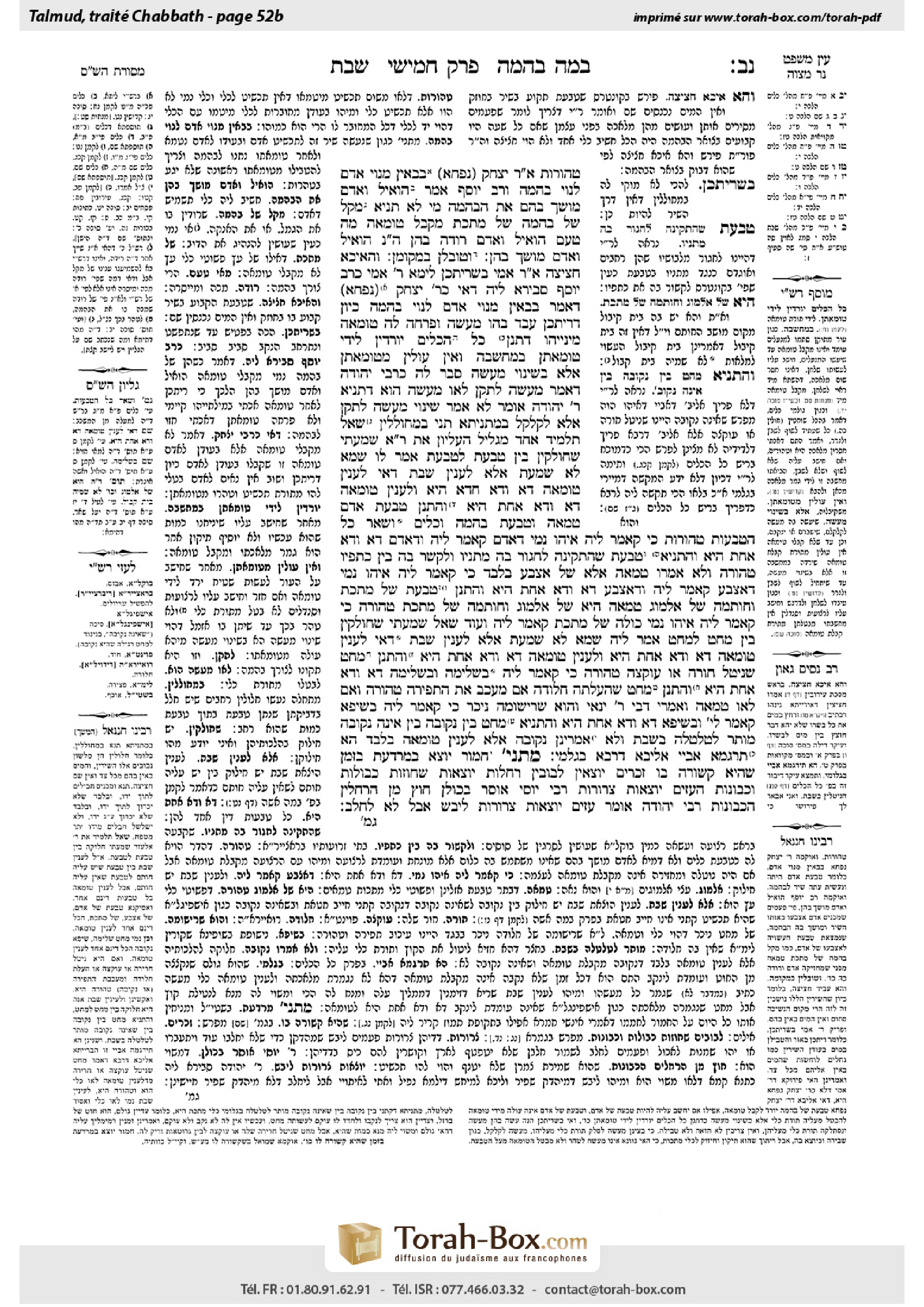
Shabbat 52b: Talmud study for Daf Yomi
Daf Yomi is the daily study of one Talmud folio. Explore 37 tractates with scans, Hebrew text, Sefaria English and AI-generated French translations where annotated.
Passage selection and English or AI-generated French translation are available where the scan has annotations. Daf Study is independent of Torah-Box and Sefaria.
Browse Shabbat · שבת · All tractatesShabbat 52b text and translations
This page of Shabbat includes the Aramaic text, an English translation and an AI-generated French translation, alongside the scan above.
שבת נ״ב ב · Aramaic and Hebrew text
טְהוֹרוֹת.
אָמַר רַבִּי יִצְחָק נַפָּחָא: בְּבָאִין מִנּוֹי אָדָם לְנוֹי בְּהֵמָה.
וְרַב יוֹסֵף אָמַר: הוֹאִיל וְאָדָם מוֹשֵׁךְ בָּהֶם אֶת הַבְּהֵמָה. מִי לָא תַּנְיָא: מַקֵּל שֶׁל בְּהֵמָה, שֶׁל מַתֶּכֶת מְקַבֵּל טוּמְאָה. מַה טַּעַם? — הוֹאִיל וְאָדָם רוֹדָהּ בָּהֶן. הָכָא נָמֵי, הוֹאִיל וְאָדָם מוֹשֵׁךְ בָּהֶן.
וְטוֹבְלָן בִּמְקוֹמָן: וְהָאִיכָּא חֲצִיצָה!
אָמַר רַבִּי אַמֵּי: בְּשֶׁרִיתְּכָן.
לֵימָא רַבִּי אַמֵּי כְּרַב יוֹסֵף סְבִירָא לֵיהּ, דְּאִי כְּרַבִּי יִצְחָק נַפָּחָא, דְּאָמַר: בְּבָאִין מִנּוֹי אָדָם לְנוֹי בְּהֵמָה — כֵּיוָן דְּרִיתְּכָן, עֲבַד בְּהוּ מַעֲשֶׂה וּפְרַחָה לַהּ טוּמְאָה מִינַּיְיהוּ.
דִּתְנַן: כׇּל הַכֵּלִים יוֹרְדִין לִידֵי טוּמְאָתָן בְּמַחְשָׁבָה, וְאֵין עוֹלִין מִטּוּמְאָתָן אֶלָּא בְּשִׁינּוּי מַעֲשֶׂה!
סָבַר לַהּ כְּרַבִּי יְהוּדָה דְּאָמַר מַעֲשֶׂה לְתַקֵּן לָאו מַעֲשֶׂה הוּא. דְּתַנְיָא, רַבִּי יְהוּדָה אוֹמֵר: לֹא אָמְרוּ שִׁינּוּי מַעֲשֶׂה לְתַקֵּן אֶלָּא לְקַלְקֵל.
בְּמַתְנִיתָא תָּנֵי בִּמְחוּלָּלִין.
שָׁאַל תַּלְמִיד אֶחָד מִגָּלִיל הָעֶלְיוֹן אֶת רַבִּי אֱלִיעֶזֶר: שָׁמַעְתִּי שֶׁחוֹלְקִין בֵּין טַבַּעַת לְטַבַּעַת. אָמַר לוֹ: שֶׁמָּא לֹא שָׁמַעְתָּ אֶלָּא לְעִנְיַן שַׁבָּת. דְּאִי לְעִנְיַן טוּמְאָה, דָּא וְדָא חֲדָא הִיא.
וּלְעִנְיַן טוּמְאָה דָּא וְדָא אַחַת הִיא? וְהָתְנַן: טַבַּעַת אָדָם טְמֵאָה, וְטַבַּעַת בְּהֵמָה וְכֵלִים וּשְׁאָר כׇּל הַטַּבָּעוֹת טְהוֹרוֹת! כִּי קָאָמַר לֵיהּ אִיהוּ, נָמֵי דְּאָדָם קָאָמַר לֵיהּ.
וּדְאָדָם, דָּא וְדָא אַחַת הִיא? וְהָתַנְיָא: טַבַּעַת שֶׁהִתְקִינָה לַחְגּוֹר בָּהּ מׇתְנָיו וּלְקַשֵּׁר בָּהּ בֵּין כְּתֵפָיו — טְהוֹרָה, וְלֹא אָמְרוּ טְמֵאָה אֶלָּא שֶׁל אֶצְבַּע בִּלְבַד! כִּי קָאָמַר לֵיהּ אִיהוּ, נָמֵי דְּאֶצְבַּע קָאָמַר לֵיהּ.
וּדְאֶצְבַּע דָּא וְדָא אַחַת הִיא? וְהָתְנַן: טַבַּעַת שֶׁל מַתֶּכֶת וְחוֹתָמָהּ שֶׁל אַלְמוֹג — טְמֵאָה. הִיא שֶׁל אַלְמוֹג וְחוֹתָמָהּ שֶׁל מַתֶּכֶת — טְהוֹרָה! כִּי קָאָמַר לֵיהּ אִיהוּ, נָמֵי כּוּלָּהּ שֶׁל מַתֶּכֶת קָאָמַר לֵיהּ.
וְעוֹד שָׁאַל: שָׁמַעְתִּי שֶׁחוֹלְקִין בֵּין מַחַט לְמַחַט. אָמַר לוֹ: שֶׁמָּא לֹא שָׁמְעַתְּ אֶלָּא לְעִנְיַן שַׁבָּת, דְּאִי לְעִנְיַן טוּמְאָה דָּא וְדָא אַחַת הִיא.
וּלְעִנְיַן טוּמְאָה דָּא וְדָא אַחַת הִיא? וְהָתְנַן: מַחַט שֶׁנִּיטַּל חוֹרָהּ אוֹ עוּקְצָהּ — טְהוֹרָה! כִּי קָאָמַר לֵיהּ בִּשְׁלֵימָה.
וּבִשְׁלֵימָה דָּא וְדָא אַחַת הִיא? וְהָתְנַן: מַחַט שֶׁהֶעֶלְתָה חֲלוּדָה, אִם מְעַכֵּב אֶת הַתְּפִירָה — טְהוֹרָה, וְאִם לָאו — טְמֵאָה. וְאָמְרִי דְּבֵי רַבִּי יַנַּאי: וְהוּא שֶׁרִישּׁוּמָהּ נִיכָּר! כִּי קָאָמַר לֵיהּ, בְּשִׁיפָא קָאָמַר לֵיהּ.
וּבְשִׁיפָא דָּא וְדָא אַחַת הִיא? וְהָתַנְיָא: מַחַט בֵּין נְקוּבָה בֵּין אֵינָהּ נְקוּבָה מוּתָּר לְטַלְטְלָהּ בְּשַׁבָּת, וְלָא אָמְרִינַן נְקוּבָה אֶלָּא לְעִנְיַן טוּמְאָה בִּלְבַד!
הָא תַּרְגְּמַהּ אַבָּיֵי אַלִּיבָּא דְּרָבָא — בְּגֻלְמֵי.
מַתְנִי׳ חֲמוֹר יוֹצֵא בַּמַּרְדַּעַת בִּזְמַן שֶׁהִיא קְשׁוּרָה בּוֹ. זְכָרִים יוֹצְאִין לְבוּבִין. רְחֵלוֹת יוֹצְאוֹת שְׁחוּזוֹת, כְּבוּלוֹת וּכְבוּנוֹת. הָעִזִּים יוֹצְאוֹת צְרוּרוֹת. רַבִּי יוֹסֵי אוֹסֵר בְּכוּלָּן, חוּץ מִן הָרְחֵלִין הַכְּבוּנוֹת.
רַבִּי יְהוּדָה אוֹמֵר: עִזִּים יוֹצְאוֹת צְרוּרוֹת לְיַבֵּשׁ, אֲבָל לֹא לֵחָלֵב.
Shabbat 52b · English translation
are ritually pure.
Rabbi Yitzḥak Nappaḥa said: Our mishna is referring to ornaments that were transformed from their original designation for a person’s adornment to an ornament designated for an animal’s adornment. They had once belonged to a person who later affixed them in order to attach a strap to an animal. Their original ritual impurity does not cease when they are attached to the animal.
And Rav Yosef said: Animals’ rings can become ritually impure since a person pulls his animal with them. Consequently, they are considered utensils used by people. Wasn’t it taught in a baraita: The metal animal prod becomes ritually impure? What is the reason that it becomes ritually impure even though it is an animal’s utensil? Since a person subjugates his animal with it, it is regarded as a utensil for use by a person; therefore, it can become ritually impure. Here too, with regard to chains, since a person pulls his animal with them, they are regarded as utensils for use by a person.
And we learned in our mishna: If the animals’ chains became ritually impure, one may immerse them while they are in their place on the animal, and they need not first be removed. The Gemara raises a question: Isn’t this an obstruction that renders the immersion invalid? The rings of the chain are firmly attached to the chain, and there is no room for the water of the ritual bath to completely surround the chain.
Rabbi Ami said: The mishna is referring to a case where he struck the rings of the chain with a hammer, widening them and thereby creating sufficient space to allow the water to surround the chain on all sides.
The Gemara asks: Let us say that Rabbi Ami holds in accordance with the opinion of Rav Yosef. As, if he held in accordance with the opinion of Rabbi Yitzḥak Nappaḥa, who said that our mishna is referring to ornaments that were transformed from their original designation for a person’s adornment to an ornament designated for an animal’s adornment, and therefore they can be ritually impure with impurity contracted while it was still a person’s ornament, it is difficult. Since he struck the chain, he performed an action which altered its identity, and the impurity would have ceased even without immersion.
As we learned in a mishna: All vessels descend into their state of ritual impurity by means of thought. Even though an unfinished vessel cannot become ritually impure, if the craftsman decided not to complete it, it immediately assumes the legal status of a completed vessel and can become ritually impure. However, they only ascend from their state of ritual impurity by means of a change resulting from an action. A ritually impure vessel, once it undergoes physical change, is no longer ritually impure. Hammering the rings is an action that effects physical change. Therefore, the chain should be ritually pure without immersion.
The Gemara rejects this argument: Actually, Rabbi Ami could interpret the mishna just as Rabbi Yitzḥak Nappaḥa did, as he holds in accordance with the opinion of Rabbi Yehuda, who said that an action performed to enhance a utensil is not an action capable of ridding that utensil of its ritual impurity, as it was taught in a baraita: Rabbi Yehuda said: He did not say that an action that effects a physical change purifies a utensil of its ritual impurity with regard to an action performed to enhance a utensil; rather, he made his statement with regard to an action performed to ruin the utensil.
It was taught in a baraita: The mishna is referring to a case where the rings attached to the chain are well spaced so that the water completely surrounds the rings of the chain with no obstruction.
It was taught in the Tosefta: A certain disciple from the Upper Galilee asked Rabbi Eliezer: I heard that one distinguishes between one type of ring and another type of ring. However, I do not know with regard to what halakha this distinction is made. Rabbi Eliezer said to him: Perhaps you only heard that distinction with regard to the matter of Shabbat; a ring for adornment may be moved on Shabbat and other rings may not. As, with regard to the matter of ritual impurity, this ring and that ring are one and the same, and there is no distinction between them.
The Gemara raises an objection: And with regard to the matter of ritual impurity, are this and that one and the same? Didn’t we learn in a mishna: A ring worn by a person is ritually impure; however, the ring of an animal, and that of utensils, and all other rings not worn by people are ritually pure? Apparently, a distinction is made between different types of rings with regard to the halakhot of ritual impurity as well. The Gemara answers: When Rabbi Eliezer was saying that statement to the disciple, he too was saying to him that with regard to ritual impurity there is no distinction between different types of rings worn by a person.
The Gemara raises another objection: And with regard to rings worn by a person, are this and that one and the same? Wasn’t it taught in a baraita: A ring that one fashioned into a buckle at the end of a belt to wear it around his waist, or into a clasp to tie garments between his shoulders, is ritually pure? The Sages only said that a ring is ritually impure with regard to a ring worn on a person’s finger. Apparently, there is in fact a distinction between different rings worn by a person. The Gemara answers: When Rabbi Eliezer was saying that statement to the disciple, he too was saying to him that there is no distinction between different types of rings worn on a person’s finger.
The Gemara raises yet another objection: And with regard to rings worn on a person’s finger, are this and that one and the same? Didn’t we learn in a mishna: A ring made of metal and its seal is made of coral, is ritually impure? The primary component of the ring, metal, is the determining factor, and a metal utensil can become ritually impure. However, a ring that is made of coral and its seal is made of metal is ritually pure. Apparently, there is a distinction between different types of finger rings with regard to ritual impurity. The Gemara answers: When Rabbi Eliezer was saying that statement to the disciple, he too was saying to him that there is no distinction between different types of rings that are made entirely of metal.
And furthermore, that same disciple asked: I heard that one distinguishes between one type of needle and another type of needle. Still, I do not know with regard to what halakha this distinction is made. Rabbi Eliezer said to him: Perhaps you only heard that distinction with regard to Shabbat. With regard to the prohibition of carrying from a private to a public domain, or vice versa, there is a distinction between a needle with an eye, for which one is liable to bring a sin-offering, and one without an eye, for which one is not. As, if you were to suggest that the distinction is with regard to ritual impurity, this, a needle with an eye, and that, a needle without an eye, are one and the same, and there is no distinction between them.
The Gemara raises an objection: And with regard to the matter of ritual impurity, are this and that one and the same? Are all needles alike? Didn’t we learn in a mishna: A needle whose eye or whose point was removed is ritually pure, as it is no longer fit for use? Apparently, there is a distinction between an intact needle and a broken one with regard to the halakhot of ritual impurity. The Gemara answers: When Rabbi Eliezer was saying that statement to the disciple, he was referring to a whole needle. Indeed, there is no distinction between different types of whole needles with regard to the halakhot of ritual impurity.
The Gemara raises another objection: And with regard to whole needles, are this and that one and the same? Is there no distinction between them? Didn’t we learn in a mishna: With regard to a needle that became rusty; if the rust inhibits the sewing, the needle is ritually pure; and if it does not inhibit the sewing, it is ritually impure. And the Sages of the school of Rabbi Yannai said: And that is the halakha that the needle cannot become ritually impure not only when it is impossible to push the needle through the fabric, but even when the mark of rusty needle is conspicuous in the stitching. Apparently, there is a distinction between different types of whole needles. The Gemara answers: When Rabbi Eliezer was saying that statement to the disciple, he was saying to him that there is no distinction between different types of needles that were smoothed and filed. He was not referring to rusty needles.
The Gemara raises yet another objection: And with regard to smoothed needles, are this and that one and the same? Wasn’t it taught in a baraita: A needle, whether it has an eye and whether it does not have an eye, may be moved on Shabbat? And we only said that a needle with an eye is different with regard to the halakhot of ritual impurity. Apparently, there is a distinction between different types of smoothed needles with regard to the halakhot of ritual impurity.
The Gemara answers: Didn’t Abaye already interpret that baraita in accordance with the opinion of Rava as referring to unfinished needles? If a needle is unfinished, and it has not been perforated to create an eye, it cannot become ritually impure because it is not yet a utensil. However, if the needle is finished, whether it has an eye and is used for sewing, or it does not have an eye and is used as a pin, it is regarded as a utensil and therefore can become ritually impure.
MISHNA: A donkey may go out on Shabbat with a saddlecloth that protects it from the cold when it is tied to the animal, and there is no room for concern lest it fall. Rams may go out levuvin. Ewes may go out sheḥuzot, kevulot, and kevunot. All of these terms are discussed and explained in the Gemara. She-goats may go out with their udders bound. Rabbi Yosei prohibits the animals from going out with all of these items, as he considers them burdens, except for the ewes that are kevunot.
Rabbi Yehuda says: Goats may go out on Shabbat with their udders bound to dry their milk supply and discontinue their lactation, in order to facilitate conception. In that case, they are tied with a tight, permanent knot, and there is no concern lest it fall in the public domain. However, they may not go out with their udders bound to conserve their milk, as in that case they are bound loosely.
Shabbat 52b · Traduction française (IA)
sont rituellement purs.
Rabbi Yitzḥak Nappaḥa dit : Notre Michna parle de parures qui ont changé de destination : initialement destinées à orner une personne, elles ont ensuite été affectées à la parure d’un animal. Elles avaient appartenu à une personne qui les a ensuite fixées afin d’y attacher une sangle pour un animal. L’impureté rituelle qu’elles avaient contractée à l’origine ne disparaît pas lorsqu’elles sont attachées à l’animal.
Et Rav Yosef dit : Les anneaux des animaux peuvent contracter l’impureté rituelle, car une personne tire son animal au moyen de ces anneaux. Ils sont donc considérés comme des ustensiles utilisés par des personnes. N’a-t-il pas été enseigné dans une baraïta : Le bâton métallique servant à aiguillonner un animal contracte l’impureté rituelle ? Pour quelle raison contracte-t-il l’impureté rituelle, bien qu’il s’agisse d’un ustensile destiné à un animal ? Puisqu’une personne s’en sert pour soumettre son animal, il est considéré comme un ustensile destiné à l’usage d’une personne ; il peut donc contracter l’impureté rituelle. Ici aussi, en ce qui concerne les chaînes, puisqu’une personne tire son animal au moyen de celles-ci, elles sont considérées comme des ustensiles destinés à l’usage d’une personne.
Et nous avons appris dans notre Michna : Si les chaînes des animaux ont contracté l’impureté rituelle, on peut les immerger alors qu’elles sont encore à leur place sur l’animal, sans devoir d’abord les retirer. La Guemara soulève une question : N’est-ce pas un obstacle qui invalide l’immersion ? Les anneaux de la chaîne y sont fermement attachés, de sorte que l’eau du mikvé ne peut pas entourer complètement la chaîne.
Rabbi Ami dit : La Michna parle d’un cas où l’on a frappé les anneaux de la chaîne avec un marteau, les élargissant et créant ainsi suffisamment d’espace pour que l’eau puisse entourer la chaîne de tous côtés.
La Guemara demande : Faut-il en conclure que Rabbi Ami partage l’avis de Rav Yosef ? En effet, s’il partageait l’avis de Rabbi Yitzḥak Nappaḥa, qui dit que notre Michna parle de parures qui ont changé de destination, initialement destinées à orner une personne puis affectées à la parure d’un animal, et qu’elles peuvent donc conserver l’impureté contractée lorsqu’elles étaient encore des parures pour une personne, cela poserait difficulté. Puisqu’il a frappé la chaîne, il a accompli une action qui en a modifié la nature, et l’impureté aurait disparu même sans immersion.
Car nous avons appris dans une Michna : Tous les ustensiles accèdent au statut d’objets susceptibles de contracter l’impureté rituelle par la pensée. Bien qu’un ustensile inachevé ne puisse pas contracter l’impureté rituelle, si l’artisan décide de ne pas le terminer, il acquiert aussitôt le statut juridique d’un ustensile achevé et peut contracter l’impureté rituelle. En revanche, ils ne perdent leur statut d’objets rituellement impurs que par une modification résultant d’une action. Un ustensile rituellement impur, dès lors qu’il subit une modification physique, n’est plus rituellement impur. Or, marteler les anneaux est une action qui entraîne une modification physique. La chaîne devrait donc être rituellement pure sans immersion.
La Guemara rejette cet argument : En réalité, Rabbi Ami pourrait interpréter la Michna comme Rabbi Yitzḥak Nappaḥa, car il partage l’avis de Rabbi Yehuda, qui dit qu’une action destinée à améliorer un ustensile ne peut pas le débarrasser de son impureté rituelle. En effet, il a été enseigné dans une baraïta : Rabbi Yehuda dit : Il n’a pas dit qu’une action entraînant une modification physique purifie un ustensile de son impureté rituelle lorsqu’il s’agit d’une action destinée à améliorer l’ustensile ; il a parlé d’une action destinée à l’endommager.
Il a été enseigné dans une baraïta : La Michna parle d’un cas où les anneaux fixés à la chaîne sont suffisamment espacés pour que l’eau entoure complètement les anneaux, sans aucun obstacle.
Il a été enseigné dans la Tosefta : Un certain disciple de Haute-Galilée demanda à Rabbi Eliezer : « J’ai entendu qu’on distingue un type d’anneau d’un autre, mais je ne sais pas à propos de quelle halakha cette distinction est faite. » Rabbi Eliezer lui dit : « Peut-être n’as-tu entendu cette distinction qu’à propos du Chabbat : un anneau servant de parure peut être déplacé le Chabbat, contrairement aux autres anneaux. En effet, en matière d’impureté rituelle, cet anneau et l’autre sont identiques, et il n’y a pas de distinction entre eux. »
La Guemara soulève une objection : En matière d’impureté rituelle, sont-ils vraiment identiques ? N’avons-nous pas appris dans une Michna : « Un anneau porté par une personne est rituellement impur ; en revanche, l’anneau d’un animal, celui d’un ustensile et tous les autres anneaux qui ne sont pas portés par des personnes sont rituellement purs » ? Il apparaît donc qu’une distinction est également faite entre différents types d’anneaux en matière d’impureté rituelle. La Guemara répond : Lorsque Rabbi Eliezer fit cette déclaration au disciple, il voulait lui dire qu’en matière d’impureté rituelle, aucune distinction n’est faite entre les différents types d’anneaux portés par une personne.
La Guemara soulève une autre objection : En ce qui concerne les anneaux portés par une personne, sont-ils vraiment identiques ? N’a-t-il pas été enseigné dans une baraïta : « Un anneau que l’on a transformé en boucle à l’extrémité d’une ceinture pour la porter autour de la taille, ou en agrafe pour attacher des vêtements entre les épaules, est rituellement pur » ? Les Sages ont dit qu’un anneau est rituellement impur uniquement lorsqu’il est porté au doigt d’une personne. Il apparaît donc qu’il existe bien une distinction entre les différents anneaux portés par une personne. La Guemara répond : Lorsque Rabbi Eliezer fit cette déclaration au disciple, il voulait lui dire qu’il n’y a pas de distinction entre les différents types d’anneaux portés au doigt d’une personne.
La Guemara soulève encore une autre objection : En ce qui concerne les anneaux portés au doigt d’une personne, sont-ils vraiment identiques ? N’avons-nous pas appris dans une Michna : « Un anneau en métal dont le chaton est en corail est rituellement impur » ? C’est la matière de la partie principale de l’anneau, le métal, qui est déterminante ; un ustensile en métal peut contracter l’impureté rituelle. En revanche, un anneau en corail dont le chaton est en métal est rituellement pur. Il apparaît donc qu’il existe une distinction entre les différents types d’anneaux portés au doigt en matière d’impureté rituelle. La Guemara répond : Lorsque Rabbi Eliezer fit cette déclaration au disciple, il voulait lui dire qu’il n’y a pas de distinction entre les différents types d’anneaux entièrement en métal.
De plus, ce même disciple demanda : « J’ai entendu qu’on distingue un type d’aiguille d’un autre, mais je ne sais pas à propos de quelle halakha cette distinction est faite. » Rabbi Eliezer lui dit : « Peut-être n’as-tu entendu cette distinction qu’à propos du Chabbat. En ce qui concerne l’interdiction de transporter d’un domaine privé vers un domaine public, ou inversement, il existe une distinction entre une aiguille percée d’un chas, pour laquelle on est passible d’apporter un sacrifice expiatoire, et une aiguille sans chas, pour laquelle on ne l’est pas. En effet, si tu suggères que la distinction concerne l’impureté rituelle, cette aiguille, celle qui a un chas, et cette autre, celle qui n’en a pas, sont identiques, et aucune distinction n’est faite entre elles. »
La Guemara soulève une objection : En matière d’impureté rituelle, sont-elles vraiment identiques ? Toutes les aiguilles se valent-elles ? N’avons-nous pas appris dans une Michna : « Une aiguille dont le chas ou la pointe a été retiré est rituellement pure, puisqu’elle ne convient plus à son usage » ? Il apparaît donc qu’il existe une distinction entre une aiguille intacte et une aiguille brisée en matière d’impureté rituelle. La Guemara répond : Lorsque Rabbi Eliezer fit cette déclaration au disciple, il parlait d’une aiguille intacte. En effet, il n’y a pas de distinction entre les différents types d’aiguilles intactes en matière d’impureté rituelle.
La Guemara soulève une autre objection : En ce qui concerne les aiguilles intactes, sont-elles vraiment identiques ? N’y a-t-il aucune distinction entre elles ? N’avons-nous pas appris dans une Michna : « À propos d’une aiguille rouillée, si la rouille empêche de coudre, l’aiguille est rituellement pure ; si elle n’empêche pas de coudre, elle est rituellement impure » ? Et les Sages de l’école de Rabbi Yannai ont dit : « L’aiguille ne peut pas contracter l’impureté rituelle non seulement lorsqu’il est impossible de la faire passer à travers le tissu, mais même lorsque la trace de l’aiguille rouillée est visible dans la couture. » Il apparaît donc qu’il existe une distinction entre les différents types d’aiguilles intactes. La Guemara répond : Lorsque Rabbi Eliezer fit cette déclaration au disciple, il voulait lui dire qu’il n’y a pas de distinction entre les différents types d’aiguilles qui ont été lissées et limées. Il ne parlait pas des aiguilles rouillées.
La Guemara soulève encore une autre objection : En ce qui concerne les aiguilles lissées, sont-elles vraiment identiques ? N’a-t-il pas été enseigné dans une baraïta : « Une aiguille, qu’elle ait un chas ou non, peut être déplacée le Chabbat » ? Et nous avons seulement dit qu’une aiguille munie d’un chas diffère en matière d’impureté rituelle. Il apparaît donc qu’il existe une distinction entre les différents types d’aiguilles lissées en matière d’impureté rituelle.
La Guemara répond : Abaye n’a-t-il pas déjà interprété cette baraïta, conformément à l’avis de Rava, comme parlant d’aiguilles inachevées ? Si une aiguille est inachevée et n’a pas été percée pour former un chas, elle ne peut pas contracter l’impureté rituelle, car elle n’est pas encore un ustensile. En revanche, si l’aiguille est achevée, qu’elle ait un chas et serve à coudre, ou qu’elle n’en ait pas et serve d’épingle, elle est considérée comme un ustensile et peut donc contracter l’impureté rituelle.
MICHNA : Un âne peut sortir le Chabbat avec une couverture qui le protège du froid, à condition qu’elle soit attachée à l’animal et qu’il n’y ait donc pas à craindre qu’elle tombe. Les béliers peuvent sortir levuvin. Les brebis peuvent sortir sheḥuzot, kevulot et kevunot. Tous ces termes sont discutés et expliqués dans la Guemara. Les chèvres peuvent sortir avec leurs mamelles attachées. Rabbi Yosei interdit aux animaux de sortir avec tous ces objets, car il les considère comme des fardeaux, à l’exception des brebis qui sont kevunot.
Rabbi Yehuda dit : Les chèvres peuvent sortir le Chabbat avec leurs mamelles attachées afin de tarir leur lait et de mettre fin à leur lactation, pour faciliter la conception. Dans ce cas, elles sont attachées par un nœud serré et permanent, et il n’y a pas à craindre que cela tombe dans le domaine public. Cependant, elles ne peuvent pas sortir avec leurs mamelles attachées pour conserver leur lait, car dans ce cas, elles sont attachées lâchement.
Traduction française générée par IA à partir de l’édition anglaise de Sefaria. Vérifie toujours un passage avec le texte source.
Text from Sefaria: William Davidson Edition - Vocalized Aramaic (CC BY NC); William Davidson Edition - English (CC BY NC).